

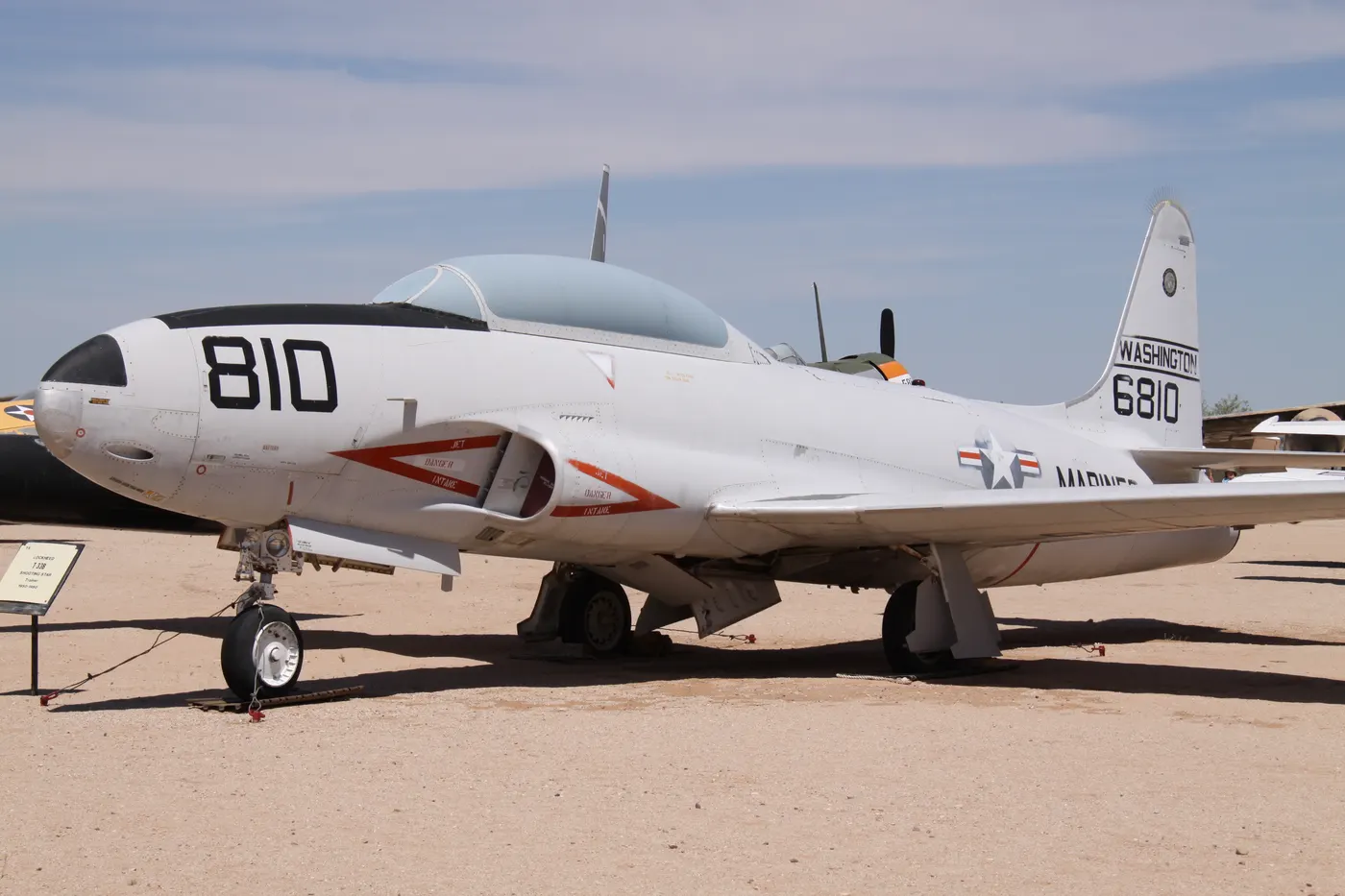
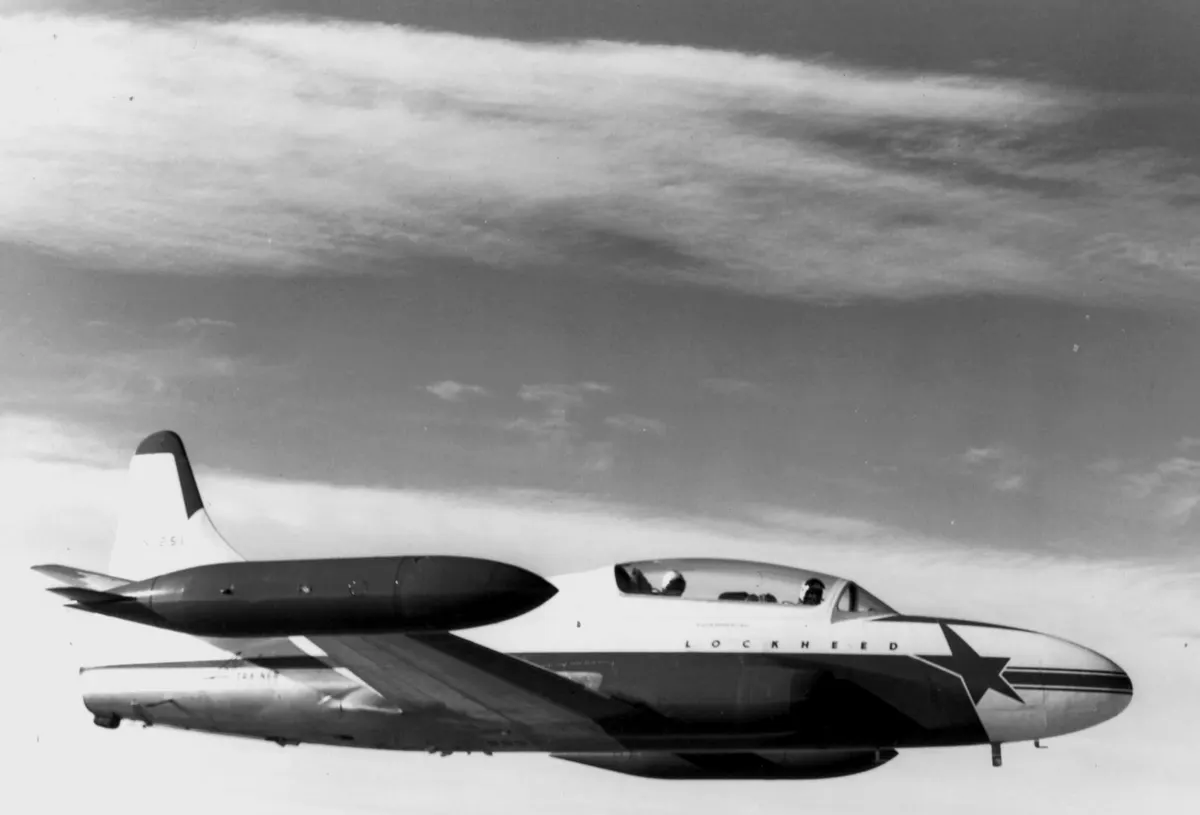
The Lockheed T-33B is the US Navy and Marine Corps' designation for its land-based version of the Air Force's T-33A Shooting Star jet trainer. The Navy began taking T-33As diverted straight off Lockheed's Burbank line in 1949, calling the first 28 aircraft TO-2 before settling on TV-2 for the rest of the buy; in September 1962, under the new tri-service designation system, all 649 surviving Navy and Marine Corps airframes became T-33B.1,3 Three names, one airplane: apart from paperwork and a handful of Navy-specific radios, the type was, in the words of the museum that preserves one, "in all ways identical to the Air Force version."4
- Airframe, engine, and performance identical to the combat-proven T-33A
- Cheap to acquire, coming straight off an existing USAF production line
- Simple, forgiving handling suited to jet familiarization training
- Wingtip tanks gave usable range for instrument cross-country work
- Not carrier-capable, so it covered only part of Navy training needs
- Added nothing new over the Air Force T-33A it was based on
- Three designation changes (TO-2/TV-2/T-33B) for no material change
- Retired earlier from front-line training than the purpose-built T2V SeaStar
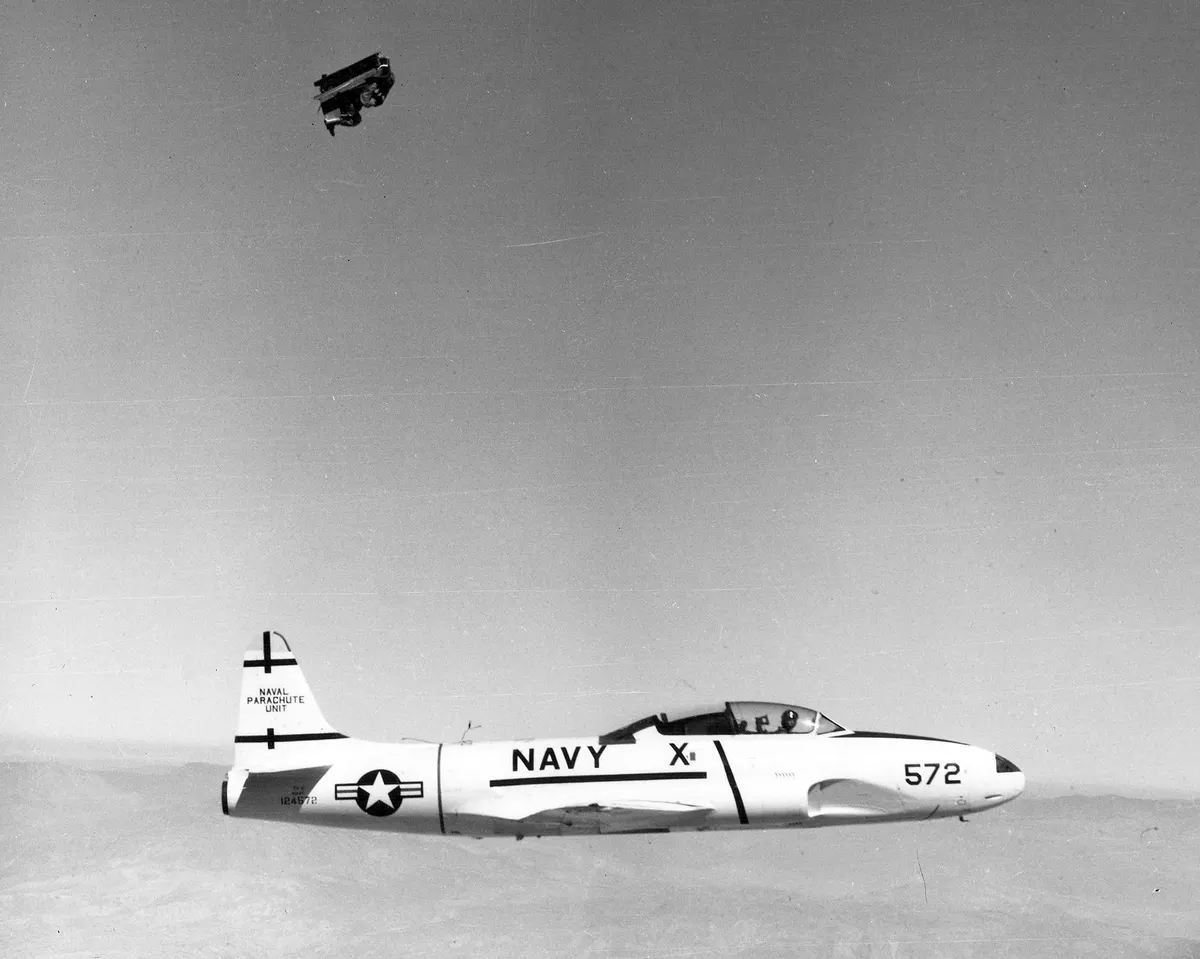
That administrative simplicity is the whole story. This is not a redesigned airplane, and readers looking for a genuinely reworked Navy T-33 want the Lockheed T2V-1/T-1A SeaStar, a far deeper re-engineering with an arrestor hook, catapult fittings, and power-operated flaps that actually made carrier landings possible.2
The T-33B never went near a flight deck; its job was land-based jet familiarization and instrument training, plus a later second career feeding drone-control and target squadrons.1,3 Most were retired between 1958 and 1965, though drone conversions lingered into the mid-1970s.3
An Air Force Airframe Wearing Navy Paint
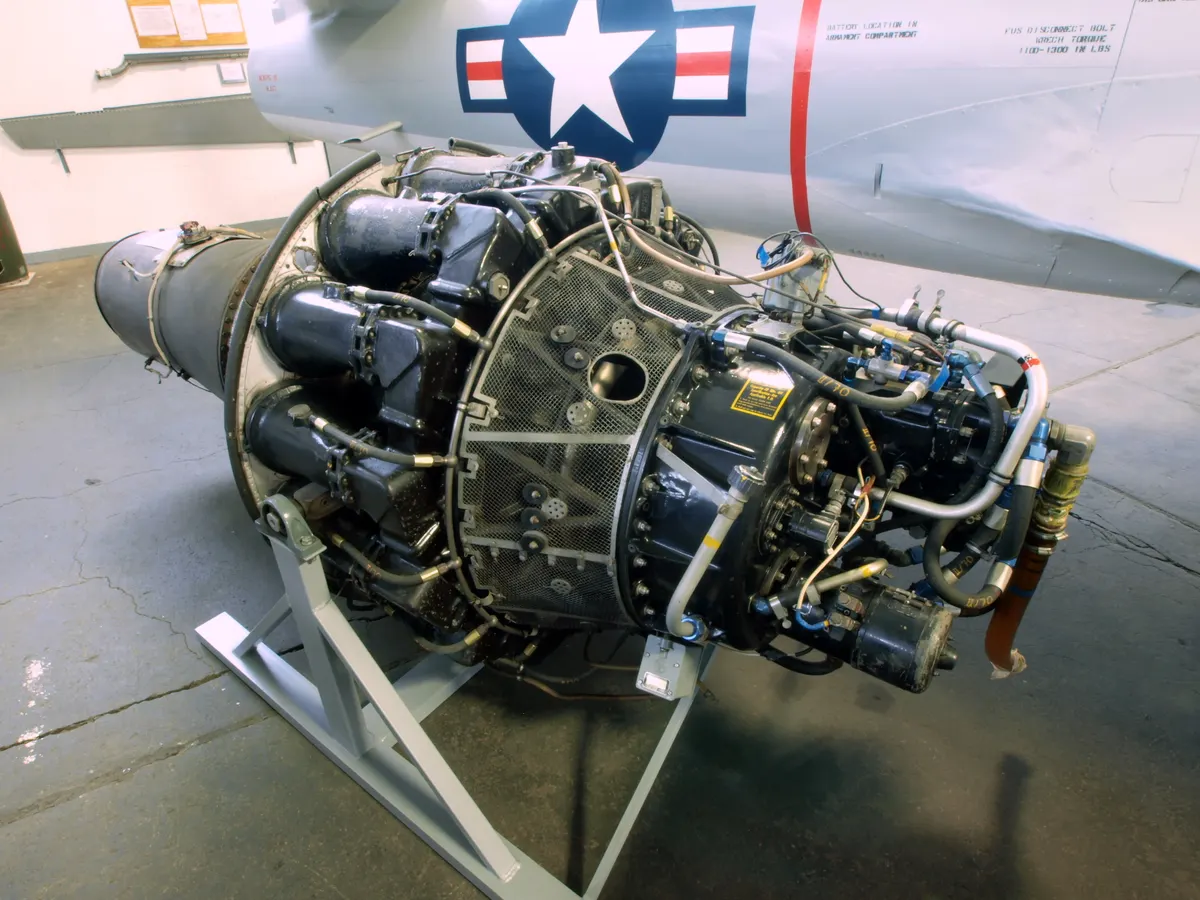
Structurally the T-33B is the T-33A: same 38 ft 10 in wingspan, same roughly 37 ft 9 in length, same tandem two-seat cockpit, same Allison J33-A-35 centrifugal-flow turbojet rated at about 4,600 lbf dry thrust.4 Wingtip tanks gave a listed range near 1,275 miles, a top speed around 543 mph, and a service ceiling near 47,500 feet, figures close enough to the Air Force's that pilots noticed no difference moving between cockpits.4 The only real changes were in radio and navigation fit, adjusted for Navy communications and over-water instrument work rather than for any different flight regime.3
Lockheed never tooled up a separate Navy production line or added the corrosion protection and structural reinforcement that went into the later T2V SeaStar. The T-33B simply arrived already built.
Every T-33B began life as a standard T-33A on Lockheed's Burbank, California line before diversion to Navy contracts, not a separate Navy specification.1,3 Airframe, the Allison J33-A-35 engine built under license in Indianapolis, and essentially all structure and avionics were wholly American, with none of the foreign licensing seen in Canada's Rolls-Royce-engined CT-133 derivative of the same design. The only Navy-specific items, communications radios and instrument-flying aids for overwater routes, were minor additions rather than a distinct manufacturing effort.3
From TO-2 to TV-2: A Trainer Bought Off Another Service's Line
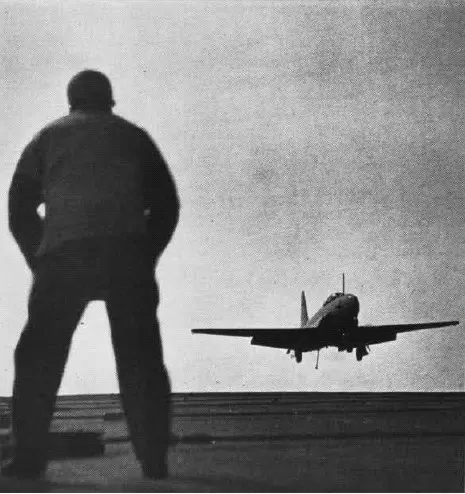
The Navy's jet-training problem in the late 1940s mirrored the Air Force's: pilots moving straight from propeller aircraft into single-seat jets were crashing at an alarming rate, and a two-seat trainer with dual controls was the obvious fix.1 Rather than commission a separate design, the Navy bought into the T-33A program already running at Burbank. The first 28 aircraft, delivered in 1949, were TO-2; the rest of the 649-aircraft buy arrived as TV-2.1,3 The Navy briefly flew 50 ex-Air Force single-seat P-80Cs the same way, as the TO-1/TV-1, a parallel showing how closely the two services' early jet fleets tracked each other.1
Advanced jet and instrument training fell to units at NAS Kingsville and NAS Chase Field, Texas, where the TV-2 sat alongside Grumman F9F Panthers used for initial jet transition. By 1955 Kingsville's training command flew some 233 aircraft, only about 48 of them TV-2s, a snapshot of how narrow a slice of the pipeline the type filled.5 Fleet detachments under FAWTULANT and FAWTUPAC, the Atlantic and Pacific all-weather training organizations, also flew the TV-2 for instrument and intercept proficiency, not carrier work.3
Drones, Targets, and a Blue Angels Sideline
As the training fleet modernized, the Navy converted surplus TV-2s rather than scrapping them: TV-2D and TV-2KD drone-control aircraft became DT-33B and DT-33C in 1962, and other airframes were rebuilt as QT-33A full-scale aerial targets, expended in missile testing at NAS Point Mugu and NAS China Lake.1,3
The T-33B has essentially no combat record, and that is worth stating plainly rather than stretching for drama. It was never exported into a shooting war while still in US colors, and its only "operational" work was bogey duty against friendly air-defense units and drone-control missions in missile testing.1,3 That is a real contrast with its parent, the USAF T-33A/RT-33A, which flew classified reconnaissance sorties over Southeast Asia and equipped Cuban and Indonesian air arms that did fly armed T-33s in actual combat; the Navy's own airframes, diverted from the same production line, never left the training and target-support role the Navy bought them for.
 Lockheed T-33B
DT-33B, DT-33C, and QT-33A: The Drone Family
The Navy-specific sub-variants are drone and target conversions, not new training designs: the DT-33B (ex-TV-2D) and DT-33C (ex-TV-2KD) controlled radio-guided target drones from a modified rear cockpit, while the QT-33A was rebuilt as an expendable full-scale target flown unmanned into the path of test missiles.1,3 None involved a new airframe, only mission equipment swapped into the existing structure.
Why the T2V SeaStar Is a Separate Aircraft, Not a T-33B Sub-Variant
It bears repeating, since the two are so often confused: the T2V-1/T-1A SeaStar was not a T-33B upgrade but a near-total rework, first flown December 1953 and built in only 150 examples before its own 1972 retirement.2 It has its own article on this site; the Comparison section below sets out exactly how it differed.
 ArgentinaRETIRED
 AustraliaRETIRED
 BrazilRETIRED
 CanadaRETIRED
 ChileRETIRED
 ColombiaRETIRED
 DenmarkRETIRED
 EgyptRETIRED
 FinlandRETIRED
 GermanyRETIRED
 GreeceRETIRED
 IndiaRETIRED
 IndonesiaRETIRED
 IranRETIRED
 IsraelRETIRED
 JapanRETIRED
 MexicoRETIRED
 NorwayRETIRED
 PakistanRETIRED
 PhilippinesRETIRED
 SerbiaRETIRED
 South KoreaRETIRED
 SpainRETIRED
 SwedenRETIRED
 TaiwanRETIRED
 ThailandRETIRED
 TurkeyRETIRED
 United StatesRETIRED
 VenezuelaRETIRED
The T-33B's only military operators were the US Navy and US Marine Corps, flying it in the land-based training, proficiency, bogey, and drone-support roles described above; it was never carrier-deployed or assigned to a combat squadron.1,3
After US retirement, surplus airframes passed abroad through military assistance channels alongside larger numbers of ex-Air Force T-33As. Yugoslavia took in the largest documented block of ex-Navy TV-2s, forming a majority of its overall T-33 fleet by the early 1960s, and Thailand was among the smaller later recipients; in neither case did the Navy origin change how the aircraft was flown, since recipients used ex-TV-2s in the same training and light-utility roles as their ex-Air Force counterparts.1,6
T-33B vs T-33A: A Difference of Paperwork, Not Performance
Set side by side, the T-33B and the Air Force's T-33A are the same airplane under different service ownership: wingspan, length, engine, top speed, and range are effectively identical, and the only real divergence is Navy communications and instrument-flying equipment.4 Where the T-33A compiled a genuine combat and reconnaissance record through export operators and the classified RT-33A missions, the T-33B's story stayed confined to American training ramps and missile ranges. The comparison that matters is institutional, not aerodynamic: two services buying essentially one trainer and giving it three names over a fourteen-year span.
T-33B vs T2V/T-1A SeaStar: The Real Engineering Story Sits Elsewhere
The more instructive comparison is within the Navy's own T-33 family. The T-33B kept the standard wing, fixed undercarriage, and tail of the basic design and was never rated for carrier operations; the SeaStar added an arrestor hook, catapult fittings, power-operated flaps, and a redesigned tail to survive a carrier approach, at the cost of a smaller production run of 150 against the T-33B's 649.2,3 A pilot moving from the T-33B to the SeaStar moved to a materially different, harder-to-fly airplane; one moving to the Air Force's T-33A would barely have noticed.
| Trainer | Carrier capable | Number built | Retired |
|---|---|---|---|
| T-33B (Navy) | No | 649 | Mostly 1958-1965 |
| T2V-1/T-1A SeaStar | Yes | 150 | c. 1972 |
| T-33A (USAF) | No | 5,691 | 1987 (ANG) |


What is the difference between the T-33B and the T-33A?
Almost nothing airframe-wise. The T-33B was the Navy and Marine Corps' designation, from 1962, for T-33A trainers diverted from the same Burbank line, fitted with Navy radios but otherwise structurally identical.1,4
Was the Navy's T-33B carrier-capable?
No. It flew only from land bases for familiarization, instrument, and drone-support duty; the Navy's carrier-capable trainer was the separately designed T2V-1/T-1A SeaStar.2,3
How many T-33Bs did the Navy operate?
649 airframes, delivered from 1949 as TO-2 and then TV-2 before the surviving fleet was redesignated T-33B in September 1962.1,3
What was the T-33B's top speed?
Roughly 543 mph on a single Allison J33-A-35 turbojet producing about 4,600 lbf dry thrust, essentially matching the Air Force T-33A.4
Is the T-33B still in service anywhere?
No. Most were retired between 1958 and 1965, drone conversions lingered into the mid-1970s, and no operator flies the type today.3
- "Lockheed T-33", Wikipedia — en.wikipedia.org ↩
- "Lockheed T2V SeaStar", Wikipedia — en.wikipedia.org ↩
- "Lockheed TO-2/TV-2 Shooting Star", Forgotten Jets (Warbirds Resource Group) — forgottenjets.warbirdsresourcegroup.org ↩
- "Lockheed TV-2 (T-33B) Shooting Star", Pima Air & Space Museum — pimaair.org ↩
- "NAS Kingsville, About: History, 1950s", Commander, Navy Installations Command — cnic.navy.mil ↩
- "T-33 Shooting Star: Military Training Aircraft Specs & Operators", GlobalMilitary.net — globalmilitary.net ↩