

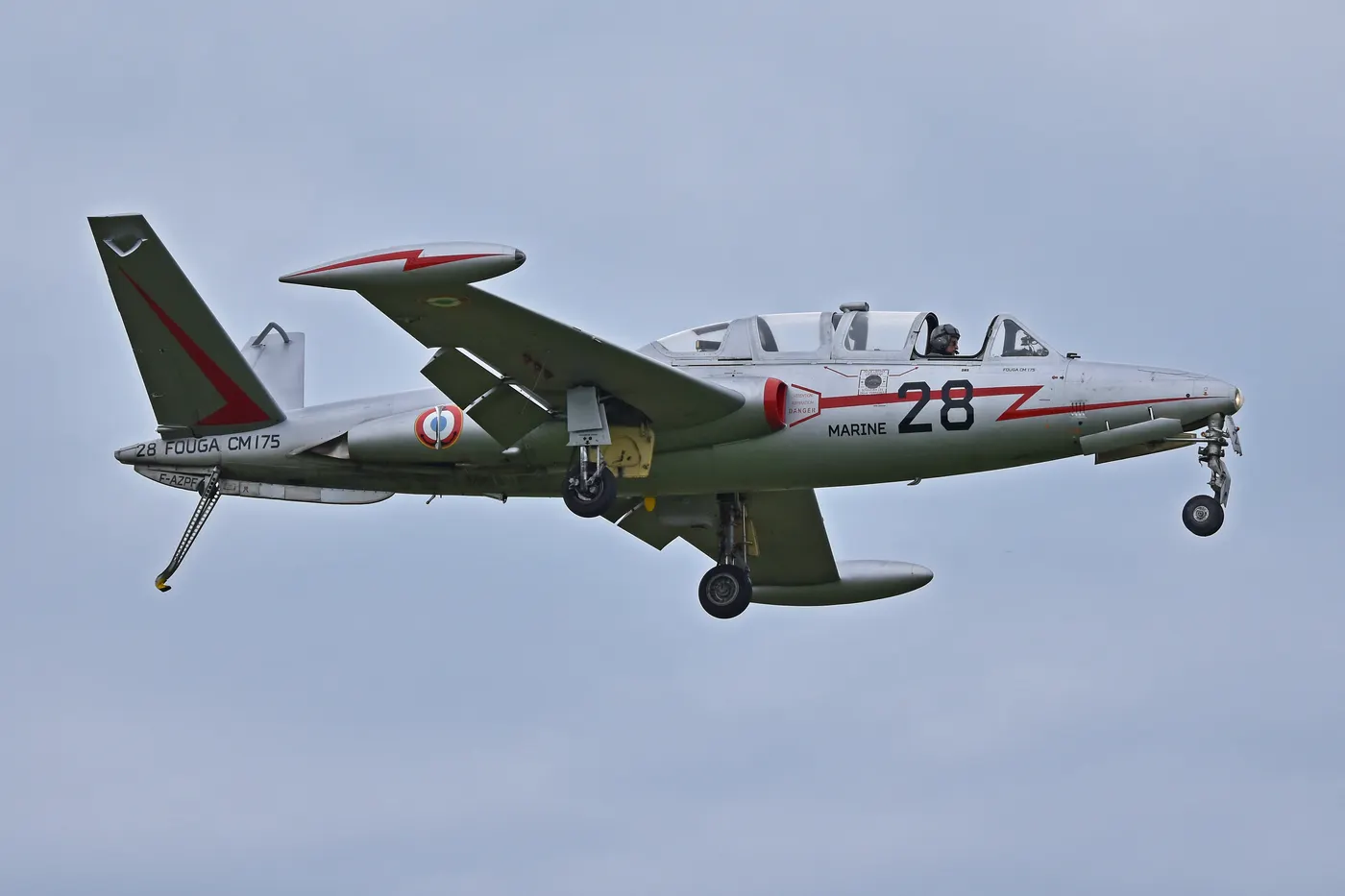

The Fouga CM.175 Zéphyr is the carrier-capable naval derivative of the CM.170 Magister, built for the French Navy's Aéronavale to qualify pilots for catapult launches and arrested landings.1 Where the Magister was a land-based primary trainer exported to more than twenty air forces, the Zéphyr existed for one narrow job: teaching naval aviators to fly a jet off a moving deck. The prototype, designated CM-170M Esquif, first flew on 31 July 1956 and was renamed Zéphyr once early trials confirmed the naval changes worked.1
- Dedicated deck-landing qualifier, cheaper than a front-line jet
- Retains the Magister's twin-engine safety margin over open water
- Sliding canopy allowed rapid escape without an ejection seat
- Arrestor hook and reinforced gear proven over 35 years of carrier work
- No ejection seats, a real liability on an aircraft flown mostly over the sea
- Only 32 built, leaving no spares base once French output ended
- Never exported, so no allied air arm shared upgrade costs
- Confined to one training role for its entire career
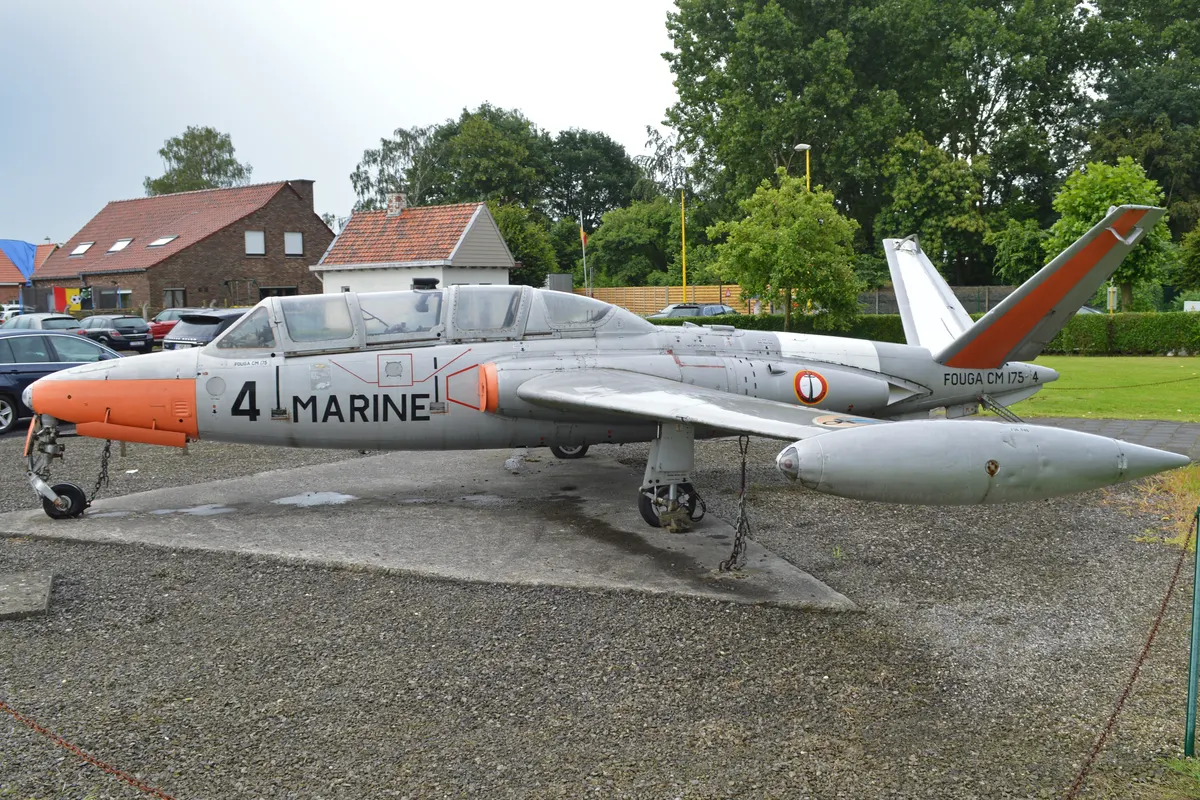
Externally the two aircraft are close to indistinguishable, sharing the Magister's V-tail, twin Turbomeca Marboré IIA turbojets, and tandem cockpit.1 What changed sits underneath: an arrestor hook, catapult attachment points, a reinforced undercarriage and fuselage, a nose landing light, and sliding canopy hoods that locked open for launch and recovery, in place of the ejection seats neither version carried.1 Production was tiny: 32 airframes against the Magister's 868, a reflection of a role confined to a single navy's training pipeline rather than an export product.1,2
The type never fired a shot and never left French naval service. Every pilot who passed through the deck-landing school at Hyères went on to fly Étendards, Crusaders, or other Aéronavale carrier types, making the Zéphyr an oceangoing extension of the Magister programme rather than a distinct combat design.1
An Arrestor Hook and Reinforced Gear, Not a New Airframe
Fouga's naval brief was narrow: adapt the Magister to survive catapult launches and arrested landings without redesigning it. Engineers added an arrestor hook, catapult fittings, and a strengthened undercarriage and structure, plus a nose-mounted landing light for deck approaches.1
- First Flight1956
- Service Entry Year1959
- Crew (seats)2
- Trainer TypeCarrier-capable jet trainer
- In ServiceNo
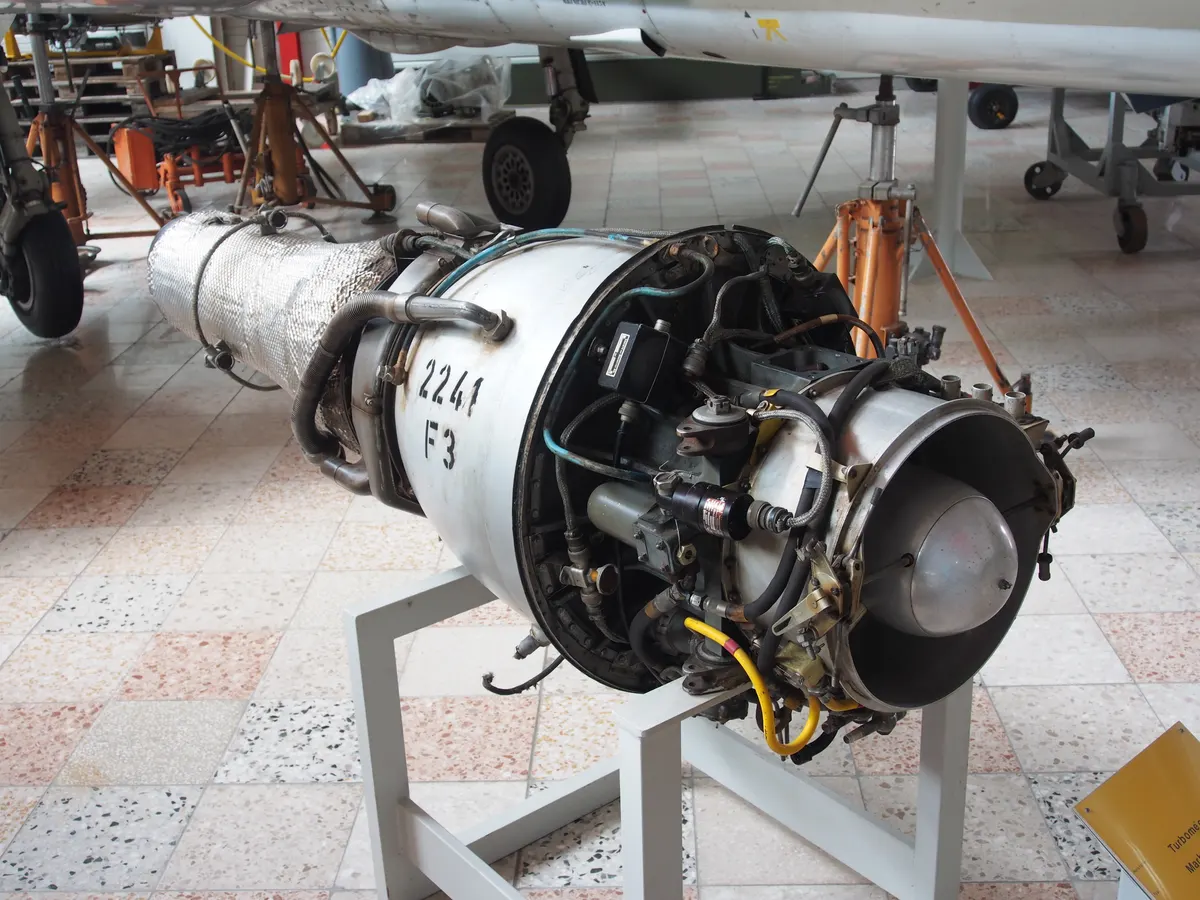
Dimensions, weights, and the twin Marboré IIA engines, each rated at 3.92 kN thrust, carried over unchanged: length 10.06 m, wingspan 12.15 m, height 2.80 m, empty weight about 2,150 kg, maximum takeoff weight 3,200 kg, top speed 715 km/h, and a service ceiling of 11,000 m.1,2 The naval modifications added structural weight without adding thrust or changing the aerodynamics, so none of the baseline performance figures moved.1 One six-round rocket pod could be carried under each wing for weapons-delivery practice, and two nose machine guns were fitted but seldom carried.1
- Engine TypeTurbomeca Marboré IIA
- Thrust3.92
As with the Magister, the Zéphyr's airframe was designed and built in France by Fouga (later Potez, then Sud Aviation), and both Marboré IIA engines came from Turbomeca's own Bordes plant, making it an almost entirely French-sourced aircraft.1,6 The naval-specific hardware, the hook, catapult fittings, and reinforced gear, was engineered and fitted on the same French production line rather than imported, despite France's limited experience with catapult carriers at the time.1
- Top Speed715 km/h
- Service Ceiling11,000 m
- Range925 km
- Cockpit Configurationtwo-seat
- Light Attack CapableYes
- Hardpoints2
- Ejection SeatsNo
- Length10.06 m
- Wingspan12.15 m
- Height2.8 m
- Max Takeoff Weight3,200 kg
- Total Built32
- Operators1
- Retirement Year1994
- Production Start1959
From a Borrowed Royal Navy Deck to France's Own Carriers
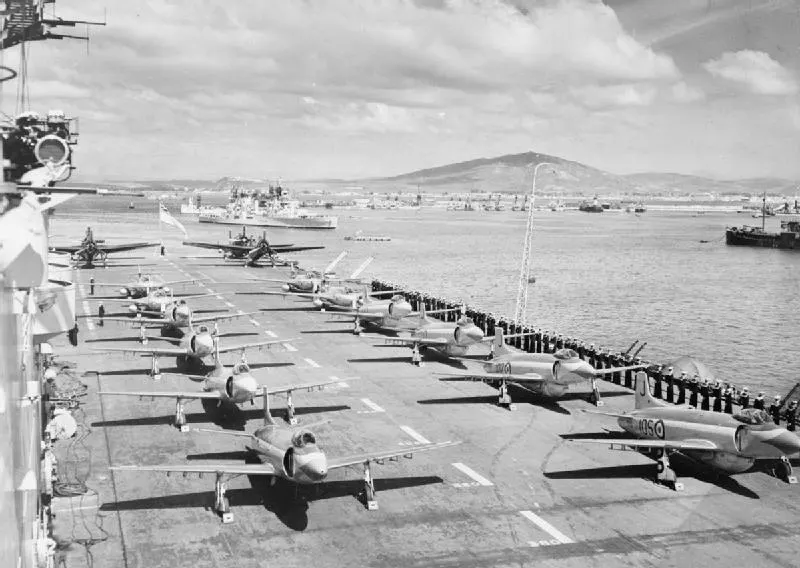
No French carrier was ready when trials needed to start, so the Zéphyr prototype qualified aboard the Royal Navy's HMS Eagle and HMS Bulwark, off the French coast in August 1957 and March 1958, before the French Arromanches became available later that year.1
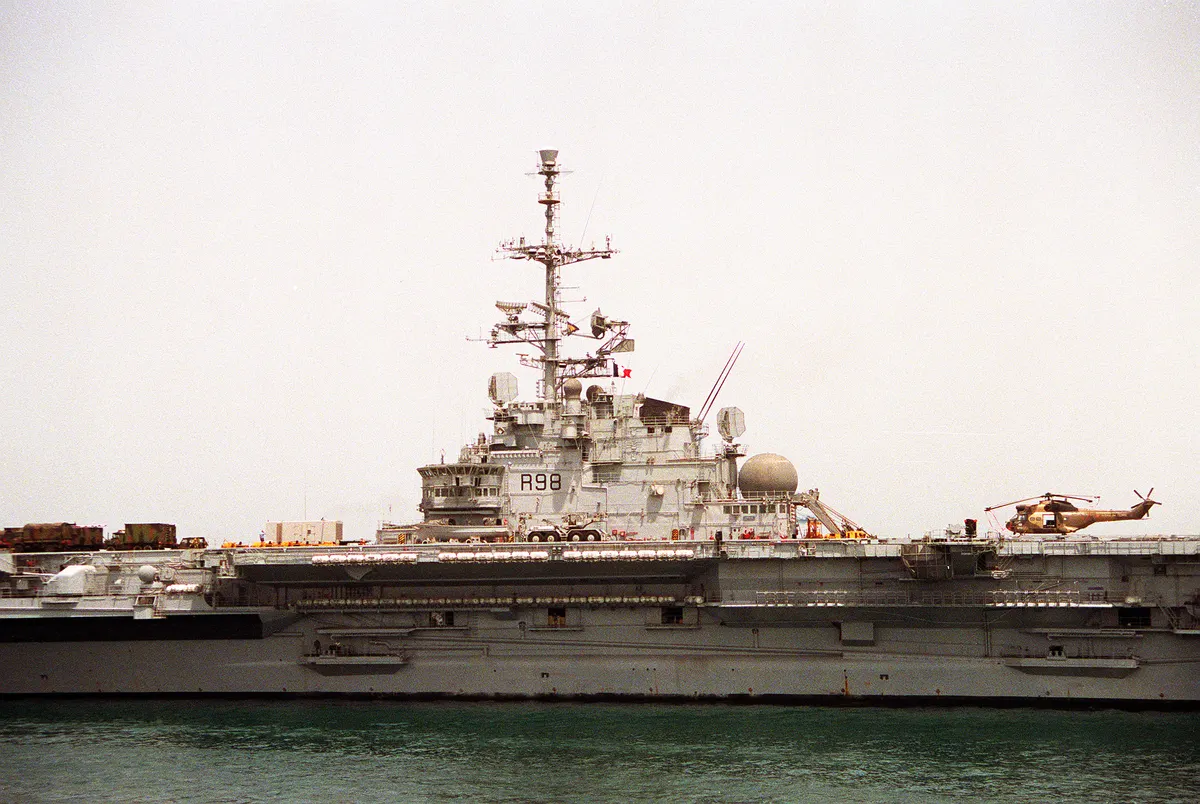
The first production Zéphyr flew on 30 May 1959, entering service that October with Escadrille 59S, the deck-landing school at Hyères.
Zéphyrs then trained pilots aboard Arromanches and, from the early 1960s, the larger Clemenceau and Foch.1 Escadrille 59S kept only 14 aircraft flying at a time, rotating the rest through storage to spread flying hours across a fleet that would never be replenished.1 France retired the type on 25 November 1994, after 35 years spent almost entirely near Hyères.1
Several airframes survive today, including examples at the Naval Aviation Museum in Rochefort, the Air and Space Museum at Le Bourget, and the preserved second prototype at Savigny-lès-Beaune.1,3,4
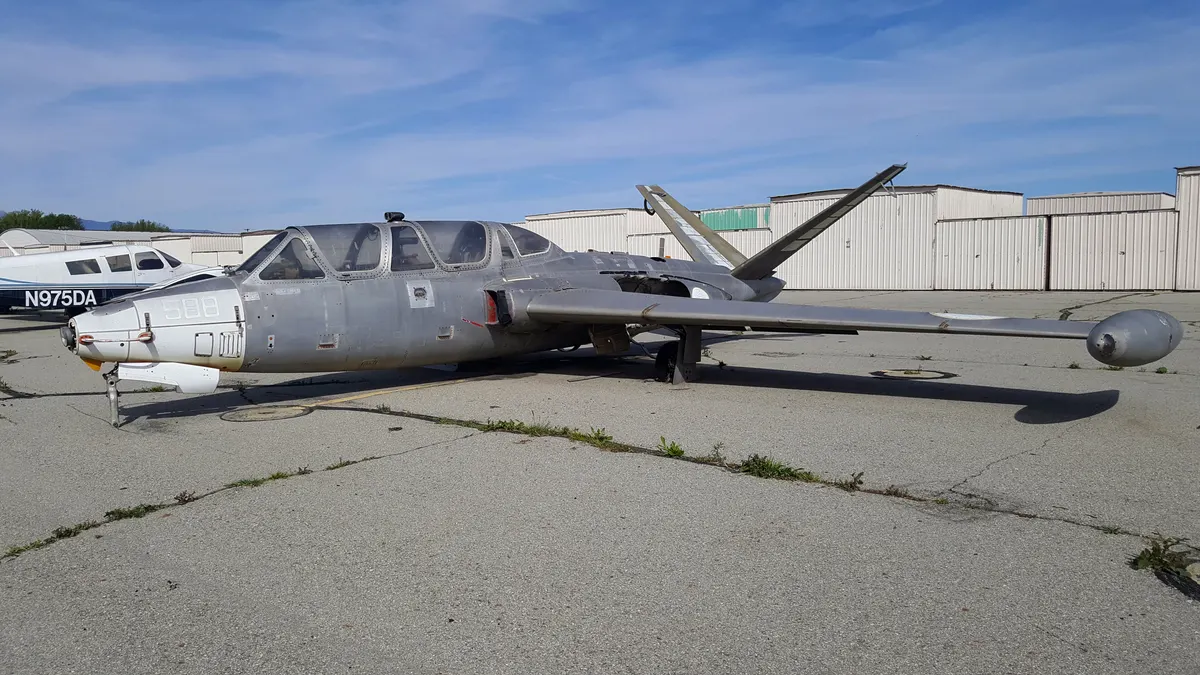
Only two designations exist: the two prototypes flew as CM-170M Esquif before Fouga renamed the production type Zéphyr, and no distinct sub-variant followed.1 All 30 production aircraft were built to a single specification in 1959 and 1960.1,2
None of the Magister's later upgrades, the re-engined CM.170-2 or the one-off CM.173 Super Magister prototype with ejection seats, ever reached a naval equivalent; every Zéphyr flew its whole career with the original engines and no ejection seats.1,2

The Zéphyr had exactly one operator in its entire service life: the French Navy, and specifically Escadrille 59S at Hyères, from 1959 to 1994.1 Unlike the Magister, which spread through export sales to more than twenty air forces, the Zéphyr was never offered abroad.1,2
That single-operator status reflects the aircraft's function, not a lack of foreign interest. Deck-landing qualification is tied to one navy's own carrier fleet, and few air arms of the era needed a bespoke fleet this small. The US Navy solved the same problem with a purpose-built aircraft of its own, discussed below.
The Zéphyr Against Its Own Parent, and Against the US Navy's T-2 Buckeye
The most useful comparison is not a foreign rival but the aircraft the Zéphyr was built from. The Magister and Zéphyr share an airframe, tail, engines, and cockpit, yet took opposite career paths: the Magister was widely exported and saw real combat over Congo, Sinai, and El Salvador, while the Zéphyr never fired a shot and never left one French air station.1,2 A closer match in role is the North American T-2 Buckeye, the US Navy's own carrier-qualification trainer, first flown in January 1958. The US Navy built 609 Buckeyes across four variants against the Zéphyr's 32, a difference driven by fleet size rather than aircraft quality; the Buckeye was also larger and faster, at roughly 3,681 kg empty and 839 km/h against the Zéphyr's 2,150 kg and 715 km/h.5
| Spec | Fouga CM.175 Zéphyr | North American T-2 Buckeye (T-2C) |
|---|---|---|
| First flight | 1956 | 1958 |
| Total built | 32 | 609 |
| Max speed | 715 km/h | ~839 km/h |
| Empty weight | 2,150 kg | 3,681 kg |
France adapted an existing light trainer at minimal cost; the US Navy commissioned a dedicated, more powerful aircraft for a pipeline it expected to run for decades. Both did the same essential job, but at very different scales.1,5


What is the Fouga CM.175 Zéphyr? The carrier-capable naval version of the CM.170 Magister, built for the French Navy to qualify pilots for catapult launches and arrested landings; only 32 were built, all for a single squadron.1
How does it differ from the CM.170 Magister? It adds an arrestor hook, catapult attachment points, a reinforced undercarriage and structure, a nose landing light, and lockable sliding canopies; the tail, engines, and cockpit are otherwise unchanged.1
How many were built? Thirty-two: two prototypes and 30 production aircraft, against 868 Magisters built across France and three foreign licensees.1,2
Is it still in service? No. France retired the type on 25 November 1994; one privately owned example, F-AZPF, remains airworthy.1,3
Did it ever operate from real aircraft carriers? Yes, aboard Arromanches, Clemenceau, and Foch, after early trials on the Royal Navy's HMS Eagle and HMS Bulwark.1
- "Fouga CM.175 Zéphyr", Wikipedia — en.wikipedia.org ↩
- "Fouga CM.170 Magister", Wikipedia — en.wikipedia.org ↩
- "Sole airworthy Fouga CM.175 Zéphyr damaged in runway excursion in France", World Warbird News — worldwarbirdnews.com ↩
- "Fouga CM-175 Zephir", Minijets — minijets.org ↩
- "North American T-2 Buckeye", Wikipedia — en.wikipedia.org ↩
- "Turbomeca Marboré", Wikipedia — en.wikipedia.org ↩