

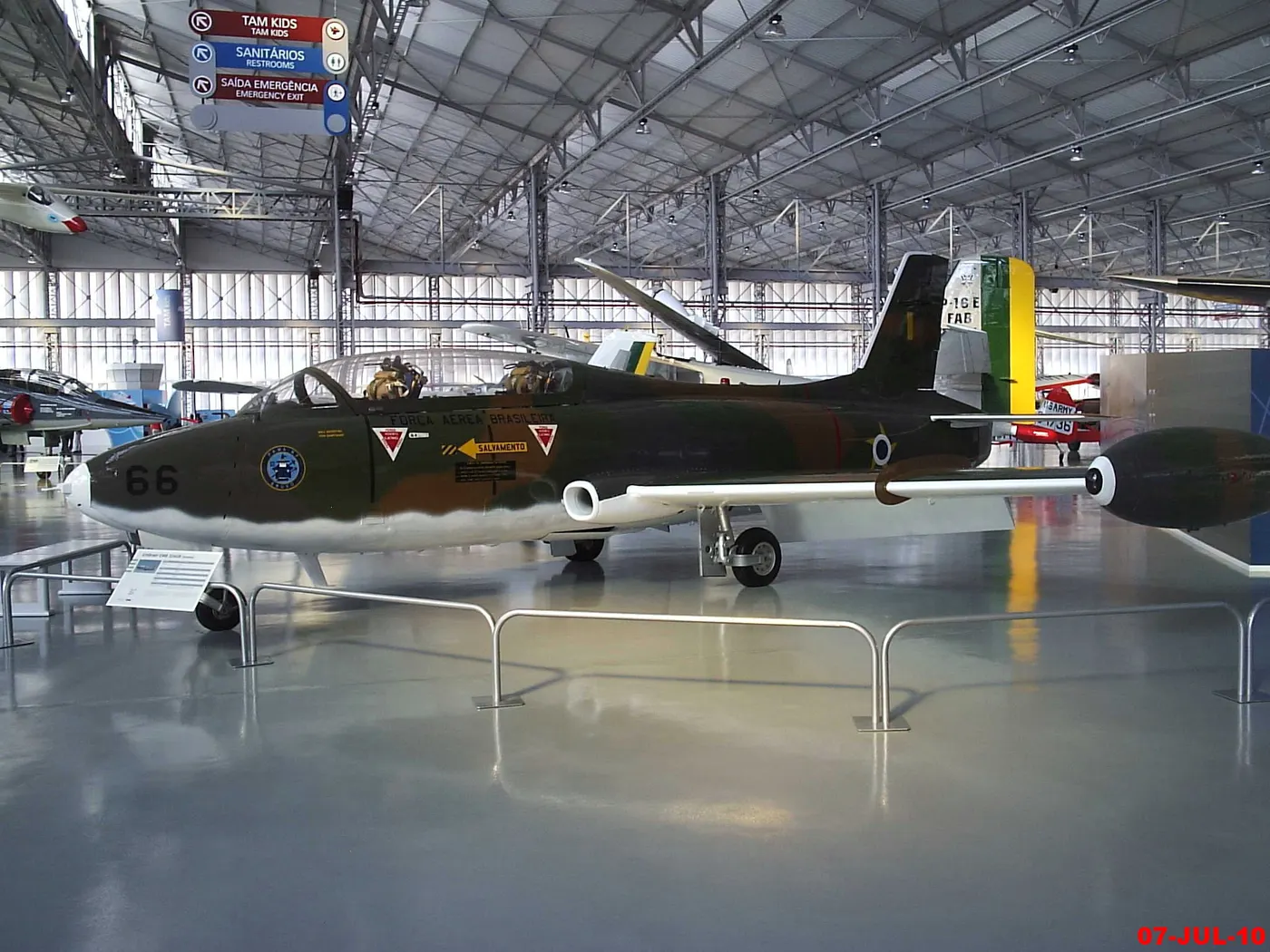
The EMB-326 Xavante is a two-seat jet trainer and light-attack aircraft built by Embraer in São José dos Campos, Brazil, under licence from the Italian firm Aermacchi. It is the Brazilian production version of the Aermacchi MB-326GC, sharing the same tandem-seat airframe, single Rolls-Royce Viper turbojet, and six underwing hardpoints as its Italian parent, but assembled, and increasingly manufactured, on Brazilian soil.1,2 In Força Aérea Brasileira (FAB) service it carried the military designation AT-26, and it entered squadron use in 1972 to replace the piston-and-jet mix of AT-33s and other ageing trainers then flying at the Air Force Academy.3
- Simple, rugged airframe with low operating costs
- Docile handling suited to ab initio to advanced training progression
- Six hardpoints gave genuine light-attack capability, not just weapons familiarization
- Long-lived Viper turbojet with a large worldwide user base for spares
- Proven licence-production vehicle that grew Brazil's aerospace workforce
- Subsonic performance and dated 1950s cockpit ergonomics by the 1990s
- Single engine with no redundancy, unlike rival twin-engine trainers
- Modest ordnance load next to purpose-built attack aircraft
- Import dependence on the British engine and ejection seat throughout its life
- No radar or all-weather avionics, limiting its attack role to daylight/visual conditions
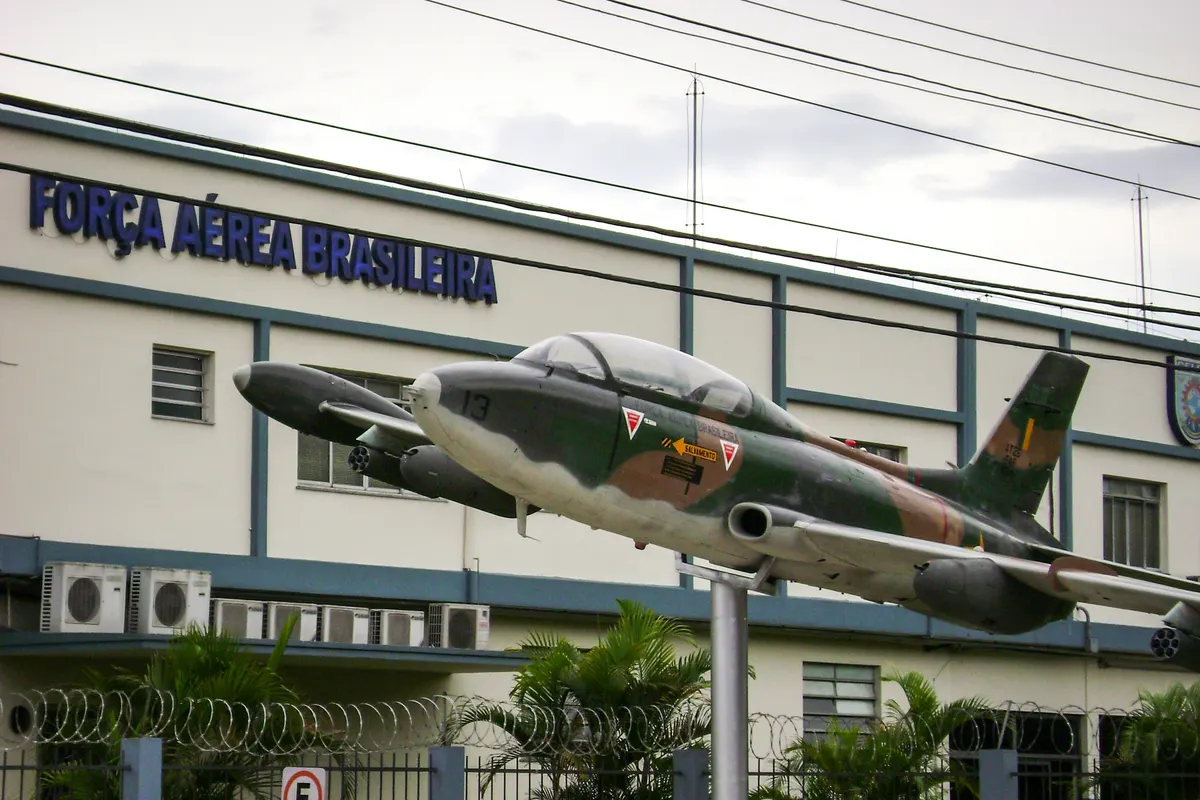
What makes the Xavante historically significant is not the airframe itself, which was a decade-old Italian design by the time Brazil started building it, but what building it did for Embraer. The company had been founded only in January 1970, and the Xavante was its third product line and its first jet — the deal that proved a fledgling state-backed manufacturer in a country with almost no aerospace industrial base could licence-build a supersonic-era combat jet to Italian quality standards.1,4 Engineers from São José dos Campos trained at Aermacchi's Varese plant, Italian technicians came to Brazil, and over a production run that stretched into the 1980s, Embraer moved from assembling largely imported kits to manufacturing the bulk of the airframe itself.4
Production totalled at least 182 airframes: 166–167 for the FAB, 6 for Togo, and either 9 or 10 for Paraguay depending on the source (a detailed Paraguayan unit history lists ten serials, 1001 through 1010, putting the true total at 183).3,5,6 Eleven more ex-FAB airframes went to Argentina's naval aviation after the 1982 Falklands War, making the Xavante one of the few aircraft types whose user base grew as a direct result of that conflict, despite never serving in it.2,7
The Xavante's career was long by trainer standards — nearly four decades, from first flight in September 1971 to the FAB's last retirement ceremony in December 2010 — and its role shifted more than once, from primary jet trainer, to counter-insurgency light attacker, to advanced instrument and weapons trainer once purpose-built successors arrived.3,8 Across its FAB service life the fleet is credited with well over 500,000 flight hours and training several thousand Brazilian military pilots.3
The Xavante's airframe follows the standard MB-326G-family layout: a low, straight wing, tandem stepped cockpit under a single long canopy, and a single turbojet fed by fuselage-side intakes. Brazilian-built aircraft matched the Italian MB-326G/GC specification, with a length of about 10.65 m, a wingspan of 10.85 m with wingtip fuel tanks fitted, and a maximum take-off weight of roughly 4,580 kg.2 Maximum speed is usually quoted at around 867 km/h (539 mph, Mach 0.82) at altitude, with a service ceiling near 14,300 m and a ferry range, using tip tanks, of about 2,445 km.2,5
The Rolls-Royce Viper and Its Reputation
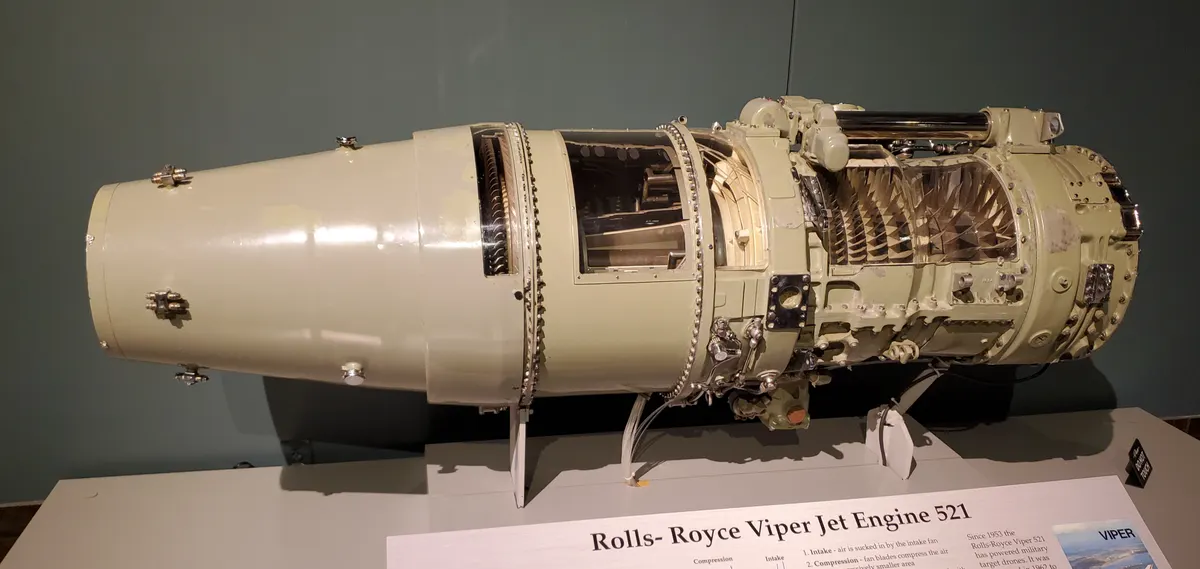
Power came from a single Rolls-Royce (originally Bristol Siddeley) Viper 20-series turbojet, rated at roughly 15.2 kN (around 3,400 lbf) of thrust in most references, though Brazilian and U.S. defense-industry sources sometimes cite the later Viper 632 sub-variant at closer to 4,000 lbf.2,1,3 The discrepancy is typical of Viper literature generally, since the engine went through many small thrust-rated sub-marks and Brazilian squadron histories are not always precise about which one equipped which batch.
What is not in dispute is the Viper's reputation: a simple, single-shaft centrifugal-flow design descended from 1950s British fighter engines, chosen for the MB-326 because it was cheap, easy to maintain in the field, and already flying in dozens of countries. The same engine family, in different thrust ratings, also powered the BAC Jet Provost/Strikemaster, giving 1970s air forces a wide common logistics base.
Armament and the Attack Role
Brazilian factory literature describes an ordnance capacity of up to 2,500 kg spread across six wing hardpoints, noticeably higher than the roughly 1,800 kg figure usually quoted for the standard Aermacchi-built MB-326G;1,2 this gap is likely explained by rounding and by different assumptions about fuel versus weapons loading rather than a genuine structural difference, but it has not been definitively reconciled between the two source traditions. Typical FAB loadouts combined 7.62mm or .50-calibre gun pods with unguided rockets and iron bombs; some published references also credit the type with compatibility for the French Nord AS.12 wire-guided missile, inherited from the wider MB-326G weapons list, though there is no confirmed record of Brazil actually operating that missile on the Xavante.
Domestic Content
Embraer built the Xavante's airframe, structure, and final assembly in São José dos Campos under licence from Aermacchi, with company engineers trained at Aermacchi's Varese factory in Italy and Italian technicians posted to Brazil during the early production run.4 Domestic content grew across the 1970s as Embraer localized more sub-assemblies, but the aircraft's most safety-critical systems stayed foreign: the Rolls-Royce Viper turbojet was British-built and imported for the life of the program, as was the Martin-Baker Mk.6 rocket-assisted ejection seat fitted to both cockpits.2,10 Instruments, radios, and some hydraulic components were also imported in the early batches. The Viper engine alone represents the single largest foreign line item in the aircraft's value, consistent with most licence-built jet trainers of the era.
Brazil's Air Ministry needed a modern jet trainer to replace its Lockheed T-33/AT-33 fleet at the turn of the 1970s, and it settled on the Aermacchi MB-326G, then in production for several export customers, rather than commit to a costly indigenous design.1,3 The licence agreement with Aeronautica Macchi was signed in 1970, the same year Embraer itself was created as a mixed state-private company, and on 29 May 1970 the Ministry of Aeronautics placed an initial order for 112 aircraft, a number that would eventually grow past 165.1,4
The first Brazilian-assembled airframe flew on 3 September 1971, an approximately 90-minute sortie over São José dos Campos flown jointly by Major-Aviator Carlos Rubens Resende and Embraer test pilot Brasílico Freire Neto.1,4 FAB took delivery of the first three production aircraft the very next day, and the type entered squadron service in 1972 with the 1st Fighter Aviation Group, which alone would go on to train more than 650 Brazilian combat pilots on the type from 1973 onward.3 The aircraft was named Xavante after an indigenous people of the Mato Grosso region, continuing a FAB convention of naming trainers and light aircraft after Brazilian Indigenous groups (the later EMB-312 Tucano, named for a bird rather than a tribe, broke the pattern).
By December 1976 the FAB had taken delivery of 119 Xavantes, and production continued into the early 1980s, eventually equipping multiple fighter, attack, and instructional squadrons; the 3rd/10th Aviation Group alone logged nearly 70,000 flight hours on the type before converting to the AMX in 1998.1,3 A dedicated Air Force aerobatic flight, the Esquadrilha Alouette, flew seven AT-26s in formation displays through the early 1980s before it was progressively stood down after the reactivation of the famous Esquadrilha da Fumaça display team in October 1983, which used other aircraft types.11
The Xavante program also became the springboard for Embraer's next, far larger military venture.
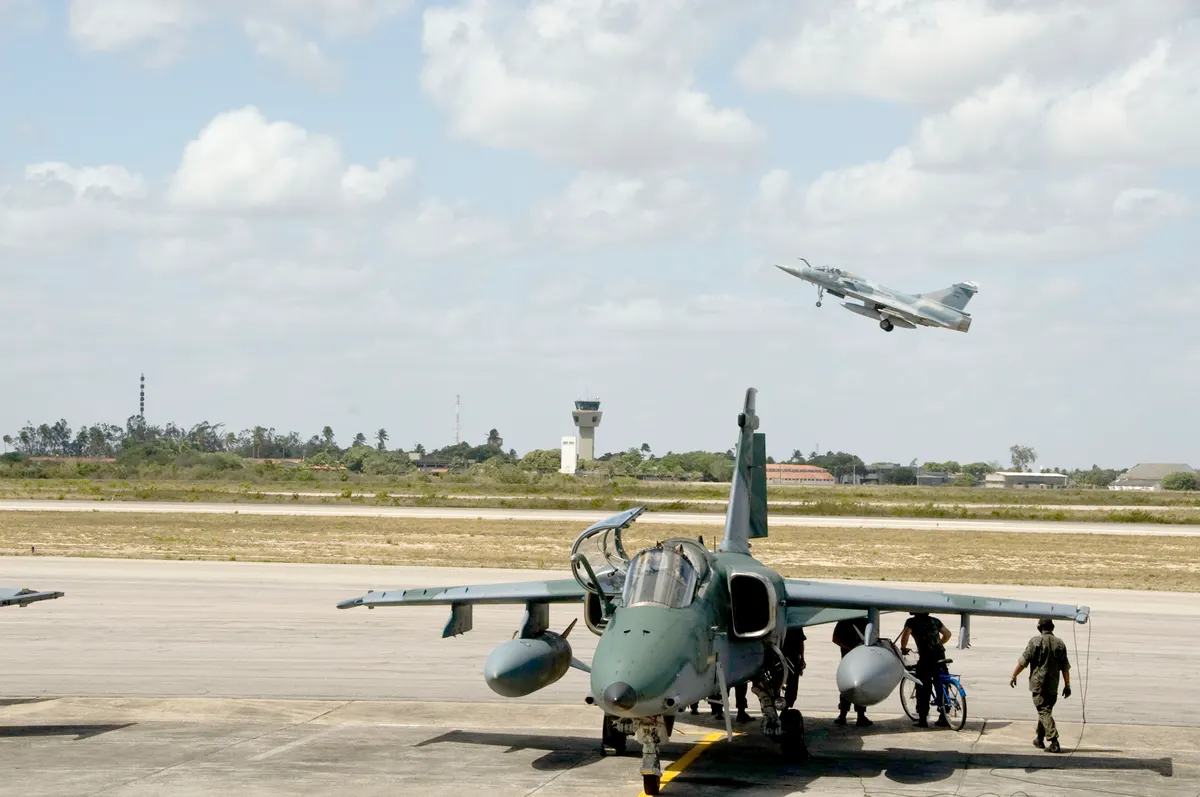
When Brazil went looking for a Xavante successor in the early 1980s, it did not commission a clean-sheet national design; instead, in 1980–81 it joined the Italian AMX International program that Aermacchi and Aeritalia had already launched, explicitly to field a follow-on for the aging MB-326/Xavante fleet.12 Embraer took a 29.7 percent industrial share of the new AMX attack jet, building the wing, air intakes, pylons, and drop tanks, while Aeritalia and Aermacchi split the rest of the airframe.12
Embraer founder Ozires Silva later wrote that Aeritalia's management initially resisted having Brazilian engineers involved as full partners rather than subcontractors, friction the Xavante relationship had not fully dissolved even after a decade of cooperation.12 The AMX first flew in 1984 and entered FAB service as the A-1 in the late 1980s, finally displacing the Xavante from front-line attack squadrons, though trainer-role Xavantes flew on for another two decades.
Brazil's Xavantes were never committed to combat by the FAB itself; Brazil fought no external wars during the aircraft's service life, and the type's operational history there is one of training, border patrol, and internal security rather than shooting engagements. Its closest brush with a real conflict came indirectly. Argentina's Naval Aviation Command (Comando de Aviación Naval, COAN) had operated eight Aermacchi-built MB-326GBs before the 1982 Falklands War and lost aircraft and pilots during that conflict; afterward, Brazil transferred eleven of its own AT-26/MB-326GC airframes to Argentina to rebuild COAN's attack squadron strength, making Brazilian-built Xavantes the direct replacements for a unit that had genuinely fought in the war, even though the transferred aircraft arrived only once the fighting was over.2,7
Paraguay's ten Xavantes, delivered between late 1979 and early 1982 to equip the newly formed Grupo Aerotáctico, likewise saw no combat, but they had a rougher operational record than Brazil's own fleet: five of the ten aircraft were lost in accidents between 1985 and 1995, including a fatal crash near Lake Ypacaraí, two asymmetric-stall losses, an ejection incident, and an in-flight engine fire, a loss rate of fully half the delivered fleet before the survivors were finally retired in 2004 after accumulating nearly 18,000 combined flight hours.5
Togo's six Xavantes, delivered in the mid-to-late 1970s, are the least documented branch of the program; available English- and Portuguese-language sources give little detail on their operational history or eventual fate, and this is a genuine gap rather than an editorial choice, since reliable public information on Togolese Xavante operations simply has not surfaced.
The baseline Brazilian production standard was the EMB-326GB, called AT-26 in FAB service and directly equivalent to the Aermacchi MB-326GC used as the type's export designation elsewhere.2 A small number of AT-26 airframes were converted to the unofficial RT-26 configuration, fitted with camera equipment in place of some combat systems for tactical photo-reconnaissance, expanding the type's role beyond training and light attack without any structural redesign.2 The single air-to-air-refuelling-capable aircraft, FAB serial 4600, effectively formed its own one-off sub-variant, unique among the entire worldwide MB-326 family for probe-equipped in-flight refuelling capability.9
Export airframes for Togo and Paraguay were built to essentially the same EMB-326GB/GC standard as FAB's own aircraft, rather than to a separate export specification, which kept spares and maintenance compatible across all three air forces and with the eleven aircraft later passed to Argentina.2,5


Brazil was by far the largest operator, with the FAB's own fleet numbering somewhere between 166 and 168 aircraft depending on the count used, flown by fighter, attack, and training units including the 1st Fighter Aviation Group and the 3rd/10th Aviation Group, from 1972 until final retirement in December 2010.1,3,4
Paraguay's Air Force flew ten Xavantes from 1979 to 2004 with its Grupo Aerotáctico, while Togo's Air Force received six in the mid-to-late 1970s and remains the least documented of the three original operators.2,5 Argentina's Naval Aviation Command became a fourth operator by inheritance, receiving eleven ex-FAB airframes after 1982 to rebuild its light-attack squadron following the Falklands War.2,7
No Xavante remains in active military service anywhere today; Brazil's retirement in 2010 closed out the type's last flying military use, and Paraguay had already stood its survivors down in 2004. Several retired FAB airframes survive as museum exhibits and gate guardians across Brazil, including examples at the TAM Museum in São Carlos and at the Espaço Ciência museum in Olinda, but there is no confirmed active civilian warbird population flying on international registers, unlike some other 1960s-70s jet trainers that have found a second life on the airshow circuit.
The Xavante's closest philosophical rival is the Cessna T-37 Tweet, built by the United States to the same "all-through jet training" concept that inspired the MB-326 family. Where Aermacchi and Embraer bet on a single Viper turbojet and tandem seating, Cessna bet on twin small turbojets and side-by-side seating, reasoning that a student and instructor sitting together eased early jet instruction and that two engines added a safety margin a single-engine trainer could not offer.13 The tradeoff showed in the numbers: the T-37 was slower (around 630 km/h for early models, less with wingtip tanks fitted) and shorter-ranged than the Xavante's roughly 867 km/h and 2,445 km ferry range, but Cessna built 1,269 of them against Embraer's roughly 182, reflecting a far larger home market and the fact that the T-37 was purely a trainer with negligible attack capability, while the Xavante's six hardpoints gave export customers a genuine, if modest, light-attack jet as well.13,2
| Spec | EMB-326 Xavante | Cessna T-37 (late models) |
|---|---|---|
| Engines | 1x Rolls-Royce Viper turbojet | 2x Continental J69 turbojets |
| Max speed | ~867 km/h2 | ~595-630 km/h13 |
| Range (ferry) | ~2,445 km2 | ~1,770 km13 |
| Total built | ~182-1833,5 | 1,26913 |
| Attack hardpoints | 6 | None (trainer only) |
A closer sibling, in engineering terms, is the BAC Strikemaster, which shared the Xavante's basic formula of a Viper-powered, tandem-seat, hardpoint-equipped jet trainer aimed at exactly the same export market of smaller air forces wanting one airframe to cover both roles.14 The two aircraft are near-contemporaries powered by different sub-marks of the same British engine family, but their service records diverged sharply: the Strikemaster saw genuine combat over Oman during the Dhofar campaign, in North Yemen's civil war, and with Ecuador during its border fighting with Peru, while the Brazilian-built Xavante, despite comparable specifications and a larger production run, never fired its weapons in anger under its own air force's flag and reached a shooting war only second-hand, through the aircraft handed to Argentina after 1982.14,7 It is a reminder that a trainer's combat record often has less to do with its design than with which air force happens to be flying it and when.


How many EMB-326 Xavantes were built? Embraer built at least 182 aircraft: roughly 166–168 for the Brazilian Air Force, 6 for Togo, and 9 or 10 for Paraguay depending on the source consulted; a detailed Paraguayan unit history with individual serials points to 10, which would put total production at 183.1,3,5
What engine powers the Xavante? A single Rolls-Royce (originally Bristol Siddeley) Viper turbojet, generally cited in the 15.2 kN / 3,400 lbf class for the Viper 20 series used on the wider MB-326G family, though some Brazilian sources quote figures closer to 4,000 lbf for later sub-marks.2,1
What was the Xavante's top speed? Around 867 km/h (539 mph, roughly Mach 0.82) at altitude.2,4
Is the EMB-326 Xavante still in service? No. Brazil retired its last Xavantes in December 2010 after nearly 40 years of service, and Paraguay had already retired its fleet in 2004. No air force operates the type today.3,5
How does the Xavante compare to the Cessna T-37? Both were built to the same "all-through jet trainer" philosophy of the 1950s-60s, but the Xavante's single Viper engine and tandem cockpit gave it higher speed and range and real light-attack capability via six hardpoints, while the twin-engine T-37 prioritized instructional safety and was built in far greater numbers for the U.S. Air Force alone.2,13
- "EMB 326 AT-26 Xavante", GlobalSecurity.org — globalsecurity.org ↩
- "Aermacchi MB-326", Wikipedia — en.wikipedia.org ↩
- "Embraer EMB-326GB AT-26 Xavante", História da Força Aérea Brasileira — historiadafab.rudnei.cunha.nom.br ↩
- "Embraer EMB-326GB AT-26 Xavante", Armas Nacionais - Modelismo & História — armasnacionais.com ↩
- "La Fuerza Aérea Paraguaya en la era del jet - The Paraguayan Air Force in the Jet Age (Part 1)", Aviation Rainbows — aviationrainbows.com ↩
- "Paraguayan Air Force", Wikipedia — en.wikipedia.org ↩
- "Argentine air forces in the Falklands War", Wikipedia — en.wikipedia.org ↩
- "EMB 326 Xavante", Embraer Historical Center — historicalcenter.embraer.com ↩
- "AT-26 Xavante in-flight refuelling trials", História da Força Aérea Brasileira — historiadafab.rudnei.cunha.nom.br ↩
- "MK6", Martin-Baker — martin-baker.com ↩
- "Esquadrilha da Fumaça History", Aerobatic Teams — aerobaticteams.net ↩
- "AMX International", Wikipedia — en.wikipedia.org ↩
- "Cessna T-37 Tweet", Wikipedia — en.wikipedia.org ↩
- "BAC Strikemaster", Wikipedia — en.wikipedia.org ↩