

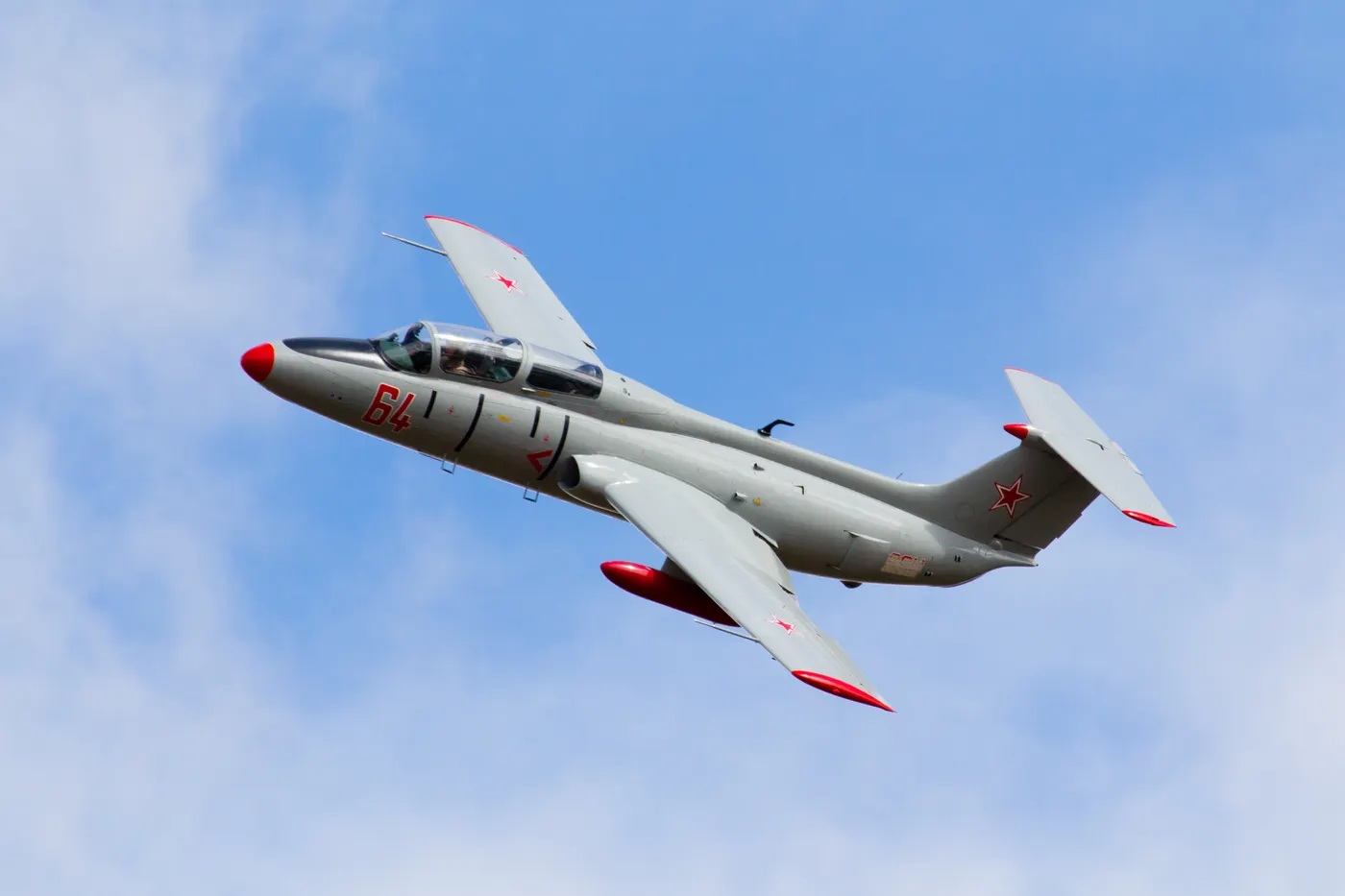

The Aero L-29 Delfín is a twin-seat, single-engine jet trainer built by Aero Vodochody in Czechoslovakia from 1963 to 1974. It won a formal 1961 Warsaw Pact competition against the Soviet Yakovlev Yak-30 and the Polish PZL TS-11 Iskra, and the result made it the standard basic and advanced jet trainer across almost the entire Eastern Bloc.1 Roughly 3,665 were built, of which more than 2,000 went to the Soviet Union alone, and the type was eventually flown by air arms and aeroclubs in at least 25 countries.1,5 NATO gave it the reporting name "Maya"; pilots in the Warsaw Pact mostly just called it the Delfín, Czech for "dolphin," after the shape of its nose intake fairings.
- Rugged, forgiving flight characteristics for first-solo jet students
- Simple structure, low maintenance burden, tolerant of rough airstrips
- Domestically designed and built engine, no dependence on Soviet powerplants
- Cheap and plentiful; became the default jet on the Western warbird market
- Underpowered turbojet gives modest speed and poor high-altitude performance
- Only two hardpoints, minimal armament for anything beyond harassment strikes
- Ejection seat has a documented low-altitude/low-speed safety margin problem
- Obsolete avionics even by Warsaw Pact standards after the mid-1970s

Design goals were narrow and pragmatic: a jet cheap enough to build in the hundreds, tough enough to survive being flown by cadets on their first solo, and simple enough that a regimental workshop could keep it flying without factory support. Aero delivered on all three counts with an unglamorous mid-wing airframe, fixed-geometry wing-root intakes, and a locally designed turbojet that tolerated grass-strip operation. It was not fast, not agile, and carried only a token weapons load, but it was the aircraft that took an entire generation of Soviet, Czechoslovak, East German, Hungarian, Bulgarian, Romanian, and non-aligned air force pilots from propeller trainers into jets. A handful of countries flew it in actual combat, usually with mixed results, and several hundred surplus airframes now fly on Western civil registers as some of the cheapest jets available to a private owner.
The L-29's career divides cleanly into two acts. For roughly its first decade it was a production-line success story: an unglamorous but reliable trainer built in greater numbers than any other jet aircraft in Czechoslovak history. After the Aero L-39 Albatros replaced it as the Warsaw Pact's front-line trainer in the early-to-mid 1970s, the type's second act became a long afterlife as a light attack aircraft in conflicts its designers never anticipated, and later as a civilian warbird.
The Motorlet M701 and a Deliberately Rugged Turbojet
The production L-29 is powered by a single Motorlet (Walter) M701c turbojet rated at about 8.7 kN (1,960 lbf) of static thrust, a modest figure that gives the aircraft a thrust-to-weight ratio closer to a glider with an afterthought engine than to a fighter.2,3 The first prototype, the XL-29, actually flew in April 1959 with a borrowed British Bristol Siddeley Viper turbojet because the Czechoslovak engine was not yet ready; the second prototype flew in July 1960 with the M701 installed, and that combination became the production standard.1,5
- First Flight1959
- Service Entry Year1961
- Crew (seats)2
- Trainer Typebasic and advanced levels of the training regime
- In ServiceYes
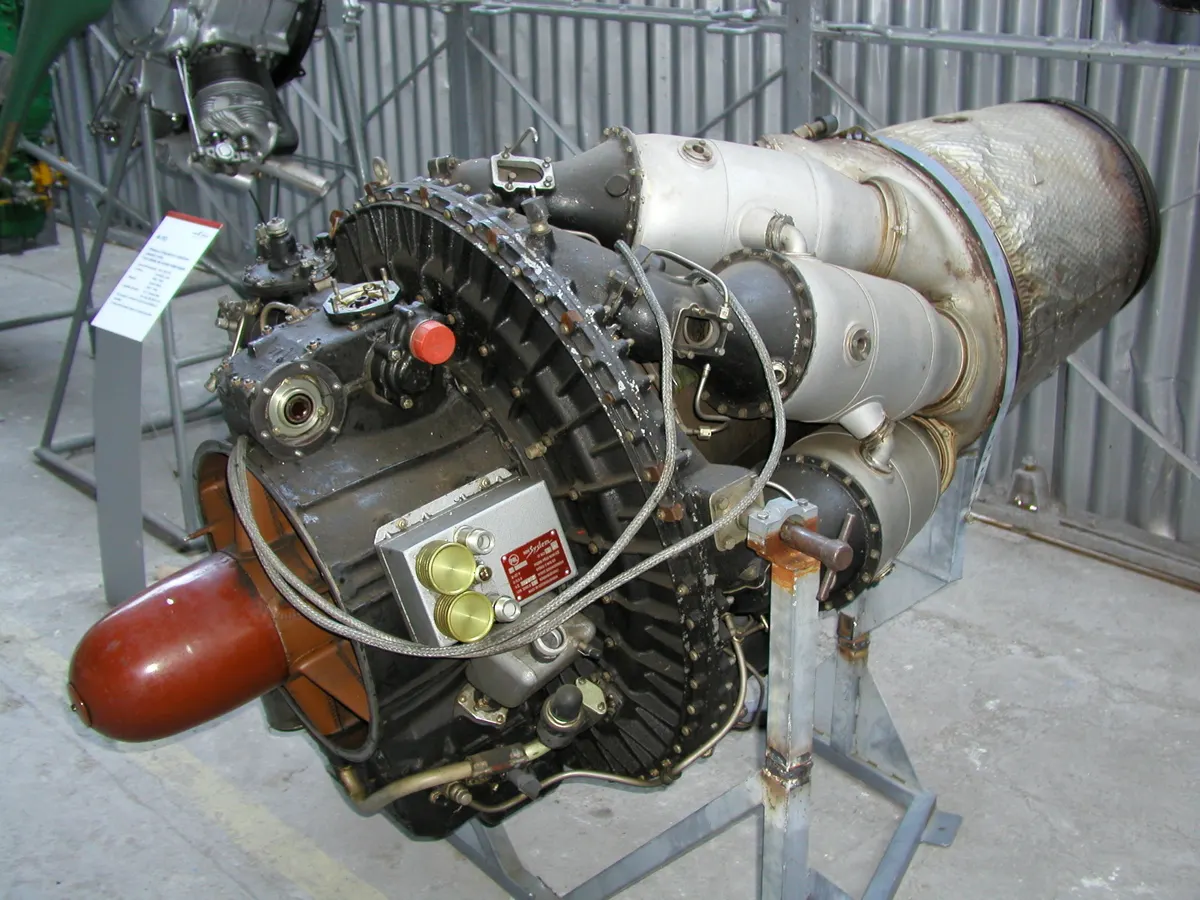
The M701's centrifugal-flow layout, rather than the more efficient axial-flow arrangement common on Western engines of the period, was a deliberate choice. Soviet air force planners specified in 1956 that the new trainer had to operate from unprepared grass strips, and a centrifugal compressor is far less vulnerable to foreign-object damage from dust and debris kicked up on takeoff than the multi-stage axial compressors found in contemporary Western trainers.5 The tradeoff was performance: with full internal fuel the L-29 reaches roughly 655 km/h at 5,000 m, or about 620 km/h at sea level, with a cruise speed near 545 km/h; its structural limit (never-exceed speed) is 820 km/h in a dive.1,3,4 Rate of climb is about 840 m/min (14 m/s), service ceiling is 11,000 m, and range on internal fuel with two underwing 150-liter drop tanks fitted is around 894 km, for an endurance of roughly two and a half hours.1,3
- Engine TypeMotorlet M-701c 500
- Thrust17.6
Fuel is carried in a 962-liter internal system, topped up when needed by the two underwing drop tanks; the docile stall and forgiving low-speed handling that made the type popular with training commands were a direct product of the priorities set during the 1961 trials, where recoverability by a nervous first-time jet student mattered more than outright performance.1,5
- Top Speed570 km/h
- Cruise Speed450 km/h
- Service Ceiling11,000 m
- Range894 km
- Rate of Climb12 m/s
- Endurance2
A Deliberately Simple Airframe
Structurally the L-29 is a straight, unswept mid-wing design with a distinctive T-tail and intakes built into the wing roots rather than the nose, which kept the forward fuselage clear for a stepped tandem cockpit with reasonable visibility for both the student in front and the instructor behind. Retractable tricycle landing gear, hydraulically actuated flaps and airbrakes, and Czechoslovak-made VS-1BRI ejection seats round out a design that emphasized low-speed handling over anything else: the L-29 posted the lowest stall speed, lowest landing speed, and shortest unprepared-strip takeoff run of all three competitors in the 1961 trials.5 The airframe measures 10.81 m long, spans 10.29 m, and stands 3.13 m tall; empty weight is about 2,280 kg and maximum takeoff weight is 3,280 kg.1,3,4 Two underwing hardpoints allow a pair of 7.62mm gun pods, light bombs of roughly 100 kg each, or unguided rocket pods to be fitted for weapons training or, as several air forces later discovered, genuine light attack work.1,4
- Cockpit Configurationtandem
- Light Attack CapableYes
- Hardpoints2
- Ejection SeatsYes
The L-29 program was almost entirely Czechoslovak in content. Aero Vodochody built the airframe and the Let works at Kunovice supplied major subassemblies, while the Motorlet (later Walter) works at Jinonice designed and manufactured the M701 turbojet from scratch rather than importing a Soviet or Western engine.1,2,5 The only significant foreign-origin component of note was the borrowed British Bristol Siddeley Viper engine fitted to the first prototype alone, before the M701 matured; every production airframe used the domestic engine. Instruments, radios, and the VS-1BRI ejection seat were also produced within Czechoslovakia, making the L-29 one of the more self-sufficient aircraft programs of the Warsaw Pact era.
- Length10.18 m
- Wingspan10.29 m
- Height3.13 m
- Max Takeoff Weight3.28 kg
- Total Built3,665
- Production Start1963
- Production End1974
- Operational StatusLimited service; popular civilian warbird
Winning the 1961 Warsaw Pact Trainer Trials
By the late 1950s, most Warsaw Pact air forces still trained pilots on piston aircraft before transitioning them directly to first-line jet fighters, an approach that Soviet planners judged too slow and too dangerous for the scale of pilot production they wanted. The Soviet air force asked Czechoslovakia, Poland, and its own design bureaus each to develop a candidate for a single standardized jet trainer that every Warsaw Pact air arm would then adopt.5 The Czechoslovak entry was the L-29; Poland submitted the PZL TS-11 Iskra; the Soviet Union submitted the Yakovlev Yak-30.
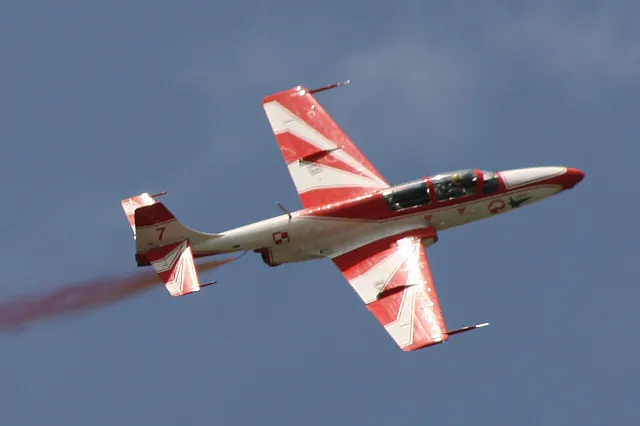
The formal evaluation ran for roughly two months in 1961 at Monino airfield outside Moscow, and it went well beyond test flights: examiners scored cockpit ergonomics, ease of maintenance, time required to swap an engine, and the aircraft's behavior in an all-through jet syllabus, from a cadet's very first flight to weapons training.5 The Delfín came out ahead on almost every practical measure that mattered for training rather than combat performance: lowest stall and landing speeds, shortest takeoff and landing runs from unprepared strips, and the best score in a test of how many complete five-minute training circuits an aircraft could fly on one internal fuel load without shutting down between sorties — the L-29 managed 15 circuits against 10 for its rivals.5 The evaluation commission concluded that "for pilot training purposes, including in the use of weapons, as well as from a production and economical point of view, the L-29 is the most suitable plane."1
Every Warsaw Pact air force except Poland's adopted the Delfín under COMECON's division-of-labor agreements; Poland, unsurprisingly, kept building the Iskra it had just lost the competition with, and flew it as its own national trainer for decades afterward.1,5 Full production at Aero Vodochody began in April 1963 and ran without a major redesign until 1974, and the L-29 entered squadron service with the Czechoslovak air force that same year, 1963, two years after the competition rather than immediately following it.1,4
From Aeroclub Benches to Front-Line Squadrons
The single largest customer was the Soviet Union, which took delivery of more than 2,000 airframes and folded the type into both its air force training schools and the DOSAAF paramilitary aeroclub network that gave millions of Soviet citizens their first flying instruction.1 The Saransk training center became one of the USSR's principal facilities for the second, jet-conversion phase of pilot training, moving cadets from the Yak-18 or Yak-52 piston trainers onto the L-29 before they ever touched a MiG.1 That "all-through jet" training model — the same one the 1961 evaluation had been designed to validate — let air forces retire their piston-trainer fleets almost entirely and cut years off the pipeline from enlistment to a front-line cockpit.
Beyond the Warsaw Pact core, Aero exported the type widely: Egypt, Syria, Iraq, Nigeria, Uganda, Indonesia, Afghanistan, and Vietnam all operated L-29s at various points, and Iraq alone took delivery of 78 aircraft between 1968 and 1974.1 Production wound down in 1974 once the more modern, turbofan-powered L-39 Albatros — designed from the outset as the L-29's successor — was ready to take over the Warsaw Pact's standard-trainer role; the L-39 first flew in November 1968 and gradually replaced the Delfín through the 1970s, although many air forces kept both types in parallel service for years rather than retiring the older aircraft outright.7
Ground Attack Over Biafra: The Nigerian Civil War
The clearest example of the L-29 being pressed into a role its designers never intended came during the Nigerian Civil War of 1967–1970. Facing a breakaway Biafran state and a blockade that limited access to purpose-built attack aircraft, the Nigerian Air Force took delivery of a batch of Czechoslovak-supplied L-29s and flew them as improvised strike aircraft, fitted with gun pods, bombs, and rockets on the two underwing hardpoints against Biafran positions and lines of supply.1,8
The type's limitations as a combat aircraft were exposed quickly: minimal ordnance, no self-defense armament beyond what could be strapped to two pylons, and a top speed that gave ground fire an easy target during low, slow attack runs. The Nigerian Air Force still lost aircraft and, more prominently, senior personnel to the strain of flying an under-armed trainer in a real war: Colonel Shittu Alao, the second Nigerian-born Chief of Air Staff, was killed on 15 October 1969 when his L-29 ran low on fuel in poor weather and crashed into a tree near Uzebba while he was attempting an emergency landing.1
The episode is a reminder of how thin Nigeria's combat capability actually was when the war started. The Nigerian Air Force, formed only in 1964, had no jet fighters, no bombers, and no combat mission at all on its books before 1967; its fleet was built around Dornier Do-27 liaison aircraft, Piaggio P.149D trainers, and Alouette helicopters.13 The L-29 trainers ordered before the war became, by default, the country's first strike jets, flying alongside newly arrived Soviet-supplied MiG-17s and Il-28 bombers once those started reaching Kano and Calabar in August 1967; a 1971 assessment credited the Nigerian Air Force with eight L-29s among a total combat fleet of 32 aircraft.14
Egypt's Delfins Against Israeli Armor, 1973
Egypt operated the L-29 from the mid-1960s and used it in a genuine attack role during the October 1973 Yom Kippur War, flying low-level strikes against Israeli armored columns advancing across the Sinai Peninsula.1,8 As in Nigeria, the aircraft's actual usefulness in this role came less from any inherent capability and more from sheer availability: Egypt needed every airframe it could put over the battlefield during the war's opening days, and an obsolescent trainer with two pylons was still better than nothing when the alternative was leaving ground troops without any air cover at all.
Slaughter in the Skies: Azerbaijan's Losses in Nagorno-Karabakh
The L-29's most costly combat deployment came decades later, in the First Nagorno-Karabakh War of the early 1990s. Azerbaijan, short of dedicated ground-attack jets after the Soviet collapse, threw its inventory of roughly 18 L-29s into ground-attack sorties against Armenian and Karabakh Armenian forces.1 The results were brutal: at least 14 of the 18 aircraft were lost to Armenian air defenses, an attrition rate that reflects exactly what the L-29 was never built to survive — sustained exposure to man-portable and vehicle-mounted anti-aircraft fire during slow, low, straight attack runs with no countermeasures and no speed to break contact.1
Iraq attempted a very different and ultimately unsuccessful use of surplus L-29s in the 1990s: the Ibn Firnas Center converted several airframes into remotely piloted vehicles under a program known as Al Bay'ah, fitting camera systems and a Mirach-100-derived ground control link with the stated aim of extending the type's operational usefulness after UN sanctions cut off spare parts for its front-line jets.9,10 Western intelligence assessed the program, at least in part, as a possible delivery method for chemical or biological agents, but technical limits — the control link could not reliably reach beyond about 70 km line-of-sight — left the conversion a technical failure, and funding was cut in 2001.9,10
Aero kept variation on the basic L-29 to a minimum, which was itself part of the design philosophy: a single standard airframe was easier for two dozen air forces to support than a family of sub-types.
Two genuine derivatives did exist. The L-29A Akrobat was a dedicated single-seat aerobatic version, built in only two examples in 1967, with perforated fuselage-mounted speed brakes and lightened equipment; the two Akrobats toured Warsaw Pact and Western airshows into the early 1970s, including an appearance at the 1969 Paris Air Show.1,6 The L-29R was a reconnaissance proposal with camera fairings under the forward fuselage and semi-permanent wingtip fuel tanks for extended range, but the project was cancelled in 1965 before it reached production.1
Beyond Aero's own designs, the most unusual "variant" of the L-29 was never built by Aero at all: Iraq's unauthorized conversion of surplus airframes into unmanned reconnaissance vehicles under the Al Bay'ah program in the late 1990s, discussed above, which stripped the cockpit of its normal instrumentation in favor of a remote camera and radio-control package.9,10 It never entered operational service in that form.


At its peak the L-29 flew with the air forces of essentially the entire Warsaw Pact — the Soviet Union (over 2,000 aircraft), Czechoslovakia, East Germany, Hungary, Bulgaria, and Romania — plus a long list of Soviet-aligned or non-aligned states outside Europe, including Egypt, Syria, Iraq (78 aircraft, 1968–1974), Indonesia, Nigeria, Uganda, Afghanistan, and Vietnam.1 Georgia and Angola are the last confirmed military operators still flying small numbers, on the order of only a handful of aircraft each as of the early 2020s, making sustained front-line military use of the L-29 effectively over.1
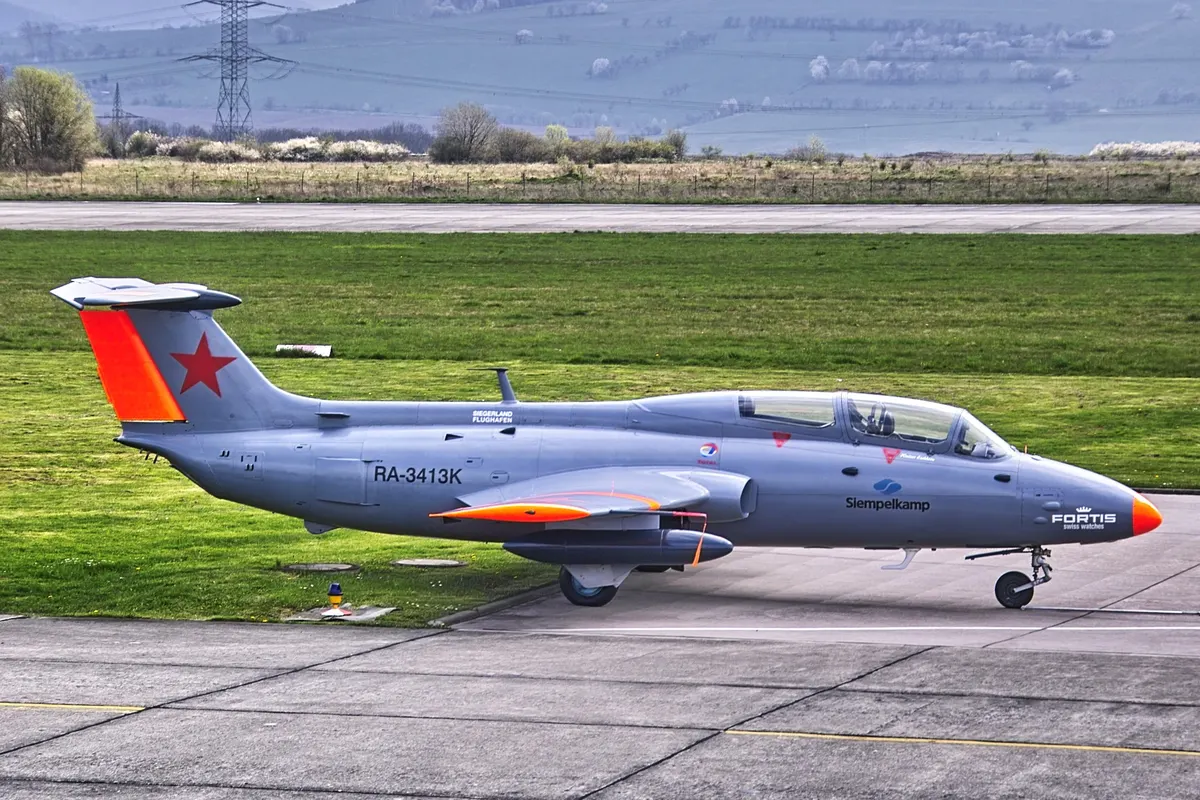
That military retirement fed directly into one of the type's stranger afterlives: hundreds of surplus L-29s were exported to Western civilian owners from the 1990s onward, drawn by a jet that is genuinely cheap to buy and, by jet standards, cheap to maintain and operate. Two L-29s took first and second place in the Jet class at the 2008 Reno Air Races, with former NASA astronaut Curt Brown winning in an aircraft named "Viper" ahead of Red Bull racing pilot Mike Mangold in "Euroburner," both regularly posting lap speeds above 500 mph.1 In October 2007, pilots Carol Sugars and Douglas Rodante flew an unmodified L-29 from Reno to Florida on 100 percent biodiesel fuel, the first jet flight ever completed on that fuel without engine modification, intended as a demonstration of the fuel's viability in older turbine designs.1
The civilian scene has not been without cost. A former Royal Air Force Red Arrows display pilot, Ted Girdler, was killed on 18 August 2000 when his L-29 failed to pull out of a diving aerobatic maneuver and struck the sea at the Eastbourne Airbourne air show in England.11 A civilian L-29 flown by the formation team "Thunder Delfins" crashed into terrain during low passes at the Mountain Festival air show in Tehachapi, California, on 4 July 2009, killing pilot Dave Zweigle and passenger Robert Chamberlain.12 More recent fatal accidents at the Reno Air Races in September 2022 and at an airshow in Villa Cañás, Argentina, in November 2023 underline that the type's low operating cost has not made it a forgiving aircraft in unforced low-altitude aerobatics.12
L-29 vs. PZL TS-11 Iskra: The Trainer That Got Away
The Iskra is the aircraft the L-29 actually has to be measured against, because the two were built for the same requirement and evaluated head-to-head at the same trials. On paper the Iskra was the better performer: its SO-3 turbojet produced about 9.8 kN of thrust against the M701's 8.7 kN, giving it a higher top speed (roughly 720–760 km/h depending on series, against the Delfín's 655 km/h at altitude) and a slightly better sustained climb rate.1,6 What the L-29 offered instead was everything the 1961 trials were actually built to measure: a lower stall speed, a shorter unprepared-runway takeoff and landing distance, and better endurance for repeated training circuits without a fuel-tank change. Poland's decision to keep the Iskra despite losing the competition was as much industrial policy as technical judgment — Warsaw already had a production line running and little appetite for retooling to build someone else's design under license — and the Iskra went on to serve the Polish air force for decades, remaining in front-line training use into the 21st century, longer than most Delfíns stayed in Warsaw Pact military service.6
| Spec | L-29 Delfín | TS-11 Iskra |
|---|---|---|
| Engine thrust | 8.7 kN (M701)2 | 9.8 kN (SO-3)6 |
| Top speed | 655 km/h at 5,000 m1 | ~720 km/h6 |
| Rate of climb | 14 m/s1 | ~14.8 m/s6 |
| Hardpoints | 21 | 46 |
The Iskra's extra pair of hardpoints also made it the more credible light-attack aircraft on paper, yet in practice it never saw anything like the combat exposure the L-29 got in Nigeria, Egypt, or Azerbaijan, simply because Poland never found itself fighting the kind of low-intensity wars that pushed Nigerian and Egyptian commanders to press trainers into strike duty.
L-29 vs. Aero L-39 Albatros: Its Own Replacement
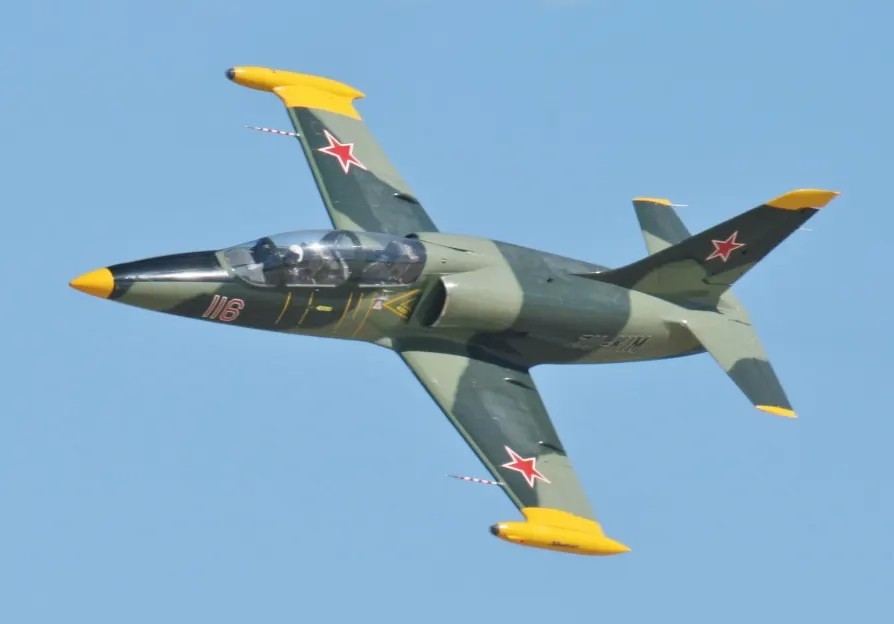
The comparison that matters most for understanding why the L-29's frontline career was relatively short is the one against its own successor. The L-39 kept the L-29's basic mission and general layout — tandem seating, side-by-side underwing hardpoints, simple systems built for large-scale training use — but replaced the M701 turbojet with a Progress AI-25TL turbofan, the first turbofan ever fitted to a purpose-built trainer, delivering both better fuel efficiency and materially more thrust.7 The L-39 also carried four hardpoints rather than two and could credibly serve as a light attack aircraft in its own right rather than an improvised one, a role Aero leaned into fully with the later L-59 and L-159 combat derivatives.7 For a Warsaw Pact air force re-equipping in the 1970s, the practical difference was that a squadron of L-39s could do everything a squadron of L-29s did, plus meaningfully more, at a lower fuel cost per flight hour — which is precisely why most air forces phased the L-29 out of front-line training as soon as L-39 deliveries allowed, even while, in several cases, keeping small numbers of Delfíns in secondary or aerobatic-display use for years afterward.


How many Aero L-29 Delfins were built? Approximately 3,665 were built at Aero Vodochody between 1963 and 1974, making it the highest-production jet aircraft ever built in Czechoslovakia; more than 2,000 went to the Soviet Union alone.1
What is the L-29 Delfin's top speed? About 655 km/h (407 mph) at 5,000 m altitude, or roughly 620 km/h at sea level; its structural never-exceed speed in a dive is 820 km/h.1,3,4
Is the L-29 Delfin still in service? Only in very small numbers. Georgia and Angola were the last confirmed military operators still flying a handful of aircraft as of the early 2020s; most other air forces retired the type decades ago in favor of the L-39 Albatros or newer trainers. Several hundred surplus airframes remain airworthy in private civilian hands, mostly in the United States.1
How does the L-29 Delfin compare to the PZL TS-11 Iskra? The Iskra was faster and slightly better-armed, with four hardpoints against the L-29's two, but the L-29 won the 1961 Warsaw Pact trainer competition on training-specific criteria: lower stall speed, shorter takeoff and landing runs on unprepared strips, and more training circuits per fuel load. Poland kept the Iskra as its national trainer regardless of the result.1,5,6
Was the L-29 Delfin ever used in real combat? Yes, though never as its designers intended. Nigeria flew it as an improvised strike aircraft during the 1967–1970 civil war, Egypt used it against Israeli armor in the 1973 Yom Kippur War, and Azerbaijan lost at least 14 of its 18 L-29s to Armenian air defenses during the early-1990s Nagorno-Karabakh War.1
- "Aero L-29 Delfín", Wikipedia — en.wikipedia.org ↩
- "Motorlet M-701", Wikipedia — en.wikipedia.org ↩
- "Aero L-29 Delfin - Specifications", flugzeuginfo.net — flugzeuginfo.net ↩
- "Aero L-29 Delfin / Maya Trainer", Military Factory — militaryfactory.com ↩
- "Aero L-29 Delfin – The Little Trainer that Could", Pickled Wings — pickledwings.com ↩
- "PZL TS-11 Iskra", Wikipedia — en.wikipedia.org ↩
- "Aero L-39 Albatros", Wikipedia — en.wikipedia.org ↩
- "L-29 Delfin", GlobalSecurity.org — globalsecurity.org ↩
- "MiG-21 / L-29 RPVs", GlobalSecurity.org — globalsecurity.org ↩
- "History Lesson: Iraq's Foil-clad Drones", Center for the Study of the Drone at Bard College — dronecenter.bard.edu ↩
- "List of air show accidents and incidents in the 20th century", Wikipedia — en.wikipedia.org ↩
- "List of air show accidents and incidents in the 21st century", Wikipedia — en.wikipedia.org ↩
- "When War Forced Nigeria's Young Air Force to Learn Combat Overnight", Historical Nigeria — historicalnigeria.com ↩
- "Nigerian Air Force", Wikipedia — en.wikipedia.org ↩