

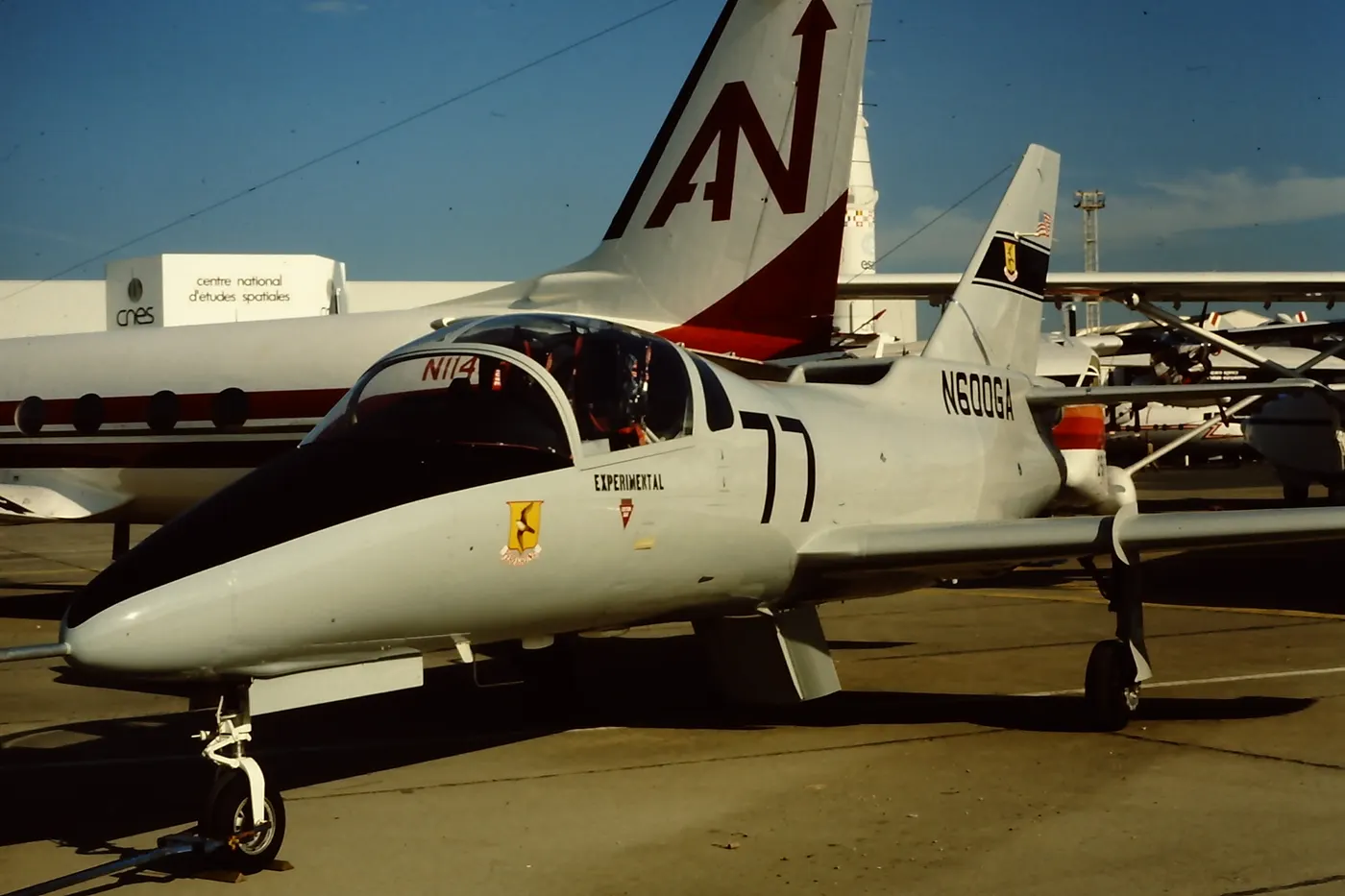

The Peregrine 600 was a single-engine military jet trainer prototype built by Gulfstream American, first flown on 22 May 1981.1 Only one airframe was ever completed; it flew for roughly two and a half years before crashing in November 1983, and the program was shut down in 1985 without a single production order.1,2 Documentation is thin: no operator ever received one, and most of what can be verified traces back to a handful of aviation-history articles, a single newspaper account of the crash, and Jane's All the World's Aircraft. This article states plainly where the record runs out rather than filling gaps with guesswork.
- Reused proven Hustler wings and tail, cutting development risk
- Simple single-engine layout kept unit cost down
- Side-by-side seating suited instructor visibility
- Genuine NGT flight-test data, unlike paper-only rivals
- Lost the NGT competition outright to the Fairchild T-46
- Sole prototype destroyed after only limited flight hours
- No export sale despite marketing in four countries
- Never reached series production or squadron service
The aircraft was Gulfstream American's answer to the US Air Force's Next Generation Trainer (NGT) requirement, an effort to replace the aging Cessna T-37 Tweet primary trainer.7 Gulfstream built it around the wings, tail, and rear fuselage of its earlier Hustler business jet, fitting a new forward fuselage with side-by-side seating for student and instructor.1,8 The Air Force chose a rival design, and Gulfstream's own attempts to sell the aircraft abroad went nowhere.
From the Hustler's Wings: A Recycled Airframe for a New Trainer
Gulfstream American, formed when Allen Paulson bought Grumman American in 1978 and renamed it, had already spent years on the Hustler, a business aircraft with an unusual mixed turboprop-and-turbofan layout.8 When that program stalled, the company reused the Hustler's wings, empennage, and rear fuselage on a new forward section built for two crew sitting side by side, marketing the result as a military trainer.1,8 Much of this "clean-sheet" trainer had, in effect, already flown once before under a different name.
- First Flight1981
- Crew (seats)2
- Trainer Typebasic/advanced jet trainer
- In ServiceNo
The Pratt & Whitney Canada JT15D-4 and a Modest 2,500 Pounds of Thrust
The prototype, known internally as the Peregrine A, was powered by a single Pratt & Whitney Canada JT15D-4 turbofan rated at 2,500 lbf (11.1 kN), the same engine family used on several contemporary light business jets.1,2 A twin-engine, tandem-seat proposal, the Peregrine B, was drawn up with two Williams WR44 turbofans of 1,500 lbf each, but it was never built.2
- Engine TypePratt & Whitney Canada JT15D-4
- Thrust11.12
Numbers Worth Double-Checking
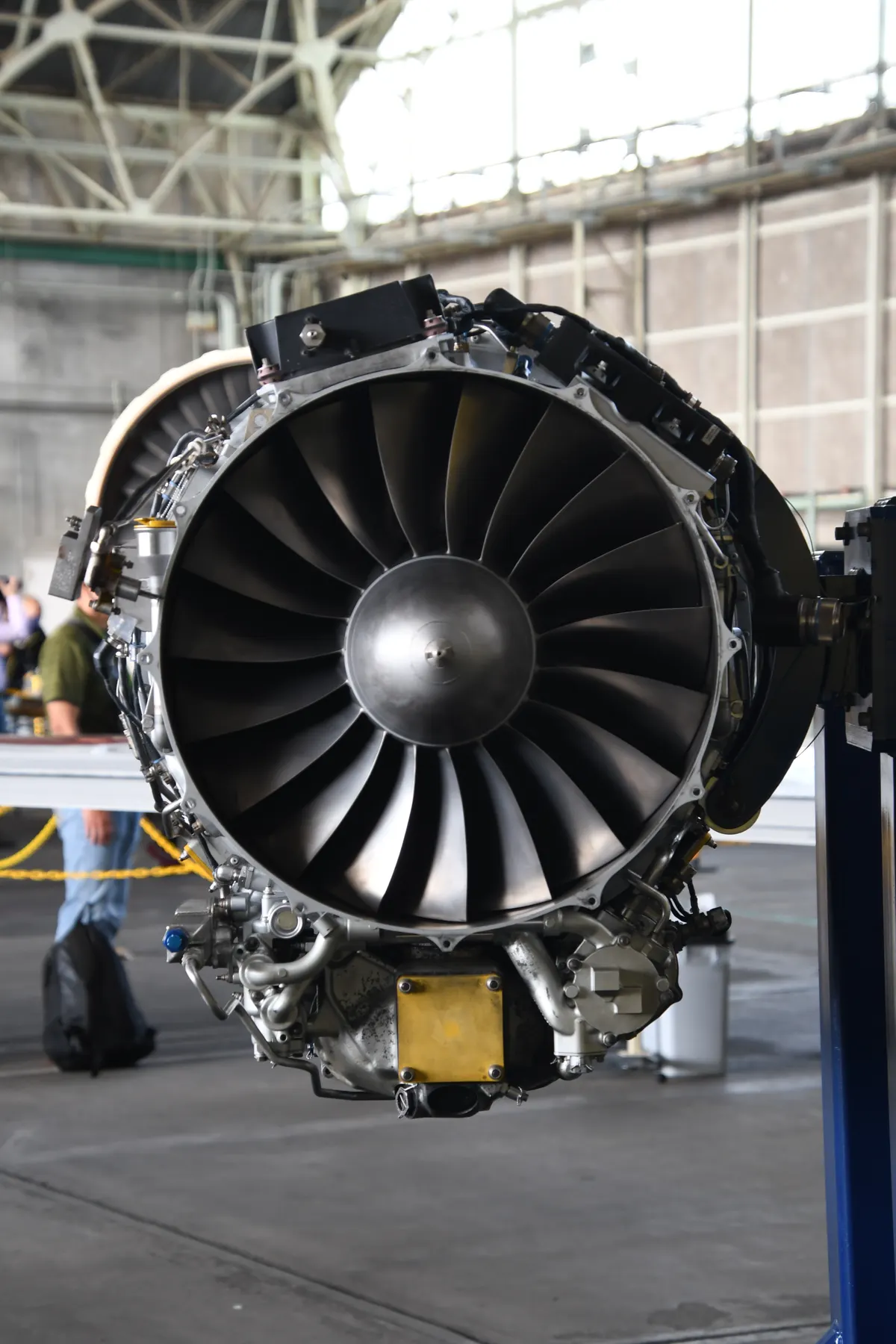
Reported performance for the flown Peregrine A includes a maximum speed of about 394 knots (roughly 730 km/h, 453 mph) at 20,000 ft, a service ceiling of 48,000 ft (about 14,630 m), and a sea-level climb rate of 5,200 ft/min (about 26.4 m/s).1,2 Gross weight was reported at 5,254 lb (2,383 kg) against a maximum takeoff weight of 6,199 lb (2,811 kg); the two are close enough that some secondary listings appear to have conflated them, so any single "weight" figure for this aircraft deserves caution.2 It carried ejection seats for both crew, confirmed by the pilot's escape from the 1983 crash, though no source available here names the seat's manufacturer.4
- Top Speed394 km/h
- Service Ceiling14,630 m
- Range2,000.16 km
- Rate of Climb26.4 m/s
Final assembly took place in the United States, at Gulfstream American's Oklahoma City facility, the light-aircraft plant the company inherited from the 1973 merger that had created Grumman American.8 The aircraft's single largest imported component was its engine: the Pratt & Whitney Canada JT15D-4 turbofan, built by Pratt & Whitney Canada at Longueuil, Quebec.1 No source consulted for this article details a specific avionics supplier, and the cockpit was a conventional analog fit with no glass-cockpit instrumentation.1 Weighing a US-built airframe against one imported Canadian engine, a rough estimate of 75-80 percent domestic content by value is reasonable, with Canada supplying the largest single foreign share.
- Cockpit Configurationside-by-side
- Glass CockpitNo
- Embedded SimulationNo
- Light Attack CapableNo
- Hardpoints0
- Ejection SeatsYes
- Length11.68 m
- Wingspan10.5 m
- Height4.09 m
- Max Takeoff Weight2,383 kg
- Total Built1
- Operators0
- Retirement Year1985
- Production Start1981
- Production End1985
- Operational Statusprototype only, destroyed in crash
Answering the Air Force's Next Generation Trainer Requirement
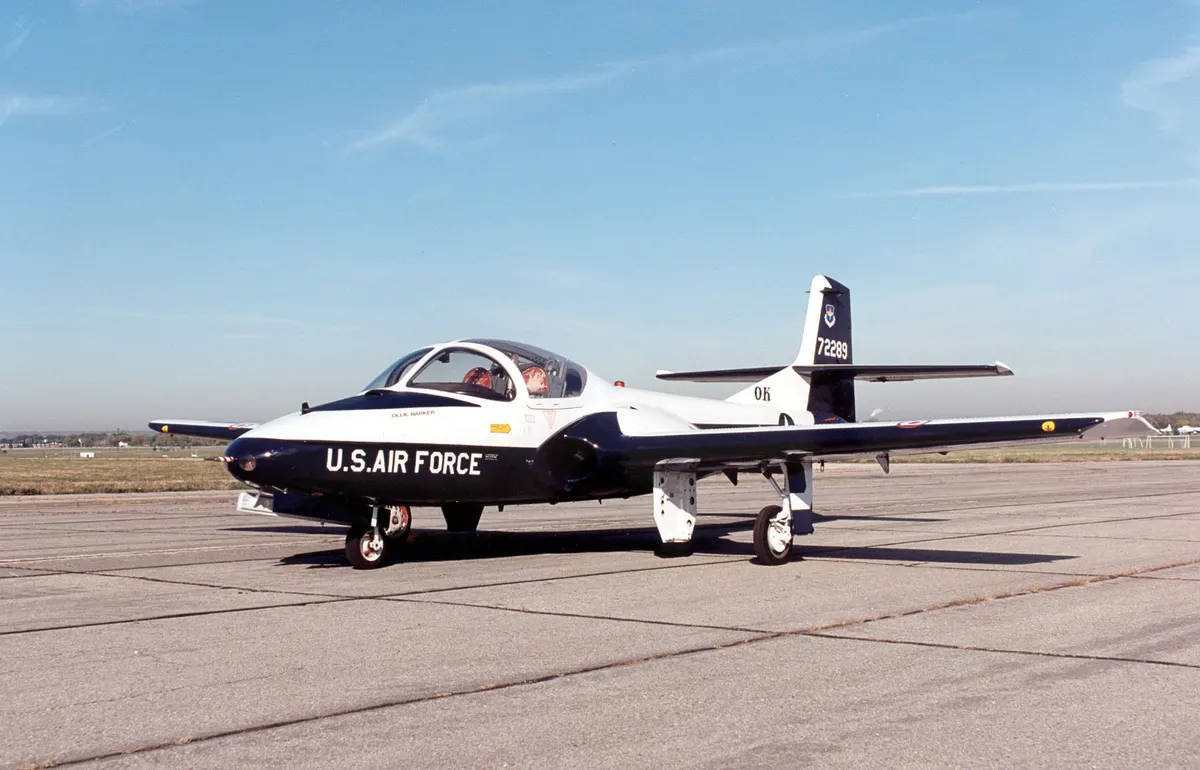
The Next Generation Trainer competition was launched to replace the Cessna T-37 Tweet, and by late 1981 five manufacturers, Cessna, Ensign, Fairchild Republic, Gulfstream American, and Rockwell, had shown interest before the formal request for proposals went out that October.7 Gulfstream had already flown its Peregrine prototype on 22 May 1981, ahead of the RFP, giving it real flight-test data to set against competitors' paper studies.1,3
Losing to the Fairchild T-46 and a Failed Export Push
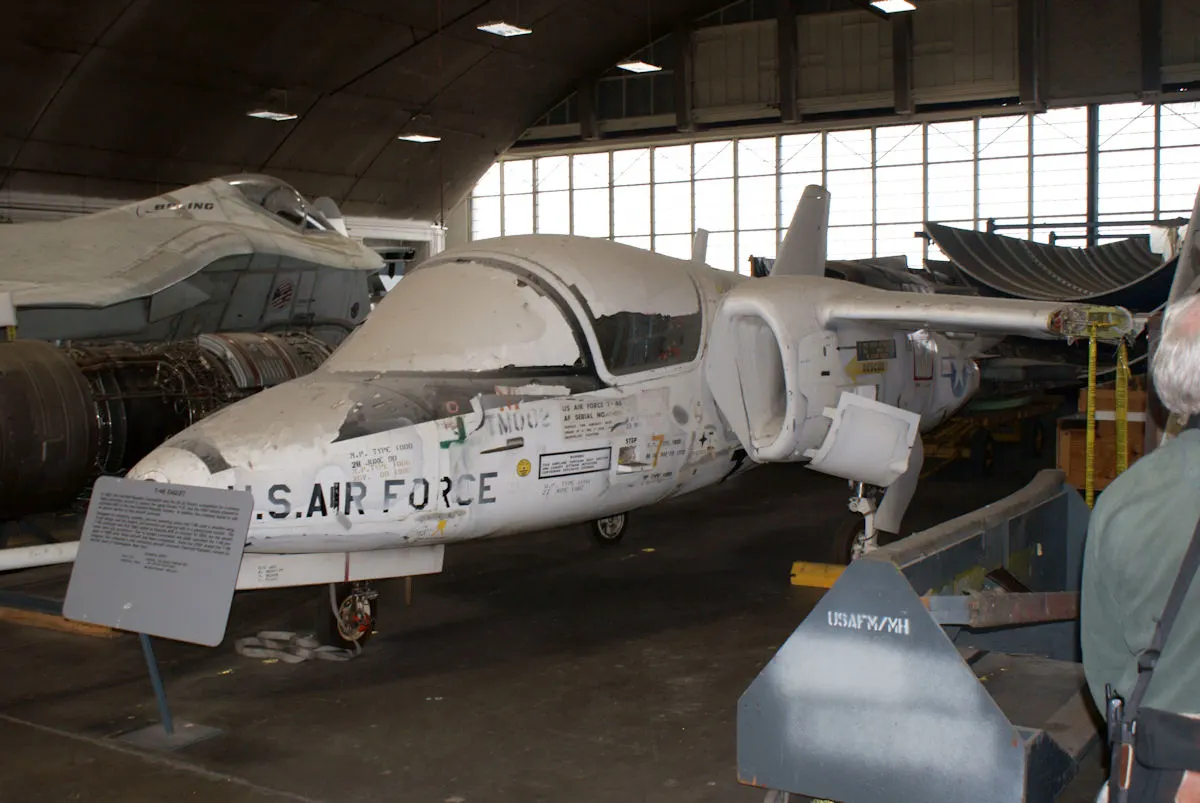
The Air Force instead chose the Fairchild-Republic entry, a twin-engine, twin-tail monoplane with side-by-side seating and two Garrett F109 turbofans, announcing it winner on 2 July 1982 and ordering two prototypes under the designation T-46.7 Passed over at home, Gulfstream displayed the Peregrine at the Paris Air Show at Le Bourget in June 1983 and pitched it to the air forces of Australia, New Zealand, Japan, and China; none of the four ordered it.2
The Crash at Wiley Post Airport and a Quiet Cancellation
On 23 November 1983 the sole Peregrine 600 was destroyed after losing control shortly after taking off from Wiley Post Airport; test pilot Bill Lawton ejected and survived.1,4 The NTSB opened a formal investigation, filed under report number FTW84FA075.5 With its only flying prototype gone and no order in hand, Gulfstream suspended the program in March 1985, and the aircraft never flew again.1
Only one configuration ever flew: the Peregrine A, with a single JT15D-4 turbofan and side-by-side seating, registered N600GA.1,2 A twin-engine Peregrine B, seating crew in tandem behind two Williams WR44 engines, existed only as a proposal and was never built.2 Gulfstream reused the Peregrine 600's wings, tail, and rear fuselage a second time on an unrelated civilian aircraft, originally the Commander Fanjet 1500 and renamed the Peregrine (sometimes "Peregrine 550") to trade on the earlier program's name; that business jet first flew 14 January 1983 and was itself cancelled in 1985, after Gulfstream struggled to meet a single-engine stall-speed rule and could not convert 27 deposit-backed orders into firm sales.6


The Peregrine 600's only real point of comparison is the aircraft that beat it, the Fairchild T-46 Eaglet, since both were built to the same Next Generation Trainer requirement and both ultimately failed to reach the fleet. The two designs took opposite bets: Gulfstream backed a single JT15D-4 turbofan on a layout inherited from a business jet, wagering that reused, already-flying hardware would offset the risk of one engine on a trainer. Fairchild bet on redundancy, fitting two small Garrett F109 turbofans to a twin-tail airframe designed from scratch for the requirement.7 The Air Force's choice suggests the twin-engine margin and a purpose-built design mattered more to evaluators than Gulfstream's head start in flight hours. That judgment did not age well: the T-46 contract was itself cancelled in 1986 after only three aircraft were delivered, so neither NGT contender ever equipped a training squadron.7

How many Peregrine 600 aircraft were built?
Just one. The single prototype, registered N600GA, was the only Peregrine 600 ever completed, and it was destroyed in a 1983 crash.1,2
What was the Peregrine 600's top speed?
Around 394 knots, roughly 730 km/h or 453 mph, recorded at 20,000 ft during testing.1,2 That figure is sometimes miscopied as "394 km/h" in secondary listings; the underlying reported value is in knots, not kilometers per hour.
Is the Peregrine 600 still in service anywhere?
No. It never entered service with any air force; the prototype crashed in 1983, the program was cancelled in 1985, and no production aircraft were ever built.1,2
- "Gulfstream Peregrine 600", Wikipedia — en.wikipedia.org ↩
- "Grounded Dreams: Gulfstream Peregrine 600, The Luxury Jet Maker's Failed Military Trainer", Vintage Aviation News — vintageaviationnews.com ↩
- "Today In Aviation History: First Flight of the Gulfstream Peregrine 600", Vintage Aviation News — vintageaviationnews.com ↩
- "Military Test Plane Destroyed in Crash", The Oklahoman, 24 November 1983 — oklahoman.com ↩
- "Aviation Investigation Final Report FTW84FA075", National Transportation Safety Board — data.ntsb.gov ↩
- "Gulfstream Peregrine", Wikipedia — en.wikipedia.org ↩
- "Fairchild T-46", Wikipedia — en.wikipedia.org ↩
- "GULFSTREAM HUSTLER & PEREGRINE", Gulfstream American Report Archive — gulfbiz.jimdoweb.com ↩