

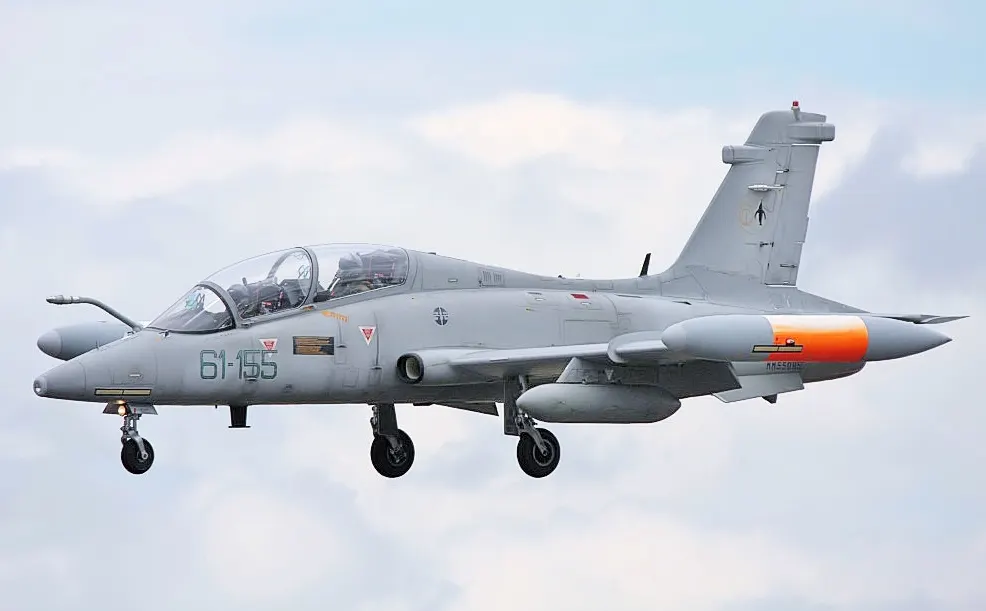

The Aermacchi MB-339 is a twin-seat jet trainer and light attack aircraft built by the Italian company Aermacchi, first flown on 12 August 1976 and delivered to the Italian Air Force from 1979.1 It is a direct descendant of the earlier MB-326, sharing that aircraft's straight, unswept wing and Rolls-Royce Viper turbojet but with a redesigned, stepped forward fuselage that raises the rear instructor's seat for a clear view over the student pilot's head.1,2 Around 230 airframes were built between 1978 and roughly 2010, when a last batch was completed for Malaysia years after the original production line had supposedly closed.1,3
- Forgiving, docile handling for student pilots
- Simple, reliable Viper turbojet with low maintenance burden
- Six hardpoints give real light-attack capability for a trainer
- Long production run kept spares and support available for decades
- Straight wing limits top speed well below swept-wing rivals
- Modest weapons payload next to dedicated light-attack aircraft
- Analogue-era MB-339A cockpit dated quickly against glass-cockpit trainers
- Viper turbojet is thirstier and noisier than modern turbofans
Aermacchi (based in Varese, in northern Italy) pitched the MB-339 as a low-risk, low-cost derivative rather than a clean-sheet design: engineers weighed seven new proposals, grouped under the internal designation MB-338, against an improved MB-326 airframe, and the improved MB-326 (renumbered MB-339) won on cost while meeting the Italian Air Force's requirements.1 That conservatism defined the aircraft's whole career. It never chased the speed or payload of newer rivals built around swept wings and turbofans; instead it built a reputation, in the words of one longtime Italian Air Force instructor, for "outstanding qualities in flight" and for forgiving the mistakes of young pilots learning to fly jets.4 Pilots call it, affectionately, the Macchino.4
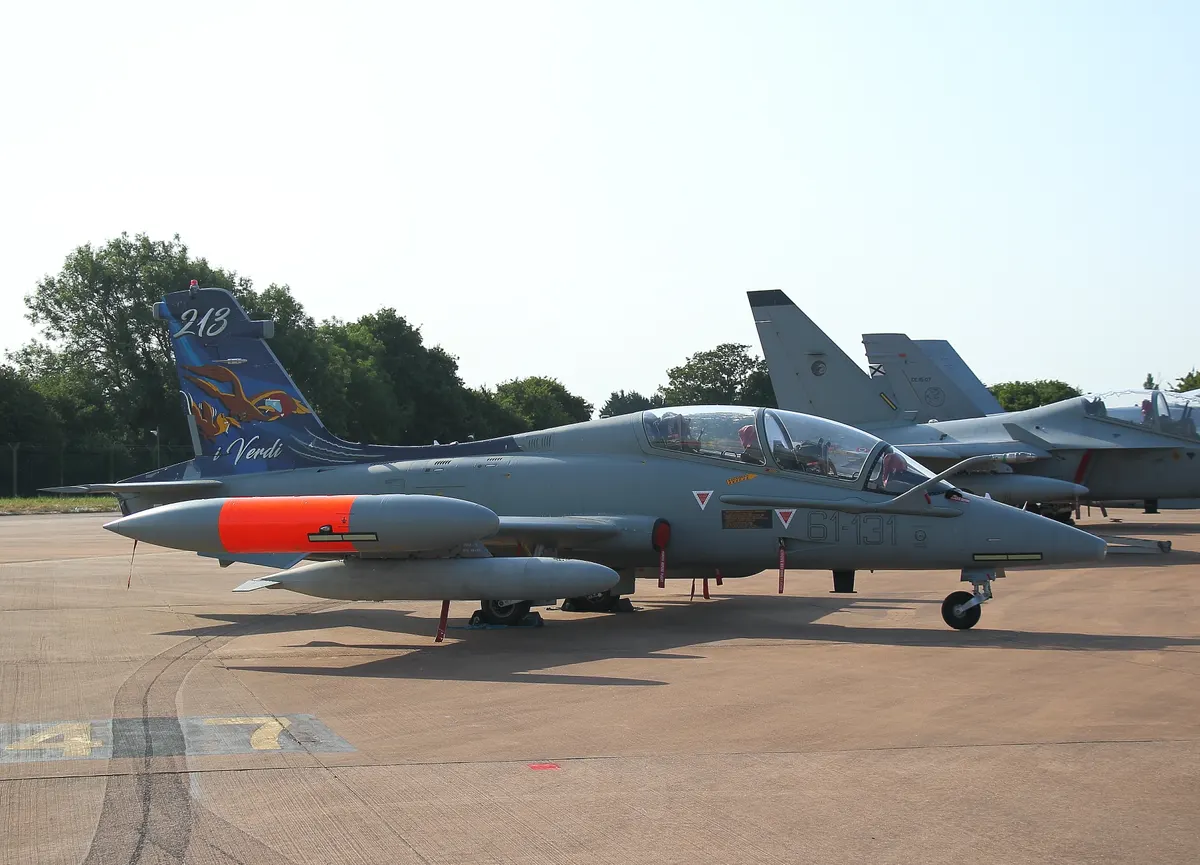
The airframe's straight wing kept costs and pilot workload down but capped performance well short of contemporaries built for speed: about 900 km/h at sea level against something closer to Mach 0.9 for the BAE Hawk.1,5 What it lacked in outright performance it made up in visibility for the display role and in operating economics that kept it in front-line service, in one air force or another, for over 45 years. Italy, Argentina, Eritrea, Ghana, Malaysia, New Zealand, Nigeria, Peru and the United Arab Emirates have all flown it, and Italy and the UAE still do.1,6
The Rolls-Royce Viper 632 and Its Reputation for Simplicity
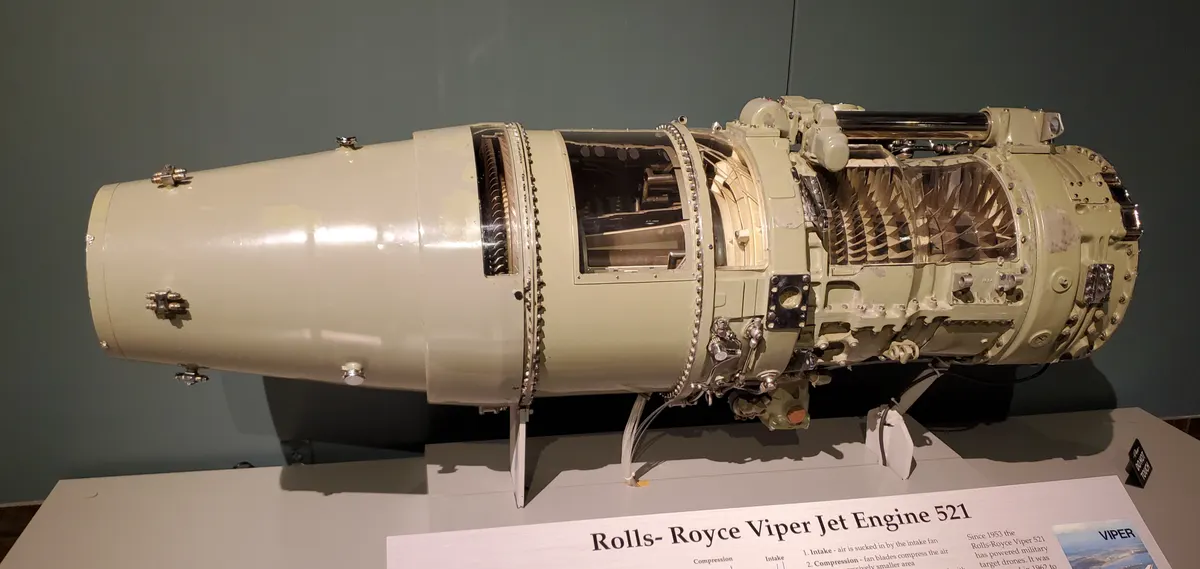
The MB-339A is powered by a single Rolls-Royce Viper Mk 632-43 turbojet rated at 17.8 kN (4,000 lbf) of dry thrust, essentially the same engine family used in the MB-326, the British Jet Provost and the Yugoslav Soko Galeb.1,2 The Viper began life in 1948 as a cheap, expendable turbojet for the Jindivik target drone, and its simple annular combustion chamber and lack of variable geometry became its calling card: pilots reported that "if you could light it off it would then never let you down."7 Rolls-Royce (through its Bristol Siddeley heritage) licensed production of the Viper to the Italian firm Piaggio starting in 1959 to 1960, so most Vipers fitted to Italian-built MB-339s were actually assembled in Italy rather than imported outright.8 Later variants, the MB-339C and MB-339CD, switched to the uprated Viper 680-43, delivering around 19.8 kN (4,450 lbf) and refurbished Viper engines were still being fitted to newly built MB-339CDs for Malaysia as late as 2009, two decades after Viper production officially ended in Britain.7,3
Straight Wing, Tip Tanks and a Raised Cockpit
The MB-339's low, unswept wing is lifted almost unchanged from the MB-326K attack variant, complete with fixed wingtip fuel tanks, and it is this wing, more than anything else, that separates the aircraft from swept-wing contemporaries like the Hawk.1 Overall dimensions run to roughly 10.97 m in length, a 10.86 m span across the tip tanks, and a wing area of about 19.3 m², with a tail height cited between about 3.6 and 4.0 m depending on the source and undercarriage configuration.2,9 Empty weight is around 3,100 to 3,200 kg, and maximum takeoff weight with a full load of external stores reaches close to 5,900 kg, considerably heavier than the lightly loaded trainer figures sometimes quoted for the type.2,9 Six underwing hardpoints (four rated at 454 kg and two outboard ones at 340 kg) can carry up to 1,815 kg of stores: gun pods, unguided bombs, rocket pods, AGM-65 Maverick missiles, AIM-9 Sidewinder or Matra Magic air-to-air missiles, and, on some export aircraft, the Otomat-derived Marte anti-ship missile.10,1 Structural limits are rated at +8g/-4g, generous for a straight-wing airframe of this class.1
The forward fuselage was reshaped from the MB-326 specifically to stagger and raise the two Martin-Baker ejection seats, giving the rear-seat instructor an unobstructed view forward over the student's head, a detail pilots and instructors single out as one of the aircraft's better ergonomic choices.1 The later MB-339CD replaced the analogue MB-339A cockpit with a fully digital suite: a head-up display, three color multi-function displays, hands-on-throttle-and-stick controls and a MIL-STD-1553B databus, plus a fixed refueling probe used purely for training pilots in the mechanics of air-to-air refueling rather than for genuine extended range.3
The MB-339's airframe, final assembly and, on later variants, its digital avionics suite are all produced by Aermacchi (later Alenia Aermacchi, now Leonardo) at Venegono Superiore in Italy.4 The one major foreign-origin element is the engine design itself: the Rolls-Royce Viper turbojet was developed in Britain, though Piaggio has license-built and supported Viper and Viper-derived engines in Italy since 1959 to 1960, meaning most of the powerplant's value is captured domestically even though the intellectual property is British.8 Export CD-model avionics packages sometimes add further foreign content depending on the customer's chosen sensors and datalinks, but the baseline aircraft is best described as an Italian airframe around a British-designed, Italian-built engine.8,4
Development began under a 1972 Italian Air Force requirement for an MB-326 replacement, and rather than fund a riskier new airframe (the MB-338 studies), Aermacchi's management chose the safer, cheaper path of stretching the existing design.1 The MB-339X prototype flew on 12 August 1976, and after a three-year test and certification program the first production MB-339A entered Italian Air Force service in 1979, eventually forming roughly the first half of all Italian-operated MB-339s delivered through 1987.1

The Italian Air Force's aerobatic team, the Frecce Tricolori, adopted a dedicated MB-339PAN variant (fitted with a smoke-generation system) to replace its ageing, swept-wing Fiat G.91PAN in the early 1980s. The switch was not an easy sell at first: the MB-339's unswept wing, unlike the G.91's arrow-shaped one, left almost no margin for error in tight aerobatic formations, and the team's early relationship with the type was reportedly hesitant.4 Over time that same demanding handling became a point of pride for the unit, credited with sharpening the precision that made the Frecce Tricolori one of the best-known military aerobatic teams in the world.4
That precision came at a severe cost on 28 August 1988, at the Flugtag '88 airshow at Ramstein Air Base in West Germany. During the team's signature "pierced heart" (Cardioide) maneuver, in which two formations trace a heart shape and pass each other along the runway, the solo pilot's aircraft collided with the lead formation.11 Three MB-339s crashed onto the crowd within seconds; the accident killed 70 people, including the three pilots (team leader Mario Naldini, Giorgio Alessio and solo pilot Ivo Nutarelli) and 67 spectators, injuring 346 more in the resulting fireball.11 One stricken jet struck a US Army medevac helicopter on the ground; its pilot, Captain Kim Strader, died of his burns 20 days later.11 At the time it was the deadliest air show accident on record, a distinction it held until the 2002 Sknyliv crash in Ukraine.11
Away from the airshow circuit, the MB-339 has had a smaller but genuine afterlife as flight-simulation hardware. The Italian studio IndiaFoxtEcho, working with serving Frecce Tricolori pilots to validate the flight model, released a detailed MB-339 add-on for Microsoft Flight Simulator in October 2020, followed by an official DCS World combat-simulation module in 2022 built from an earlier fan-made mod.19,20
Falklands War, 1982: The First Argentine Aircraft to Engage the Landing Force
Argentina's naval air arm, the Comando de Aviación Naval Argentina, ordered ten MB-339As in 1980 and took delivery in 1981, assigning them to the 1st Attack Squadron of the 3rd Naval Air Wing.13 By late April 1982, six of the ten were based at Port Stanley's airfield, redesignated Base Aérea Militar Malvinas, alongside FMA IA 58 Pucará attack aircraft and Beechcraft T-34 Turbo-Mentors; the rest operated from mainland bases at Almirante Zar, Bahía Blanca and Río Grande.13

On 21 May 1982, during the British landing at San Carlos, an MB-339A flown by Lieutenant Owen Crippa made a low-level attack on the Royal Navy's amphibious force, strafing and rocketing the frigate HMS Argonaut with 30 mm cannon fire and unguided rockets. The attack damaged the ship's Type 965 radar and wounded her fighter direction officer and two sailors on the hangar roof; it was the first Argentine aircraft to engage the British landing force directly.14,15 Argonaut was hit again shortly afterward by Argentine A-4 Skyhawks with unexploded bombs, one of which still detonated a Sea Cat missile magazine, but the MB-339 strike was the opening blow of the day's fighting in San Carlos Water.14
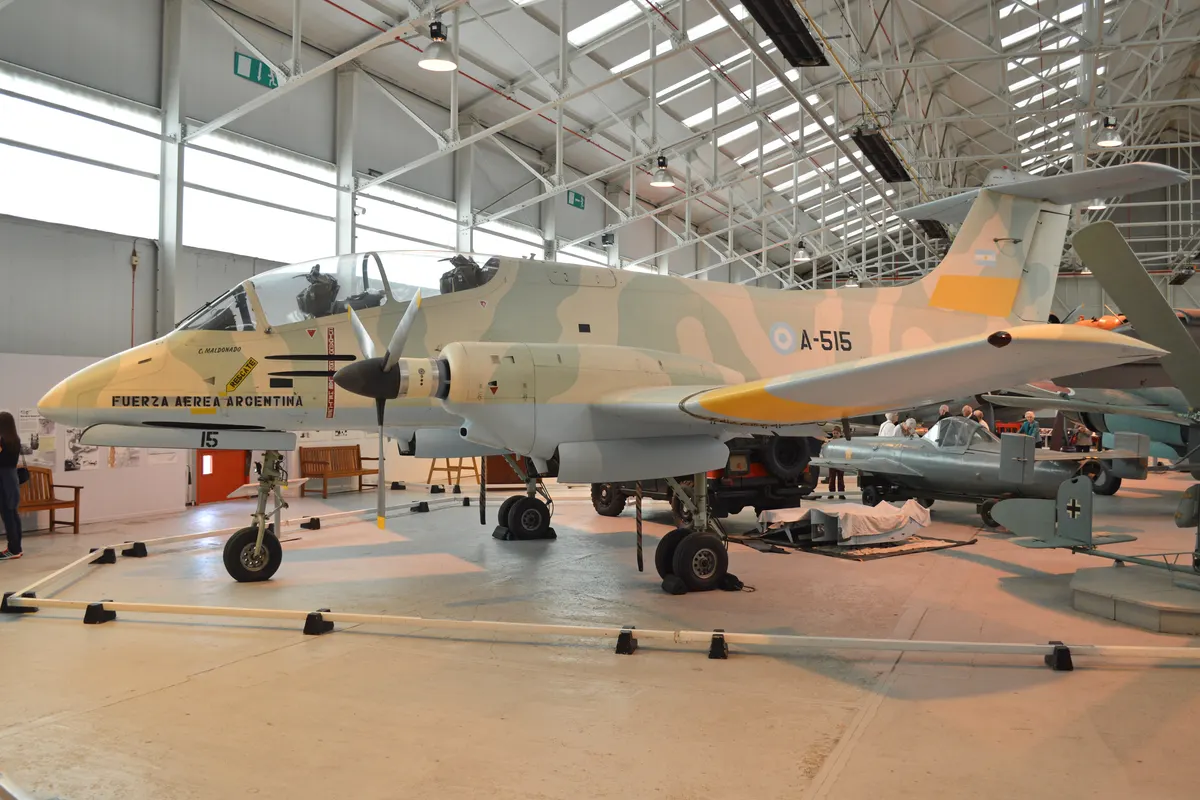
Argentine MB-339s paid for that exposure. On 27 or 28 May 1982 (sources differ by a day), during the Battle of Goose Green, an MB-339A carrying the serial 4-A-114 was shot down by a British Blowpipe surface-to-air missile while attacking ships and troops ashore; its pilot, Lieutenant Miguel, was killed.16,1 The Blowpipe, a shoulder-launched missile with a poor overall combat record in the Falklands, is credited with only this single confirmed kill of the war, making the loss something of a statistical outlier as well as a real one.16 A separate MB-339 was lost on 3 May 1982 near Stanley in a non-combat crash that killed Lieutenant Benitez.1 British forces later captured three intact Argentine MB-339 airframes on the islands; one now sits in the South Yorkshire Aircraft Museum.1
The Eritrean-Ethiopian War, 1998 to 2000
Eritrea ordered six MB-339CE light-attack aircraft in 1996 and stood up its first jet combat unit around them in 1997.1 They saw action almost immediately once the border war with Ethiopia reignited: on 5 June 1998, Eritrean MB-339FDs reportedly struck the Ethiopian regional capital Mekelle, a strike Ethiopian sources say killed 44 people and injured 135, in a tit-for-tat exchange that also saw Ethiopian MiG-23s bomb Asmara airport the same day.1 One Eritrean MB-339 was shot down north of Mekelle the following day, its pilot ejecting safely, and on 12 June four aircraft carried out rocket and cluster-bomb attacks around Adigrat.1 Eritrean MB-339s allegedly struck a fuel depot 48 km inside Ethiopian territory in February 1999, by which point the light trainer-turned-attacker had racked up a combat record disproportionate to its size and modest six-aircraft fleet.1
The baseline MB-339A trainer accounted for the bulk of Italian and export production, but the type branched widely. The single-seat MB-339K Veltro II, first flown in May 1980, stripped out the second cockpit for a dedicated light-attack aircraft with twin 30 mm DEFA cannon, but it attracted no orders and only one prototype was built.1 The MB-339PAN display variant and the small MB-339RM radio and radar calibration batch (three aircraft, later converted back to standard) filled niche Italian Air Force roles.1
Export orders generated their own designators: the MB-339AM for Malaysia (13 aircraft from 1983, later supplemented by MB-339CD/CM jets delivered from 2009), MB-339AN for Nigeria (12 aircraft), MB-339AP for Peru (16 aircraft from November 1981), MB-339CB for New Zealand (18 weapons-capable trainers delivered 1991, armed for AIM-9L Sidewinder and AGM-65 Maverick use) and MB-339CE for Eritrea (six aircraft).1,17 The most significant technical leap came with the MB-339C, introduced in the late 1980s with modernized avionics and the more powerful Viper 680 engine, followed by the MB-339CD (first flight 1996), which added the fully digital glass cockpit, an air-refueling training probe and a new avionics databus; Italy later contracted upgrades to bring its first-batch CDs to an improved "Batch 2" standard with embedded simulation and night-vision compatibility.1,3 An MB-339-based "T-Bird II," offered with Lockheed and General Motors backing for the United States' JPATS trainer competition in 1989 to 1990, did not win a contract.1


Italy remains the type's largest operator by far, having taken roughly half of all MB-339s built; its air force still flies the MB-339A (in an upgraded mid-life form), the MB-339CD and the Frecce Tricolori's MB-339PAN.1 Italy announced in 2013 that it intended to eventually replace the MB-339 with the newer Leonardo M-345, though the older jet remained in front-line training and display use well past that announcement.1
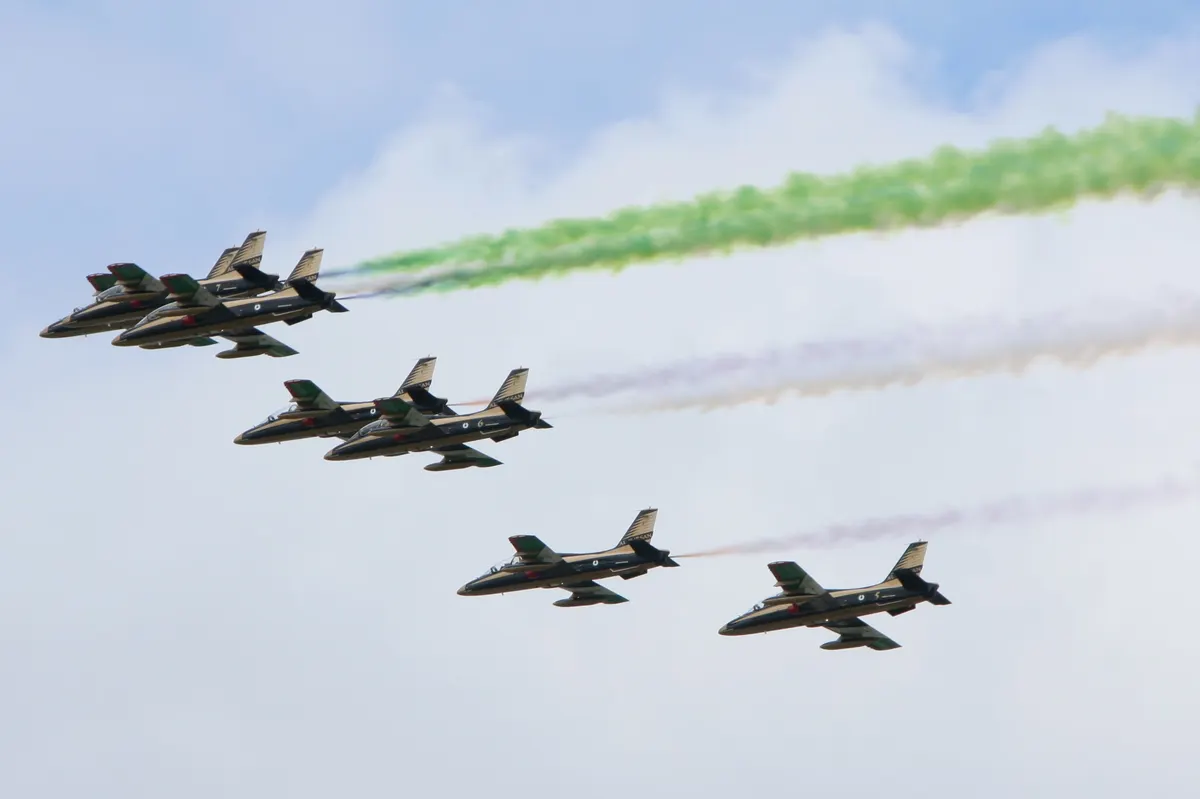
The United Arab Emirates operates a small MB-339NAT fleet, several converted from earlier standard aircraft, primarily to support its Al Fursan aerobatic display team.1 Eritrea still fields a handful of MB-339CEs from its original 1996 order.1 In France, MB-339CBs originally built for New Zealand found a second life with SDTS, a private contractor that operates jets under contract to provide initial fast-jet screening for French Air and Space Force pilot candidates.1 Former operators include Argentina (its ten MB-339As withdrawn during the 1990s after Falklands losses), Ghana (four aircraft), Malaysia, New Zealand (which retired its fleet in 2002, some later resold to the American contractor Draken International) and Nigeria and Peru, both of which have kept airframes in storage rather than active flying status.1
The MB-339's closest Western competitor was always the BAE Hawk, and the comparison is unflattering on raw numbers. The Hawk, which first flew in 1974, pairs a Rolls-Royce Turbomeca Adour turbofan of around 28.9 kN (6,500 lbf) thrust with a swept wing, reaching roughly 1,028 km/h in level flight and Mach 0.88, well beyond the Viper-powered MB-339's roughly 900 km/h ceiling.5,1 The Hawk also carries more ordnance (up to 3,085 kg across five hardpoints against the MB-339's 1,815 kg across six) and, in its single-seat Hawk 200 form, doubles as a genuine light fighter rather than a trainer with attack provisions bolted on.5 With over a thousand Hawks built across all variants and continued production for decades, Britain's aircraft also won the volume war decisively against the roughly 230 MB-339s completed.1,5 What the MB-339 offered instead was cost: a simpler, non-afterburning turbojet, a less structurally demanding straight wing and a correspondingly lower price per airframe and per flight hour, arguments that mattered more to smaller air forces and to export customers such as Peru, Ghana and Nigeria than outright performance.1
The Aero L-39 Albatros, the MB-339's Eastern Bloc contemporary from Czechoslovakia, makes for a closer and more interesting match. The L-39 actually trails the Italian jet on top speed, at roughly 750 km/h against the MB-339's 900 km/h, largely because its Ivchenko AI-25TL turbofan produces less thrust (about 16.9 kN) than the Viper, but it undercut the MB-339 heavily on cost and was built in vastly greater numbers, with around 2,900 airframes delivered against Aermacchi's 230.18 The Albatros also compiled a broader, messier combat record of its own, from Ethiopia and Angola to Georgia and Syria, generally in air forces too poor to afford Western hardware, whereas the MB-339's combat use concentrated in two specific, well-documented episodes: the Falklands and the Eritrean-Ethiopian war.18 Where the MB-339 wins the argument is refinement and support network: license-built Viper engines and an unbroken Aermacchi-then-Leonardo manufacturing line kept parts and expertise flowing for over four decades, longer than the L-39's original Czechoslovak, later Czech and Slovak, industrial base was able to sustain uninterrupted after 1989.1,18
| Spec | MB-339A | BAE Hawk T1 | Aero L-39 Albatros |
|---|---|---|---|
| First flight | 1976 | 1974 | 1968 |
| Engine | Viper 632 turbojet, 17.8 kN | Adour turbofan, ~28.9 kN | AI-25TL turbofan, ~16.9 kN |
| Top speed | ~900 km/h | ~1,028 km/h | ~750 km/h |
| Hardpoints / payload | 6 / 1,815 kg | 5 / 3,085 kg | 4 / ~1,200 kg |
| Total built | ~230 | ~1,000+ (all marks) | ~2,900 |


What engine does the Aermacchi MB-339 use? A single Rolls-Royce Viper turbojet: the Mk 632-43 (17.8 kN dry thrust) on the original MB-339A, and the more powerful Viper 680-43 (about 19.8 kN) on the MB-339C and MB-339CD. Piaggio has license-built Viper engines in Italy since 1959 to 1960.1,8
How many MB-339s were built? Around 230 were completed between 1978 and roughly 2010, including a late batch built for Malaysia's MB-339CD order years after most sources describe the production line as closed.1,3
What is the MB-339's top speed? Approximately 900 km/h (about Mach 0.73) at sea level for the MB-339A, figures cited across independent technical databases; some sources round slightly higher, to around 917 km/h.1,2
Is the MB-339 still in service? Yes. Italy flies the MB-339A, MB-339CD and MB-339PAN (Frecce Tricolori); the United Arab Emirates flies a small MB-339NAT fleet supporting its Al Fursan display team; Eritrea retains a handful of MB-339CEs; and France's SDTS operates ex-New Zealand MB-339CBs under contract for pilot screening.1
Did the MB-339 ever see real combat? Yes, twice. Argentine Naval Aviation MB-339As attacked British ships during the 1982 Falklands War, including the frigate HMS Argonaut, and lost one aircraft to a Blowpipe missile at Goose Green. Eritrean MB-339CEs flew strike missions, including against Mekelle, during the 1998 to 2000 war with Ethiopia.14,16,1
MB-339 vs BAE Hawk: which trainer is better? It depends on the mission. The Hawk is faster, carries more weapons and has sold in much greater numbers, making it the better light-fighter-trainer hybrid; the MB-339 is simpler, cheaper to operate and, according to instructor pilots, more forgiving for early jet training, which is why smaller air forces on tighter budgets favored it.5,4,1
- "Aermacchi MB-339", Wikipedia — en.wikipedia.org ↩
- "Aermacchi M.B.339 - Specifications - Technical Data", flugzeuginfo.net — flugzeuginfo.net ↩
- "ARCHIVED REPORT Aermacchi MB.339 Series", Forecast International — forecastinternational.com ↩
- "MB-339 training jet, an all-Italian success story", Leonardo — leonardo.com ↩
- "Hawker Siddeley / BAe / BAE Systems Hawk - Specifications", flugzeuginfo.net — flugzeuginfo.net ↩
- "MB-339 Jet Trainer", Airforce Technology — airforce-technology.com ↩
- "Rolls Royce Viper Engine", PPRuNe Forums — pprune.org ↩
- "Piaggio Aerospace", Wikipedia — en.wikipedia.org ↩
- "Aermacchi MB.339 Advanced Trainer / Light Attack Aircraft", Military Factory — militaryfactory.com ↩
- "MB-339", Army Recognition — armyrecognition.com ↩
- "Ramstein air show disaster", Wikipedia — en.wikipedia.org ↩
- "2023 National Aerobatic Team Aermacchi MB-339 crash", Wikipedia — en.wikipedia.org ↩
- "Argentine Naval Aviation", Wikipedia — en.wikipedia.org ↩
- "The Falklands War - HMS Argonaut", British Empire — britishempire.co.uk ↩
- "Battle of San Carlos (1982)", Wikipedia — en.wikipedia.org) ↩
- "Falklands War order of battle: Argentine air forces", Wikipedia — en.wikipedia.org ↩
- "Aermacchi MB-339: Military Training Aircraft Specs & Operators", Global Military — globalmilitary.net ↩
- "L-39 Albatros vs MB-339: Specs, Speed & Range Compared", Global Military — globalmilitary.net ↩
- "IndiaFoxtEcho MB-339 Microsoft Flight Simulator", Key.Aero — key.aero ↩
- "DCS: MB-339 by IndiaFoxtEcho Visual Simulation", Digital Combat Simulator — digitalcombatsimulator.com ↩