

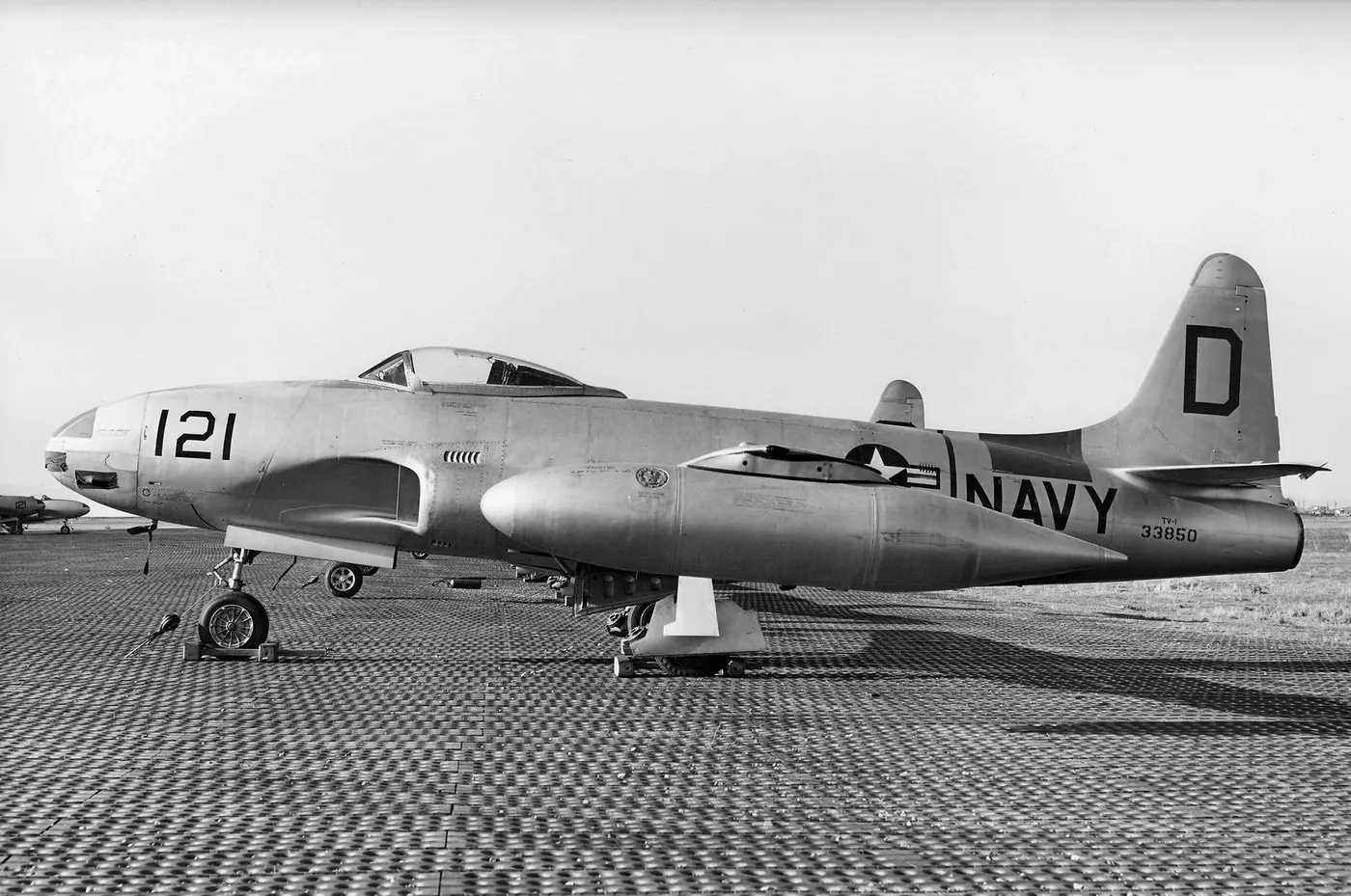

The Lockheed T-33 Shooting Star, nicknamed the "T-Bird," is a two-seat subsonic jet trainer built by Lockheed from 1948 to 1959, with additional license production in Canada and Japan running into the early 1960s. Total output reached 6,557 airframes: 5,691 by Lockheed in Burbank, California, plus 656 built by Canadair in Montreal as the CT-133 Silver Star and 210 by Kawasaki in Japan.1 That figure makes the T-33 one of the most numerous jet aircraft ever built, trainer or otherwise, and for a long stretch of the Cold War it was the aircraft in which most of the world's jet pilots, American and allied alike, learned to fly with a jet engine behind them.
- Simple, forgiving handling well suited to jet transition training
- Shared most structure and systems with the combat-proven P-80/F-80
- Rugged, easily maintained airframe with a long parts-commonality tail
- Pressurized tandem cockpit and dual controls, a first for a US jet trainer
- Cheap and plentiful as military surplus, fueling decades of export sales
- Subsonic performance made it obsolete as a lead-in trainer by the 1960s
- Limited armament and payload compared to purpose-built light attack jets
- Mach 0.8 compressibility buffet capped high-speed, high-altitude flying
- Centrifugal-flow J33 engine was thirstier and less efficient than later axial designs
- Ejection seat and cockpit pressurization were dated by the time of retirement
The design origin was pragmatic rather than visionary. Lockheed stretched a P-80C Shooting Star fighter fuselage by 38.5 inches, added a second cockpit with dual controls under a lengthened canopy, and kept nearly everything else, wings, tail, landing gear, and the Allison J33 turbojet, unchanged.1 The prototype, initially designated TP-80C and then TF-80C before settling on T-33A in May 1949, first flew on 22 March 1948 with Lockheed test pilot Tony LeVier at the controls.1,14 It entered service just as the U.S. Air Force was struggling with an alarmingly high accident rate among pilots transitioning directly from propeller aircraft into single-seat jets, and the T-33's dual-control cockpit addressed that problem directly.1

The aircraft went on to serve with the air arms of roughly 25 to 30 nations across six decades, outliving the fighter it was derived from by half a century.1 Bolivia, which had bought Canadian- and French-surplus T-33s starting in 1973, flew the last operational military examples anywhere in the world until their retirement on 31 July 2017, ending a 44-year run for that air force and a 69-year run for the type overall.2,3 Beyond military service, a healthy civilian warbird population, Boeing's use of two Canadair-built examples as commercial jetliner chase planes until 2020, and continued appearances on the air show circuit mean the T-33 has never fully left American skies even though no air force flies it operationally today.11,12
Airframe and Aerodynamics: From Fighter to Trainer
Structurally, the T-33 is a P-80 with an extra three feet of fuselage inserted forward of the wing to make room for a second, elevated rear seat. Lockheed's engineers retained the P-80's low, straight wing, its tricycle landing gear, and its all-metal semi-monocoque fuselage, changing only what was necessary to fit an instructor behind the student under a single long clamshell canopy.1,4 The nose held a three-panel windshield with a bullet-resistant center panel rated to survive bird strikes, a detail inherited unchanged from the fighter.1 Cabin pressurization ran at a modest 3.5 psi differential and only engaged above 8,000 feet, reflecting a trainer built for instrument and formation work rather than sustained high-altitude combat sorties.1
- First Flight1948
- Service Entry Year1948
- Crew (seats)2
- Trainer Typesubsonic jet trainer
- In ServiceNo
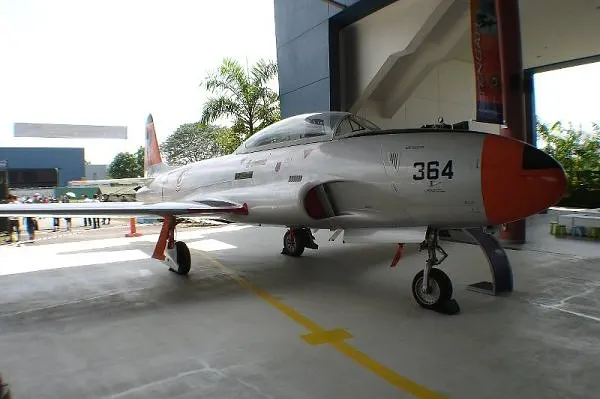
Handling qualities were deliberately benign. Pilots and flight-test writers who flew the type decades later still describe it as docile at low speed, honest in the stall, and forgiving of ham-fisted inputs from students fresh off piston trainers, exactly the qualities the Air Force needed after the P-80's rough introduction to service.4 The tradeoff came at the top of the speed envelope: like its parent, the T-33's straight, relatively thick wing generated pronounced buffeting as airflow approached the speed of sound, and squadrons standardized on keeping the aircraft below roughly Mach 0.8 to avoid the compressibility effects that could make the airframe difficult to control.1,4
- Engine TypeAllison J33 turbojet
- Thrust20
- Power (turboprop)15,000 kW
Allison J33 Turbojet and Performance Figures
Power came from a single Allison J33-A-35 centrifugal-flow turbojet rated at roughly 5,400 lbf of thrust with water-methanol injection for takeoff, and about 4,600 lbf dry.1 It was the same engine family fitted to the P-80/F-80, a lineage traceable to the wartime General Electric I-40 by way of Allison's licensed production, and it gave the T-33 a top speed of around 600 mph (Mach 0.8) at sea level, a service ceiling near 48,000 feet, an initial climb rate of about 4,870 feet per minute, and a range on internal and tip-tank fuel of roughly 1,275 miles.1,24 Cruise speed sat close to 455 mph. These numbers made the T-33 comfortably supersonic-adjacent for its era without ever being a supersonic aircraft, a distinction that mattered once the Air Force began fielding supersonic front-line fighters in the 1950s and needed a lead-in trainer that could better approximate their handling.
- Top Speed970 km/h
- Cruise Speed800 km/h
- Service Ceiling12,500 m
- Range2,200 km
- Rate of Climb15 m/s
- G-Limit7.33
- Endurance2.5

Empty weight ran about 8,365 lb, with a normal gross weight near 12,070 lb and a maximum takeoff weight around 15,060 lb depending on external stores.1,5 Wingspan was 38 ft 10.5 in, length 37 ft 9 in, and height 11 ft 8 in, dimensions barely distinguishable from the P-80 apart from the stretched fuselage.1 Standard T-33As carried no fixed armament, though many export airframes were fitted or retrofitted with underwing hardpoints; the dedicated AT-33A light-attack conversion added two 12.7 mm Browning M3 machine guns in the nose and could carry up to 2,000 lb of bombs or rockets across two underwing stations, turning a trainer into an economical counterinsurgency aircraft for air forces that could not afford purpose-built attack jets.19
- Cockpit Configurationtandem two‑seat pressurised cockpit
- Glass CockpitNo
- Embedded SimulationNo
- Light Attack CapableYes
- Hardpoints2
- Ejection SeatsYes
T-33 Shooting Star Specifications: Domestic Content
The T-33 was an almost entirely American design and build for the vast majority of the fleet: Lockheed's Burbank plant produced 5,691 of the 6,557 total airframes, and the standard powerplant, the Allison J33, was itself built in Indianapolis under a wartime-derived license from the original British-inspired General Electric turbojet line.1 The two significant exceptions were foreign, not imported components within the American production run: Canadair in Montreal built 656 aircraft under license as the CT-133 Silver Star, substituting a British Rolls-Royce Nene engine for the Allison J33, and Kawasaki in Japan built 210 more from 1954 for the newly reconstituted Japan Air Self-Defense Force.1,9,10 Within the US-built fleet, domestic content was overwhelmingly high; airframe, engine, and avionics all originated from American manufacturers, with only minor instrumentation and radio equipment occasionally imported from allied suppliers on export-configured aircraft.
- Length13.7 m
- Wingspan11.8 m
- Height3.8 m
- Max Takeoff Weight9,072 kg
- Total Built6,557
- Operators25
- Retirement Year2017
- Production Start1948
- Production End1959
- Operational Statusretired
Development: Lockheed's Million-Dollar Gamble
Lockheed financed the T-33 program largely with its own money rather than waiting on a formal Air Force development contract, a bet that paid off handsomely once the trainer requirement became urgent.6 The urgency was real: in 1946 the single-seat P-80 was recording the highest accident rate of any fighter in the Army Air Forces' inventory, largely because pilots were being checked out in a jet with no dual-control option.1 Lockheed's engineers took a P-80C fuselage, lengthened it, and fitted a raised second seat with a full set of flight controls so an instructor could take over instantly if a student got into trouble. Tony LeVier, who had survived an engine disintegration and bailout from an earlier XP-80 that left him with two crushed vertebrae, flew the new two-seater on its first flight in March 1948 and later used a repaired XP-80 to set an unofficial speed record of 565 mph, testament to how much confidence Lockheed's test pilots had rebuilt in the basic design.14 The Air Force designated the prototype TP-80C, then TF-80C, and finally settled on T-33A in May 1949 once the type's identity as a dedicated trainer rather than a fighter variant was fixed.1
Production Boom and the Making of a Trainer Standard
Once orders were confirmed, Lockheed ramped production so aggressively that, according to period accounts, only about one in four airframes coming off the line was individually test-flown before delivery, the rest being accepted on the strength of the type's now well-proven design and manufacturing consistency.1 Between 1948 and 1959 the Burbank plant alone turned out 5,691 T-33As, a rate that made the type the backbone of American jet flight training for two decades and the natural candidate for allied nations rebuilding or standing up air forces after the Second World War and through the early Cold War. Canadair began its own production run in Montreal in 1952 under a Royal Canadian Air Force contract, substituting a Rolls-Royce Nene turbojet for the Allison J33 and naming the result the CT-133 Silver Star; Kawasaki followed in Japan from 1954, building 210 more once the country's postwar restrictions on aircraft manufacturing were lifted.1,9,10
Retirement from US Service and a Long Export Afterlife
The USAF began pulling the T-33 out of front-line Air Training Command duty in the early 1960s as the purpose-built Cessna T-37 and supersonic Northrop T-38 Talon entered service, and the last American advanced-training T-33s left Craig Air Force Base, Alabama, on 8 February 1967.1 Air National Guard units kept flying the type in secondary and proficiency roles for another two decades, with the final examples retired from Guard service in 1987, twenty years after the active-duty training mission ended.6 By then the T-33 had already found a second career: hundreds of surplus and newly built export airframes were sold or granted through military assistance programs to dozens of allied and non-aligned air forces from the early 1950s onward, a pipeline that kept Lockheed's production lines and Canadair's running well past the point where the US services themselves needed more aircraft.
Bolivia: The Last Military T-33 Operator
Bolivia's Fuerza Aérea Boliviana acquired 15 ex-Canadian T-33ANs in 1973 to 1974, added five more from Canada in 1977, and then bought 18 surplus T-33SFs from France in 1985, later upgrading a portion of the fleet to a T-33-2000 standard around 2000 to 2001.3 Those aircraft flew on for internal security, aerial policing, and training duties in a country that never fielded a more modern jet fighter to replace them. On 31 July 2017, the Grupo Aéreo de Caza 31 retired the last four airworthy T-33s in military service anywhere in the world, closing out 44 years of Bolivian service and, with it, the type's entire 69-year military career.2,3 No air force has flown the T-33 operationally since.
Warbirds, Chase Planes, and a Life After the Military
Outside military service, the T-33 became one of the more accessible early jets on the American warbird market, since it was long classified as trainer surplus rather than a front-line combat type, though it remains subject to US arms-export controls for private international sales.11 Fewer than fifty are thought to still fly in private hands. A Canadair-built CT-33 Silver Star owned by Planes of Fame serves as the official pace aircraft for the unlimited class at the Reno Air Races, pilot Gregory "Wired" Colyer flies a trio of T-33s billed as the Ace Maker Jet Team on the air show circuit, and the aircraft known as the Red Knight has entertained American crowds for decades under a succession of private owners.11 Boeing's own use of the type was more utilitarian than sentimental: from 1981 the company flew two Canadair-built T-33s, nicknamed Red Bird and Blue Bird, as safety chase planes trailing the first flights of nearly every new Boeing commercial jet, including the 787 in 2009 and the 777-9 in 2020, before retiring both in December 2020 once parts support for the aging airframes became untenable.12 NASA's Dryden (now Armstrong) Flight Research Center likewise operated four T-33As between 1958 and 1973 for chase and support duties on its experimental flight-test programs.22
The T-33 also had a modest but real run in front of movie cameras during the 1950s jet age. William Holden's 1956 test-pilot drama Toward the Unknown, shot on location at Edwards Air Force Base, used the T-33 in background flying shots and reportedly flew Holden himself in one for familiarization before filming.15 Howard Hughes's Jet Pilot, released in 1957 after a famously drawn-out production, likewise featured the T-33 among its jet aircraft footage.16
Korea and the F-80/T-33 Relationship
The T-33 itself was not designed or generally used as a combat aircraft, and confusion sometimes arises because its single-seat parent, the F-80 (renamed from P-80 in 1948), did fight in Korea. An F-80C flown by Lt. Russell J. Brown was credited with the first jet-versus-jet aerial kill in history, downing a MiG-15 near the Yalu River on 8 November 1950, and F-80s went on to fly extensive ground-attack and armed reconnaissance sorties through the war.1 The two-seat T-33's role during the same conflict was almost entirely in the training pipeline that fed pilots into the F-80, F-84, and F-86 units actually fighting, underscoring the aircraft's real historical significance: it shaped the men who flew Korea's air war rather than flying much of it directly.
The Bay of Pigs: Cuba's Trainers Become Fighters
The T-33's one unambiguous, sustained air-to-air combat record came in April 1961, when Cuba's fledgling revolutionary air force had no combat jets of any kind except a handful of T-33s left over from the Batista-era air force's American training relationship.7,8 Facing a CIA-backed exile invasion at the Bay of Pigs, Cuban pilots fitted their T-33s with improvised gun and rocket armament and flew them alongside a handful of Hawker Sea Furies and B-26 Invaders against the invasion force's own B-26s and shipping. Rocket-armed T-33s proved unexpectedly effective against the slower, unescorted exile bombers; Cuban pilots, including Lt. Alberto Fernández, who downed a B-26 over Girón airfield on the morning of 17 April, are credited with several of the roughly ten exile B-26s lost during the three-day battle.7,8 Among the American-crewed losses was a B-26 flown by Maj. Riley Shamburger, hit by T-33 fire while his wingman, Lt. Col. Joe Shannon, managed to evade a separate attacking T-33 on the same mission.7 It remains the clearest case of the type engaging in genuine air combat rather than serving purely as a trainer or light-attack platform against ground targets.
Cold War Reconnaissance: RT-33A Over Vietnam, Laos, and Beyond
Eighty-five production T-33s were completed or converted with a camera installed in the nose and supporting equipment in the rear cockpit as the RT-33A, a tactical reconnaissance variant built mainly for export to allied air forces rather than for USAF front-line use.1 The US Air Force nonetheless flew a single RT-33A on classified overflights of South Vietnam and Laos beginning in 1961 under the codename Project FIELD GOAL, using an aircraft drawn from Philippine Air Force stocks with an American pilot, until the mission passed to the faster and better-equipped McDonnell RF-101 Voodoo.1,6 Reconnaissance-configured T-33s were also lost to hostile action on at least one occasion during the 1950s, when an RT-33 flown by a US officer was forced down over Albania by MiG-15s in December 1957, an incident that placed the trainer squarely inside one of the tensest corners of the early Cold War rather than in a classroom.1
Indonesia, East Timor, and Low-Intensity Counterinsurgency
Indonesia bought 19 unarmed T-33As in 1973 and, needing cheap strike aircraft for the invasion and subsequent occupation of East Timor, had several rearmed with machine guns and bomb racks salvaged from retired Il-28 bombers and B-25 Mitchells.1 Those improvised gunships flew counterinsurgency sorties over East Timor from 1976 until the Indonesian Air Force retired its last T-33s around 1980, a small but concrete example of a trainer airframe being pressed into a genuine, if second-tier, combat role decades after its original design purpose had passed.
Ogaden War and African Air Forces
Ethiopia operated the T-33 alongside F-86 Sabres, F-5s, and Canberras through the 1970s, and it appears in the order of battle for the 1977 to 1978 Ogaden War against Somalia, though the Ethiopian Air Force's actual combat sorties in that conflict were flown predominantly by its F-5 interceptors and attack aircraft and its Canberra bombers rather than by the T-33 fleet.17 The aircraft's African service is best understood as backbone training and light utility support underpinning a combat force built around more capable imported types, a pattern repeated across many of the smaller air forces that operated the T-33.
Cold War Airspace Incidents
Even in nominally peacetime service the T-33 occasionally found itself at the center of Cold War friction. On 21 June 1996, a Hellenic Air Force T-33A flown by Squadron Leader Ioannis Kouratzoglou intercepted a Turkish F-16C that had violated Athens FIR airspace, a striking illustration of how long-serving air forces kept elderly T-33s in genuine operational taskings well into the 1990s.1 A darker episode occurred on 20 August 1971, when Pakistan Air Force instructor pilot Matiur Rahman attempted to hijack a T-33 in midair, intending to defect to India and join the Bangladesh Liberation War effort; his student, Pilot Officer Rashid Minhas, radioed that he had been hijacked before the aircraft crashed near the Indian border, killing both men.1
RT-33A: The Camera-Nosed Reconnaissance Shooting Star
The RT-33A replaced the standard nose with a camera installation and reworked the rear cockpit for reconnaissance equipment while retaining the trainer's basic flying qualities. Eighty-five were built or converted, and the type saw service with export operators including the Philippine Air Force, Republic of China (Taiwan) Air Force, and Yugoslav Air Force, in addition to limited, classified USAF use over Southeast Asia in the early 1960s.1,6
Canadair CT-133 Silver Star and the Rolls-Royce Nene Swap
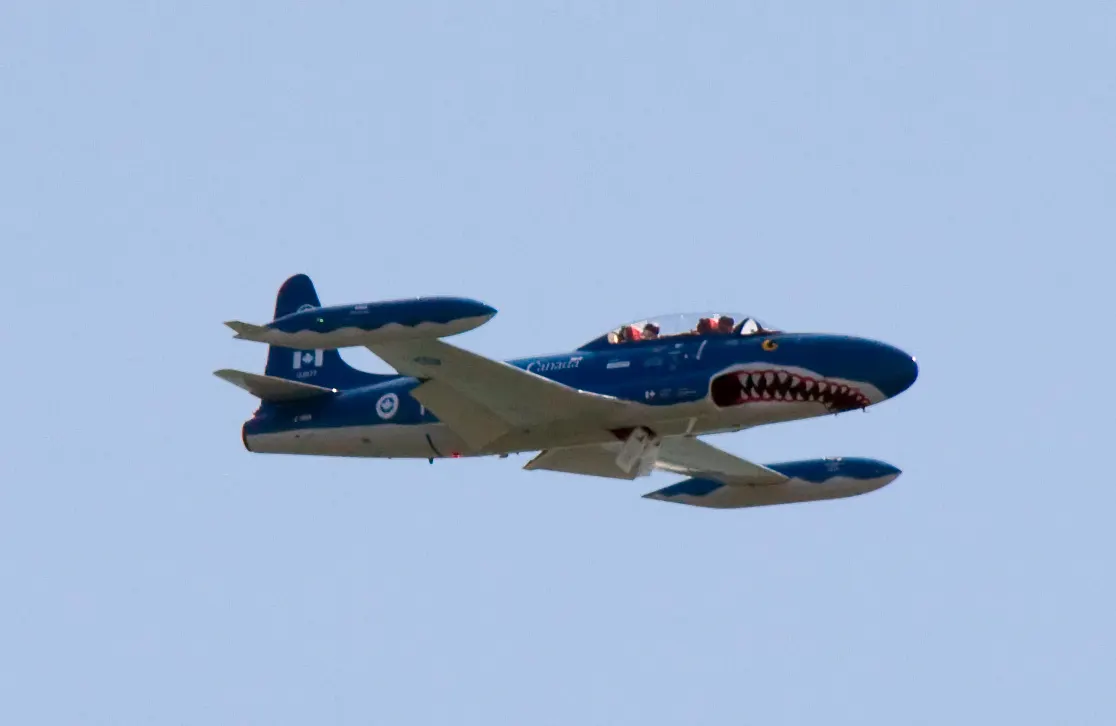
Canadair's licensed version, company designation CL-30 and RCAF name Silver Star, resulted from a 1951 contract and first flew from Montreal in October 1952, entering Royal Canadian Air Force service the following year.9 The key engineering change was the powerplant: Canadair fitted a Rolls-Royce Nene 10 turbojet in place of the Allison J33, a switch driven by British-Canadian industrial ties and Nene availability rather than any performance shortfall in the American engine. Canadair completed 656 airframes before ending production in 1958, one year ahead of Lockheed's own American line, and later variants were designated Silver Star Mk 1 through Mk 3, with the Nene-powered Mk 3 also exported as the T-33AN. Canada kept the type flying, in trainer, target-towing, and utility roles, until 2005, one of the longest continuous operational runs of any T-33 variant anywhere in the world.9
Kawasaki-Built T-33A in Japan
Japan's postwar aviation industry restrictions lifted in March 1954, and Kawasaki resumed aircraft manufacturing that same year with a license-production run of the T-33A for the newly formed Japan Air Self-Defense Force, after an initial batch of 68 American-built examples had already been delivered.1,10 Kawasaki completed 210 more through the second half of the 1950s, and the type remained a mainstay of JASDF jet training until Japan retired its last T-33s in the early-to-mid 1990s, giving the airframe one of the longest single-country service records outside Canada and Bolivia.
T2V/T-1A SeaStar: Re-Engineering for the Carrier Deck
The US Navy's land-based T-33 derivative, the TO-2/TV-2 (later T-33B), shared the basic Air Force design, but the Navy judged its low-speed handling unfit for carrier operations. Lockheed responded with the L-245, flown in December 1953 and delivered to the fleet from 1956 as the T2V-1 SeaStar, later redesignated T-1A under the 1962 tri-service system.13 Compared with the basic T-33, the SeaStar carried a redesigned tail, a strengthened lower fuselage with a retractable arrestor hook, catapult fittings, power-operated leading-edge flaps to improve low-speed lift, and a raised rear instructor's seat for better forward visibility, changes extensive enough that the type amounted to a near-total re-engineering of the airframe rather than a simple navalization.13 The Navy ordered 390 but ultimately took delivery of only 150, with the remaining 240 cancelled, and flew the SeaStar exclusively within its Naval Air Training Command until retiring the type in 1970.
AT-33A, QT-33, and Other Specialized Conversions
Several second-line conversions extended the basic T-33 design into new roles. The AT-33A added nose-mounted machine guns and underwing hardpoints for light attack and counterinsurgency work, and was exported widely to Latin American and other air forces that needed an affordable strike platform, including Nicaragua, which received four AT-33As from the United States shortly after the Bay of Pigs invasion and retired them in 1979.19 The QT-33A was a full-scale aerial target drone conversion flown by the US Navy for missile testing, effectively converting worn-out trainers into expendable targets rather than scrapping them outright.1,6 DT-33A drone-director aircraft controlled QT-33 and other target drones remotely, while a small number of NT-33A airframes were retained as dedicated variable-stability testbeds supporting flight-control research long after most of the fleet had retired.1
Modernization Proposals That Never Took Off
Not every proposed T-33 update reached production. Boeing's Skyfox program in the 1980s aimed to retain roughly 70 percent of the original airframe while replacing the single Allison J33 with two Garrett AiResearch TFE731 turbofans and modern avionics, targeting air forces wanting an affordable jet trainer or light-attack upgrade; the project was ultimately cancelled without securing a launch customer.1 France's Aérospatiale explored its own modified-wing derivative under the Pégase name, and Iran has more recently converted retired T-33 airframes into an unmanned target drone referred to as the Khodkar, evidence that the basic design still had enough structural life left in it decades after Lockheed stopped building new ones.1
 BangladeshACTIVE
 BelgiumACTIVE
 BoliviaACTIVE
 BrazilACTIVE
 CanadaACTIVE
 ColombiaACTIVE
 CubaACTIVE
 DenmarkACTIVE
 Dominican RepublicACTIVE
 EcuadorACTIVE
 El SalvadorACTIVE
 EthiopiaACTIVE
 FranceACTIVE
 IndonesiaACTIVE
 IranACTIVE
 JapanACTIVE
 Kingdom of the NetherlandsACTIVE
 LibyaACTIVE
 MexicoACTIVE
 NicaraguaACTIVE
 NorwayACTIVE
 PakistanACTIVE
 PeruACTIVE
 PhilippinesACTIVE
 Saudi ArabiaACTIVE
 South KoreaACTIVE
 SpainACTIVE
 ThailandACTIVE
 TurkeyACTIVE
 United StatesACTIVE
 AustriaRETIRED
 ChileRETIRED
 FinlandRETIRED
 GermanyRETIRED
 GreeceRETIRED
 IsraelRETIRED
 ItalyRETIRED
 SwedenRETIRED
 TaiwanRETIRED
 VenezuelaRETIRED
| Year | Buyer | Quantity | Amount | Present Value (2025) |
|---|---|---|---|---|
| — |  Bolivia | 20 | — | — |
The United States: Two Decades as the Primary Advanced Trainer
The US Air Force was both launch customer and largest single operator, running the T-33 as its principal advanced jet trainer from 1948 until the early 1960s and continuing to fly it in secondary training, proficiency, and utility roles with Air Training Command and the Air National Guard through 1987.1,6 The US Navy operated its own TO-2/TV-2/T-33B fleet in parallel from 1949, alongside the purpose-built carrier-capable T2V/T-1A SeaStar from 1957 to 1970, and later expended some airframes as QT-33 target drones for weapons testing.1,13
NATO and Allied Europe
West Germany operated around 192 T-33As as it rebuilt the Luftwaffe within NATO, while France flew roughly 163 American-built examples alongside 61 Canadian-built Silver Stars.1 Belgium, the Netherlands, Norway, Denmark, Italy, Portugal, and Spain all flew the type in NATO training roles, and Greece and Turkey both operated large T-33 fleets well into the 1990s, including the aircraft's role in the 1996 Athens FIR interception described above.1 Yugoslavia, outside the NATO framework, fielded around 125 T-33s across four sub-variants, reflecting the aircraft's reach across both alliance blocs in Cold War Europe.
Latin America's Long T-33 Twilight
Latin American air forces became some of the type's longest-serving customers precisely because the T-33 remained cheap, simple, and available as American front-line units retired theirs. Brazil, Mexico, Chile, Colombia, Ecuador, Peru, Uruguay, Paraguay, Guatemala, the Dominican Republic, El Salvador, Honduras, Nicaragua, and Cuba all flew T-33s or AT-33As at various points from the 1950s onward, several using them for light attack and internal security as much as for training.1,19 Bolivia's fleet, described above, was both the last acquired among major Latin American operators and, by a wide margin, the last flying anywhere in a military capacity, soldiering on until 2017.2,3
Asia-Pacific Operators
Japan's Kawasaki-built fleet and Taiwan's Republic of China Air Force T-33s and RT-33As anchored the type's presence in East Asia, while South Korea, the Philippines, Thailand, Burma, Singapore, Pakistan, and Indonesia operated it across Southeast and South Asia in training, reconnaissance, and, in Indonesia's case, light counterinsurgency roles.1 Saudi Arabia, Iran, and Libya rounded out Middle Eastern and North African operators, generally using the type purely for pilot training ahead of transition to more advanced Western fighters.1
T-33 vs P-80 Shooting Star: Same Airframe, Different Mission
The comparison closest to the T-33's own DNA is with its direct parent, the P-80/F-80. Airframe, wing, tail, landing gear, and Allison J33 engine were essentially unchanged between the two; the entire difference came down to a 38.5-inch fuselage stretch and a second cockpit with dual controls.1 That made the T-33 marginally heavier and very slightly slower than a clean P-80, but the tradeoff bought something the fighter never had: an instructor who could recover the aircraft the instant a student pilot got behind the airplane. The P-80 compiled a genuine, if brief, combat record, including the first jet-versus-jet kill of the Korean War, while the T-33 compiled an enormous training record and, at the Bay of Pigs and in East Timor, occasional combat use of its own once armed. In effect, Lockheed's designers solved the P-80's accident-rate problem not by redesigning the airplane's flight characteristics but by giving pilots a second set of hands, and the fact that this simple fix produced an aircraft that outlasted its parent by five decades says as much about the value of dual-control jet training as it does about either airframe's aerodynamics.
T-33 vs Fouga CM.170 Magister: Two Philosophies of Jet Training
The French Fouga CM.170 Magister, which entered service in the mid-1950s roughly a decade after the T-33, represents a genuinely different design philosophy rather than a mere rival. Where the T-33 was a stretched fighter carrying a single, relatively powerful centrifugal-flow turbojet, the Magister was purpose-built from the outset as a light, twin-engine trainer, powered by two small Turbomeca Marboré turbojets of only about 400 kgf thrust each and distinguished by its lightweight airframe and distinctive butterfly, or V-tail.20 The result was an aircraft with markedly lighter wing loading and noticeably better low-speed maneuverability than the T-33, at the cost of a substantially lower top speed; the T-33's more powerful single engine gave it a clear edge in raw performance and high-altitude capability, while the Magister's docile handling and lower operating costs made it attractive to air forces, again mostly French-aligned and francophone African states, that valued economy and gentle handling over speed.20 Both aircraft ended up serving parallel careers as light attack aircraft in the hands of smaller air forces once their primary training utility faded, but they arrived at that second career from opposite design starting points, one from a fighter cut down, the other from a glider tradition scaled up.
T-33 vs MiG-15UTI: East and West's Parallel Answers
The Soviet counterpart most often invoked alongside the T-33 is the MiG-15UTI, NATO reporting name Midget, the two-seat trainer version of the MiG-15 fighter. The parallel to the T-33 is close in concept: like Lockheed's aircraft, the UTI was created by stretching an existing single-seat fighter fuselage, in this case by about ten inches, to add an instructor's cockpit, while leaving the rest of the airframe essentially intact.21 Because the Mikoyan-Gurevich bureau never built comparable two-seat trainer versions of its later MiG-17 or MiG-19 fighters, the MiG-15UTI ended up serving as the Warsaw Pact's primary advanced jet trainer for a strikingly long stretch, well into the 1970s, in a role broadly analogous to the T-33's within NATO and allied air forces, until Czechoslovak-built Aero L-29 and L-39 trainers took over the bulk of Eastern Bloc jet training.21 Performance-wise the two aircraft were fairly evenly matched for their era: both were subsonic, straight-wing designs derived from swept-wing or straight-wing fighters of similar vintage and thrust class, and both ended up widely exported and, on occasion, lightly armed for secondary combat roles far outside their original training brief. The clearest difference is longevity of the parent lineage: the MiG-15 family was decisively surpassed by faster Soviet fighters within a few years, whereas the T-33's own P-80/F-80 stock, though also short-lived as a front-line fighter, left the trainer descendant to soldier on in production and service for far longer than anyone in 1948 likely expected.
At a Glance: The T-33 and Its Contemporaries
The three comparisons above can be summarized on the numbers that mattered most to the air forces choosing between them.1,20,21
| Aircraft | First flight | Engine | Top speed | Seats |
|---|---|---|---|---|
| T-33 Shooting Star | 1948 | 1 × Allison J33 | ~965 km/h | 2 |
| P-80 Shooting Star | 1944 | 1 × Allison J33 | ~956 km/h | 1 |
| Fouga CM.170 Magister | 1952 | 2 × Turbomeca Marboré | ~715 km/h | 2 |
| MiG-15UTI | 1949 | 1 × Klimov VK-1 | ~1015 km/h | 2 |


How many T-33 Shooting Stars were built?
Total production reached 6,557 aircraft: 5,691 built by Lockheed in the United States between 1948 and 1959, 656 built under license by Canadair in Canada as the CT-133 Silver Star, and 210 built under license by Kawasaki in Japan.1 That makes it one of the most numerous jet-powered aircraft of any type ever produced.
Is the T-33 still flying today?
Not in military service. The Bolivian Air Force retired the last four operational military T-33s on 31 July 2017, ending the type's 69-year military career worldwide.2,3 A small number, generally estimated at fewer than fifty, still fly as privately owned civilian warbirds in the United States and elsewhere, appearing regularly at air shows.11
What is the difference between the T-33 and the P-80?
The T-33 is a P-80/F-80 fighter fuselage lengthened by about 38.5 inches to add a second, elevated cockpit with dual flight controls for an instructor, plus a correspondingly extended single-piece canopy.1 Wings, tail, landing gear, and the Allison J33 engine carried over essentially unchanged, so the two aircraft share almost identical performance apart from the trainer's slightly greater weight.
What was the CT-133 Silver Star?
The CT-133 Silver Star was Canadair's Canadian-built version of the T-33, produced from 1952 under a Royal Canadian Air Force contract and distinguished mainly by its Rolls-Royce Nene 10 turbojet in place of the American Allison J33.9 Canadair built 656 examples, and Canada operated the type until 2005; two Canadian-built airframes later became Boeing's longtime commercial-jetliner chase planes.9,12
How fast was the T-33, and what was its top speed?
The T-33A's top speed was approximately 600 mph (roughly Mach 0.8) at sea level, with a service ceiling near 48,000 feet and an initial climb rate of about 4,870 feet per minute.1 Pilots avoided pushing much beyond Mach 0.8 because the straight, relatively thick wing produced pronounced compressibility buffet at higher speeds.1,4
Who was the last military operator of the T-33?
The Bolivian Air Force was the T-33's final military operator, flying Canadian- and French-sourced examples from 1973 until their retirement in July 2017 after 44 years of Bolivian service.2,3
Did the T-33 ever see real combat?
Yes, though rarely and mostly in improvised roles. Cuban T-33s, armed with makeshift guns and rockets, fought exile-flown B-26 bombers during the 1961 Bay of Pigs invasion, and Indonesian T-33s, rearmed with salvaged weapons from retired Il-28s and B-25s, flew counterinsurgency strikes over East Timor from 1976.1,7,8 A reconnaissance RT-33A also flew classified overflights of Laos and South Vietnam in 1961 under the codename FIELD GOAL.1,6
- "Lockheed T-33", Wikipedia — en.wikipedia.org ↩
- "Bolivia retires last active Lockheed T-33", World Warbird News — worldwarbirdnews.com ↩
- "Final military T-33s retired in Bolivia", Key.Aero (Key Military) — key.aero ↩
- "Lockheed T-33 Shooting Star: Taming the T-Bird", AOPA — aopa.org ↩
- "Lockheed T-33A Shooting Star", National Museum of the United States Air Force — nationalmuseum.af.mil ↩
- "Boneyard Files: Lockheed T-33 Shooting Star, The Ghost of the Jet Classroom", Vintage Aviation News — vintageaviationnews.com ↩
- "Airpower at the Bay of Pigs", Air & Space Forces Magazine — airandspaceforces.com ↩
- "Bay of Pigs, The Men and Aircraft of the Cuban Revolutionary Air Force", Latin American Aviation Historical Society — laahs.com ↩
- "Canadair CT-133 Silver Star", Wikipedia — en.wikipedia.org ↩
- "Aerospace Systems, History of the Business", Kawasaki Heavy Industries — global.kawasaki.com ↩
- "Warbird Alley: Lockheed T-33 Shooting Star / Canadair CT-133", Warbird Alley — warbirdalley.com ↩
- "News, Boeing Retires T-33 Chase Planes", Global Aviation Resource — globalaviationresource.com ↩
- "Lockheed T2V SeaStar", Wikipedia — en.wikipedia.org ↩
- "Lockheed T-33A Shooting Star", This Day in Aviation — thisdayinaviation.com ↩
- "Toward the Unknown", Wikipedia — en.wikipedia.org ↩
- "Thunder in the Cinema: Hollywood's Jet Age Movies", HistoryNet — historynet.com ↩
- "Ethiopian Air Force", Wikipedia — en.wikipedia.org ↩
- "T-33 Shooting Star: Military Training Aircraft Specs & Operators", GlobalMilitary.net — globalmilitary.net ↩
- "Fouga Magister: a legendary aircraft", Fly a Jet Fighter — flyajetfighter.com ↩
- "Mikoyan-Gurevich MiG-15", Wikipedia — en.wikipedia.org ↩
- "Lockheed T-33A Jet Trainer", NASA — nasa.gov ↩
- "Lockheed T-33, Specifications, Technical Data / Description", flugzeuginfo.net — flugzeuginfo.net ↩