

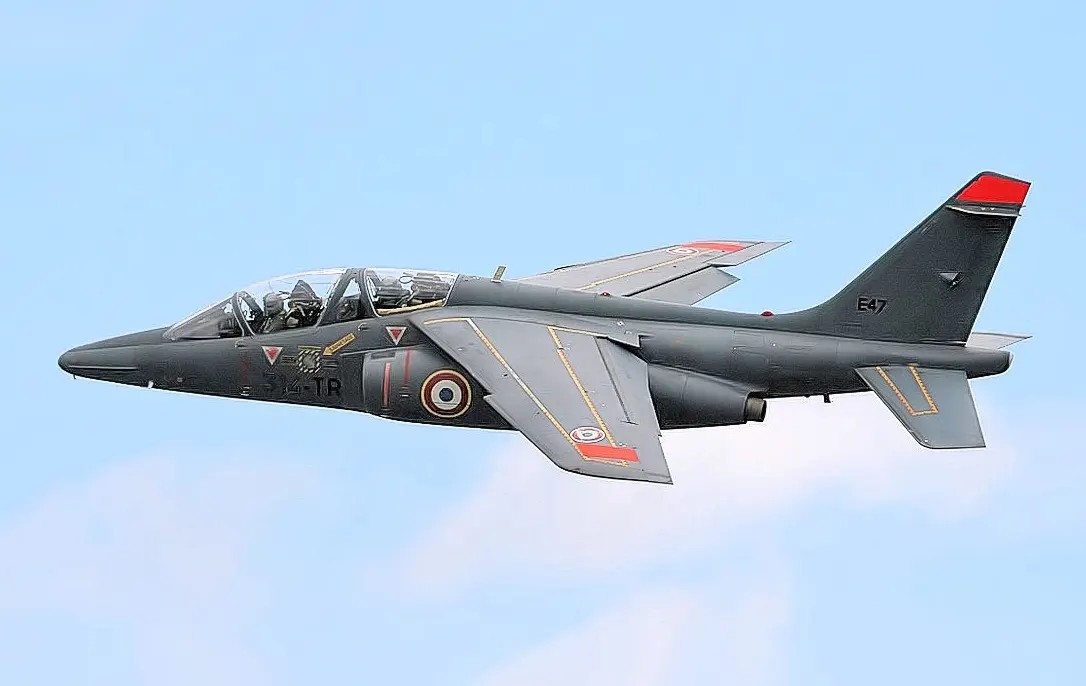

The Dassault/Dornier Alpha Jet is a twin-engine, tandem two-seat jet aircraft developed jointly by France and West Germany, first flown as a prototype on 26 October 1973 at Istres.1 It exists because two air forces wanted two different aircraft and were given one airframe built to satisfy both: France wanted a straightforward jet trainer to replace its aging Fouga Magisters, while West Germany wanted a light attack and close-support aircraft to replace the Fiat G.91, and Bonn's negotiators insisted the shared design carry two engines rather than one, a direct reaction to the heavy losses the Luftwaffe had suffered flying the single-engine F-104 Starfighter.1,3 The result, designated TA501 when it won the Franco-German competition on 23 July 1970, split into the Alpha Jet E (École) for France and the Alpha Jet A (Appui Tactique) for Germany, sharing a common airframe but diverging in cockpit shape, avionics, and mission equipment.1
- Twin-engine redundancy, a deliberate German requirement after F-104 losses
- Martin-Baker Mk10 zero-zero ejection seat across most variants
- Simple, low-maintenance airframe with quick turnaround times
- Wide, well-proven export base spanning Africa, the Middle East, and Asia
- High-set wing gives generous ground clearance for large underwing stores
- Never matched the BAE Hawk's export success despite an earlier flight debut
- Austere baseline avionics limited its usefulness as a genuine light attack jet without upgrades
- Modest thrust and payload compared with dedicated ground-attack aircraft
- Franco-German-Belgian production split added cost and coordination overhead
- Aging fleets in African operators increasingly reliant on secondhand German and Belgian airframes for spares
Manufacturing was split three ways from the outset: Dassault, as the designated "pilot" company with final design authority, built the forward and center fuselage in France; Dornier built the wings, tail, and rear fuselage in West Germany; and Belgium's SABCA, brought in once Belgium ordered its own batch, built the nose section and flaps.1 Dassault's own figures put total production at 512 airframes, 329 of them exported, flown by ten air forces and logging more than a million flight hours combined; Wikipedia's infobox, by contrast, lists 480 built between 1973 and 1991, a gap between manufacturer and secondary sources that nothing consulted resolves.1,2
Operationally, the Alpha Jet has always lived a double life. As a trainer it is unglamorous and forgiving, criticized at times by French instructors precisely because it is too easy to fly, leaving new pilots under-prepared for the far less docile combat jets waiting at the end of the syllabus.22 As a light attack aircraft, particularly in African air forces short on faster combat types, it has repeatedly been flown in earnest against insurgents and rebel forces, sustaining real losses in Nigeria, Morocco, and elsewhere. That gap between the aircraft's benign training reputation and its actual record in low-intensity war is one of the more consistently underappreciated facts about the type.
The Twin Larzac Turbofans and the Case for Two Engines
The Alpha Jet is powered by two SNECMA/Turbomeca Larzac 04 turbofans, each rated at 13.24 kN (2,980 lbf) of thrust in the baseline C5/C6 versions used on most production aircraft.1,4 The Larzac was itself a joint venture engine, developed from 1969 by SNECMA (now part of Safran) and Turbomeca with German participation from MTU and KHD; it first flew aboard the Alpha Jet prototype, entered full service in 1979, and was built in series from 1975 to 1988, totaling 1,274 units across all applications.6
- First Flight1973
- Service Entry Year1977
- Crew (seats)2
- Trainer TypeAdvanced trainer and light attack
- In ServiceYes
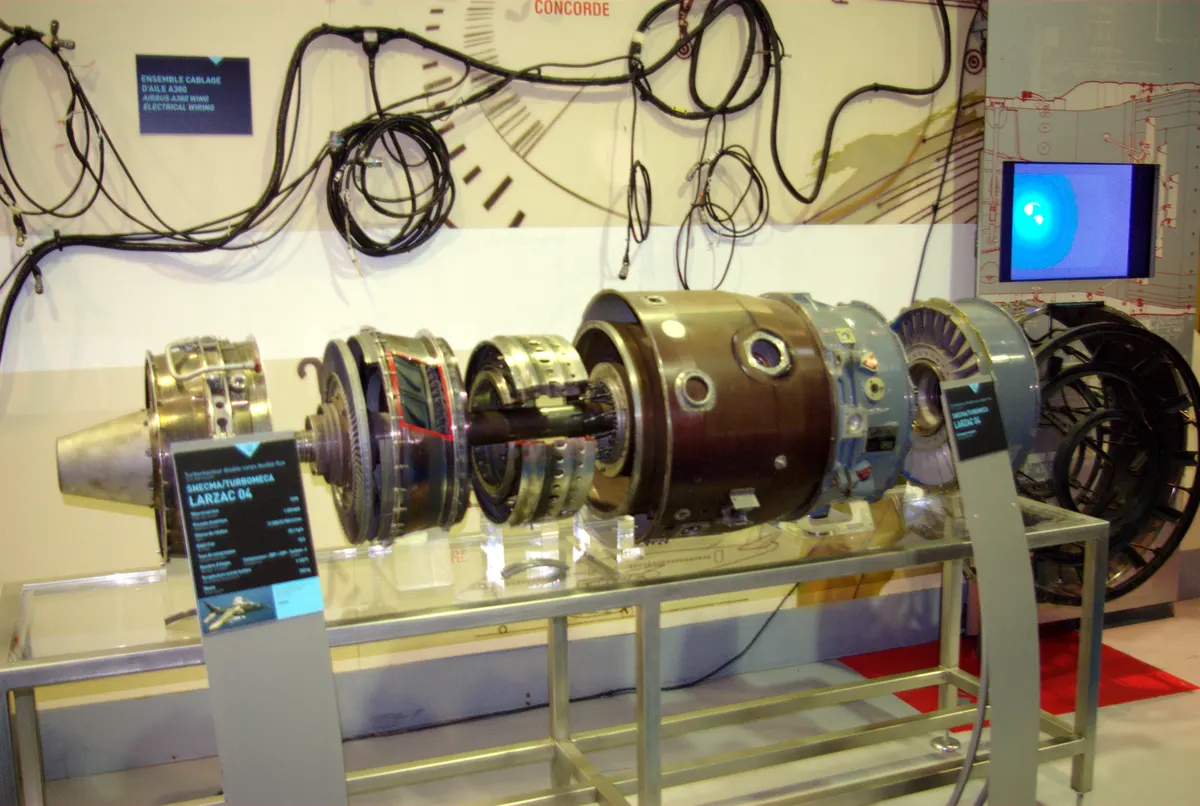
Its modular construction, separable inlet, core, turbine, and nozzle sections, shortens overhaul time on the flight line rather than requiring a full engine pull for every fault.6 The choice of two engines was also not primarily a performance decision: West German negotiators pushed hard for a twin-engine layout because the Luftwaffe's single-engine F-104G Starfighter fleet had suffered such heavy accident and combat losses through the 1960s that the type earned the grim nickname "Witwenmacher," the widow-maker.1,3 A second engine meant a compressor stall, bird strike, or battle-damage hit did not automatically mean an ejection, a margin that mattered more to a light-attack force flying low over hostile ground than to a pure training squadron.
- Engine TypeSNECMA Turbomeca Larzac 04-C5
- Thrust13.24
Cockpit Layout, the French/German Nose Split, and Ejection Seats
The clearest visual way to tell a French from a German Alpha Jet apart is the nose: the French E model has a rounded, blunter profile optimized for its training avionics fit, while the German A model carries a sharper, pointed nose housing attack-mission equipment.22 Both share the same stepped tandem cockpit, and most production airframes were fitted with the Martin-Baker Mk10 rocket-assisted ejection seat, a zero-zero design capable of safe ejection with no minimum airspeed or altitude requirement, a genuine advantage over contemporaries still flying older ballistic seats into the 1970s; a lighter variant, the MKF10LN, equips some export airframes.5
- Top Speed1,000 km/h
- Cruise Speed780 km/h
- Service Ceiling14,630 m
- Range2,880 km
- Rate of Climb57 m/s
- G-Limit8
- Endurance2
Baseline Alpha Jets carried deliberately austere, analog avionics, a decision driven as much by export economics as training philosophy: a simpler cockpit was cheaper to build and easier to sell to air forces with limited technical infrastructure.3 That changed with later variants; Egypt's MS2 added a Sagem Uliss 81 navigation and attack system, a Thomson-CSF laser rangefinder and head-up display, and a digital databus.1 Reported maximum take-off weight varies noticeably across sources, from around 7,500 kg for the clean baseline configuration up to roughly 8,100 kg quoted for weapons-loaded and later production standards, a spread that likely reflects genuine variant differences rather than an error in any one source.1,4
- Cockpit ConfigurationTandem two-seat
- Glass CockpitYes
- Embedded SimulationNo
- Light Attack CapableYes
- Hardpoints5
- Ejection SeatsYes
Domestic Content
The Alpha Jet is, by design, a trinational aircraft rather than a nationally "domestic" one: Dassault built the forward and center fuselage and held final design authority in France, Dornier built the wings, tail, and rear fuselage in West Germany, and Belgium's SABCA supplied the nose section and flaps once Belgium joined as a production partner.1 The single most consequential shared component is the engine, the Larzac 04 turbofan, jointly built by France's SNECMA and Turbomeca (now Safran) with German participation from MTU and KHD, so even the "foreign" content in any one partner's airframe stayed almost entirely inside the Franco-German-Belgian program.1,6 Egypt later added its own layer of domestic content, assembling Alpha Jets from knockdown kits at Helwan and, since 2024, overhauling Larzac engines locally rather than shipping them back to France.2,8
- Length13.23 m
- Wingspan9.11 m
- Height4.19 m
- Max Takeoff Weight8,100 kg
- Total Built480
- Operators10
- Production Start1973
- Production End1991
- Operational StatusIn service with multiple air forces
From F-104 Losses to a Joint Requirement
France and West Germany began discussing a shared jet-trainer program in 1967, formalizing a joint specification in 1968 and, in July 1969, committing to buy roughly 200 aircraft apiece.1 Germany's actual gap was not a trainer shortfall at all but an attack-aircraft one: the Luftwaffe needed to replace its Fiat G.91 light strike fleet, and Bonn used the joint program to get there, proposing the shared design be built in two roles, an inexpensive trainer for France and a close-support platform for Germany, a compromise Paris accepted.1 Three industrial groupings competed for the contract; the winner, merging Breguet's Breguet 126 concept with Dornier's P.375 design into the TA501, was declared on 23 July 1970.1,3 Dassault subsequently absorbed Breguet, and the integrated design team was established at Saint-Cloud outside Paris in February 1971, the same month a formal Franco-German protocol authorized four flying prototypes.1
The French prototype flew first, on 26 October 1973 from Istres with test pilot Jean-Marie Saget at the controls; the German prototype followed from Oberpfaffenhofen on 9 January 1974.1,2 The first production-standard aircraft flew on 4 November 1977, deliveries to France began the following year, and the type formally entered operational French service on 30 January 1979, more than a year after the year commonly cited as its service entry, which in fact marks only the first flight of a production airframe, not any squadron actually receiving one.2 Dassault's factory could turn out fifteen aircraft a month at peak, against six a month at Dornier's German line.1
A Fatal Rehearsal and the Patrouille de France's Uncertain Future
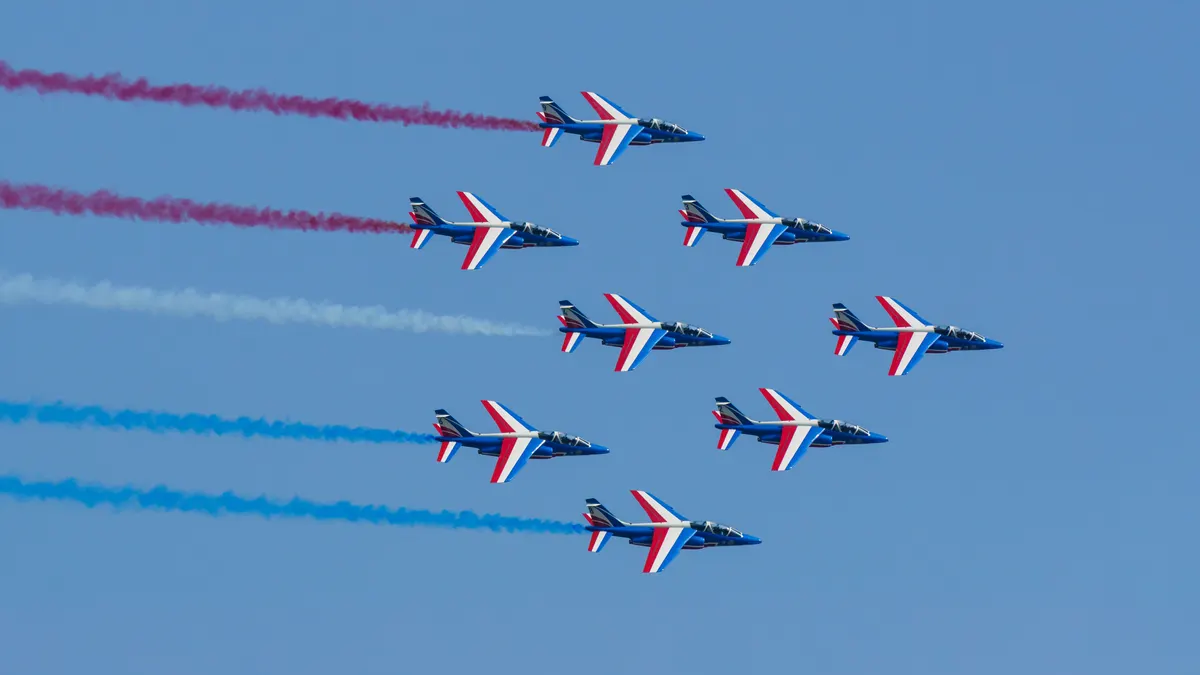
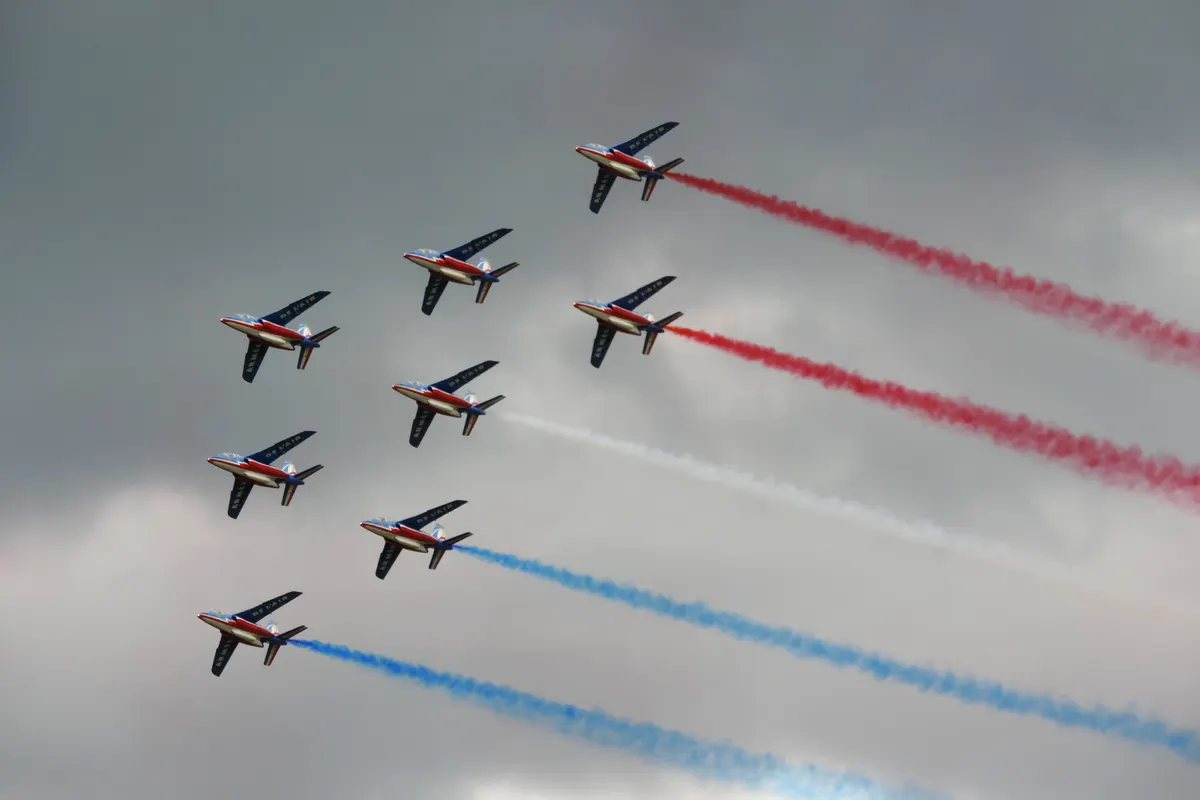
France's Patrouille de France aerobatic team adopted the Alpha Jet in 1981, replacing the Fouga Magister it had flown since the team's founding, and it remains the Patrouille's aircraft today even though the French Air and Space Force retired the Alpha Jet from mainline fighter-pilot training in 2020 for the turboprop Pilatus PC-21.2,18 That left the display team as effectively the last significant French military user of the type, flying roughly a dozen aircraft that officials say can be extended in service to around 2032-2033, with no replacement yet chosen; Paris has explored joint options with the United Kingdom, which also needs to replace its Hawk T2 trainers.17,18
The risk of flying an aging, close-formation display jet was demonstrated starkly on 25 March 2025, when two Patrouille de France Alpha Jets collided during a rehearsal near Saint-Dizier air base; three pilots and one passenger ejected safely, and both aircraft were destroyed.19 The accident did not ground the fleet permanently, but it renewed pressure on the French government to settle on a successor before the current jets run out of structural life.
Morocco and the Western Sahara War
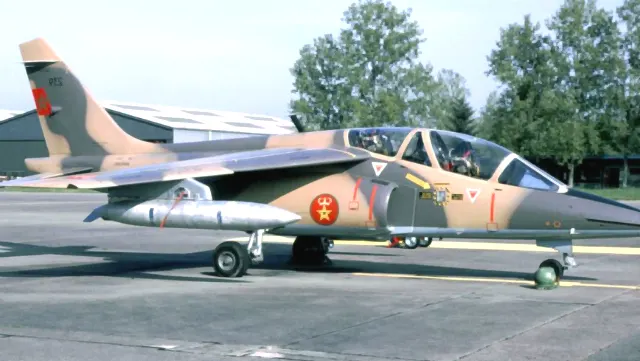
Morocco took delivery of 24 Alpha Jet Es beginning around 1979, based at Meknes for training and light attack, and used part of the fleet operationally against the Polisario Front during the Western Sahara War, losing one aircraft to a shootdown in December 1985.1
Morocco's Alpha Jet fleet has continued to generate losses well after that conflict ended, most recently a fatal crash near Fez-Saïss airport in August 2025 that killed two officers during what was described as a routine training mission, following a separate, less-documented incident near the same airfield the previous April.20
Nigeria's Long War: Liberia, Boko Haram, and Bandit Gangs
Nigeria's Alpha Jets, acquired mainly as trainers, first saw sustained combat far from home, flying under the ECOMOG intervention force against Charles Taylor's National Patriotic Front of Liberia from 1990. Six aircraft flew roughly 3,000 combat sorties against rebel positions, convoys, and shipping by 1992, reportedly without losing a single airframe to enemy fire, though several took anti-aircraft damage.1
The larger campaign came at home. From 2013, facing an escalating Boko Haram insurgency, the Nigerian Air Force returned a substantial share of its aging fleet to serviceable condition, flying from Yola and Maiduguri against insurgent-held territory in Borno State.10 Maiduguri itself came under direct assault in March 2014, with Nigerian Alpha Jets bombing targets close to their own base; further bombardment around Bama in September 2014 helped dislodge fighters from the Sambisa Forest stronghold by March 2016.10
The campaign has not been cost-free. In early October 2014, Boko Haram released a video claiming to show the execution of a captured Nigerian pilot from a downed Alpha Jet, and on 31 March 2021 an Alpha Jet coded NAF475 went missing near Borno State during a close air support mission, with both crew presumed dead.1,11 In a rare instance of a fixed-wing jet being brought down by a non-state armed group rather than an organized military, a Nigerian Alpha Jet was reportedly shot down on 18 July 2021 while flying an interdiction mission against criminal bandit gangs along the Zamfara-Kaduna border, well outside the aircraft's original Boko Haram theater.1
Cameroon Against Boko Haram
Cameroon's Alpha Jet MS2s joined the fight against Boko Haram directly in December 2014, striking a militant force that had overrun a Cameroonian position at Assighassia, killing around 41 fighters and driving the rest back across the border.13 Cameroon has kept leaning on the type for close air support since, though its fleet has shrunk to roughly eleven serviceable aircraft out of the 27 originally acquired, an attrition rate driven as much by age and spares shortages as by combat losses.14
Ivory Coast: An Idle Fleet Seized, Not Destroyed
Ivory Coast's Air Force took delivery of six Alpha Jet CI light attack aircraft from 1980, later adding a seventh, but the fleet's most notable role in that country's civil conflict was passive: when rebel forces seized Bouaké air base in 2002, they captured a group of Alpha Jets found there, though UN inspectors reported the aircraft as non-operational and in need of repair both then and again when reassessed in 2006.15 Unlike the Sukhoi Su-25s that Ivory Coast separately lost to French retaliatory strikes in November 2004, the Alpha Jet fleet played essentially no active combat role of its own during the civil war.15
The Alpha Jet E ("École") is the baseline French and Belgian trainer configuration, distinguished by its rounded nose and training-optimized avionics; the Alpha Jet A ("Appui Tactique") is Germany's sharper-nosed attack configuration, built around German-specified weapon-aiming systems, a yaw damper, and originally intended mission equipment tailored to close support rather than instruction.1
Egypt fields the most heavily modified production lineage. The Alpha Jet MS1, licence-assembled from 1978 by the Arab Organization for Industrialization at Helwan, was a straightforward close-support-capable trainer; the follow-on MS2 added a Sagem Uliss 81 navigation and attack system, a Thomson-CSF laser rangefinder and head-up display, and a digital multiplex databus, and Egypt has since upgraded its entire MS1 fleet to MS2 standard.1 The Alpha Jet NGEA ("New Generation Attack," later marketed as the Alpha Jet 2) carried the MS2's avionics forward with a more powerful Larzac 04-C20 engine and compatibility with the Matra Magic 2 missile, debuting at the 1982 Farnborough Airshow as, its makers claimed, the first aircraft in its class with a fully integrated digital navigation and attack system; a further-refined Alpha Jet 3, sometimes called the Lancier, added multifunction cockpit displays and studied radar, infrared, and laser-designator fits for anti-ship and anti-helicopter missions, though it never reached large-scale production.1 A single Moroccan aircraft, the Al-Ghait, was a one-off weather-modification conversion rather than a combat variant.1
Outside the military lineage, a small population of demilitarized ex-military airframes now flies in civilian hands, including with the Flying Bulls display team and, briefly, a Silicon Valley-owned research aircraft flown under agreement with NASA, both discussed above under History.21,23


Ten air forces have flown the Alpha Jet as an original or secondhand military operator: France, West Germany, Belgium, Egypt, Morocco, Nigeria, Cameroon, Togo, Qatar, and Ivory Coast, a list Dassault Aviation itself uses when citing the aircraft's total export record.2 Some further tallies mention a disputed sale of around 32 retired German airframes, including spares hulks, to the United Arab Emirates, a transaction that never appears in the manufacturer's own operator list and whose operational status, if any, is thinly documented.1
Egypt operates the largest current fleet by a wide margin, having absorbed the type through licence production at Helwan and upgraded its entire inventory to MS2 standard, and it now also holds a Safran-issued licence to overhaul the Larzac engine domestically.2,8 France's own fleet, once numbering 176 aircraft delivered between December 1978 and July 1990, has shrunk to little beyond the Patrouille de France's roughly dozen display jets since the PC-21 took over basic fighter training.1,18 Germany, Belgium, Portugal, and the UK's QinetiQ have all retired their Alpha Jets from front-line military service, though QinetiQ kept a dozen former Luftwaffe A-models flying into the 2010s to support test-pilot training at the Empire Test Pilots' School at Boscombe Down.25

The type's most active second career is as a civilian-contracted adversary aircraft. Top Aces, based in Montreal, operates a fleet built substantially from around 30 former Luftwaffe and 25 former Belgian Air Force Alpha Jets, flown in aggressor camouflage to simulate hostile fighters for the Canadian Armed Forces, the Bundeswehr, and, more recently, the US Air Force.12
Draken International in Lakeland, Florida runs a comparable Red Air business for the US Department of Defense with a mixed fleet that has also included Alpha Jets.12 Both companies exist because it is cheaper for Western air forces to contract out realistic dissimilar-aircraft training than to keep dedicated squadrons of their own front-line fighters flying that role.
The Alpha Jet Versus the BAE Hawk
The comparison that matters most for the Alpha Jet is not a combat matchup but a commercial one, against the aircraft that beat it in nearly every export competition either type entered: the BAE Systems Hawk. Both are twin-seat jet trainers of the same generation, the Hawk flying first in August 1974, roughly ten months after the Alpha Jet's October 1973 debut, yet the Hawk still entered RAF service before the Franco-German-Belgian design completed its more complex three-country delivery arrangements.1,3,16 On paper the Alpha Jet has a case for the better aircraft: its twin Larzac turbofans give a stronger thrust-to-weight ratio than the Hawk's single Adour, its quoted service ceiling of roughly 14,630 m exceeds figures typically cited for the Hawk, and its high-mounted wing leaves clearance for external stores that would foul the Hawk's low-set wing.1,3,4
None of that showed up in the order books. By the late 1990s the Hawk had sold more than 730 times, over 550 of those export sales, spanning air forces from Saudi Arabia to Indonesia to South Korea, while the Alpha Jet's independent export wins, apart from resold secondhand German and Belgian aircraft, remained a comparatively short list built mainly around Egypt, Morocco, and a handful of smaller African and Gulf air forces.3 The likeliest explanation is organizational rather than technical: a single-nation program with one design authority and one export office was an easier proposition for a foreign buyer than a joint program split three ways, whatever the two data sheets said.3
| Spec | Alpha Jet | BAE Hawk T1 |
|---|---|---|
| First flight | 26 Oct 19731 | 21 Aug 197416 |
| Engine(s) | 2x Larzac 04, 13.24 kN each4 | 1x Adour 151, ~23 kN16 |
| Top speed | ~1,000 km/h (sea level)1 | ~1,028 km/h16 |
| Total built (all variants) | 480-512 (sources differ)1,2 | 900+ across all Hawk variants16 |
The Alpha Jet Versus Its Predecessor, the Fouga Magister
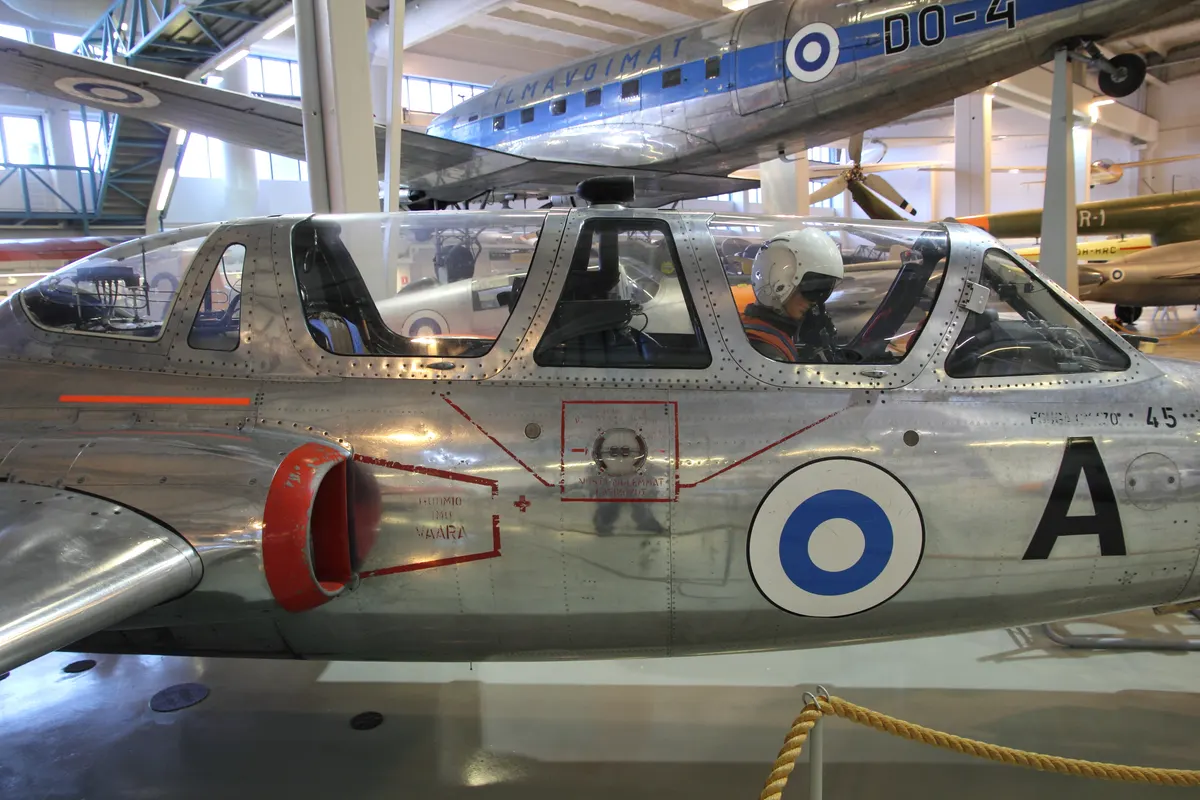
Set against the Fouga CM.170 Magister it replaced in French service, the Alpha Jet represents a generational leap rather than a close technical contest. The Magister, in French service from the mid-1950s, was a lighter, slower, single-purpose basic trainer with two small Turbomeca Marboré turbojets producing a fraction of the Larzac's combined thrust, negligible weapons capacity, and none of the zero-zero ejection-seat protection the Alpha Jet's Martin-Baker Mk10 provides.1 What the Magister offered instead was an earlier order of simplicity, cheap and rugged enough that dozens of small air forces flew it with minimal infrastructure, a niche the Alpha Jet never fully replaced since its own dual trainer/attack role pushed cost and complexity upward. The gap between the two aircraft is really a proxy for how far the "jet trainer" category moved in twenty years, from a machine meant only to introduce cadets to jet handling into one expected to double, credibly, as a light attack platform.


What are the Alpha Jet's basic specifications? A tandem two-seat, twin-engine jet roughly 13.23 m long with a 9.11 m wingspan and 4.19 m height, powered by two Larzac 04 turbofans producing 13.24 kN of thrust each, with maximum take-off weight most often cited around 7,500 kg for the baseline configuration (weapons-loaded and later-production figures run higher, up to roughly 8,100 kg).1,4
What is the Alpha Jet's top speed? About 1,000 km/h (620 mph) at sea level for standard production variants, with a service ceiling around 14,630 m (48,000 ft) and a climb rate near 57 m/s (11,200 ft/min).1
How many Alpha Jets were built? Sources disagree. Dassault Aviation's own page states 512 built in total, 329 exported, while the more commonly repeated secondary figure, used in Wikipedia's infobox, is 480 built between 1973 and 1991; nothing consulted reconciles the gap.1,2
Is the Alpha Jet still in service? Yes. Egypt, Morocco, Nigeria, Cameroon, Togo, and Qatar still fly it operationally, and France's Patrouille de France continues flying it despite the French Air and Space Force retiring the type from mainline fighter-pilot training in 2020 for the Pilatus PC-21.2,18 Separately, dozens of retired German and Belgian airframes fly as civilian-contracted adversary jets with Top Aces and Draken International.12
How does the Alpha Jet compare with the BAE Hawk? It has real technical advantages, including a stronger thrust-to-weight ratio and a higher service ceiling, but the single-nation Hawk vastly outsold it, more than 730 built against the Alpha Jet's 480-512, largely because a single-supplier program was simpler for foreign buyers to deal with than a three-country production arrangement.1,3,16
Was the Alpha Jet used in real combat? Yes, repeatedly, despite its trainer origins. Morocco flew it against the Polisario Front in the Western Sahara War, Nigeria used it under the ECOMOG intervention in Liberia and then for years against Boko Haram and armed bandit groups at home, and Cameroon has struck Boko Haram positions near its own border with the type.1,10,13
- "Dassault/Dornier Alpha Jet", Wikipedia — en.wikipedia.org ↩
- "Alpha Jet: origins, characteristics and performance data", Dassault Aviation — dassault-aviation.com ↩
- "The Dassault-Dornier Alpha Jet & FMA Pampa", AirVectors — airvectors.net ↩
- "Dassault-Breguet / Dornier Alpha Jet, Specifications, Technical Data, Description", flugzeuginfo.net — flugzeuginfo.net ↩
- "Martin-Baker Mk.10", Wikipedia — en.wikipedia.org ↩
- "SNECMA Turbomeca Larzac", Wikipedia — en.wikipedia.org ↩
- "AOI obtains licence to maintain Alpha Jet light fighter engines", Airforce Technology — airforce-technology.com ↩
- "Nigeria, Egypt enters pilot training, and Alpha jet maintenance agreement", Military Africa — military.africa ↩
- "Nigeria's Tiny, Low-Tech Alpha Jets Have Flown in Brutal Wars Across Africa", War Is Boring (Medium) — medium.com ↩
- "5 things you didn't know about Nigeria's Alpha jets", Businessday NG — businessday.ng ↩
- "Top Aces", Wikipedia — en.wikipedia.org ↩
- "Ever ready for the fight against Boko Haram", African Aerospace — africanaerospace.aero ↩
- "Cameroonian Air Force: Full Inventory", Global Military — globalmilitary.net ↩
- "Ivory Coast Air Force", GlobalSecurity.org — globalsecurity.org ↩
- "BAE Systems Hawk", Wikipedia — en.wikipedia.org ↩
- "La Patrouille de France pourrait garder ses Alphajet jusqu'en 2035", Zone Militaire (Opex360) — opex360.com ↩
- "France selects Pilatus PC-21 as Alpha Jet replacement", Gaëtan Marie's Aviation Profiles — gaetanmarie.com ↩
- "Two Alpha Jets of the Patrouille de France Display Team Collide During Rehearsal Flight", The Aviationist — theaviationist.com ↩
- "Moroccan Air Force Alpha jet crash, two officers killed", Military Africa — military.africa ↩
- "Dassault-Dornier Alpha Jet (civilian)", Royal International Air Tattoo — airtattoo.com ↩
- "Dassault/Dornier Alpha Jet – A Tutor with Teeth", Pickled Wings — pickledwings.com ↩
- "A Fighter Jet and Friends in Congress: How Google Got Access to a NASA Airfield", Tech Transparency Project — techtransparencyproject.org ↩
- "Looking Back: QinetiQ Alpha Jet", Royal International Air Tattoo — airtattoo.com ↩
- "War Thunder 2.35 'Alpha Strike' comes with Hungarian aircraft, five rank VII premium ground vehicles, and more", NotebookCheck — notebookcheck.net ↩