

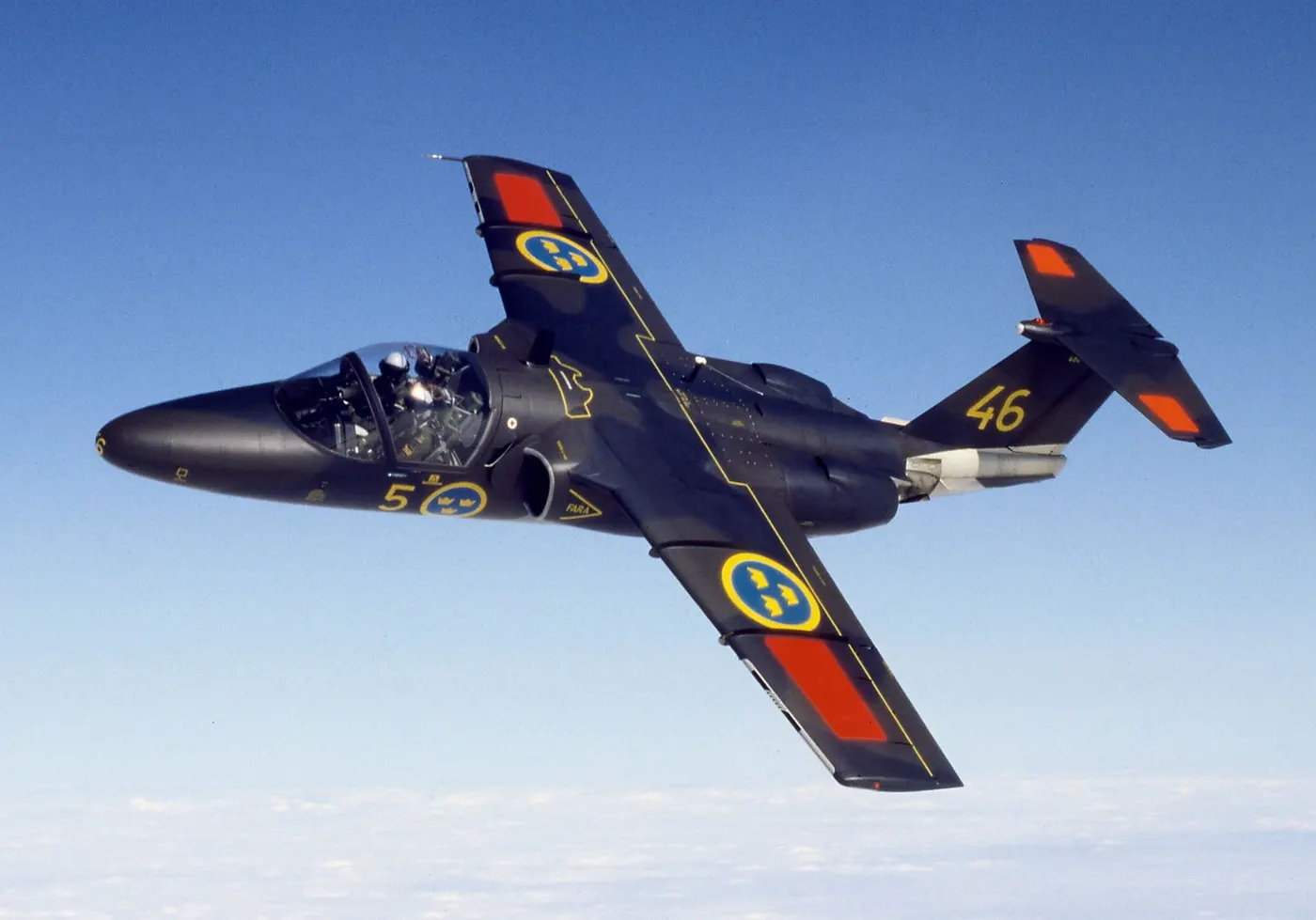

The Saab 105 is a Swedish twin-engine jet trainer and light-attack aircraft, designed as a private venture by Saab and first flown on 29 June 1963.1 The Swedish Air Force ordered it into service as the Sk 60, taking delivery from 1967 to replace its ageing de Havilland Vampire trainers, and eventually operated 150 airframes in training, light-attack and reconnaissance configurations.2,3 A single export customer, Austria, bought 40 aircraft as the Saab 105Ö from 1970, using them as trainers, reconnaissance platforms and, for lack of anything faster, subsonic light interceptors.4 Total production across both operators plus two prototypes came to 192 aircraft, built between 1963 and 1972.1
- Side-by-side seating aids instructor-student communication
- Twin-engine layout gives an extra margin over single-engine trainers
- Genuine secondary light-attack and reconnaissance capability
- Long, low-cost service life with two major operators
- Simple, robust airframe suited to a small air force's logistics
- Subsonic performance, weak as an actual interceptor
- Never won a major export order beyond Austria
- Original Aubisque engines aged out, forcing a costly 1990s re-engine program
- Limited useful payload compared with later light-attack jets
- Cramped cockpit by later ejection-seat trainer standards
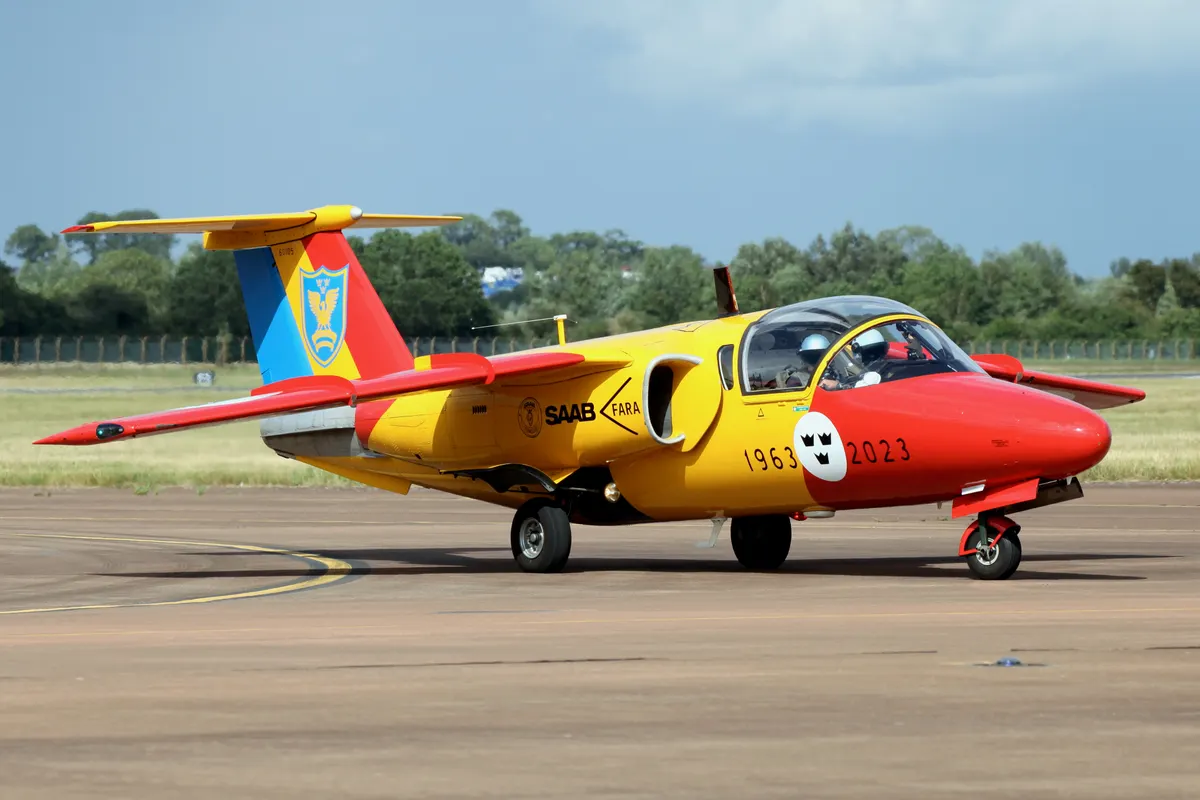
The airframe's defining features are a high, sharply anhedral shoulder wing, a T-tail, and side-by-side seating for two under a single long canopy — an arrangement that let an instructor watch a student's hands on the controls directly rather than over a shoulder, as in a tandem cockpit.1,5 The original design brief was unusually broad even for a Cold War jet trainer: Saab pitched it simultaneously as a military trainer, a light-attack aircraft, a reconnaissance platform and, on paper, a four-seat civilian business jet, though no civil customer ever materialised.1 What did materialise, and lasted far longer than anyone in Linköping likely expected in 1963, was 57 years of Swedish service and 50 years of Austrian service, with the type formally retired by both air arms only in the 2020s.2,4
Sweden's own Sk 60 fleet did more than train pilots. Reconnaissance-configured Sk 60Cs, fitted with a Fairchild KB-18 panoramic camera and an infrared search unit in an extended nose, flew border and coastal surveillance sorties during the Cold War, a role that mattered to a country whose defence policy rested on armed neutrality rather than alliance membership.6 The same basic airframe, in the Sk 60B attack configuration, could carry rockets, gun pods, bombs and even AIM-9 Sidewinder missiles on its underwing hardpoints — a substantial secondary role for an aircraft most of the world filed simply as "trainer."3,6
The Turbomeca-Derived Aubisque and Its Swedish Rebuild
Production Sk 60s and Saab 105Ös were both powered by a pair of Turbomeca Aubisque turbofans, built under licence in Sweden by Volvo Flygmotor as the RM9 (later RM9A and RM9B), each rated at roughly 7.3 kN (1,640 lbf) of static thrust.7,8 That modest thrust, split across two small engines rather than concentrated in one larger unit, gave the aircraft a sea-level top speed of about 770 km/h and a service ceiling near 13,700 m — respectable for a 1960s trainer, but well short of the aircraft's own uprated demonstrator variants.7,9 Saab built two General Electric J85-17B-powered demonstrators, the 105XT and 105G, offering nearly double the thrust and a 970 km/h top speed, and pitched them to Switzerland and Finland; neither country bought in, and no production customer ever received the J85-engined version — both Sweden and Austria flew Aubisque-powered aircraft throughout their service lives.1,9
- First Flight1963
- Service Entry Year1967
- Crew (seats)2
- Trainer TypeJet trainer
- In ServiceNo
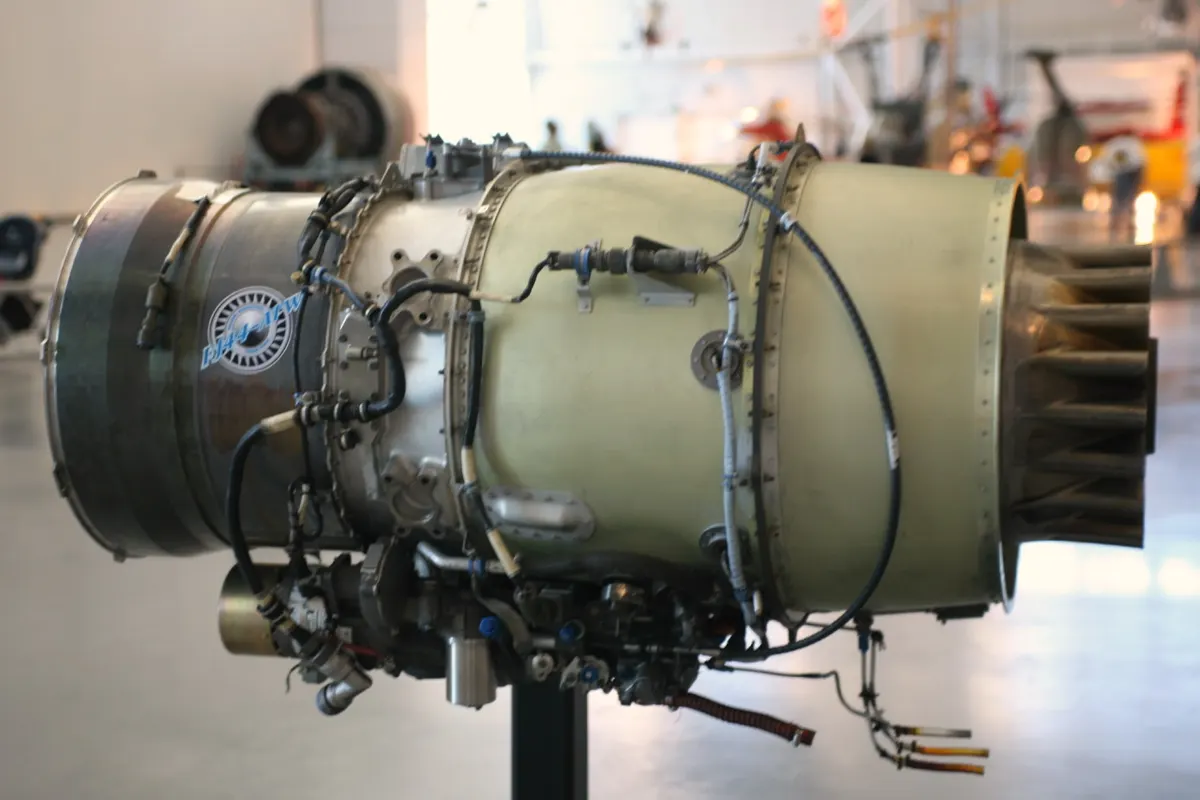
By the early 1990s the original Aubisque engines were reaching the end of their structural life, and Sweden signed a contract in November 1993 to re-engine 115 aircraft with the American Williams International FJ44 turbofan, locally designated RM15, delivering about 8.45 kN each.10 The first converted "SK 60W" flew in August 1995 and re-deliveries ran through the late 1990s; the new engines were lighter, quieter and markedly cheaper to maintain than the Aubisque, and the upgrade was explicitly framed as keeping the trainer fleet compatible with the newer Gripen-era Air Force it fed pilots into.10,1 Austria never re-engined its aircraft and flew the original Aubisque powerplant to the end of its service life in 2020.4
- Engine TypeGeneral Electric J85-17B
- Thrust7.2
Side-by-Side Seating and a Shoulder-Mounted Wing
Beyond the powerplant, the airframe itself was built around its cockpit layout. Side-by-side seating was unusual among jet trainers of the period, most of which — the Aermacchi MB-326 and Fouga Magister among them — used tandem seating with the instructor behind the student.11 Swedish Air Force flight-school instructors and later retrospectives credited the arrangement with making early-stage instruction noticeably easier, since the instructor could watch the student's hands and eyes directly instead of relying on mirrors or a periscope; Sweden's Sk 60 training course reportedly graduated around 95 percent of students, with first solos typically flown after about 30 hours.2 The shoulder-mounted wing with pronounced anhedral, meanwhile, kept the engine intakes clear of ground debris and gave the aircraft benign low-speed handling, at some cost to high-speed aerodynamic refinement compared with contemporaries built for outright performance.1
- Top Speed770 km/h
- Cruise Speed645 km/h
- Service Ceiling13,700 m
- Range1,400 km
- Rate of Climb70 m/s
- G-Limit7
- Endurance2.5
The airframe was designed and built in Sweden by Saab at Linköping, and the vast majority of avionics, structure and systems were Swedish-sourced. The powerplant is the exception that complicates the picture: the Aubisque turbofan was originally a French Turbomeca design, though it was manufactured entirely in Sweden under licence by Volvo Flygmotor as the RM9, which kept most of its value domestic despite the foreign origin of the design.7,8 That changed with the 1990s upgrade, when Sweden imported the Williams International FJ44 turbofan outright from the United States rather than building it under licence, making the engine the largest genuinely foreign-sourced component on the modernised SK 60W fleet.10
- Cockpit ConfigurationSide-by-side (SK 60B/C) or tandem (SK 60A)
- Glass CockpitNo
- Embedded SimulationNo
- Light Attack CapableYes
- Hardpoints4
- Ejection SeatsYes
- Length10.8 m
- Wingspan9.5 m
- Height2.7 m
- Max Takeoff Weight4,050 kg
- Total Built192
- Operators2
- Retirement Year2024
- Production Start1963
- Production End1972
- Operational StatusRetired from Swedish and Austrian Air Forces; active in Swedish Air Force Historic Flight
Saab began design work on what became the 105 in 1958 as an unsolicited private venture, aiming at a low-cost, multi-role jet that could be sold as a trainer, a light-attack aircraft and, the company hoped, a civilian light jet.1 The Swedish government funded a single prototype in December 1961, and test pilot Bengt Olow flew it for the first time on 29 June 1963; the flight programme reported good handling and aerobatic qualities, and by March 1965 the Swedish Air Force had authorised an initial order for 130 aircraft.1,12
Deliveries began in 1967, and student pilots started flying the type that July, replacing the piston-turned-jet-trained syllabus that had previously relied on the de Havilland Vampire.2 Sweden eventually split its fleet into several sub-variants built on the same basic airframe: the SK 60A two/four-seat trainer and liaison version, the SK 60B light-attack variant with a gunsight suited to weapons delivery, and the SK 60C reconnaissance model with its camera nose, alongside smaller conversion batches for liaison transport (SK 60D) and navigation training (SK 60E).3,6 Austrian pilot training on the 105Ö began in July 1970, after Vienna ordered the type specifically because it could plausibly cover trainer, reconnaissance, interception and ground-attack roles at once for an air force too small to field separate specialised fleets.4
The Sk 60's best-known public face outside Sweden's own flight schools was Team 60, a Central Flying School display team formed at Ljungbyhed in 1974 with four aircraft, expanded to six the following year, and which gave its first show under that name at Gothenburg in the spring of 1976.13,14 The team toured airshows across Sweden and Europe for decades and, remarkably late in the type's life, won the award for best overall flying display at the Royal International Air Tattoo in 2023 — a year before the aircraft's retirement.2
The type also reached a much younger audience long after Team 60 stopped touring: the online combat-flight game War Thunder added the Sk 60B to its Swedish tech tree with the "New Power" update on 17 November 2020, followed later by the export-engined Saab 105G.25
Sweden kept extending the Sk 60's service life well past its original planning horizon: a December 2008 contract worth SKr 900 million funded operations through 2017, and a further SKr 130 million deal in 2009 paid for cockpit and systems updates.1 Formal replacement planning did not begin in earnest until 2009, when Saab itself proposed the Embraer Super Tucano as a successor; by 2014 the Air Force was studying the Alenia Aermacchi M-346, BAE Hawk and Pilatus PC-21, before eventually selecting the piston-turboprop Grob G 120TP — designated SK 40 in Swedish service — as the new basic trainer in May 2021.1,16 The Sk 60 flew its last operational sorties in June 2024, with Deputy Commander Tommy Petersson noting that the type had been in Swedish inventory "since before I was born."2
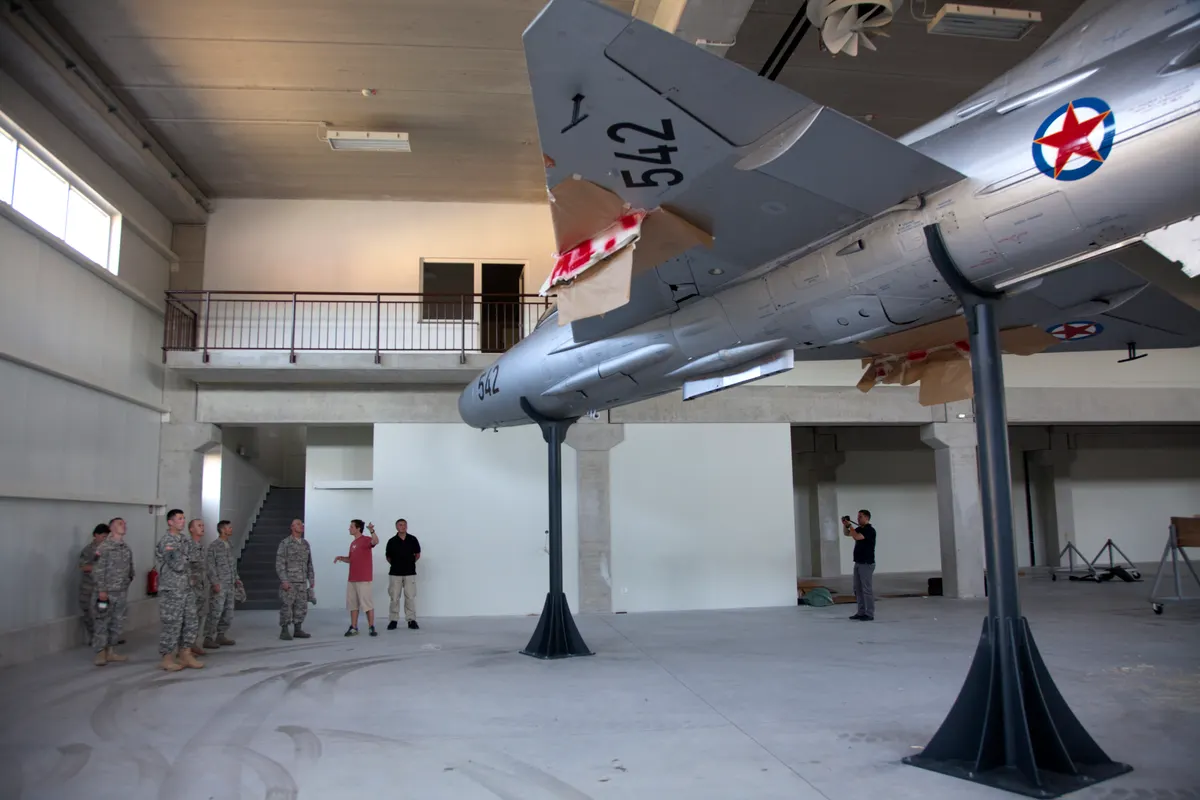
Neither Sweden nor Austria used the Saab 105 in a shooting war, and the aircraft's closest brush with actual combat came from events unfolding just across Austria's southern border rather than from Austrian action itself. As Yugoslavia broke apart in 1991, Yugoslav military aircraft repeatedly crossed into Austrian airspace during the fighting in Slovenia; in June that year a Yugoslav jet reportedly overflew Graz, some 50 km from the border, prompting weeks of heightened alert with anti-aircraft units deployed around the city's air base.17 Saab 105s, alongside Austria's small fleet of supersonic Saab 35 Drakens, flew quick-reaction patrols along the frontier through the crisis, even though the 105 itself carried no radar and only a marginal air-to-air capability.4,17
The one clearly documented interception involving the type came on 25 October 1991, when Yugoslav Air Force pilot Rudolf Perešin, a Croat flying a reconnaissance sortie for the federal air force, broke away from his formation and flew his MiG-21R across the border to land at Klagenfurt rather than continue flying missions against his own people.18 Austrian records describe an alert flight scrambled against the intruding MiG-21, and two Saab 105s intercepted and escorted the defector to Klagenfurt airport, where he landed and requested asylum before being allowed to leave for Croatia days later.19,18 It was a bloodless, almost ceremonial interception by any standard of Cold War air combat, but it is the only recorded instance of a Saab 105 shadowing a hostile-air-force jet across a live international crisis.
Sweden's own production split into the SK 60A, a two/four-seat trainer and liaison aircraft that made up the bulk of the original order; the SK 60B, structurally identical but wired for a gunsight and weapons release suited to the light-attack role; and the SK 60C, a reconnaissance conversion with an extended, camera-filled nose replacing the standard cockpit glazing forward of the main canopy.3,6 Smaller batches were converted again later into the SK 60D four-seat liaison transport and the SK 60E navigation trainer used to qualify commercial and reserve pilots.2 From the mid-1990s, roughly 115 of these airframes were rebuilt with Williams FJ44 engines and informally known as the SK 60W, though the Swedish Air Force never adopted that as a formal type designation distinct from the underlying A/B/C variant.10
Export-only demonstrator variants never entered production for any customer. The Saab 105XT and the improved Saab 105G, both fitted with General Electric J85-17B turbojets for substantially more thrust and a higher top speed, were shopped to Switzerland (as the proposed 105H) and Finland (as the 105S); Switzerland pursued other options and Finland bought the BAe Hawk instead, leaving the J85-engined Saab 105 without a single production order.1,9 A four-seat business-jet variant, the Saab 105D, was floated even earlier in the programme and attracted no civilian buyers at all, closing off the aircraft's original dual-market ambition entirely.1


Sweden was the founding and largest operator, taking 150 Sk 60s from 1967 and flying them continuously — through a full engine-type change — until the type's retirement on 18 June 2024.2 Austria was the sole export customer, buying 40 Saab 105Ös delivered from 1970 and flying them for 50 years, accumulating roughly 157,000 flight hours and 254,000 sorties before the last aircraft were withdrawn on 31 December 2020; twelve airframes were lost to accidents over that half-century, with fourteen crew fatalities, the last a 2003 training accident from which the pilot ejected safely.4,20
No formal military operator remains today. Sweden's decommissioned fleet was largely retired to storage or museums, though the Swedish Air Force Historic Flight kept a handful of Sk 60s — including at least one, registered SE-DXG — airworthy for heritage displays, a status distinct from front-line service but the closest thing to an active Saab 105 anywhere in the world.1 Austria replaced the 105Ö's roles piecemeal, its interception mission having already passed to the Saab 35 Draken in 1988 and later the Eurofighter Typhoon, while its jet-trainer requirement was ultimately filled by the Leonardo M-346FA Master.4,21
The Saab 105's closest period rival is the Aermacchi MB-326, an Italian tandem-seat jet trainer that first flew in 1957 and, unlike the Saab, became one of the most widely exported military jets of its generation — roughly 800 built for Italy and more than ten export and licence customers including Australia, Brazil, South Africa, Argentina and several African air forces.22 Where the Saab relied on two small turbofans and side-by-side seating, the MB-326 used a single, more substantial Bristol Siddeley/Rolls-Royce Viper turbojet and conventional tandem seating; depending on engine fit, MB-326 variants reached 806-867 km/h against the Aubisque-powered Saab's 770 km/h, a real if not dramatic speed advantage.23,7 The two designs made almost opposite bets on the same problem: Saab traded raw performance for an instructional layout and a built-in engine-failure margin that a single-engine trainer cannot offer, while Aermacchi traded that margin for a simpler, cheaper, single-powerplant airframe that easily accepted a single-seat armed derivative, the MB-326K, without needing a second engine bay.
| Spec | Saab 105 (Sk 60) | Aermacchi MB-326 |
|---|---|---|
| Engines | 2× Aubisque/RM9B turbofan, ~7.3 kN each7 | 1× Viper turbojet, 11.1-17.8 kN depending on variant23 |
| Top speed | 770 km/h7 | 806-867 km/h23 |
| Seating | Side-by-side | Tandem |
| Total built | 1921 | ~80022 |
| Combat record | None (border patrols only) | South African Border War, mobilised in 1982 Falklands War24 |
That difference in combat record is the sharpest contrast between the two. The armed, single-seat MB-326K, built in South Africa as the Impala Mk II, flew real low-level strike missions over Angola and Namibia through the 1970s and 1980s, taking losses to shoulder-fired missiles and in at least one well-documented case shooting down opposing helicopters with its cannon.24 The Saab 105, despite carrying a broadly comparable attack fit on Swedish and Austrian airframes, never flew in anger; its closest brush with hostile airspace was the bloodless 1991 MiG-21 interception described above. Whether that reflects the aircraft's own limitations or simply the fact that Sweden stayed out of every war during its service life, and Austria's only real crisis passed to faster jets, is not something the airframe itself can settle — but it means direct combat performance is not a fair axis to compare the two types on, however often the comparison gets made.


How many Saab 105 aircraft were built? 192 in total: 150 for the Swedish Air Force as the Sk 60, 40 for Austria as the Saab 105Ö, and two prototypes, produced between 1963 and 1972.1
Is the Saab 105 still in service? No air force operates it as a front-line type. Austria retired its 105Ös in December 2020 and Sweden retired its Sk 60 fleet in June 2024; a small number of Swedish aircraft remain airworthy with the Swedish Air Force Historic Flight for heritage displays only.4,2
What is the Saab 105's top speed? The standard Aubisque-engined Sk 60 and Saab 105Ö reach about 770 km/h at sea level. The unsold, more powerful J85-engined demonstrator variants (105XT/105G) were rated at around 970 km/h, but no operational customer flew that engine fit.7,9
What replaced the Saab 105 in Swedish service? The Grob G 120TP turboprop, designated SK 40, was selected in May 2021 as the new basic trainer, with the Saab Gripen absorbing more of the advanced training role previously covered by the Sk 60.16
How does the Saab 105 compare with the Aermacchi MB-326? Both were period-contemporary light jet trainers with light-attack derivatives, but the MB-326 sold roughly four times as many airframes across many countries and saw real combat use in Africa, while the Saab 105's side-by-side, twin-engine layout stayed a Swedish and Austrian type only and never flew in a war.22,24
- "Saab 105", Wikipedia — en.wikipedia.org ↩
- "Sweden's Unique Little Saab 105 Jet Retired After 57 Years", The War Zone — twz.com ↩
- "SK 60 Trainer Aircraft", Airforce Technology — airforce-technology.com ↩
- "50 years of Saab 105OE: Time to say goodbye", militaeraktuell.at — militaeraktuell.at ↩
- "Saab 105", Plane-Encyclopedia — plane-encyclopedia.com ↩
- "Saab 105", Wikipedia — en.wikipedia.org ↩
- "Saab-105 - Specifications", flugzeuginfo.net — flugzeuginfo.net ↩
- "Turbomeca Aubisque", Wikipedia — en.wikipedia.org ↩
- "Saab 105", Wikipedia — en.wikipedia.org ↩
- "Saab 105", Wikipedia — en.wikipedia.org ↩
- "Aermacchi MB-326", Wikipedia — en.wikipedia.org ↩
- "Today in Aviation History: First Flight of the Saab 105", Vintage Aviation News — vintageaviationnews.com ↩
- "Team 60", Wikipedia — en.wikipedia.org ↩
- "Team 60 aerobatic display team", Aerobatic Teams — aerobaticteams.net ↩
- "Sweden's Unique Little Saab 105 Jet Retired After 57 Years", The War Zone — twz.com ↩
- "Sweden orders Grob 120TP as new basic trainer", Key.Aero — key.aero ↩
- "Austrian Air Force", Wikipedia — en.wikipedia.org ↩
- "Rudolf Perešin", Wikipedia — en.wikipedia.org ↩
- "Historie der Saab 105 Ö", Airpower.at — airpower.at ↩
- "Austria prepares to say goodbye to Saab 105", Blog Before Flight — blogbeforeflight.net ↩
- "Austrian Air Force Picks M-346FA Masters To Replace Saab 105 Trainers: What To Know", Simple Flying — simpleflying.com ↩
- "Aermacchi MB-326", Wikipedia — en.wikipedia.org ↩
- "Aermacchi MB-326K", Global Military — globalmilitary.net ↩
- "Aermacchi MB-326", Wikipedia — en.wikipedia.org ↩
- "Meet Major Update 'New Power'", War Thunder — warthunder.com ↩