

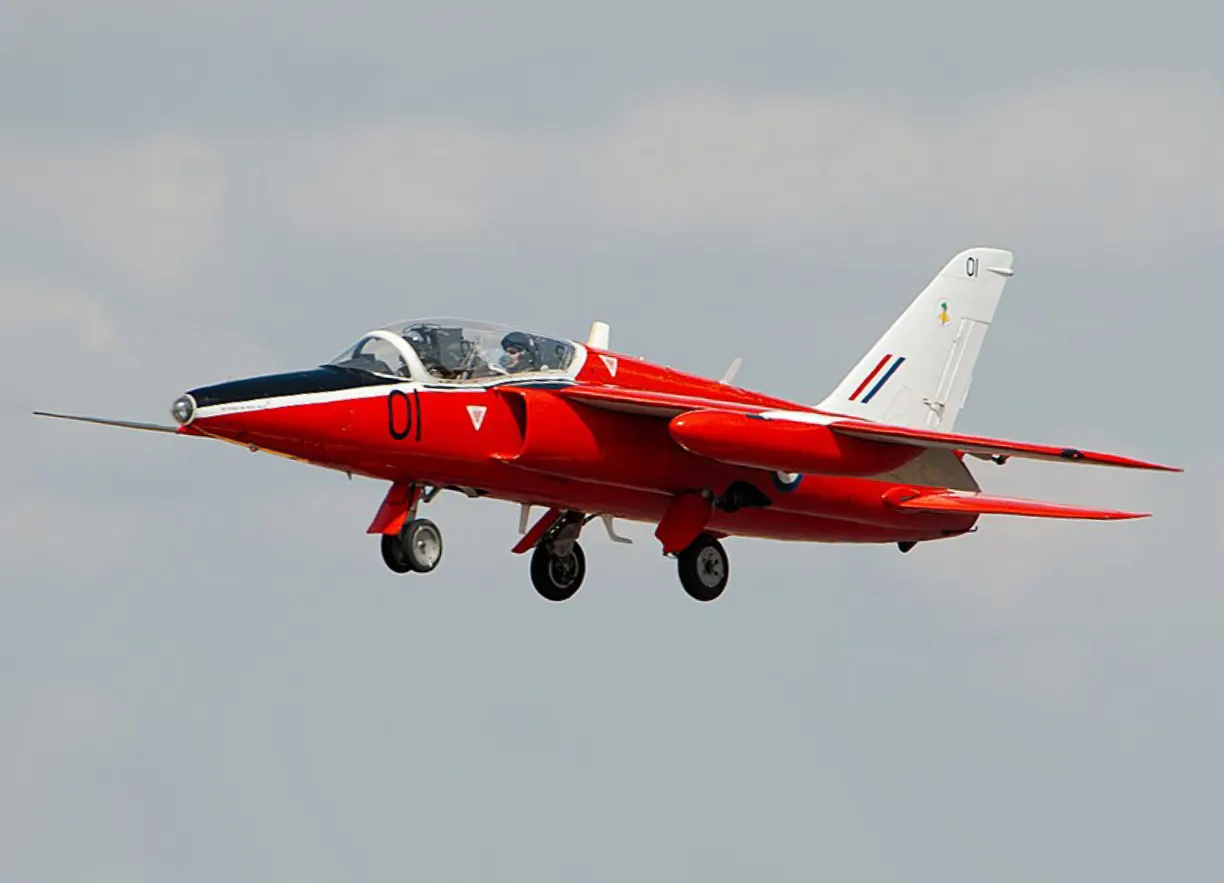
The Folland Gnat is a British single-seat lightweight fighter that was reworked into a two-seat advanced jet trainer, and it is the trainer version that most people mean when they picture it: a small, wasp-shaped jet in red-and-white, flying tight formations. Designer W. E. W. "Teddy" Petter built the fighter around a simple bet — that a fast, agile combat aircraft did not need to be big or expensive.1 The prototype, the private-venture Folland Midge, first flew on 11 August 1954, and the full-size Gnat (company designation Fo.145) followed on 18 July 1955.1
- Exceptional roll rate and turning performance for its era
- Cheap, low-labour airframe construction
- Small radar and visual cross-section in a dogfight
- Twin-role legacy: light fighter and advanced trainer
- Cramped, difficult ground handling and maintenance access
- Early hydraulic system had a serious design flaw
- Never adopted by the RAF as an operational fighter
- Demanding, unforgiving handling for inexperienced pilots
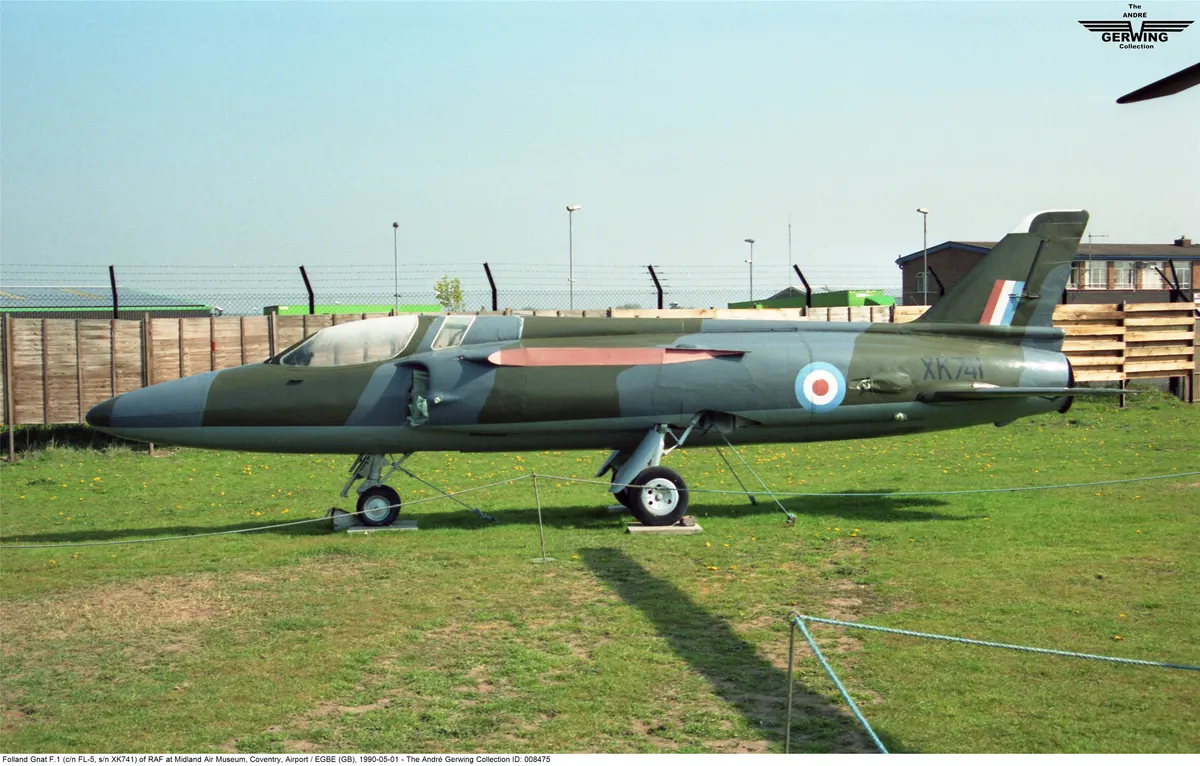
The Royal Air Force never bought the Gnat as a frontline fighter — it lost that argument to the larger, faster Hawker Hunter and, later, supersonic types — but it did buy the two-seat Gnat T.1 trainer, which entered Central Flying School service in February 1962.1,13 Two export customers, Finland and Yugoslavia, bought the fighter version in small numbers, and the Indian Air Force went further, buying the fighter, then building it under licence, then redesigning it into an indigenous fighter of its own, the HAL Ajeet.1,6 Roughly 449 airframes were built across all Gnat and Ajeet variants combined, in the United Kingdom and in India.1
What made the aircraft notable was less its raw performance than its handling. Folland's engineers claimed the wing could be built for a quarter of the cost and a fifth of the labour of a contemporary fighter wing, and pilots consistently praised the Gnat's roll rate, reportedly exceeding 360 degrees per second, and its willingness to turn hard.6,12 Those same qualities made it a demanding aircraft to fly well, and a punishing one to fly badly.
The Bristol Orpheus and a Fighter Built Around One Engine
Petter originally designed the Gnat around the projected Bristol BE.22 Saturn turbojet, rated at roughly 16.9 kN; when that engine was cancelled, Folland switched to the Bristol Orpheus, then still in development, and the aircraft was resized around it.1 The production F.1 fighter used the Bristol Siddeley Orpheus 701, quoted at around 20.9 kN (4,705 lbf) of thrust, giving the roughly 4,100 kg fighter a thrust-to-weight ratio unusually good for a 1950s light aircraft.1,11 The two-seat T.1 trainer, heavier and with a longer fuselage and 40 percent more wing area to compensate, used a lower-rated Orpheus in the 18–19 kN class.12
- First Flight1955
- Service Entry Year1959
- Crew (seats)1
- Trainer Typeadvanced jet trainer
- In ServiceYes
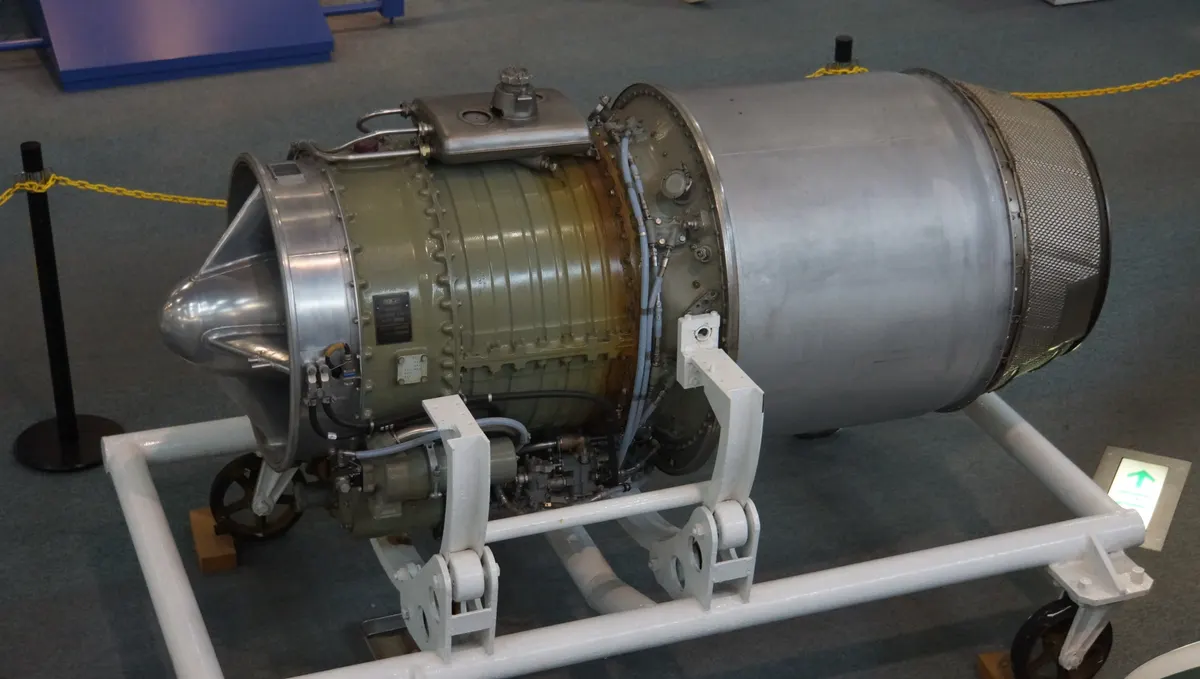
Because the Orpheus was a single, centrally mounted engine, Folland could keep the fuselage slim and the frontal area small — one reason the Gnat proved hard to spot in a dogfight, especially at the low altitudes where most of its combat took place.6 The airframe used flush riveting, simplified skinning, and fewer machined parts than contemporaries, which is where the "quarter of the cost" wing claim originates; a Gnat could also be kept flying without much of the specialised tooling a larger air force would otherwise need.1
- Engine TypeBristol Siddeley BOr.2 Orpheus 701-01
- Thrust17.8
Cockpit, Canopy, and Escape: Two Very Different Seats
The single-seat F.1 fighter used a steeply raked ejection seat of Folland's own design, adapted from a Saab licence, chosen to minimise the aircraft's frontal profile.1 The T.1 trainer instead carried two seats in tandem beneath a large, clear-view canopy, closer in concept to the seating of the Saab J 29 Tunnan; production trainers were later fitted with Martin-Baker ejection seats as the type matured.1 The change from a single raked seat to two upright tandem seats, together with the enlarged tail and wing, is the single biggest visual difference between the fighter and the trainer, and it is also why the two variants' handling and performance figures diverge as much as they do.
- Top Speed1,018 km/h
- Service Ceiling15,240 m
- Range804.694 km
- Rate of Climb101.6 m/s
- G-Limit7
As built in the United Kingdom by Folland and later Hawker Siddeley, the Gnat was a fully domestic design: British airframe, British Bristol Siddeley Orpheus engine, British ejection seat. The Indian programme changed that balance. Under a licence agreement signed in 1956, Hindustan Aeronautics Limited (HAL) built its own airframes at Bangalore and established a dedicated Engine Division there to manufacture the Orpheus under licence from Bristol Siddeley/Rolls-Royce; by the time full local production matured, HAL was building around 85 percent of the airframe and 60 percent of the engine domestically, with the remainder — chiefly precision engine components and some avionics — still imported from Britain.7,6 Finland's and Yugoslavia's Gnats, by contrast, arrived as complete British-built aircraft with no local content at all.
- Cockpit Configurationsingle-seat
- Ejection SeatsYes
- Length8.839 m
- Wingspan6.75 m
- Height2.69 m
- Max Takeoff Weight2,948 kg
- Total Built449
- Retirement Year1979
From Westland to Folland: Petter's Lightweight Fighter Gamble
W. E. W. Petter had already designed the Westland Lysander and, at English Electric, the Canberra bomber, before joining Folland Aircraft as managing director and chief engineer in October 1950.1 There he pursued an idea the mainstream industry was moving away from: that a fighter could be small, light, and cheap rather than large and expensive, an approach that lined up with the Air Ministry's Operational Requirement OR.303 for a lightweight interceptor.1 Folland financed the initial work itself, flying the unarmed Midge demonstrator in August 1954 and the definitive Gnat prototype in July 1955.1
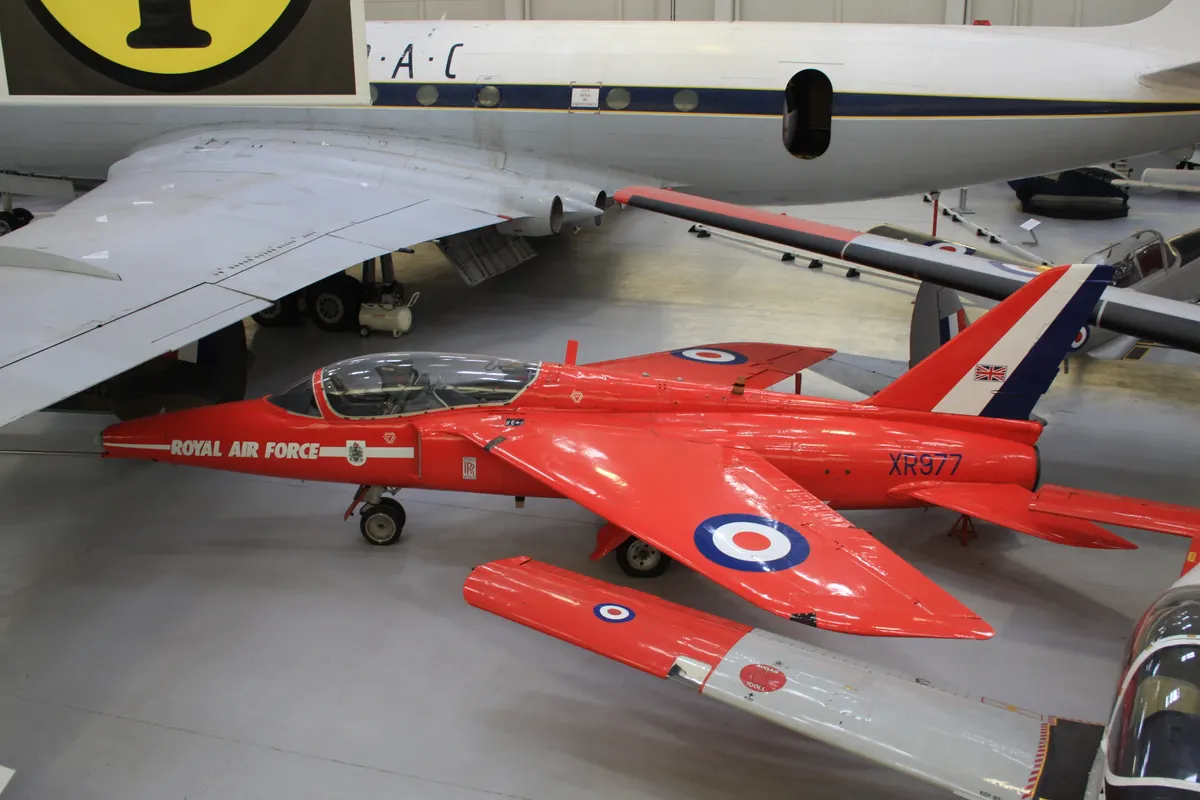
RAF interest in the Gnat as an operational fighter cooled quickly — the Hawker Hunter already filled that role, and faster, missile-armed interceptors were coming — but the Air Ministry's requirement for a cheaper, jet-powered advanced trainer, Specification T.185D, gave Folland a second opening.1 The resulting Gnat T.1 first flew in August 1959 and reached the Central Flying School at RAF Little Rissington in February 1962, followed by 4 Flying Training School at RAF Valley later that year.1,13
The Yellowjacks, the Red Arrows, and Fourteen Seasons on the Gnat
In May 1964, a group of flying instructors at 4 FTS Valley, led by Flight Lieutenant Lee Jones, began flying a five-aircraft aerobatic team in Gnats painted bright yellow; they called themselves the Yellowjacks.2 Air Ministry officials disliked both the nickname and the team's informal, self-organised status, and in November 1964 it was reformed as the official RAF aerobatic team, the Red Arrows, for the 1965 display season.2 The Red Arrows flew the Gnat for fourteen seasons, developing the Diamond Nine formation that remains their signature, before converting to the BAe Hawk in 1979.2
Finland's Rocky Start with the F.1
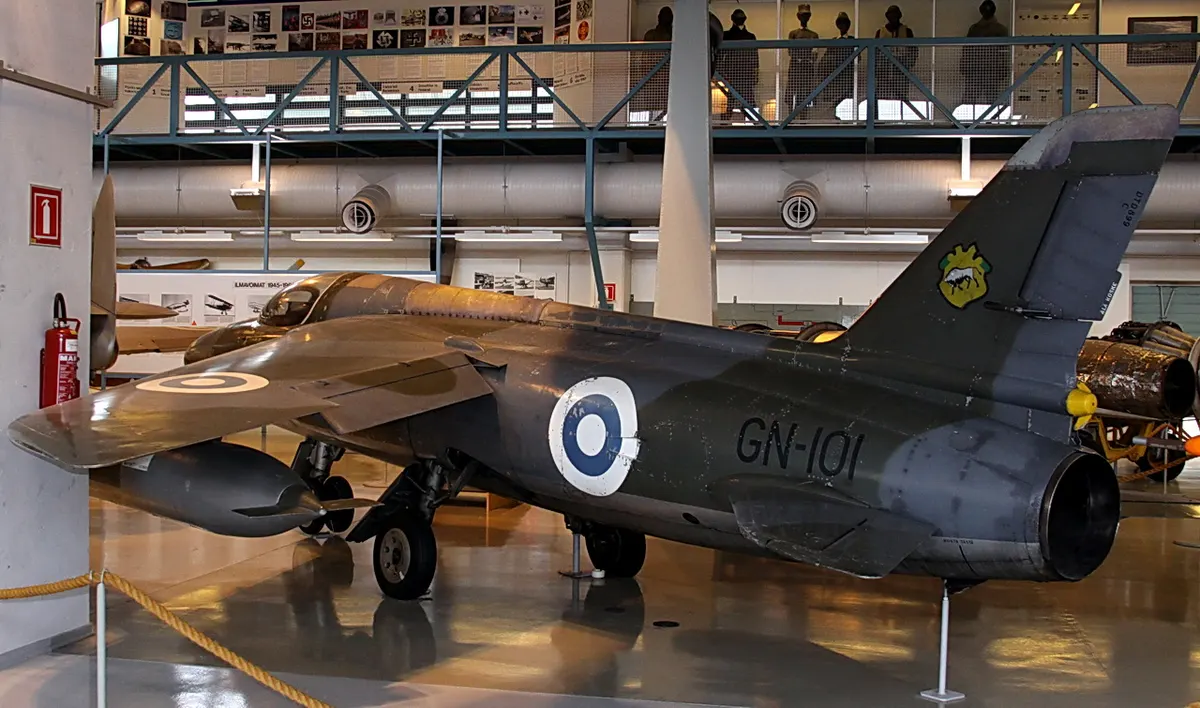
Finland was the Gnat's first export customer and its most difficult early customer. The Finnish Air Force took delivery of 13 aircraft — 11 F.1 fighters and 2 FR.1 photo-reconnaissance variants — starting 30 July 1958, and the very next day Major Lauri Pekuri, a Second World War fighter ace, became the first Finnish pilot to break the sound barrier, diving a Gnat over Lake Luonetjärvi.10 The celebration did not last. On 26 August 1958, aircraft GN-102 was destroyed near Tampere by a design flaw in the hydraulic system, and the entire Finnish fleet was grounded for six months while the fault was traced and fixed.10
The Gnat never fully shed its reputation in Finnish service for demanding heavy ground maintenance, and the type was withdrawn in 1972 when the Häme Wing re-equipped with Saab Draken interceptors.10 Yugoslavia's experience was briefer still: two F.1s were shipped by rail for evaluation in 1958, one was destroyed in a crash that October, and no further order followed; the surviving aircraft is preserved today in Belgrade.6
India Buys In: Licence Production at Bangalore
India signed its Gnat licence agreement in 1956, well before the type had even entered squadron service anywhere, and set up a purpose-built HAL Engine Division at Bangalore to build the Orpheus locally.7 The Indian Air Force's first Gnat squadron converted in 1960, initially on British-built aircraft; the first entirely HAL-built airframe flew on 21 May 1962, and production continued until the last Indian-built Gnat was delivered on 31 January 1974, by which point more than 200 had come off the Bangalore line.6,7
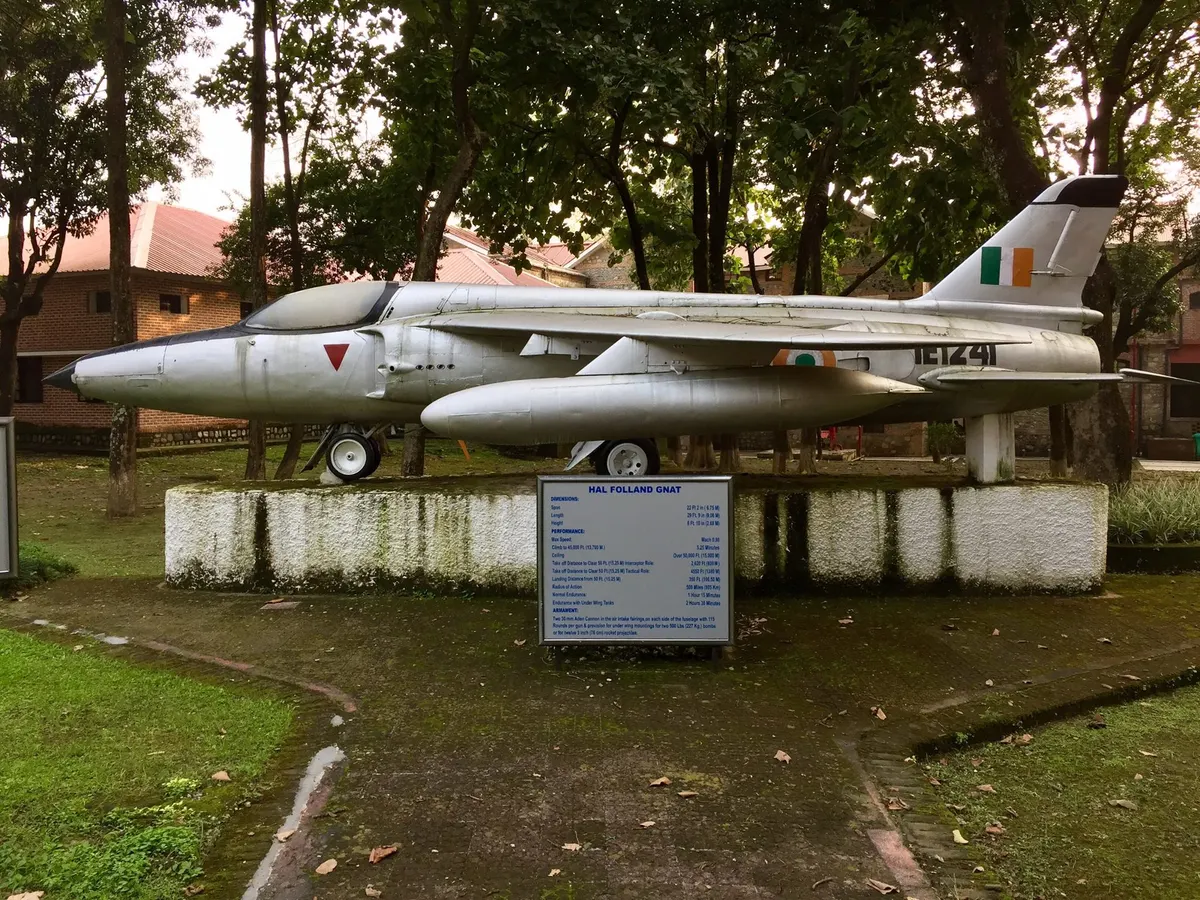
That scale of local investment is why the Gnat's career in India ran so much longer, and so much more eventfully, than its career anywhere else — the aircraft that Britain treated as a stopgap trainer became India's frontline lightweight interceptor for more than a decade, and its combat reputation was made almost entirely over the subcontinent.
By the mid-1960s, HAL-built Gnats equipped IAF squadrons including No. 2, No. 9, No. 15, No. 23, and No. 24, based along both the western and eastern borders with Pakistan.6
The 1965 War and the "Sabre Slayer" Nickname
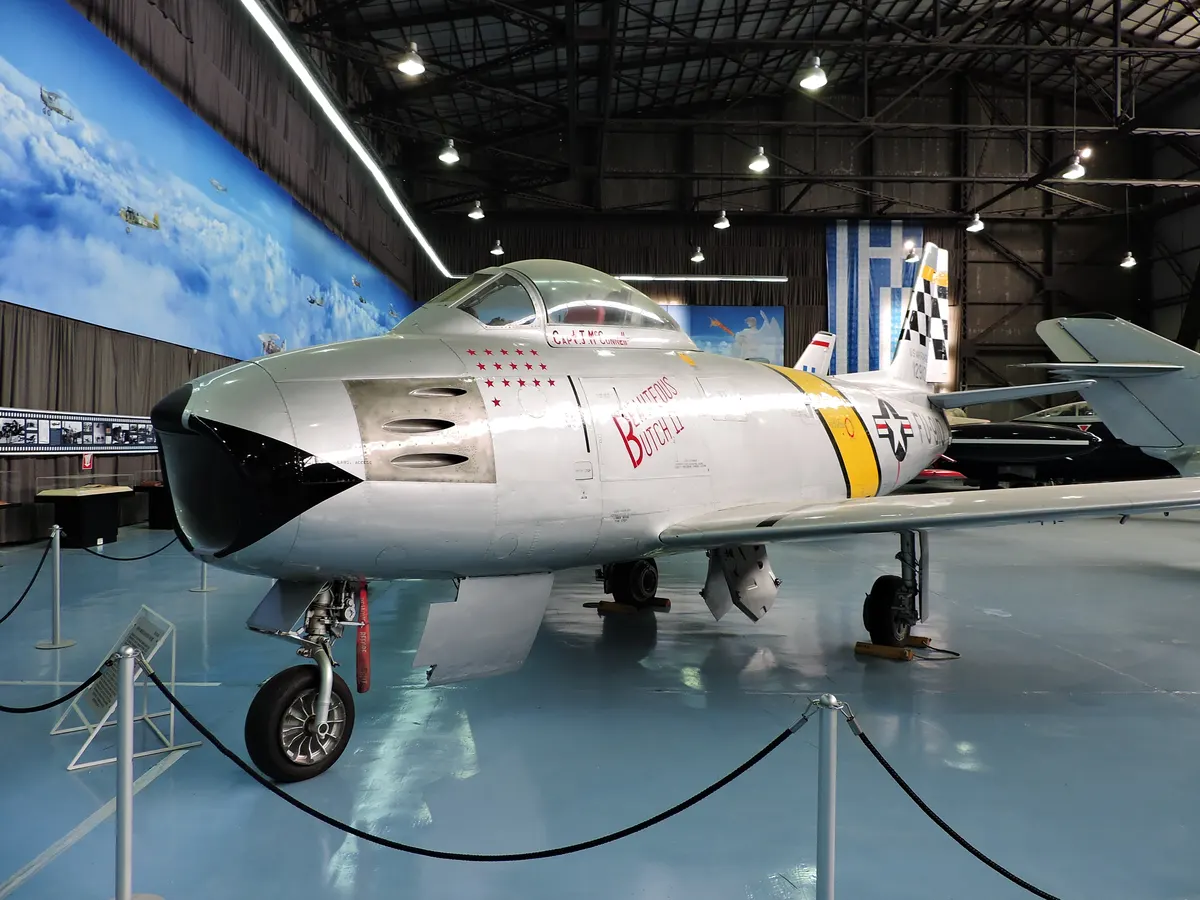
By the outbreak of the 1965 Indo-Pakistani War, the Indian Air Force had five squadrons of Gnats, flying against a Pakistan Air Force built substantially around the North American F-86 Sabre.4,5 Indian pilots quickly worked out that the Gnat's tight turning circle and small size gave it an edge if it could draw a Sabre into a vertical, close-in fight rather than a high-speed pass, and Indian sources credit Gnat pilots with shooting down seven Sabres during the war — the origin of the "Sabre Slayer" nickname that stuck to the type inside the IAF.5
Pakistani pilots had initially rated the Gnat as a minor threat, having watched its troubled early export career in Finland; several were caught out in 1965 by just how tightly the little jet could turn once its teething problems had been fixed.4
Verifying the Legend: What the Record Actually Shows
The "Sabre Slayer" story is popular, but a closer, source-by-source review complicates it. One reconstruction of all eleven Gnat-versus-Sabre engagements across the 1965 and 1971 wars — roughly 38 Gnats against 46 Sabres in total — found that only six of ten Indian victory claims and three of eight Pakistani claims meet a strict evidentiary standard combining pilot reports, gun-camera film, and wreckage analysis.4 That does not erase the Gnat's record, but it argues for treating the widely repeated "kill ratio" figures with caution; several claimed kills on both sides are more plausibly explained by mechanical failure, ground fire, or simple over-claiming.4
The Battle of Boyra and Nirmal Jit Singh Sekhon's Param Vir Chakra
The most one-sided documented engagement came shortly before the 1971 war was formally declared, in the skirmish remembered as the Battle of Boyra, where IAF Gnats shot down two Pakistani Canadair-built Sabres and damaged a third over what was then East Pakistan; a Pakistani claim to have downed a Gnat in the same fight was later undercut by gun-camera evidence.6,5 The war's grimmer, better-documented Gnat story came on 14 December 1971, when six Sabres of the PAF's No. 26 Squadron attacked Srinagar air base under Operation Chengiz Khan. Flying Officer Nirmal Jit Singh Sekhon scrambled alone to meet them, engaged a pair of Sabres at treetop height, and damaged or destroyed two before being overwhelmed and killed.9 He remains the only Indian Air Force airman ever awarded the Param Vir Chakra, India's highest gallantry decoration.9
Midge to Gnat: The Prototype Lineage
The unarmed Fo.139 Midge, powered by a modest Armstrong Siddeley Viper turbojet, proved the airframe concept before it was destroyed in a 1955 accident; the definitive Fo.145 Gnat F.1 fighter followed, along with a small-run FR.1 photo-reconnaissance version built for Finland with nose-mounted cameras.1 Several more ambitious derivatives — an F.2 with a more powerful engine, an F.4 interceptor with radar, even a proposed variable-geometry Gnat — never reached prototype stage; the design that mattered commercially was the two-seat T.1 trainer, built in far greater numbers than the fighter ever was.1
The HAL Ajeet: India's Homegrown Redesign
Dissatisfied with some of the original Gnat's rougher edges, the Indian Air Force asked HAL in 1972 to develop an improved successor. The result, named Ajeet ("Invincible"), kept the Gnat's basic shape but reworked the hydraulics, added anti-skid brakes to the landing gear, and — most usefully — moved fuel into new integral wing tanks holding 250 litres each, freeing all four underwing pylons for weapons that the original Gnat's wing-mounted fuel tanks had blocked.3 HAL built 79 new Ajeets and converted a further 10 existing Gnats to the standard before production ended in 1982; the type equipped a single IAF squadron and was withdrawn, together with the last Gnats, in 1991.3
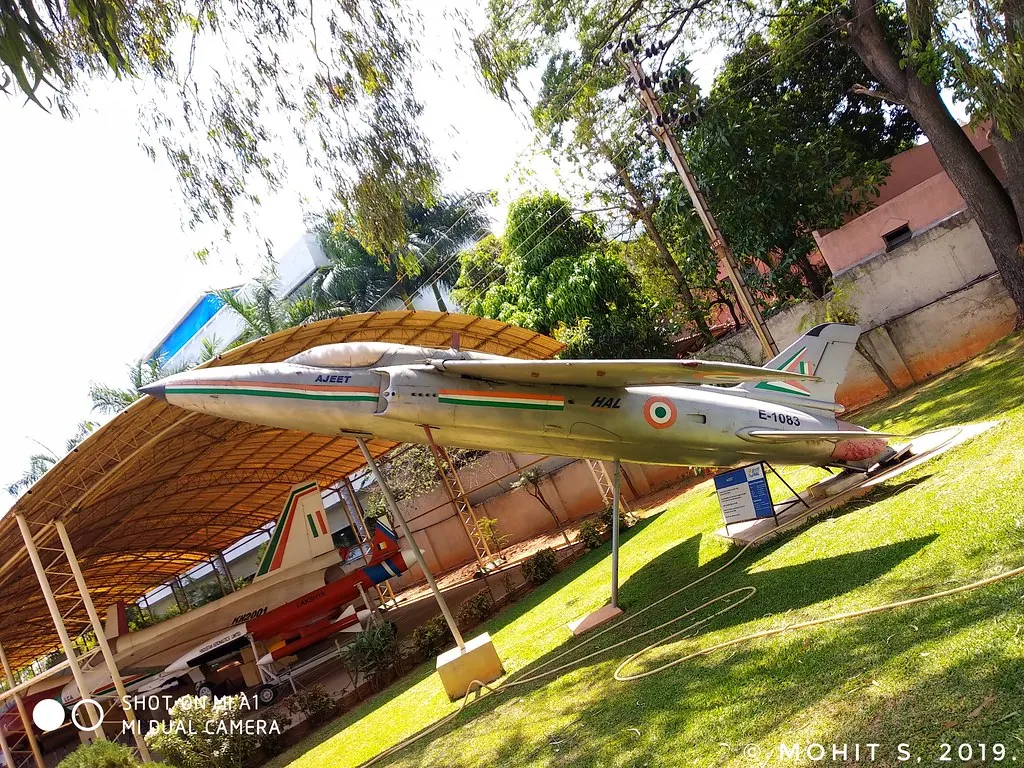
A two-seat Ajeet Trainer variant followed the same logic as the earlier Gnat T.1: taking a lightweight fighter airframe already in indigenous production and adapting it for advanced flying instruction rather than developing a wholly separate trainer type.3
Unlike the original Gnat, the Ajeet was never offered for export; it remained an India-only type throughout its short production run, equipping a single squadron rather than the eight that had flown the Gnat before it.3


Royal Air Force, Indian Air Force, and Two Small Evaluation Fleets
The Royal Air Force operated the T.1 trainer exclusively — never the fighter — through the Central Flying School and 4 Flying Training School, plus the Red Arrows display team, retiring the last training examples in November 1978 and the last Red Arrows aircraft after the 1979 season.1,13 The Indian Air Force was the largest and longest-serving operator by a wide margin, flying the Gnat and later the Ajeet across eight squadrons from 1960 until 1991.6 Finland and Yugoslavia each flew small evaluation or operational fleets of the fighter version in the late 1950s and early 1960s, and neither followed up with further orders once alternatives — the Saab Draken for Finland — became available.10,6
No air force other than these four ever flew the Gnat or the Ajeet operationally — a design built in Britain that found its real career defined by a single, much larger export customer rather than by its home air force.
Survivors in the Warbird and Display Scene
A meaningful number of ex-RAF and ex-Indian Gnats survive today, mostly in Britain and the United States, where private owners keep several airworthy as warbirds; a UK-based Gnat Display Team continues to fly the type at airshows.1 None remain in frontline military service anywhere — the type's active career, in any air force, ended with India's 1991 retirement of the Ajeet fleet.
Gnat vs. North American F-86 Sabre: The Combat Encounter
The comparison that matters most for the Gnat is not a paper one but a combat one: it fought the F-86 Sabre directly and repeatedly over more than a decade of Indo-Pakistani tension. On paper the Sabre should have won easily — a third longer, considerably heavier, and armed with six 0.50-calibre machine guns against the Gnat's two 30mm cannon — but raw numbers undersell the fight.5,9 The Gnat's tighter turning circle and smaller visual signature let Indian pilots who could force a slow, close, vertical fight take away much of the Sabre's speed advantage, while Pakistani pilots who kept the fight fast and high generally fared better.5 Neither aircraft was clearly "better" in the abstract; the outcome depended on which pilot dictated the geometry of the fight.
| Spec | Folland/HAL Gnat (fighter) | North American F-86F Sabre |
|---|---|---|
| Length | about 9.1 m | 11.4 m |
| Empty weight | about 2,180 kg | about 4,940 kg |
| Engine thrust | about 20.9 kN | about 23 kN (J47) |
| Max speed | about 1,120 km/h | about 1,090 km/h (sea level) |
| Guns | 2 x 30mm cannon | 6 x .50cal machine guns |
Gnat vs. Fouga Magister: Two Answers to the Same Cheap-Jet Problem
A more useful design comparison is with France's Fouga CM.170 Magister, a contemporary that answered the same "cheap jet trainer" brief with an almost opposite solution. Where Folland built the Gnat around one powerful Orpheus turbojet to keep weight down, Fouga used two small, low-thrust Turbomeca Marboré engines, each rated at around 4 kN, trading performance for engine-out safety during student training.15 The Magister was slower — about 650 km/h against the Gnat T.1's roughly 1,020 km/h — and never had a fighter career worth mentioning, but nearly 1,000 were built and exported across three continents, more than double the Gnat/Ajeet family's total production, precisely because a twin-engine trainer was judged the safer bet for a mass training fleet.15 The Gnat gave students a faster jet closer to the frontline aircraft they would fly next; the Magister gave instructors a gentler, more forgiving one.


How many Folland Gnats were built? Around 449 airframes across all Gnat variants and the derived HAL Ajeet, split between production in the United Kingdom and licence production in India.1
What is the Folland Gnat's top speed? The single-seat F.1 fighter reached roughly 1,120 km/h (Mach 0.98) at altitude; the heavier, less powerful two-seat T.1 trainer topped out at around 1,020 km/h.1,12
Why was the Gnat called the "Sabre Slayer"? Indian Air Force pilots flying HAL-built Gnats were credited with shooting down Pakistani F-86 Sabres in the 1965 and 1971 wars, giving the aircraft its nickname inside the IAF — though independent review of the combat record suggests the confirmed kill count was lower than the popular figure.4,5
Is the Folland Gnat still in service anywhere? No. The last operational examples, Indian Ajeets and Gnats, were withdrawn in 1991. A number of privately owned Gnats remain airworthy on the civilian warbird circuit in Britain and the United States.1
Folland Gnat vs. Fouga Magister — which was the better trainer? Neither was simply "better"; they optimised for different things. The Gnat was faster and closer in feel to a frontline fighter, useful for advanced training; the twin-engine Magister was slower but safer for students and sold in far greater numbers worldwide.15
- "Folland Gnat", Wikipedia — en.wikipedia.org ↩
- "Yellowjacks", Wikipedia — en.wikipedia.org ↩
- "HAL Ajeet", Wikipedia — en.wikipedia.org ↩
- "Sabre Slayer: The Myth and Reality of the Gnat", IAF History — iafhistory.in ↩
- "Gnat – The IAF's Small 'Sabre Slayer'", SP's Aviation — sps-aviation.com ↩
- "The Folland Gnat / HAL Ajeet", faqs.org (Air Vectors mirror) — faqs.org ↩
- "Engine Division, Bangalore", Hindustan Aeronautics Limited — hal-india.co.in ↩
- "Nirmal Jit Singh Sekhon", Wikipedia — en.wikipedia.org ↩
- "Folland Gnat Mk.1 (GN-101)", Finnish Air Force Museum — airforcemuseum.fi ↩
- "Folland / Hawker-Siddeley Gnat", Military Factory — militaryfactory.com ↩
- "Folland's little revolutionary: the Gnat", Aircraft InFormation.info — aircraftinformation.info ↩
- "Folland Gnat - History", Thunder & Lightnings — thunder-and-lightnings.co.uk ↩
- "Fouga CM.170 Magister", Wikipedia — en.wikipedia.org ↩