

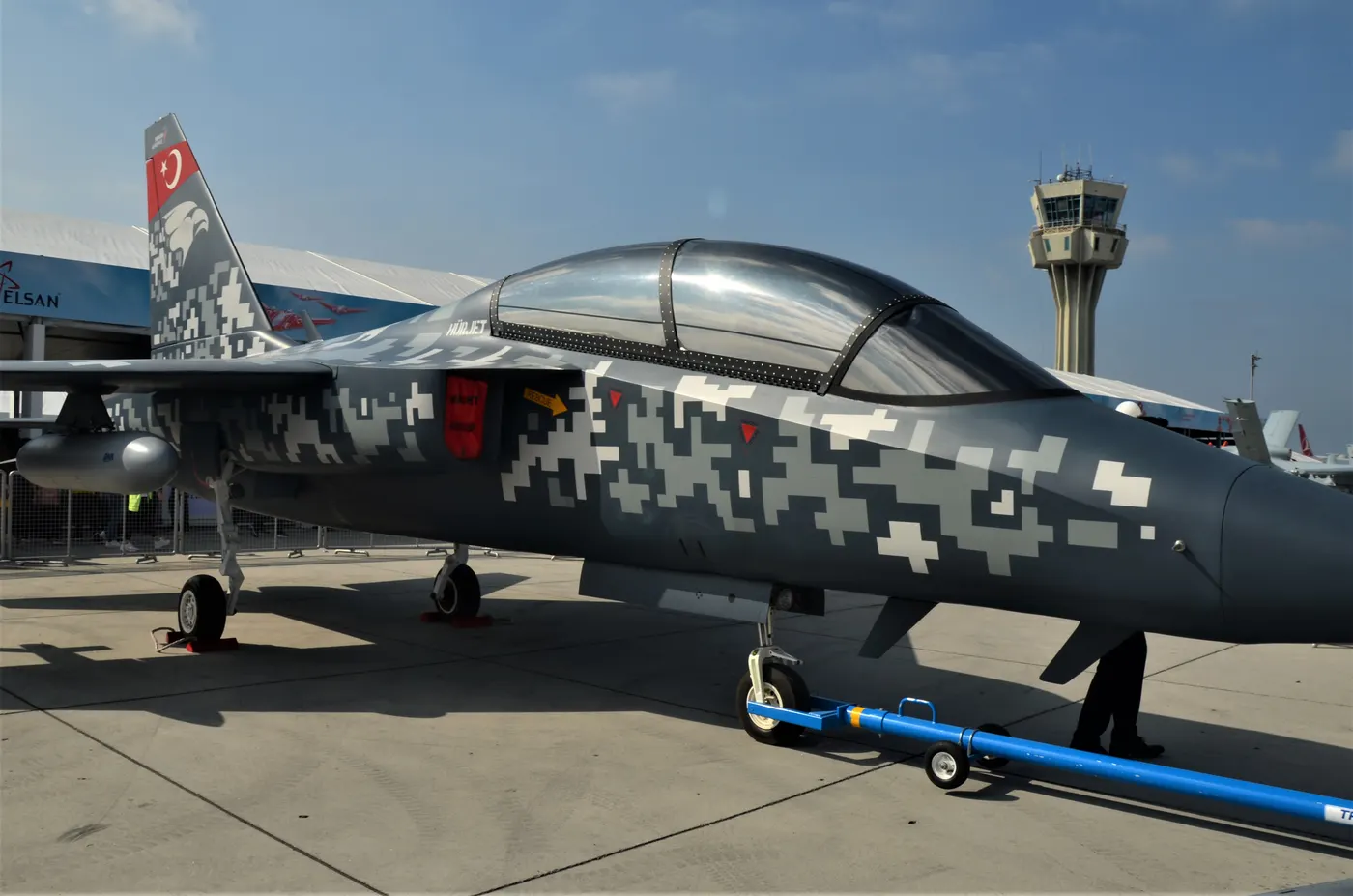
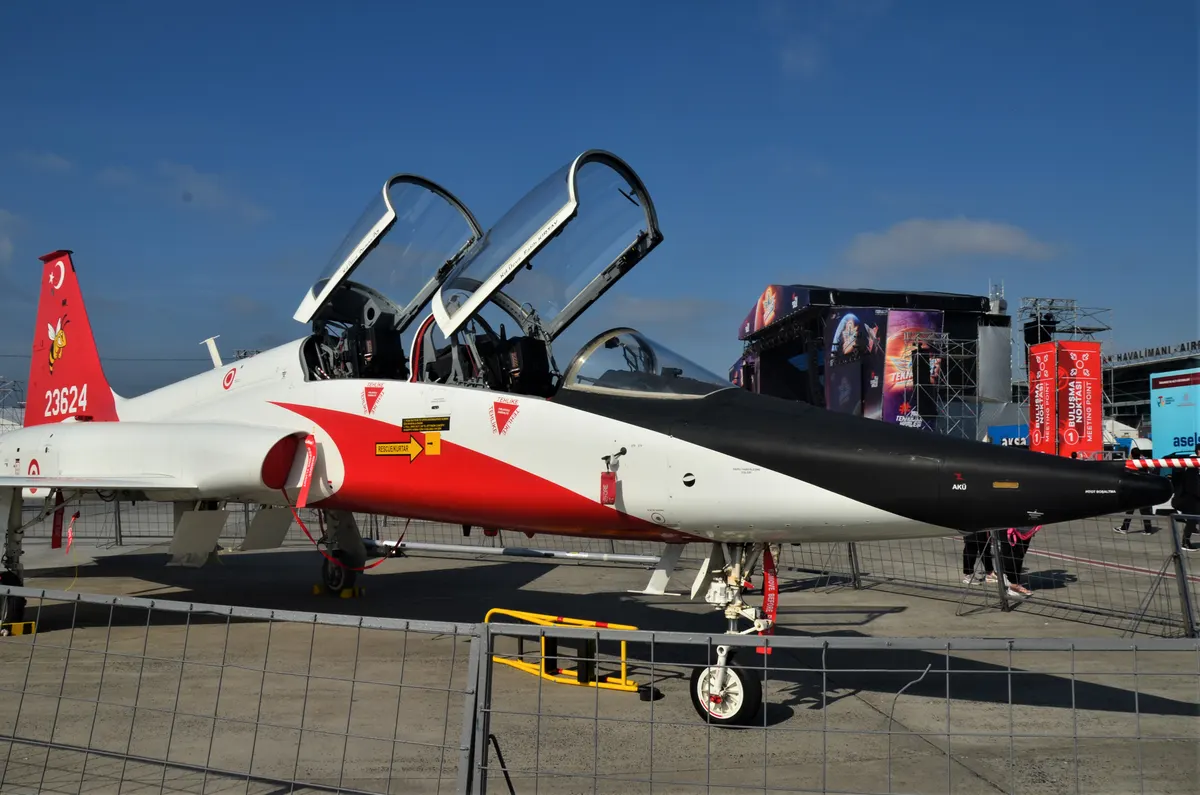
The Hürjet is a single-engine, tandem-seat supersonic jet trainer developed by Turkish Aerospace Industries (TAI, corporately branded TUSAŞ) to replace the Northrop T-38M Talon in the Turkish Air Force's advanced flying-training syllabus and to re-equip the Turkish Stars aerobatic team, which currently flies the F-5 Freedom Fighter.1
- Supersonic performance rare in a dedicated trainer
- Single, well-proven US engine simplifies logistics
- Real export win (Spain) before entering service
- Light-attack hardpoints built into the base design
- No operational service history anywhere yet
- Engine and some avionics still foreign-sourced
- Slower-than-planned schedule (service entry pushed back)
- Single engine versus twin-engine trainer rivals
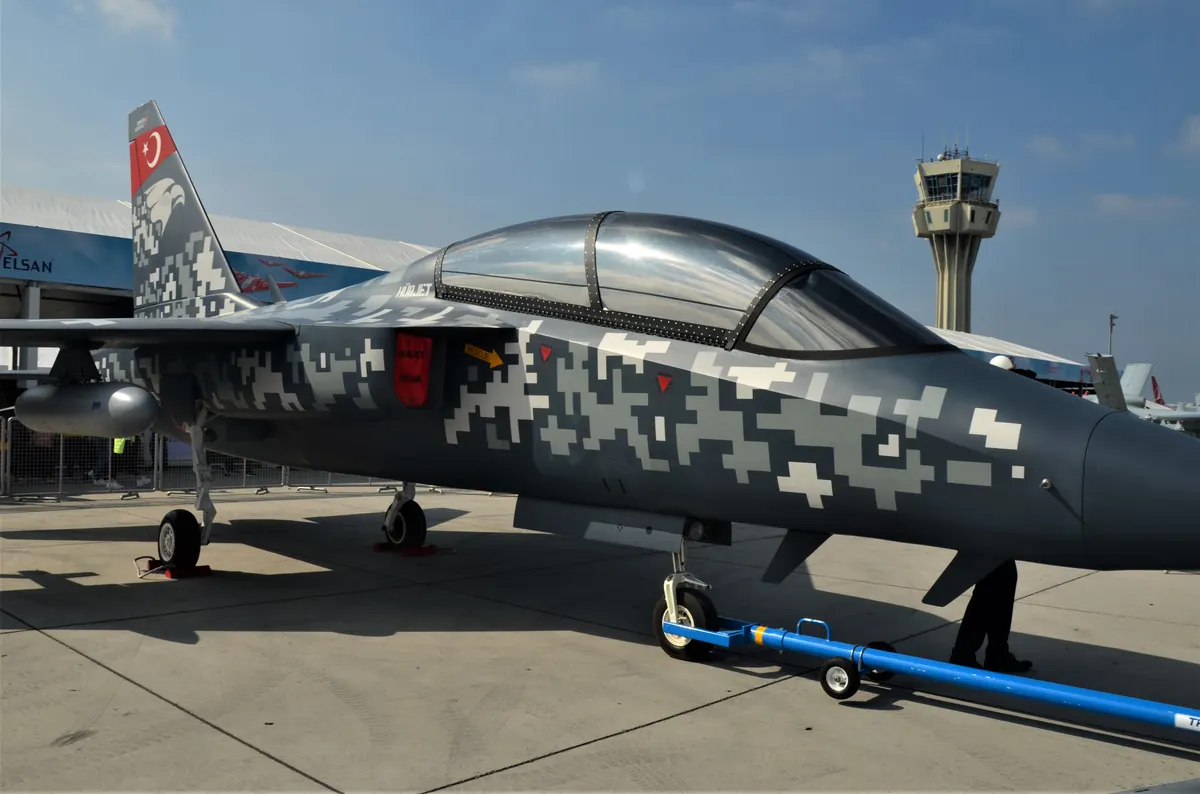
The first prototype flew on 25 April 2023 from TAI's flight test center at Mürted, near Ankara, powered by a single General Electric F404-GE-104 turbofan.2 It is TAI's first domestically designed manned jet aircraft to fly, predating first flight of the larger KAAN fifth-generation fighter by roughly two years, and the two programs share design offices, some suppliers, and a general push toward a self-sufficient Turkish combat-aircraft industry.3
Hürjet is best understood as two aircraft in one airframe. The baseline configuration is an advanced jet trainer (AJT) meant to teach fighter fundamentals, high-angle-of-attack handling, and instrument procedures to student pilots before they move to front-line jets. A second, structurally near-identical configuration, marketed as the Light Combat Aircraft (LCA) standard, adds wing and centerline hardpoints for guided bombs, air-to-air and air-to-surface missiles, and podded guns, aimed at light-attack and counter-insurgency roles as well as at export customers who cannot afford or do not need a full multirole fighter.4 As of mid-2026 no Hürjet has entered operational squadron service anywhere; the program is in the final stages of flight test and low-rate initial production, with delivery to the Turkish Air Force's training command and to the Turkish Stars both targeted for 2026.5 That timeline has already slipped once, and further slippage before an aircraft actually wears a training-command badge would not be a surprise given how most new jet programs run.
What makes Hürjet notable outside Turkey is less its performance, which is competitive but not exceptional against established rivals, than its export traction while still unproven. In December 2025 Spain signed a firm contract for 30 Hürjets, part of a program that had already secured a Spanish government approval for up to 45 aircraft three months earlier, making Spain the type's first confirmed export customer.6 That order, still short of any Hürjet actually wearing an operator's colors on a squadron ramp, is the primary reason the type draws international attention: a NATO air force chose an unproven Turkish jet over the combat-proven Leonardo M-346 and the offered Boeing/Saab T-7 in a competition it did not have to decide on any particular timeline.
The design lineage is more American than the "indigenous" label suggests at first glance. Hürjet grew out of a joint venture between TAI and Colorado-based Sierra Nevada Corporation (SNC), which together pitched a clean-sheet trainer called the Freedom Trainer for the US Air Force's T-X competition in the mid-2010s. When that partnership dissolved, TAI kept developing the airframe on its own as a Turkish Air Force program rather than an export bid to Washington.7
The General Electric F404 and a Deliberately Conservative Engine Choice
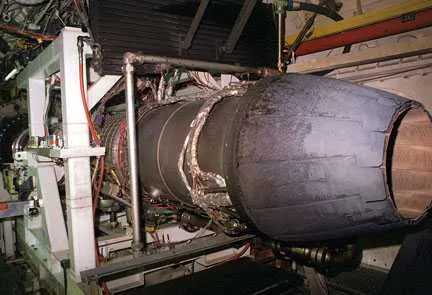
Hürjet is powered by one General Electric F404-GE-104 afterburning turbofan rated at roughly 53 kN (11,930 lbf) dry and 78.7 kN (17,700 lbf) with afterburner, giving the jet a top speed of Mach 1.4 and a documented maximum sustained turn of 6.3 g at 15,000 feet.8 TAI did not gamble the program on an unproven Turkish engine. The F404 family, first developed for the F/A-18 Hornet in the late 1970s, was built around operability and reliability rather than peak thrust, and by the time it was fitted to jets such as the Korean T-50 Golden Eagle and the Indian Tejas it had already accumulated well over ten million flight hours fleet-wide, a track record TAI's own marketing leans on heavily when pitching Hürjet to risk-averse air forces.9
- First Flight2023
- Service Entry Year2026
- Crew (seats)2
- Trainer TypeAdvanced jet trainer / Lead-in fighter trainer
- In ServiceNo
In July 2024, TAI, GE Aerospace, and Turkish Engine Industries (TEI, a GE-TAI joint venture dating to 1985) signed a memorandum extending the F404 relationship to cover engine assembly, testing, and long-term maintenance and overhaul work inside Turkey rather than only in the United States.10 A domestically developed alternative, the TEI-TF6000 turbofan, is in parallel development for Turkish trainers and light combat aircraft and was first run publicly in September 2025, but as of 2026 no production Hürjet has flown with anything other than the American F404.11
- Engine TypeGeneral Electric F404-GE-104
- Thrust78.7
Airframe, Aerodynamics and the Supersonic Threshold
The airframe is a conventional mid-wing, tandem-cockpit monoplane with a single ventral engine intake, built mostly from aluminum-lithium alloys and composites rather than the all-composite structure SNC had originally proposed for the T-X Freedom Trainer.12 Dimensions are modest for a supersonic jet: length 13.6 m, wingspan 9.5 m, height 4.1 m, and a wing area of 25 m².13 TAI quotes a service ceiling of 45,000 ft (13,716 m), a rate of climb of 48,500 ft/min (246 m/s), a maximum payload of 3,402 kg (7,500 lb) on the LCA hardpoints, and a design range of about 1,060 nautical miles (1,960 km) on internal fuel.14
- Service Ceiling13,716 m
- Range1,963.12 km
- Rate of Climb246 m/s
- G-Limit8
The flight control system is digital fly-by-wire with parameter limiting, a design choice inherited fairly directly from the original SNC-TAI T-X concept, and later-block aircraft add an aerial-refueling probe and a built-in auxiliary power unit that trainer aircraft of this class often omit.15 Structural design load factors are +8/-3 g, generous for a trainer and close to what a fourth-generation fighter pilot would actually experience, which is the entire point of exposing a student to the airframe before they reach an F-16 or KAAN cockpit.16
- Cockpit Configurationtandem seat
- Glass CockpitYes
- Light Attack CapableYes
- Ejection SeatsYes
Cockpit, Avionics and the Glass Trainer Environment
Both cockpits carry a full glass instrument suite, night-vision-goggle compatible lighting, a head-up display in the front seat, and Martin-Baker Mk T-16N zero-zero ejection seats for both occupants.17 Mission software and the associated ground simulators are supplied by HAVELSAN, the Turkish state-linked systems house, whose full-mission simulator package was also selected as part of the Spanish sale.18
- Length13.6 m
- Wingspan9.5 m
- Height4.1 m
For the armed LCA standard, TAI has paired the airframe with the Turkish-made MURAD family of active electronically scanned array radars and with locally developed Gökdoğan (beyond-visual-range) and Bozdoğan (within-visual-range) air-to-air missiles, alongside the ASELPOD electro-optical targeting pod already fielded on Turkish F-16s.19 In May 2026 the second prototype, tail number TUS-A003, was photographed flying with four underwing pylons fitted, the clearest public sign yet that weapons-carriage flight testing for the armed variant had begun.20
- Total Built2
The airframe, final assembly, mission software, and most sensors and weapons are Turkish: TAI builds the structure in Ankara, HAVELSAN supplies simulators and mission software, and ASELSAN, Roketsan, and TÜBİTAK SAGE provide the radar, targeting pod, and missiles planned for the armed variant.18,19 Turkish officials have described the program's domestic content as exceeding 70 percent, a figure expected to rise as the indigenous TEI-TF6000 engine and further Turkish sensors mature.11 The largest foreign-origin item remains the powerplant: the General Electric F404 core is an American design, even though TEI, a GE-TAI joint venture, now assembles, tests, and will maintain the engines inside Turkey.10
- Production Start2017
- Operational StatusPrototype flight testing
From a Cancelled American Bid to a Turkish Air Force Program
Hürjet's design lineage begins not in Ankara but in Colorado. In the mid-2010s, TAI and Sierra Nevada Corporation jointly developed a clean-sheet trainer, unveiled as a mockup called the Freedom Trainer in September 2017, intended to compete for the US Air Force's T-X program to replace the T-38 Talon.21 That partnership broke up before a bid was submitted. SNC later resurfaced an unrelated aircraft it also called Freedom Trainer for a 2025 pitch at the US Navy's T-45 Goshawk replacement, a coincidence of naming that has confused open-source trackers ever since; the two "Freedom Trainer" designs share a design lineage but are not the same airplane, and the second has no structural connection to Hürjet.22
TAI's board formally approved its own version of the design as a Turkish-funded private venture on 14 August 2017, with the Turkish Air Force endorsing the project in July 2018.23 Conceptual design closed in April 2018 and Critical Design Review was reached in March 2021, about seven months later than originally planned, an early sign that Hürjet would run on Turkish, not American, program timelines from that point on.23
Design, Assembly and a Long Path to Rollout
Detail-part manufacturing started in 2021, structural assembly of the first prototype began in January 2022, and TAI publicly unveiled the completed but not-yet-flying airframe at its Ankara facility in late December 2022.24 Ground tests followed through the winter: landing-gear cycling, wiring checks, canopy mechanisms, and full avionics, electrical, and fuel-system trials, all before the engine was even installed.24
Company officials at the time targeted a first flight on 18 March 2023, timed to coincide with the anniversary of the 1915 Battle of Gallipoli, a symbolically loaded date often used for Turkish defense-industry milestones. The aircraft was not ready; the flight slipped by five weeks and the jet did not actually leave the ground until 25 April.25
First Flight and the Turkish Stars Debut
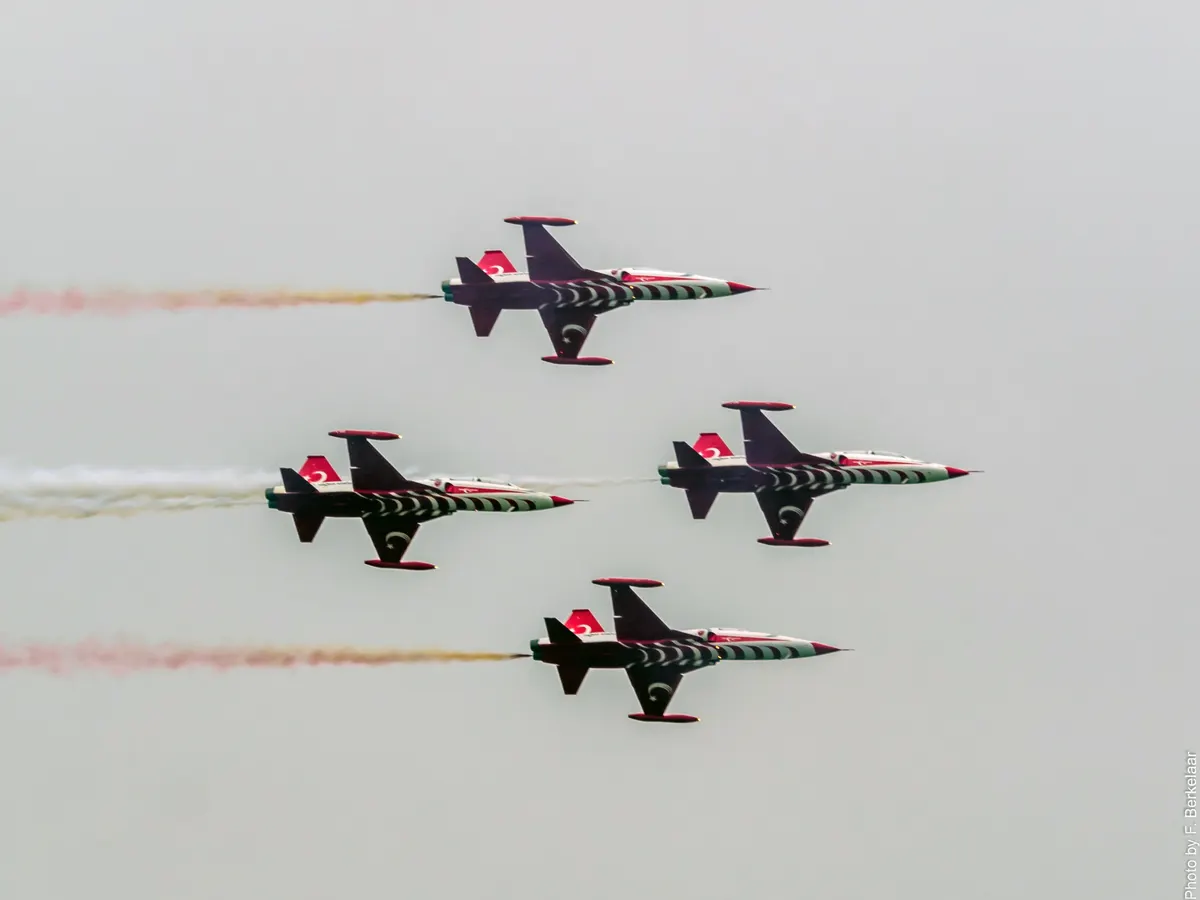
The maiden flight, on 25 April 2023, lasted 26 minutes, during which chief test pilot Ercan Çelik took the aircraft to about 14,000 ft and 250 knots with an F-16 chase plane alongside.2 Less than five months later, on 3 September 2023, the still-lone prototype flew a nine-flight, roughly nine-hour formation sequence with the Turkish Stars display team, an early and very public statement of intent about the aircraft's eventual second role.26
Flight-test tempo built steadily rather than explosively: the aircraft logged its 100th flight on 16 August 2024, by which point it had accumulated 118 flight hours, a pace consistent with a cautious, single-prototype test program rather than a rushed one.27
Breaking the Sound Barrier
A second prototype, structurally closer to the planned production standard, made its first flight on 12 November 2024, roughly doubling the size of the flight-test fleet at a stroke.20 Supersonic flight came in stages: a transonic test reaching Mach 0.9 at 30,000 ft on 11 July 2024, a first supersonic dash exceeding Mach 1 on 21 October 2024 out of Mürted airfield, and a Mach 1.2 flight announced by Turkish Aerospace on 17 April 2025.28
On 26 February 2025, the Turkish and Spanish air force commanders flew a joint formation with both prototypes, a deliberately staged image aimed at the still-pending Spanish sale.29 By 2026 the program had logged more than 500 combined test flights across at least four airframes, and TAI has stated an ambition to reach a production rate of two to three Hürjets per month as the Turkish Air Force's initial batch and the Spanish order both move through the assembly line.5
Block 0, Block 1 and the Armed LCA Standard
TAI describes the program in blocks rather than fixed variant names. Block 0 covers the flying prototypes, used to clear the basic flight envelope, structural limits, and supersonic performance. Block 1 is the intended production trainer standard for the Turkish Air Force and Spain, incorporating lessons from Block 0 flight test and adding refinements such as the aerial-refueling probe.30 Layered onto either block is the Light Combat Aircraft configuration, which keeps the same airframe and engine but adds wing and centerline stores stations rated for roughly 3.4 tonnes of ordnance; public weapons-carriage flight testing of this configuration began visibly in May 2026, when the second prototype was photographed flying with four underwing pylons fitted, though no live weapons release has been publicly confirmed as of this writing.20
A Naval Hürjet for Turkey's Future Carrier
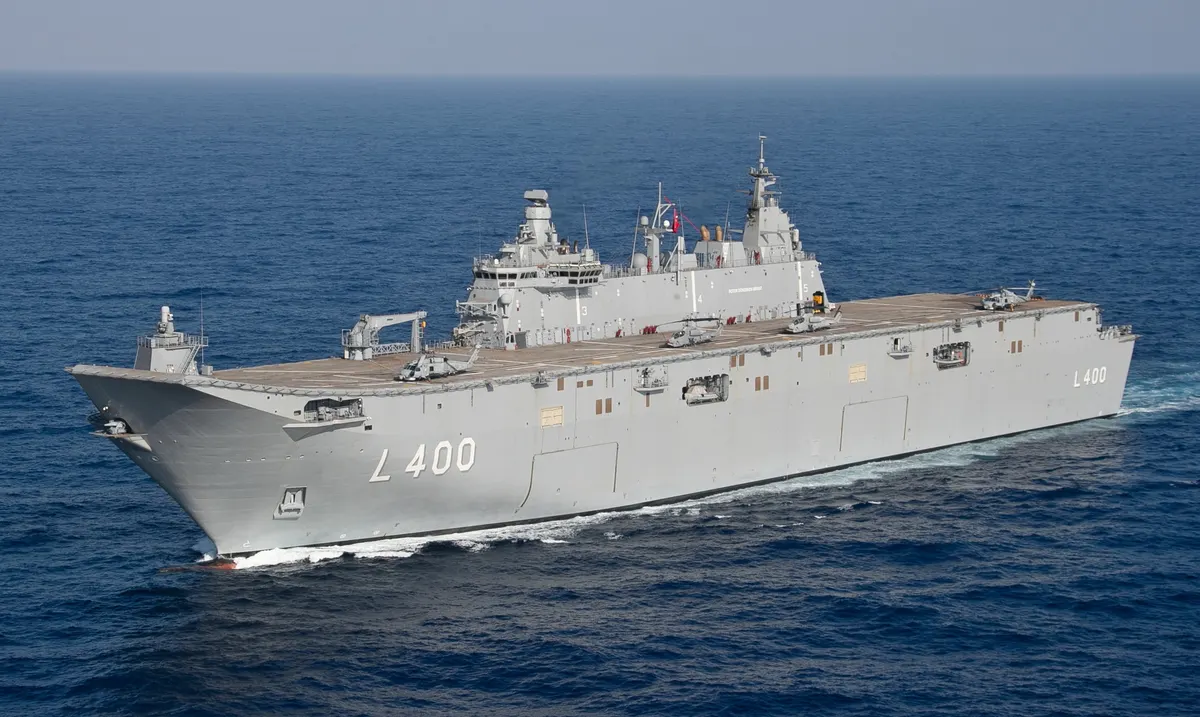
In May 2026, Turkish media reported that TAI had started design work on a carrier-capable Hürjet variant for the MUGEM-class carrier, an indigenous 60,000-tonne, 285-meter Turkish Navy vessel whose keel-laying began in January 2025 and which is planned as a ski-jump-equipped STOBAR carrier with its flight deck built to allow a later catapult retrofit.31 The naval Hürjet is described as receiving reinforced, shock-absorbing landing gear, a purpose-built arrestor hook, increased wing area to offset the added structural weight and shorter carrier deck runs, and full marinization of components against saltwater corrosion, all changes well beyond a simple hook-and-tailwheel bolt-on.32
The concept is notable mainly for what it is not: rather than developing or importing a heavy carrier-borne fighter, Turkey appears to be structuring MUGEM's planned air wing around a light, manned Hürjet derivative for training, air defense, and light strike, backed by multiple tiers of uncrewed aircraft such as the Kızılelma and Anka-3 for the heavier strike role.32 The naval variant remains at a paper and early-design stage, with no flying prototype, no confirmed in-service date, and every specific figure attached to it best treated as a design target rather than a settled specification; Spanish defense commentators have separately noted the concept's relevance to Madrid's own carrier-aviation thinking given Spain's parallel Hürjet purchase.32

Turkey: Replacing the T-38 and Re-Equipping the Turkish Stars
The Turkish Air Force is the launch customer and, alongside Spain, one of only two air arms with a firm order to date. TAI's original plan of four Block 0 prototypes plus an option for twelve Block 1 aircraft was converted into a firm order for sixteen production aircraft with an accelerated delivery schedule.30 TAI's own plan calls for the trainer configuration to enter service first, with the Turkish Stars configuration to follow; both the training command and the Turkish Stars are targeted to receive their first jets in 2026, though independent reporting has also cited 2027 as a more conservative internal delivery estimate.5 As of mid-2026, no Hürjet has been handed over to an operational Turkish Air Force unit; every flying airframe remains under TAI's own test and production-acceptance program.
Spain: The First Export Customer
Spain is, as of 2026, the only confirmed export customer. Hürjet was evaluated at Torrejón Air Base in July 2024 against the Leonardo M-346 and the Boeing/Saab T-7 Red Hawk for Spain's advanced-trainer requirement, a competition Leonardo lobbied hard to keep from being decided in Turkey's favor given the M-346's established position with several NATO air forces.33 Madrid and Ankara signed a cooperation memorandum in December 2024, and TAI and Airbus concluded a cooperation agreement in mid-2025 detailing a planned 30-aircraft procurement, after the Spanish government had approved acquisition of up to 45 Hürjets in September 2025.34
The firm contract, covering 30 aircraft and worth roughly €2.4-2.6 billion depending on the source, was signed on 28 December 2025, leaving the remaining 15 aircraft under the government's approved ceiling as an unconfirmed option.34 The plan calls for the first two aircraft to be delivered in a basic configuration in 2028-2029 and converted at Airbus's Getafe facility, with the remaining 28 to follow through a new Spanish Conversion Centre and enter Spanish Air and Space Force service progressively through 2031-2035 fitted with Spanish mission systems; Airbus formally launched the Spanish industrial consortium, which includes Indra, GMV, Sener, Aertec, Grupo Oesía, Orbital, and ITP with roughly 60 percent Spanish industrial participation, on 28 April 2026.35
Bids Lost and Bids Pending
Hürjet's export record is not one of unbroken success. It was offered into Malaysia's light combat aircraft competition, launched in 2021 with an approximately $900 million budget for 18 aircraft, competing against the KAI T-50/FA-50, the Leonardo M-346, the HAL Tejas, the Hongdu L-15, the Mikoyan MiG-35, and others; Malaysia selected the T-50/FA-50 family in 2023.36 TAI has since pursued other Southeast Asian prospects and has been reported as a contender in discussions around the US Navy's eventual T-45 Goshawk replacement and around a possible Japanese successor to the Kawasaki T-4, though neither of those represents a firm bid or contract as of 2026.20
Hürjet's closest rivals in the advanced-jet-trainer-and-light-attack category are the Korean KAI T-50 Golden Eagle and the Italian Leonardo M-346 Master, and the contrast with each highlights a different tradeoff in the design.
Against the T-50, the comparison is closer than it looks on paper, because both aircraft use the same base engine. The T-50 also flies on a General Electric F404 (a slightly different -102 variant with extra single-engine redundancy features) and posts a similar top speed around Mach 1.5, a higher service ceiling near 55,000 ft, and a broadly similar sustained-g figure.37 The real difference is maturity, not physics: the T-50 first flew in 2002, has been in frontline service with South Korea and several export customers since the mid-2000s, and has an established combat-capable derivative (the FA-50) with a real, if limited, operational record. Hürjet offers a newer glass cockpit and a more current avionics architecture, but it is competing against a design that has already answered the questions Hürjet has not yet been asked, such as how the type behaves over years of squadron use, deployment, and attrition.
Against the M-346, the tradeoff is closer to first principles. The M-346 is twin-engine, subsonic (a level top speed near 1,090 km/h), and traces its aerodynamic lineage to a shared 1990s design effort with what became the Russian Yak-130 before the Italian side diverged onto Western Honeywell F124 engines and Western avionics.38 Twin engines give the M-346 a redundancy margin a single-engine Hürjet cannot match, an argument Leonardo has made directly and repeatedly while lobbying against Hürjet in competitions such as Spain's, and the M-346 already flies with Italy, Israel, Singapore, Poland, Qatar, and Greece, a customer list Hürjet cannot yet approach.39 Hürjet's answer is speed and altitude: a genuinely supersonic Mach 1.4 top end against the M-346's subsonic performance, which TAI argues lets a Hürjet-trained pilot experience compressibility effects and high-speed handling that a subsonic trainer cannot replicate before that pilot moves to an F-16 or a KAAN.
| Spec | Hürjet | KAI T-50 | M-346 Master |
|---|---|---|---|
| Engines | 1 x GE F404-GE-104 | 1 x GE F404-GE-102 | 2 x Honeywell F124 |
| Top speed | Mach 1.48 | Mach 1.537 | ~1,090 km/h (subsonic)38 |
| Service ceiling | 45,000 ft14 | 55,000 ft37 | 45,000 ft38 |
| First flight | 20232 | 200237 | 200438 |
| In frontline service | No | Yes | Yes |
Whether Hürjet ultimately competes on price is the open question analysts raise most often, since the Spanish contract bundles airframes with an entire training system, conversion work, and decade-long support; the roughly €2.5 billion figure for 30 aircraft is not a clean per-airframe number and is not a reliable price comparison against a bare T-50 or M-346 unit cost.34


Is the Hürjet supersonic? Yes. TAI's published maximum speed is Mach 1.4, and the aircraft has publicly demonstrated flight past Mach 1 (October 2024) and up to Mach 1.2 (April 2025), making it one of the few dedicated jet trainers in the world capable of supersonic flight.28
Is the Hürjet in service yet? No. As of mid-2026 every flying Hürjet remains a test or pre-production airframe under TAI control. The Turkish Air Force's training command and Turkish Stars are both targeted to receive first aircraft in 2026, and Spain's first deliveries are planned for 2028-2029.5,35
How many Hürjets have been built? At least four flying prototype/pre-production airframes were confirmed in flight test by May 2026, with additional Block 1 production aircraft in assembly for the Turkish Air Force's firm order of sixteen units and for Spain's firm order of 30.20,30
What engine does the Hürjet use? A single General Electric F404-GE-104 afterburning turbofan, the same engine family used in the F/A-18 Hornet, the KAI T-50, and (in an uprated form) the HAL Tejas.8,9
Hürjet vs T-50 vs M-346: which is better? There is no single answer; each favors a different priority. The T-50 offers a decade-plus operational record and a slightly higher service ceiling, the M-346 offers twin-engine redundancy and an established customer base, and Hürjet offers newer avionics and demonstrated supersonic performance in a still-unproven package.
Will Hürjet replace the T-38 in Turkish service? That is TAI's and the Turkish Air Force's stated intent, but it has not happened yet; the T-38M Talon remains Turkey's advanced trainer pending Hürjet's actual squadron delivery.1
- "TAI Hürjet", Wikipedia — en.wikipedia.org ↩
- "Turkey's Jet Trainer And Light Attack Aircraft HURJET Makes Its First Flight", Overt Defense — overtdefense.com ↩
- "Turkey's First Homegrown Manned Tactical Jet Has Flown", TWZ — twz.com ↩
- "TUSAŞ's New Hürjet Aircraft Gains More Combat Capacities", TURDEF — turdef.com ↩
- "TAI targets monthly production of 3 Hurjet aircraft as Türkiye ramps up defense programs", Türkiye Today — turkiyetoday.com ↩
- "Spain Signs Contract for 30 Hürjets", The Aviationist — theaviationist.com ↩
- "Turkey - Jet Trainer Aircraft (T-X) Freedom Trainer", GlobalSecurity.org — globalsecurity.org ↩
- "HÜRJET", TUSAŞ (official product page) — tusas.com ↩
- "Why the General Electric F404 Is Still the King of Fighter Engines", Militarybudget.org — militarybudget.org ↩
- "Turkish Aerospace, TUSAŞ Engine Industries and GE Aerospace Sign MOU to Extend Collaboration on HÜRJET Advanced Training Jet Program", GE Aerospace — geaerospace.com ↩
- "Türkiye accelerates domestic engine development with TF6000, TF10000", Türkiye Today — turkiyetoday.com ↩
- "Turkey Begins Assembly Of Hürjet National Jet Trainer Prototype", The Aviationist — theaviationist.com ↩
- "TAI Hürjet", Wikipedia — en.wikipedia.org ↩
- "HÜRJET", TUSAŞ (official product page) — tusas.com ↩
- "TAI Hürjet", Wikipedia — en.wikipedia.org ↩
- "HÜRJET", TUSAŞ (official product page) — tusas.com ↩
- "HÜRJET Turkish Jet Trainer", US Army TRADOC ODIN — odin.tradoc.army.mil ↩
- "TUSAŞ President & CEO Mehmet DEMİROĞLU: 'We Are Ready to Sign the HÜRJET Contract with Spain'", Defence Turkey — defenceturkey.com ↩
- "Turkey's Hürjet Trainer Spotted With Weapon Pylons", MiGFlug — migflug.com ↩
- "Hürjet Spotted Flying with Underwing Weapon Pylons", The Aviationist — theaviationist.com ↩
- "Turkey - Jet Trainer Aircraft (T-X) Freedom Trainer", GlobalSecurity.org — globalsecurity.org ↩
- "SNC Debuts Freedom Trainer Jet to Compete in US Navy Program Replacing Aging T-45 Goshawk Fleet", Army Recognition — armyrecognition.com ↩
- "HÜRJET New Generation AJT's CDR Phase Completed", Defence Turkey — defenceturkey.com ↩
- "Turkey Unveils The First Prototype of the HURJET Jet Trainer and Light Attack Aircraft", Overt Defense — overtdefense.com ↩
- "Türkiye's Hürjet prototype of light attack jet completes first flight with key design modifications", Army Recognition — armyrecognition.com ↩
- "Hürjet Flies in Formation with Turkish Stars Acroteam", TURDEF — turdef.com ↩
- "TAI Hürjet", Wikipedia — en.wikipedia.org ↩
- "Türkiye's TAI Hurjet reaches supersonic speed of mach 1.2 in flight test", Türkiye Today — turkiyetoday.com ↩
- "TAI Hürjet", Wikipedia — en.wikipedia.org ↩
- "TAI Hürjet", Wikipedia — en.wikipedia.org ↩
- "MUGEM-class aircraft carrier", Wikipedia — en.wikipedia.org ↩
- "Türkiye Begins Naval Hürjet Development for MUGEM Carrier", Quwa — quwa.org ↩
- "Leonardo Tries to Convince Madrid for M346 over Hürjet", TURDEF — turdef.com ↩
- "Spain Signs Contract for 30 Hürjets", The Aviationist — theaviationist.com ↩
- "Airbus leads national industry launch of Spain's new combat training system", Airbus — airbus.com ↩
- "Big Victory For Turkey's Hurjet Aircraft; After Malaysian Setback, TAI Wins Maiden Export Order From Spain", Eurasian Times — eurasiantimes.com ↩
- "KAI T-50 Golden Eagle", Wikipedia — en.wikipedia.org ↩
- "Alenia Aermacchi M-346 Master", Wikipedia — en.wikipedia.org ↩
- "Will Spanish Pilots Embrace Hürjet? M-346 Remains a Contender?", Frontier India — frontierindia.com ↩