

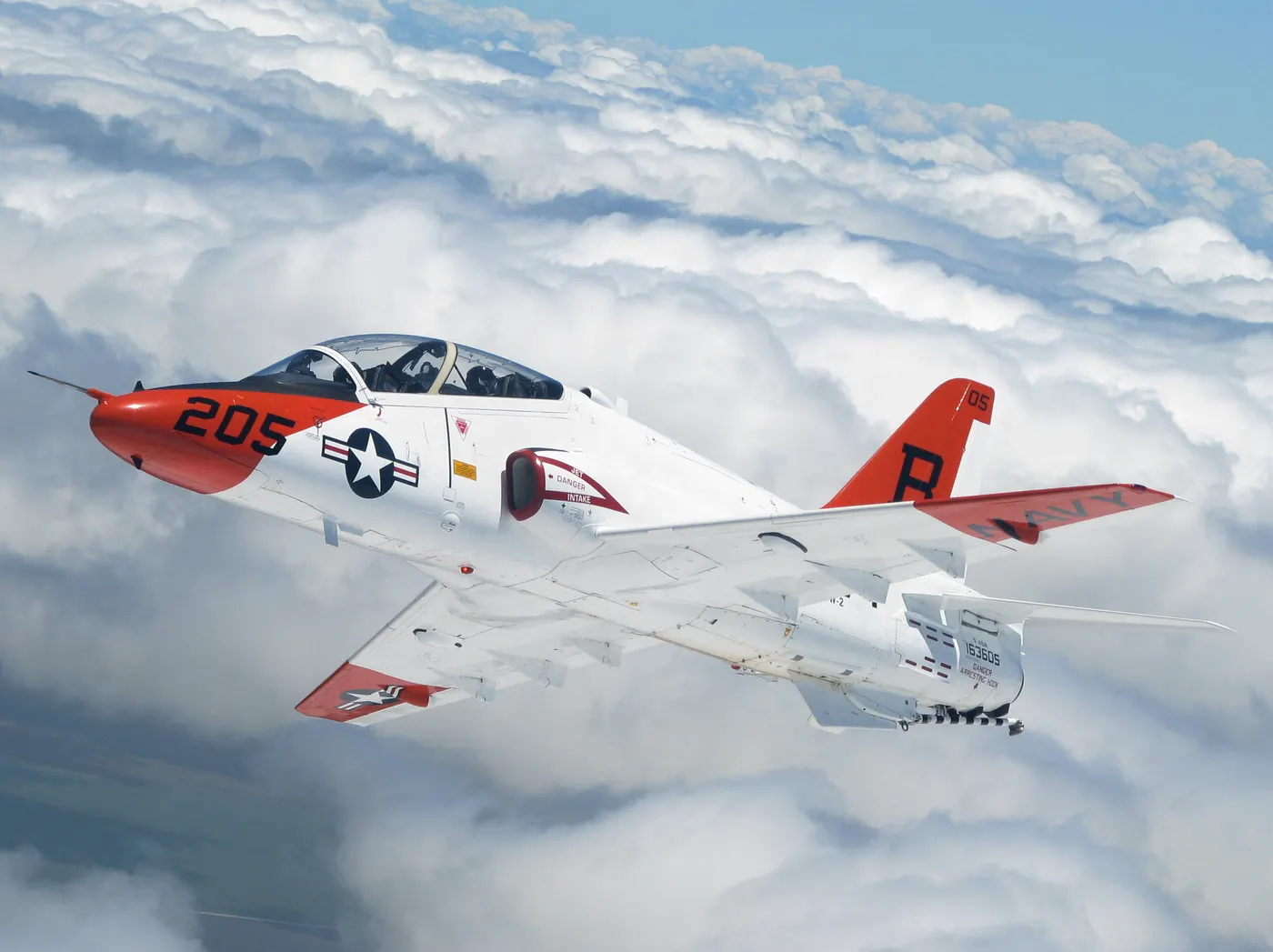

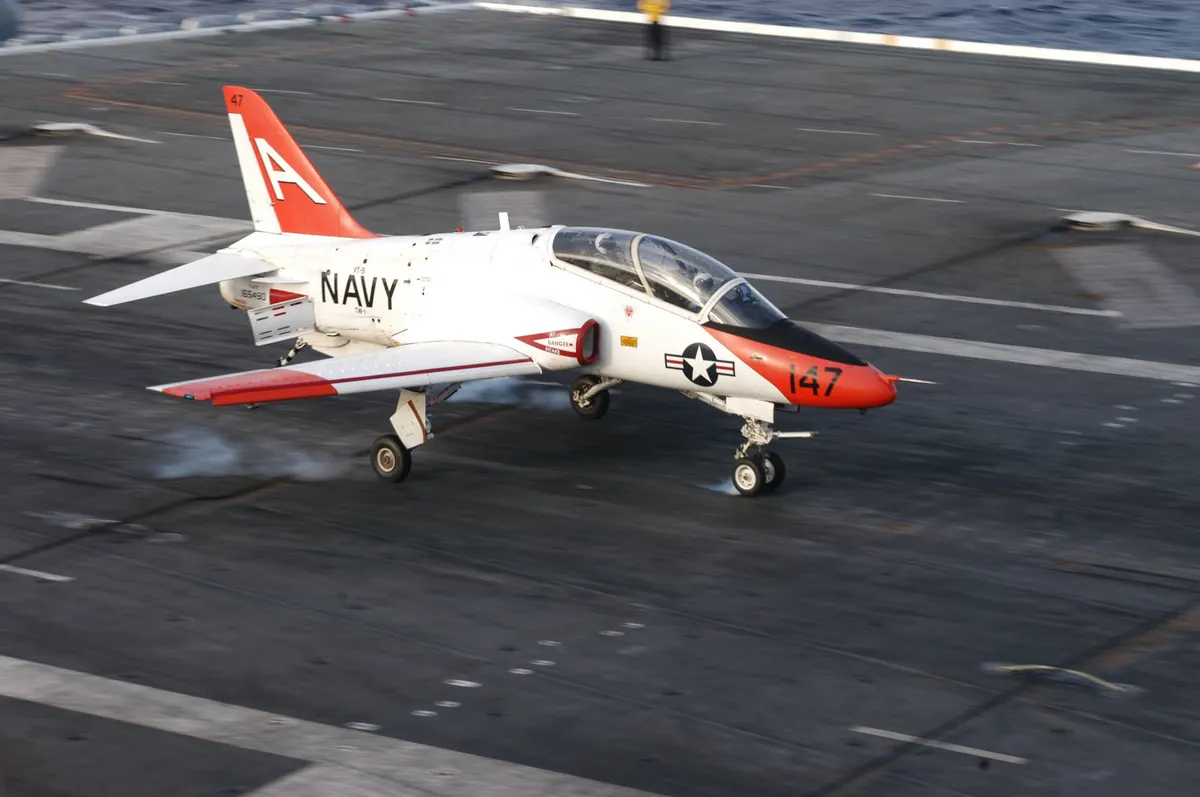
The McDonnell Douglas T-45 Goshawk is a tandem-seat, carrier-capable jet trainer built for the United States Navy, developed from the British Aerospace Hawk under a 1981 Anglo-American program and flown operationally since 1991.1 It turns a student naval aviator into a carrier aviator: strengthened landing gear, an arrestor hook, and a catapult tow fitting let it launch from and recover aboard a moving flight deck, something its land-based Hawk cousin cannot do.1,2 Two hundred twenty-one were built between 1988 and 2009, and the type remains the sole aircraft in the Navy's inventory dedicated to that task.3
- Only jet trainer that carrier-qualifies naval aviators
- Structurally proven for catapult launches and arrested landings
- Docile, forgiving handling for students learning carrier approach speeds
- Cockpit 21 avionics bridge students toward fleet fighter displays
- Analog origins mean an increasingly obsolete parts and support base
- Adour engine and OBOGS have driven repeated fleet-wide groundings
- No air-to-air radar or weapons system to rehearse tactical employment
- Never exported, so no shared production or sustainment base abroad
That exclusivity narrowed slightly in March 2025. For decades, every student in the Navy and Marine Corps strike-fighter pipeline had to complete an at-sea carrier qualification detachment in the Goshawk before receiving their wings. Under a restructured syllabus, most strike pipeline graduates now complete only field carrier landing practice ashore and finish their first real carrier landings later, in the F/A-18 Fleet Replacement Squadron. Students bound for the E-2 Hawkeye community, and international military students training alongside them, still qualify at sea in the T-45C before graduation.4,5
The airframe traces to a 1970s Navy requirement (the VTX-TS program) to replace two separate trainers, the North American T-2 Buckeye and the Douglas TA-4J Skyhawk, with a single type covering intermediate and advanced jet instruction.6 British Aerospace and McDonnell Douglas won that competition in November 1981 with a navalized Hawk Mk 60, beating a Dassault/Dornier Alpha Jet proposal and other contenders; the deal split manufacturing across the Atlantic, with BAe building wings and rear fuselage in England and McDonnell Douglas (later Boeing) handling final assembly in the United States.6,7
More than three decades on, the design is showing its age. The Navy has opened a formal competition, the Undergraduate Jet Training System (UJTS), to replace the Goshawk, citing rising obsolescence in the airframe, the Rolls-Royce engine, and onboard systems that officials say will erode aircraft availability by 2030.8 A contract award is targeted for 2027 with first deliveries planned for 2032, meaning the T-45 is likely to keep training naval aviators into the mid-2030s even as its successor is chosen.8,9
The Navalized Airframe: From Hawk Mk 60 to Carrier Trainer
Converting the land-based Hawk into a deck-capable aircraft touched almost every structural element behind the cockpit. Engineers fitted a deeper forward fuselage to house a new twin-wheel nose gear with a catapult tow bar and improved steering, replaced the single ventral airbrake with twin lateral perforated airbrakes on the rear fuselage sides (nicknamed SMURFS, for Side-Mounted Upper Rear Fuselage Strakes), and lengthened the tail fin by six inches for stability at the low approach speeds carrier landings demand.7,10 The main gear was redesigned with a longer stroke to absorb sink rates of roughly 4.3 meters per second, far harder than a runway landing, and the whole airframe and engine mounting structure were reinforced to survive the repeated shock of catapult shots and trap landings across a multi-decade service life.7
- First Flight1988
- Service Entry Year1991
- Crew (seats)2
- Trainer Typeintermediate and advanced jet trainer
- In ServiceYes
None of this came free. At roughly 4,262 kg empty and up to 6,123 kg at maximum takeoff weight, the Goshawk is measurably heavier than the export Hawk it was built from, a direct tax for the added structure.11 Overall dimensions stayed close to the parent design: length just under 12 meters, a wingspan of 9.39 m, and a height of roughly 4.1 m, with squared-off wingtips and leading-edge slats added on the British side of the program to improve low-speed handling.7,11 The result flies at up to 543 knots (about 1,006 km/h) at 8,000 ft, with a service ceiling of 42,500 ft (12,954 m) and a sustained climb rate near 8,000 ft/min at sea level, figures a strike-fighter candidate needs to feel before ever touching an F/A-18.11,12
- Engine TypeRolls-Royce Turbomeca F405-RR-401
- Thrust26
- Power (turboprop)19 kW
The Rolls-Royce Turbomeca F405 Adour and a Split-Ocean Engine
A single Rolls-Royce Turbomeca F405-RR-401 turbofan, the US Navy's designation for the Adour Mk 861 used in the Hawk family, powers the aircraft. The engine traces back to the 1960s SEPECAT Jaguar program, a joint Rolls-Royce (Bristol, England) and Turbomeca (France) venture, and by the time it went into the Goshawk it had already logged millions of flight hours across Jaguars and Hawks worldwide, a reputation for ruggedness that made it a low-risk choice for a new trainer.13 Rated thrust is commonly quoted two ways: a nominal figure near 5,845 lbf (26.0 kN) and a de-rated, flight-cleared figure of 5,527 lbf (24.6 kN), the lower number reflecting the margin the Navy built in for engine life and reliability rather than raw output.11 A mid-1990s bid to build the Adour in the United States through Rolls-Royce's newly acquired Allison Engine Company fell through in 1997, so the powerplant has remained a genuinely transatlantic product for the airframe's entire service life, sourced from Britain and France rather than domestic industry.7
- Top Speed1,005.549 km/h
- Cruise Speed800 km/h
- Service Ceiling12,954 m
- Range1,296.4 km
- Rate of Climb40.64 m/s
- G-Limit7.33
- Endurance3
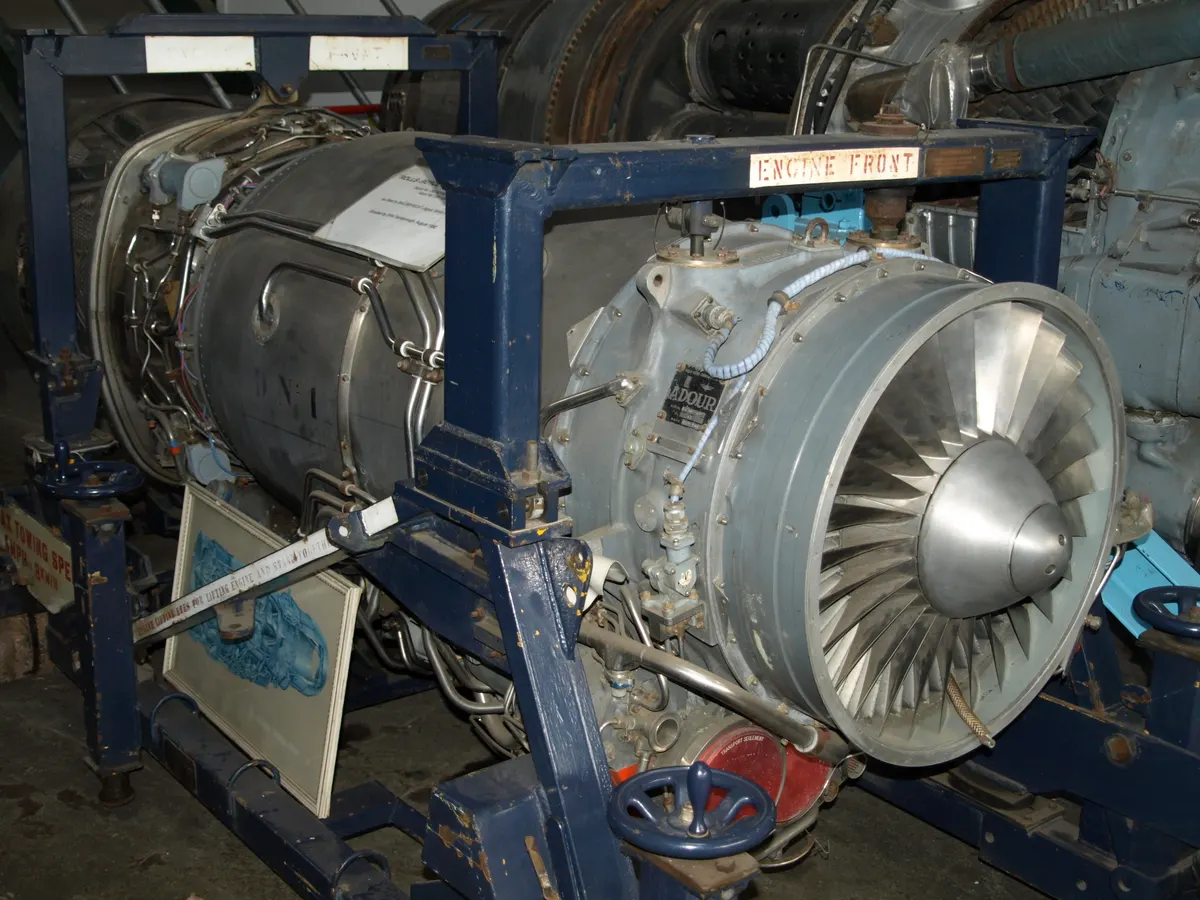
That reliability record has not made the Adour immune to modern sustainment problems. In October 2022 the entire T-45 fleet was grounded for two weeks after inspectors found a low-pressure compressor blade fault during routine pre-flight checks, one of several engine-related stand-downs that have punctuated the aircraft's later career.14 Rolls-Royce has told the Navy it will only support the Adour through 2035, a deadline now converging with the UJTS replacement schedule.15
- Cockpit Configurationtandem two-seat
- Glass CockpitYes
- Embedded SimulationNo
- Light Attack CapableNo
- Hardpoints0
- Ejection SeatsYes
Analog to Digital: The T-45A and the "Cockpit 21" Rebuild
The first 83 aircraft delivered, designated T-45A, carried an analog instrument panel essentially unchanged in philosophy from 1970s Hawk trainers.16 Starting in December 1997, Boeing delivered a new-build variant, the T-45C, fitted with a digital "Cockpit 21" suite: two multi-function displays in each seat, a head-up display, and an inertial navigation system, built specifically to resemble the displays students would meet in frontline F/A-18 and F-35 cockpits rather than the gauges of the aircraft they were leaving behind.16,17 From 2003 the Navy ran a Required Avionics Modernization Program that rewired every surviving T-45A to the same Cockpit 21 standard, so today the operational fleet is avionically uniform even though the airframes themselves span two decades of production.7
- Length11.887 m
- Wingspan9.39 m
- Height4.08 m
- Max Takeoff Weight5,900 kg
By value, the Goshawk splits close to evenly across the Atlantic but tilts toward the United States. BAE Systems in England builds the wings, aft fuselage, air inlets, and vertical tail, while Boeing (originally McDonnell Douglas, in Long Beach and then St. Louis) manufactures the forward fuselage and cockpit, installs the undercarriage and engine, and performs final assembly.7 The single largest foreign component is the powerplant itself: the Rolls-Royce Turbomeca F405-RR-401 is a Britain-and-France joint product with no American production share, a legacy of a failed 1990s attempt to license-build the Adour domestically through Rolls-Royce's Allison subsidiary.7 Mission avionics, by contrast, are almost entirely American: Honeywell, Rockwell Collins, and Northrop Grumman equipment fills the Cockpit 21 suite.11
- Total Built221
- Operators1
- Production Start1988
- Production End2009
- Operational Statusin service
The Navy's search for a combined intermediate-and-advanced jet trainer began in the mid-1970s and formally launched as the VTX-TS program in 1978, aimed at retiring both the T-2 Buckeye and the TA-4J Skyhawk with one design.6 An Anglo-American team pairing British Aerospace with McDonnell Douglas proposed navalizing BAe's Hawk Mk 60, competing against a Dassault/Dornier Alpha Jet bid and Lockheed's own submission; the Hawk derivative was declared the winner on 18 November 1981, and a full-scale development contract followed in September 1982.6,7
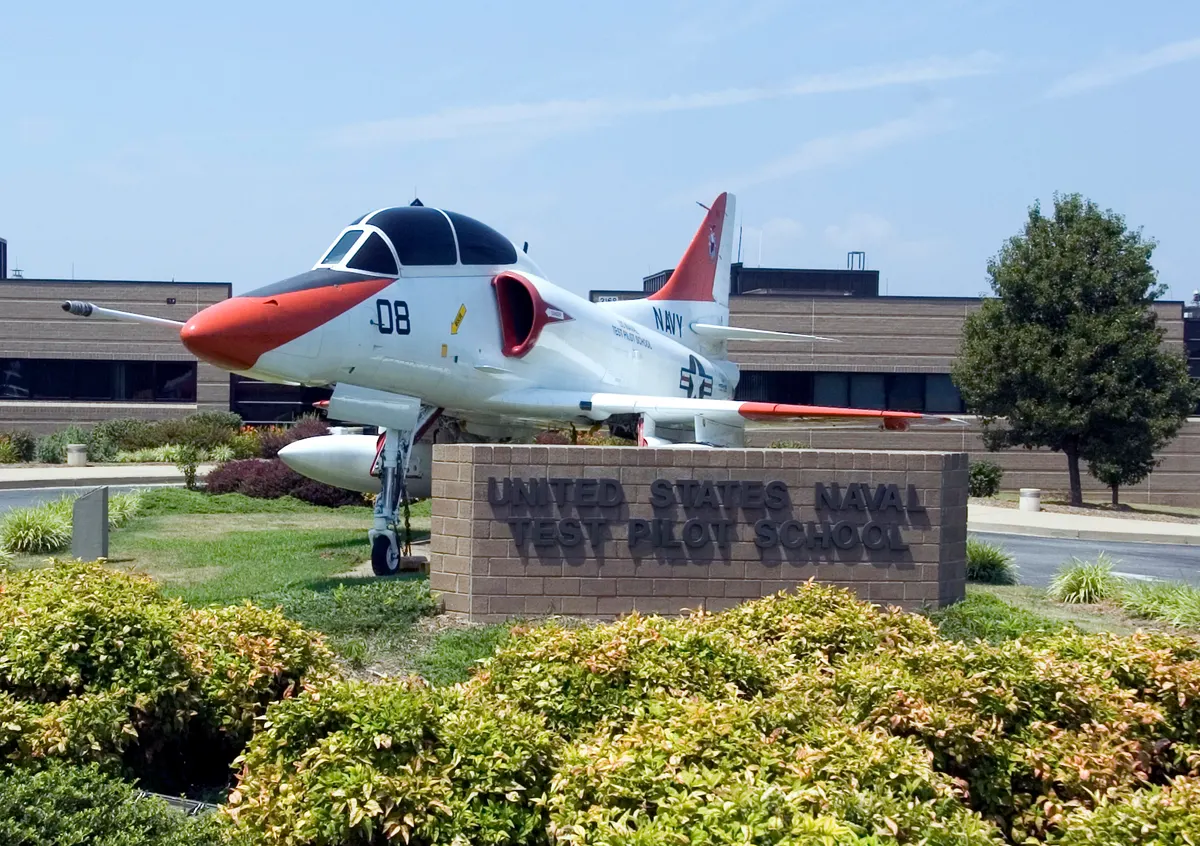
The prototype first flew on 16 April 1988, and after an extended test and carrier-suitability program the type entered fleet service in 1991 under the name Goshawk.6,18 Production ran until November 2009, by which point 221 airframes, two prototypes and 219 production aircraft split between the T-45A and T-45C standards, had rolled off the line; 16 March 2007 had marked the ceremonial delivery of the 200th airframe.3,19 The Navy also briefly flight-tested an alternative International Turbine Engine Company F124 engine on a T-45A testbed in October 1996, an effort to reduce Adour dependence that went nowhere.7
The most disruptive episode in the aircraft's career began in April 2017, when more than 100 T-45C instructor pilots at Naval Air Stations Kingsville, Meridian, and Pensacola refused to fly, citing a sharp rise in hypoxia-like physiological episodes they linked to the Cobham GGU-7 On-Board Oxygen Generation System (OBOGS).21 Ninety-four flights were cancelled on 7 April alone. The Navy first ordered a three-day safety pause, then extended it indefinitely, before settling on an interim compromise that let flights resume below 10,000 ft, where OBOGS was not required, while instructors flew missions above that altitude.21,22 Restrictions were lifted by August 2017 after the fleet received new oxygen-system sensors and a revised water separator, and Cobham later fitted an upgraded GGU-25 generator fleet-wide; a Pentagon-wide review found the T-45 was one of several types, alongside the F/A-18, T-6, F-22, and F-35, wrestling with unexplained physiological events in the same period.23,24

Accidents have been a steady, if not epidemic, feature of the program. As of May 2026 roughly 34 Goshawks, about 15% of the total built, had been destroyed since 1991, a rate close to one airframe a year, with at least seven fatalities.18,20 Bird strikes caused a 2021 crash into a Lake Worth, Texas neighborhood that injured five people and damaged three homes, and a 2022 crash near NAS Kingsville from which the sole instructor safely ejected; investigators separately attributed a March 2021 loss to a mechanical hydraulic failure and an October 2017 fatal crash near Tellico Plains, Tennessee to aggressive maneuvering by the instructor and student.18,20,25 The most recent loss came in late May 2026, when a T-45C went down near Naval Air Station Meridian, Mississippi; both aviators aboard survived, and the wing paused some training flights while investigators worked the case.26
Retirement is now formally underway on the procurement side. The Navy released a final Request for Proposals for the Undergraduate Jet Training System in March 2026, seeking 216 aircraft with a contract award targeted for 2027 and first deliveries in 2032.8,9 The field has narrowed sharply: Lockheed Martin withdrew its TF-50N in early 2026 over required US-content levels, and Boeing declined to offer its T-7A Red Hawk, judging it did not fit the Navy's requirements, leaving Sierra Nevada Corporation's clean-sheet Freedom Trainer (with Northrop Grumman and General Atomics) and a Textron/Leonardo M-346N pairing as the remaining contenders.27,28,29 Notably, the new requirement drops the demand that the replacement itself be able to complete a full carrier landing to touchdown, only a wave-off approach, formalizing the syllabus shift that already moved most students' first real carrier landing to the Fleet Replacement Squadron stage.5
The Goshawk has no combat record, and it was never designed to have one. It has flown exclusively from US Navy training commands, Training Air Wings One, Two, and Six at Meridian, Kingsville, and Pensacola, plus a small test detachment at Patuxent River, and it has never been exported to a foreign air arm or fielded operationally by the United States.18 That puts it in a different category from one of the aircraft it replaced: Marine Corps TA-4J Skyhawks, modified as Fast Forward Air Controllers, actually flew over Vietnam directing strikes, a combat role its successor trainer was never asked to fill.30
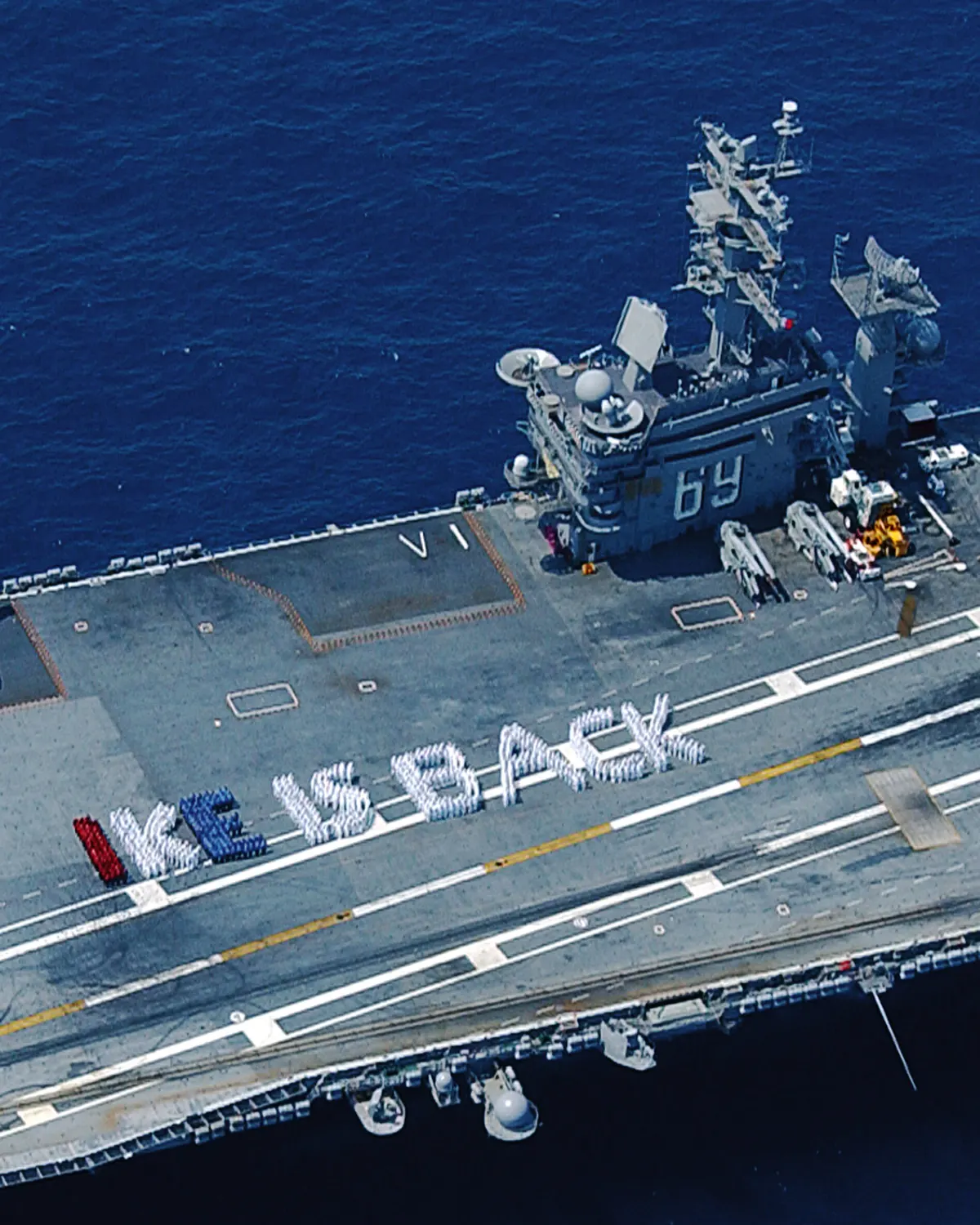
What the T-45 does provide is a rehearsal space shaped by real combat experience one step removed. Many of its instructor pilots are veterans of the strike-fighter squadrons that flew over Iraq, Afghanistan, Libya, and Syria, and the carrier qualification syllabus, arrested landings and touch-and-go approaches flown to a real flight deck, exists specifically because those same instructors know what a first unassisted carrier landing looks like in a combat air wing. In late June 2026, 24 student naval aviators, including 15 headed for the E-2 Hawkeye community, seven international military students, and two strike pilots, completed 428 arrested landings and 143 touch-and-goes aboard USS Dwight D. Eisenhower in a single four-day detachment, the kind of high-tempo evolution the syllabus is built to produce before those pilots ever reach a real carrier air wing.31 For the international students in that cohort, several of whom go on to fly combat sorties in their own nations' air forces, the T-45 is the only aircraft in which they will ever land on a US carrier.
The baseline T-45A entered service in 1991 with the analog cockpit inherited from the Hawk lineage; 83 were built before Boeing shifted to the improved standard.16 A proposed T-45B, a land-based Hawk with a Navy-specific cockpit but no carrier gear, was studied but dropped in 1984 in favor of cheaper interim fixes to the existing T-2 and TA-4 fleets rather than a second, non-navalized derivative.7
From December 1997 the T-45C introduced the "Cockpit 21" digital suite described above, and became the standard for all new production; from 2003 the Required Avionics Modernization Program retrofitted every remaining T-45A to the same configuration, so the T-45A designation no longer describes any aircraft actually flying today.7,16 A specialized batch of 19 T-45Cs delivered from 2008 added a Virtual Mission Training System that simulates the Boeing F/A-18E/F's APG-73 radar, letting student Naval Flight Officers at Pensacola rehearse air-to-ground and air-to-air radar employment the airframe itself has no hardware to perform.7 A further upgrade, sometimes referred to informally as the T-45D and reportedly intended to add manufacturing refinements and a helmet-mounted display, was studied but never funded or built.7

The United States Navy is the Goshawk's only operator, and always has been. It trains Navy and Marine Corps student naval aviators and, through the Chief of Naval Air Training command structure, US Coast Guard and allied international military students as well, distributed across Training Air Wing One at NAS Meridian, Mississippi, Training Air Wing Two at NAS Kingsville, Texas, and Training Air Wing Six at NAS Pensacola, Florida, with a handful of test aircraft at Patuxent River, Maryland.18,32
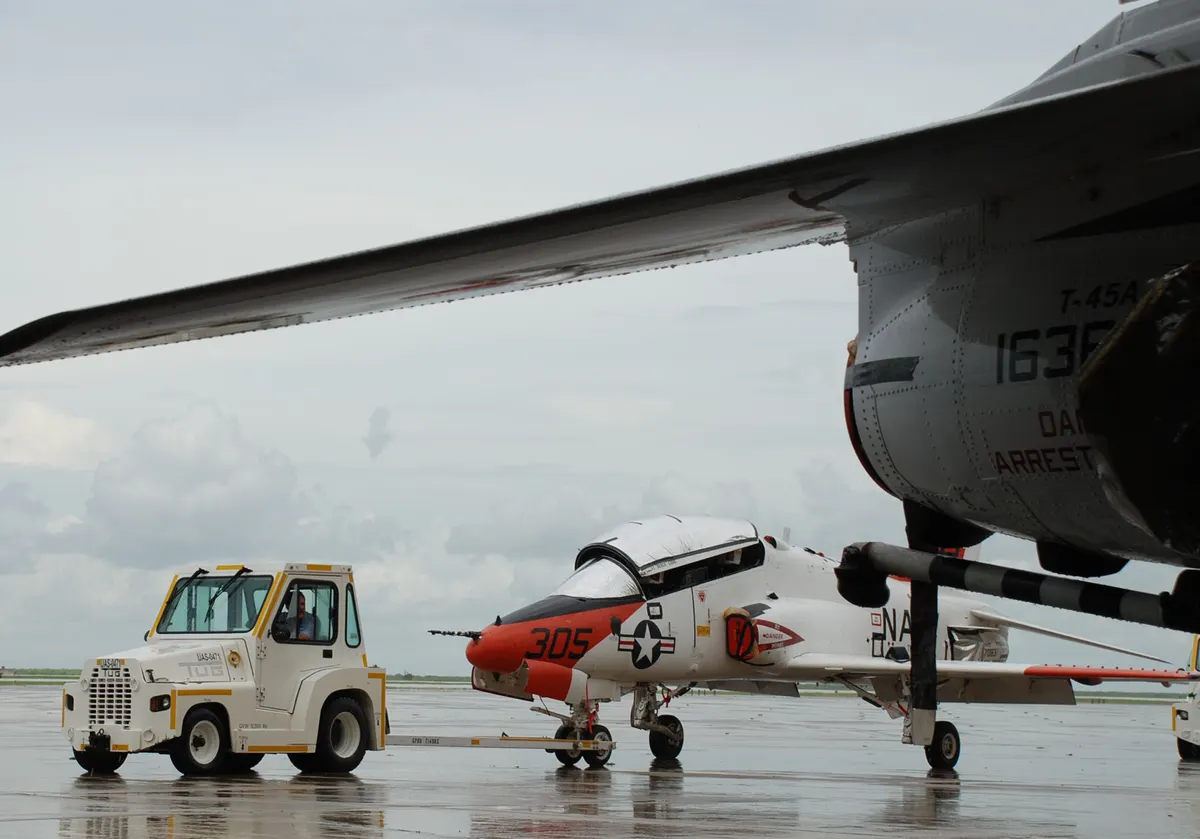
That single-operator status is not for lack of trying. Boeing and McDonnell Douglas pitched the T-45 abroad repeatedly and never closed a deal: teamed with Rockwell in the mid-1990s for a Royal Australian Air Force requirement, pitched to Israel in the early 2000s, marketed to Greece in 2006 alongside the Beechcraft T-6A Texan II, and discussed with the Indian Navy in 2007.7 None converted into an order, partly because the carrier-capable version's cost made sense only for a navy operating large fixed-wing carriers, a short list that already had its own trainers or no equivalent flight-deck requirement at all.
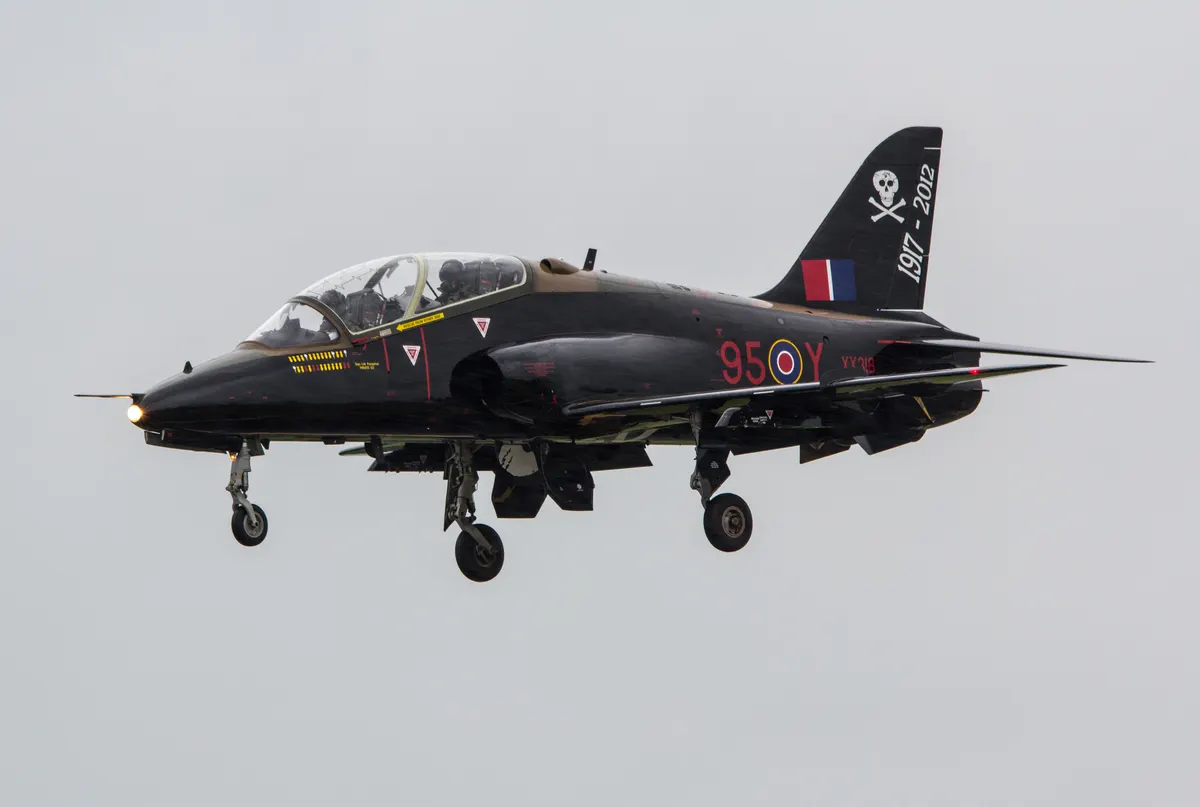
The most instructive comparison is the one built into the airframe: the T-45C against the land-based BAE Systems Hawk T1 it was adapted from. Both share the same basic wing, tail, and Adour-family engine, but the resemblance masks a real performance gap. The Hawk T1, unburdened by naval reinforcement, is lighter at roughly 3,647 kg empty, reaches a marginally higher top speed near 1,028 km/h, and can carry weapons on five hardpoints for a light-attack role the Goshawk was never fitted for.33 The Goshawk trades that margin for a twin-wheel catapult nose gear, a strengthened long-stroke main gear, an arrestor hook, and the SMURFS airbrakes needed to survive a carrier approach, structure that adds several hundred kilograms and slightly reduces peak speed and climb relative to its unmodified cousin.7,33 A Royal Air Force Hawk student and a US Navy Goshawk student experience broadly similar handling and cockpit workload right up until the approach turn to a carrier, where the Goshawk's entire reason for existing takes over.
| Spec | T-45C Goshawk | BAE Hawk T1 | Boeing/Saab T-7A Red Hawk |
|---|---|---|---|
| Empty weight | ~4,262 kg | ~3,647 kg | n/a (MTOW ~5,500 kg) |
| Top speed | ~1,006 km/h (M0.84) | ~1,028 km/h (M0.88) | Supersonic (M1.4+) |
| Engine | 1x Adour F405-RR-401, ~24.6 kN | 1x Adour Mk951, FADEC | 1x GE F404, ~76 kN with afterburner |
| Carrier capable | Yes | No | No |
A second, more pointed comparison is with the aircraft that is not replacing it. The Air Force's Boeing-Saab T-7A Red Hawk targets the same basic mission with a genuinely modern digital cockpit, embedded simulation, and supersonic performance the Goshawk cannot match.34 Yet Boeing chose not to offer the T-7A for UJTS at all, judging it did not meet the Navy's requirements, a tacit admission that carrier-suitable handling needs structural characteristics a supersonic, land-optimized design was never built around.28 The T-45's true successors, Sierra Nevada's clean-sheet Freedom Trainer and a Textron/Leonardo M-346N derivative, both had to be designed or adapted from the outset with carrier-approach handling in mind, the same constraint that turned an export Hawk into a Goshawk in the first place.27,29


What are the T-45 Goshawk's specifications? The T-45C is a tandem two-seat jet trainer roughly 12 m long with a 9.39 m wingspan, a maximum takeoff weight near 6,123 kg, a top speed of about 543 knots (1,006 km/h), a service ceiling of 42,500 ft, and a single Rolls-Royce Turbomeca F405-RR-401 turbofan.11,12
How many T-45 Goshawks were built? Boeing and BAE Systems built 221 aircraft, two prototypes plus 219 production airframes, between the 1988 first flight and the final delivery in November 2009.3,19
Is the T-45 Goshawk still in service? Yes. It remains the US Navy's only carrier-qualification jet trainer as of 2026, though the Navy has opened a formal replacement competition (UJTS) targeting a contract award in 2027 and first deliveries in 2032, with the Goshawk expected to keep flying into the mid-2030s during the transition.8,9
What is replacing the T-45 Goshawk? As of mid-2026 the field has narrowed to two contenders: Sierra Nevada Corporation's clean-sheet Freedom Trainer and a Textron/Leonardo M-346N, after Lockheed Martin and Boeing both withdrew their respective bids.27,28,29
How is the T-45 Goshawk different from the BAE Hawk? The Goshawk is a heavier, structurally reinforced version of the Hawk with a twin-wheel catapult-capable nose gear, an arrestor hook, redesigned main landing gear, and side-mounted airbrakes, changes needed for carrier launches and landings that the standard land-based Hawk was never built to survive.7,33
Why did Navy instructors refuse to fly the T-45 in 2017? More than 100 instructor pilots declined to fly starting in April 2017 over a spike in hypoxia-like physiological episodes they attributed to the aircraft's OBOGS oxygen-generation system, prompting a fleet-wide safety pause, temporary altitude restrictions, and an eventual hardware fix.21,22
- "McDonnell Douglas T-45 Goshawk", Wikipedia — en.wikipedia.org ↩
- "T-45 Goshawk", Naval History and Heritage Command — history.navy.mil ↩
- "Boeing (McDonnell Douglas) T-45 Goshawk Carrierborne Advanced Jet Trainer Aircraft", MilitaryFactory — militaryfactory.com ↩
- "Navy's T-45 Replacement Will Not Be Capable Of Making Carrier Landing Touch And Goes", The War Zone — twz.com ↩
- "T-45 to Depart the Pattern", USNI Proceedings, October 2025 — usni.org ↩
- "McDonnell Douglas T-45 Goshawk", Wikipedia (Development section) — en.wikipedia.org ↩
- "McDonnell Douglas T-45 Goshawk", Wikipedia (Design, Manufacturing, and Variants sections) — en.wikipedia.org ↩
- "U.S. Navy kicks off T-45 replacement competition", Axios — axios.com ↩
- "U.S. Navy Launches Competition for T-45's Replacement with Final RFP", The Aviationist — theaviationist.com ↩
- "The T-45 Goshawk: It's What You Fly When You Want To Fly Navy", Avgeekery — avgeekery.com ↩
- "McDonnell Douglas T-45 Goshawk", Wikipedia (Specifications, T-45A) — en.wikipedia.org ↩
- "Boeing (McDonnell Douglas) T-45 Goshawk Carrierborne Advanced Jet Trainer Aircraft", MilitaryFactory — militaryfactory.com ↩
- "Rolls-Royce Turbomeca Adour", Wikipedia — en.wikipedia.org ↩
- "T-45 Goshawk - Deficiencies", GlobalSecurity.org — globalsecurity.org ↩
- "Rolls-Royce Turbomeca Adour", Wikipedia (Operators and support section) — en.wikipedia.org ↩
- "T-45 Goshawk Gets New State-of-the-Art Cockpit: Cockpit-21", Boeing press release, 31 October 1997 — boeing.mediaroom.com ↩
- "T-45 Goshawk Gets New State-of-the-Art Cockpit: Cockpit-21", Boeing press release — boeing.mediaroom.com ↩
- "List of T-45 Goshawk losses", Wikipedia — en.wikipedia.org ↩
- "Today in Aviation History: First Flight of the McDonnell-Douglas T-45 Goshawk", Vintage Aviation News — vintageaviationnews.com ↩
- "The T-45 Goshawk: It's What You Fly When You Want To Fly Navy", Avgeekery — avgeekery.com ↩
- "Temporary Fix Identified for T-45C Trainer Oxygen System Failures; Students Still Can't Land On Carriers Until Permanent Solution Found", USNI News — news.usni.org ↩
- "New Problems Hit T-45; Navy Tightens Flight Limits", Breaking Defense — breakingdefense.com ↩
- "Navy's Whole T-45 Trainer Fleet to Get New Oxygen Systems After Hypoxia-Like Events", Military.com — military.com ↩
- "Report to Congress: Out of Breath — Military Aircraft Oxygen Issues", USNI News — news.usni.org ↩
- "Bird strike caused T-45 Goshawk crash last August, investigation finds", Navy Times — navytimes.com ↩
- "2 Naval Aviators Safe After T-45C Goshawk Crashes in Mississippi, Some Training Flights Paused", USNI News — news.usni.org ↩
- "SNC's Freedom Jet Enters Race To Replace Navy's T-45 Goshawk Trainer", The War Zone — twz.com ↩
- "Boeing Drops Out Of Navy's T-45 Jet Trainer Replacement Competition", The War Zone — twz.com ↩
- "EXCLUSIVE: Lockheed exits Navy trainer aircraft competition", Breaking Defense — breakingdefense.com ↩
- "TA-4J Skyhawk", Naval History and Heritage Command — history.navy.mil ↩
- "Future Naval Aviators and International Military Students Complete Carrier Qualifications Aboard USS Dwight D. Eisenhower", DVIDS — dvidshub.net ↩
- "T-45C Goshawk", Chief of Naval Air Training, Training Air Wing Six — cnatra.navy.mil ↩
- "BAE Systems Hawk", Wikipedia — en.wikipedia.org ↩
- "Boeing–Saab T-7 Red Hawk", Wikipedia — en.wikipedia.org ↩