

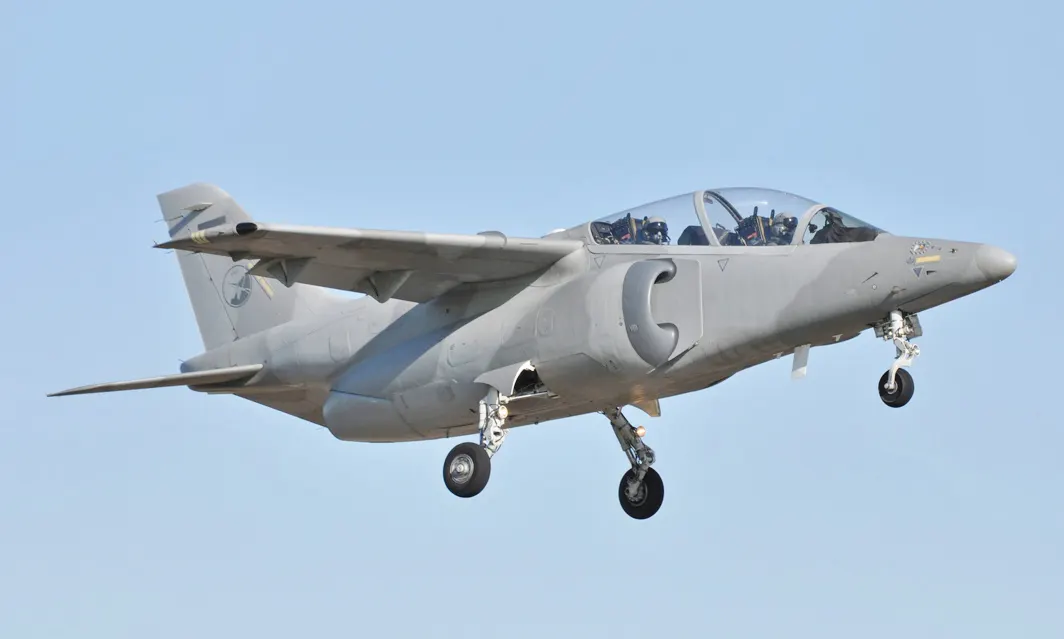

The FMA IA-63 Pampa is a single-engine, tandem two-seat advanced jet trainer built in Argentina by Fábrica Militar de Aviones (later privatized and renamed FAdeA, Fábrica Argentina de Aviones). It first flew on 6 October 1984 and entered squadron service with the Argentine Air Force in April 1988.1 Design work began in 1978 as a replacement for the elderly Morane-Saulnier MS.760 Paris, and FMA brought in Germany's Dornier Flugzeugwerke as a technical partner, drawing on Dornier's experience co-developing the Franco-German Alpha Jet.1,2 The result looks like a smaller, single-engine cousin of the Alpha Jet: straight, unswept supercritical wings instead of a swept planform, one Garrett (later Honeywell) TFE731 turbofan instead of two Snecma/Turbomeca Larzacs, and a similar tandem cockpit under a single clamshell canopy.
- Simple, low-cost single-engine design
- Domestically built and maintained by FAdeA
- Straightforward maintenance, low operating cost per hour
- Continuously modernized (Pampa II, Pampa III, Block II)
- Chronic low production rate tied to Argentina's economy
- No radar or genuine beyond-visual combat systems
- Never achieved a serious export customer
- Modest range and payload next to twin-engine rivals
Four decades on, the Pampa is still Argentina's standard advanced trainer, still built in small batches by FAdeA, and still the only jet the Argentine Air Force uses to bridge cadets from propeller trainers to fighters like the A-4AR (now retired) and the newer F-16 fleet.3 Production never came close to the roughly 300 airframes FMA once hoped to sell, and only about thirty have been completed across all variants.1,4 The type's history is really a story of a competent, unglamorous design that survived decades of Argentine economic crises, a failed run at the US trainer market, and a political dispute with Britain that changed even its ejection seat.
Operationally, the Pampa has always been a trainer with a secondary light-attack capability rather than the ground-attack platform it is sometimes filed under: its standard weapons fit is a centerline 30mm cannon pod, rocket launchers, practice and general-purpose bombs, and machine-gun pods, carried on five hardpoints.1,5 It has no radar, no dedicated air-to-air missile integration, and nothing resembling an anti-ship role; its combat utility has always been counter-insurgency-style light strike, not fleet or fighter work.
The Straight Supercritical Wing and Its Alpha Jet Lineage

FMA and Dornier reportedly worked through around seven configuration studies before settling on the shape that flew in 1984.1 The chosen layout used a Dornier-designed supercritical airfoil (identified in period technical literature as the DoA-7 section) on a straight, high-mounted wing, a decision that traded some of the sustained-turn performance a swept wing would give at higher speed for better low-speed handling and gentler stall characteristics, useful qualities in a primary-to-advanced trainer rather than a pure light-attack jet.1 Structurally the airframe is conventional aluminum alloy, with carbon-fiber used for the air intake ducts, an early use of composite material in Argentine aircraft manufacturing.1 Because Dornier had just finished co-developing the twin-engine, swept-wing Alpha Jet with Dassault, comparisons to that aircraft followed the Pampa from its first unveiling; some contemporary writers called it "an Alpha Jet Lite," a description that misses the wing and engine differences but captures the family resemblance in fuselage and cockpit layout.6
The Garrett/Honeywell TFE731 Turbofan and Its Reputation
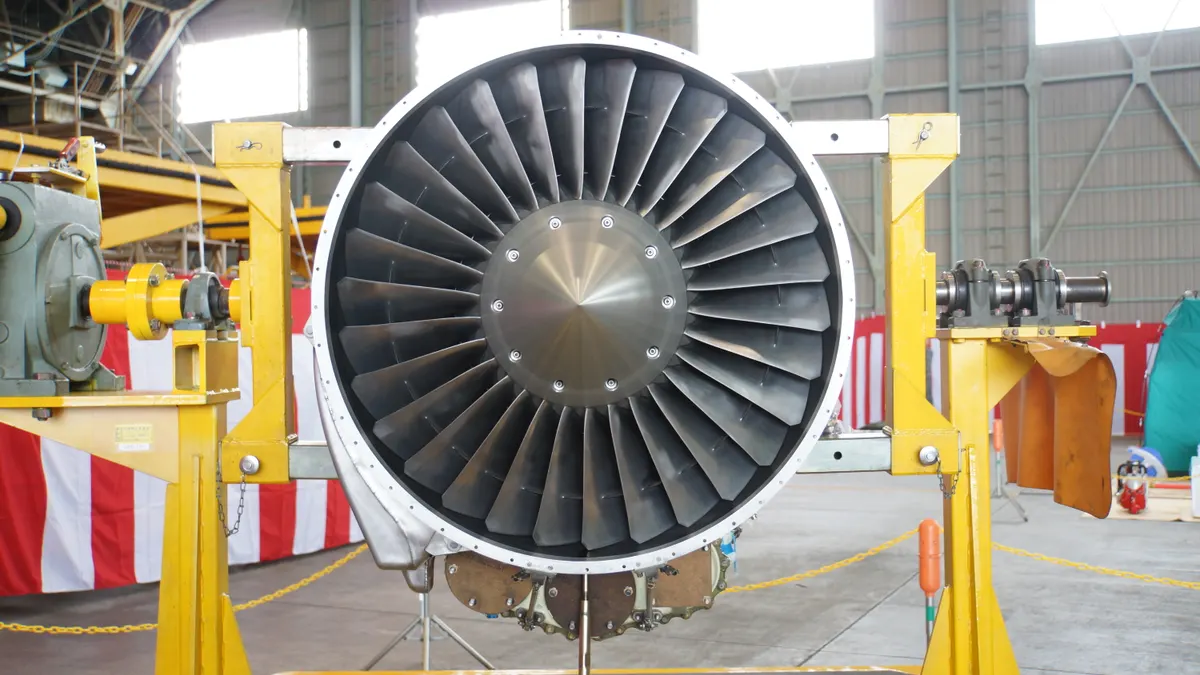
A single Garrett TFE731-2-2N turbofan, rated at roughly 15.6 kN (3,500 lbf) of thrust, powers the production IA-63.1 Garrett Turbine Engine Company became part of AlliedSignal and later Honeywell through corporate mergers, so the same physical engine family is catalogued in Argentine documentation under both the Garrett and Honeywell names; it is not two different engines. The TFE731 series was already a well-proven business-jet and light-military-trainer powerplant by the early 1980s, chosen for the Pampa largely because it was available off the shelf and needed no dedicated Argentine production line, unlike the airframe. Internal fuel is carried in a 550-liter integral wing tank and a 418-liter flexible fuselage tank for a standard total of 968 liters, expandable to about 1,383 liters with optional tanks in the outer wing panels.7 Combat radius depends heavily on profile and loadout: a high-altitude intercept-style sortie with a light external load and standard internal fuel gives a radius on the order of 700 km, considerably more than the 350 km sometimes quoted for a low-level attack profile with a heavier load and reserve margins built in.7
Domestic Content
The Pampa's aluminum airframe, final assembly, and most structural fabrication are done in Argentina by FAdeA at its Córdoba plant, the country's main aerospace manufacturing site.3 The single Garrett/Honeywell TFE731 turbofan, however, is entirely imported from the United States, and it represents the single largest foreign-sourced component by value on every variant built.1 Ejection seats have also been foreign-sourced throughout the program's life: Martin-Baker Mk10 units from the United Kingdom equipped the original IA-63 and Pampa II, before a 2013 Argentine government decision, driven by the ongoing Falklands sovereignty dispute, banned new British-made seats and shifted the Pampa III to the Russian Zvezda K-36 instead.8 FAdeA has been narrowing the import gap in avionics and structural hardware: in 2024 it certified and delivered the first Pampa III Block II aircraft fitted with locally manufactured ("nationalized") weapons pylons, replacing parts previously bought abroad.9
A Post-Junta Replacement for an Aging Trainer
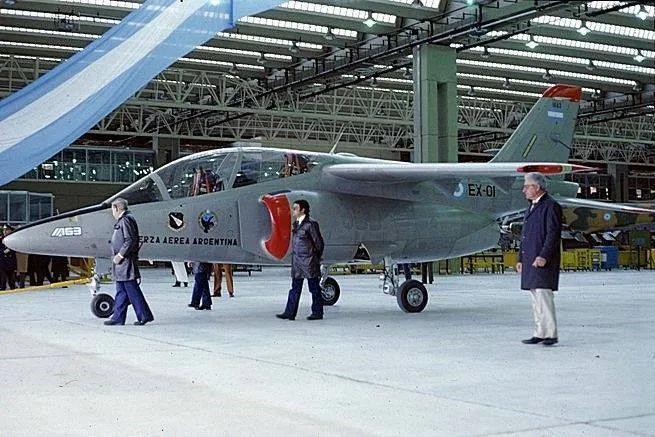
Preliminary studies for what became the IA-63 started at FMA in 1978, aimed squarely at replacing the Morane-Saulnier MS.760 Paris that had served the Argentine Air Force since 1958.1,6 The Dornier partnership was signed the same year design work began, giving FMA access to swept-wing and composite manufacturing know-how the Argentine industry lacked on its own. Three flying prototypes (designated EX-01 through EX-03) and two static/fatigue test airframes were built; the Argentine Air Force had originally asked for four flying prototypes but the post-dictatorship government, managing a strained budget after 1983, allowed only three.10 EX-01 rolled out in August 1984 and flew for the first time on 6 October that year, roughly two years after the Falklands War ended, meaning the Pampa itself never had any chance of seeing action in that conflict, despite sometimes being lumped in with Argentina's Falklands-era combat types.
The program's most serious setback came in 1992. On 31 August, prototype E-813 (the second Pampa built) crashed near Bournemouth Airport in Dorset, England, while its Argentine test crew practiced a display routine ahead of that year's Farnborough International Airshow. The pilots, Vicecomodoro Juan Carlos Sapolsky and Captain Darío Omar Gelardi, were both killed; the UK Air Accidents Investigation Branch published a formal report on the loss.11,12 The accident, coming just before what was meant to be a high-visibility European sales showcase, undercut FMA's efforts to interest foreign air forces in the type at a moment when export orders were badly needed.
Slow Production Through Argentina's Economic Turmoil
Series production never matched FMA's ambitions. The Argentine Air Force originally wanted around 64 Pampas; the first production batch delivered only 18 aircraft between 1988 and 1990, and a second batch of just six followed in 2006-2007, a 16-year gap driven by successive Argentine currency and debt crises rather than any technical problem with the aircraft.1,4 Lockheed Martin bought a majority stake in FMA in 1995, briefly rebranding the improved attack-trainer version as the AT-63 Pampa "Phase 2," compatible with the A-4AR Fightinghawk's weapons and avionics standard, before Lockheed Martin's Argentine subsidiary (LMAASA) exited the country in the early 2000s and the plant reverted to state ownership as FAdeA.4,5
The Pampa 2000 and America's JPATS Bid

In the early 1990s, FMA teamed with the American manufacturer LTV/Vought to offer a modified Pampa, marketed as the "Pampa 2000," for the US Joint Primary Aircraft Training System (JPATS) competition, a contract eventually worth several hundred aircraft for the US Air Force and Navy.14 A fully missionized Pampa 2000 was shipped to Wright-Patterson Air Force Base in Ohio, where Air Force and Navy pilots ran roughly ten days of flight evaluations in August 1994.14 The Pampa 2000 lost to the Beechcraft/Raytheon T-6 Texan II, a turboprop design, ending Vought's involvement and closing off what had been Argentina's best real shot at a large export order.
From Pampa II to Pampa III: A Cockpit Rebuilt Twice
The airframe has been re-avionicked in stages rather than replaced outright. An avionics update produced the Pampa II starting around 2005, and a 2011 re-engining and further upgrade created the Pampa II-40.3 The most substantial rework, the Pampa III, introduced a full glass cockpit, an embedded virtual avionics (EVA) training system able to simulate weapons and sensors the physical airframe does not carry, a head-up display, and a data-link and mission-planning suite.3,9 The first series-production Pampa III (E-824) flew in September 2018, and by March 2020 all six aircraft of that initial Pampa III batch had been delivered to the Argentine Air Force.1 FAdeA has continued the line into a "Block II" standard, delivering aircraft with locally made weapons pylons in 2024 and, as of mid-2026, still building and modernizing airframes for the same air force that received the first batch in 1988.9
The baseline IA-63 Pampa covers the 18 first-batch (1988-1990) and 6 second-batch (2006-2007) airframes built to the original analog-cockpit standard.1,4 The Pampa II designation applies to airframes given the mid-2000s avionics update, with the further re-engined Pampa II-40 following in 2011.3 Under Lockheed Martin's ownership of FMA, the attack-optimized AT-63 Pampa "Phase 2" added compatibility with the A-4AR Fightinghawk's weapons and sensor standard, marketed for both the home fleet and export.4,5 The America-focused Pampa 2000, built with Vought, modified the basic design for the abortive 1990s JPATS bid and never entered service anywhere.14 The current-production IA-63 Pampa III, including the 2024-onward Block II standard with nationalized pylons, represents a near-total avionics rebuild around a glass cockpit and virtual training systems while retaining the original 1984 airframe, wing, and engine choice.3,9

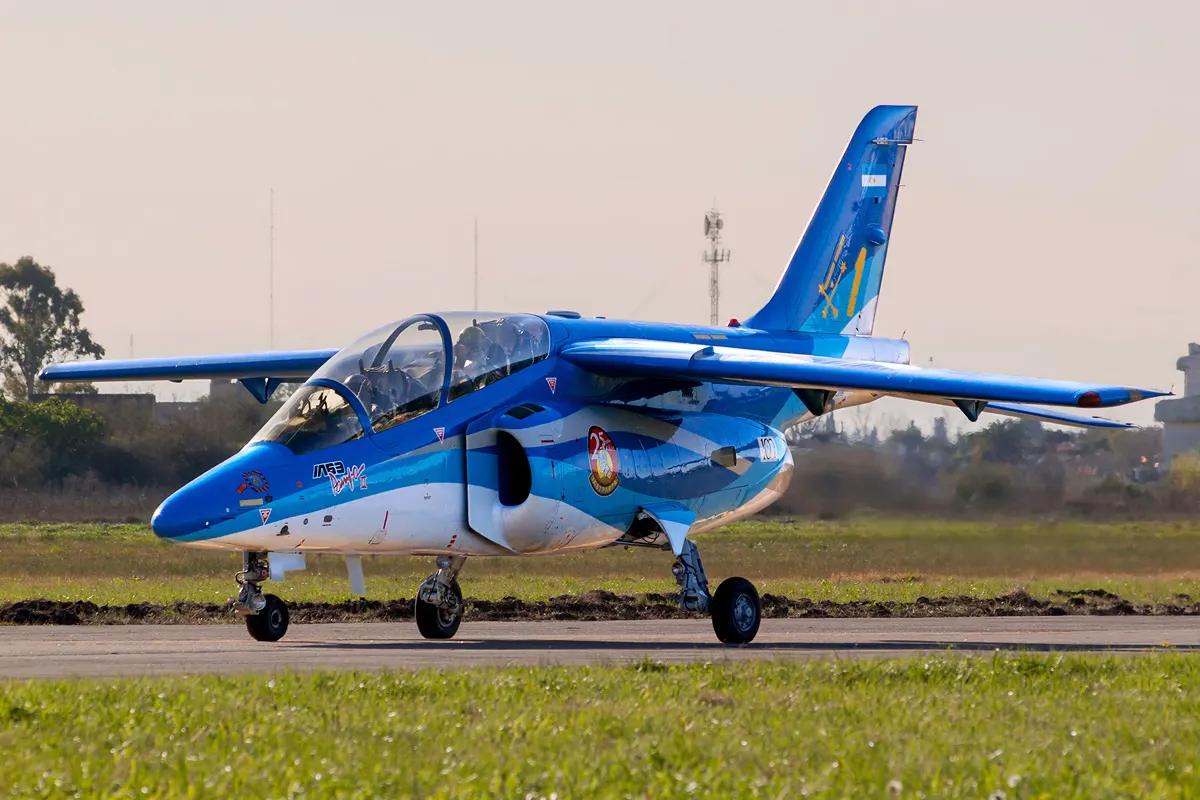
The Argentine Air Force has been the type's only operator throughout its production life, currently flying roughly two dozen Pampas of various standards from bases including IV Air Brigade at Mendoza and the Escuela de Aviación Militar.1,15 Guatemala came close to becoming the first export customer, signing a $28 million contract in July 2019 for two Pampa III trainers, but the Guatemalan Comptroller General's office recommended canceling the procurement over irregularities, and the government backed out before delivery.16,17 Since 2012 the Argentine Air Force's aerobatic display unit, the Escuadrilla Acrobática Cruz del Sur, has flown upgraded Pampa IIs, giving the type its highest-visibility public role.18 The aircraft remains active in multinational exercises: Argentine Pampa IIIs deployed to Chile in June 2026 for the multinational Exercise Salitre, underlining that, four decades after its first flight, the type is still Argentina's day-to-day advanced trainer rather than a museum piece.19
The most natural comparison is the Dassault/Dornier Alpha Jet, the aircraft whose design team gave the Pampa its Dornier input and much of its general layout. The Alpha Jet is a genuinely different aircraft under the skin: two Turbomeca/Snecma Larzac turbofans against the Pampa's single TFE731, a swept wing against the Pampa's straight one, and a heavier maximum weight that lets it carry more fuel and ordnance over a longer range (an Alpha Jet's typical range is often quoted near 1,800 km ferry, versus the Pampa's roughly 1,500 km).20,21 That extra capability came at a price the Pampa was specifically designed to avoid: twin-engine maintenance costs and a larger airframe to build. In the end neither aircraft's market fortunes tracked its technical merits particularly closely. The Alpha Jet sold to over a dozen air forces on the strength of France and Germany's export networks and combined production runs of several hundred, while the single-source, non-aligned Pampa sold to exactly one air force, its own, largely because Argentina in the late 1980s and 1990s had neither the diplomatic reach nor the sustained production run to compete in the same league.
| Spec | IA-63 Pampa | Alpha Jet E |
|---|---|---|
| Engines | 1 x TFE731-2-2N (15.6 kN) | 2 x Larzac 04 (13.2 kN each) |
| Wing | Straight, supercritical | Swept |
| Max speed | ~819 km/h | ~1,000 km/h |
| Ferry range | ~1,500 km | ~1,800 km |
| Air forces operating type | 1 (Argentina) | 12+ |
A second useful comparison is the Beechcraft/Raytheon T-6 Texan II, the aircraft that beat the Pampa 2000 in the 1990s JPATS competition, precisely because the two represent opposite bets on what an advanced primary trainer should be. The T-6 is a single turboprop, slower and far cheaper to operate per flight hour than any jet, reflecting the US services' post-Cold-War conclusion that a primary trainer's job is building basic flying skill as cheaply as possible before students move to a separate advanced jet trainer. The Pampa 2000 was, by contrast, a jet from day one, matching Argentina's traditional single advanced-trainer model in which one aircraft carries cadets from intermediate flying straight through to fighter-representative handling. The US evaluators at Wright-Patterson in 1994 judged operating cost and syllabus fit, not raw performance, and the turboprop model won decisively: the T-6 went on to a production run in the high hundreds across multiple countries, while the Pampa 2000 never left prototype status.14


How many IA-63 Pampas were built? Roughly thirty airframes have been completed across every version: three flying prototypes, 18 first-batch and 6 second-batch original IA-63/Pampa II aircraft, and six Pampa IIIs delivered by 2020, with further Pampa III Block II examples added since.1,4,9 That is well short of the roughly 300 units FMA originally hoped to sell, including export orders that never materialized.1
Is the IA-63 Pampa still in service? Yes. The Argentine Air Force still operates the type as its standard advanced jet trainer and flies it in the Cruz del Sur display team and in multinational exercises such as Salitre 2026 in Chile, while FAdeA continues to build and upgrade Pampa III Block II airframes.3,9,19
What is the IA-63 Pampa's top speed? The production IA-63 has a maximum speed of around 819 km/h (Mach 0.72) at altitude, powered by its single Garrett/Honeywell TFE731 turbofan.1
How does the Pampa compare to the Alpha Jet? The Pampa is a lighter, single-engine, straight-wing derivative of the design philosophy behind the twin-engine, swept-wing Alpha Jet, built with direct Dornier assistance but scaled down and simplified to cut cost; it trades range, speed, and payload for a cheaper, lower-maintenance airframe.1,20
Why did the Pampa lose the US JPATS competition? The Pampa 2000, FMA and Vought's jet-powered entry, lost the 1990s JPATS competition to the Beechcraft/Raytheon T-6 Texan II turboprop primarily on operating cost and syllabus fit, not raw performance, after flight evaluations at Wright-Patterson Air Force Base in 1994.14
- "FMA IA-63 Pampa", Wikipedia — en.wikipedia.org ↩
- "The Dassault-Dornier Alpha Jet & FMA Pampa", Greg Goebel / Vectorsite — airvectors.net ↩
- "IA-63 Pampa III", FAdeA S.A. — fadeasa.com.ar ↩
- "IA-63 Pampa Advanced Jet Trainer / Light Attack Aircraft", Airforce Technology — airforce-technology.com ↩
- "Fact File: Lockheed Martin Aircraft Argentina SA AT-63 Pampa", Aircraft Information — aircraftinformation.info ↩
- "FMA IA-63/AT-63 Pampa", WW2Aircraft.net Forums — ww2aircraft.net ↩
- "LMAASA AT-63 Pampa", All the World's Aircraft (Jane's) — janes.migavia.com ↩
- "Argentina bans British made ejection seats from local jet trainer IA-63 Pampa III", MercoPress — en.mercopress.com ↩
- "FAdeA has completed the delivery of two IA-63 Pampa III Block II to the Argentine Air Force", Zona Militar — zona-militar.com ↩
- "FMA IA-63 Pampa", Grokipedia — grokipedia.com ↩
- "Accident FMA IA 63 Pampa E-813, 31 Aug 1992", Aviation Safety Network — aviation-safety.net ↩
- "IA-63 Pampa, E-813, 31 August 1992", UK Air Accidents Investigation Branch — gov.uk ↩
- "Accident FMA IA 63 Pampa EX-01, 10 Dec 2004", Aviation Safety Network — aviation-safety.net ↩
- "Pampa 2000", GlobalSecurity.org — globalsecurity.org ↩
- "IA-63 Pampa", GlobalSecurity.org — globalsecurity.org ↩
- "Guatemala Becomes First Pampa III Export Customer", Aviation Week — aviationweek.com ↩
- "Guatemala canceló la compra de los aviones Pampa III", Ámbito Financiero — ambito.com ↩
- "Southern Cross Aerobatic Squadron", Wikipedia — en.wikipedia.org ↩
- "Los IA-63 Pampa de la Fuerza Aérea Argentina ya se encuentran en Chile para participar en el Ejercicio Multinacional Salitre 2026", Zona Militar — zona-militar.com ↩
- "Dassault/Dornier Alpha Jet", Wikipedia — en.wikipedia.org ↩
- "Alpha Jet: origins, characteristics and performance data", Dassault Aviation — dassault-aviation.com ↩