

The AIDC AT-3 is a twin-engine advanced jet trainer and light attack aircraft built by Taiwan's Aerospace Industrial Development Corporation (AIDC) for the Republic of China Air Force (ROCAF).1 Its name, Tzu Chung (自強), translates roughly as "self-strengthening" or "self-reliance" — the same characters are sometimes romanized as Tz-Chiang or Tzu Chiang in older English-language sources, which is why the aircraft appears under slightly different spellings across references.1,2 Design work began in March 1975 under a technology-transfer arrangement with the American firm Northrop, originally for a single-engine trainer; the Ministry of National Defense ordered the switch to the twin-engine layout that defines the production aircraft in June 1976.2 The first of two development aircraft flew on 16 September 1980, and deliveries of production AT-3As to the ROCAF ran from 1984 into 1990.1,2
- twin-engine redundancy uncommon in its trainer class
- genuine light-attack payload (2,720 kg across five hardpoints)
- Martin-Baker zero-zero ejection seats
- proven indigenous production base for later AIDC programs
- analog cockpit and limited sensor fit by the 2010s
- never achieved a single confirmed export sale
- 1970s airframe aerodynamics capped high-speed performance at Mach 0.85
- accident record shows the type was unforgiving in low-level and formation flying
Roughly 62 to 64 airframes were built in total, depending on whether the two early XAT-3 development aircraft and two single-seat XA-3 attack prototypes are counted alongside the 60 production AT-3As — sources are not fully consistent on this point, and no single authoritative production ledger appears to be public.1,2 For four decades the AT-3 filled the advanced phase of ROCAF pilot training, bridging the gap between the propeller-driven T-34C primary trainer and front-line jets such as the F-5E, the Mirage 2000-5, and the F-CK-1 Ching-kuo. It also became the mount of the ROCAF's "Thunder Tiger" aerobatic display team from 1988 onward. The type was formally retired on 5 August 2025, replaced by the newer, jointly AIDC/National Chung-Shan Institute-built T-5 Brave Eagle.1,6
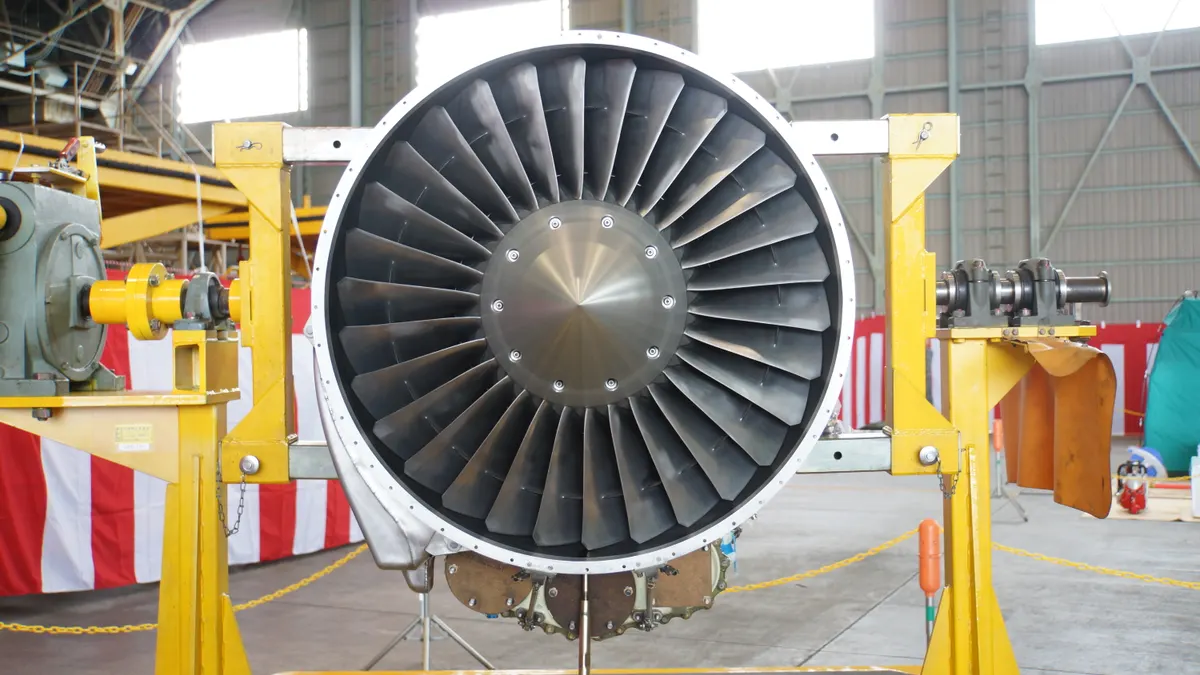
Structurally the AT-3 is a conventional low-wing monoplane with tricycle landing gear and a tandem two-seat cockpit, the rear (instructor's) seat raised about 30 cm above the front to preserve forward visibility.2 Two non-afterburning Garrett (later Honeywell) TFE731-2-2L turbofans, mounted in fuselage-side nacelles, give it enough thrust for both training maneuvers and a genuine light-attack load, a combination that was unusual among 1980s-vintage advanced trainers, many of which relied on a single engine.1 It was, and remains, Taiwan's only indigenously designed twin-engine jet aircraft to reach large-scale production before the F-CK-1 fighter arrived a decade later.
The AT-3's airframe is mostly aluminum, with graphite-composite airbrake panels and honeycomb-core ailerons — a modest but deliberate use of composites for a Taiwanese aerospace industry that had almost no prior large-aircraft manufacturing base.2 Overall length is 12.9 m, wingspan 10.46 m, and empty weight is about 3,855 kg against a maximum take-off weight cited at roughly 7,940 kg; published figures for maximum weight vary somewhat between sources, which is common for a type with several role-specific loadouts.1 Top speed is 904 km/h (about Mach 0.85) at 11,000 m, with a service ceiling near 14,650 m and range quoted around 2,280 km in the ferry configuration.1
The Twin Garrett TFE731 Turbofans and a Shared Cross-Strait Engine Family
Each of the AT-3's two TFE731-2-2L engines produces about 3,500 lbf (15.6 kN) of thrust, for a combined 7,000 lbf (31.1 kN) — modest by fighter standards but ample for an aircraft in the 4-to-8-tonne class.1,2,8 The choice of a proven, widely used American business-jet-derived turbofan rather than a bespoke military engine kept the propulsion side of the program low-risk while AIDC's engineers concentrated on the airframe, an approach later reused, in modified form, for the F-CK-1 fighter's indigenously assembled TFE1042 engines.
Martin-Baker Ejection Seats and the Armament Fit
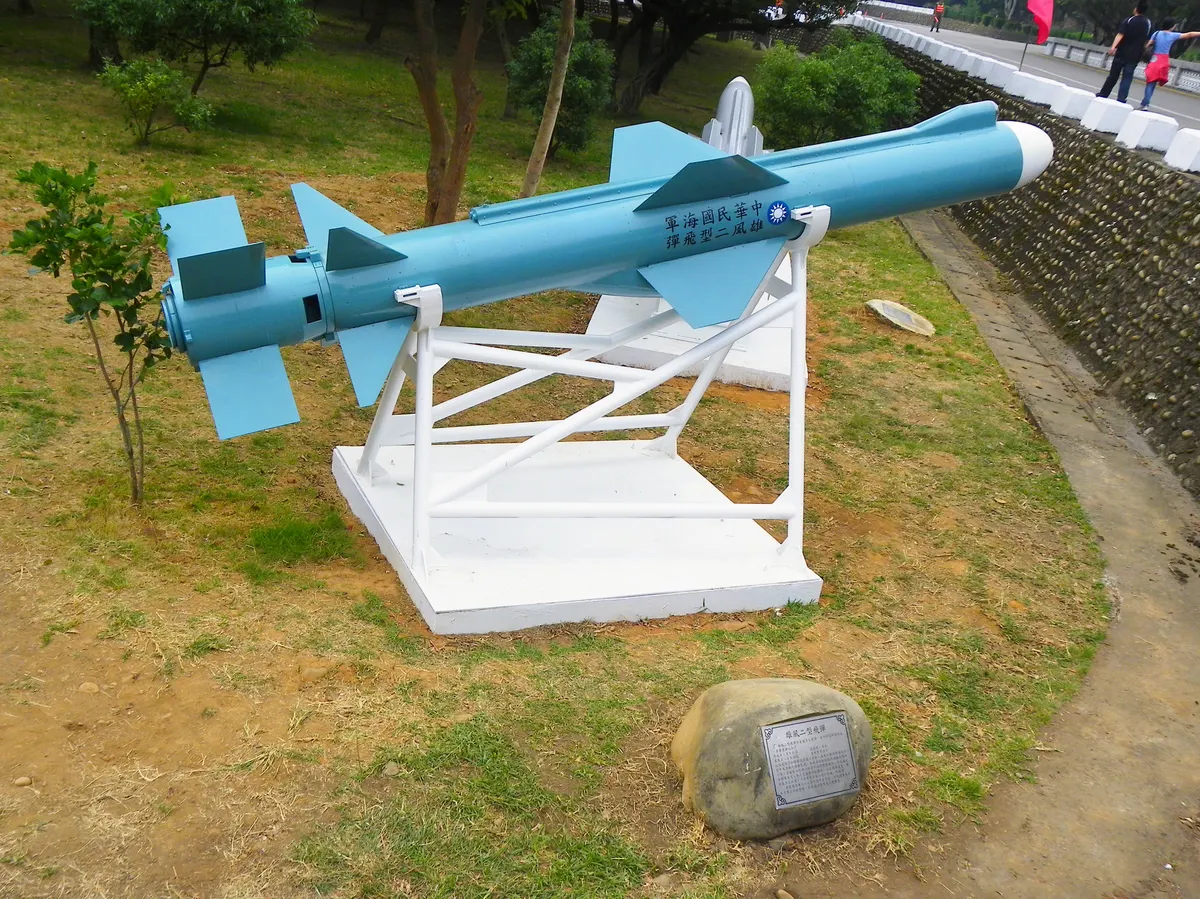
Production AT-3s carry Martin-Baker Mk10 zero-zero ejection seats, meaning a survivable escape is theoretically possible even at zero altitude and zero airspeed — a meaningful safety margin given the low-level attack training the type was routinely used for.2 For weapons, the AT-3 has five hardpoints (one centerline, two inboard and two outboard underwing) plus wingtip launch rails, rated for up to 2,720 kg of stores: iron bombs such as the Mk 82 and Mk 84, Mk 20 cluster munitions, 2.75-inch and 5-inch rocket pods, AIM-9 Sidewinder and locally built TC-1 Sky Sword I air-to-air missiles, and, on the dedicated attack prototypes, a shortened Hsiung Feng II anti-ship missile.1,2 A pair of 12.7 mm machine guns sits in a semi-recessed ventral pack on most airframes, though the guns were removed from at least one operational squadron's aircraft in the early 1990s in favor of the wingtip missile rails.2
The AT-3's airframe, final assembly, and structural composites were produced in Taiwan by AIDC itself, giving the aircraft a genuinely domestic airframe. Its propulsion, however, sits on a licensed foreign design: the twin TFE731-2-2L turbofans were assembled locally under a Garrett AiResearch (United States) license from 1983 to 1989 rather than designed in Taiwan, and the core hot-section technology and intellectual property remained American.2,3 Later AT-3B testbed work added a US-sourced APG-66T radar, another significant imported component. On balance the airframe and structure are domestic, but the engine core and the more advanced sensors are foreign in origin, putting overall domestic content by value at roughly 55 to 65 percent.
Taiwan's push for an indigenous advanced trainer grew out of the same strategic anxiety that later produced the F-CK-1 fighter: after the United States normalized relations with the People's Republic of China in the 1970s, Taipei could not assume continued, unconstrained access to American combat aircraft, and moved to build a domestic aerospace design and production capability from the ground up.2 AIDC's 15 December 1975 agreement with Northrop for the original single-engine XAT-3 concept gave Taiwanese engineers their first real exposure to modern trainer aircraft design practice; the switch to the twin-engine configuration eight months later reflected a preference for engine-out safety margin over the fuel economy of a single-engine design, at the cost of extra weight and complexity.2

The two XAT-3 prototypes, serials 0801 and 0802, flew in September 1980 and October 1981 respectively; the first production airframe, 0803, rolled out on 1 March 1984.2 Deliveries to the ROCAF's Flight Training Command at the Air Force Academy in Gangshan ran through the rest of the decade, with student pilots typically logging around 110 hours on the type before moving to the F-5 as a lead-in fighter trainer.2 Early production aircraft flew in bare metal with fluorescent orange nose and tail markings before the fleet-wide adoption of the blue-white-red scheme most people now associate with the aircraft.2
On 1 November 1988 the ROCAF's Thunder Tiger aerobatic team, until then flying the F-5E, transitioned to the AT-3, making its public debut in the new type on 27 March 1989 with a display of six aircraft in formation plus two solo performers.4 The team has flown the AT-3 in its distinctive blue, white, and red livery ever since, based at the Air Force Academy in Gangshan since 1993.4 Separately, on 9 September 1989, the 35th Combat Squadron (Night Attack) re-equipped with about twenty AT-3s finished in Southeast Asia-style jungle camouflage, replacing aging T-33 Shooting Stars in a dedicated light-attack and night-strike role; after 1991 the squadron's aircraft lost their semi-recessed machine guns in favor of wingtip missile rails, and the unit stood down in February 1999, with its jets folded back into the training fleet.2
A mid-life update conducted between 2001 and 2006 refreshed instruments and structure to keep the fleet viable beyond 2016, and a small number of aircraft — most notably airframe 0825 — were modified as AT-3B testbeds carrying an APG-66T radar and Hsiung Feng II missile integration, though this remained a limited testbed effort rather than a fleet-wide standard.1,2 AIDC tried in the late 1990s to market the AT-3 for export as an affordable lead-in trainer, but the aircraft's American-origin engine and avionics content meant any sale required a US re-export license; none was granted, and the ROCAF remains the type's sole operator.1
The AT-3 was never used in an actual shooting war, and Taiwan has not fought an air campaign since the type entered service. Its closest brush with combat came during the Third Taiwan Strait Crisis of 1995 to 1996, when the People's Liberation Army conducted missile tests and large-scale exercises in the strait ahead of Taiwan's first direct presidential election.4 The two XA-3 Lui Meng single-seat attack prototypes, otherwise a dead-end program cancelled in favor of the F-CK-1, were kept armed with a shortened Hsiung Feng II anti-ship missile and held at readiness during the crisis — a rare case of an abandoned prototype program being reactivated, however briefly, for a live contingency.1,4
More broadly, the AT-3's operational risk came from training rather than combat. Aviation Safety Network and unit-history records document a string of hull-loss accidents spread across the fleet's service life, several fatal, including a mid-air collision on 21 October 2014 between two Thunder Tiger aircraft (serials 0815 and 0847) shortly after take-off from Gangshan, which killed pilot Chuang Pei-yuan while the second pilot returned safely.5 Earlier losses on record include airframe 0804 in October 1992 and 0827 in June 2003, both with two fatalities, and 0833 in June 1997.2 These losses, concentrated disproportionately among Thunder Tiger and training sorties rather than the dedicated attack squadron, are consistent with the type's use profile: most AT-3 flight hours were spent in demanding low-level formation and attack-pattern training rather than in routine transport-style flying.
The 35th Combat Squadron's brief 1989-to-1999 existence as a dedicated night-attack unit is the closest the AT-3 came to a standing combat role outside the aerobatic and training mission, but it was stood down without ever being committed to actual strikes, its aircraft absorbed back into flight training as cross-strait tensions ebbed and Taiwan's front-line fighter fleet (F-16s, Mirage 2000-5s, and the indigenous F-CK-1) matured enough to cover the light-attack mission itself.2
The baseline AT-3A is the production standard: 60 aircraft, twin-seat, unarmed of radar, built between 1984 and 1990 for training with a secondary light-attack capability.1 The two earlier XAT-3 development aircraft (0801 and 0802) differ mainly in minor equipment fit rather than airframe shape and are sometimes folded into the AT-3A production count in casual references, which is part of why total-production figures vary across sources.2
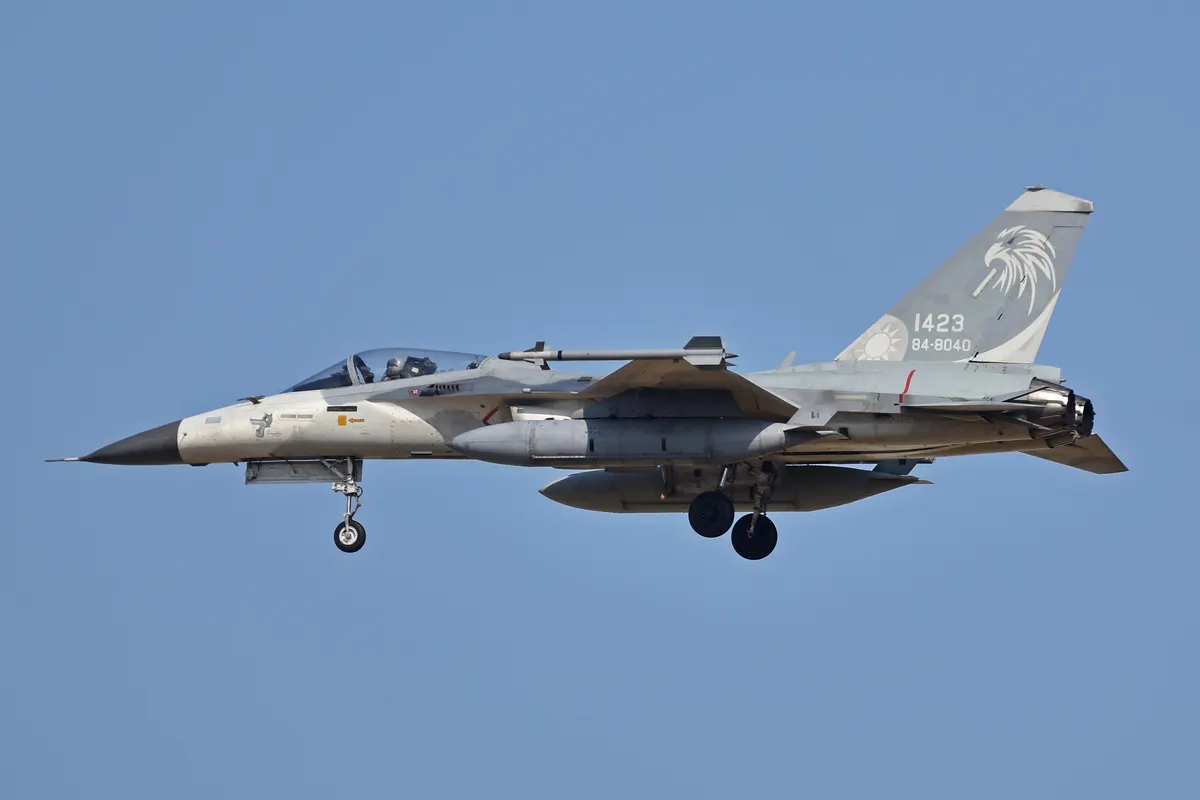
AT-3B is not a clean fleet-wide upgrade in the way the designation might suggest. Some references describe it as a planned mid-life standard for up to 45 aircraft, adding a head-up display and APG-66T radar; the more detailed unit-level history available, however, identifies it as an unofficial label applied to a single heavily modified testbed, airframe 0825, fitted with the APG-66T radar, Hsiung Feng II missile integration, and hands-on-throttle-and-stick controls.1,2 This is a genuine point of disagreement between sources, and it is not possible from public material to say with confidence how far, if at all, the AT-3B standard was actually rolled out fleet-wide.
The XA-3 Lui Meng ("Thunder") was the dedicated single-seat attack derivative, stripped of the trainer's second cockpit in favor of more fuel and systems space. Only two were built, numbered 901 and 902; the program was cancelled once the AIDC F-CK-1 Ching-kuo fighter program absorbed AIDC's engineering resources and the ROCAF's attack-aircraft budget priority, leaving the XA-3 as a two-aircraft dead end that nonetheless saw brief operational relevance during the 1995 to 1996 crisis.1,4

The Republic of China Air Force was the AT-3's sole operator throughout its service life; no export customer was ever secured despite AIDC's marketing efforts in the late 1990s.1 Within the ROCAF, the type served in three distinct roles over time: as the advanced-trainer backbone of the Flight Training Command at the Air Force Academy in Gangshan from 1984; as the mount of the Thunder Tiger aerobatic display team from November 1988 until the type's 2025 retirement; and, for a single decade (1989 to 1999), as the light-attack aircraft of the 35th Combat Squadron (Night Attack).2,4
By the time of the type's retirement in August 2025, essentially the entire surviving fleet had been repainted into the Thunder Tiger blue-white-red scheme, including former 35th Squadron airframes that had spent a decade in jungle camouflage.2 The AT-3's replacement, the AIDC T-5 Brave Eagle, had reached 43 of a planned 66 aircraft delivered by March 2025 and began taking over both the AT-3's advanced-training role and the F-5E/F's lead-in fighter training role, consolidating what had been a three-type training pipeline (T-34C, AT-3, F-5) into a simpler two-type one (T-34C, T-5).6,7
The AT-3's closest rough contemporary and closest ideological opposite is the Hongdu (Nanchang/PAC) K-8 Karakorum, developed jointly by mainland China and Pakistan and first flown in 1990, a decade after the AT-3. Both aircraft were built explicitly to reduce dependence on a single foreign supplier of trainers, and, in one of the stranger coincidences of Cold War-era aviation, both ended up powered by the same American engine family: the K-8 uses a single Garrett/Honeywell TFE731-2A turbofan of about 3,600 lbf, versus the AT-3's twin TFE731-2-2Ls totaling roughly 7,000 lbf.1,9 In effect, two air forces on opposite sides of the Taiwan Strait built their next-generation trainers around variants of the same Arizona-designed turbofan — a reminder that even programs framed around national self-reliance often rest on a shared, globalized supply base for the parts that matter most.
The AT-3's twin-engine layout gives it a larger airframe, a heavier maximum weapons load (2,720 kg across five stations plus wingtip rails, against roughly 1,000 kg on the K-8's hardpoints), and a redundancy margin the single-engine K-8 cannot match, at the cost of a more complex and expensive airframe to build and maintain.1,9 The K-8 went on to become one of the most widely exported Chinese-origin military aircraft of its generation, serving with more than a dozen air forces from Africa to Southeast Asia; the AT-3, despite arguably comparable capability and a decade-long head start, was frozen out of the export market entirely by the American-content export-control restrictions on its engine and avionics.1 The contrast says less about the airframes themselves than about the geopolitics wrapped around them: Taiwan's supplier, the United States, treated onward transfer of AT-3 technology as a proliferation risk to be blocked, while China and Pakistan actively marketed the K-8 as a low-cost trainer for developing-world air forces.
| Spec | AIDC AT-3 | Hongdu/PAC K-8 Karakorum |
|---|---|---|
| Engines | 2x TFE731-2-2L, ~7,000 lbf combined | 1x TFE731-2A, ~3,600 lbf |
| Max weapons load | 2,720 kg | ~1,000 kg |
| First flight | 1980 | 1990 |
| Export customers | None | 12+ air forces |
Against its own successor, the T-5 Brave Eagle, the AT-3 looks like exactly what it was: a first-generation indigenous jet built with 1970s avionics and a largely analog cockpit, whereas the Brave Eagle — derived substantially from the F-CK-1 fighter and carrying roughly 80 percent new components relative to the AT-3 — is built from the outset as a lead-in fighter trainer compatible with the sensor and weapons logic of Taiwan's current front-line jets.6,7 The AT-3 could carry ordnance and hold its own doctrinally as a light-attack aircraft, but it could not meaningfully train pilots for radar-guided beyond-visual-range engagements the way the Brave Eagle is designed to.
What does "Tzu Chung" mean, and why do some sources call it "Tz-Chiang"? Tzu Chung (自強) means "self-strengthening" or "self-reliance," reflecting Taiwan's push to build indigenous military aircraft after the diplomatic isolation of the 1970s. The same Chinese characters have been romanized inconsistently in English-language references, which is why both "Tzu Chung" and "Tz-Chiang" or "Tzu Chiang" appear for the same aircraft.1,2
How many AIDC AT-3s were built? Most sources converge on 60 production AT-3As, plus two early XAT-3 development aircraft and two single-seat XA-3 attack prototypes — a total of roughly 62 to 64 airframes depending on how the prototypes are counted. No single public record fully reconciles the discrepancy.1,2
What is the AT-3's top speed? Approximately 904 km/h (562 mph), about Mach 0.85, at 11,000 m altitude — subsonic across its entire flight envelope.1
Is the AIDC AT-3 still in service? No. The Republic of China Air Force formally retired the AT-3 on 5 August 2025, with the AIDC T-5 Brave Eagle taking over its advanced-training and lead-in fighter training roles.1,6,7
How does the AT-3 compare to the Hongdu K-8 Karakorum? The AT-3 is a heavier, twin-engine design with roughly double the K-8's payload and a decade's design head start, but it never secured a single export customer, while the single-engine K-8 became one of the best-selling trainers of its era across Africa, Asia, and the Middle East, largely because it carried none of the AT-3's American export-control baggage.1,9
- "AIDC AT-3", Wikipedia — en.wikipedia.org ↩
- "ROCAF AIDC AT-3", TaiwanAirPower.org — taiwanairpower.org ↩
- "TFE731 Engine", Aerospace Industrial Development Corporation — aidc.com.tw ↩
- "Republic of China Air Force Thunder Tiger Aerobatics Team", Wikipedia — en.wikipedia.org ↩
- "Pilot killed after two Taiwan air force training jets collide mid-air", South China Morning Post — scmp.com ↩
- "Taiwan Brave Eagle jet trainer to replace AT-3 and F-5 jets", AeroTime — aerotime.aero ↩
- "Taiwan accelerates the deployment of the new T-5 Brave Eagle light attack aircraft to improve combat readiness", Army Recognition — armyrecognition.com ↩
- "AIDC AT-3 Tz-Chiang Advanced Weapons Trainer / Light Strike Aircraft", Military Factory — militaryfactory.com ↩
- "Hongdu JL-8", Wikipedia — en.wikipedia.org ↩