

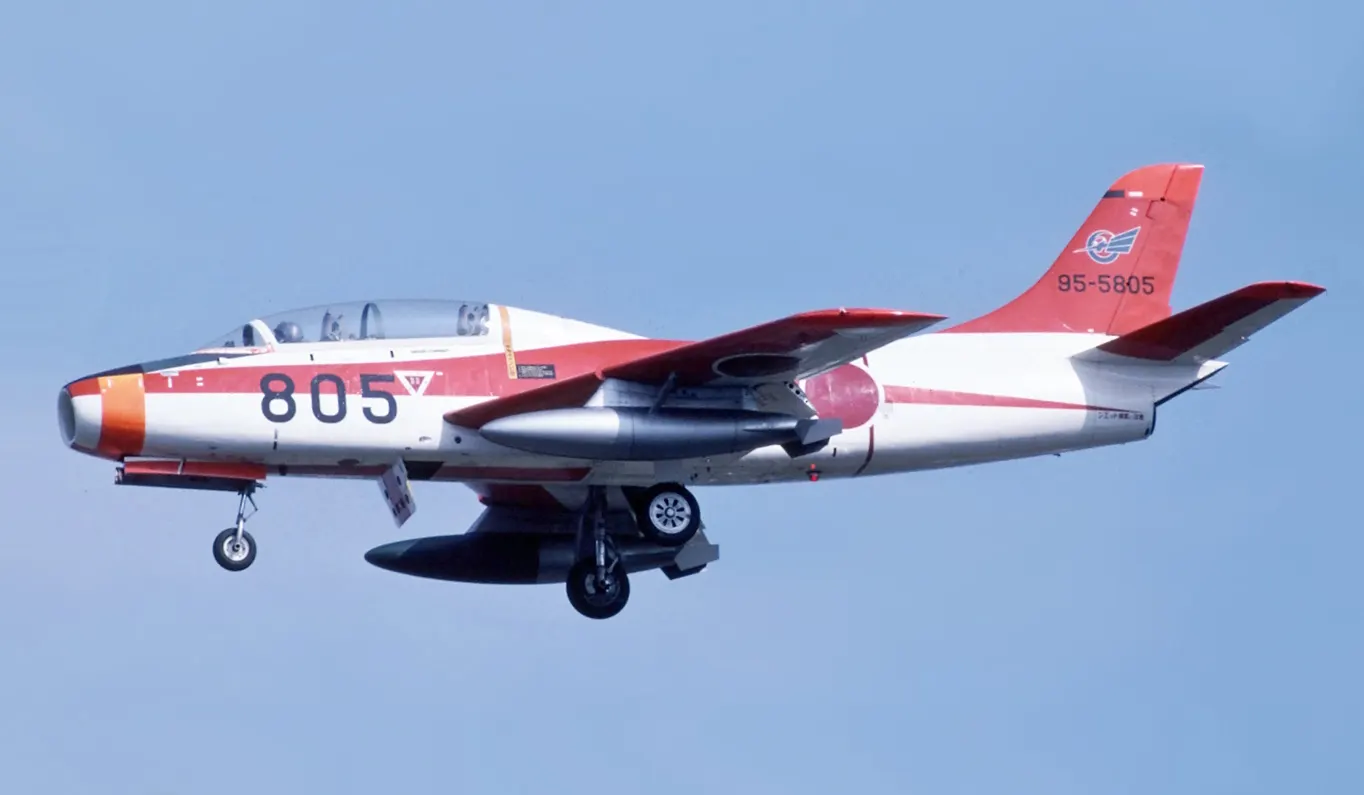

The Fuji T-1 is a subsonic, tandem two-seat jet trainer developed by Fuji Heavy Industries for the Japan Air Self-Defense Force. Its first prototype flew on 19 January 1958 at Utsunomiya airfield, making it the first jet aircraft of Japanese design to fly since the end of the Second World War.1 The significance of that fact outweighs the aircraft's modest performance: seven years earlier, Japan had been legally barred from designing or building aircraft of any kind under the terms of the Allied occupation, and its wartime aviation industry, including Fuji's corporate ancestor Nakajima, had been dismantled.1 The T-1 was the vehicle through which a rebuilt Japanese aerospace sector proved it could still do original engineering.
- first Japanese-designed jet since WWII (major industrial milestone)
- swept-wing handling rare among trainers of its generation
- simple, rugged airframe with a 40+ year service life
- validated Japan's first postwar indigenous jet engine (T-1B/J3)
- thrust roughly half that of contemporary jet trainers abroad
- production stopped at 66, a third of the original 200-unit plan
- displaced from its intended training role by imported Lockheed T-33As
- zero export sales despite active marketing efforts
Two engines defined the program. The T-1A, the initial production version, used an imported British Bristol Siddeley Orpheus Mk 805 turbojet rated at 17.79 kN (4,000 lbf) because Japan's own engine was not ready in time.2 The T-1B, structurally identical, was re-engined with the Ishikawajima-Harima J3-IHI-3, a 11.77 kN (2,645 lbf) turbojet and the first Japanese-designed jet engine to enter production after the war.3,2 Forty-six T-1As and twenty T-1Bs were built, 66 aircraft in total, well short of an original ambition to procure around 200.1 The JASDF nicknamed the type Hatsutaka (初鷹), "first hawk," a name that doubled as an unusually literal statement of purpose.4
Visually the T-1 owes an obvious debt to the North American F-86 Sabre, which Mitsubishi was license-building in Japan through the same period: sharply swept wings, a nose intake, and a slim fuselage.5,6 For a country not yet trusted to design a jet fighter, borrowing a proven fighter's aerodynamics for a trainer was a pragmatic way to give student pilots swept-wing handling before they moved on to frontline types. The aircraft remained in JASDF service for well over four decades, training more than 33,000 jet pilots before the last airframes retired in 2006.4
The Bristol Orpheus Stopgap and Japan's First Postwar Jet Engine
Development of a homegrown trainer began formally in January 1956, when Japan's Defense Agency asked four manufacturers to submit jet-trainer proposals; Fuji Heavy Industries was the only bidder to propose a swept-wing design, and it won the contract that July.4 In parallel, the Agency had already tasked the newly formed Nippon Jet-Engine Company, with Ishikawajima-Harima Heavy Industries as prime contractor from 1959, to build Japan's first postwar turbojet.3 That engine, the J3, was not ready when the airframe was, so the first 46 production aircraft (designated T-1A) flew instead on an imported Bristol Siddeley Orpheus Mk 805, the same basic engine family used in the Fiat G91 and Folland Gnat.2 Only once the J3-IHI-3 matured did Fuji deliver the 20 J3-powered T-1Bs, between June 1962 and June 1963, giving Japan an operational aircraft flying on a fully domestic engine for the first time since 1945.2,3
- First Flight1958
- Service Entry Year1962
- Crew (seats)2
- Trainer TypeIntermediate jet trainer
- In ServiceNo
The T-1's airframe, tooling, and final assembly were entirely Fuji Heavy Industries' own work, built at the company's Utsunomiya plant that had also produced license-built Beechcraft T-34A Mentors just a few years earlier.7 The single biggest imported item on the T-1A was the engine itself, the British Bristol Siddeley Orpheus Mk 805, sourced because the intended Ishikawajima-Harima J3 was still years from production readiness.2,3 Once the J3-IHI-3 turbojet entered service on the T-1B in 1962, the aircraft's largest foreign-content component became Japanese as well, though instrumentation and some subsystems on both variants still followed period-typical practice of drawing on Western-derived designs.3 Weighted for the engine's share of an aircraft's total value, domestic content is a reasonable estimate for the T-1A and higher for the J3-powered T-1B.
A Swept Wing Borrowed From the F-86's Playbook
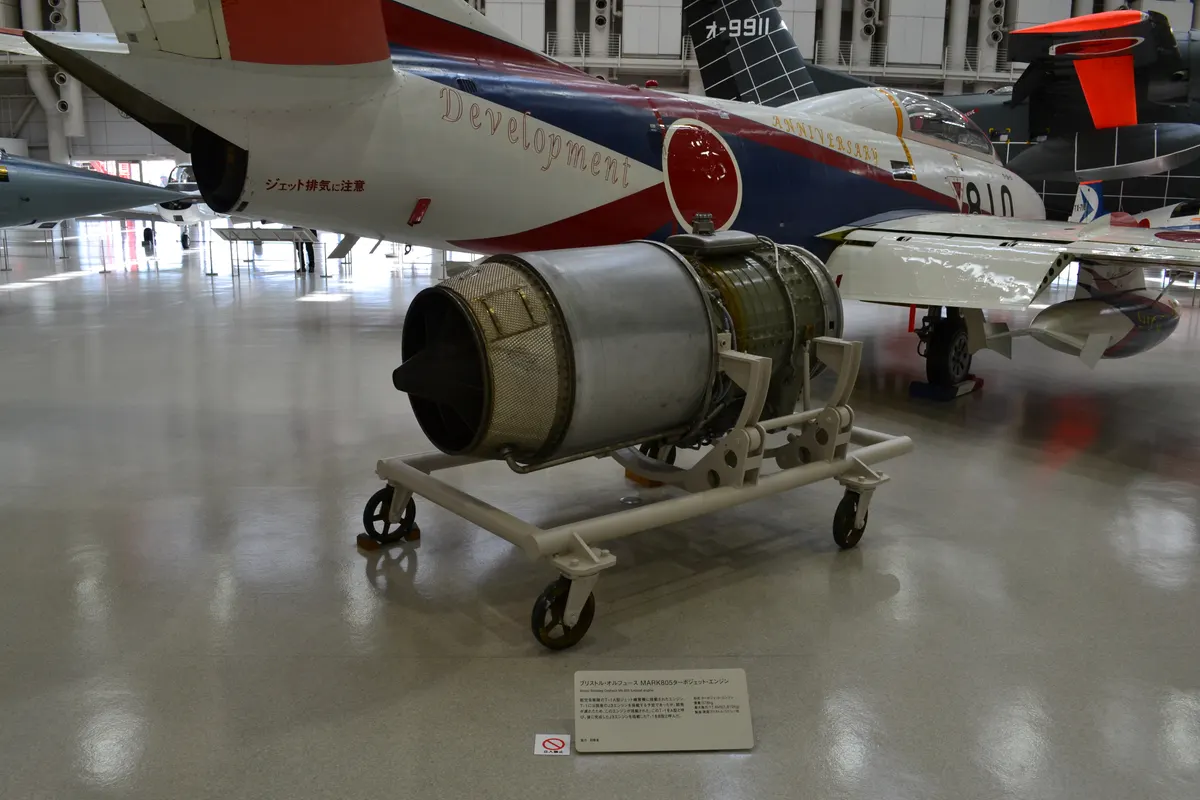
Where Fuji's domestic rival proposals for the same requirement kept the straight wing and side-mounted intakes of the Lockheed T-33, Fuji's team went the other way, giving the T-1 a nose intake and sharply swept wings reminiscent of the F-86 Sabre then in frontline JASDF service.5,1 The choice added maneuverability at the cost of some low-speed handling docility, a trade later trainer generations elsewhere would also make. The airframe carried a 12.7 mm Browning M53-2 machine gun in the nose and two underwing pylons capable of AIM-9 Sidewinder practice rounds, unguided rockets, small bombs, or drop tanks, giving instructors a basic weapons syllabus alongside pure flying training, although in practice this armament saw only limited use since Japan's constitution kept the JASDF out of combat operations.1
- Engine TypeBristol Siddeley Orpheus Mk 805
- Thrust17.79

Performance reflected the compromise: a top speed around 924 km/h (575 mph) at altitude on the T-1A, a service ceiling of roughly 14,400 to 15,900 m depending on the source consulted, and a climb rate of about 33 m/s (6,500 ft/min), figures drawn from Jane's All the World's Aircraft for the mid-1960s.2,1 Range on internal fuel was about 1,300 km, stretching to roughly 1,950 km with external tanks.1 None of these numbers were exceptional even by 1960 standards, but they did not need to be: the T-1's job was to bridge a student from a piston-engine primary trainer to a frontline swept-wing fighter, not to fight.
- Top Speed800 km/h
- Cruise Speed620 km/h
- Service Ceiling14,400 m
- Range1,000 km
- Rate of Climb15 m/s
- G-Limit7
- Endurance2
- Cockpit ConfigurationTandem two-seat
- Glass CockpitNo
- Embedded SimulationNo
- Light Attack CapableNo
- Hardpoints0
- Ejection SeatsYes
- Length10.25 m
- Wingspan10.5 m
- Height4.08 m
- Max Takeoff Weight4,150 kg
- Total Built66
- Operators1
- Retirement Year2006
- Production Start1962
- Production End1963
- Operational StatusRetired
Rebuilding a Banned Industry, From Nakajima's Ashes to Fuji Heavy Industries
Japan's aircraft industry was shut down entirely after 1945 and only permitted to resume in April 1952, and even then under close watch.4 Fuji Heavy Industries was formed in July 1953 from five successor companies of the old Nakajima Aircraft conglomerate, the wartime maker of the Ki-43 Hayabusa and Ki-84 Hayate fighters, reportedly organizing around the internal slogan "Aircraft Again."8 Its first postwar aircraft work was modest by comparison: license production of the Beechcraft T-34A Mentor piston trainer beginning in 1953, followed by the T-1 jet program that began three years later.8,4 Winning the 1956 jet-trainer contract, as the only bidder to propose a swept wing, put Fuji rather than any of its larger wartime-legacy rivals at the center of Japan's re-entry into original jet design.4
First Flight and a Test Pilot Who Bridged Two Eras
The prototype's 30-minute maiden flight on 19 January 1958 was flown by Susumu Takaoka, a former Imperial Japanese Navy officer.9 Takaoka was not a random choice of test pilot: on 7 August 1945, in the closing days of the war, he had also flown the first flight of the Nakajima Kikka, Japan's first jet aircraft.10,9 Thirteen years and a lost war later, the same man put Japan's first postwar jet into the air, a continuity of personnel across the country's aviation program that is easy to overstate emotionally but is nonetheless a documented fact rather than a coincidence of trivia writing.9
A Procurement Decision That Cut the Program Short
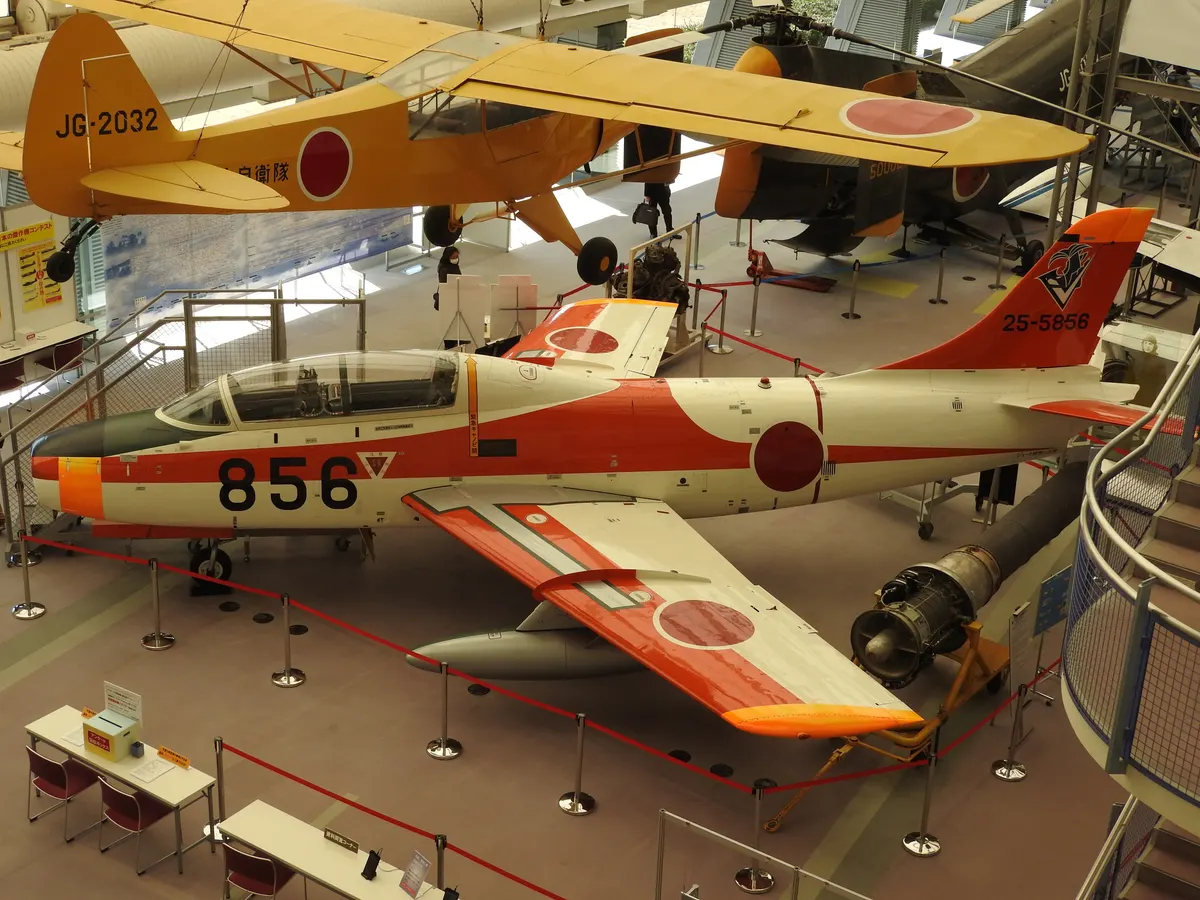
The JASDF's original plan called for roughly 200 T-1s to re-equip its jet training pipeline.1 That plan collapsed when Japan's training requirements shifted and the service chose to import the American Lockheed T-33A Shooting Star in bulk instead, a decision that squeezed the market Fuji had been building the T-1 to fill.1 Production ended at 66 airframes, and while marketing efforts reportedly drew interest from the Royal Australian Air Force as a prospective export customer, no foreign sale was ever concluded.1 The surviving fleet nonetheless proved durable: T-1s stayed in front-line training use with units such as the 13th Flying Training Wing at Ashiya Air Base into the 1990s and 2000s, decades after the political decision that had capped their numbers.7
The T-1 never flew in combat, and it was never going to. Japan's postwar constitution restricts the Self-Defense Forces to a non-offensive role, and the JASDF has not conducted air-to-air or ground-attack operations in anger during the T-1's entire service life.1 That single fact shapes everything else worth saying in this section: the aircraft's nose gun and underwing pylons for practice rockets, small bombs, and Sidewinder training rounds existed to teach a weapons syllabus in peacetime, not to prepare for a specific adversary.1 Students who trained on the T-1 went on to fly Lockheed F-104J Starfighters, Mitsubishi F-1s, and later F-15Js in a Cold War posture built around deterrence and, after 1970, occasional intercepts of Soviet reconnaissance aircraft approaching Japanese airspace, rather than sustained combat.1 The T-1's own contribution to that posture was entirely indirect: it built the flying and gunnery habits of pilots whose eventual aircraft, not the T-1 itself, might have gone to war.
Fuji built the T-1 in a small number of distinct configurations. Two hand-built prototypes, unofficially T1F1 and T1F2, tested the Nippon J3 and imported Bristol Orpheus engines respectively before the design was frozen for production.2 The T-1A became the definitive production version, 46 built with the Orpheus Mk 805, forming the bulk of the fleet and the version most associated with the type's swept-wing reputation.2,1 The T-1B followed, 20 aircraft built between June 1962 and June 1963 with the Ishikawajima-Harima J3-IHI-3 in place of the imported engine, structurally identical but marking the type's completion as a wholly Japanese aircraft.2,3 A number of surviving airframes were later re-engined again as the T-1C, fitted with the improved 13.72 kN J3-IHI-7 turbojet during overhaul, extending their useful life without changing the basic design.2

The Japan Air Self-Defense Force was the T-1's only operator; it never entered any other nation's inventory despite Fuji's export efforts and reported interest from the Royal Australian Air Force.1 Within the JASDF, T-1s served principally with jet training units, most durably the 13th Flying Training Wing based at Ashiya Air Base in Fukuoka Prefecture, which flew the type as the intermediate step between primary propeller trainers and operational fighter conversion.7 Over more than four decades of service, T-1s trained upward of 33,000 jet pilots, a figure that gives some sense of how much flying an aircraft bought in relatively small numbers can still accumulate when it stays in the syllabus for that long.4 Flight training on the type ended around 2000, though individual airframes remained in test and support roles for a few more years before the last examples were formally retired in 2006.1
The most instructive comparison is not with another swept-wing trainer but with the aircraft that effectively cut the T-1's production run short: the Lockheed T-33A Shooting Star, the American jet trainer the JASDF chose to import in bulk instead of buying more T-1s.1 The contrast is almost a case study in two different design philosophies for the same job. The T-33A's straight wing and side intakes, derived from the P-80 fighter of the mid-1940s, prioritized simplicity and a huge existing production and support base; its Allison J33-A-35 centrifugal-flow turbojet produced up to 24 kN (5,400 lbf) with water-injection assist for takeoff, roughly a third more thrust dry than the T-1A's Orpheus even before that boost.11 The T-1, by contrast, traded some of that power margin for handling qualities closer to a contemporary fighter, on the theory that a student who had already flown a swept wing would convert to the F-86 or F-104 with less of a step change.1,5
In practice, both approaches worked, which is precisely why the comparison is interesting rather than one-sided. Sources describing JASDF trials note that despite having roughly half the T-33A's engine thrust, the T-1 matched or exceeded it in some handling respects, a function of the swept wing and a lighter overall airframe.12 What decided the outcome was not performance but industrial policy and cost: the T-33A was already in mass production worldwide under license and available cheaply through American assistance programs, while the T-1 was a small-batch domestic product without that economy of scale.1 A rough side-by-side illustrates the trade clearly:
| Spec | Fuji T-1A | Lockheed T-33A |
|---|---|---|
| Engine thrust | 17.79 kN (dry)2 | up to 24 kN (wet)11 |
| Top speed | ~924 km/h2 | ~965 km/h11 |
| Range (internal fuel) | ~1,300 km1 | ~2,050 km11 |
| Units built (type total) | 661 | over 6,50011 |
The gap in production numbers is the real story here: Lockheed's aircraft was a mature, globally distributed design being bought off an existing line, while Fuji's was a first-generation product from a rebuilding industry that could not yet compete on price or delivery schedule. That the T-1 nonetheless stayed in frontline training service for over 40 years suggests the airframe itself was never the weak link.


How many Fuji T-1 aircraft were built? Sixty-six: 46 T-1As with the imported Bristol Siddeley Orpheus engine and 20 T-1Bs with the domestic Ishikawajima-Harima J3, well short of an original plan for around 200.1,2
What was the Fuji T-1's top speed? Around 924 km/h (575 mph) at altitude for the T-1A, per period references including Jane's All the World's Aircraft.2,1
Is the Fuji T-1 still in service? No. The JASDF ended T-1 flight training around 2000, and the last airframes were formally retired in 2006, replaced in the training role by the Kawasaki T-4.1
Fuji T-1 vs Lockheed T-33A, why did Japan choose the American trainer? Cost and availability rather than performance: the T-33A was already in mass production and available cheaply through American assistance programs, while the T-1 was a small-batch domestic aircraft, so the JASDF shifted much of its jet-training buy to the imported type and capped T-1 production at 66.1
What does "Hatsutaka" mean? "First hawk" (初鷹), a name that referred directly to the aircraft's status as Japan's first postwar jet design.4
- "Fuji T-1", Wikipedia — en.wikipedia.org ↩
- "Fuji T-1 - Specifications", flugzeuginfo.net — flugzeuginfo.net ↩
- "Ishikawajima-Harima J3", Wikipedia — en.wikipedia.org ↩
- "日本初の国産ジェット機 富士T-1 初鷹" ("Japan's First Domestic Jet, the Fuji T-1 Hatsutaka"), Saitama Subaru — saitama-subaru.co.jp ↩
- "T-1 Basic Jet Trainer", GlobalSecurity.org — globalsecurity.org ↩
- "North American F-86 Sabre", Wikipedia — en.wikipedia.org ↩
- "Fuji T-1 series", Forgotten Jets, Warbirds Resource Group — forgottenjets.warbirdsresourcegroup.org ↩
- "Fuji Heavy Industries", Wikipedia — en.wikipedia.org ↩
- "高岡迪" ("Susumu Takaoka"), Japanese Wikipedia — ja.wikipedia.org ↩
- "Nakajima Kikka", Wikipedia — en.wikipedia.org ↩
- "Lockheed T-33", Wikipedia — en.wikipedia.org ↩
- "T-1 Basic Jet Trainer", GlobalSecurity.org — globalsecurity.org ↩