


The Aero L-39 Albatros is a two-seat jet trainer designed in Czechoslovakia and first flown on 4 November 1968.1 Between the start of series production in 1971 and the end of the run in 1999, roughly 2,900 airframes left the Aero Vodochody plant at Odolena Voda, making it the most-produced jet trainer aircraft in history.1 Over 44 countries have operated it since, spanning six decades, three currency systems, and at least four wars.2
- Very low operating and acquisition cost relative to any jet in its performance class
- Forgiving, docile handling that suits low-hours student pilots
- Turbofan efficiency and low noise versus turbojet-powered predecessors
- Simple systems, widely available spare parts and mechanics on the civilian market
- Proven airframe with an enormous fleet history to draw safety data from
- Ejection seat (VS-1 BRI) falls well short of modern zero-zero standards
- Original Ivchenko AI-25TL engine is a legacy Soviet-Ukrainian product, increasingly hard to support post-2014
- Underpowered and lightly protected for any serious ground-attack role
- Civilian ejection seat maintenance is costly enough that most US-owned examples fly with seats deactivated
- Aging avionics on unmodernized examples limit usefulness for advanced weapons training
It was also a technical milestone that gets less attention than the production numbers: the L-39 was the world's first trainer aircraft built around a turbofan rather than a turbojet, using the Ukrainian-designed Ivchenko AI-25TL.1,3 That single engineering choice, a bypass engine instead of a straight jet, is why the L-39 sips less fuel, runs quieter, and holds a longer training sortie than the aircraft it replaced, the Aero L-29 Delfín. Despite emerging from the Warsaw Pact's largest aircraft design bureau outside the Soviet Union itself, the type never received a NATO reporting name of the kind assigned to Soviet fighters and bombers, an oddity attributable to its unarmed-trainer classification during the Cold War.4
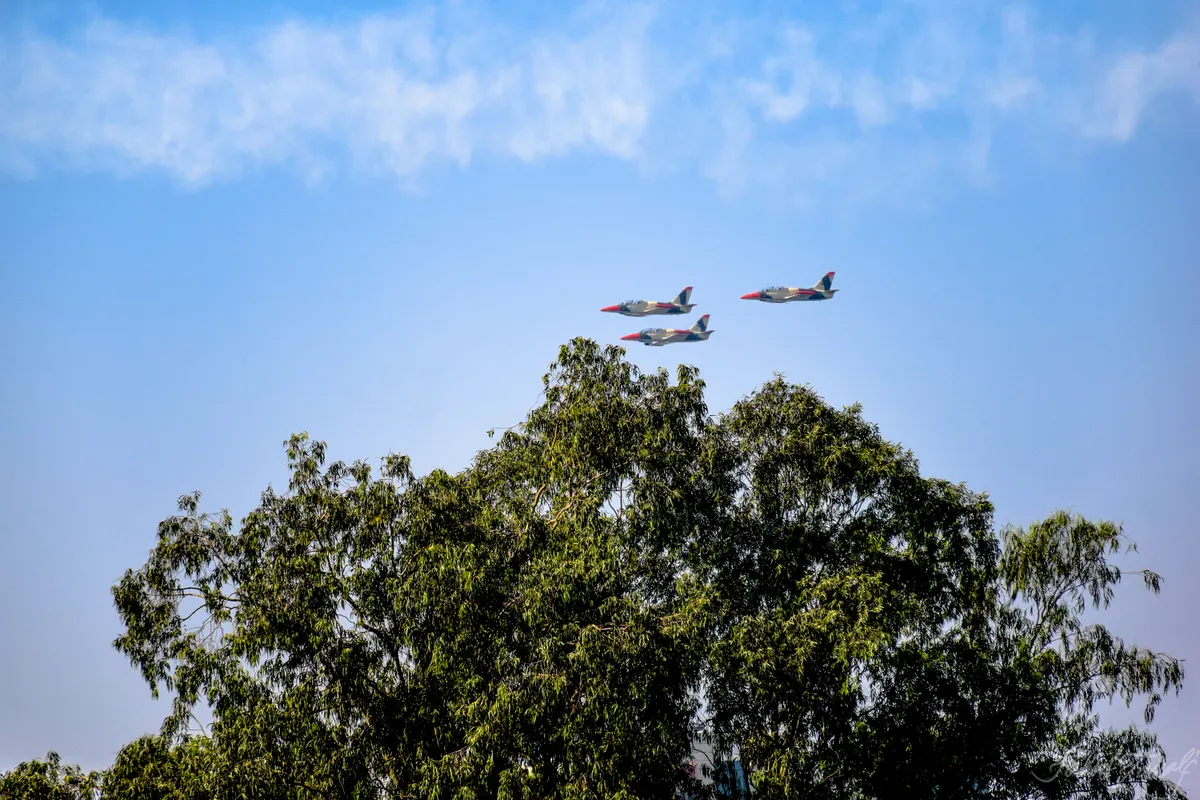
The airframe's second life has arguably eclipsed its first. When the Warsaw Pact dissolved, thousands of L-39s became surplus almost overnight, and a large share migrated west into private hands, airshow teams, and camera-plane work, a path so well-trodden that an entire Swiss touring company, MiGFlug, traces its origin to a single unauthorized flight a founder negotiated with a Russian military pilot in a bar in 2004.5 Roughly 300 of the type are on the US civil register today, more than any other jet warbird, and it has become the backbone aircraft of the Reno Air Races' Jet Class since 2002.6 Meanwhile the design itself did not simply retire: Aero Vodochody relaunched it as the L-39NG (Skyfox), swapping the original Soviet-Ukrainian engine for a Western Williams International turbofan and re-entering serial production in the 2020s for the Czech Air Force and a growing list of export customers.7
Militarily, the L-39 is not a combat aircraft in the fighter sense, and no serious operator has ever pretended otherwise; it was built to teach basic and advanced jet handling, weapons employment on simplified underwing hardpoints, and to bridge cadets from propeller trainers to front-line fast jets like the MiG-21, MiG-29, and Su-27. Where air forces lacked anything faster, however, it has repeatedly been pressed into light strike and counter-insurgency duty, sometimes at heavy cost to the airframes and their pilots, a pattern documented from Chad in the 1980s to Syria and Ukraine in the 2020s.
Airframe Layout and the Stepped Tandem Cockpit
The L-39 follows a conventional low-wing, single-engine layout with a straight, moderately tapered wing and, on the basic trainer version, distinctive teardrop-shaped fuel tanks fixed to the wingtips. The tandem cockpit is stepped, with the rear instructor's seat raised above and behind the student's position so the instructor retains a usable forward view over the student's head, a detail borrowed from the L-29 and by the late 1960s already a settled convention in the jet-trainer class.1 The fuselage carries a retractable boarding step and handholds on the left side, letting pilots climb aboard without a portable ladder, a minor feature but one repeatedly singled out by pilots and maintainers as a convenience Western trainers of the same era generally lacked.2
- First Flight1968
- Service Entry Year1974
- Crew (seats)2
- Trainer Typebasic and advanced jet trainer
- In ServiceYes

Published performance figures vary somewhat between sources and sub-variants, which is worth flagging rather than smoothing over. The commonly cited cruise-class maximum speed for the baseline L-39C is about 750 km/h (405 knots, 466 mph) at 5,000 meters, with a low-level figure closer to 700 to 720 km/h; some armed variants and export data sheets list figures approaching 900 km/h, which appear to reflect dive limits or the more powerful L-39MS/L-59 sub-family rather than the base trainer.1,8 Treat any single "L-39 top speed" number with caution unless the specific variant is named. Service ceiling is around 11,000 meters (36,000 feet), maximum range is roughly 1,750 km (944 nautical miles) with the wingtip tanks and external stores fitted, and empty weight for the basic trainer sits close to 3,600 kg against a maximum take-off weight of 4,700 kg.1,8
- Engine TypeIvchenko AI-25TL
- Thrust16.9
- Power (turboprop)21.6 kW
The Ivchenko AI-25TL and Its Reputation
The Ivchenko AI-25TL turbofan, built by the Zaporizhzhia design bureau that became Ivchenko-Progress and manufactured in cooperation with the engine plant now known as Motor Sich, was the aircraft's defining engineering decision.9,10 Compared with the turbojet in the preceding L-29 Delfín, the turbofan cut fuel consumption by roughly 30 percent, reduced noise by around 15 decibels, and stretched flight endurance to about 3.8 hours, while also smoothing out low-speed handling during the approach and landing phase that matters most for students.3 The engine has a time-between-overhaul rating of around 1,000 flight hours and has a reputation, among operators and civilian owners alike, for being comparatively cheap and straightforward to maintain by turbine standards.3,9
- Top Speed750 km/h
- Cruise Speed750 km/h
- Service Ceiling11,000 m
- Range1,100 km
- Rate of Climb15 m/s
- G-Limit6
- Endurance180
That reputation for reliability comes with a widely acknowledged asterisk: the AI-25TL is thirsty by the standards of a modern trainer engine, and since the breakup of the Soviet Union, and especially since 2014, sourcing genuine spare parts and factory overhaul support from Ukraine has become progressively harder for operators outside the former Eastern Bloc.3 This is one of the central reasons the L-39NG relaunch discarded the original engine entirely rather than modernizing around it.
- Cockpit Configurationtandem, dual‑control
- Glass CockpitNo
- Embedded SimulationNo
- Light Attack CapableYes
- Hardpoints4
- Ejection SeatsYes
Cockpit Ejection Seats and the VS-1 BRI Problem
The L-39 was equipped with the domestically designed VS-1 BRI ejection seat, notable at the time because only a handful of countries worldwide had the industrial capacity to build ejection seats at all.4 The seat, however, does not match the performance envelope of later Western "zero-zero" seats capable of safe ejection at zero altitude and zero airspeed; documentation on the type indicates a minimum ground speed requirement near 150 km/h for the seat to function safely at ground level, a limitation that has been implicated in at least one fatal accident during a low-speed runway excursion.11
- Length12.13 m
- Wingspan9.46 m
- Height4.2 m
- Max Takeoff Weight6,400 kg
Domestic Content
The L-39's airframe, tooling, and final assembly were entirely Czechoslovak, carried out by Aero Vodochody at Odolena Voda, with the domestically developed VS-1 BRI ejection seat and most cockpit instrumentation likewise built in Czechoslovakia.1,4 The aircraft's single most critical imported component was its engine, the Ivchenko AI-25TL, designed by the Zaporizhzhia bureau that is now Ivchenko-Progress and produced in cooperation with the Motor Sich plant in Ukraine, then part of the Soviet Union.9,10 That dependency did not end with the Cold War; modern operators of the original engine variant still rely on Ukrainian overhaul and spares support, a supply chain badly strained since 2014, which is precisely why Aero Vodochody's L-39NG successor replaced the Ivchenko unit with a Western Williams International turbofan rather than continuing to source it domestically or from Ukraine.3,7
- Total Built2,900
- Operators30
- Operational Statusactive
From the C-39 Requirement to First Flight
Aero Vodochody began development in 1964 under a design team led by Jan Vlček, working to a specification then referred to internally as the C-39, intended as the eventual replacement for the same company's L-29 Delfín.1,12 The L-29 had itself only been selected as the Warsaw Pact's standard jet trainer a few years earlier, in 1961, after a comparative fly-off at Monino airfield near Moscow against the Polish PZL TS-11 Iskra and the Soviet Yakovlev Yak-30; contemporary assessments suggest the Iskra actually out-turned and out-climbed the L-29 thanks to a lighter airframe, but the L-29 won the contract on political rather than purely technical grounds, with Poland alone declining to adopt it and continuing to build the Iskra for its own air force.13 That history matters for the L-39 because it explains why Czechoslovakia, rather than the Soviet Union, was again entrusted with the Pact's next trainer: Aero had already proven it could deliver an aircraft the whole bloc would standardize on.
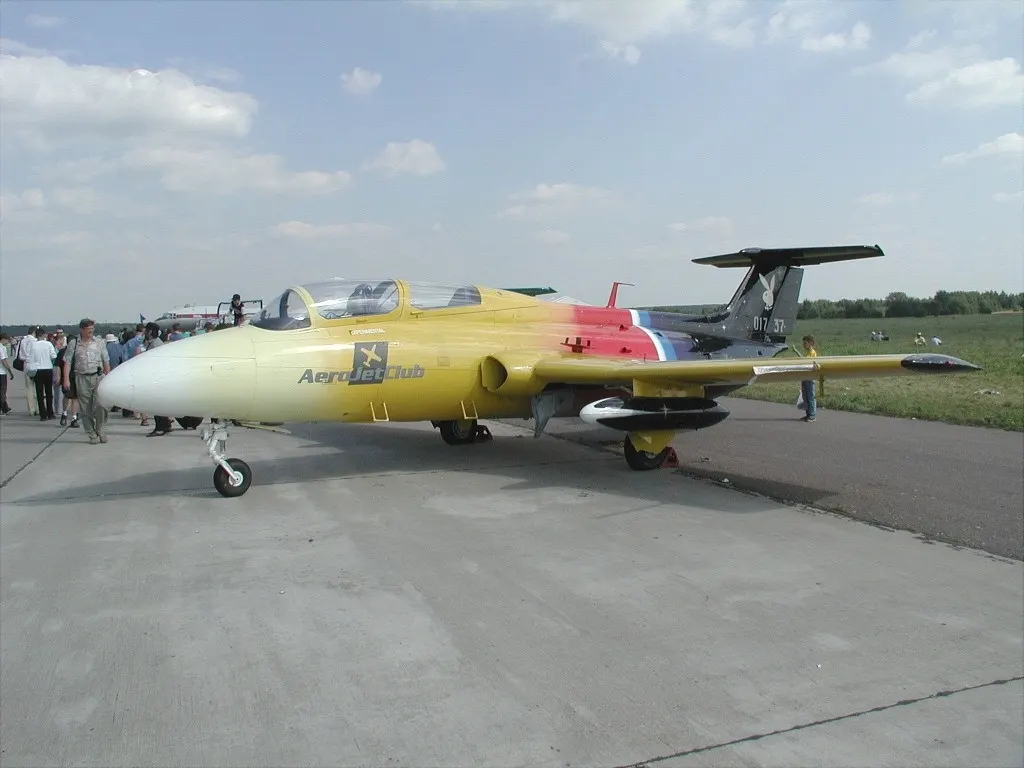
The L-39 prototype flew for the first time on 4 November 1968, becoming, as noted above, the first trainer aircraft anywhere fitted with a turbofan.1 Quantity production began in 1971, and by 1972 the type had been formally adopted by the great majority of Warsaw Pact air forces as their preferred primary jet trainer, a remarkably fast standardization process for a multi-nation alliance.1
Warsaw Pact Standardization and the Soviet Order Books
The Soviet Union alone eventually took delivery of more than 2,000 L-39s, the bulk of total production, using them across its enormous flight-school network to carry cadets from propeller trainers up to front-line fast jets.12 Beyond the Pact proper, Aero Vodochody exported the type widely into the wider Soviet client-state network across the Middle East, Africa, and Asia throughout the 1970s and 1980s, a customer list that by the end of the Cold War included Afghanistan, Libya, Syria, Iraq, Vietnam, Cuba, and Nigeria among many others.2
The Post-Cold War Scattering and the Civilian Second Life
The Warsaw Pact's collapse left former member states holding L-39 fleets far larger than their shrunken post-1991 air forces needed, and a substantial share of the surplus was sold off through the 1990s, much of it flowing to Western private buyers rather than to other militaries.6 The US alone now hosts roughly 300 privately registered examples, more than any other jet warbird type, and when the National Championship Air Races at Reno introduced a dedicated Jet Class in 2002, the L-39 quickly became its defining aircraft: cheap enough to field in numbers, fast enough to be genuinely competitive, and tough enough to be flown hard around a closed pylon course race after race.6
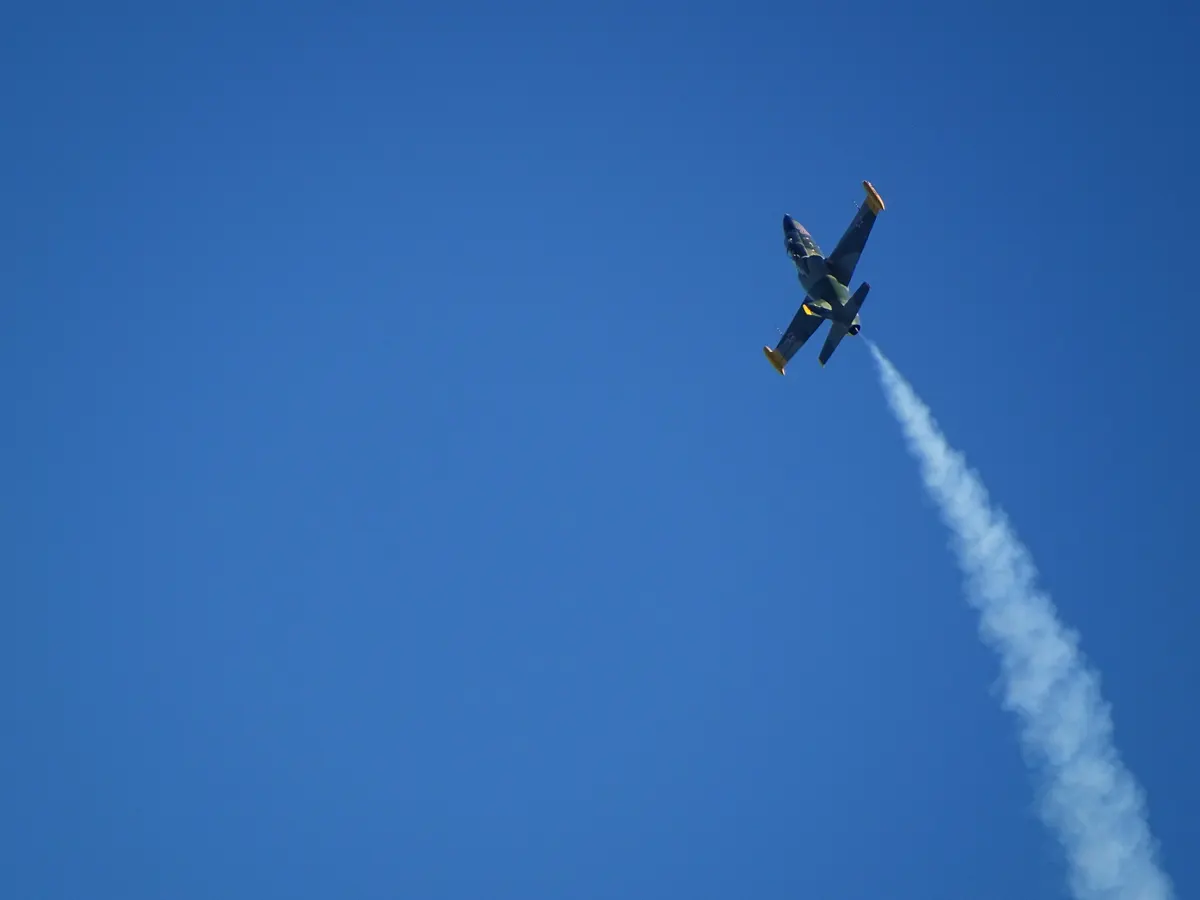
Prices on that civilian market have stayed remarkably low for a jet aircraft: unrestored ex-military L-39s from the 1970s and 1980s can trade for as little as 400,000 to 1 million US dollars, which is what puts the type within reach of well-off private pilots rather than only institutions, and is the direct commercial reason the aircraft dominates civilian jet ownership statistics.17 That affordability also explains the parallel rise of dedicated jet-experience operators such as MiGFlug, which turn the same low operating costs into a business model selling flights to paying customers who could never justify buying a jet outright.
The L-39NG "Skyfox": A Western-Engine Revival
Aero Vodochody launched the L-39NG (marketed since 2025 as the Skyfox) program in 2014, partnering with Draken International on the North American market and with Williams International, which supplies the FJ44-4M turbofan at the program's core.7 A technology demonstrator, internally designated L-39CW, first flew on 14 September 2015, and the first true L-39NG prototype flew on 22 December 2018 after rollout that October.7 The new engine produces thrust broadly comparable to the old Ivchenko AI-25 but burns noticeably less fuel, and the redesigned aircraft adopts a "wet," fuel-carrying wing that finally eliminates the original's signature wingtip tanks, along with modern Western avionics and a fifth underwing hardpoint.7
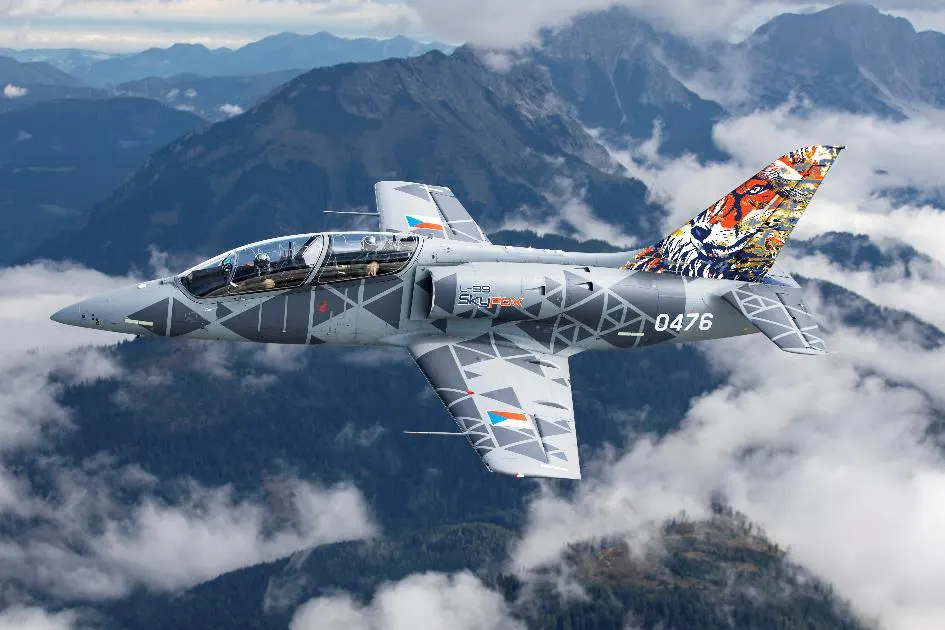
The program offers two tracks: a Stage 1 retrofit that re-engines and optionally re-avionicizes existing L-39 airframes for current operators, and a Stage 2 new-build aircraft incorporating the full set of structural changes.7 The Czech Air Force placed an order in November 2022 for four aircraft with an option for four more, a contract worth roughly 2.1 billion Czech koruna (about 101.5 million US dollars) once support and warranty coverage through 2028 is included, putting unit cost, depending on how support packages are counted, somewhere between about 15 and 25 million dollars per aircraft.18 Deliveries to the Czech training center began in 2025, and Aero Vodochody has stated it held 34 contracted aircraft at the start of serial production, enough to keep the line running double shifts for roughly three years.19 Algeria and Angola are among the newer prospective customers reported for the type as of the mid-2020s.20
Ground Attack Debut in the Chadian-Libyan War
Libya acquired around 180 L-39ZO aircraft beginning in 1978, initially for its flying schools, but deployed a portion of the fleet operationally during the long-running Chadian-Libyan conflict, flying strike missions out of the Ouadi Doum air base in northern Chad.2 This was among the earliest instances of the trainer being used in anger rather than purely in the training role its underwing hardpoints were originally intended for.
Nagorno-Karabakh and the Afghan Air Force's Long War
During the First Nagorno-Karabakh War in the late 1980s and early 1990s, Azerbaijani forces flew L-39s alongside older L-29s on ground-attack sorties against Armenian and Nagorno-Karabakh Defense Army positions, and a number of the jets were shot down by the defenders' air defenses.21 Separately, the Afghan Air Force operated as many as 26 L-39Cs from 1977 through the fall of the communist-aligned government and beyond, into 2001; only three of those aircraft were reported to have survived by the time of the US-led intervention that year, a rate of attrition that reflects both decades of continuous internal conflict and the difficulty of sustaining any jet fleet through prolonged civil war.2
The Syrian Civil War: An Aging Jet Turned Counter-Insurgency Platform
From the early stages of the Syrian civil war, the Syrian Air Force routinely deployed its L-39 fleet in counter-insurgency strikes against rebel-held ground positions, including during the Battle of Aleppo, and lost a number of aircraft to ground fire over the course of the conflict.22 In February 2013, insurgent forces captured a batch of intact L-39s along with their support equipment after overrunning the Al-Jarrah air base, turning some of the government's own training fleet, briefly, into rebel-held hardware.22
Libya's Second Civil War and Contractor-Flown Fleets
The L-39 resurfaced in Libyan skies during the 2011 civil war, among the first aircraft government forces committed against the uprising, and again after 2014 as the country split between rival governments; Government of National Accord forces operated roughly a dozen L-39s for strikes against Libyan National Army positions, relying on the type's underwing hardpoints for rockets and bombs despite its modest speed and lack of armor.2 More broadly across Africa and the Middle East, open reporting describes a pattern, smaller and less documented than state air force use, of L-39s flown by privately contracted crews rather than uniformed pilots, including reported cases tied to Libya since 2019 and earlier arrangements in Mozambique, Sudan, and Chad, generally where the nominal operator lacked enough qualified military pilots of its own.23 These arrangements are consistently described as limited in scale and typically temporary, providing light air support or aircrew training rather than a decisive combat role.23
Ukraine: Losses, a Foreign Donation, and a Contested Anti-Drone Proposal
Ukraine flew the L-39 as an advanced trainer with its 39th Tactical Aviation Brigade going into the Russian invasion, and lost an aircraft on the war's opening day, 24 February 2022, when pilot Dmytro Kolomiyets was shot down over Khmelnytskyi.24 On 25 August 2023, two Ukrainian L-39s collided during a combat training mission over Zhytomyr, killing all three pilots aboard.24 Lithuania, one of the type's smaller former operators, donated its sole remaining L-39ZA to Ukraine in late 2024 to help offset such losses.25
The war has also generated a genuinely contested proposal: using L-39s, and prospectively the re-engined L-39NG, against Shahed-type loitering munitions. Analysts have pointed out real limits to the idea, including the jet's high fuel burn and cost per intercept against a cheap slow-flying target, and the difficulty of visually acquiring small drones from a fast-moving cockpit, even while acknowledging that simple unguided rocket pods could theoretically be hung on the airframe.26 Aero Vodochody has separately marketed a purpose-adapted L-39NG configuration armed with laser-guided 70mm rockets specifically for the counter-drone role, pitching an approximate 2,500-dollar-per-flight-hour operating cost as a more sustainable "cost-exchange ratio" than firing surface-to-air missiles at low-value drones.5
The L-39C is the baseline unarmed trainer, entering production in 1971 with two wingtip fuel pods and no hardpoints beyond what basic instrumentation required; it remains the version most commonly seen in civilian ownership today.27 The L-39ZO followed in 1975 as a dedicated weapons trainer, adding four underwing hardpoints, a strengthened wing, and reinforced landing gear to handle the extra weight, though it retains no built-in gun.27
The L-39ZA took the armed concept further, fitting a Gryazev-Shipunov GSh-23 twin-barrel 23mm cannon in a conformal pod under the fuselage in addition to the four wing hardpoints, along with sturdier landing gear and a total payload capacity around 1,290 kg; it is the closest the family comes to a genuine light-attack aircraft rather than a trainer with attachment points.27 The L-39MS represents a more thorough second-generation redesign: a strengthened, lengthened fuselage, a substantially updated cockpit, and a more powerful Lotarev DV-2 engine rated at 21.6 kN of thrust, enough to push maximum speed toward roughly 872 km/h. It is visually distinguishable by a one-piece upward-opening canopy with a canted center bow, unlike the separate front and rear canopies of the ZA.27 The L-59 is essentially the export designation for the L-39MS airframe, with country-specific sub-variants, the L-59E for Egypt and the L-59T for Tunisia, distinguished by a taller vertical fin carrying a horizontal formation-light bar ahead of the rudder's top.28
The modern L-39NG, marketed as the Skyfox since 2025, is covered in detail in the History section above: a Western Williams International FJ44-4M turbofan, a new wet wing removing the need for wingtip tanks, five hardpoints instead of four, and modern glass-cockpit avionics, offered both as a retrofit for existing operators' airframes and as an all-new-build aircraft.7


At its peak the L-39 family was flown by more than 44 nations, an unusually wide spread for a single trainer type.2 The largest bloc was, unsurprisingly, the Soviet Union and its Warsaw Pact allies; after 1991 the fleet was inherited piecemeal by the successor states, including Russia, Ukraine, Belarus, Kazakhstan, Kyrgyzstan, Uzbekistan, Azerbaijan, and Lithuania, alongside the paramilitary DOSAAF organization that had trained Soviet military reservists.2 Czechoslovakia's own air force, and its Czech and Slovak successors, flew the type for decades after independence, eventually transitioning toward the L-39NG and the separate L-159 light attack jet.
Beyond the former Eastern Bloc, the Middle East and Africa became the type's largest export market outside the Pact itself: Libya, Syria, Iraq, Algeria, Egypt, Ethiopia, Nigeria, Uganda, Equatorial Guinea, Ghana, Senegal, and more than a dozen other African states have operated it, drawn by the same combination of versatility (training pilots for higher-end MiG-29, Su-27, or F-16-type aircraft while also being usable for light strike and reconnaissance) and affordability that keeps it popular on the civilian market.29 More than 17 African air forces alone have bought the type at one time or another.29 In Asia, operators have included Vietnam, Cambodia, Bangladesh, Thailand, and North Korea.2 Afghanistan's decades-long operation of the type, and its near-total attrition by 2001, is covered above under Conflicts.

The United States is unusual among "operators" in that its roughly 300 registered examples are almost entirely private and civilian rather than military; no US armed service has ever operated the L-39, but it is nonetheless the most numerous jet warbird type on the American civil register and the backbone of the Reno Jet Class, several airshow demonstration teams, and companies selling civilian fighter-jet flight experiences.6,5
The L-39 Versus Its Predecessor, the L-29 Delfín
The most direct and best-documented comparison for the L-39 is the aircraft it was explicitly built to replace. The L-29 Delfín, in service across the Warsaw Pact from the early 1960s, used a straightforward turbojet, the Motorlet M701, an engine that was rugged and simple but thirsty and comparatively noisy, with correspondingly shorter sortie endurance. The L-39's switch to the turbofan Ivchenko AI-25TL cut fuel burn by around 30 percent, cut noise by roughly 15 decibels, and pushed usable endurance up to about 3.8 hours, while also giving smoother low-speed handling on approach, precisely the phase of flight where a student pilot most needs a forgiving aircraft.3 The L-39 was also, from the outset, designed to accept a wider spread of underwing stores across its later variants, giving the Pact a single trainer family that could plausibly double as a light-attack aircraft in a way the L-29 rarely did.
The trade-off is less clean than a simple better-in-every-way story. The L-29 had already proven itself as a rugged aircraft matched to the poorly surfaced grass and gravel strips common at the smaller Warsaw Pact training fields, and its turbojet, while less efficient, had fewer parts and arguably an even simpler maintenance profile than the AI-25TL's twin-shaft turbofan. What is well documented is that despite the Iskra's stronger showing in the original 1961 fly-off that chose the L-29 over its Polish rival, the Pact's aircraft industry and training pipeline had, by the mid-1960s, become built around the Aero-Motorlet ecosystem, and the L-39 program was as much a continuation of that industrial commitment as it was a purely technical leap.13
The L-39 Versus the BAC Strikemaster: Two Cold War Philosophies
The L-39's nearest Western contemporary in role and era is the British Aircraft Corporation Strikemaster, a licensed development of the Jet Provost built for many of the same export markets, particularly in the Middle East and Southeast Asia, that the L-39 would later reach from the other side of the Iron Curtain. The comparison is instructive precisely because the two designs solved similar problems with different priorities. The Strikemaster used a Rolls-Royce Viper turbojet, giving it a top speed in the region of 480 mph (roughly 770 km/h) and a longer straight-line range, around 1,382 miles (2,224 km), against the L-39's roughly 840 to 1,090-mile range depending on external tanks, alongside a higher quoted service ceiling near 40,000 feet.30,8 The L-39, using its turbofan, still comes out somewhat faster at altitude on the most commonly cited figures and burns noticeably less fuel doing it, a direct benefit of the decade of engine development separating the two designs.
The more consequential difference, and one where the two philosophies genuinely diverge, is safety equipment. The Strikemaster was fitted with Martin-Baker ejection seats, a Western product line with an exceptionally well-documented and continuously improved safety record across dozens of aircraft types, whereas the L-39's domestically designed VS-1 BRI seat, an impressive achievement for a country with no prior ejection-seat industry, never matched the zero-zero performance envelope that Martin-Baker had already achieved by the era the L-39 entered service, and its civilian safety limitations remain an active source of controversy on the warbird circuit today.11 Production numbers also tell a story about the two blocs' industrial scale rather than about which aircraft was "better": only 146 Strikemasters were built in total against the L-39's nearly 2,900, a gap that reflects the sheer size of the Warsaw Pact's centralized training requirement far more than any technical shortfall on the British side.31


What are the Aero L-39 Albatros's basic specifications? The baseline L-39C is a tandem two-seat jet trainer roughly 12 meters long with a wingspan near 9.5 meters, weighing about 3,600 kg empty and up to 4,700 kg at maximum take-off weight, powered by a single Ivchenko AI-25TL turbofan producing around 1,720 kg (16.87 kN) of thrust.1,8 Commonly cited performance figures put maximum speed around 750 km/h (405 knots) at altitude, service ceiling near 11,000 meters (36,000 feet), and range up to about 1,750 km with external tanks fitted, though some sources list higher speed figures for later armed variants.1,8
What is the L-39 Albatros's top speed? Most standard references give roughly 750 to 755 km/h (about 405 to 470 mph) at 5,000 meters for the basic L-39C, with lower figures nearer 700 to 720 km/h at low level; the more powerful L-39MS and L-59 variants, using the uprated Lotarev DV-2 engine, are credited with a considerably higher maximum speed around 872 km/h.1,27 Because different data sheets mix cruise, maximum level, and dive figures across variants, treat any single unqualified "top speed" claim with some skepticism.
How much does an L-39 cost? On the civilian market, unrestored ex-military L-39s typically trade in the 400,000 to 1 million US dollar range, which is what makes it the most widely privately owned jet warbird in the world.17 New-build L-39NG aircraft are an entirely different price class, with the Czech Air Force's 2022 order valuing each aircraft, once support and warranty packages are included, at somewhere between roughly 15 and 25 million US dollars.18
Is the L-39 Albatros still in military service? Yes, in two overlapping forms. A number of the original Cold War-era airframes remain in active service with air forces across the former Soviet bloc, the Middle East, and Africa, while the re-engined and modernized L-39NG has entered serial production for the Czech Air Force and additional export customers since the mid-2020s, meaning the type's military service life is now expected to extend well beyond its 1968 first flight by several more decades.7,19
How does the L-39 compare with the L-59 or L-39NG? The L-59 is essentially an export version of the second-generation L-39MS, sharing its more powerful Lotarev DV-2 engine, updated cockpit, and one-piece canopy, but built on the same basic Soviet-era engine architecture as the original L-39.27 The L-39NG is a more fundamental break: a new Western Williams International engine, a redesigned wet wing without wingtip tanks, modern glass-cockpit avionics, and a fifth hardpoint, making it closer to an all-new aircraft that merely shares the L-39's outward silhouette and name recognition.7
Was the L-39 used in real combat, or only for training? Both. Its primary global role has always been training, but numerous operators have used it operationally in ground-attack and counter-insurgency missions, including Libya during the Chadian-Libyan War, Azerbaijan during the First Nagorno-Karabakh War, Syria throughout its civil war, Libya again during its two post-2011 civil conflicts, and Ukraine since the 2022 Russian invasion, generally in situations where the operator lacked more capable combat aircraft.2,21,22,24
Why doesn't the L-39 have a NATO reporting name? NATO assigned reporting names to Soviet and Warsaw Pact combat aircraft, missiles, and some support types for identification purposes during the Cold War, but the L-39 was classified purely as an unarmed jet trainer at the time it entered widespread service, which placed it outside the categories that typically received a name.4
- "Aero L-39 Albatros", Wikipedia — en.wikipedia.org ↩
- "List of Aero L-39 Albatros operators", Wikipedia — en.wikipedia.org ↩
- "The adoption of the AI-25TL turbofan on the L-39 revolutionized flight training", Fly a Jet Fighter — flyajetfighter.com ↩
- "55 years since the first flight of the L-39 Albatros: 7 interesting facts about the legendary aircraft", Aero Vodochody — aero.cz ↩
- "From a Bar in Russia to the Drone Wars: The L-39 Story, and How It Built MiGFlug", MiGFlug — migflug.com ↩
- "Used Aircraft Guide: Aero Vodochody L-39 Albatros", Flying Magazine — flyingmag.com ↩
- "Aero L-39 Skyfox", Wikipedia — en.wikipedia.org ↩
- "Aero L-39 Albatros, Specifications, Technical Data, Description", flugzeuginfo.net — flugzeuginfo.net ↩
- "Motor Sich", Wikipedia — en.wikipedia.org ↩
- "Ivchenko-Progress", Wikipedia — en.wikipedia.org ↩
- "L-39 Albatros: The Real Headache of Civilian Ejection Seats", Fly a Jet Fighter — flyajetfighter.com ↩
- "The L-39 Albatros, Czech Engineering at Its Finest", War History Online — warhistoryonline.com ↩
- "PZL TS-11 Iskra", Wikipedia — en.wikipedia.org ↩
- "Aero L-39 Albatros", James Bond Wiki (Fandom) — jamesbond.fandom.com ↩
- "Smithsonian National Air and Space Museum Acquires Record-Setting L-39 Jet Racer American Spirit", Vintage Aviation News — vintageaviationnews.com ↩
- "The Secret Weapon Behind The Awesome Aerial Footage In Top Gun: Maverick", Simple Flying — simpleflying.com ↩
- "17 African air forces bought this tiny jet, here's why they love it", Military Africa — military.africa ↩
- "Could L-39NG Skyfox Be Ukraine's Counter-Drone Aircraft? Delivery Timeframes and Price", Defense Express — en.defence-ua.com ↩
- "Aero Vodochody takes a breath and starts serial production of L-39NG", CZDefence — czdefence.com ↩
- "First serial Aero L-39NG jet trainer completes maiden flight", AeroTime — aerotime.aero ↩
- "Aero L-39 Albatros", Military Wiki (Fandom) — military-history.fandom.com ↩
- "Lightning Offensive! Syrian Rebels 'Seize' Several L-39 Albatros Aircraft Used By Assad's Forces, Reports", Eurasian Times — eurasiantimes.com ↩
- "The L-39, a training jet that has become a discreet asset for mercenaries", Fly a Jet Fighter — flyajetfighter.com ↩
- "39th Tactical Aviation Brigade (Ukraine)", Wikipedia — en.wikipedia.org) ↩
- "Lithuania Donates L-39ZA Albatros Jet Trainer to Ukraine", The Defense Post — thedefensepost.com ↩
- "Are the L-39 Combat Training Jets Worth Trying to Shoot Down a UAV, And Why It Is a Bad Idea", Defense Express — en.defence-ua.com ↩
- "L-39 Albatros Trainer / Ground Attack Aircraft", Airforce Technology — airforce-technology.com ↩
- "L-39 Albatros, L-59", GlobalSecurity.org — globalsecurity.org ↩
- "17 African air forces bought this tiny jet, here's why they love it", Military Africa — military.africa ↩
- "BAC Strikemaster", Wikipedia — en.wikipedia.org ↩
- "BAC Strikemaster", Wikipedia — en.wikipedia.org ↩