


The Airbus Future Jet Trainer (AFJT) is a proposed advanced jet trainer that Airbus Defence and Space's Spanish division has been pitching to the Spanish Air and Space Force since 2020. No prototype has been built and no metal has been cut; what exists is a set of renders, mock-ups, and a repeatedly updated sales deck.1
- Clean-sheet European design, no third-party export licensing
- Reconfigurable cockpit to emulate multiple frontline types
- Growth path tied to FCAS/NGWS pilot pipeline
- Choice of two mature, combat-proven engines
- Never funded past the concept/study phase
- No prototype, first flight, or firm order ever materialized
- Displaced by a cheaper, already-flying Turkish competitor
- Uncertain export market against entrenched rivals

The design is a clean-sheet, tandem two-seat, single-engine transonic jet meant to replace Spain's ageing CASA C-101 Aviojet and Northrop F-5M trainers, and to give European air forces an indigenous alternative to importing an American or Korean design. Airbus has also floated it as a training platform for future Future Combat Air System (FCAS) pilots, since Spain holds an equal industrial share in that fighter programme alongside France and Germany.2 No country besides Spain has ever placed a firm order or funding commitment, despite early outreach to France and Finland.1
That gap between ambition and funding runs through the whole of the programme's history, from its first unveiling to its quiet supersession years later.
Airbus's published figures describe a roughly 14-metre, 3.2 to 3.4-tonne-empty airframe with a maximum take-off weight cited anywhere from 5.5 to 8 tonnes depending on which iteration of the pitch is referenced; the lack of a settled number reflects how preliminary the design remains.4,5 The airframe is pitched as damage-tolerant, built from aluminium-lithium alloys and composites, with fly-by-wire controls and four underwing stations for training pods and practice munitions.4,5
- Crew (seats)2
- Trainer TypeAdvanced Jet Trainer
- In ServiceYes
The Eurojet EJ200 versus the Safran M88
Airbus has left the engine choice open between two existing European afterburning turbofans: the Eurojet EJ200, built by the four-nation consortium (UK, Germany, Italy, and Spain's own ITP Aero) that powers the Eurofighter Typhoon, and the Safran M88, the French engine behind the Dassault Rafale.1,2 Both are rated in the 90 kN class with reheat.6
- Engine TypeTurbofan
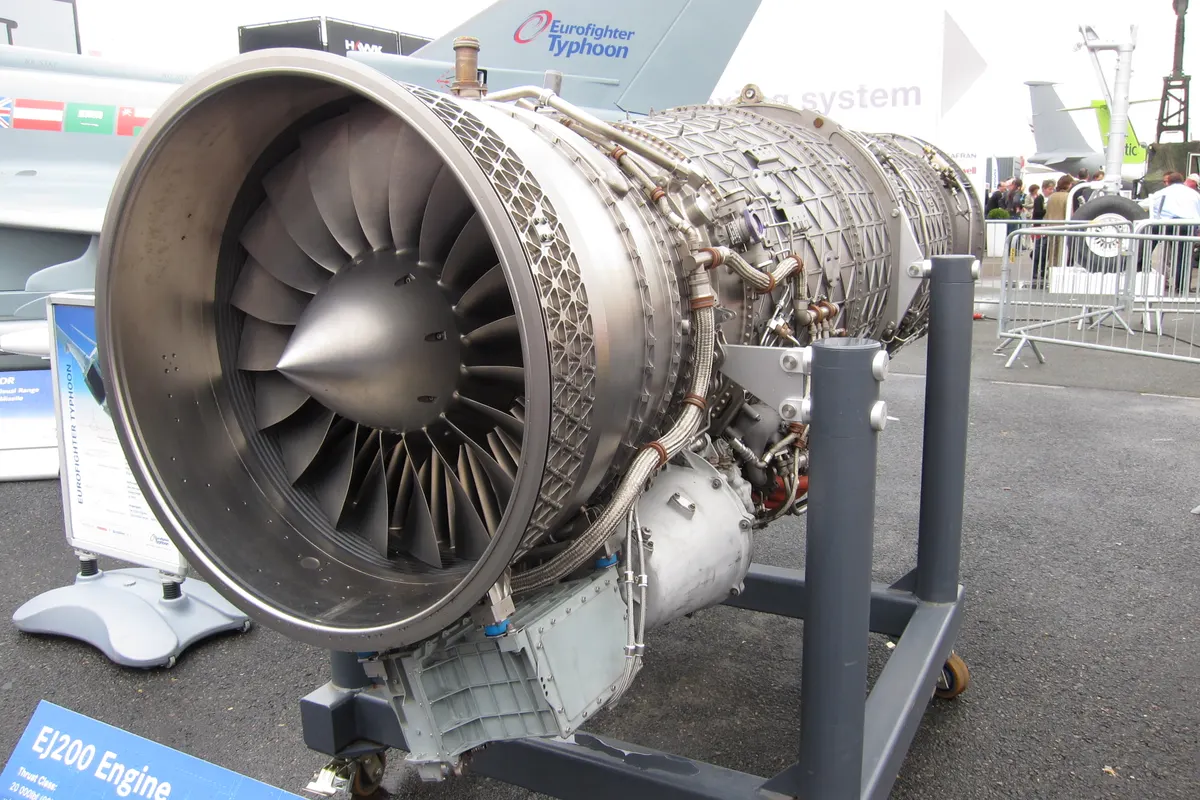
Neither choice has been formally committed, and the decision carries consequences beyond thrust figures. Picking the EJ200 keeps the supply chain inside the existing Eurofighter industrial base and ITP Aero's production share; picking the M88 would pull French suppliers into a programme Paris has otherwise stayed out of, something Airbus officials floated in 2021 as a way to spread development cost.3
- Cockpit ConfigurationTandem
- Glass CockpitYes
- Embedded SimulationYes
- Light Attack CapableYes
- Ejection SeatsYes
A Cockpit Built to Pretend to Be Other Aircraft
The AFJT's central selling point is not raw performance but its embedded training system: a fully digital, glass cockpit whose multi-function displays and mission software can be reconfigured to approximate the handling and symbology of the EF-18 Hornet, the Eurofighter Typhoon, or eventually an FCAS-family fighter, without separate simulators for each type.1,2 Airbus describes this live-virtual-constructive approach, layering simulated weapons, radar returns, and threats onto real flight, as the aircraft's main advantage over older, simpler jet trainers.2
- Operational StatusIn development
As proposed, the AFJT would be assembled by Airbus Defence and Space in Spain, with Indra, Tecnobit, GMV, and CESA named as Spanish suppliers for mission systems, simulation, and ground support equipment.1 The airframe structure is Spanish-led design work. The single largest imported element is the engine: whichever is chosen, the EJ200 or the M88, sits inside a foreign-led consortium, though Spain's ITP Aero already machines EJ200 components under the existing Eurofighter programme, giving Madrid a partial stake either way.1,6 Avionics integration would lean on Indra and GMV, both Spanish, for mission computers and simulation software.1
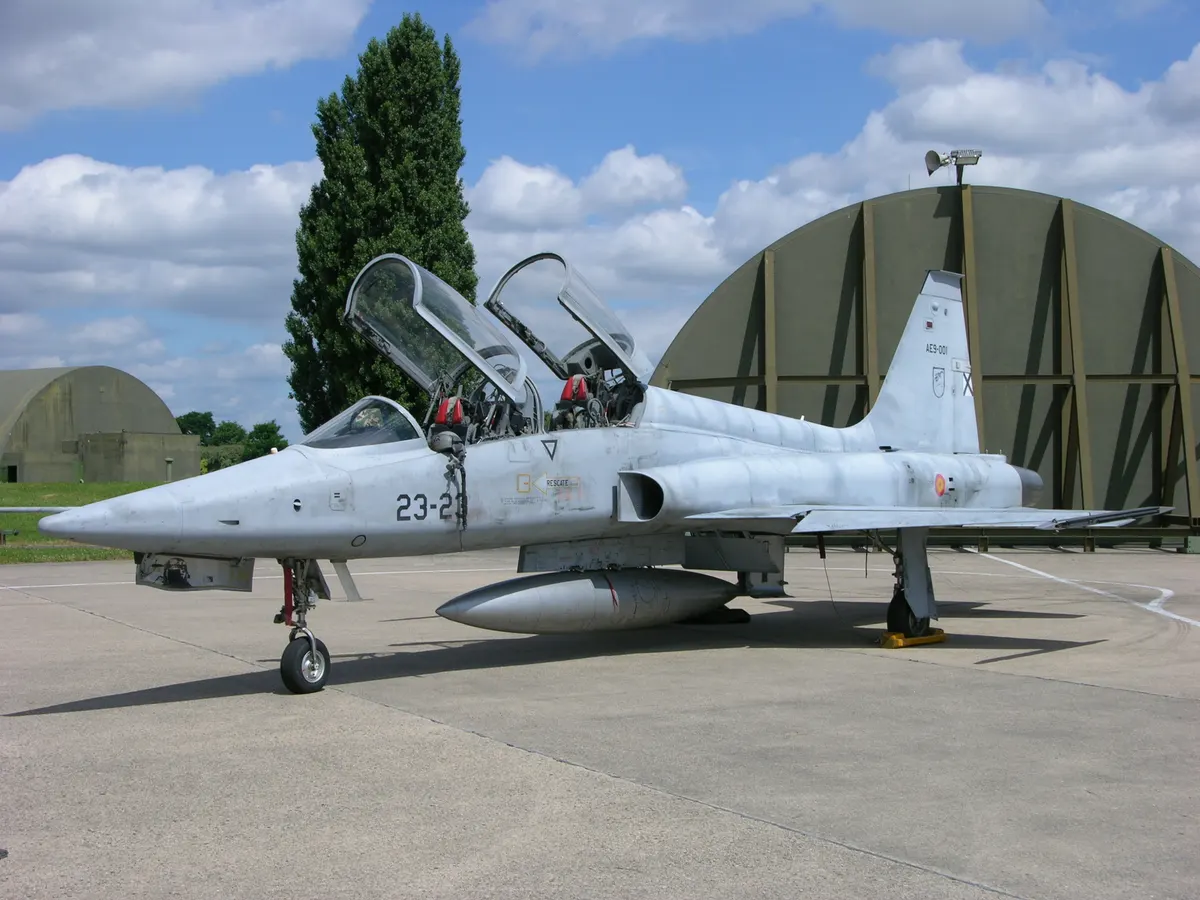
The AFJT's lineage runs through an even older Airbus Spain project. Between 2016 and 2019 the same design effort was marketed as the "C-101 NG," an upgraded successor to the C-101 Aviojet, before Airbus rebranded and expanded the concept once Spain picked the Pilatus PC-21 turboprop for its basic-trainer requirement instead.7 That left an opening for an advanced jet trainer to replace the F-5M fleet, and Airbus formally unveiled the renamed AFJT in October 2020, with programme head Abel Nin describing an aircraft meant to serve "the advanced training mission, red-air aggressor and even in the light attack role."1
Spain's government signed a study-funding agreement with Airbus in July 2020, and sales manager Raúl Tena said at the time that Airbus hoped the jet would "not only serve Spain, but also serve Europe," pointing to France and Finland as potential customers.1 By January 2021 Spanish officials were discussing acquiring 55 aircraft in two batches.
Airbus revived the pitch, unchanged in substance, at the FEINDEF defence show in Madrid in November 2021, still targeting a first flight roughly four years after any formal launch. That launch never came.3
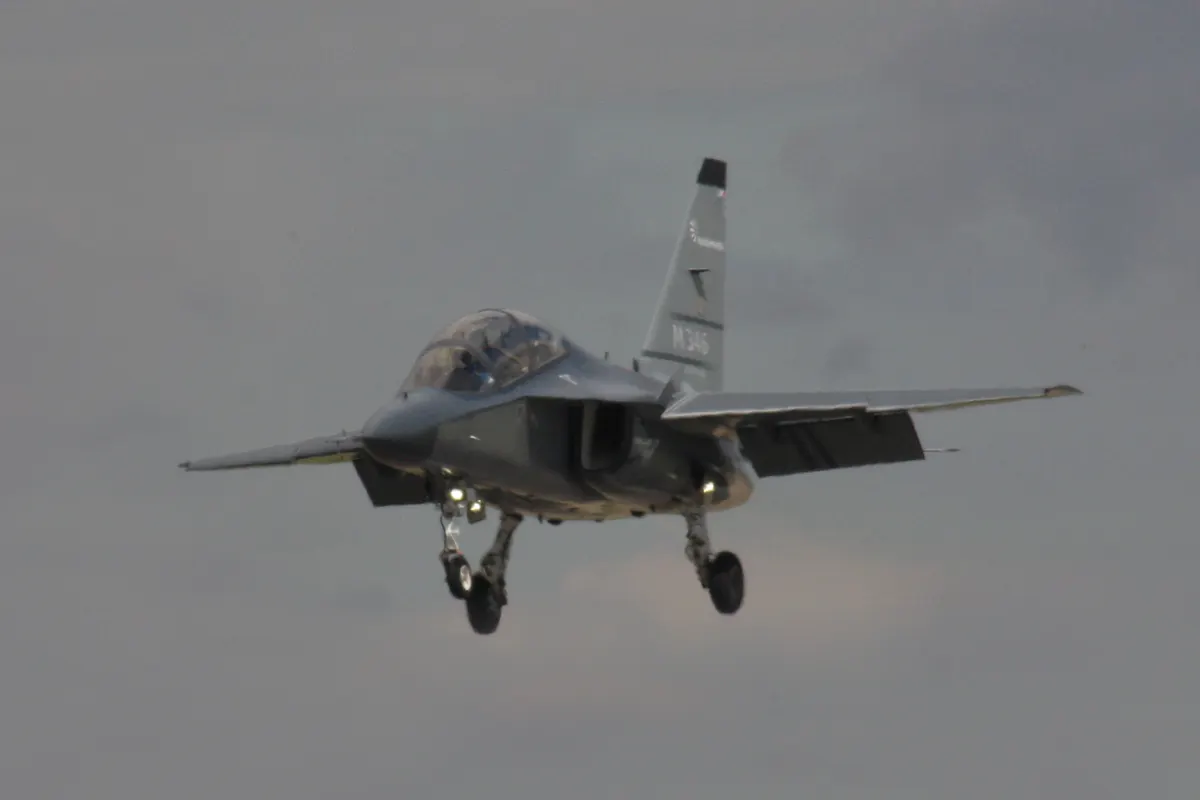
The pivotal break came in June 2023, when Airbus and Leonardo signed a memorandum of understanding to jointly pursue advanced-trainer business built around Leonardo's already-flying M-346, rather than around the AFJT.9 Airbus Defence and Space executive Jean-Brice Dumont framed it as building "a strong, innovative and competitive defence industry" for Europe collectively, but the practical effect was that Airbus started marketing someone else's aircraft.9
Little further public detail on the AFJT design followed. In May 2025 Spain signed an initial agreement with Turkish Aerospace Industries for the Hürjet, and in December 2025 Airbus announced it would lead Spain's Integrated Training System, built around 30 Hürjets delivered from 2028 and converted with Spanish avionics between 2031 and 2035.8 Airbus's own materials do not describe that programme as an AFJT derivative; it is a licensed, Turkish-designed airframe with Spanish systems integration layered on top.8
Because the AFJT never left the concept stage, Airbus never issued formal variant designations. Early marketing material described a baseline trainer configuration alongside a light-attack derivative, with reported hardpoint loads including IRIS-T or AIM-9 air-to-air missiles, laser-guided bombs, and gun pods.4,5

Some materials also mentioned a reconnaissance-pod option. None of this was worked into distinct type numbers or separate airframes, and none of it has resurfaced in Airbus's more recent statements; read it as a menu of roles floated in 2020 and 2021, not as committed variants.
Whatever weapons integration Spain eventually receives will now come through the Hürjet-based programme instead, with a different mission computer and a different set of Spanish suppliers than anything the AFJT literature described.8

The AFJT's closest real-world analogue, and the aircraft that effectively replaced it in Airbus's own pitch, is Leonardo's Aermacchi M-346: a twin-engine trainer already flying with Italy, Poland, Israel, Singapore, Greece, and Qatar, powered by two non-afterburning Honeywell F124 turbofans, with a published top speed around 1,092 km/h and roughly 100,000 flight hours logged fleet-wide.10 Where the AFJT was pitched as a lighter, single-engine, afterburning design closer to a light fighter, the M-346 wins the argument that matters commercially: it exists, it is exportable today, and Airbus now sells access to it rather than to its own design.9,10
The Boeing-Saab T-7A Red Hawk is a useful counterpoint on programme risk rather than airframe class. Also single-engine and afterburning, using a General Electric F404 rated near 17,200 lbf with reheat, the T-7A first flew in prototype form in December 2016 and has still slipped its in-service date, with the U.S. Air Force pushing initial capability from 2024 to 2028 or later despite full government funding and an established manufacturer. The AFJT, without that backing, never reached prototype stage at all.11


Is the Airbus Future Jet Trainer still in development? Not as an active Airbus programme. Airbus shifted its sales effort to Leonardo's M-346 in 2023 and by December 2025 was leading a Spanish programme built around Turkey's Hürjet instead.9,8
What replaced the AFJT for Spain's F-5 requirement? The TAI Hürjet, under a Spanish-led Integrated Training System Airbus now manages, with deliveries from 2028 and Spanish-content conversions running to 2035.8
What engine was the AFJT going to use? Airbus left the choice open between the Eurojet EJ200 (Eurofighter Typhoon) and the Safran M88 (Dassault Rafale); neither was ever finalized because no development contract was signed.1,2
How fast was the AFJT supposed to be? Airbus's figures put it in the transonic-to-low-supersonic range, broadly comparable to the M-346 and T-7A, but these are design targets never verified in flight test.4,5
How many Airbus Future Jet Trainers were built? None. No prototype airframe was ever constructed.3,7
- "Airbus pitches new trainer jet for Spain, but with eyes for Europe", Defense News — defensenews.com ↩
- "Airbus Spain Pursues Jet Trainer Concept", Aviation Week Network — aviationweek.com ↩
- "Airbus dusts off Advanced Fighter Jet Trainer AFJT project", Blog Before Flight — blogbeforeflight.net ↩
- "Airbus Spain AFJT (Airbus Future Jet Trainer) Advanced Jet Trainer Concept", Military Factory — militaryfactory.com ↩
- "Airbus Spain AFJT (Airbus Future Jet Trainer)", War Wings Daily — warwingsdaily.com ↩
- "Eurojet EJ200", Wikipedia — en.wikipedia.org ↩
- "Airbus Future Jet Trainer", Wikipédia (French) — fr.wikipedia.org ↩
- "Airbus to lead Spain's new combat training system", Airbus — airbus.com ↩
- "Airbus and Leonardo sign MoU to jointly approach future integrated training systems market", Airbus — airbus.com ↩
- "Alenia Aermacchi M-346 Master", Wikipedia — en.wikipedia.org ↩
- "Boeing–Saab T-7 Red Hawk", Wikipedia — en.wikipedia.org ↩