

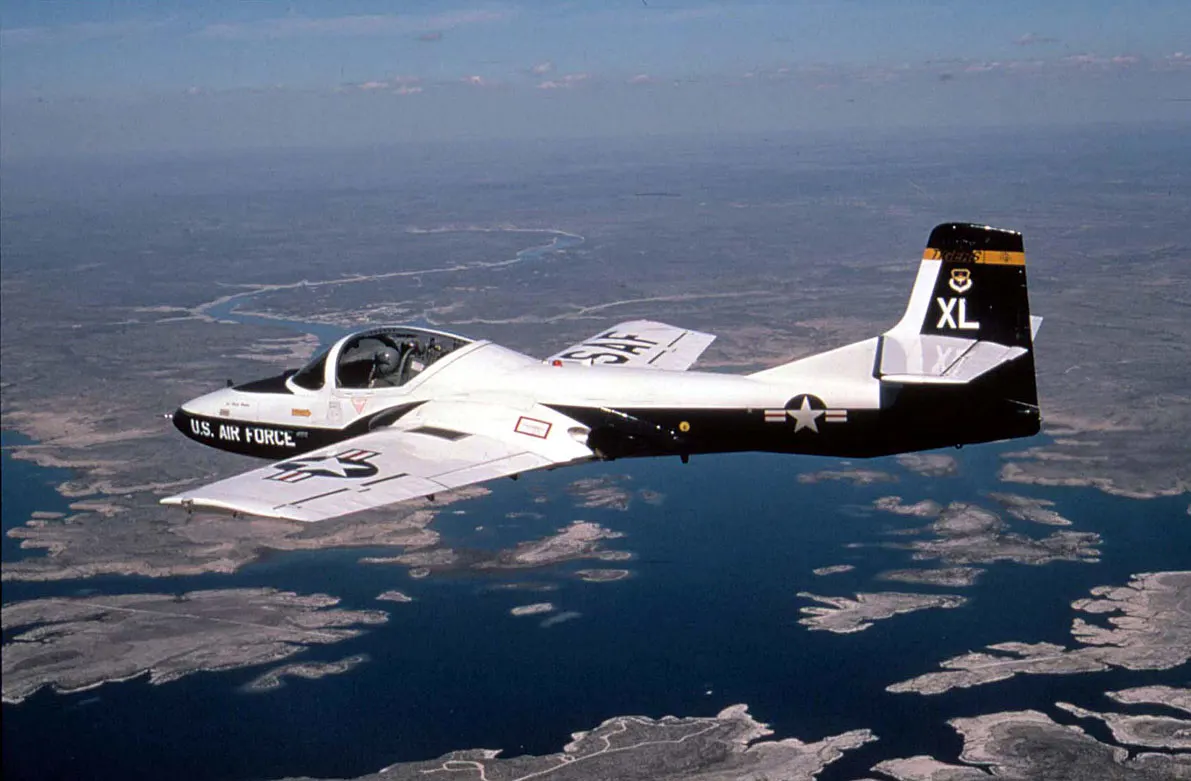

The Cessna T-37 Tweet, company designation Model 318, was the United States Air Force's primary jet trainer from 1957 until 31 July 2009, a run of just over five decades that made it one of the longest-serving aircraft types in American military history.1 It seated student and instructor side by side rather than in tandem, an arrangement almost no other jet trainer of its generation used; contemporaries like the Lockheed T-33 and the later Northrop T-38 put crew one behind the other.1,17 Cessna built 1,269 examples between the mid-1950s and 1975 across three production variants, plus a heavily reworked armed derivative, the A-37 Dragonfly, that fought throughout the Vietnam War.1,2
- Cheap, simple, forgiving handling suited to first-time jet students
- Side-by-side seating let instructors watch and coach student technique directly
- Rugged twin-turbojet layout with genuine engine-out safety margin
- Armed A-37 derivative proved a durable, accurate light-attack platform
- Subsonic performance left a large gap before the supersonic T-38
- Underpowered J69 turbojets gave sluggish climb and limited hot-and-high performance
- Extremely loud intake noise created real health and community complaints
What most people who stood near a T-37 remember first is not how it looked but how it sounded. Its two Continental-Teledyne J69 turbojets, an American-built version of the French Turbomeca Marboré, drew air through small intakes at a pitch high enough that generations of airmen nicknamed the aircraft "Tweety Bird," shortened to "Tweet," and less affectionately "Screaming Mimi," "the Converter" (for turning fuel and air into noise and smoke), and "the 6,000-pound dog whistle."1,6 The Air Force judged the noise an acceptable trade for engine performance, left it largely unmuffled, and instead spent real money soundproofing buildings near training bases.1
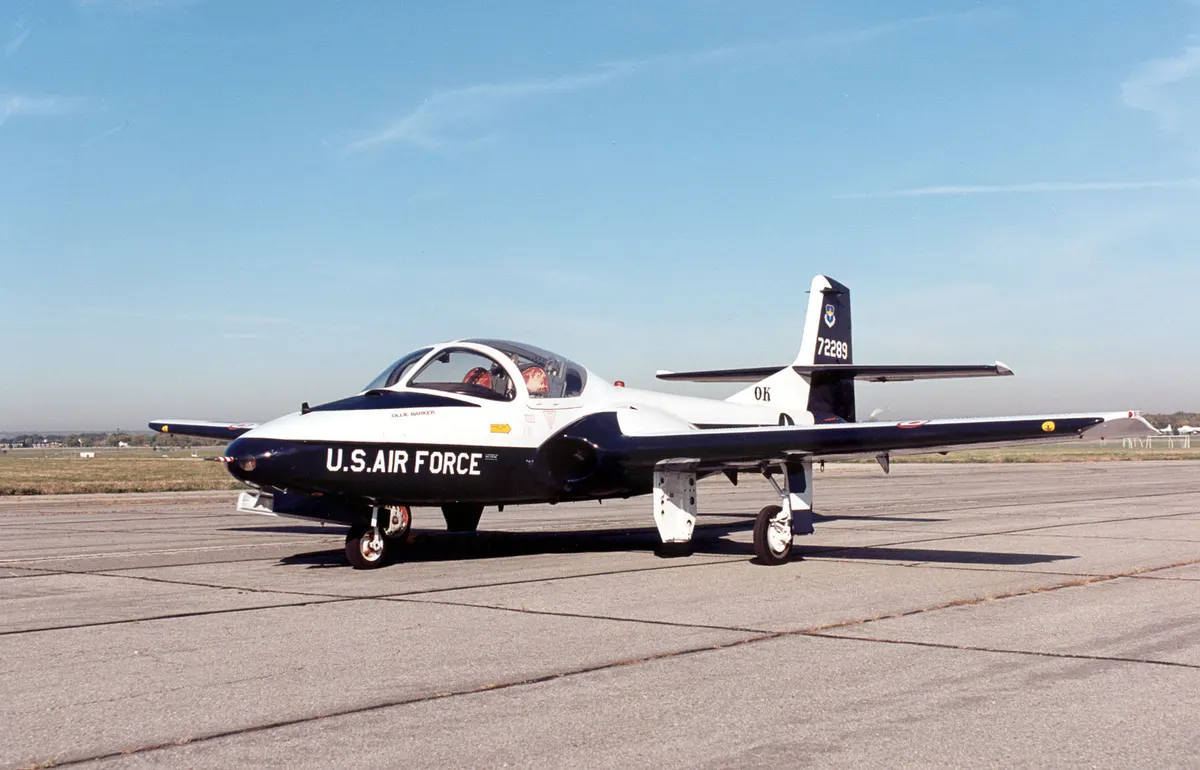
The design brief behind it was plain: a cheap, simple, twin-engine jet that could take a cadet straight from a propeller trainer into jet flying. Cessna, then known only for piston aircraft, won that 1952 Air Force contract over more established jet manufacturers, and the resulting airframe proved compact and forgiving, though early spin testing forced a tail redesign before production could begin.1,4,9 From 1957 the Tweet, and from 1961 the supersonic T-38 Talon, formed a two-stage training pipeline that shaped nearly every USAF pilot for four decades, until the turboprop Beechcraft T-6 Texan II replaced both between 2001 and 2009.1,18 Its armed offspring outlived that teaching career by decades: roughly doubled in weight and thrust, the A-37 Dragonfly, unofficially the "Super Tweet," flew tens of thousands of sorties over South Vietnam and still flies with several Latin American air forces today.2,12
Side-by-Side Seating and the XT-37's Rocky Start
Cessna's defining design choice was seating student and instructor next to each other, letting an instructor watch a student's hands and eyes directly rather than relying on a mirror or a shout from behind.1 It also meant one shared clamshell canopy and twin engines mounted low in the fuselage roots, so a compressor stall on one side did not automatically doom the aircraft the way it might in a single-engine trainer.1,4
- First Flight1954
- Service Entry Year1957
- Crew (seats)2
- Trainer Typeprimary trainer
- In ServiceYes
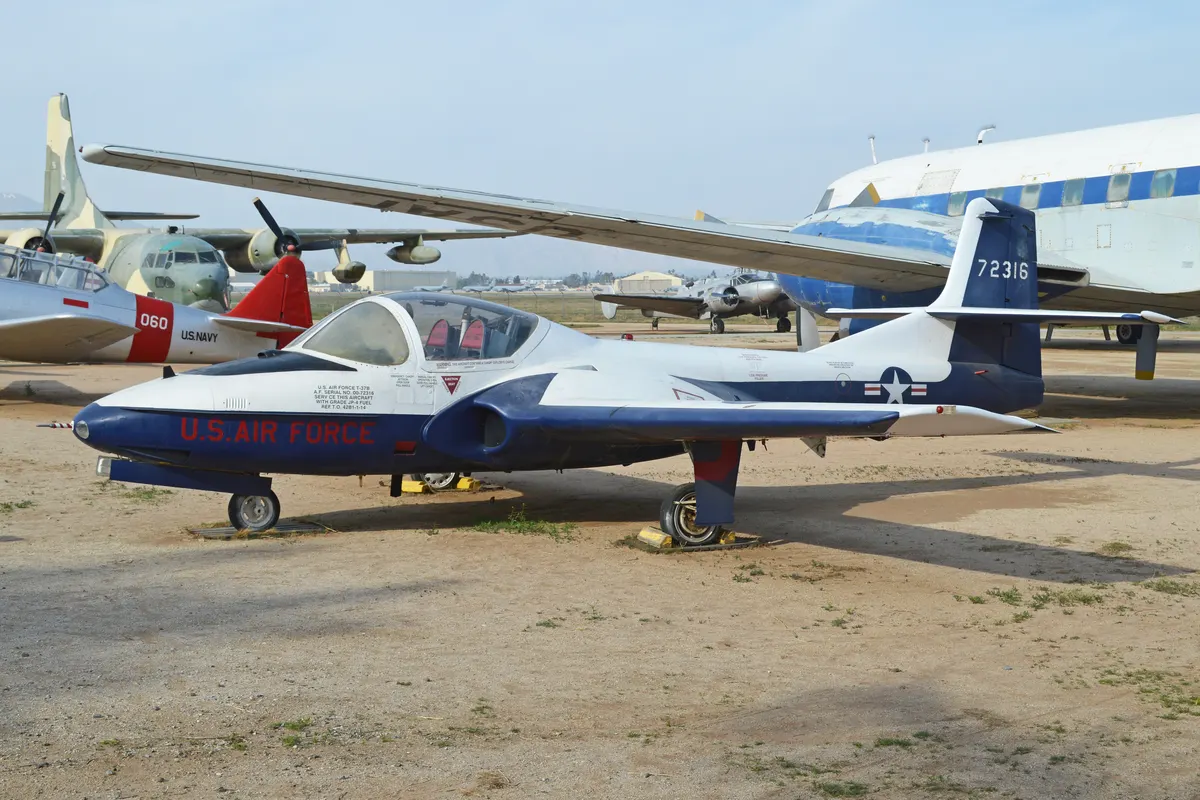
The prototype XT-37 first flew on 12 October 1954, but the program nearly stalled soon after: an early prototype was lost during spin testing, and data showed the basic airframe took up to five full turns to recover from a developed spin, unacceptable for an aircraft meant to teach spin recovery to novices.9 Cessna's engineers answered with nose strakes and a much larger tail, after which the production T-37 settled into a flatter, more predictable spin, tame enough that spin training became a standard part of the syllabus for decades.9,1 The first production T-37A reached the Air Force in mid-1956 and entered training service in 1957.1,18
- Engine TypeContinental-Teledyne J69-T-25
- Thrust8.2
The Continental-Teledyne J69 and "the 6,000-Pound Dog Whistle"
Power came from two Continental-Teledyne J69 turbojets, an American-built derivative of the French Turbomeca Marboré that Continental licensed from Turbomeca in 1951 and marketed successfully to Cessna the following year.10,11 Early T-37As used the J69-T-9, rated at roughly 920 lbf (4.1 kN) each; the improved T-37B, from 1959, switched to the uprated J69-T-25 at 1,025 lbf (4.56 kN) each, a combined 2,050 lbf (about 9.1 kN), along with better avionics.1,11 Every surviving T-37A was eventually brought up to T-37B standard.1
- Top Speed683.91 km/h
- Cruise Speed579.312 km/h
- Service Ceiling10,668 m
- Range1,505 km
- Rate of Climb12 m/s
- Endurance2
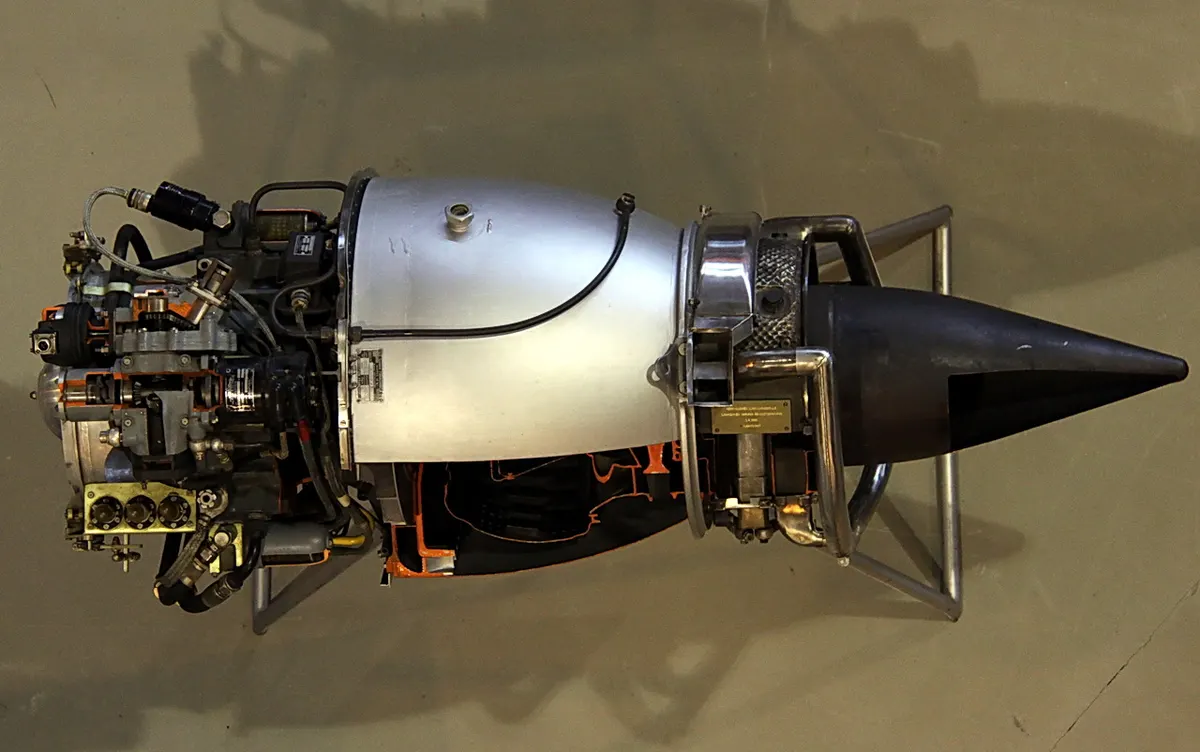
The noise was not an engineering accident but a deliberate trade-off: Cessna and the Air Force had two candidate government-furnished engines to choose from, and picked the noisier one because it performed better, later removing sound-damping inlet vanes once it was clear the whistling cost nothing in flight safety.4 The result was an intake shriek audible for miles, giving rise to "Tweety Bird" and "the 6,000-pound dog whistle."6,1
- Cockpit Configurationside-by-side seating
- Glass CockpitNo
- Embedded SimulationNo
- Light Attack CapableYes
- Hardpoints2
- Ejection SeatsYes
Dimensions, Weights, and Performance
The T-37B measured about 8.92 m (29 ft 3 in) long, spanned 10.30 m (33 ft 9 to 10 in), and stood roughly 2.8 m (9 ft 2 in) tall, noticeably smaller than either its T-33 predecessor or T-38 successor.1,3,4 Empty weight ran about 1,840 kg (4,056 lb), rising to a maximum takeoff weight near 2,980 to 2,993 kg (6,569 to 6,598 lb).1,3,4 Top speed reached about 684 km/h (425 mph), cruise speed about 579 km/h (360 mph) at 35,000 ft, service ceiling 10,668 m (35,000 ft), range roughly 1,500 km (932 mi), and initial climb about 17.1 m/s (3,370 ft/min).1,3,4 The light-attack T-37C added two underwing hardpoints for stores up to about 227 kg (500 lb) each, enough for practice bombs or gun pods, though it never carried the internal minigun the armed A-37 would.1,3 Crew escape relied on Weber Aircraft ejection seats with an upward canopy piercer; either crew member's trigger jettisoned the canopy first, with the seat firing about a third of a second later.8
- Length8.839 m
- Wingspan9.14 m
- Height3 m
- Max Takeoff Weight1,814 kg
The T-37 was designed and built almost entirely in the United States: Cessna's Wichita, Kansas plant produced the complete airframe, and the great majority of avionics on USAF aircraft came from domestic suppliers.1 The one significant foreign-origin element was the engine's underlying design: the Continental-Teledyne J69 was an American-manufactured derivative of the French Turbomeca Marboré II, built domestically under a 1951 license rather than imported, so the finished engines were machined in the US even though the core design originated with Turbomeca in France.10,11 Export customers received essentially the same American-built airframe and engine package.
- Total Built1,269
- Retirement Year2009
- Production Start1955
- Production End1975
- Operational StatusRetired from American service in 2009, In limited service with the Pakistan Air Force
From TX Program to a Company Nobody Expected
The Air Force's 1952 Trainer Experimental request called for a lightweight, twin-engine jet that could take cadets straight from piston primary trainers into jet flying, closing a real gap in a fleet where candidates otherwise jumped straight into much faster single-engine jets like the T-33.1,4 Cessna's win was, by aviation historian Kev Darling's account, a surprise, since the company had no jet experience at all; larger, established manufacturers had also bid.4 Once past the spin-recovery redesign, the production T-37A entered service in 1957, and pilots found it forgiving enough that one experimental Air Force class, starting its flying entirely in the T-37 rather than a propeller trainer, soloed in under eight hours on average.4
Cessna delivered 444 T-37As before switching in 1959 to the improved T-37B; 552 new-build T-37Bs followed, and all surviving T-37As were upgraded to the same standard. A further 269 T-37Cs, fitted with hardpoints and export avionics, went overwhelmingly to allied air forces, bringing total production to roughly 1,269 airframes by the time the line closed in 1975.1
Pairing With the T-38 and a Training Standard
From the early 1960s the T-37 formed the first jet leg of a three-phase pipeline: propeller screening in the Cessna T-41, primary jet training in the T-37, and advanced supersonic training in the Northrop T-38 Talon from 1961.1 That pairing anchored American undergraduate pilot training for four decades, and the arrangement extended abroad: Sheppard Air Force Base in Texas has hosted the Euro-NATO Joint Jet Pilot Training program in the T-37 and T-38 since 1981, a program that marked its 45th anniversary in 2026 having graduated more than 8,600 combat pilots.18
Retirement and the Handover to the T-6 Texan II
The Air Force began replacing the T-37 with the T-6 Texan II in 2001. The last USAF training sorties flew on 17 June 2009, and the final ceremonial flights, seven aircraft from the 80th Flying Training Wing at Sheppard Air Force Base, took place on 31 July 2009, closing out 52 years of continuous service.18 The T-6, itself a license-built derivative of the Swiss Pilatus PC-9, later also replaced the Navy's Beechcraft T-34C, ending the propeller-jet split that had defined American pilot training since the T-37's introduction.1
The A-37 Dragonfly: Turning a Trainer Into a Gunship
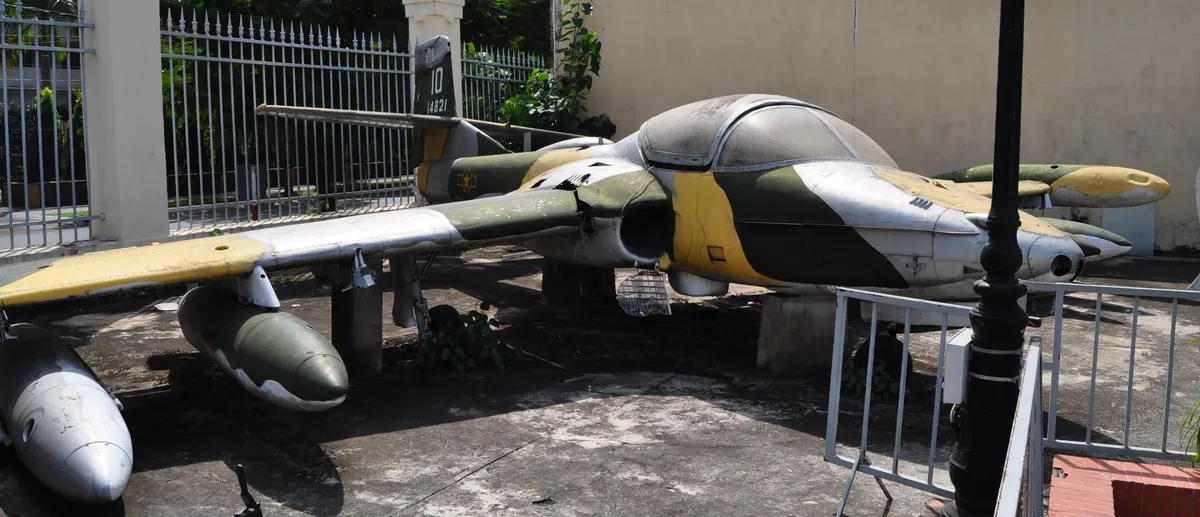
Needing a durable, inexpensive counterinsurgency aircraft in Vietnam, the Air Force had Cessna rework the T-37 into the A-37, roughly doubling gross weight and engine thrust, adding a nose-mounted minigun, eight hardpoints, and armor plating, while keeping the trainer's side-by-side layout and easy handling.2 In August 1967, 25 A-37As deployed to Bien Hoa Air Base under the Combat Dragon evaluation, flying close air support, escort, and night interdiction; the aircraft flew thousands of sorties without a single combat loss, though two were wrecked in landing accidents.2,14 Pilots credited its low attack speed, often as slow as 100 mph on a firing pass, with unusually tight accuracy, reportedly averaging hits within about a 45-foot radius of target.13
The trial's success led to the definitive A-37B, with wet wings for more fuel and a refueling probe. More than 200 went to the Republic of Vietnam Air Force from 1969, and across the war A-37s flew well over 160,000 combat sorties, with only around 22 USAF examples lost to enemy action.2,12
The Fall of Saigon and a Captured Air Force
By April 1975 an estimated 187 A-37Bs remained in South Vietnamese hands; roughly 92 were flown out and recovered as Saigon fell, while the rest, including 33 captured intact at Da Nang Air Base in late March 1975, passed to North Vietnamese forces.2 On 28 April 1975, several of those captured A-37s, flown by defected former South Vietnamese pilots, struck Tan Son Nhut Air Base, still held by the South, one of the war's stranger footnotes: an American-built attack jet turned against the government it had been supplied to defend.2 Captured examples stayed on Vietnamese rosters only briefly, hampered by a lack of spare parts.2 The unarmed T-37 trainer itself never flew combat; its wartime relevance ran almost entirely through the pilots it trained and through its own armed derivative.1
T-37A, T-37B, and T-37C: Three Steps of the Same Design
The T-37A was the original standard, 444 built with the lower-powered J69-T-9 and basic instrumentation, entering service in 1957.1 The T-37B, from 1959, standardized the more powerful J69-T-25 and better avionics across 552 new-build aircraft; every surviving T-37A was later retrofitted to match. The T-37C, 269 built, added hardpoints and export-specific instruments and went almost exclusively to foreign customers rather than the USAF.1,3
A-37A and A-37B Dragonfly: The Armed Derivative
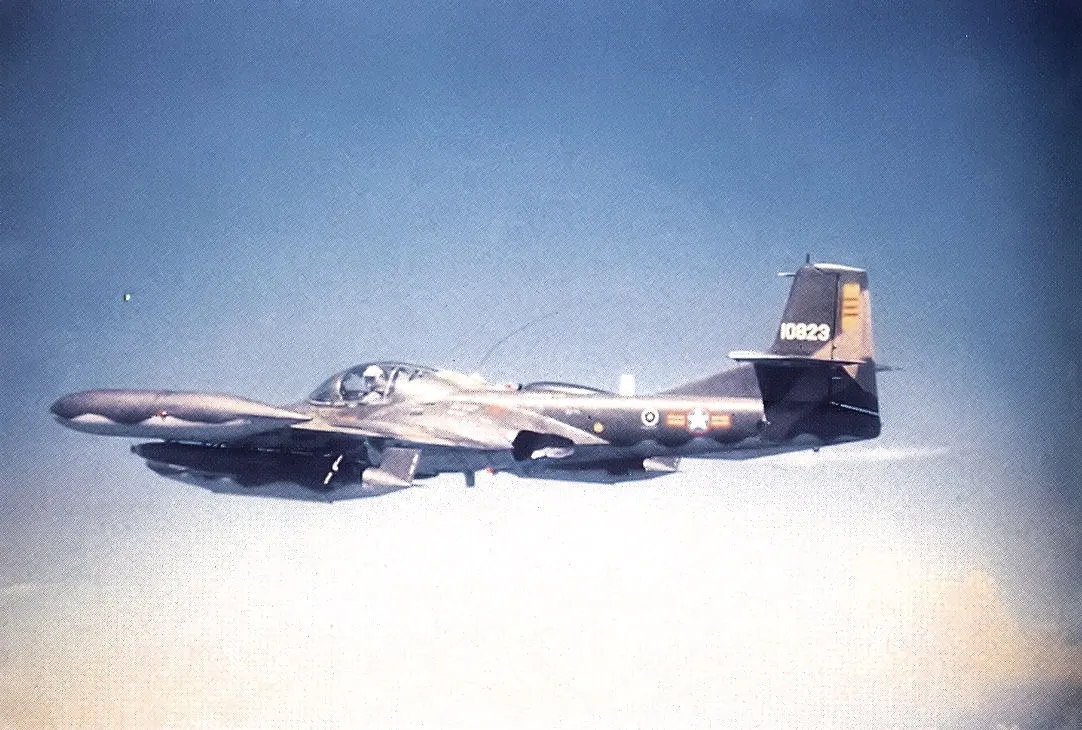
The A-37A was the initial combat conversion used in the 1967 Combat Dragon trials, roughly doubling the T-37's weight and thrust and adding a minigun and eight hardpoints.2 The definitive A-37B added strengthened wet wings, a refueling receptacle, and further reinforcement, becoming the version supplied in bulk to South Vietnam and, later, to Latin American air forces.2,12
Later Conversions
A small number of A-37Bs were converted to the OA-37B forward air control standard for Air National Guard and reserve units, serving into the early 1990s. Cessna also studied, but never built past concept stage, more radical derivatives, including a vertical-takeoff version with lift-jet pods in the wings.4


The United States Air Force: The Primary Customer
The USAF was launch customer and by far the largest operator, running the T-37 as its standard primary jet trainer from 1957 until the final flights from Sheppard Air Force Base on 31 July 2009.1,18 Air National Guard and reserve units flew the armed OA-37B into the early 1990s, well past the trainer's own frontline role.1
Export Trainers Around the World
Dozens of allied air forces bought new-build or surplus T-37s from the 1960s onward. Confirmed operators included Turkey (about 65 aircraft), Pakistan (roughly 62 to 63), Brazil (65), Greece (32), Chile (32), Peru (32), Portugal (30), South Korea (around 55), Colombia (14), Thailand (16), Burma, Cambodia, and South Vietnam.1,15 Pakistan, Turkey, Morocco, and Bangladesh were among the more recent operators still listing small numbers on strength into the 2010s and, in some cases, the 2020s.15
The A-37's Long Latin American Afterlife
The A-37 Dragonfly found its most durable second career in Central and South America. Peru, Honduras, El Salvador, Guatemala, and Colombia all operated A-37Bs into the 2020s, with Colombia retiring its last examples around 2021 to 2023 and small fleets remaining active elsewhere as of the mid-2020s.15 Between trainer and armed derivative, the design has now been in some air force's active inventory continuously for close to seven decades.
T-37 vs Northrop T-38 Talon: Two Halves of One Pipeline
The T-37 is best understood not as a rival to any single aircraft but as one half of a deliberately paired system with the Northrop T-38 Talon, which took over where the Tweet left off from 1961.1,17 Where the T-37 was subsonic, twin-engine, and side-by-side, built around forgiving low-speed handling for cadets fresh out of propeller trainers, the T-38 was a genuinely supersonic, tandem-seat, swept-wing aircraft capable of roughly Mach 1.3 on twin General Electric J85 turbojets producing several times the T-37's thrust with afterburner engaged.17 The pairing worked because the two aircraft were so different: a student who had mastered the T-37's forgiving basics moved to the T-38 to learn tandem cockpit discipline and supersonic handling before reaching a fighter or bomber. Neither aircraft alone made a complete training system, and the fact that the USAF kept both in the syllabus for four decades says as much about the two-stage concept as about either individual airframe.
T-37 vs Beechcraft T-6 Texan II: The Aircraft That Replaced It
The T-6 Texan II, a license-built derivative of the Swiss Pilatus PC-9 turboprop, replaced the T-37 between 2001 and 2009, and the contrast shows how far training philosophy shifted in half a century.1 The T-37's twin turbojets gave genuine jet handling, including real spin behavior, from day one, but at the cost of high fuel burn, heavy noise, and low thrust for its weight. The single-engine T-6, despite being propeller-driven, produces far more usable power per pound through its Pratt & Whitney Canada PT6A turboprop, climbs faster, and costs dramatically less per flight hour, a factor that mattered more to the Air Force by the 2000s than early jet exposure.1 The Air Force effectively concluded, after decades of Tweet operations, that lower operating cost and modern avionics outweighed the value of pure jet handling in the earliest phase of training.
| Aircraft | First flight | Engines | Top speed | Seating |
|---|---|---|---|---|
| T-37 Tweet | 1954 | 2 × Continental-Teledyne J69 | ~684 km/h | Side-by-side |
| T-38 Talon | 1959 | 2 × General Electric J85 | ~1,381 km/h | Tandem |
| T-6 Texan II | 1992 | 1 × Pratt & Whitney Canada PT6A | ~578 km/h | Tandem |

What were the Cessna T-37 Tweet's specifications?
The T-37B measured about 8.92 m (29 ft 3 in) long with a 10.30 m (33 ft 9 to 10 in) wingspan, weighed roughly 1,840 kg (4,056 lb) empty and up to about 2,980 to 2,993 kg (6,569 to 6,598 lb) at maximum takeoff weight, and reached a top speed near 684 km/h (425 mph) on two Continental-Teledyne J69-T-25 turbojets.1,3,4
How many T-37 Tweets were built?
Cessna built 1,269 examples across the T-37A, T-37B, and T-37C variants between the mid-1950s and 1975, not counting the separately produced A-37 Dragonfly.1
Why was the T-37 nicknamed "Tweety Bird" or "the 6,000-pound dog whistle"?
Its two small Continental-Teledyne J69 turbojets, license-built versions of the French Turbomeca Marboré, drew air through the intakes with a distinctive high-pitched shriek. The Air Force chose the noisier of two candidate engines for its better performance and left it largely unmuffled.1,6
Is the T-37 still in service anywhere?
The USAF retired its last T-37s in 2009, but Pakistan, Turkey, Morocco, and Bangladesh have continued flying small numbers past that date. The armed A-37 Dragonfly derivative remains in limited service with Peru, Honduras, El Salvador, and Guatemala into the mid-2020s.15
Did the T-37 or A-37 see combat in the Vietnam War?
The basic T-37 trainer did not fly combat missions. Its armed derivative, the A-37 Dragonfly, flew extensively over South Vietnam from 1967 onward, ultimately logging well over 160,000 combat sorties, with more than 200 aircraft also transferred to the Republic of Vietnam Air Force before the war's end in 1975.2,12
- "Cessna T-37 Tweet", Wikipedia — en.wikipedia.org ↩
- "Cessna A-37 Dragonfly", Wikipedia — en.wikipedia.org ↩
- "Cessna 318 T-37 Tweet, Specifications, Technical Data / Description", flugzeuginfo.net — flugzeuginfo.net ↩
- "Cessna T-37 Tweet Jet-Powered Advanced Trainer / Light Attack Aircraft", MilitaryFactory — militaryfactory.com ↩
- "Cessna A-37 Dragonfly, The 6,000-Pound Dog Whistle", JetsProps — jetsprops.com ↩
- "The Ejection Site, Weber T-37 Seat", ejectionsite.com — ejectionsite.com ↩
- "The Fascinating Spin History of the T-37 Tweet", The CFI Guy — thecfiguy.com ↩
- "Teledyne CAE J69", Wikipedia — en.wikipedia.org ↩
- "Continental J69", Minijets — minijets.org ↩
- "How the Viet Cong Learned to Fear the Cessna A-37 Dragonfly", The National Interest — nationalinterest.org ↩
- "Cessna A-37 Dragonfly", WarHistory.org — warhistory.org ↩
- "The A-37 Dragonfly in Vietnam", Defense Media Network — defensemedianetwork.com ↩
- "Cessna T-37 Tweet, Military Training Aircraft Specs & Operators", GlobalMilitary.net — globalmilitary.net ↩
- "Northrop T-38 Talon", Wikipedia — en.wikipedia.org ↩
- "Euro-NATO Joint Jet Pilot Training Program (ENJJPT)", Sheppard Air Force Base — sheppard.af.mil ↩