


Data Quality87%
MASS(Military Archive Scoring System)
ⓘ Regardless of era, the same scoring system applies to all units in the anti-radiation missiles (arm) category.
01 / Overview
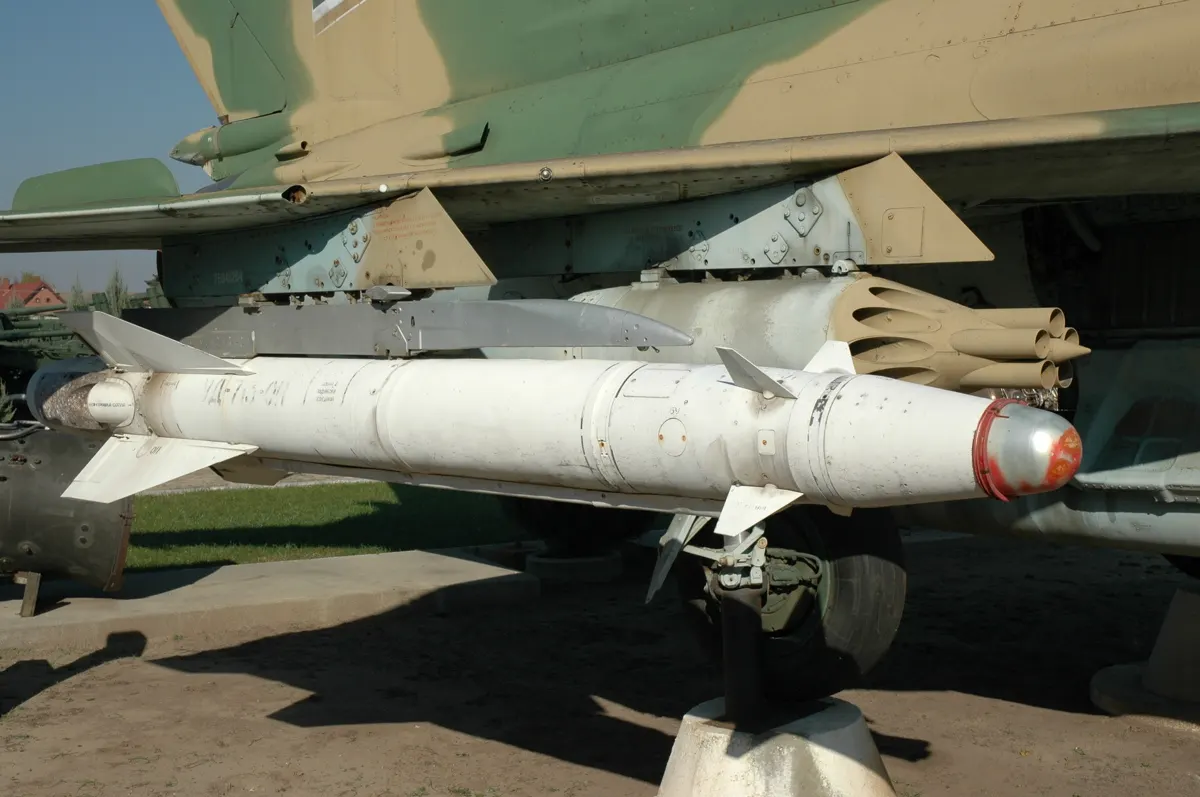
Kh-25
💰 PERFORMANCE / PRICE ASSESSMENT Methodology ↗
ANTI-RADIATION MISSILES (ARM) · COLD WAR
8
PERFORMANCE/PRICE
87
UNIT COST (2025 USD)
—
ⓘ Performance/Price and MASS score are computed across all units in the anti-radiation missiles (arm) category, regardless of era.
02 / Specs & Design
◎General7MOD.7
- Missile Typeair-to-surface
- Service Entry Year1975
- DesignerZvezda-Strela
- Length3.705 m
- Diameter275 mm
- Launch Weight299 kg
- In ServiceYes
◈Guidance8MOD.8
- Guidance TypeAnti-Radiation
- Seeker Typelaser, anti-radiation, TV, imaging IR, satellite, active radar
- Fire-and-ForgetNo
- Two-Way DatalinkYes
- Top-Attack CapableNo
- Imaging Infrared SeekerYes
- Inertial / GPS GuidanceYes
- Sea-SkimmingNo
▣Propulsion5MOD.5
- Propulsion Typerocket
- Motor Typesolid-propellant rocket motor
- Boost StageNo
- Two-StageNo
- Fuel / Propellantsolid
◇Performance6MOD.6
- Minimum Range10 km
- Maximum Range60 km
- Top Speed380 m/s
- Top Speed (Mach)1.1 Mach
- Flight Profilesubsonic to supersonic
- HypersonicNo
◆Warhead5MOD.5
- Warhead Typehigh-explosive, shell-forming
- Warhead Weight89.6 kg
- Tandem HEAT ChargeNo
- Proximity FuzeYes
- Nuclear-CapableNo
▤Launch Platform6MOD.6
- Launch PlatformMiG-21, MiG-23/27, MiG-29, Ka-52, Su-17/20/22, Su-24, Su-25, Su-27, Yakovlev Yak-130 ; Kh-25MP : MiG-23/27, Su-17/22, Su
- Air-LaunchedYes
- Ground-LaunchedNo
- Naval-LaunchedNo
- Man-PortableNo
- Launcher Typepylon-mounted
⬢Production3MOD.3
- Operators15
- Variants12
- Production Start1,975 year
▲Warhead Detail3MOD.3
- Detonation Mechanism / Fuzeimpact/proximity
- Explosive Filler Weight34 kg
- Explosive Filler TypeHigh explosive, shell-forming
03 / History
SERVICE LIFESPANStill in Service
- 1975Production started
51
years in service
19
countries operating
ⓘ The producing country still actively operates it. 3 countries retired it.
04 / Operators
Operator Countries22country
 AfghanistanACTIVE
 AlgeriaACTIVE
 BelarusACTIVE
 BulgariaACTIVE
 EthiopiaACTIVE
 HungaryACTIVE
 IndiaACTIVE
 IranACTIVE
 IraqACTIVE
 KazakhstanACTIVE
 LibyaACTIVE
 North KoreaACTIVE
 People's Republic of ChinaACTIVE
 PolandACTIVE
 RussiaACTIVE
 SyriaACTIVE
 UkraineACTIVE
 UzbekistanACTIVE
 VietnamACTIVE
 Czech RepublicRETIRED
 GermanyRETIRED
 RomaniaRETIRED
05 / MASS Score
ANTI-RADIATION MISSILES (ARM) RANKING Anti-Radiation Missiles (ARM) · Cold War


MASS RANKINGSMASS ↗
10ANTI-RADIATION MISSILES (ARM)8COLD WAR · ANTI-RADIATION MISSILES (ARM)597RUSSIA · ALL WEAPONS4PERFORMANCE/PRICE · ANTI-RADIATION MISSILES (ARM)
ⓘ Rankings are within theAnti-Radiation Missiles (ARM)category.
📖 TERMS ON THIS PAGE6terms
Capability of launching an anti-tank guided missile from an airborne platform, such as a helicopter or aircraft.
Guidance method using passive radar detection to home in on enemy radar emissions.
A guidance system in ATGMs that uses infrared sensors to create a thermal image of the target for precise homing.
A guidance method that uses inertial navigation sensors together with satellite‑based GPS signals to determine a missile’s position and steer it toward a target.
A proximity fuze is a detonation mechanism in ATGMs that triggers when the missile approaches within a set distance of a target, using sensors like radar or laser to detect proximity.
Enables real-time sharing of position, targeting, and sensor data among aircraft and platforms for coordinated combat operations.
These terms are listed automatically because they appear on this page.full encyclopedia →
📚 Sources