

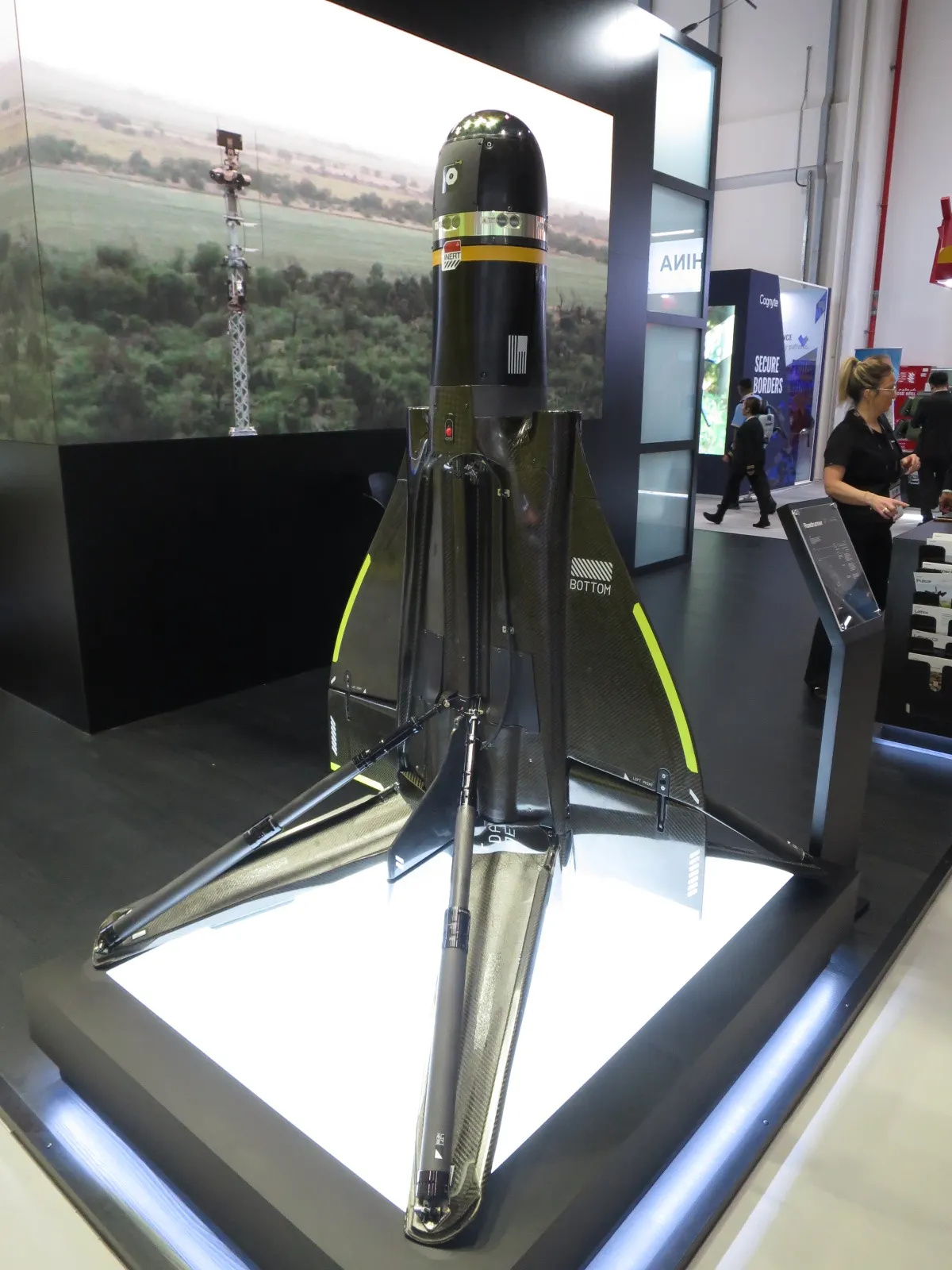

Roadrunner is a twin-turbojet, vertical-takeoff-and-landing (VTOL) autonomous air vehicle built by Anduril Industries to intercept drones, cruise missiles, and other aerial threats — and, unlike almost every guided weapon before it, to fly home and be reused if the intercept is called off.1,2 Anduril's leadership has described it as sitting "somewhere between a reusable missile and a full-scale autonomous aircraft," or, more bluntly, from chief strategy officer Chris Brose: "we've basically built a fighter jet weapon that lands like a Falcon 9."3,4 The company unveiled the system on November 30, 2023, after roughly two years of internally funded, secret development, alongside an armed variant called Roadrunner-Munition (Roadrunner-M).1,5,6
- Reusable if the intercept is not expended, unlike single-use guided missiles or rocket interceptors
- Designed to reach a wider target band than most ground-based counter-drone interceptors, up to full-size aircraft and cruise missiles according to Anduril
- Vertical takeoff/landing from a self-contained "Nest" container needs no runway or launcher infrastructure
- Tight Lattice integration lets one operator manage multiple Roadrunners cued from external radars and sensors
- Fast turnaround claimed between landing, refueling, and relaunch, intended to support rapid, repeated engagements
- Detailed performance figures (range, altitude ceiling, endurance, exact speed) remain undisclosed as of mid-2026
- Unit cost, in the low hundreds of thousands of dollars, is well above ramming interceptors like Anvil or rocket-based systems like Coyote
- Combat record consists of undisclosed "combat evaluation" deployments rather than confirmed, sourced intercepts
- Full-rate production was still ramping up in 2026, years after the 2023 unveiling, limiting fielded numbers
- No independent verification of Anduril's own performance claims (3x payload, 10x range, 3x maneuverability versus rivals)
The core idea behind Roadrunner is what Anduril calls "launch without regret." Traditional surface-to-air missiles are consumed the moment they leave the rail, whether or not the target turns out to be hostile, decoy, or a false alarm — a problem that became acute as low-cost drones proliferated faster than the expensive interceptors built to stop them.4,7 Roadrunner-M instead takes off vertically, closes on a designated track under its own autonomy, and can either detonate its high-explosive warhead against a confirmed threat or, if the target is destroyed by another means, misidentified, or the mission is aborted, fly back to its launch point, land tail-down, and be refueled and relaunched within minutes.2,8,9 Founder Palmer Luckey has called the armed variant "effectively a kamikaze craft when you actually want to use it" — expendable only by choice, not by design.9
Roadrunner is one entry in a wider Anduril counter-drone product family that also includes the smaller, ramming-kill quadcopter Anvil, the Pulsar electronic-warfare system, and the Sentry/Wisp detection towers, all tied together through Lattice, Anduril's AI-enabled command-and-control software.10 Where Anvil is a cheap, largely single-use interceptor built for the smallest and most numerous Group 1-2 drones, Roadrunner is a larger, faster, reusable vehicle aimed at a broader threat band that also includes Group 3-5 drones, loitering munitions, and cruise missiles.10,11
Roadrunner is a compact, delta-winged airframe that Anduril and outside reporting describe as roughly 1.5 to 1.8 meters (5 to 6 feet) long — Luckey has said it is "shorter than [he is] tall," and Luckey stands well over six feet.1,4,12 The airframe is built heavily from carbon fiber and is powered by two small turbojet engines that Anduril developed in-house; Luckey has described them as "the most power-dense turbojet engines that have ever been built" and among "the fastest starting jet engines of any size that have ever been built," claims that have not been independently verified.4 Four flip-down outriggers at the base of the airframe let it land tail-down after a vertical descent, a configuration outside reporting has repeatedly compared to SpaceX's Falcon 9 booster.1,4
- System TypeVTOL twin-turbojet reusable interceptor (Roadrunner-M variant carries high-explosive warhead; base Roadrunner carries modular ISR payload)
- Service Entry Year2024
- MobileYes
- In ServiceYes
- First Flight2023
The vehicle takes off and lands vertically from a self-contained, transportable ground enclosure Anduril calls the Nest, a box-like container that houses the airframe upright between sorties.13 The Nest does more than store the vehicle: it continuously monitors Roadrunner's system health, performs maintenance and environmental-control functions, and serves as a communications node linking the vehicle to the operator console and to Lattice.13 Anduril has said a single operator can use networked Nests to launch, monitor, and recover multiple Roadrunners at once, and that a vehicle can land, be refueled, and take off again "inside of a couple of minutes" — a turnaround time far shorter than any traditional recoverable aircraft requires.4,13
- Warhead TypeHigh-explosive (Roadrunner-M only)
Guidance blends onboard autonomy with external cueing. Roadrunner carries its own sensors and processing to find a designated track and calculate an intercept path once handed a target, but it depends on Lattice to fuse detections from outside sensors — in demonstrations, Anduril's own Sentry radar towers — into a track it can pursue.4 A human operator retains the decision to launch and, per Anduril's stated design philosophy, to commit the vehicle to an actual strike rather than a recoverable pursuit, which the company frames as preserving accountable, human-authorized use of lethal force even as more of the flight itself is automated.2,4 This mirrors the same operator-in-the-loop approach Anduril uses for the ramming interceptor Anvil, though Roadrunner's added reusability changes the risk calculus of launching in the first place: because an errant or unnecessary launch can be recalled and reused rather than wasted, operators can commit interceptors more freely to ambiguous tracks.4,7
Anduril markets Roadrunner's payload bay as modular, capable of carrying intelligence, surveillance, and reconnaissance sensors on the unarmed base variant in addition to the high-explosive warhead fitted to Roadrunner-M.1,2 Company figures, none independently confirmed, claim Roadrunner-M carries roughly three times the warhead payload, ten times the one-way effective range, and three times the maneuverability (measured in g-forces) of unnamed comparable interceptor systems, along with faster launch and takeoff times.3,8 Anduril has also entered a Roadrunner-derived variant in the XPRIZE Wildfire competition for aerial wildfire detection and suppression, illustrating the company's broader ambition for the airframe beyond air defense, though that civil application remains a secondary, experimental use case relative to the military interceptor role that is the focus of this article.4
- PlatformGround-launched from containerized VTOL enclosure ("Nest"); also selected for shipborne integration on US Navy Arleigh Burke-class destroyers
Unit cost has been described by Luckey only as "low hundreds of thousands of dollars" per vehicle, with Anduril saying it expects the price to fall as production scales; for comparison, the Pentagon's October 2024 order of more than 500 Roadrunner-M rounds together with Pulsar electronic-warfare equipment was valued at roughly $250 million, implying an approximate blended cost per unit in that range once Pulsar hardware is netted out.8,14,15 That places Roadrunner-M well above cheaper ground interceptors such as Anvil or Raytheon's rocket-boosted Coyote, but still far below traditional area-defense missiles: Anduril and defense press have repeatedly contrasted Roadrunner-M's low-hundred-thousand-dollar cost with multi-million-dollar interceptors such as the Patriot system's PAC-3 MSE (around $5.2 million) or the Navy's SM-6 (around $4.27 million), the kind of missiles that have been fired against comparatively cheap drones and cruise missiles in the Red Sea and Gulf.16,17
- Unit Cost500,000 USD
- Active Mitigation (vs. Detect-Only)Yes
Anduril began developing Roadrunner around 2021, funding the roughly two-year program internally rather than starting from a formal government requirement, according to the company's own account.1,4 US Special Operations Command's fiscal year 2024 budget request included $19 million earmarked to accelerate Roadrunner development, indicating at least some early government interest and funding alongside Anduril's internal investment.5
Anduril unveiled Roadrunner and Roadrunner-M publicly on November 30, 2023, describing the program as having gone "from a napkin sketch to an operationally validated and fieldable solution in less than two years."1,7 At the time of the unveiling, the company said it had an undisclosed US government customer already committed to purchasing "hundreds of units" and moving into low-rate production, while declining to name the customer or disclose further contract details.5,6,9
By the company's account, Roadrunner had been "operationally deployed for Combat Evaluation" since January 2024, alongside Pulsar's deployment in multiple regions since August 2023 — though Anduril has not disclosed where, or described any specific engagement, leaving the claim unverified in open sources.15 In October 2024, the Pentagon formalized a contract worth roughly $250 million for more than 500 Roadrunner-M rounds together with Pulsar systems, a deal defense press described as about two and a half times the size of the company's prior Roadrunner-related spending, with deliveries slated to begin that same quarter and continue through 2025.8,14,15
In March 2025, the US Navy announced it would arm a batch of Arleigh Burke-class destroyers accompanying the carrier strike group of USS Gerald R. Ford with both Roadrunner-M and Raytheon's rocket-based Coyote Block 2 interceptors, aiming to give ship commanders a cheaper option than expending SM-2, SM-6, or ESSM missiles — costing on the order of $2.5 million to $4.27 million apiece — against comparatively inexpensive drones and cruise missiles.21,22,23 Fleet Forces commander Admiral Daryl Caudle said the destroyers would deploy with "two additional missile systems... the Roadrunner system and the Coyote system, both specifically designed to go after UASs," a step driven directly by the cost of the Navy's ongoing Red Sea intercepts of Houthi drones and missiles, which by that point had consumed some 220 munitions worth close to $1 billion.17,21,22 Details of exactly how Roadrunner-M integrates with a destroyer's Aegis combat system and vertical/horizontal launch arrangement were not disclosed.22
Through 2026, Anduril moved toward full-scale manufacturing, opening its first major Roadrunner hiring wave that spring for Arsenal-1, a planned 5-million-square-foot "software-defined" factory near Rickenbacker Airport in Pickaway County, Ohio, representing a roughly $900 million investment and an expected 4,000 direct jobs.24 The company said new hires would train at its Costa Mesa, California headquarters before returning to Ohio to launch the Roadrunner production line at Arsenal-1's first building before the end of 2026, alongside planned lines for the Barracuda low-cost cruise missile and an undisclosed classified platform.24
The system's largest single export commitment to date came on June 5, 2026, when the US State Department's Bureau of Political-Military Affairs approved a possible $1.98 billion Foreign Military Sale to Kuwait built around Roadrunner-M and Anvil-Kinetic interceptors, together with launch equipment, Sentry towers, Pulsar electronic-warfare systems, and associated training and logistics support.19,20 The approval followed a June 3, 2026 Iranian drone-and-missile strike on Kuwait International Airport during the 2026 Iran war, which killed one person and damaged facilities, and which Kuwaiti and industry observers cited as exposing the vulnerability of relying solely on expensive systems like Patriot against cheap, mass drone and missile salvos.19,25,26 As of mid-2026, the Kuwaiti sale carried US government approval but had not been delivered or fielded.
Roadrunner-M's development and procurement rationale is tied closely to two overlapping conflicts even though open sources do not document a confirmed kinetic intercept credited specifically to the system. First, the US Navy's need for cheaper counter-drone options grew directly out of its extended campaign defending shipping from Houthi drone and missile attacks launched from Yemen; by early 2025 the Navy had expended roughly 220 interceptor missiles — including SM-2s, SM-6s, ESSMs, and 5-inch rounds — at a cost approaching $1 billion, a cost-exchange ratio that became the explicit justification for arming Arleigh Burke destroyers deploying with the USS Gerald R. Ford strike group with Roadrunner-M and Coyote Block 2 rather than committing full-price area-defense missiles to every intercept.17,21,22
Second, the 2026 Iran war directly shaped Roadrunner-M's largest confirmed export deal. Iranian drones and missiles struck Kuwait International Airport on June 3, 2026, part of the broader Iranian strikes on Kuwait, killing one person and damaging airport infrastructure.19,25 A retired Kuwaiti air force officer said the attack demonstrated how cheap, mass drone and missile salvos could exhaust the interceptor stocks of far costlier systems such as Patriot, whose PAC-3 interceptors run roughly $4-5 million each, directly informing Kuwait's decision to pursue lower-cost systems including Roadrunner-M and Anvil-Kinetic just two days later.25,26
Roadrunner (base/ISR variant) — the unarmed configuration, carrying modular intelligence, surveillance, and reconnaissance payloads rather than a warhead, intended for reconnaissance and non-kinetic missions using the same reusable VTOL airframe.1,2
Roadrunner-Munition (Roadrunner-M) — the armed interceptor variant, fitted with a high-explosive warhead, unveiled alongside the base vehicle in November 2023.1,5 Anduril positions Roadrunner-M against a wide threat band: unmanned aerial systems from small loitering munitions up to Group 4-5 drones, cruise missiles, and even low-flying manned aircraft, according to Luckey.6,18 This is the variant the Pentagon and US Navy have ordered and the one named in Anduril's 2026 Kuwaiti export package.14,19
Anvil-Kinetic / Roadrunner-M export package — in the 2026 Kuwaiti Foreign Military Sale, Roadrunner-M was bundled with Anduril's smaller Anvil ramming interceptor (marketed for export as "Anvil-Kinetic"), Sentry detection towers, and Pulsar electronic-warfare equipment as a single layered counter-drone package rather than sold as a standalone system.19,20


| Year | Buyer | Quantity | Amount | Present Value (2025) |
|---|---|---|---|---|
| 2026 |  Kuwait | — | $1.98 Mr | $1.98 Mr |
The United States is Roadrunner's sole confirmed operator as of mid-2026. An undisclosed US government agency became the system's first customer around the November 2023 unveiling, committing to "hundreds of units" and prompting Anduril's move into low-rate production.5,9 US Special Operations Command's fiscal year 2024 budget requested funding specifically to accelerate Roadrunner development.5 The Pentagon expanded its commitment with an October 2024 contract worth roughly $250 million for more than 500 Roadrunner-M rounds, and the US Navy separately announced in March 2025 that it would field Roadrunner-M aboard Arleigh Burke-class destroyers deploying with the USS Gerald R. Ford carrier strike group.8,14,21
Kuwait is the first announced export customer, via the $1.98 billion Foreign Military Sale package approved by the US State Department on June 5, 2026, bundling Roadrunner-M with Anvil-Kinetic, Sentry towers, and Pulsar equipment.19,20 As of this writing, that sale had received US government approval but had not been delivered or fielded, leaving the United States as the only country with Roadrunner units in actual service or field evaluation.
Within Anduril's own counter-drone line, Roadrunner-M sits well above Anvil in size, cost, and target reach: Anvil is a small, largely single-use quadcopter built for the cheapest, most numerous Group 1-2 drones, while Roadrunner-M is a twin-turbojet, VTOL vehicle marketed as reusable and capable of engaging faster and larger targets, up to cruise missiles and full-size aircraft by Anduril's account.10,11 Both share Lattice as their common command-and-control layer and were sold together, rather than separately, in Kuwait's 2026 Foreign Military Sale, reflecting a deliberate layered-defense pairing: Anvil-Kinetic for low-cost, close-in drone threats, and Roadrunner-M for faster or more capable ones that a ramming quadcopter could not reliably reach.19,20
| SPEC | Anduril Roadrunner | Anduril Anvil | Raytheon Coyote |
|---|---|---|---|
| Unit Cost | 500000 USD | 250000 USD | 125000 USD |
| Service Entry Year | 2024 year | 2019 year | 2019 year |
| In Service | ✓ | ✓ | ✓ |
| System | Engagement method | Reusability | Approx. unit cost | Reported target band |
|---|---|---|---|---|
| Roadrunner-M (Anduril) | VTOL twin-turbojet interceptor, high-explosive warhead | Recoverable and reusable if not expended | ~$500,000 (derived from $250M/500-round contract)8,14 | UAS through Group 4-5, cruise missiles, low-flying aircraft (Anduril claim)6,18 |
| Anvil (Anduril) | Autonomous ramming quadcopter (or Anvil-M fire-control munition) | Consumed on engagement | Low hundreds of thousands (est.)27 | Group 1-2 drones |
| Coyote (Raytheon) | Radar-cued, rocket-boosted interceptor | Consumed on engagement | ~$100,000-125,00028 | Small-to-medium UAS, cruise missiles |
Against Raytheon's rocket-boosted Coyote, the comparison is one of reusability against unit simplicity: Coyote is a proven, cheaper, single-shot rocket interceptor already integrated onto Navy destroyers and Army counter-drone batteries, while Roadrunner-M costs more per unit but is designed to survive an aborted or unnecessary engagement and fly again, a proposition Anduril argues lowers the effective cost of intercepting threats over a sustained campaign even though the up-front unit price is higher.21,22 Both systems were selected together for the same Arleigh Burke destroyers deploying with the Gerald R. Ford strike group, suggesting the Navy sees them as complementary rather than competing options rather than picking one over the other.21,22
MASS Assessment
Mobility (95) is Roadrunner's standout component in this archive's scoring, ahead of nearly every other system in the leaf. The VTOL launch-and-recovery cycle from its self-contained "Nest" container, combined with genuine reusability across engagements, gives it a deployability profile closer to a fielded interceptor round than a fixed installation — it can be repositioned, restocked, and relaunched without the logistics tail a runway-dependent aircraft would need.
Non-kinetic options (60) sits well below that, and deliberately so: Roadrunner-M's entire effector concept is a high-explosive warhead delivered by a maneuvering airframe, with no jamming, laser, or RF-takeover mode built in. That is a design choice rather than a shortfall — Anduril pairs Roadrunner with its own non-kinetic Pulsar/EW products elsewhere in the Lattice ecosystem rather than building soft-kill into the interceptor itself — but it means Roadrunner alone cannot offer the collateral-damage-free defeat option that jamming- or laser-based systems in this leaf can.
What does "reusable" mean for Roadrunner-M — does it fly again after every shot? Only if the target is not actually struck. If Roadrunner-M reaches a confirmed hostile track and detonates its warhead, the vehicle is expended like any other munition. Its reusability applies to launches that are recalled, aborted, or sent after a track that turns out not to require a strike — in those cases, Anduril says the vehicle can land, refuel, and be relaunched within minutes.2,4,9
How is Roadrunner different from Anvil, Anduril's other counter-drone interceptor? Anvil is a small, mostly single-use quadcopter built to ram or (in the Anvil-M variant) detonate against small Group 1-2 drones at short range. Roadrunner is a larger, twin-turbojet, vertical-takeoff vehicle marketed as reusable and capable of reaching a wider target band, including larger drones and cruise missiles. Both integrate with Lattice and were sold together in Kuwait's 2026 export package.10,19
Has Roadrunner-M ever destroyed a real target in combat? Anduril says the system has been in "combat evaluation" deployment since January 2024, but has not disclosed where or against what, and no open-source reporting reviewed for this article confirms a specific kinetic intercept. Its clearest documented uses so far are contracted evaluation quantities, a 2025 Navy destroyer-integration decision, and a 2026 Kuwaiti export approval, rather than a confirmed combat kill.15,19,22
Who currently operates Roadrunner? Only the United States has confirmed operational or evaluation use, split between an undisclosed government customer from 2023, the Pentagon's 2024 procurement, and the Navy's 2025 destroyer-integration plan. Kuwait is the first announced export customer via a 2026 Foreign Military Sale that had not been delivered as of this writing.5,14,19,21
Where is Roadrunner built? Anduril has said full-rate Roadrunner production is moving to Arsenal-1, a planned 5-million-square-foot factory near Rickenbacker Airport in Pickaway County, Ohio, with the company targeting the start of Roadrunner manufacturing there before the end of 2026.24
- "Roadrunner", Anduril Industries — anduril.com ↩
- "Anduril unveils Roadrunner & Roadrunner-M", Anduril Industries — anduril.com ↩
- "Anduril's Roadrunner is a unique reusable missile interceptor", Sandboxx — sandboxx.us ↩
- "Roadrunner Reusable Anti-Air Interceptor Breaks Cover", The War Zone — twz.com ↩
- "Anduril unveils VTOL Roadrunner-Munition for aerial defense, one US customer buying in", Breaking Defense — breakingdefense.com ↩
- "Anduril develops new Roadrunner drones that it says can perform air defense missions", DefenseScoop — defensescoop.com ↩
- "Anduril unveils Roadrunner & Roadrunner-M twin-jet-powered VTOL UAVs", European Security & Defence — euro-sd.com ↩
- "Pentagon Spending Big to Counter Cheap Drones", Air & Space Forces Magazine — airandspaceforces.com ↩
- "What is the Anduril Roadrunner? America's latest game-changing weapon", Newsweek — newsweek.com ↩
- "Counter UAS", Anduril Industries — anduril.com ↩
- "Anduril Just Unveiled an Incredible New Counter-Drone Interceptor", The National Interest — nationalinterest.org ↩
- "Anduril Roadrunner", Designation Systems — designation-systems.net ↩
- "Roadrunner and its Nest", Anduril Industries (LinkedIn) — linkedin.com ↩
- "Anduril lands $250 million Pentagon contract for drone defense system", Defense News — defensenews.com ↩
- "Anduril's Roadrunner Drone Hunting Drone Gets Expanded Order From Pentagon", The War Zone — twz.com ↩
- "Inside the Pentagon's $250 Million Bet on 'Roadrunner' Reusable Drone Interceptors", 19FortyFive — 19fortyfive.com ↩
- "Roadrunner and Coyote: Navy Set to Deploy Land-Based Anti-Drone Systems at Sea", Military.com — military.com ↩
- "Roadrunner-M Unveiled: CUAS High-Explosive Interceptor", Unmanned Systems Technology — unmannedsystemstechnology.com ↩
- "US approves Anduril C-UAS sale to Kuwait", Janes — janes.com ↩
- "US approves $2B sale of Anduril counter-drone systems to Kuwait", Breaking Defense — breakingdefense.com ↩
- "Coyote, Roadrunner Loitering Drone Interceptors To Arm U.S. Navy Destroyers", The War Zone — twz.com ↩
- "U.S. Navy Eyes Coyote and Roadrunner Interceptors Deployed on Destroyers as the Solution to Houthi Drones", Defense Express — en.defence-ua.com ↩
- "The Navy's Roadrunner and Coyote Anti-Drone Systems in Development", The National Interest — nationalinterest.org ↩
- "Anduril Launches Major Hiring Wave for 'Roadrunner' Production at Pickaway County Mega-Factory", Scioto Post — sciotopost.com ↩
- "US approves Kuwait request to buy nearly $2 billion of counter-drone platforms", Defense News — defensenews.com ↩
- "Kuwait Reinforcing Air Defense With Cost-Effective Counter-Drone Systems", Forbes — forbes.com ↩
- "Anduril showcases Anvil interceptor in new test footage", Defensehere — defensehere.com ↩
- "Drastic Increase In Army Coyote Drone Interceptor Purchase Plans", The War Zone — twz.com ↩