
AUDS (Anti-UAV Defence System) is a counter-drone system built by bolting together three separately manufactured British components into one detect, track, defeat chain. A Ku-band electronic-scanning radar from Blighter finds the target. A stabilised electro-optic and infrared tracker from Chess Dynamics confirms and follows it. A directional, multi-band radio-frequency inhibitor from Enterprise Control Systems breaks the drone's control link. None of the three firms had built a finished weapon system before. They combined existing, already-fielded products (Blighter's border-security radar, Chess Dynamics' naval and land fire-control optics, ECS's counter-IED jammers) into a package first shown to the public in 2015.1
- Combines three mature, separately proven sensor and effector technologies
- Detects and engages out to roughly 8 to 10 kilometres, longer than most handheld jammers
- Multi-band RF inhibitor can hit several drone control links at once, useful against swarms
- Single operator can run the whole detect-track-defeat cycle in under 15 seconds
- Consortium ownership structure has fragmented since 2021, complicating long-term support
- Radio-frequency jamming does nothing against fibre-optic-tethered or fully autonomous drones
- Six-figure to seven-figure unit cost compared to man-portable jammers costing a fraction as much
- Effectiveness against dense, coordinated swarm attacks is still mostly vendor-claimed, not independently tested
That consortium structure sets AUDS apart from most of the rest of this leaf. DroneShield, Anduril, and Rafael each sell a system built and badged by a single company. AUDS was, and largely still is, three specialist manufacturers' products wired together under a shared brand, sold through a fourth company (originally Colorado-based Liteye Systems) for the North American market. The approach let each partner keep improving its own hardware line independently, but it also meant AUDS never had one parent company driving a single roadmap, which shows up later in its corporate history.
AUDS is a non-kinetic, soft-kill system. It does not shoot the drone down. It jams the radio link between the drone and its operator (and, on later versions, the satellite-navigation signal the drone uses to hold position), so the aircraft loses control, triggers a fail-safe return-to-home, or simply falls out of the sky under its own flight-controller logic. Publicly quoted pricing put a full system at roughly 800,000 pounds, or about 1.2 million dollars, when it reached the market, with individual government contracts (see Operators) running from about 2 million dollars up to 18 million dollars for multi-unit orders.2
The system was designed from the outset to be modular. Its three sensor and effector heads can be mounted on a fixed mast, wheeled trailer, flatbed vehicle, or inside a shipping container, and a single AUDS radar can cue multiple RF inhibitor heads spread around a perimeter (see Variants). That flexibility, more than any single spec number, is what has kept AUDS in government trials and procurement shortlists for over a decade even as newer, cheaper competitors have entered the c-uas market.
The Blighter A400 Radar and Its Detection Envelope
AUDS's detection layer is a Blighter A400-series Ku-band radar using electronically scanned, frequency-modulated continuous-wave (FMCW) Doppler technology rather than a rotating dish. It has no moving parts in the antenna itself and can hold a fixed stare across its sector while still resolving very small, slow targets using micro-Doppler signal processing, the same technique used to pick a quadcopter's rotor blades out of ground clutter. Blighter and its partners have consistently quoted a detection range out to about 10 kilometres against larger drones and a shorter, more conservative figure of roughly 2 kilometres against the smallest Group 1 micro-UAVs, with practical engagement typically closer to 8 kilometres once weather, terrain masking, and target size are accounted for.3
- System TypeIntegrated three-sensor detect-track-defeat system, e-scan radar plus EO/IR tracker plus multi-band RF inhibitor (non-kinetic soft-kill)
- Service Entry Year2015
- Engagement Layer (SHORAD/Med/Long)Wide-area fixed-site and airport/critical-infrastructure perimeter defense against Group 1-2 UAS
- MobileYes
- Crew1
- In ServiceYes
Chess Dynamics' Hawkeye Tracker and the Human Decision Point
Once the radar hands off a track, Chess Dynamics' stabilised Hawkeye electro-optic director slews onto the bearing and holds the target in a combined daylight colour camera and thermal imager. This is where a human operator, not an algorithm, makes the call. AUDS was built around the idea that a single console operator should be able to look at the live video feed, classify the object as a genuine drone rather than a bird or debris, and authorise the jam, all within the same short window the radar first flagged it. Vendors have quoted a typical detect-to-defeat cycle of 8 to 15 seconds.4
- All-WeatherYes
- Yes
The Enterprise Control Systems Inhibitor and Its Multi-Band Reach
The final link is Enterprise Control Systems' directional RF inhibitor, descended from the company's counter-IED jamming line rather than a purpose-built anti-drone product. Early AUDS units carried a single-band inhibitor. The production version shown at the DSEI exhibition in September 2015 added a quad-band inhibitor plus an optical dazzler, letting one AUDS head jam several of a drone's likely control and video-link frequencies (and, on GNSS-capable variants, the GPS L1 navigation band) simultaneously rather than requiring the operator to guess and retune.5 That multi-band capability is also the basis for AUDS's swarm-defeat claims. Company-reported testing put the system against more than 60 distinct drone types across roughly 2,000 flown sorties without giving an independent, third-party pass or fail rate.6
- Search RadarBlighter A400 Series Ku-band electronic-scanning air-security radar
- AESA RadarNo
A fully assembled AUDS head is designed to be broken into modules of about 25 kilograms each so a small team can carry, mount, and align the radar, tracker, and inhibitor without a crane, a deliberate design choice aimed at rapid emplacement at an airfield perimeter or forward operating base rather than a fixed silo installation.2
- PlatformFixed-site mast, trailer-mounted (T-AUDS), vehicle-mounted, or 20-ft ISO shipping-container-housed (C-AUDS)
- Unit Cost1,200,000 USD
- Operators4
- Variants3
- Sensor SuiteBlighter A400-series Ku-band electronic-scanning FMCW Doppler radar plus Chess Dynamics Hawkeye stabilised EO/IR director (daylight camera and thermal imager)
- EO/IR SensorYes
- Maximum Detection Range (km)10,000
- Effective Jamming Range8,000 m
- Jammed Frequency BandsQuad-band multi-frequency RF inhibitor covering common UAV control and video-link frequencies plus GNSS GPS L1 navigation signal
- GNSS/GPS Jamming CapabilityYes
- Non-Kinetic Defeat MechanismYes
Blighter Surveillance Systems was founded in 2003 near Cambridge by radar engineer Mark Radford to build electronic-scanning ground and coastal surveillance radars, a product line that by the mid-2010s had sold several hundred units to dozens of countries for border and perimeter security.8 Consumer and then hostile drones started showing up as a distinct nuisance and threat category in the same period, and in 2014 Radford began adapting the Blighter radar family specifically to detect small, slow UAVs, then pulled in Chess Dynamics for tracking optics and Enterprise Control Systems for the jamming link to close the loop into a full engagement system.8
The three companies formally launched the system as AUDS in May 2015, and showed the fully featured production version, with the upgraded quad-band inhibitor and optical dazzler, at DSEI that September. By that point the consortium had logged over 150 hours of government-organised live trials against more than 200 flown drone sorties, testing intended to satisfy UK government customers before any export sale.5
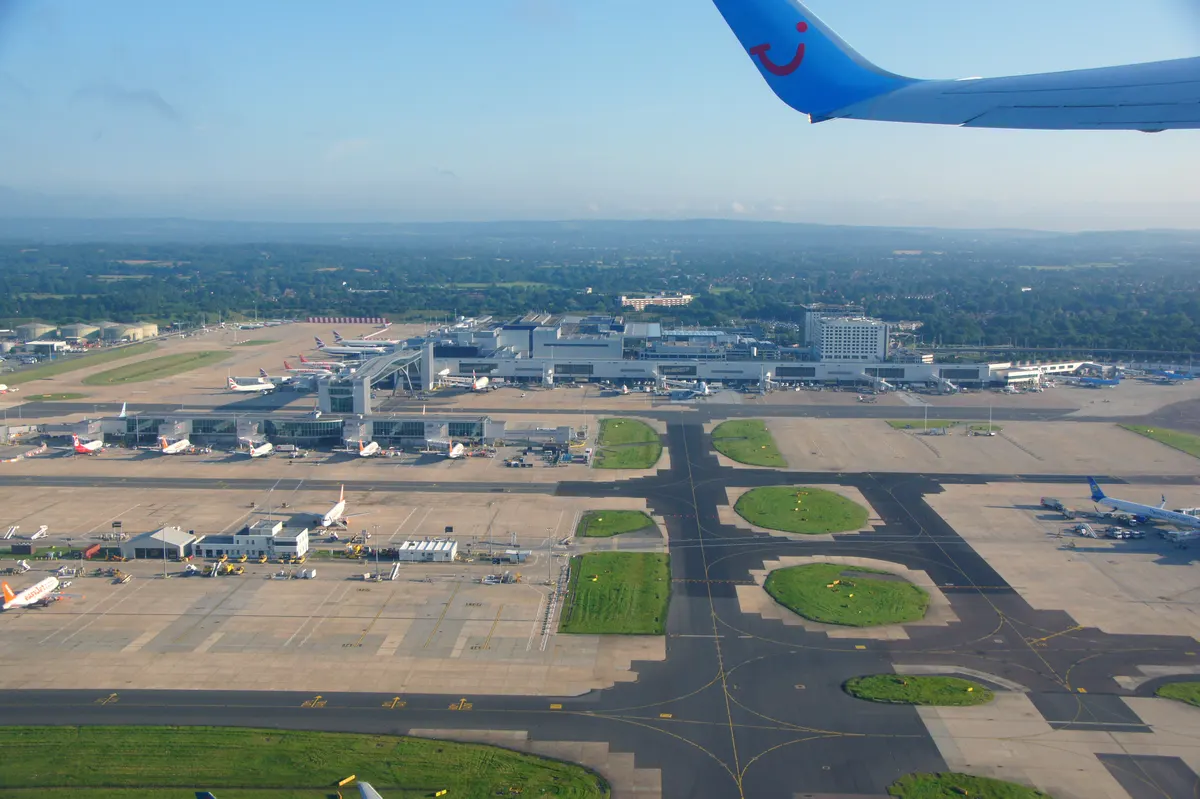
AUDS got its highest-profile civilian moment by accident. On 19 to 21 December 2018, repeated drone sightings shut London's Gatwick Airport for roughly 36 hours, disrupting travel for around 140,000 passengers over the peak Christmas period. Chess Dynamics signed a contract and had an AUDS unit operational at the airport within days of the closure, and the system has remained part of Gatwick's permanent security posture since.11 The incident itself, however, has never been fully resolved. No drone was ever recovered, no video or photo evidence was handed to police, and the Sussex Police investigation was closed in 2019 for lack of information. Some independent observers, including a former DJI executive, have since argued publicly that no genuine hostile drone was ever airborne at all, and that panic and misidentification account for many of the 170 reported sightings.12
Export and government sales followed the Gatwick episode as much as they preceded it. The US Federal Aviation Administration selected AUDS for its Pathfinder Programme, testing counter-drone technology at US airports under a cooperative agreement with Liteye Systems, after AUDS performed well in separate US government trials at the end of 2015.13
The system's corporate ownership has since fragmented in ways unusual for a single named product. Chess Dynamics was bought by the London-listed defence group Cohort plc in 2018.14 Enterprise Control Systems was acquired by the US industrial group SPX Technologies in 2021.15 On the North American side, Liteye Systems (which built the vehicle and container-mounted AUDS variants under licence) was acquired by Highlander Partners in November 2022, folded alongside another Highlander company into DZYNE Technologies by January 2023 and June 2024, and DZYNE was in turn acquired by Ondas for roughly 876 million dollars on 6 July 2026, forming a new autonomous-defence division called Ondas Sentinel.16 DZYNE's own IonStrike loitering munition and Ondas's Iron Drone Raider interceptor are consequently now corporate siblings of the North American AUDS product line, a small illustration of how fast the counter-drone industry has been consolidating.
AUDS's first confirmed combat use came in Iraq in 2016, when US forces protecting bases and personnel against the drone reconnaissance and improvised-bomb-dropping campaign run by the Islamic State fielded early AUDS units, the deployment that let the makers claim TRL-9 status the following January.9
Islamic State's cheap, modified commercial quadcopters, dropping small mortar bombs on Iraqi and coalition positions around Mosul and elsewhere, were exactly the kind of low, slow, small threat AUDS's radar and RF inhibitor were built to catch, and the Iraq deployment is generally cited by the makers as the system's first proof under fire rather than in a government test range.9
AUDS units, or systems closely descended from the same UK-built components, have also been reported in Ukrainian hands during the full-scale Russian invasion, passed on as part of the broader Western drone-jammer support effort rather than through a single publicised government-to-government contract.17 Ukrainian and Russian forces have, since, both leaned heavily on exactly the countermeasures AUDS cannot touch, fibre-optic-tethered FPV drones immune to any radio jammer and increasingly autonomous terminal guidance on one-way attack drones, a gap that has pushed newer Ukrainian and Western systems toward acoustic, optical, and kinetic interception rather than pure RF disruption.7
The baseline AUDS configuration is a fixed or semi-permanent installation, radar, tracker, and inhibitor mounted on masts or a static platform for airport, prison, or critical-infrastructure perimeter defence.
Liteye subsequently developed two mobile derivatives under licence. T-AUDS is a trailer-mounted, on-the-move version towable by a standard pickup truck, intended to defeat radio-controlled threats while the towing vehicle itself is moving rather than only from a stationary post.18 C-AUDS packages the same radar, tracker, and inhibitor inside a standard 20-foot ISO shipping container, letting the whole system be craned onto a flatbed, moved by heavy-lift aircraft, and made operational at a new site in hours rather than days.
A US Air Force contract for multiple C-AUDS units, worth about 18 million dollars, was awarded to Liteye in September 2018, the fifth counter-drone contract the company had received since the initial 2016 fielding.19


| Year | Buyer | Quantity | Amount | Present Value (2025) |
|---|---|---|---|---|
| 2018 |  United States | — | $18.0 M | $23.1 M |
| 2018 |  United Kingdom | — | — | — |
| 2017 |  Spain | — | $2.0 M | $2.6 M |
The United Kingdom was the first user, both through government-funded development trials that preceded the 2015 launch and through the British Army's own force-protection use of Blighter radars, and AUDS has been operational at Gatwick Airport since December 2018.11
The United States fielded AUDS with military forces from 2016, the deployment behind the system's TRL-9 claim, and the US Air Force separately bought multiple C-AUDS containerised units in 2018.9 Spain's Ministry of Defence bought a system to protect critical assets and personnel, with units shipped in May 2017 for a rapid-delivery timeline the makers say they compressed specifically to meet Madrid's schedule, in a contract reported at roughly 2 million euros.20
Ukraine has also been reported, via unofficial footage rather than an announced state contract, to be operating AUDS or closely related UK-built jamming equipment as part of its wider counter-drone effort.17
AUDS's closest conceptual rival in this leaf is Rafael's Drone Dome, an Israeli system that performs the same radar-plus-EO/IR-plus-jammer function but is built, sold, and supported end to end by a single company rather than a three-firm consortium. That difference matters more than any individual spec. A buyer signing for Drone Dome deals with one contractor for detection, tracking, jamming, spares, and software updates. A buyer signing for AUDS has historically dealt with a UK radar company, a UK optics company, a UK jamming company, and (outside Europe) a US integrator, four separate corporate relationships that have now scattered across at least four different owners since 2018. AUDS's radar-led detection chain also tends to reach further in open terrain, where Blighter's Ku-band FMCW technology is well proven against small, slow targets, while Drone Dome's marketing has leaned more on layered software classification to cut down false alarms in cluttered urban environments.
| AUDS | Rafael Drone Dome | |
|---|---|---|
| Detection range | up to ~10 km (radar)3 | shorter, sensor-fusion dependent |
| Defeat method | Multi-band RF/GNSS jamming (non-kinetic) | RF jamming, laser-equipped variant available |
| Vendor structure | Three-company UK consortium plus licensed integrator | Single company (Rafael) |
| Confirmed unit price | ~$1.2M (base), contracts up to $18M | not publicly disclosed |
Against DroneShield's handheld DroneGun Tactical, the comparison is really one of scale rather than approach. Both are non-kinetic RF jammers built by non-defence-prime companies that grew out of adjacent technology, but DroneGun Tactical is a rifle-shaped, single-operator device covering a couple of kilometres for a few thousand dollars, while AUDS is a fixed or vehicle-mounted installation covering an entire airfield perimeter for six or seven figures. The two are more often complementary than competing, a wide-area system like AUDS for standoff detection and a handheld jammer like DroneGun Tactical for the final close-range intercept a radar-cued operator walks toward.
MASS Assessment
MASS scoring rates AUDS across ten components tied to what is publicly documented about the system, rather than a single blended figure.
Mobility (80) is AUDS's strongest component, driven by the T-AUDS trailer and C-AUDS containerized variants that let the same radar-jammer-EO/IR stack redeploy from a fixed airport installation to an expeditionary site without a full rebuild. Non-kinetic options (60) is comparatively weak. AUDS defeats a target through RF and GNSS jamming alone, with no in-house hard-kill add-on of the kind Rafael offers through Drone Dome-L, so an operator who needs a kinetic option has to pair AUDS with a separate system rather than buying one integrated product.
What are the AUDS Anti-UAV Defence System's specifications? AUDS combines a Blighter Ku-band electronic-scanning radar, a Chess Dynamics stabilised electro-optic and infrared tracker, and a multi-band Enterprise Control Systems RF inhibitor. Publicly quoted figures put detection range at up to roughly 10 kilometres and the full detect-track-defeat cycle at 8 to 15 seconds.3,4
How does AUDS work? The radar scans for small, slow-moving aerial targets using micro-Doppler processing, the electro-optic tracker locks on and lets an operator visually confirm the object is a genuine hostile drone, and the RF inhibitor then jams the drone's control and, on some builds, GPS links so it loses guidance.1
How does AUDS compare to Rafael's Drone Dome? Both perform the same detect-track-jam function, but AUDS is built by a three-company British consortium plus a licensed North American integrator, while Drone Dome is a single-vendor Israeli product, a structural difference in support and accountability more than a difference in core capability.
Is AUDS still in service? Fielded units remain in use with reported operators including the UK, US, and Spain, but the AUDS brand name itself has faded from its original makers' marketing since 2020, and the North American licence-holder has changed ownership three times since 2022, most recently in a July 2026 acquisition by Ondas.16
What does an AUDS unit cost? Public reporting has put a base system at roughly 1.2 million dollars, with individual government contracts for multiple or containerised units ranging from about 2 million to 18 million dollars.2,19,20
- "Anti-UAV system released by Blighter, Chess Dynamics, and Enterprise Control Systems", Military Embedded Systems — militaryembedded.com ↩
- "World's First Fully Integrated Anti-UAV Defence System (AUDS) Now Features Quad Band RF Inhibitor and Optical Disruptor", PR Newswire — prnewswire.com ↩
- "Anti-UAV Defence System (AUDS) Unveiled by Trio of British Technology Companies", Blighter — blighter.com ↩
- "British Counter-UAV Technology (AUDS) Selected by FAA for US Airport Trials", PR Newswire — prnewswire.com ↩
- "MILITARY TECHNOLOGY, DSEI 2015, Neutralising UAVs, the Anti-UAV Defence System", Military Technology Magazine — miltechmag.com ↩
- "AUDS Counter-drone System Enhanced for Vehicle Deployment and to Defeat Swarm Attacks", Blighter — blighter.com ↩
- "Fiber-Optic Drones Explained, Why Militaries Are Ditching RF Control Links", Akran IQ — akraniq.com ↩
- "RDU0132, Written evidence submitted by Blighter Surveillance Systems Ltd", UK Parliament Committees — committees.parliament.uk ↩
- "AUDS Counter-drone System First to Achieve TRL-9 Status Following Successful Deployment With U.S. Forces", PR Newswire — prnewswire.com ↩
- "Aerial Threat Detection", Blighter — blighter.com ↩
- "Case study, Supporting London Gatwick with Counter-UAV Technology", Cohort PLC — cohortplc.com ↩
- "Gatwick Airport drone incident", Wikipedia — en.wikipedia.org ↩
- "British Counter-UAV Technology (AUDS) Selected by FAA for US Airport Trials", Blighter — blighter.com ↩
- "Our Story", Chess Dynamics — chess-dynamics.com ↩
- "SPX Announces Acquisition of Enterprise Control Systems Ltd", SPX Technologies — spx.com ↩
- "Ondas Announces Transformative Acquisition of DZYNE Technologies, Establishing the Leading Autonomous Defense Platform", DZYNE Technologies — dzyne.com ↩
- "AUDS anti-UAV defense systems handed over to Ukraine", Militarnyi — militarnyi.com ↩
- "Liteye Launches T-AUDS On-The-Move C-UAS Solution", Moench Publishing Group — monch.com ↩
- "Colorado Company Liteye Systems Receives $18mil Contract for Counter UAS Systems", PR Newswire — prnewswire.com ↩
- "Spanish Defence Ministry to deploy AUDS counter-UAV system", Army Technology — army-technology.com ↩