

SMASH 2000 is a clip-on electro-optical fire-control sight developed by SmartShooter Ltd. of Israel that attaches to a standard infantry rifle or carbine and uses computer vision to lock onto a target — including a small, fast-moving drone — and control the precise instant the weapon fires.1 It belongs to a category of counter-drone equipment fundamentally different from the radars, jammers, and dedicated interceptor munitions that make up most of this archive's c-uas leaf: rather than detecting a drone at range and defeating it with electronic warfare, a laser, or a purpose-built interceptor, SMASH accepts a drone that a soldier has already spotted and personally aimed at, then removes the human error that ordinarily causes a rifle shot at a small aerial target to miss.2
- Clips onto rifles and carbines soldiers already carry, needing no separate detection radar, vehicle, or dedicated interceptor round
- Removes aim error from recoil, movement, wind, and stress rather than relying on the shooter's raw marksmanship
- Combat-tested at scale: the IDF reports thousands of units used against drones, kites, and human targets during the Gaza war
- Lightweight, self-contained, and inexpensive next to radar/jammer/laser C-UAS suites, letting it equip individual squads rather than just fixed sites or vehicles
- Growing family (2000L, 3000, X4, Hopper) extends the same fire-control core from a rifle sight to a remote weapon station
- Fundamentally a kinetic, line-of-sight tool: it cannot detect or engage a drone the shooter has not already visually acquired and aimed at
- Effective range against small aerial targets remains modest (on the order of 100-250 meters for the rifle-mounted versions) compared with radar-cued or missile-based C-UAS layers
- Depends on the shooter holding a weapon actually capable of downing the target; a single 5.56mm round has limited effect on some drone airframes even with a guaranteed hit
- SOCOM's own combat evaluation, after an early adoption push, concluded the system offered only limited added capability over existing special-operations optics
- Cannot suppress or redirect a drone the way jamming or cyber-takeover systems can; a miss or an evasive drone simply survives to try again
The system's core idea is a fire-control computer married to a day-sight optic. A soldier presses a button to enter targeting mode, the sight highlights candidate targets it detects in the frame, the soldier selects one, and the system locks on and tracks it while continuously recalculating a ballistic solution from the target's range, speed, and angular motion.3 Critically, the rifle will not fire until the calculated point of impact matches the target: the trigger mechanically closes the circuit, but the weapon's own bolt or firing pin release is electronically inhibited until the fire-control computer determines a hit is assured, at which point release happens automatically within milliseconds of the correct aim being achieved.3 SmartShooter markets this as "one shot, one hit," and the company's own account of its origin ties the idea directly to guided-missile logic: founder Michal Mor, a Rafael missile-division engineer whose husband was called up as a Golani Brigade reservist during the 2006 Second Lebanon War, has said she began asking why the terminal-guidance logic that steers a missile onto a moving target could not be miniaturized to steer a single rifle bullet instead.4
Mor and fellow former Rafael engineer Avshalom Ehrlich founded SmartShooter in Kibbutz Yagur, in northern Israel, in 2011, and the Israel Defense Forces tested the resulting SMASH sight with infantry and special-operations troops through 2017 before approving it for service that year.4,5 Since then the system has moved from a single-country trial into one of the most widely exported pieces of counter-drone equipment on the market: SmartShooter states its products are in use across more than 25 countries, and by 2026 the United States Army, Marine Corps, Navy, and Air Force had all placed separate orders, alongside the United Kingdom, India, and reported use in Ukraine.6,7
At its core, SMASH 2000 is a day-sight housing built around a digital camera, a small onboard processor, an eyepiece display, and a fire-control computer, all packaged to sit atop a rifle's Picatinny rail in place of, or alongside, a conventional red-dot or magnified optic.3,8 The processor runs computer-vision and target-tracking algorithms that detect and classify candidate targets in the camera's field of view, then lock onto whichever one the shooter selects with a dedicated button, continuously recalculating range, closing speed, and lateral motion as the target moves.1,3 Early press descriptions from the system's original Israeli rollout in the late 2010s emphasized its cost advantage over the American TrackingPoint precision-guided-firearm scopes it competed against, along with broader weapon compatibility and an expanding feature set covering night operation, video recording, and dedicated drone-engagement modes.5
- System TypeClip-on electro-optical fire-control sight for standard-issue rifles/carbines
- Service Entry Year2017
- Engagement Layer (SHORAD/Med/Long)Shooter-assist / dismounted kinetic
- MobileYes
- In ServiceYes
- System Weight1.2 kg
The distinguishing mechanical feature is what SmartShooter calls "one shot, one hit": once a target is locked, the sight's computer withholds the weapon's firing-pin or bolt release even after the shooter pulls the trigger, releasing it only in the fraction of a second when the calculated point of impact coincides with the target.3 This converts the weapon into something closer to a supervised, semi-automatic terminal-guidance system than a passive optic — the human still aims, decides to engage, and pulls the trigger, but the machine decides the precise instant the round actually leaves the barrel. SmartShooter has said this specifically compensates for the factors that make small, erratically moving drones difficult targets for an unaided rifleman: recoil anticipation, breathing and heartbeat movement, combat stress, and the target's own unpredictable acceleration and deceleration.9
Later hardware generations trimmed the system's weight considerably while extending its target set. The original SMASH 2000 weighed roughly 1.2 kilograms (2.6 pounds); the lightened SMASH 2000L reduced this to about 1.1 kilograms while adding a dedicated counter-UAS engagement mode, and the further-redesigned SMASH 3000 brought the unit down to roughly 0.74 kilograms (1.63 pounds), compatible with both the M4 carbine and the M110 semi-automatic sniper rifle, with a claimed battery endurance of about 72 hours or up to 3,600 assisted shots.10,11 Reported engagement performance against drones has grown across this progression, from an initial target-acquisition range on the order of 120-200 meters against small quadcopters up to a claimed 400 meters when the same fire-control module was adapted for a vehicle-mounted heavy machine gun rather than a shoulder-fired rifle.12,13 SMASH sights integrate with the Android Tactical Assault Kit (ATAK) battle-management ecosystem used across US and allied forces, letting cued target data from an external sensor or command post pass directly to an individual soldier's sight rather than relying solely on the shooter's own visual detection.13
- PlatformRifle/carbine (Picatinny rail-mounted)
- EO/IR SensorYes
- Effective Jamming Range200 m
- Non-Kinetic Defeat MechanismNo
- Active Mitigation (vs. Detect-Only)Yes
SmartShooter's founding traces to the 2006 Second Lebanon War, when Michal Mor — then leading research teams within Rafael's missile division — had her husband called up as a Golani Brigade reservist; she has described that experience as the origin of her idea to apply guided-missile terminal logic to an infantry rifle.4 Mor co-founded SmartShooter with fellow former Rafael engineer Avshalom Ehrlich in Kibbutz Yagur in 2011, raising early venture funding to develop what became the SMASH sight.4,20 The IDF evaluated the resulting system with infantry and special-operations units through 2017 and formally approved it for service at the end of that year, after which SmartShooter began offering the technology to foreign militaries and police forces in 2018.5
US government interest followed quickly. Special-operations units, evaluated through the Pentagon's Irregular Warfare Technical Support Directorate (then the Counter Terrorism Technical Support Office), field-tested SMASH systems starting around 2020, including reported use by US special operations forces in Syria, and initial units were distributed to several SOCOM commands.7 That early enthusiasm did not convert into a lasting SOCOM program of record: a subsequent combat evaluation concluded the system provided only a limited enhanced capability over the optics US special-operations forces already carried, and SOCOM ultimately declined to field it further.7 The conventional Army took a different view. In June 2020 it named SmartShooter as one of several vendors selected to provide interim counter-drone equipment to units facing the small-drone threat, and in October 2022 SMARTSHOOTER Inc. — working through subcontractor Atlantic Diving Supply — won a US Army contract to supply SMASH 2000L systems to Army divisions as part of the service's counter-small unmanned aircraft systems effort.6,7
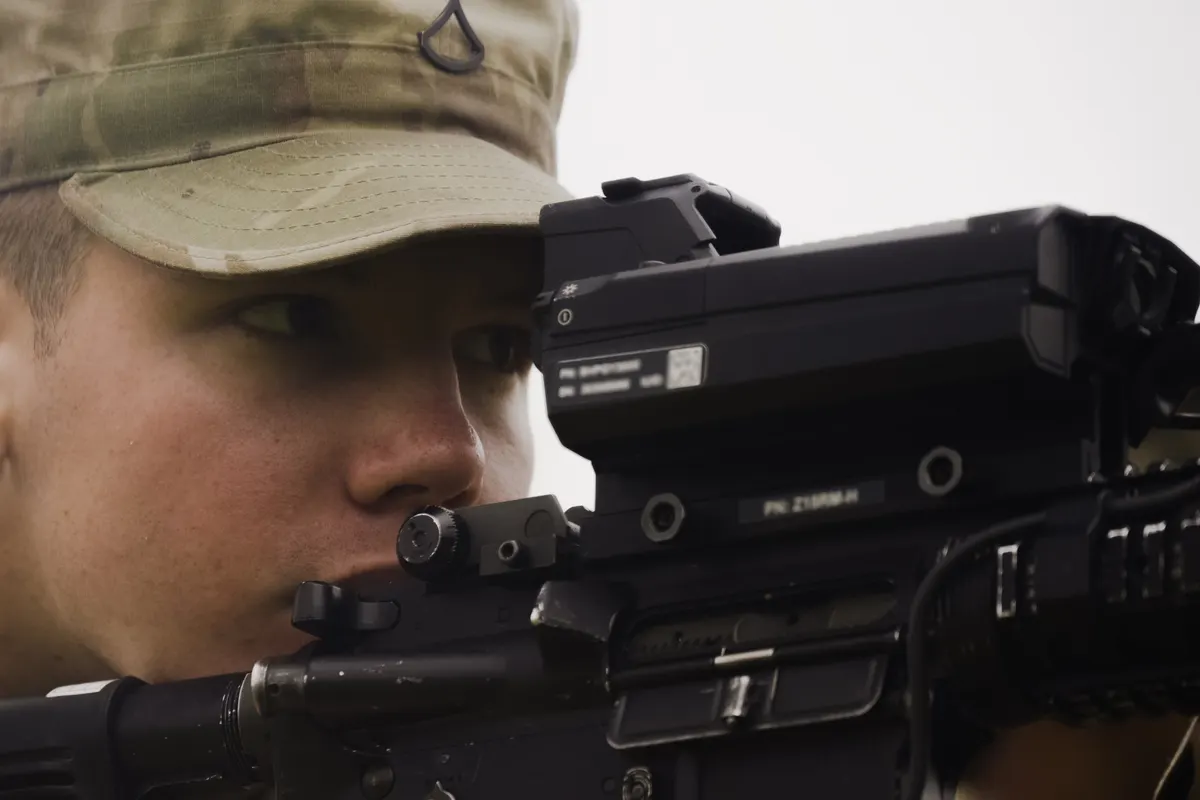
The system's most consequential real-world test came in Gaza rather than on a training range. The IDF's own account describes SMASH sights being carried into the war against Hamas beginning in October 2023, crediting the system with quadrupling a soldier's chance of a first-shot hit against a moving target and stating that thousands of units had been issued to infantry by early 2024.21 The IDF specifically cited an engagement in which the Golani Brigade's 51st Battalion, attacked by explosive-carrying drones, used SMASH-equipped rifles to neutralize seven drones within seconds.21 That combat record became a central part of SmartShooter's marketing and export pitch through the mid-2020s, alongside a parallel challenge along Israel's northern border: Hezbollah's fiber-optic-guided FPV drones, immune to the radio-frequency jamming that defeats most commercial quadcopters, left kinetic interception — including rifle fire cued by a SMASH sight — as one of the few options available to defend against them, a threat profile the company has said drove specific tracking-algorithm adaptations for drones that loiter slowly during reconnaissance before accelerating sharply into an attack run.9,22
Export orders accumulated through the early 2020s. India's Ministry of Defence contracted for SMASH 2000 Plus systems for the Indian Navy in December 2020, intended mainly for AK-47/103-pattern rifles and explicitly framed by the Navy as a defense against drone attacks, while Indian special-operations units have since been reported using the magnified SMASH X4 variant.14,16 In the United Kingdom, the Ministry of Defence selected SMASH technology in 2023 for its Counter-small Unmanned Aircraft System Smart Weapon Sight (CsUAS-SWS) requirement, awarding a framework agreement worth up to £20 million through UK distributor Viking Arms after trials in which SmartShooter's systems reportedly nearly quadrupled hit probability against drone targets compared with standard optical sights.23 Ukraine's use of SMASH-equipped rifles against Russian loitering munitions and first-person-view drones has been reported by open-source and trade-press accounts, though as of this writing it remains less formally documented in on-the-record government statements than the confirmed US, UK, Indian, and Israeli programs; this article treats Ukrainian battlefield use as reported rather than officially confirmed.24
US procurement broadened further from 2025. The Army awarded a $13 million follow-on contract in May 2025 under its Transformation in Contact (TIC 2.0) modernization effort, demonstrating the system live on 6 June 2025 at the Joint Multinational Readiness Center in Hohenfels, Germany, with soldiers of the 3rd Squadron, 2nd Cavalry Regiment engaging targets during the multinational Project Flytrap exercise.25,26 The Marine Corps placed its own order in July 2025, describing SMASH 2000L as an interim solution for dismounted counter-drone protection at the squad level, and by mid-2026 SmartShooter reported that every major US service branch maintained an active contract: a further $10.7 million Army follow-on order in May 2026, a $3.4 million Marine Corps follow-on in June 2026, a $1.8 million initial Navy contract the same month, and an order from Joint Interagency Task Force 401 in March 2026 that extended use to Air Force Global Strike Command for airbase and critical-infrastructure protection.6,27
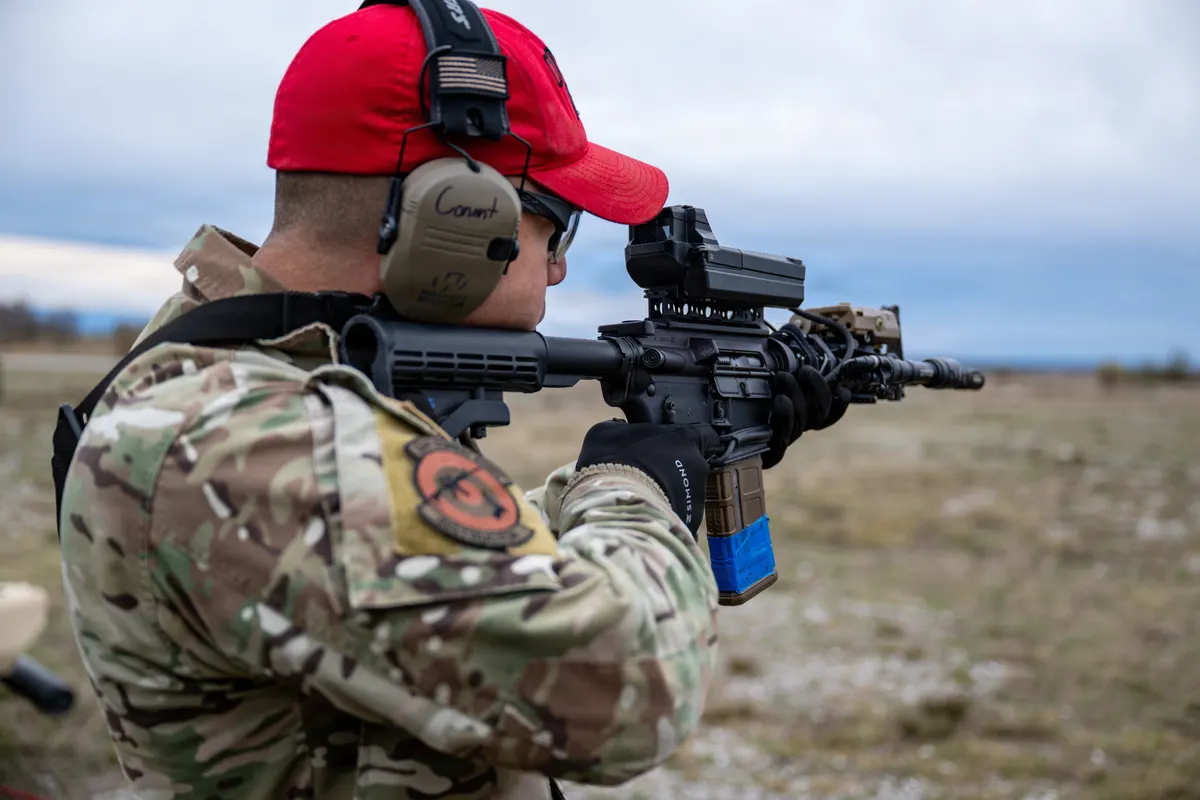
Australia's Defence Force contracted to evaluate the SMASH 3000 in December 2025, part of a wider pattern of Western militaries testing equipment SmartShooter markets as combat-proven in Gaza.6 SmartShooter itself completed an initial public offering on the Tel Aviv Stock Exchange on 2 March 2026, raising roughly $65 million in primary shares and a further $19.5 million in secondary sales at a post-money valuation near $293 million, with the IDF alone accounting for 36 percent of the company's revenue over the first nine months of 2025 and total 2025 revenue projected at roughly $36.5 million, up from $24.5 million in 2024 and $12.3 million in 2023.20
SMASH 2000, the original production model fielded by the IDF from 2017, established the base fire-control-sight concept: a stand-alone electro-optical unit roughly 1.2 kilograms in weight, mounted on an individual rifle, with target-lock and guaranteed-hit logic aimed initially at moving human and vehicle targets as much as aerial ones.4,5
SMASH 2000L followed as a lightened evolution, cutting weight to roughly 1.1 kilograms while adding a dedicated hard-kill counter-UAS mode; it is the version most widely referenced in US military contracting since 2020 and remains the Army, Marine Corps, and Navy's baseline procurement designation as of 2026.6,10 Indian distributor literature also lists a SMASH 2000 Plus configuration for export customers, carrying the same expanded feature set including the counter-UAS hard-kill mode.14
SMASH 3000 is the further weight-reduced successor, at roughly 0.74 kilograms, compatible with both the M4 carbine family and the M110 semi-automatic sniper system; SmartShooter and several export customers use "SMASH 2000L" and "SMASH 3000" close to interchangeably in public materials, reflecting the fact that the two names have described closely related hardware generations of the same rifle-mounted product line.10,11
SMASH X4 adds a fixed 4x magnifying optic to the same fire-control core, intended for engaging aerial and ground threats at extended range, and includes an etched reticle that keeps the sight usable for basic aiming even with the electronics powered down, plus an optional integrated laser rangefinder that feeds range data into the ballistic solution.15 The Indian special-operations community has been reported using the X4 variant specifically.16
SMASH Hopper repackages the same fire-control technology as a remote-controlled weapon station rather than a shoulder-fired sight: a roughly 15-kilogram, tripod-, mast-, or vehicle-mountable unit with day/night sensors and automatic scanning, intended for base-perimeter, border, and static-site defense so that operators can engage ground and aerial threats from a protected position rather than exposing a rifleman directly.17 Israel's Ministry of Defense placed an initial order for Hopper systems worth roughly NIS 6.7 million (with options for a further NIS 7.9 million) in May 2026, aimed specifically at the growing threat from drones along Israel's northern border.17


| Year | Buyer | Quantity | Amount | Present Value (2025) |
|---|---|---|---|---|
| 2025 |  United States | — | $13.0 M | $13.0 M |
| 2023 |  United Kingdom | — | $20.0 M | $21.1 M |
| 2022 | United States | — | — | — |
| 2020 |  India | — | — | — |
Israel is SMASH's home market and largest customer by revenue share, having approved the original SMASH 2000 for IDF service in 2017 and subsequently issued thousands of units to infantry units during the Gaza war beginning in October 2023, with continued procurement including a 2026 order for SMASH Hopper remote weapon stations aimed at the Hezbollah drone threat along the Lebanese border.4,5,17,21
The United States represents SMASH's largest and most fragmented customer base: US Special Operations Command field-tested early units from around 2020, including reported use in Syria, before a formal combat evaluation led SOCOM to decline further fielding; the conventional Army picked up the system instead, naming SmartShooter an interim counter-drone vendor in 2020, contracting through Atlantic Diving Supply in October 2022, and expanding via a $13 million May 2025 award and a further $10.7 million order in May 2026.6,7,25 The Marine Corps ordered SMASH 2000L in July 2025 and followed with a $3.4 million contract in June 2026; the Navy placed its first order, worth $1.8 million, that same month; and Joint Interagency Task Force 401 extended the system to Air Force Global Strike Command in March 2026 for airbase and infrastructure protection.6,27
The United Kingdom's Ministry of Defence selected SMASH in 2023 under its Counter-small Unmanned Aircraft System Smart Weapon Sight program, signing a framework agreement worth up to £20 million through distributor Viking Arms.23 India's Ministry of Defence ordered SMASH 2000 Plus systems for the Indian Navy in December 2020, chiefly for AK-47/103-pattern rifles, and Indian special-operations forces have since been reported fielding the magnified SMASH X4 variant.14,16 Australia's Defence Force contracted to trial the SMASH 3000 in December 2025.6 Ukraine's use of SMASH-equipped rifles against Russian drones has been reported in open-source and trade coverage but is less formally documented than the other listed programs, and this article treats it as reported rather than confirmed.24
SMASH 2000's closest conceptual peer among this archive's published counter-drone systems is Allen Control Systems' Bullfrog, because both replace a human's raw marksmanship with a computer-controlled aiming solution rather than jamming, lasing, or launching an interceptor at the target — the "assisted-shooter" branch of counter-drone technology rather than the electronic-warfare or kinetic-interceptor branches occupied by systems such as Rafael's Drone Dome or D-Fend's EnforceAir.1,28 The two systems sit at very different points along that shared idea, however. Bullfrog is a stationary, remotely operated turret built around a standard rifle-caliber machine gun with its own computer-vision targeting stack, designed to be emplaced at a fixed site and left largely unattended once cued; SMASH 2000 is a lightweight sight a single soldier clips onto a rifle he or she already carries into the field, keeping the human physically in the loop for target selection, movement, and the final decision to engage.1,28
| SPEC | SmartShooter SMASH 2000 | Allen Control Systems Bullfrog |
|---|---|---|
| Mobile | ✓ | ✓ |
| requires_human_trigger | ✓ | ✓ |
| Effective Jamming Range | 200 m | — |
| System Weight | 1.2 kg | — |
| In Service | ✓ | — |
That difference in form factor drives most of the practical trade-offs between them. Bullfrog's turreted mount and larger onboard sensor package let it track and engage a target with less physical strain on an operator across a longer standby period, but it needs a fixed emplacement, a power supply, and its own gun rather than the rifle a soldier already has. SMASH 2000 sacrifices that stationary reach for portability: it goes wherever the infantryman goes, requires no separate mount or generator, and can be issued at the individual-soldier level rather than the site level, at the cost of depending entirely on a human first spotting and aiming at the drone with a shoulder-fired weapon of comparatively limited power against some airframes.
MASS Assessment
Mobility (80) is SMASH 2000's best-scoring component in this archive's rating, and it is the one area where a clip-on rifle sight is always going to beat a turreted, site-emplaced system like Bullfrog: it adds barely over a kilogram to a weapon the soldier is already carrying, needs no vehicle, generator, or mount, and can be issued down to the individual level rather than positioned at a fixed perimeter.
Non-kinetic options (0), the lowest possible score in this leaf, is the direct flip side of that same portability: SMASH 2000 has no jamming, lasing, or electronic-defeat mode whatsoever — it is purely a fire-control aid that helps a human put a live round on target faster and more reliably than unassisted aim would allow. That makes it the most purely kinetic, most purely human-in-the-loop system in this archive's counter-drone leaf, useful specifically where legal or environmental constraints on live fire are not the limiting factor and where a squad simply needs a better chance of hitting a small, fast-moving target with the rifle it already has.
Does SMASH 2000 jam, shoot down with a laser, or otherwise defeat a drone electronically? No. SMASH 2000 is a purely kinetic, line-of-sight fire-control aid: it helps a soldier hit a drone with an ordinary rifle bullet by controlling the precise instant the weapon fires, rather than jamming its control link, dazzling its sensors, or firing a directed-energy or missile-based effector at it.1,3
Does the system fire the weapon by itself? Not entirely. A soldier still spots the target, aims the rifle, selects the lock, and pulls the trigger; the fire-control computer's role is to withhold the weapon's firing-pin or bolt release until its calculated point of impact matches the target, then release automatically within the shooter's own trigger pull.3
Has SMASH actually been used in combat, or only demonstrated? It has seen extensive documented combat use. The IDF's own public statements describe thousands of SMASH units issued to infantry during the Gaza war beginning in October 2023 and credit the system with helping the Golani Brigade's 51st Battalion down seven attacking drones in seconds during one engagement.21 Ukrainian battlefield use against Russian drones has also been reported, though it is less formally confirmed than the Israeli record.24
Why did US Special Operations Command stop using it if the Army adopted it? SOCOM tested SMASH early, around 2020, but a subsequent combat evaluation found it added only limited capability over the optics its operators already carried, leading the command to decline further fielding. The conventional Army, Marine Corps, Navy, and Air Force separately assessed the system against the different problem of equipping large numbers of general-purpose infantry against small drones, and each branch has placed its own procurement contracts since.7
What is the difference between SMASH 2000, 2000L, 3000, X4, and Hopper? SMASH 2000 was the original rifle-mounted model; SMASH 2000L and SMASH 3000 are progressively lighter hardware generations of the same rifle-sight concept, with SMASH 3000 adding compatibility with the M110 semi-automatic sniper rifle; SMASH X4 adds a fixed 4x magnifying optic and optional laser rangefinder for longer-range engagement; and SMASH Hopper repackages the same fire-control core as a remotely operated weapon station for fixed-site rather than shoulder-fired use.10,11,15,17
- "EXCLUSIVE: U.S. Army integrates SMASH smart fire control system on M4A1 rifle to target aerial drones", Army Recognition — armyrecognition.com ↩
- "Tactical drone defense with SMART SHOOTER", SPARTANAT — spartanat.com ↩
- "The Army is officially adopting the 'Smart Shooter' smart rifle scope", Task & Purpose — taskandpurpose.com ↩
- "Startup says it can make rifles smarter, deadlier -- and safer", The Times of Israel — timesofisrael.com ↩
- "Electronic Weapons: Smart Shooter SMASH Sight", StrategyPage — strategypage.com ↩
- "Israel's Smart Shooter sees c-UAS demand grow across US military: Exec", Breaking Defense — breakingdefense.com ↩
- "Israel's Smartshooter says US Army expanding use of high-tech fire control system", Breaking Defense — breakingdefense.com ↩
- "SMASH2000: Finally, an AI-powered optic that turns your AR-15 into a drone hunter", We Are The Mighty — wearethemighty.com ↩
- "Smart Shooter: Stepping in to close the gap against Hezbollah's fiber-optic drones", The Jerusalem Post — jpost.com ↩
- "Smart Shooter Receives Follow-On U.S. Army Award for SMASH 2000L Counter-Drone Fire Control Systems", UAS Weekly — uasweekly.com ↩
- "SMARTSHOOTER Wins Innovation Award for AI-Driven Precision Fire Control Solutions", Army Technology — army-technology.com ↩
- "SmartShooter Unveils New SMASH 3000 Turning Heavy Machine Guns Into Smart Anti-Drone Weapons", Defense Express — en.defence-ua.com ↩
- "Smartshooter Expands SMASH Anti-Drone Sight to Heavy Machine Guns, Vehicles", The Defense Post — thedefensepost.com ↩
- "Indian Navy procuring Smart Shooter 'SMASH 2000' rifle sights", IMR Media — imrmedia.in ↩
- "Smartshooter unveils another member of the SMASH Family, the SMASH X4 - a Fire Control System with a x4 magnifying optic scope", EDR Magazine — edrmagazine.eu ↩
- "Indian Special Forces uses SmartShooter's SMASH X4 sight", Israel Defense — israeldefense.co.il ↩
- "Smart Shooter wins Israel's Defense Ministry contract for anti-drone SMASH Hopper weapon stations", The Jerusalem Post — jpost.com ↩
- "Drones Weaponised with a Smart Shooter – Killers from Above", Defense Update — defense-update.com ↩
- "SMASH Handheld", Wikipedia — en.wikipedia.org ↩
- "Israeli defense tech firm Smart Shooter raises $65 million in IPO", Calcalist — calcalistech.com ↩
- "Advanced Automation and Quadrupled Precision: The IDF's New SMASH Sight Is Changing the Face of the Modern Battlefield", Israel Defense Forces — idf.il ↩
- "Israel's Smart Shooter sees c-UAS demand grow across US military: Exec", Breaking Defense — breakingdefense.com ↩
- "SMARTSHOOTER to present the SMASH technology, recently selected for purchase by the British Army", sUAS News — suasnews.com ↩
- "Ukraine Gets 'Smartshooter' Scopes Which Turns Rifles into Counter-Drone Weapons", Wes O'Donnell, Medium — wesodonnell.medium.com ↩
- "US Army deploys SMASH smart scopes to help soldiers shoot down drones", Fox News — foxnews.com ↩
- "US Army includes SmartShooter's SMASH 2000L fire control system as part of C-sUAS defence", Unmanned Airspace — unmannedairspace.info ↩
- "USMC orders SMASH 2000L fire control system from Smartshooter", Naval Technology — naval-technology.com ↩
- "Bullfrog M240", Allen Control Systems — allencontrolsystems.com ↩