

MADIS, the Marine Air Defense Integrated System, is the US Marine Corps' first purpose-built mobile short-range air defense capability since it retired its last M6 Linebacker/Avenger units in the mid-2000s.1,19 It consists of a matched pair of Oshkosh Joint Light Tactical Vehicles (JLTVs), one carrying a turreted 30mm cannon and FIM-92 Stinger missiles, the other carrying a 360-degree radar, an electronic warfare suite, and the command-and-control gear that ties the section together.1,2 The two vehicles fight as a single detect-track-engage unit, a construct the Marine Corps calls the Mk1/Mk2 pairing, and the whole system exists to answer one narrow but urgent problem, protecting dispersed Marine units from Group 1 through Group 5 drones, loitering munitions, and low-flying manned aircraft without depending on a Navy ship or an Army Patriot battery for cover.1,16
- Organic radar, EW, and kinetic kill chain in one section (no external cueing needed)
- Two effector types (Stinger missile and 30mm proximity-fuzed cannon) on the same pair
- Modular electronic warfare (Modi II) for a non-kinetic option before a shot is fired
- Built on a fielded, expeditionary JLTV base rather than a bespoke chassis
- Roughly ten times the unit cost of lighter bolt-on rivals like VAMPIRE
- Still a very small fleet, well short of its 190-system acquisition objective
- No independently confirmed real-world combat engagement as of mid-2026
- Two-vehicle section adds a logistics and maintenance footprint a single-vehicle kit avoids
The Naval Information Warfare Center (NIWC) Atlantic's Expeditionary Warfare Department built MADIS quickly by defense-acquisition standards, prototyping it from largely commercial, off-the-shelf components starting around 2018 and fielding the first systems to operational units by the end of 2024.1,14 That speed was deliberate. The Marine Corps had gone without an organic, mobile, missile-armed air defense vehicle for roughly fifteen years, relying instead on dismounted Stinger teams that had to expose themselves to acquire and fire on a target.1,19 MADIS folds detection, jamming, and kinetic engagement into armored vehicles that a Low Altitude Air Defense (LAAD) battalion can drive, camouflage, and displace as part of a distributed force, the operating concept the Marine Corps calls Expeditionary Advanced Base Operations.1
Roughly 190 MADIS systems are planned through 2035, split across the 1st, 2nd, and 3rd LAAD battalions and the 3rd, 4th, and 12th Marine Littoral Regiments, with full operational capability targeted for fiscal year 2031 across twelve air defense batteries.11,19 By mid-2026, deliveries were still in the low tens of vehicles, so most of MADIS's public record so far is exercises and testing rather than sustained combat use, a point covered in detail in Conflicts below.
The Mk1 Shooter and Mk2 Sensor, Fighting as a Pair
MADIS Mk1 is the kinetic vehicle. Its Kongsberg-built remote weapon station carries an M230LF 30mm chain gun, a lengthened, lighter derivative of the Apache helicopter's M230 that the Army and Marine Corps have also fitted to Strykers and other RWS mounts, firing at a reduced cyclic rate of roughly 200 rounds per minute and able to switch between XM1211 proximity-fuzed airburst rounds tuned for small drones and armor-piercing high-explosive dual-purpose rounds for tougher targets.22,1 Alongside the cannon sits a four-round FIM-92 Stinger launch pod, the same infrared-homing, fire-and-forget missile the Marine Corps has used since the 1980s, with a publicly cited range around 4.8 km, an altitude ceiling near 3,800 m, and a burnout speed above Mach 2.23 Mk1 also supports dismounted Stinger employment, letting a crew fight on foot if the vehicle itself is unavailable.1
- System TypeTwo-vehicle SHORAD/C-UAS pair (Mk1 kinetic, Mk2 sensor-EW)
- Service Entry Year2024
- Engagement Layer (SHORAD/Med/Long)SHORAD
- MobileYes
- In ServiceYes
MADIS Mk2 is the sensor and command node. Its centerpiece is the RPS-42, a solid-state, gallium-nitride active electronically scanned array (AESA) radar built by RADA Electronic Industries (part of Leonardo DRS since a 2022 acquisition), giving 360-degree azimuth coverage and roughly 30 km of maximum detection range against larger aircraft, narrowing to a more realistic 10 km or so against small Group 1 and Group 2 drones, across altitudes from near ground level up to 30,000 ft.1,21 Layered on top of the radar is the Modi II electronic warfare system from Sierra Nevada Corporation, which can passively locate a drone's radio-frequency control and navigation links and then jam or spoof them, including GNSS/GPS denial, giving an operator a non-kinetic option before committing a missile or a burst of cannon fire.1 Mk2 also mounts a 7.62mm M134 Minigun for close-in self-defense, since its own turret carries no long-range effector.1
- Missile / EffectorFIM-92 Stinger
- Ready Missiles4
- Maximum Range4.8 km
- Maximum Altitude3,800 m
- Missile Speed (Mach)2.2 Mach
- Warhead Typehigh-explosive fragmentation
Why an Expeditionary JLTV Base Instead of a Bespoke Vehicle
Choosing the Oshkosh JLTV as MADIS's base, rather than designing a dedicated chassis, was itself a design decision with consequences. The JLTV is already in wide Marine Corps and Army service, air-transportable, and rated for off-road expeditionary movement, which matters for a system meant to disperse with small units across islands and austere coastlines under the Corps' post-2020 Force Design concept rather than sit with a fixed air defense battery.1 The tradeoff is armor and payload margin, a JLTV-based turret system is lighter and less protected than a dedicated tracked air defense vehicle would be, a compromise the Marine Corps accepted deliberately in exchange for mobility and a smaller logistics tail.1
- Guidance Typepassive infrared homing
- Fire-and-ForgetYes
Both vehicles link into the Marine Air Command and Control System (MACCS) through the Common Aviation Command and Control System (CAC2S), and Mk2 carries a beyond-line-of-sight gateway that lets a MADIS section engage a target cued by another radar elsewhere in the network rather than only what its own RPS-42 sees, a step toward the joint all-domain command and control architecture the wider US military is pursuing.1
- Search RadarRADA RPS-42
- Tracking RadarRADA RPS-42
- AESA RadarYes
- 360° CoverageYes
- Gun-ArmedYes
- Gun Calibre30 mm
- Gun Rate of Fire200
- PlatformOshkosh JLTV Heavy Guns Carrier
- Unit Cost10,000,000 USD
- Sensor SuiteRPS-42 AESA radar, EO/IR turret, passive RF/ESM sensing
- EO/IR SensorYes
- RF Direction-Finding / ESMYes
- Command & Control SoftwareCAC2S / MACCS integration
- Maximum Detection Range (km)30
- GNSS/GPS Jamming CapabilityYes
- EW / Mitigation FunctionRF jamming, GNSS/GPS denial, data-link disruption (Modi II)
- Jamming TechniqueRF jamming and GNSS/GPS denial
- Emitter GeolocationYes
- Active Mitigation (vs. Detect-Only)Yes
The Marine Corps divested its towed and vehicle-mounted Avenger air defense systems in the mid-2000s, judging large-scale air threats unlikely after the Cold War, and left Low Altitude Air Defense battalions with dismounted Stinger teams as the only organic counter-air tool.1,19 Commercial and militarized small drones changed that calculus faster than the acquisition system could formally respond, so in 2018 the Marine Corps stood up a Ground-Based Air Defense program office and asked NIWC Atlantic's Expeditionary Warfare Department, the same rapid-prototyping organization credited with fielding the MRAP mine-resistant vehicle a decade earlier, to build an interim capability from largely commercial parts rather than wait for a conventional multi-year program.1,14
That urgency produced the Light Marine Air Defense Integrated System, a pair of Polaris MRZR buggies carrying radar, EO/IR sensors, and the Modi jamming system, fielded under an urgent operational need well before the heavier JLTV-based MADIS existed.1 L-MADIS proved its value almost immediately.
On July 18, 2019, Marines aboard the amphibious assault ship USS Boxer, transiting the Strait of Hormuz, used an MRZR-mounted L-MADIS unit staged on the ship's bow to jam and bring down a fixed-wing Iranian drone that had closed to roughly 1,000 yards.6,7 It was reportedly the first known use of that kind of electronic countermeasure by a US Navy ship, and commentators at the time noted the lopsided economics of using a system built largely from inexpensive commercial components against a drone Iran had built for a fraction of the cost of a guided missile.7 Iran denied losing a drone.6
MADIS proper, the heavier JLTV-based Mk1/Mk2 pair, moved through low-rate initial production starting around fiscal year 2020, and in September 2021 the Marine Corps awarded Kongsberg a five-year, roughly 94 million dollar indefinite-delivery contract to build the RS6 remote weapon stations that arm Mk1, with production shifting from Kongsberg's home plant in Norway to a new Kongsberg Protech Systems USA facility in Johnstown, Pennsylvania.9,8 The first US-built RWS completed assembly and testing there in March 2022, and by July 2023 the Johnstown line had reached full-rate production, a milestone specifically about the turret and weapon station rather than the complete two-vehicle MADIS system.3,10
Full MADIS sections reached operational Marine units starting in December 2024, when the 3rd Littoral Anti-Air Battalion in Hawaii and the Marine Corps Communication-Electronics School received the first vehicles, followed by the system's first live-fire event in January 2025 at the Pohakuloa Training Area.2,14 The predecessor L-MADIS went through its own milestone that same period, running for the first time through the Weapons and Tactics Instructor (WTI) course at Marine Aviation Weapons and Tactics Squadron One in Arizona in October 2024, a step toward formal tactics doctrine the system had lacked since its 2019 urgent fielding.5
In April 2025, a MADIS battery from the 3rd LAAB deployed to the Philippines for Exercise Balikatan 25, the system's first employment outside the United States, integrating into a joint air and missile defense event alongside the NMESIS anti-ship system.11,12,13 On December 15, 2025, the Marine Corps announced it had accepted the first full-rate production MADIS system, at the Marine Corps Air Ground Combat Center at Twentynine Palms, marking the shift from prototype-era vehicles to a standardized, program-of-record configuration with upgraded sensors and targeting software.4,15
By early 2026, fielding accelerated further, with the Marine Corps citing low-cost drone proliferation as the driver for pushing MADIS to additional battalions faster than originally scheduled.16 In June 2026, the Marine Corps awarded Seattle-based Overland AI a roughly 19.7 million dollar production contract, funded through the Pentagon's Accelerate the Procurement and Fielding of Innovative Technologies program, to build more than a dozen autonomous ground vehicles to operate alongside MADIS sections, initially in a resupply role rather than as an additional shooter.17,18
As of mid-2026, no publicly confirmed real-world combat engagement by a JLTV-based MADIS Mk1/Mk2 section has been reported. The system's public record so far is exercises, live-fire qualification, and testing, at Pohakuloa in Hawaii, at Twentynine Palms in California, and during Balikatan in the Philippines, rather than an actual intercept against a hostile drone.2,11,14 That stands in contrast to systems like L3Harris VAMPIRE, which Ukraine has used against Shahed-136/Geran-2 drones in the full-scale Russo-Ukrainian war, or to MADIS's own predecessor, which has a genuine kill to its name.
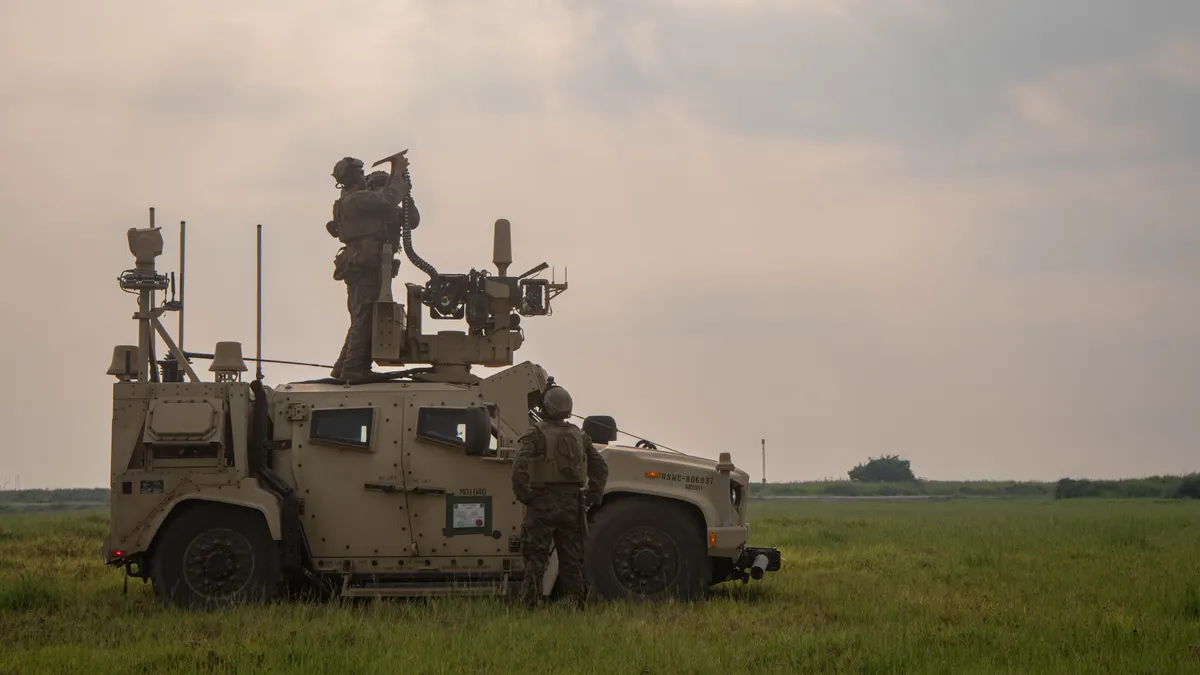
The record for the earlier L-MADIS predecessor is thinner but real. Beyond the 2019 USS Boxer intercept, Marine units operating MADIS-family systems, described in official release materials simply as MADIS without specifying which variant, were filmed employing the system in Saudi Arabia in June 2021 with a Special Purpose Marine Air-Ground Task Force Crisis Response element assigned to Central Command, a deployment aimed broadly at the same class of Iranian-origin and Iranian-backed drone threat that has since driven the Red Sea shipping crisis, though no specific engagement from that deployment has been publicly documented.20
The Marine Corps' MADIS fielding priority has leaned toward the Indo-Pacific rather than the Middle East, a reflection of Force Design 2030's focus on contested island and littoral operations against a peer threat, where distributed Marine Littoral Regiments would have to defend themselves against reconnaissance and strike drones without naval or Air Force cover nearby.1,11 Despite the Red Sea Houthi drone and missile campaign against shipping since late 2023 falling squarely within the kind of low-cost drone threat MADIS is built to counter, no MADIS deployment specifically tied to that campaign has been publicly reported as of this writing.
MADIS Mk1 and MADIS Mk2 together form the two halves of one fielded unit, covered together in Specs and Design above, the kinetic shooter and the sensor/EW/command node that only make operational sense paired.1
L-MADIS (Light MADIS) is the lighter, earlier predecessor, built on a pair of Polaris MRZR all-terrain vehicles rather than JLTVs, one carrying radar and EO/IR sensors, the other carrying the Modi jamming system, and small enough to fit inside an MV-22 Osprey for austere or shipboard deployment.1 It remains in Marine Corps LAAD battalion service alongside the newer JLTV-based system rather than having been replaced by it, filling a role where reduced signature and air-transportability matter more than the JLTV variant's heavier armor and dual kinetic effectors.1,5

An autonomous ground vehicle variant emerged in 2026, when Overland AI won a Marine Corps contract to build robotic vehicles to operate with MADIS sections, initially carrying resupply loads rather than sensors or weapons, with deliveries planned for early 2027.17,18 The Marine Corps has framed the addition as a step toward reducing the number of Marines physically exposed near a MADIS firing position rather than as a new weapon variant in its own right.17
None of these three configurations has replaced another. By mid-2026 a Marine air defense battalion could plausibly field L-MADIS, the JLTV-based Mk1/Mk2 pair, and an early batch of Overland AI's robotic support vehicles side by side, each covering a different point on the tradeoff between signature, protection, and payload.

| Year | Buyer | Quantity | Amount | Present Value (2025) |
|---|---|---|---|---|
| 2021 |  United States | — | $94.0 M | $111.7 M |
- United States (US Marine Corps). Fielded from December 2024 to the 3rd Littoral Anti-Air Battalion and the Marine Corps Communication-Electronics School, with roughly 13 systems ordered in fiscal year 2024 and 13 more in fiscal year 2025, and 10 requested for fiscal year 2026.14,19 Planned distribution runs across the 1st, 2nd, and 3rd Low Altitude Air Defense battalions and the 3rd, 4th, and 12th Marine Littoral Regiments, against a stated acquisition objective of roughly 190 systems and full operational capability across twelve batteries by fiscal year 2031.11,19
New crews go through a dedicated New Equipment Training package before a unit is certified, combining classroom instruction on the radar and electronic warfare suite with field exercises and a live-fire qualification, the same pipeline the Marine Corps ran ahead of the system's December 2025 full-rate production milestone.15 That training cycle, rather than a fixed fielding date, is what ultimately determines when a given LAAD battalion or Marine Littoral Regiment is considered combat-ready with MADIS.
No other country operates or has ordered MADIS. The program is a US-only acquisition tied to Marine Corps-specific force structure, and unlike some of this leaf's export-oriented systems, nothing in the public record points to allied interest or a pending foreign sale.
Set against L3Harris VAMPIRE, the other US-fielded, vehicle-mounted counter-drone system in this leaf, MADIS and VAMPIRE solve a similar problem from close to opposite ends. VAMPIRE is a bolt-on kit, a rocket launcher and a sensor mast that can be palletized onto almost any flatbed truck in under two hours, cheap enough that a single APKWS rocket costs roughly what the drone it kills costs. MADIS is a program of record built into two purpose-fitted armored JLTVs carrying their own radar, jamming suite, and two different kinds of kinetic effector, at roughly ten times VAMPIRE's per-unit cost. VAMPIRE depends on an external cue or its own EO/IR turret to find a target before it fires, while a MADIS section carries its own 360-degree AESA radar and can detect, track, and hand off targets without any outside sensor. That self-contained detection is MADIS's central advantage for a dispersed Marine unit with no other radar coverage nearby, and its central expense.
| SPEC | USMC MADIS | L3Harris VAMPIRE |
|---|---|---|
| Platform | Oshkosh JLTV Heavy Guns Carrier | Vehicle-agnostic palletized kit — fielded on pickup trucks, M1152A1 Humvees, M113 APCs, and MRZR buggies in Ukraine, and on GM Defense’s Infantry Squad Vehicle for the U.S. Army; JLTV and uncrewed ground vehicle integration announced |
| Missile / Effector | FIM-92 Stinger | APKWS II (BAE Systems laser-guidance kit on a Hydra-70 rocket motor/warhead); Thales FZ275 laser-guided rocket integrated as an alternative effector on some Ukrainian launchers |
| Gun-Armed | ✓ | — |
| Maximum Range | 4.8 km | 6 km |
| Mobile | ✓ | ✓ |
Against non-kinetic, jamming-only systems in the same leaf, MADIS is a hybrid rather than a pure substitute. Its Modi II suite gives an operator the option to jam or spoof a drone's control and navigation links before committing a missile or a burst of cannon fire, the same soft-kill logic dedicated jammers rely on, but MADIS backs that option with a hard-kill layer a pure jammer lacks, useful against autonomous or GPS-independent drones a jammer alone cannot stop. The cost of carrying both capabilities in one section is complexity, two vehicles, two crews, and a wider set of subsystems to maintain in the field.
MASS Assessment
MASS scoring rates MADIS across ten components tied to what is publicly documented about the system, rather than a single blended figure.
Technology (90) is MADIS's highest component, driven by a section that pairs its own 360-degree AESA radar with two distinct kinetic effectors (a 30mm cannon and Stinger missiles) and an electronic-warfare suite, all fused through CAC2S and MACCS rather than bolted onto an existing vehicle after the fact. Coverage (75) trails behind that figure. A MADIS section is built around two vehicles protecting the unit they travel with, not a wide-area fixed installation, so a Marine formation spread across a large littoral area still needs more than one section to hold continuous coverage, a tradeoff the program accepts in exchange for keeping every sensor and effector organic to the maneuver unit itself.
What does MADIS stand for and what is it? MADIS stands for Marine Air Defense Integrated System. It is a pair of Joint Light Tactical Vehicles fielded together, one armed with a 30mm cannon and Stinger missiles, the other carrying a 360-degree radar and an electronic warfare suite, built to give dispersed Marine units their own short-range air defense against drones and low-flying aircraft.1,2
What is the difference between MADIS Mk1 and Mk2? Mk1 is the kinetic shooter vehicle, carrying the 30mm M230LF cannon and Stinger missile pod. Mk2 is the sensor, electronic warfare, and command node, carrying the RPS-42 radar, the Modi II jamming system, and a self-defense minigun. The two operate together as a single section rather than independently.1
Is MADIS the same thing as L-MADIS? No. L-MADIS (Light MADIS) is an earlier, lighter predecessor built on Polaris MRZR buggies, first fielded around 2019 and still in Marine Corps service. MADIS is the newer, heavier JLTV-based Mk1/Mk2 pair fielded from December 2024 onward. Both remain in the Marine Corps inventory at once.1
How much does MADIS cost and how many has the Marine Corps bought? Marine Corps budget documents put Increment 1 MADIS at roughly 10 million dollars per two-vehicle system.24 Deliveries were still in the low tens of systems through 2025 and early 2026, against a stated acquisition objective of about 190 systems by 2035.19,24
Is MADIS still in service, and has it seen combat? Yes, MADIS is in active Marine Corps service and expanding, with full-rate production accepted in December 2025 and fielding continuing into additional battalions through 2026. The JLTV-based Mk1/Mk2 system itself has not been confirmed in real combat as of mid-2026, only exercises and live-fire training. Its L-MADIS predecessor has, most notably jamming down an Iranian drone from the deck of USS Boxer in the Strait of Hormuz in July 2019.4,6,7,16
How does MADIS compare to VAMPIRE, the other US counter-drone vehicle system? MADIS carries its own 360-degree radar and electronic warfare suite alongside a 30mm cannon and Stinger missiles, so a section can detect and engage a drone without outside help, at a cost around ten times that of L3Harris' VAMPIRE, a much cheaper rocket kit that bolts onto almost any vehicle but needs an external cue or its own camera to find a target. See Comparison, above, for the fuller picture.1,4
Who uses MADIS? Only the United States Marine Corps. No export sale or foreign operator has been publicly reported.19
- "MADIS Marine Air Defense Integrated System", Army Recognition — armyrecognition.com ↩
- "US Marines Field JLTV-Mounted System to Destroy Drones", The Defense Post — thedefensepost.com ↩
- "US Marine Corps New Air Defense System Hits Full Rate Production", The Defense Post — thedefensepost.com ↩
- "US Debuts First Full-Rate MADIS Air Defense System", The Defense Post — thedefensepost.com ↩
- "Marines putting L-MADIS counter-drone system through tactics course for the first time", DefenseScoop — defensescoop.com ↩
- "UPDATED: USS Boxer Downs Iranian Drone in 'Defensive Action'", USNI News — news.usni.org ↩
- "Marines Took Out Iranian Drone for the Cost of a Tank of Gas", USNI News — news.usni.org ↩
- "U.S. Marine Corps C-UAS Program Kicks off U.S. Production", Kongsberg — kongsberg.com ↩
- "Kongsberg USA to deliver MADIS remote weapon systems for US Marines JLTVs", Army Recognition — armyrecognition.com ↩
- "Marine Corps Ramps Up Production of Remote Weapon Stations", National Defense Magazine — nationaldefensemagazine.org ↩
- "Marines deploy drone-killing MADIS system for Balikatan drills", Marine Corps Times — marinecorpstimes.com ↩
- "U.S. Marines' Anti-Drone MADIS and Anti-Ship NMESIS Deployed for Balikatan 2025", The Aviationist — theaviationist.com ↩
- "Enhanced Defense, 3d MLR Deploys MADIS to Philippines for Balikatan 2025", 3rd Marine Littoral Regiment / US Marine Corps — 3rdmlr.marines.mil ↩
- "Drone hunter-killer MADIS vehicles now being produced for Marines", Defense News — defensenews.com ↩
- "Rapid Innovation, Real-World Impact, Marines Unveil First Full-Rate Production of Marine Air Defense Integrated System", Seapower — seapowermagazine.org ↩
- "U.S. Speeds MADIS Counter-Drone Deployment to Marines Against Low-Cost UAV Threats", Army Recognition — armyrecognition.com ↩
- "U.S. Marine Corps Modernizes MADIS Counter-Drone System with Autonomous Ground Vehicles", Army Recognition — armyrecognition.com ↩
- "Overland AI lands Pentagon contract to produce autonomous ground vehicles for Marine Corps", DefenseScoop — defensescoop.com ↩
- "Marines To More Than Triple Size Of Air Defense Forces By 2029", The War Zone — twz.com ↩
- "MADIS Employment in USCENTCOM", DVIDS — dvidshub.net ↩
- "RPS-42", Radar Basics / RADA Electronic Industries — radartutorial.eu ↩
- "Evolution of the M230 Bushmaster Chain Gun", Northrop Grumman — northropgrumman.com ↩
- "FIM-92 Stinger", Missile Defense Advocacy Alliance — missiledefenseadvocacy.org ↩
- "Marines eye 2025 fielding of 3 new, mobile air defense systems", Breaking Defense — breakingdefense.com ↩