

VAMPIRE — Vehicle-Agnostic Modular Palletized ISR Rocket Equipment — is not itself a truck, a turret, or a missile. It is a bolt-on weapon kit built by L3Harris Technologies that turns an ordinary flatbed vehicle into a counter-drone gun truck: a four-round rocket launcher, an electro-optical/infrared sensor turret on a telescoping mast, and a self-contained fire-control and power package, all designed to be palletized onto the back of nearly any vehicle with a cargo bed.1,2 The munition is the laser-guided Advanced Precision Kill Weapon System II (APKWS II), a 70mm rocket that the US Navy and Army already used against ground and air targets before Ukraine's war gave it a second life as a drone-killer.4
L3Harris began developing VAMPIRE before Russia's February 2022 invasion, running early field trials in 2021 and submitting a prototype to the Pentagon in April 2022.15 The system's timing turned out to matter: within months, Shahed-136/Geran-2 one-way attack drones and smaller reconnaissance quadcopters had become one of the defining threats of the war, and VAMPIRE was one of the few off-the-shelf answers cheap enough to use against them round after round.4,8 The US selected it that August for a Ukraine security-assistance package, and Ukrainian units have fought with it since 2023.2,3
By 2026 VAMPIRE had outgrown its original Ukraine-aid role. L3Harris opened high-volume production in Huntsville, Alabama, expanded the concept into a family of six announced derivatives spanning ground, maritime, airborne, and electronic-warfare roles, and — in the same month this article was written — won its first dedicated US Army production contract, worth up to $106 million.11,12,13 The throughline across all of it is the same pitch: shoot down a drone that costs tens of thousands of dollars with a rocket that costs a comparable amount, rather than a missile that costs a million or more.
Predominantly US-domestic content: the LAND-LGR4 launcher and fire-control system are L3Harris US designs (final assembly at the company's Huntsville, Alabama line since 2026), and the APKWS II guidance kit is built by BAE Systems Inc. in Nashua, New Hampshire, mated to the US-made Hydra-70 rocket motor and warhead. The one significant foreign-sourced subsystem is the WESCAM MX-series EO/IR sensor turret, designed and built by L3Harris's WESCAM business unit in Hamilton, Ontario, Canada. The host vehicle itself (Ford Ranger-type pickups, Humvees, etc.) is not part of the kit and is sourced separately/locally by the operator.
VAMPIRE's baseline configuration has three components. The LAND-LGR4 is a turreted, four-round 70mm rocket launcher that mounts on the rear bed of the host vehicle.4,5 A WESCAM MX-series electro-optical/infrared turret — day and thermal cameras, a short-wave-infrared "see-spot" channel, an eye-safe laser rangefinder, and a laser designator, all on a stabilized four-axis gimbal — sits on a telescoping mast, usually mounted over the cab, giving the crew an elevated line of sight for both surveillance and target designation.10,16 A fire-control system inside the cab ties the two together and can hand off targets across a wider air-defense network via L3Harris's Widow mission-management software, which is compliant with the US Army's Forward Area Air Defense Command and Control (FAADC2) architecture.10 The whole kit runs off its own power supply, needs no structural modification to the host vehicle, and two people with common tools can install and ready it in under two hours.4,15
- System TypeVehicle-mounted counter-UAS rocket weapon station (a palletized kit, not a standalone vehicle)
- Service Entry Year2023
- Engagement Layer (SHORAD/Med/Long)Short-range point defense / SHORAD (counter-UAS Groups 1-3)
- MobileYes
- Crew1
- In ServiceYes
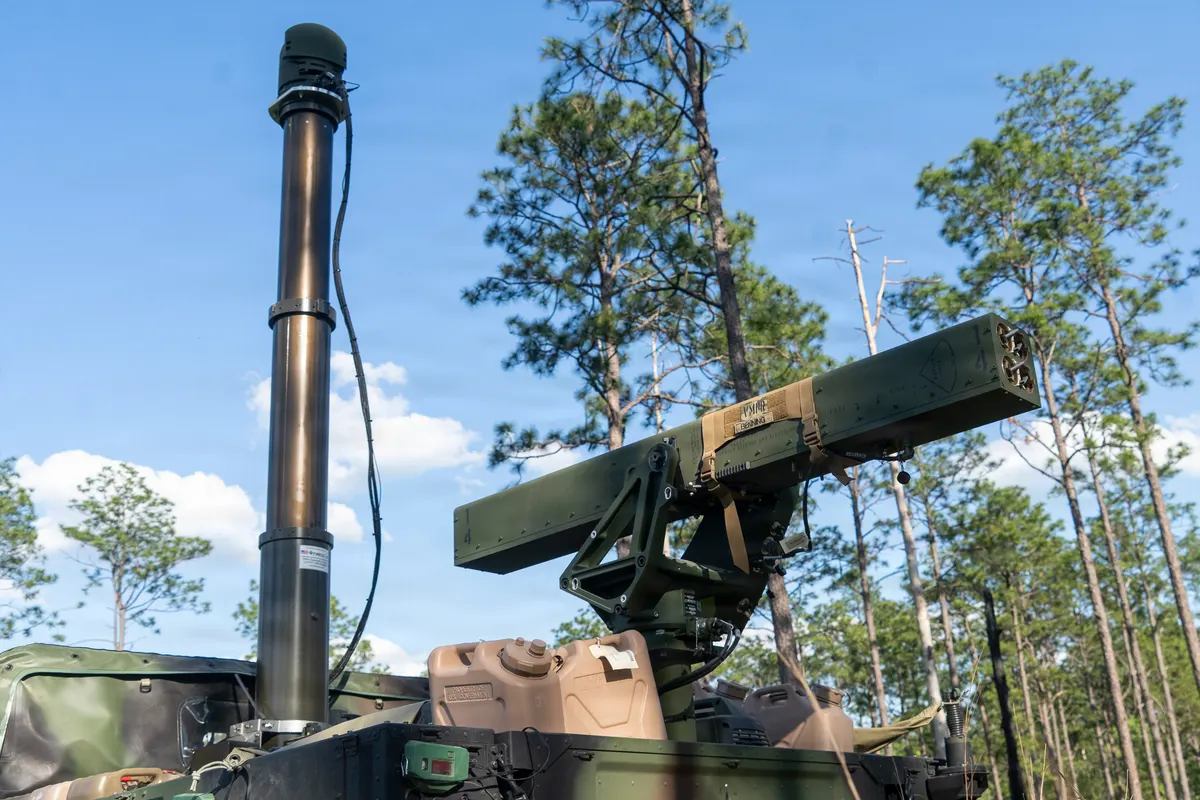
The effector is APKWS II: a WGU-59/B laser-seeker and control section from BAE Systems, threaded between a standard Hydra-70 rocket motor and warhead, turning an unguided artillery rocket into a semi-active-laser-homing precision weapon.14 The WESCAM turret's laser designator illuminates the target; the rocket's seeker steers onto the reflected laser spot. The rocket motor gives it a burnout velocity in the neighborhood of 740 m/s (roughly Mach 2.2), and paired with a proximity fuze rather than impact fuzing, L3Harris and independent reporting put its effective engagement range against small aerial targets at around 6 km.4,10 Because guidance is semi-active rather than fire-and-forget, the launcher can only prosecute one target at a time per laser designator — a real limitation against a swarm, and one of the reasons L3Harris has floated an electronic-warfare-only "Killcode" variant and richer multi-round configurations for saturation scenarios (see History, below).
- Missile / EffectorAPKWS II (BAE Systems laser-guidance kit on a Hydra-70 rocket motor/warhead); Thales FZ275 laser-guided rocket integrated as an alternative effector on some Ukrainian launchers
- Ready Missiles4
- Maximum Range6 km
- Missile Speed (Mach)2.16 Mach
- Warhead TypeM151 high-explosive fragmentation warhead (standard APKWS II); Thales FZ123 airburst/flechette warhead on the alternative FZ275 rocket
Some Ukrainian-operated launchers have also been seen firing an alternative rocket, the Thales 70mm FZ275 laser-guided rocket, which uses an FZ123 warhead built to airburst and disperse a cloud of steel fragments rather than rely on a direct hit — reportedly a better match against the small, flimsy airframes of FPV and Shahed-type drones than APKWS II's original blast-fragmentation warhead.8 L3Harris has since test-fired the Thales rocket from a VAMPIRE launcher in Poland, suggesting NATO members are evaluating it as an alternative or complementary munition rather than a full replacement.8
- Guidance TypeSemi-active laser homing (SALH) — WESCAM-mounted laser designator illuminates the target and the APKWS II seeker homes on the reflected laser spot
- Fire-and-ForgetNo
- Command GuidanceNo
- Track-Via-MissileNo
- Simultaneous Engagements1
- All-WeatherNo
- Search RadarNo onboard search radar; WESCAM MX-series EO/IR turret (day/thermal camera, laser rangefinder, laser designator) on a telescoping mast provides detection, tracking, and designation, and can be cued by an external radar or C2 network
- AESA RadarNo
- Targets Tracked1
- 360° CoverageYes
- Passive / EO ModeYes
- PlatformVehicle-agnostic palletized kit — fielded on pickup trucks, M1152A1 Humvees, M113 APCs, and MRZR buggies in Ukraine, and on GM Defense’s Infantry Squad Vehicle for the U.S. Army; JLTV and uncrewed ground vehicle integration announced
- Emplacement Time120
- AmphibiousNo
- Operators2
- Variants6
- Cost per Rocket/Round27,500 USD
L3Harris unveiled VAMPIRE publicly at the Special Operations Forces Industry Conference (SOFIC) in Tampa in May 2022, shortly after submitting a prototype to the Pentagon that April.15 In August 2022, VAMPIRE was named as part of a roughly $3 billion Ukraine security-assistance package, funded through the Ukraine Security Assistance Initiative (USAI) — the funding mechanism that pays for new-build contracts rather than drawing weapons from existing US stockpiles.2,3 That distinction matters: unlike a Presidential Drawdown transfer, none of the VAMPIRE systems sent to Ukraine existed in a US arsenal beforehand — they were built to order.
In January 2023, the Pentagon awarded L3Harris a $40 million contract to build and deliver 14 VAMPIRE systems for Ukraine, with four scheduled by mid-2023 and the remaining ten by the end of that year; L3Harris confirmed all 14 had shipped by December 2023.2,3,5 The first independently verifiable combat use came in February 2024, when Ukraine's navy released footage of a VAMPIRE-fired APKWS rocket downing a Shahed-136 drone — reporting on the clip noted defense analysts had known VAMPIRE was in Ukrainian service for some time already, but this was the first public confirmation of a kill.6,7
L3Harris has said VAMPIRE units in Ukraine and elsewhere in Europe have logged more than 350,000 operational hours since 2023, and the company's Jon Rambeau stated that "VAMPIRE users have successfully shot down hundreds of enemy drones."8 Those are manufacturer figures rather than independently audited combat statistics, and should be read as such — no government or independent body has published a verified tally of VAMPIRE kills.
In October 2025, L3Harris unveiled a broader VAMPIRE family built around the same core concept but adapted to different platforms and roles: Stalker XR, a 12-round configuration on GM Defense's M1301 Infantry Squad Vehicle; CASKET, a containerized version for fixed-site point defense; BAT (Base Anti-drone Turret), a static tower-mounted configuration for base perimeter defense that L3Harris has said could eventually integrate a high-power-microwave weapon developed with Epirus; Black Wake, a maritime variant mounted on a 41-foot autonomous surface vessel; Dead Wing, integration onto AH-64 Apache attack helicopters; and Killcode, a version that drops the rocket launcher entirely in favor of electronic-warfare-only defeat.8,9 None of these derivatives is the baseline system this article covers, but they illustrate how far L3Harris is trying to stretch the same sensor-plus-effector formula.
Production scaled accordingly: in March 2026, L3Harris opened a new high-volume line in Huntsville, Alabama, with stated capacity of 20-40 systems a month, explicitly framed as a response to demand from the United States and unnamed allied nations.11 That build-out set up the June 2026 news that opened this section: a US Army order worth up to $106 million, the first time the US military has bought VAMPIRE for its own use rather than funding it purely as aid for Ukraine.12,13 L3Harris has not disclosed how many systems the Army order covers or a delivery schedule.
VAMPIRE's only combat use publicly documented as of mid-2026 is in the full-scale Russo-Ukrainian war, where Ukrainian ground and naval units have used it since 2023 primarily against Iranian-designed Shahed-136/Russian-built Geran-2 one-way attack drones and smaller Russian reconnaissance and loitering munitions.2,6,7 Ukraine's 14 delivered systems represent a small fraction of the country's overall counter-drone effort, which also leans heavily on mobile fire teams with gun trucks, electronic warfare, and a large domestic interceptor-drone program — VAMPIRE's niche within that mix is precision engagement of individual high-value or hard-to-jam targets at a rocket cost roughly comparable to the drone being destroyed, rather than mass coverage of the drone threat as a whole.
No VAMPIRE combat use by the United States or any other operator has been reported, since the US Army's own units were only ordered in June 2026 and had not yet been fielded at the time of this writing.12,13

| Year | Buyer | Quantity | Amount | Present Value (2025) |
|---|---|---|---|---|
| 2026 |  United States | — | $106.0 M | $106.0 M |
| 2023 |  Ukraine | 14 | $40.0 M | $42.3 M |
- Ukraine — 14 systems delivered under a $40 million, USAI-funded January 2023 contract, all shipped by the end of 2023; in active combat use since 2023, with a confirmed kill filmed in February 2024.2,3,6,7
- United States — US Army, under a contract worth up to $106 million awarded in June 2026; this is the first confirmed VAMPIRE acquisition for the US military's own use. Unit quantity and delivery timeline have not been disclosed.12,13
No other country has publicly confirmed a VAMPIRE purchase as of this writing. L3Harris has said unspecified allied nations are driving some of its 2026 production expansion, and the company has test-fired a Belgian-linked Thales FZ275 rocket from a VAMPIRE launcher in Poland, which points to NATO-level interest — but neither of those amounts to a confirmed sale to a third country.8,11
Within the emerging counter-UAS category, VAMPIRE occupies a specific niche: a kinetic, precision-guided rocket system built around an existing, mass-produced munition rather than a purpose-built interceptor or a jamming-only approach. That puts it in a different lane from several types of rival system rather than head-to-head against a single direct competitor.
Against gun-based counter-drone systems such as Rheinmetall's Skynex-type 35mm airburst cannon, VAMPIRE trades sustained volume of fire for reach and precision: a gun system can throw a dense pattern of airburst rounds at a swarm and is generally cheaper per shot, but is limited to shorter ranges than a guided rocket and depends on shell dispersion rather than a lock-on. VAMPIRE's laser-guided approach costs more per engagement but is a genuine precision-guided hit rather than a probabilistic one, and reaches out to roughly 6 km rather than a gun's typical few-kilometer envelope.
Against dedicated kinetic interceptor rounds, such as Raytheon's Coyote family of interceptor drones, the comparison flips: a Coyote is itself an expendable small aircraft that chases and rams or detonates near its target, giving it maneuverability against an evading drone that a ballistic-then-guided rocket cannot fully match, but at a unit cost that has typically run higher than an APKWS round. VAMPIRE's rocket flies faster and reaches its target sooner, but cannot pursue a target that maneuvers hard after launch the way a powered interceptor can.
Against gun-based, human-portable or vehicle-mounted point defenses like Smart Shooter's SMASH 2000-series fire-control-assisted rifles, VAMPIRE is a heavier, longer-reach, vehicle-based system rather than an infantry-carried one — the two aren't really substitutes so much as different echelons of the same counter-drone problem, with SMASH aimed at squad-level self-defense against a single close-in drone and VAMPIRE aimed at area or convoy defense against Group 1-3 threats at stand-off range.
Against non-kinetic jammer systems such as DroneShield's DroneGun family, VAMPIRE's advantage is that it works against GPS-independent or fully autonomous drones that a jammer cannot disrupt, and it produces a confirmed kill rather than a hoped-for loss of control; its disadvantage is cost per engagement and the fact that a kinetic warhead, even a small one, creates fragmentation risk that a jammer does not. In practice, most fielded counter-drone architectures — Ukraine's included — mix several of these approaches rather than relying on any single system, and VAMPIRE's role in that mix is the "shoot it down for a comparable price to what it costs to build" option rather than the cheapest or the longest-ranged one available.
MASS Assessment
VAMPIRE's ten MASS components separate cleanly along the same line the rest of this article traces: a narrow, highly effective kinetic tool bolted onto an ordinary vehicle, rather than a broad sensor-and-effector network.
Defeat effectiveness (80) and technology (80) are VAMPIRE's strongest components, reflecting a real combat record: a laser-guided, proximity-fuzed rocket homing on an operator-designated target is a fundamentally more precise kill mechanism than area jamming or barrage fire, and it's backed by at least one independently verified Shahed-136 kill on video. Mobility (70) reflects the system's core selling point — a bolt-on kit installable on almost any flatbed vehicle in under two hours.
Non-kinetic options (10) is VAMPIRE's weakest score by a wide margin, and deliberately so: the system has no jamming, spoofing, or soft-kill fallback of any kind — every engagement ends in a live rocket fired at the target, with no lower-cost or reversible option if a shot turns out to be unwarranted. Coverage (30) is limited for a related reason: VAMPIRE's WESCAM turret alone provides awareness of what it's aimed at, rather than the wide-area, networked sensor picture a system like Leonardo's Falcon Shield is built around.
| SPEC | L3Harris VAMPIRE | Raytheon Coyote |
|---|---|---|
| Maximum Range | 6 km | 15 km |
| Missile Speed (Mach) | 2.16 Mach | 0.47 Mach |
| Warhead Type | M151 high-explosive fragmentation warhead (standard APKWS II); Thales FZ123 airburst/flechette warhead on the alternative FZ275 rocket | Tungsten fragmentation warhead, ~1.8 kg (Block 2 kinetic); reusable non-kinetic effector recovered by net (Block 3/3NK) |
Against Raytheon's Coyote, the other kinetic system in this batch, VAMPIRE's rocket reaches its target faster and costs less per shot, but Coyote's powered airframe can maneuver mid-flight to chase an evading drone in a way a semi-active-laser-guided rocket cannot.


What does VAMPIRE stand for, and what is it exactly? VAMPIRE stands for Vehicle-Agnostic Modular Palletized ISR Rocket Equipment. It is a bolt-on weapon kit — a four-round rocket launcher, an EO/IR sensor turret, and a fire-control system — built by L3Harris Technologies to mount on almost any vehicle with a flatbed or cargo bed. It is not a dedicated combat vehicle in its own right.1,4
What munition does VAMPIRE fire? The standard round is APKWS II, a laser-guided 70mm rocket combining a BAE Systems guidance section with an existing Hydra-70 rocket motor and warhead. Some Ukrainian-operated launchers also fire an alternative Thales FZ275 laser-guided rocket with an airburst fragmentation warhead.4,8,14
How far can VAMPIRE engage a target, and how much does it cost per shot? Reported effective range against small aerial targets is around 6 km. Individual APKWS II rounds have been reported at prices from roughly $22,000 to $35,000 depending on contract and lot size, commonly cited around $27,500 — figures that are not independently standardized across sources.4,10,14
Who uses VAMPIRE? Ukraine, with 14 systems delivered in 2023 under a USAI-funded contract and in active combat use since then, and the United States, whose Army placed its first dedicated VAMPIRE order — worth up to $106 million — in June 2026. No other country has a publicly confirmed purchase as of this writing.2,3,12,13
Has VAMPIRE actually shot down drones in combat? Yes, with at least one independently verifiable case: Ukraine's navy released footage in February 2024 showing a VAMPIRE-fired rocket downing a Shahed-136. L3Harris has separately claimed "hundreds" of drone kills across its user base, but that figure is a manufacturer statement, not an independently audited count.6,7,8
- "VAMPIRE", L3Harris Technologies — l3harris.com ↩
- "L3Harris Receives VAMPIRE Contract for Ukrainian Security Defense Efforts", L3Harris Technologies — l3harris.com ↩
- "Pentagon awards $40M 'Vampire' contract for Ukraine's drone defenses", Defense News — defensenews.com ↩
- "What The VAMPIRE Weapon System The U.S. Is Sending To Ukraine Can Actually Do", The War Zone — twz.com ↩
- "Our Best Look At A VAMPIRE Counter Drone System For Ukraine", The War Zone — twz.com ↩
- "Ukrainian Navy video footage confirms combat debut of L3Harris Vampire weapon system", Unmanned Airspace — unmannedairspace.info ↩
- "Ukraine Downs Russian Shahed Drone with US-Made VAMPIRE SAM System", Newsweek — newsweek.com ↩
- "Entire Family Of VAMPIRE Counter-Drone Systems Unveiled", The War Zone — twz.com ↩
- "L3Harris Reveals Details on Naval VAMPIRE Counter Drone System", Naval News — navalnews.com ↩
- "AUSA 2025: With its VAMPIRE system, L3Harris turns U.S. Army's light vehicle into a drone killer", Army Recognition — armyrecognition.com ↩
- "L3Harris Ramps Up Production for Counter-Unmanned Systems", L3Harris Technologies — l3harris.com ↩
- "L3Harris Delivering Counter-Drone Systems to US Army", L3Harris Technologies — l3harris.com ↩
- "US Army Taps L3Harris to Supply VAMPIRE Counter-Drone Systems for $106M", The Defense Post — thedefensepost.com ↩
- "US military commits $1.7bn for BAE's APKWS II rockets to counter drone threats", FlightGlobal — flightglobal.com ↩
- "VAMPIREs in Ukraine: L3's New Rocket System", Grey Dynamics — greydynamics.com ↩
- "L3Harris VAMPIRE Multi-Purpose Weapon System, USA", Army Technology — army-technology.com ↩