

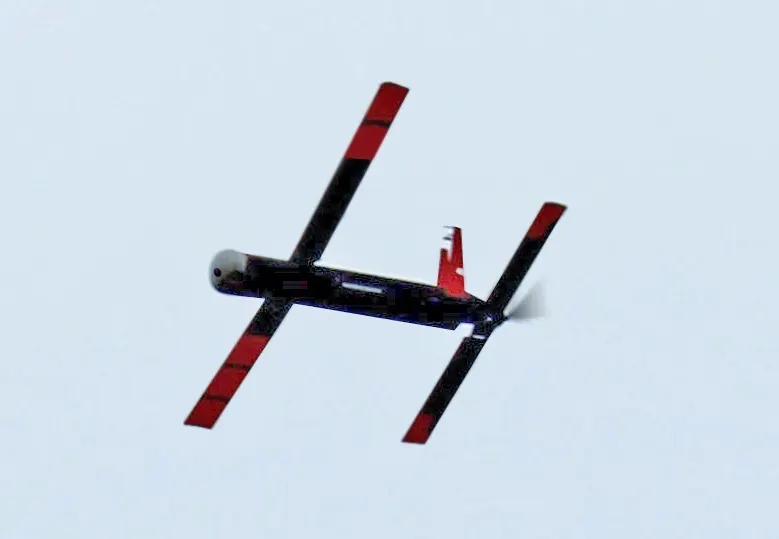
The Coyote is a small, rail- or tube-launched unmanned air vehicle built by Raytheon Missiles & Defense, now part of RTX Corporation, whose role has changed dramatically over two decades. It began as an expendable reconnaissance and target drone developed for the U.S. Navy in the 2000s; it now exists primarily as a rocket-boosted, radar-cued interceptor built to physically destroy small and medium hostile drones, and it forms the core "effector" of the U.S. Army's LIDS (Low, Slow, Small Unmanned Aircraft Integrated Defeat System) family.1,2 This article focuses on that counter-UAS role — chiefly the Coyote Block 2 kinetic interceptor and the newer Block 3/3NK non-kinetic, recoverable variant — while covering the original reconnaissance-drone lineage where it explains what changed.
- Layers a genuine kinetic "hard kill" capability with radar cueing (Ku-band KuRFS/MFRFS) into an integrated detect-track-defeat system, rather than relying on jamming alone[^2][^4]
- Priced in the low hundreds of thousands of dollars per round at most, versus low millions for a surface-to-air missile like ESSM or SM-2 — a real answer to the "cost-imbalance" problem of using expensive interceptors against cheap drones[^5][^6]
- Documented combat use: Coyote/LIDS systems reportedly downed two of three attack drones targeting Al Tanf Garrison in Syria in January 2023[^7]
- Newer Block 3/3NK variant is recoverable and reusable via net capture, cutting the cost of repeated engagements against drone swarms[^8][^9]
- Block 2's roughly 10-15 km engagement range and ~4-minute flight window are short compared with dedicated short-range air defense missiles, meaning it complements rather than replaces longer-range systems[^4][^10]
- As of mid-2026, no publicly confirmed intercept by ship-mounted Coyote launchers against Houthi targets in the Red Sea has been reported — the naval fit only reached destroyers in 2025, after most of the intense 2023-2024 fighting[^11][^12]
- Reported per-unit cost has varied across sources and years (roughly $100,000 in 2023 budget planning versus $125,000 implied by the actual January 2024 contract), and the Army's multi-year program numbers mix committed, ordered, and merely planned quantities[^10][^13]
Confusingly, "Coyote" and "Block" numbers have been reused across very different airframes and missions over the program's life, and open-source reporting is not always careful to distinguish them. The original Coyote (Block 1/1A) was a small, propeller-driven, GPS-guided drone used for weather reconnaissance and general intelligence, surveillance, and reconnaissance (ISR) work; Block 1B added a radio-frequency seeker and proximity warhead to make an early counter-UAS variant; Block 2 replaced the electric motor with a rocket-boosted turbojet for a large jump in speed; and Block 3/3NK replaced the explosive kinetic warhead with a reusable, non-kinetic payload recovered by net rather than expended.1,3 Where sources disagree on exact figures — which happens often with this program — this article notes the discrepancy rather than picking one number arbitrarily.
Airframe, warhead, and final assembly are U.S.-domestic: Raytheon Missiles & Defense (RTX) builds Coyote in Tucson, Arizona, the same site that inherited the program from Sensintel in 2015. The companion KuRFS/MFRFS cueing radar is also a Raytheon product. Some sub-tier components typical of small tactical UAS/interceptors -- e.g. the small turbojet sustainer engine and commercial off-the-shelf electronics/navigation chips -- are not confirmed as U.S.-sourced in public reporting, so a small foreign-content margin is assumed rather than proven. A separate April 2025 industrial agreement lets the UAE assemble Coyote Block 2/3/LE SR locally at Tawazun Industrial Park; that is a licensed co-production arrangement for exported units, not evidence of foreign content in the core U.S. production line this estimate describes.
The Coyote airframe traces to Advanced Ceramic Research (ACR) of Tucson, Arizona, which developed it under small-business contracts from the U.S. Office of Naval Research; it first flew in 2007, launched from a Beechcraft C-12 Huron, using a tube-launch method with wings that pop out in flight.1,14 BAE Systems acquired ACR in 2009 and later divested the unit as Sensintel; Raytheon acquired Sensintel in 2015 and folded it into Raytheon Missiles & Defense in Tucson, where Coyote production remains based.1
The baseline Block 1 airframe is small: about 0.9 m long with a roughly 1.5 m wingspan and a weight around 5.9 kg (13 lb), electrically propelled, with a top speed near 130 km/h and an endurance of roughly an hour or more — figures suited to its original ISR and reconnaissance role rather than to chasing evasive drones.1,14 Block 1B added an RF seeker and a proximity-fuzed warhead paired with Raytheon's Ku-band Radio Frequency System (KuRFS) radar, under a combination the Army nicknamed "Howler," which reached Initial Operational Capability in June 2019 after roughly seventeen months of development.1
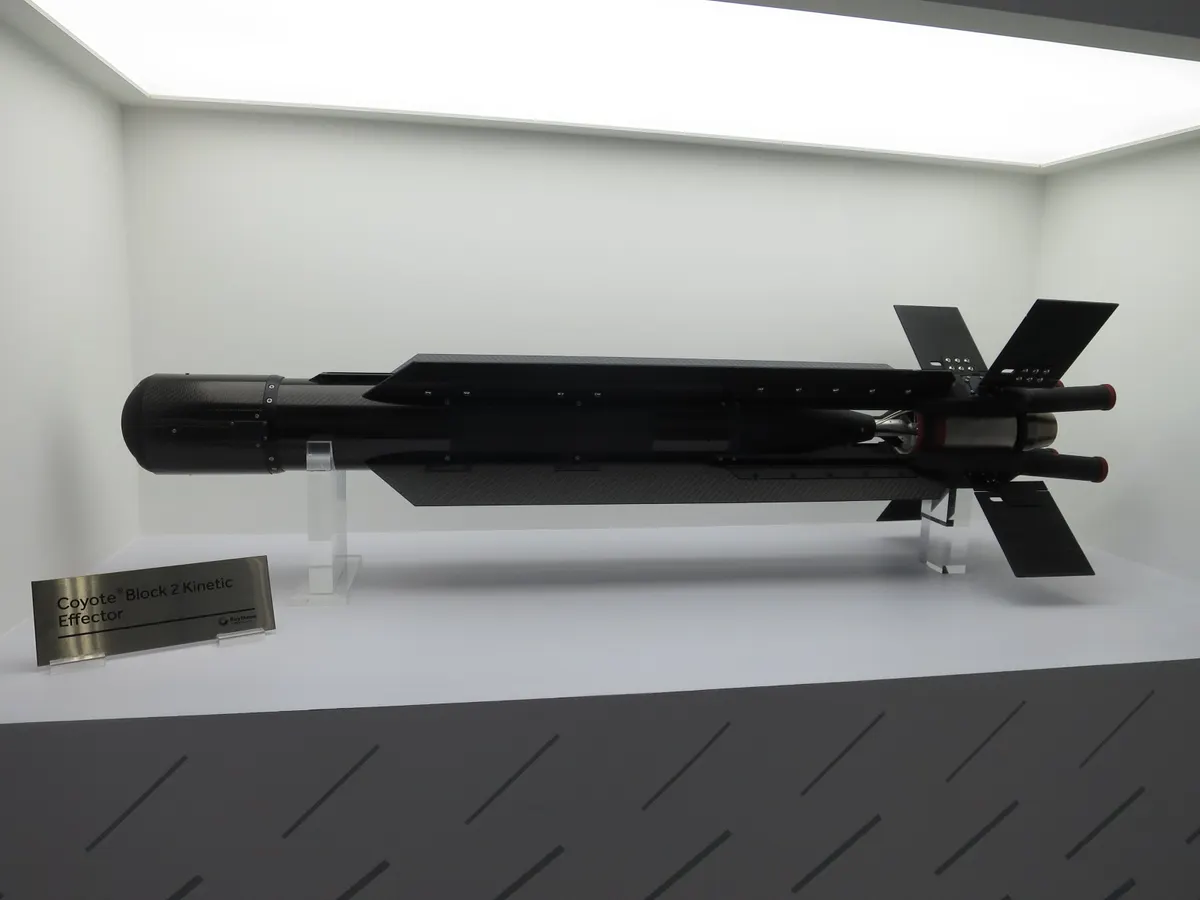
Block 2, the variant most often meant by "Coyote" in current counter-UAS reporting, replaces the electric motor with a rocket booster for launch and a small turbojet for sustained flight, pushing top speed to roughly 345-370 mph (555-595 km/h) — several times faster than Block 1.1,3 Reported engagement range runs about 10-15 km, with a flight/engagement window described as approximately four minutes; four fins pop out around the tail for maneuvering, giving the interceptor enough agility to chase a drone that maneuvers to evade the first pass, and Raytheon markets a "re-attack" capability for exactly that scenario.3,4 The warhead is a tungsten fragmentation design (roughly 1.8 kg / 4 lb) intended to shred a small airframe with a dense pattern of high-velocity fragments rather than relying on a large blast.1,4 Flight-test qualification for Block 2 completed in December 2019, and the U.S. government cleared it for international sale in March 2020.1,4
Coyote does not carry its own search radar; it is cued by a separate Ku-band radar, most often described as KuRFS (Ku-band Radio Frequency System) or its later designation MFRFS/MFRFS in newer contract documents, an active electronically scanned (AESA-class) radar mounted on a mast in fixed-site installations or on a mobile carrier.2,15 Raytheon states the radar/interceptor pairing can detect Group 1 UAS out to roughly 16 km (9.9 miles) and, in company marketing, can resolve objects as small as a 9mm bullet in flight — an illustrative claim about radar sensitivity rather than an engagement-range figure.1 Guidance for the intercept itself works in two stages: the fire-control radar provides command/control cueing and mid-course updates over a C-band data link, and an onboard RF seeker takes over for terminal homing in the last phase of the intercept.4
The newest variant, Block 3, and its non-kinetic sub-variant Block 3NK, keep the same general aerodynamic shape but swap the explosive warhead for a reusable electronic-attack payload — described in coverage as a high-power-microwave-class effect intended to disable a drone's electronics rather than physically destroy the airframe.8,9 Rather than being expended, Block 3NK is designed to be recovered by net after an engagement, refurbished, and reflown, which Raytheon and the Army frame as a way to bring down the cost of repeatedly engaging drone swarms.8,9 In February 2026, RTX announced that Block 3NK had defeated multiple drone swarms in a U.S. Army exercise, demonstrating "launch, flight, intercept and recovery" in a single test cycle.8,9 A related branch of the family, redesignated Coyote LE SR ("Launched Effects — Short Range") by 2025, has been test-launched from Bradley TOW tubes and from helicopters for reconnaissance, electronic-warfare, and strike roles that go beyond pure counter-UAS work; that broader "launched effects" mission is related to, but distinct from, the counter-drone role this article focuses on.1
The U.S. Army formally selected Coyote for a counter-UAS role in 2018, building on the ACR/Sensintel-derived airframe Raytheon had inherited three years earlier.7 Development moved quickly by defense-program standards: the Block 1B/KuRFS "Howler" combination reached Initial Operational Capability in June 2019, Block 2 completed flight-test qualification that December, and the system was cleared for foreign military sale in March 2020 — all within about two years of the Army's initial decision.1 Coyote-equipped LIDS variants, both the fixed-site version (FS-LIDS) and the vehicle-mounted mobile version (M-LIDS, built on the Oshkosh M-ATV and typically pairing a two- or four-round Coyote launcher with a 30mm XM914 automatic cannon and a 7.62mm coaxial machine gun for layered defense), have since been deployed to sites across the Middle East, Africa, and Europe.2,16
Procurement accelerated sharply from 2023 onward as drone attacks on U.S. forces and partners in the Middle East multiplied. A December 2023 Army contracting notice disclosed plans to buy roughly 6,000 kinetic Block 2 interceptors and 700 non-kinetic Block 3 interceptors between fiscal years 2025 and 2029, alongside 252 fixed and 52 mobile launchers and roughly 150 additional KuRFS-family radars, with Block 2 unit cost then estimated at about $100,000 based on budget planning rather than an actual signed contract.10 That estimate proved roughly in the right range: on 16 January 2024, under an Office of the Secretary of Defense rapid acquisition authority that completed the whole award in under 30 days, the Army signed a $75 million contract with Raytheon for 600 Coyote 2C interceptors — implying an actual per-unit price of about $125,000.13,17 A follow-on $197 million cost-plus-fixed-fee contract, covering an undisclosed additional quantity of interceptors, followed on 27 September 2024, with contract performance running through September 2027.18 The two programs were folded into a much larger umbrella: on 29 September 2025, the Pentagon awarded Raytheon a sole-source contract with a ceiling of $5.04 billion, running through September 2033, covering Coyote interceptors in both kinetic and non-kinetic forms together with their fixed and mobile launchers and KuRFS/MFRFS radars — a ceiling value that should not be read as a per-unit interceptor price, since it bundles radars and launchers as well.15
The clearest documented combat use of Coyote came on 20 January 2023, when Coyote/LIDS air-defense systems at Al Tanf Garrison — a small U.S. outpost in southeastern Syria near the Syria-Iraq-Jordan border, established during the war against the Islamic State — engaged three one-way attack drones and downed two of them; the drones were unattributed at the time but consistent with the pattern of Iranian-backed militia attacks on U.S. positions in the region.7 More broadly, versions of LIDS have been fielded to bases across the Middle East, Africa, and Europe and, according to trade press, "have seen combat use" in at least some of those locations, though detailed public accounting of individual engagements beyond Al Tanf is limited.2,16
Coyote's more recent and more prominent association is with the Red Sea crisis and the broader campaign of Houthi attacks on commercial and naval vessels. Between late 2023 and early 2025, U.S. Navy destroyers expended roughly 220 interceptor missiles defending shipping and themselves against Houthi drone and missile attacks, at a cost approaching $1 billion — an average of about $4.5 million per intercept using missiles such as the SM-2, SM-6, and ESSM against drones and missiles that individually cost a small fraction of that.5,6 That cost mismatch was a direct driver behind a 2025 decision by the United States Navy to fit Arleigh Burke-class destroyers in the USS Gerald R. Ford carrier strike group — including USS Bainbridge and USS Winston S. Churchill, first photographed with the new launchers in July 2025 — with deck-mounted Coyote and Anduril Roadrunner launchers as a cheaper first line of defense against drone-type threats.11,12


| Year | Buyer | Quantity | Amount | Present Value (2025) |
|---|---|---|---|---|
| 2026 |  United Arab Emirates | 240 | $2.10 Mr | $2.10 Mr |
| 2025 |  United States | — | $5.04 Mr | $5.04 Mr |
| 2025 |  Qatar | 200 | $1.00 Mr | $1.00 Mr |
| 2024 | United States | 600 | $75.0 M | $77.0 M |
| 2024 | United States | — | $197.0 M | $202.2 M |
The United States is Coyote's only fielded operator, having adopted the airframe for NOAA/DoD use in 2014 and for a dedicated Army counter-UAS role from 2018 onward; it remains by far the largest customer through multiple LIDS, FS-LIDS, and M-LIDS contracts described above.1,7,10
Qatar became the first confirmed export customer. The U.S. State Department first cleared a possible $1 billion sale in November 2022, covering ten FS-LIDS systems with 200 Coyote Block 2 interceptors, Ku-band radars, electronic-warfare equipment, and Forward Area Air Defense Command and Control (FAAD C2) systems; Qatar's government-to-government agreement was formally concluded in May 2025, making it the first international FS-LIDS/Coyote customer, with deliveries subsequently approved.19,20
The United Arab Emirates is the most recent and largest prospective export customer. On 19 March 2026, the U.S. approved a $2.1 billion Foreign Military Sale for ten FS-LIDS systems including 240 Coyote Block 2 "all-up-round" interceptors, Ku-band MFRFS radars, four-pack launchers, EO/IR sensors, and associated command-and-control equipment — using emergency authority to bypass the normal congressional review period, reflecting the urgency U.S. officials attached to protecting Gulf infrastructure from drone and missile threats.21 Separately, and on a different track from that government sale, Raytheon Emirates signed an April 2025 industrial agreement with the UAE's Tawazun Council to assemble Coyote Block 2, Block 3, and LE SR variants locally at Tawazun Industrial Park — a technology-transfer and co-production arrangement rather than confirmation that the March 2026 FMS case has been finalized into a signed Letter of Offer and Acceptance.22
Coyote Block 2 sits in a small but increasingly crowded category of purpose-built kinetic drone interceptors, distinct from traditional surface-to-air missiles and from softer countermeasures like jamming or nets. Its closest conceptual rival within the U.S. arsenal is Anduril's Roadrunner-M, a twin-turbojet, vertical-takeoff-and-landing interceptor that — unlike the expendable Coyote Block 2 — is designed to fly a full sortie and land itself vertically for reuse if it does not need to strike a target, at an estimated cost in the low hundreds of thousands of dollars (a $250 million, 500-unit October 2024 Pentagon contract implies roughly $500,000 per unit).24,25 Coyote is the cheaper of the two but sacrifices the reusability that makes Roadrunner-M attractive for engagements where recovery is feasible; the two systems have in fact been fielded together on the same U.S. Navy destroyers rather than treated as an either/or choice.11
Outside missile-shaped interceptors, Fortem Technologies' DroneHunter (currently in its F700 and newer 5.0 generations) takes an entirely different approach: a reusable multi-rotor aircraft that autonomously nets and physically tows away hostile drones rather than destroying them outright, with the company citing over 4,500 real-world captures and roughly an 85% autonomous capture success rate in its own figures.26 That net-capture method avoids the debris and collateral-damage risk of a kinetic warhead but generally trades away Coyote's speed and range advantage, making DroneHunter better suited to close-in, lower-speed threats than to intercepting a fast inbound target at 10-15 km. MARSS's Interceptor-MR, built in the UK and Saudi Arabia, is closer to Coyote in concept — a small, fast (about 80 m/s / 288 km/h), reusable ramming interceptor guided by an imaging-infrared seeker and MARSS's NiDAR targeting software, claimed to defeat Class I-II drones head-on out to roughly 5 km at around one-fifth the cost of a conventional short-range air-defense missile.27 Interceptor-MR's shorter range and lower speed than Coyote Block 2 reflect a design aimed more at close-in point defense (of a single ship or site) than at the layered, radar-cued engagement envelope Coyote is built around within LIDS.
None of these rivals has a published body.md article on this archive yet, since counter-UAS interceptors as a distinct weapon class are only beginning to be documented here — Coyote is the first entry in this leaf. The broader pattern across all of them, however, is consistent: the industry is converging on cheap, radar- or imaging-guided, purpose-built interceptor drones as the answer to a threat — mass-produced hostile drones — that traditional multi-million-dollar surface-to-air missiles were never priced to counter at scale.
MASS Assessment
MASS scoring rates Coyote across ten components tied to what's publicly documented about the system, rather than a single blended figure.
Non-kinetic options (80) is Coyote's standout score, driven almost entirely by the newer Block 3/3NK variant — a recoverable effector, captured by net rather than expended, that lets the same airframe defeat a drone without an explosive warhead and be reused afterward. None of Coyote's fixed-warhead rivals in this batch currently offer that. Technology (80) and mobility (70) reflect the KuRFS/MFRFS AESA radar-cueing architecture and the growing range of launch platforms — fixed pedestal, M-ATV, and now shipborne destroyer mounts.
Multi-target capability (40) is Coyote's clearest weak point: each interceptor is a single expendable round that engages one target per launch, so defeating a coordinated drone swarm means firing — and paying for — one Coyote per hostile airframe, with no way to service more than one target from a single round. Coverage (50) and reaction time (50) trail for a related reason: Coyote's own engagement window is short (roughly four minutes of powered flight) and its 10-15 km range, while adequate for point defense, is narrower than systems built around wider-area sensor fusion, such as Leonardo's Falcon Shield.
| SPEC | Raytheon Coyote | L3Harris VAMPIRE |
|---|---|---|
| Maximum Range | 15 km | 6 km |
| Missile Speed (Mach) | 0.47 Mach | 2.16 Mach |
| Warhead Type | Tungsten fragmentation warhead, ~1.8 kg (Block 2 kinetic); reusable non-kinetic effector recovered by net (Block 3/3NK) | M151 high-explosive fragmentation warhead (standard APKWS II); Thales FZ123 airburst/flechette warhead on the alternative FZ275 rocket |
| Guidance Type | Radar mid-course cueing (Ku-band KuRFS/MFRFS radar) with onboard RF seeker for terminal homing; command/control data link | Semi-active laser homing (SALH) — WESCAM-mounted laser designator illuminates the target and the APKWS II seeker homes on the reflected laser spot |
Against L3Harris's VAMPIRE — the other kinetic hard-kill system in this batch — Coyote trades VAMPIRE's cheaper, faster rocket for longer stand-off range and the ability to actively chase a maneuvering target, rather than fly a single laser-guided profile to a designated point.
What is the Raytheon Coyote? Coyote is a family of small unmanned air vehicles built by Raytheon Missiles & Defense (part of RTX). It began as an expendable reconnaissance/target drone in the 2000s and has since evolved into a rocket-boosted, radar-cued counter-UAS interceptor — Coyote Block 2 (kinetic) and Block 3/3NK (non-kinetic, recoverable) — that forms the core "effector" of the U.S. Army's LIDS counter-drone system.1,2
How does Coyote actually intercept a drone? A separate Ku-band radar (KuRFS/MFRFS) detects and tracks the incoming threat and cues the interceptor; Coyote launches off a rail on a rocket booster, accelerates to roughly 555-595 km/h on a small turbojet, and homes in during the terminal phase using an onboard RF seeker, detonating a tungsten fragmentation warhead (Block 2) or, in the newer Block 3NK, applying a non-kinetic electronic effect and returning to be recovered by net.1,3,4
How much does Coyote cost? Reported figures vary: Army budget planning in late 2023 estimated about $100,000 per Block 2 interceptor, while the actual January 2024 production contract ($75 million for 600 units) implies roughly $125,000 each. Larger contracts, including a $5.04 billion, eight-year umbrella award in September 2025, bundle radars and launchers together with interceptors and should not be divided into a simple per-unit price.10,13,15
Has Coyote been used in combat? Yes, in at least one well-documented case: Coyote/LIDS systems downed two of three attack drones targeting Al Tanf Garrison in Syria on 20 January 2023. LIDS systems have also been deployed to other sites across the Middle East, Africa, and Europe. Coyote's more recent fitting to U.S. Navy destroyers as a counter-Houthi-drone measure is real, but as of the most recent reporting reviewed, no confirmed ship-based Coyote intercept against a Houthi target has been publicly reported.7,11,12
Who operates Coyote? The United States is the only current operator with systems actually fielded. Qatar is the first confirmed export customer, with a $1 billion FS-LIDS/200-interceptor agreement concluded in May 2025. The United Arab Emirates has a $2.1 billion, 240-interceptor Foreign Military Sale approved in March 2026 under emergency authority, alongside a separate April 2025 industrial agreement to assemble Coyote locally in the UAE.7,19,21,22
- "Raytheon Coyote", Wikipedia — en.wikipedia.org ↩
- "Coyote C-UAS", RTX / Raytheon — rtx.com ↩
- "Coyote Block 2 Counter-Drone System (US)", Norsk luftvern — norskluftvern.com ↩
- "Raytheon Showcases Coyote Block 2+ Kinetic Effector for C-UAS at WDS 2024", UAS Vision — uasvision.com ↩
- "U.S. Navy Eyes Coyote and Roadrunner Interceptors Deployed on Destroyers as the Solution to Houthi Drones", Defense Express — en.defence-ua.com ↩
- "Roadrunner and Coyote: Navy Set to Deploy Land-Based Anti-Drone Systems at Sea", Military.com — military.com ↩
- "Coyote Air Defense Weapon Shoots Down Drones Attacking US Outpost", Air & Space Forces Magazine — airandspaceforces.com ↩
- "News | RTX's Raytheon's non-kinetic Coyote variant defeats multiple drone swarms", RTX — rtx.com ↩
- "U.S. Army Tests Reusable Coyote 3NK Interceptor to Counter Drone Swarms Without Missiles", Army Recognition — armyrecognition.com ↩
- "Drastic Increase In Army Coyote Drone Interceptor Purchase Plans", The War Zone (TWZ) — twz.com ↩
- "Coyote Loitering Drone Interceptors Have Arrived On U.S. Navy Destroyers", The War Zone (TWZ) — twz.com ↩
- "Coyote, Roadrunner Loitering Drone Interceptors To Arm U.S. Navy Destroyers", The War Zone (TWZ) — twz.com ↩
- "US Army Orders 600 Coyote Drone Interceptors Amid Middle East Attacks", The Defense Post — thedefensepost.com ↩
- "Raytheon Coyote", Designation Systems (Andreas Parsch) — designation-systems.net ↩
- "Pentagon Awards Raytheon $5.04B Army Contract for Coyote Counter-UAS and KuRFS Radars", Army Recognition — armyrecognition.com ↩
- "Raytheon Demonstrates M-LIDS Coyote Block 2 Counter-UAS Unmanned Aerial System Weapon Station", Army Recognition — armyrecognition.com ↩
- "Army announces rapid acquisition authority contract for Coyote Interceptors", U.S. Army — army.mil ↩
- "Army awards big contract for Coyote interceptors amid growing demand for counter-drone weapons", DefenseScoop — defensescoop.com ↩
- "Qatar Becomes First International Customer of Raytheon's FS-LIDS Counter-Drone System in $1B U.S. Defense Deal", Army Recognition — armyrecognition.com ↩
- "US approves potential $1 billion counter-drone tech sale to Qatar", Breaking Defense — breakingdefense.com ↩
- "U.S. Approves $2.1B FS-LIDS Counter-Drone System Sale to UAE Under Emergency to Protect Key Sites", Army Recognition — armyrecognition.com ↩
- "UAE to Manufacture Raytheon's Coyote Counter-Drone System Locally in Major Defense Boost", The Defense News — thedefensenews.com ↩
- "US approves $1.98bn counter-drone systems sale to Kuwait", Army Technology — army-technology.com ↩
- "Roadrunner-M Unveiled: CUAS High-Explosive Interceptor", Unmanned Systems Technology — unmannedsystemstechnology.com ↩
- "Roadrunner-M drone can take out aerial threats or live to fly another day", New Atlas — newatlas.com ↩
- "DroneHunter F700", Fortem Technologies — fortemtech.com ↩
- "INTERCEPTOR-MR", MARSS — marss.com ↩