


ODIN is the United States Navy's shipboard laser dazzler, a low-power directed-energy system fitted to Arleigh Burke-class destroyers to counter small unmanned aircraft. Its full name is Optical Dazzling Interdictor, Navy, and it carries the official hull-mounted-equipment designation AN/SEQ-4.1 ODIN does not destroy the drones it engages. It projects a focused laser beam into a drone's electro-optical or infrared camera, saturating the sensor so the operator loses the video feed needed to fly or target the aircraft.2 That distinction, dazzle rather than destroy, is central to understanding what this system is and is not.
- Near-zero marginal cost per engagement
- Effectively unlimited magazine, no interceptor missiles expended
- Fielded in roughly 2.5 years from approval to shipboard install
- No fragmentation or blast risk to the firing ship or nearby vessels
- Frees Standard Missiles and gun systems for higher-priority threats
- Soft-kill only, cannot physically destroy a hardened or armed target
- Effective range is short, a close-in layer, not a standoff weapon
- Beam quality degrades in fog, rain, dust, and heavy sea spray
- No publicly confirmed combat kill as of mid-2026
- Engages one target at a time, not a true swarm-defeat system
Despite the naming convention used for this entry, ODIN was not developed by Lockheed Martin. It was designed, built, and fielded by Navy engineers at the Naval Surface Warfare Center Dahlgren Division in Virginia, working under the Program Executive Office for Integrated Warfare Systems (PEO IWS), on a rapid-acquisition timeline of roughly two and a half years from approved concept to installed hardware.3 Lockheed Martin does build a related but distinct US Navy directed-energy weapon, the HELIOS laser, which is a separate, more powerful program discussed in the Comparison section below.
ODIN sits inside a wider Navy push to add directed-energy weapons to the surface fleet, a response to the growing number of small drones, some purely for surveillance and some carrying explosives, that have harassed US warships and merchant traffic in the Persian Gulf and Red Sea corridors. The system is one part of a layered air-defense stack that still relies on the Aegis Combat System, close-in weapon system gunnery, and interceptor missiles for harder targets, with ODIN absorbing the cheap, high-volume nuisance-drone problem so those more expensive interceptors are not spent on a system that costs a few dollars an hour to run.5 As of 2026, this counter-drone role places ODIN firmly within the broader counter-UAS category of shipboard and ground defenses fielded against Iranian-made loitering threats and commercial-derived quadcopters alike.

Search interest in phrases like ODIN laser Navy, AN/SEQ-4 specifications, and is the ODIN laser lethal has grown alongside the system's expanding footprint across the destroyer fleet, and alongside its documented presence during 2026 combat operations against Iran. The sections below cover how the ODIN laser dazzler works, its fielding history, its role in the 2026 Iran war, and how it compares to the more powerful HELIOS laser Lockheed Martin actually builds.
How the AN/SEQ-4 ODIN Laser Dazzler Works
ODIN pairs a steerable, solid-state laser head with a high-resolution electro-optical and infrared camera package in a single turreted mount.2 The camera does the identifying and tracking work, while the laser element delivers a continuous beam onto the target's own sensor aperture. Because the intent is to blind a camera rather than burn through an airframe, ODIN's output sits well below the power levels used by hard-kill lasers, and the Navy has never published an exact kilowatt figure for it. Analysts who track the program generally place it at or below the 30-kilowatt output of the earlier AN/SEQ-3 Laser Weapon System (LaWS), the Navy's first at-sea laser, tested aboard USS Ponce starting in 2014 and never put into full production.6 The AN/SEQ-3 and AN/SEQ-4 are frequently confused in casual references, but they are different systems built a decade apart for different purposes, LaWS scaled from a non-lethal dazzle setting up to a damage-inflicting setting, while ODIN is dazzle-only by design.
- System Typeshipborne low-power laser dazzler (soft-kill counter-UAS)
- Service Entry Year2019
- Engagement Layer (SHORAD/Med/Long)close-in / terminal, non-kinetic soft-kill
- MobileNo
- In ServiceYes
ODIN carries no radar of its own. Target cueing comes from the host destroyer's existing sensors, principally the ship's own EO/IR and air-search systems feeding the Aegis Combat System, which hands off a track to the ODIN operator for laser engagement.2 That dependency keeps the system relatively compact and cheap to integrate, since it does not need to duplicate detection hardware the ship already carries, but it also means ODIN's effectiveness is bounded by however well the host ship already sees the incoming drone.
Like all laser weapons, ODIN's beam is degraded by fog, heavy rain, dust, smoke, and sea spray, atmospheric scattering that limits any laser's usable range regardless of stated power.7 The Navy has not published ODIN's engagement range, altitude envelope, or dazzle duration per shot, all of which remain undisclosed for operational security reasons, so those fields are left unreported here rather than estimated. What is public is the running cost. A Congressional Research Service assessment put the electrical cost of a single ODIN-class laser shot at roughly a dollar, and multiple later estimates place it anywhere up to a few dollars, in either case a small fraction of the cost of a Rolling Airframe Missile or Standard Missile-2 interceptor, which run well into six or seven figures apiece.8 The full per-unit procurement or installation cost of ODIN itself has not been disclosed by the Navy.9
Physically, ODIN occupies a turret position on the forward superstructure of a Flight IIA Arleigh Burke-class destroyer, near the ship's forward close-in weapon system mount, chosen for a clear, largely unobstructed forward arc.10 Each installation is completed during a scheduled maintenance availability rather than new-construction, meaning every ODIN-equipped ship so far is a retrofit onto an already-commissioned hull.
- PlatformArleigh Burke-class Flight IIA destroyer, forward CIWS-adjacent pedestal mount
- Total Production8
- Operators1
- Sensor Suitesteerable laser director integrated with EO/IR tracking camera
- EO/IR SensorYes
- RF Direction-Finding / ESMNo
- GNSS/GPS Jamming CapabilityNo
- Non-Kinetic Defeat MechanismYes
- Jamming Techniqueoptical/IR sensor dazzling (non-RF)
- Emitter GeolocationNo
- Active Mitigation (vs. Detect-Only)Yes
The Navy approved ODIN as a rapid-acquisition, near-term response to a specific problem, small, cheap drones loitering near warships for surveillance, that existing shipboard weapons were poorly suited to counter without spending expensive missiles or ammunition. Naval Surface Warfare Center Dahlgren Division led design and construction under PEO IWS, moving from an approved requirement to installed hardware in about two and a half years, unusually fast for a Navy directed-energy program.3 The Navy fitted the first ODIN unit aboard USS Dewey (DDG-105) during a dry-docking in November 2019, and the installation became public in February 2020, making Dewey the first US warship to carry an operational laser dazzler as opposed to an experimental prototype.12

From Dewey, the Navy expanded ODIN across further Flight IIA hulls. USS Stockdale (DDG-106) and USS Spruance (DDG-111) received the system next, with installation work completed on schedule under a sole-source contract.4 In July 2021, the Navy's Port Hueneme Division selected the defense integrator VTG as prime contractor to install and integrate ODIN aboard five additional Arleigh Burke-class destroyers, extending the program well beyond its original three-ship test group.4 By the mid-2020s, independently confirmed reporting placed ODIN aboard eight Flight IIA destroyers, USS Dewey, USS Stockdale, USS Halsey (DDG-97), USS Sterett (DDG-104), USS Spruance, USS John Finn (DDG-113), USS Gridley (DDG-101), and USS Kidd (DDG-100), though Kidd's unit was later removed for shore-based training use while the ship underwent extended maintenance.11

ODIN is often confused with a separate, unrelated 2019 incident. On 18 July 2019, US Marines aboard the amphibious assault ship USS Boxer brought down an Iranian drone near the Strait of Hormuz using the Light Marine Air Defense Integrated System, a vehicle-mounted radio-frequency jammer, not a laser.13 No ODIN unit was fitted to Boxer, and the two systems work on entirely different principles, LMADIS jams the drone's control and navigation radio links, while ODIN blinds an optical sensor with light. The Boxer incident predates ODIN's first shipboard fielding by several months and is unrelated to it, despite the two sometimes being cited together in casual summaries of Navy counter-drone efforts in the Gulf.
ODIN During the 2026 Iran War and the Strait of Hormuz Campaign
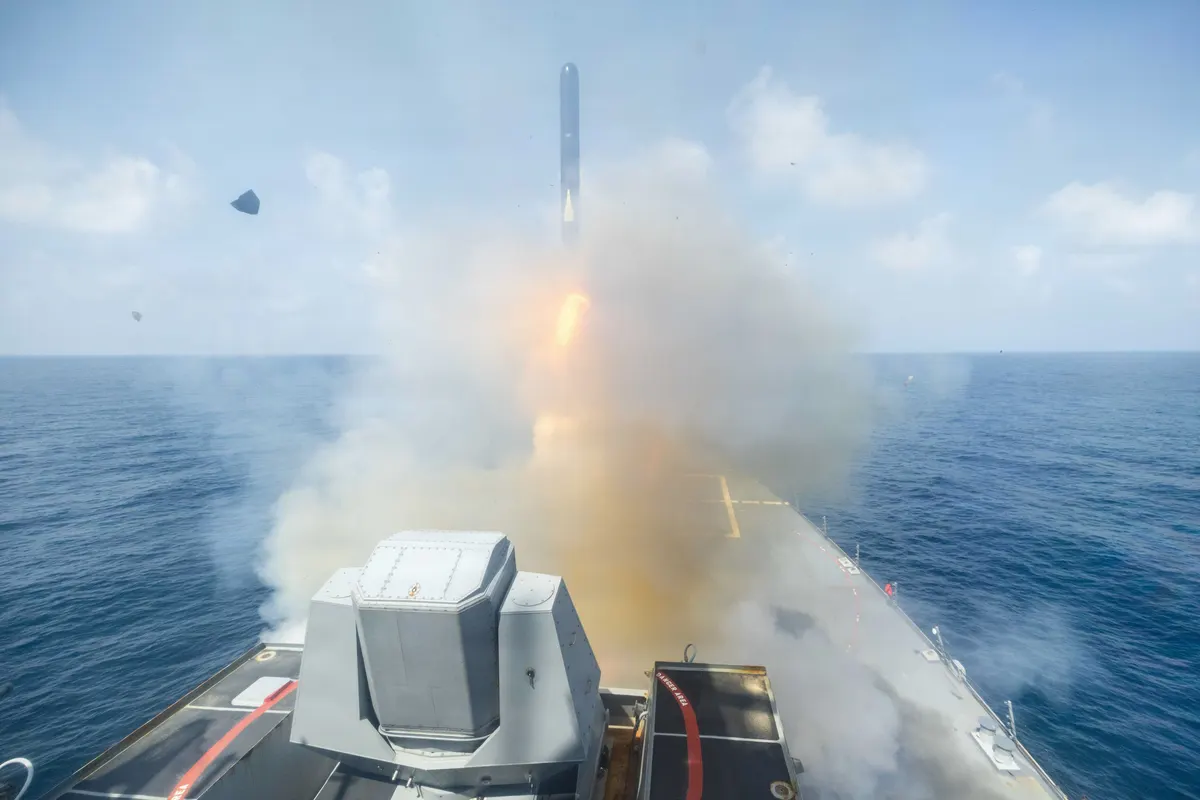
ODIN's most significant documented deployment came during the 2026 Iran war, the joint US-Israeli campaign against Iran that opened on 28 February 2026 under the American codename Operation Epic Fury.14 US Central Command released imagery that day showing an Arleigh Burke-class destroyer firing Tomahawk cruise missiles at targets inside Iran, and the same imagery confirmed an ODIN turret mounted aboard at least one ship in the strike group.1 Independently, reporting through March 2026 named USS Spruance and USS John Finn among the ODIN-equipped destroyers supporting Tomahawk strikes during the operation, placing multiple laser-dazzler-fitted hulls inside the Strait of Hormuz crisis theater as Iran's retaliatory missile and drone barrages began.15

What is not established is whether ODIN actually fired on anything during the operation. Multiple trade-press outlets that covered the strikes directly, including Army Recognition and Naval News, were explicit that the Navy had not confirmed any combat activation of ODIN during Epic Fury, even as some secondary and aggregator sites circulated unverified claims that the laser had shot down Iranian Shahed-136 drones during the operation.15 Those specific kill claims could not be traced to an official Navy, CENTCOM, or original wire-service statement, and this article does not repeat them as fact. What is confirmed is presence, not engagement, ODIN-fitted destroyers were in theater and photographed with the system mounted while Iran fired barrages of drones and missiles at US and partner forces across the Strait of Hormuz campaign that followed the opening strikes into March 2026.16
The threat ODIN exists to counter was on full display during the campaign. Iran's Shahed-136 one-way attack drones and various Shahed-family reconnaissance variants featured heavily in Iranian retaliation against US and partner shipping and bases through the Gulf region, the same low-cost, high-volume drone class that ODIN was originally built to counter economically rather than with expensive interceptor missiles.17 Whether or not any individual Shahed was dazzled or downed by ODIN specifically remains unconfirmed, but the strategic logic, cheap drones met with a cheap defense rather than an expensive one, played out at fleet scale during the operation.

The United States Navy is the only confirmed operator of ODIN. No export sale, foreign trial, or partner-nation fitting has been reported, and none is expected in the near term given the system's classification and its integration with the Aegis Combat System found only on US and a handful of allied Aegis-equipped hulls. As of the mid-2020s, ODIN equips eight Flight IIA Arleigh Burke-class destroyers, a small but growing fraction of the roughly seventy-strong Burke-class fleet, with Navy officials describing plans to extend the fit to additional destroyers through the rest of the decade as installation contracts continue.4
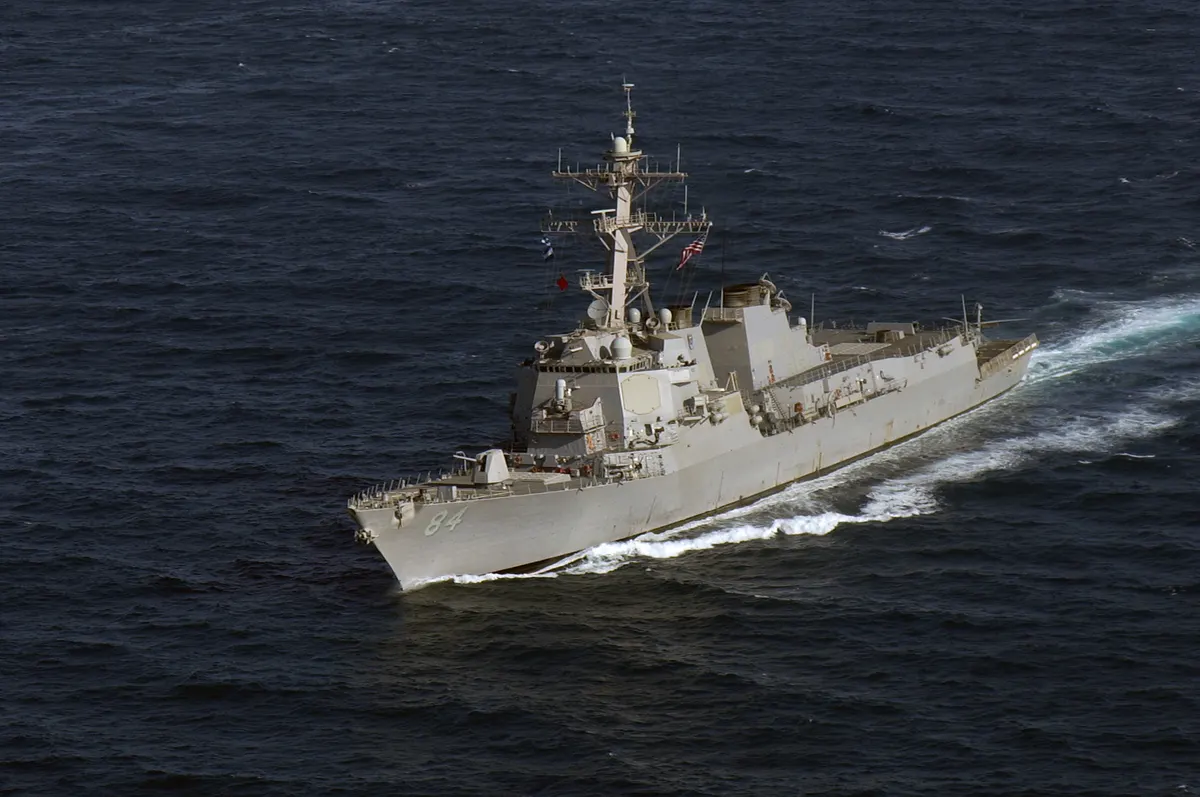
Because ODIN is a retrofit rather than a new-construction fit, each installation happens during an existing maintenance period for the host ship, which is why the program's growth has tracked individual ships' maintenance schedules rather than a single fleet-wide rollout. That pace is also why, more than six years after the first Dewey installation, ODIN remains a minority fit within the destroyer force rather than a standard one, unlike point-defense systems such as the Rolling Airframe Missile or the Phalanx close-in weapon system that equip nearly the entire class.
ODIN Against Lockheed Martin's HELIOS
The most useful comparison for ODIN is not another nation's system, it is the US Navy's own more powerful laser, HELIOS, which actually is a Lockheed Martin product. The Navy awarded Lockheed Martin a $150 million contract in March 2018, with options worth up to $942.8 million, to build the High Energy Laser with Integrated Optical-dazzler and Surveillance system, and the first HELIOS went to sea aboard USS Preble (DDG-88) beginning around 2021 to 2022.18 HELIOS folds ODIN-style dazzling into a single turret alongside a genuinely destructive 60-kilowatt beam, meaning a HELIOS-equipped ship can choose to blind a drone's sensor or burn through its airframe entirely, a hard-kill option ODIN was never designed to offer.19 HELIOS is also integrated directly into the Aegis Combat System's fire-control loop, while ODIN operates as a more standalone counter-surveillance tool cued by, but not deeply woven into, the ship's combat system.
The trade-off is fleet size and maturity. ODIN's simpler, lower-power design let the Navy field eight units across eight ships in the years since 2019, while HELIOS, more capable but far more expensive and complex, remains a single-ship fit aboard Preble as of the mid-2020s.18 For a Navy trying to defend an entire destroyer fleet against a growing volume of cheap Iranian and Houthi drones, ODIN's low per-unit cost and rapid fielding timeline matter as much as HELIOS's greater destructive power, which is why the two programs have grown along different tracks rather than one replacing the other.
| ODIN (AN/SEQ-4) | HELIOS | |
|---|---|---|
| Builder | US Navy, NSWC Dahlgren | Lockheed Martin |
| Power class | Low-power dazzler only | Up to 60 kW, dazzle and hard-kill |
| First ship | USS Dewey, 2019 | USS Preble, 2021-2022 |
| Ships equipped (mid-2020s) | 8 | 1 |
| Aegis integration | Cued, standalone operation | Direct fire-control integration |
ODIN also invites comparison to non-laser counter-drone tools already aboard the same destroyers, principally the Phalanx close-in weapon system and short-range missiles like the Rolling Airframe Missile. Those systems can physically destroy a drone at any weather condition a laser cannot handle, but each engagement costs real ammunition and carries a fragmentation risk to nearby vessels or friendly aircraft that a light-based dazzler simply does not. ODIN's role is best understood as a first line of defense against the cheapest, most numerous threats, freeing gun and missile systems for targets a dazzler cannot handle, rather than a replacement for either.
Is ODIN a Lockheed Martin weapon? Not in terms of who built it. ODIN was designed and built by the US Navy's own Naval Surface Warfare Center Dahlgren Division, with the integrator VTG handling shipboard installation. Lockheed Martin builds a different, more powerful Navy laser called HELIOS, which is sometimes confused with ODIN in casual references.3,18
What does ODIN stand for? Optical Dazzling Interdictor, Navy. Its formal hull-equipment designation is AN/SEQ-4.1
Does the ODIN laser destroy drones? No. ODIN is a soft-kill dazzler that overwhelms a drone's camera or infrared sensor with light so the operator loses the video feed needed to fly or aim it. It is not designed to burn through an airframe or detonate a warhead the way a hard-kill laser like HELIOS can.2,19
How many US Navy ships carry the ODIN laser? As of the mid-2020s, independently confirmed reporting places ODIN aboard eight Arleigh Burke-class Flight IIA destroyers, with additional installations planned as maintenance schedules allow.11,4
Has ODIN been used in actual combat? ODIN-equipped destroyers were confirmed present and photographed during Operation Epic Fury, the opening of the 2026 Iran war, in February and March 2026. The Navy has not confirmed that ODIN itself was fired in anger during that operation, despite some secondary reports claiming drone shootdowns.15
How much does an ODIN laser shot cost? Estimates put the electrical cost of a single shot at roughly a dollar to a few dollars, far below the cost of a missile interceptor such as the Standard Missile-2, which runs into the millions per round.8
- "U.S. Navy Destroyer Deploys ODIN Laser Directed-Energy Weapon System During Operation Epic Fury", Army Recognition — armyrecognition.com ↩
- "Here's Our Best Look Yet At The Navy's New Laser Dazzler System", The War Zone — twz.com ↩
- "The ODIN Shipboard Laser: Science Fiction No More", Seapower Magazine — seapowermagazine.org ↩
- "ODIN dazzler destined for more destroyers", Shephard Media — shephardmedia.com ↩
- "Navy Requests $300M to Develop Shipboard Defensive Laser Weapons", USNI News — news.usni.org ↩
- "AN/SEQ-3 Laser Weapon System", Wikipedia — en.wikipedia.org ↩
- "Cloudy and a chance of rain need not sideline high-energy lasers", C4ISRNET — c4isrnet.com ↩
- "Navy Shipboard Lasers: Background and Issues for Congress", Congressional Research Service (R44175) — congress.gov ↩
- "VTG wins US Navy contract to fit battleships with counter-UAS laser", Optics.org — optics.org ↩
- "Navy arms Burke-class destroyer USS Stockdale with Optical Dazzling Interdictor Navy (ODIN) laser weapon", Military Aerospace — militaryaerospace.com ↩
- "These American Destroyers Are Equipped With Laser Weapons", The War Zone — twz.com ↩
- "The Navy just installed a laser on a destroyer to counter incoming drones", Task & Purpose — taskandpurpose.com ↩
- "UPDATED: USS Boxer Downs Iranian Drone in 'Defensive Action'", USNI News — news.usni.org ↩
- "2026 Iran war", Wikipedia — en.wikipedia.org ↩
- "US Navy's First MOD 2 DDG Makes Combat Debut in Epic Fury Strikes", Naval News — navalnews.com ↩
- "OPERATION EPIC FURY FACT SHEET, April 1 Update", US Department of War — media.defense.gov ↩
- "Iran's Missile Campaign, Operation Epic Fury 2026", GlobalSecurity.org — globalsecurity.org ↩
- "Lockheed Martin Receives $150 Million Contract to Deliver Integrated High Energy Laser Weapon Systems to U.S. Navy", Lockheed Martin — news.lockheedmartin.com ↩
- "HELIOS", Wikipedia — en.wikipedia.org ↩