

Nuclear carries two different meanings depending on the weapon system it is attached to. On a ballistic missile, a cruise missile, or a combat aircraft, nuclear-capable means the vehicle is certified to carry a nuclear warhead, independent of how it is propelled. On a submarine, the word almost always means nuclear-powered propulsion instead, a reactor generating steam to turn the vessel's turbines for near-unlimited underwater endurance. A submarine's reactor says nothing about whether its weapons are nuclear armed.
Every weapon currently published with a confirmed nuclear-capable rating is a medium or intermediate-range ballistic missile built by China, India, Pakistan, Israel or the former Soviet Union. This entry follows that delivery sense, tracing where nuclear-armed ballistic missiles came from, how a warhead survives reentry and detonates on command, and how the capability spread across real missile forces. Nuclear-powered submarines remain a separate subject.
01First Nuclear-Armed Ballistic Missiles
The first missile built to deliver a nuclear warhead was the Soviet R-5M, launched with a live warhead from the Kapustin Yar test range on February 2, 1956, the world's first detonation of a nuclear device carried by a ballistic missile.1 Entering service that same year, the R-5M paired a single-stage, liquid-fueled airframe with a warhead adapted from earlier Soviet atomic designs, and by 1959 sister units were based in East Germany, the first Soviet nuclear missiles stationed abroad.1
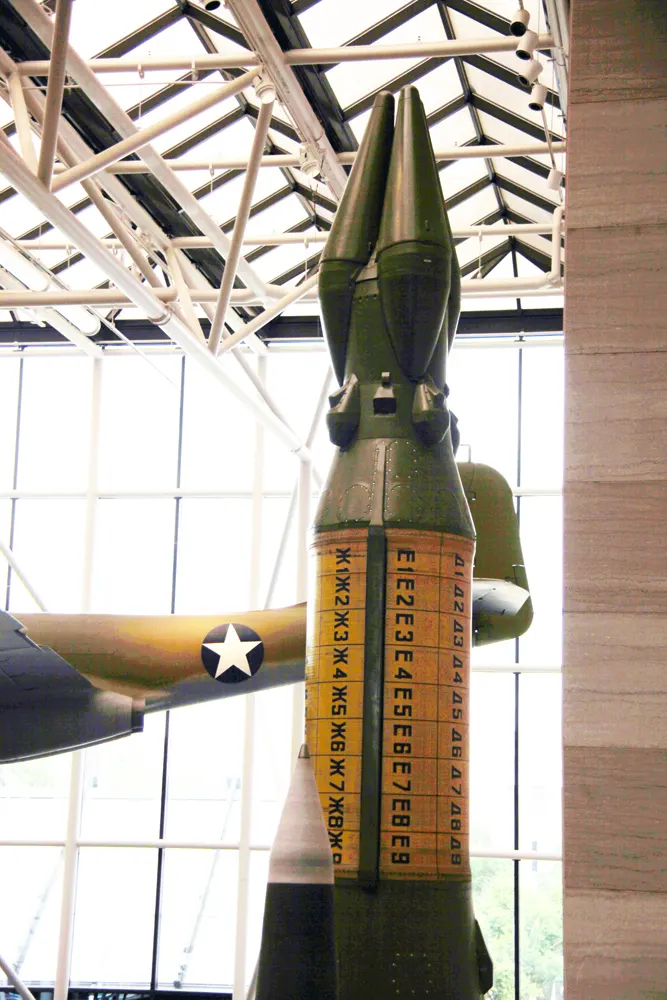
Two decades later the Soviet Union fielded the RSD-10 Pioneer (NATO reporting name SS-20 Saber), a solid-fueled, road-mobile missile carrying three thermonuclear warheads rated around 250 kilotons each.2 Its mobility made it far harder to track than the fixed R-5M, and NATO's alarm over its deployment across Russia and Eastern Europe pushed the United States to station Pershing II missiles in West Germany.
The standoff ended through arms control rather than combat. Every RSD-10 Pioneer in service was later destroyed under the 1987 Intermediate-Range Nuclear Forces Treaty, closing out the type's history by 1991.2
01Reentry, Yield and the Chain of Launch Authority
Delivering a nuclear warhead by ballistic missile means surviving the trip home as much as the trip out. After the rocket motors burn out, the warhead separates and follows an unpowered arc that briefly leaves the atmosphere before falling back at several kilometers per second. A reentry vehicle shields it from that fall's heat and stress, while an arming and fuzing system sets the altitude and timing of detonation.3
Yield, the explosive power released, is measured in kilotons or megatons of TNT equivalent and depends on warhead design rather than the missile carrying it. A single airframe can carry warheads of very different yield, or several smaller ones in a MIRV payload (multiple independently targetable reentry vehicles) that releases separate warheads at separate targets. Ababeel, first flight-tested in January 2017 on Pakistan's southern coast, was built to carry MIRVs, the first confirmed South Asian missile to do so.4
None of this fires without deliberate human authorization. Western and Soviet-designed systems both evolved permissive action links, coded locks keeping a warhead unarmed until release codes reach the launch crew from higher command, enforcing what planners call negative control.5 Submarine-launched systems typically add a two-person rule, two officers independently unlocking a launch order.
02Nuclear-Capable Missiles Across Today's Arsenals
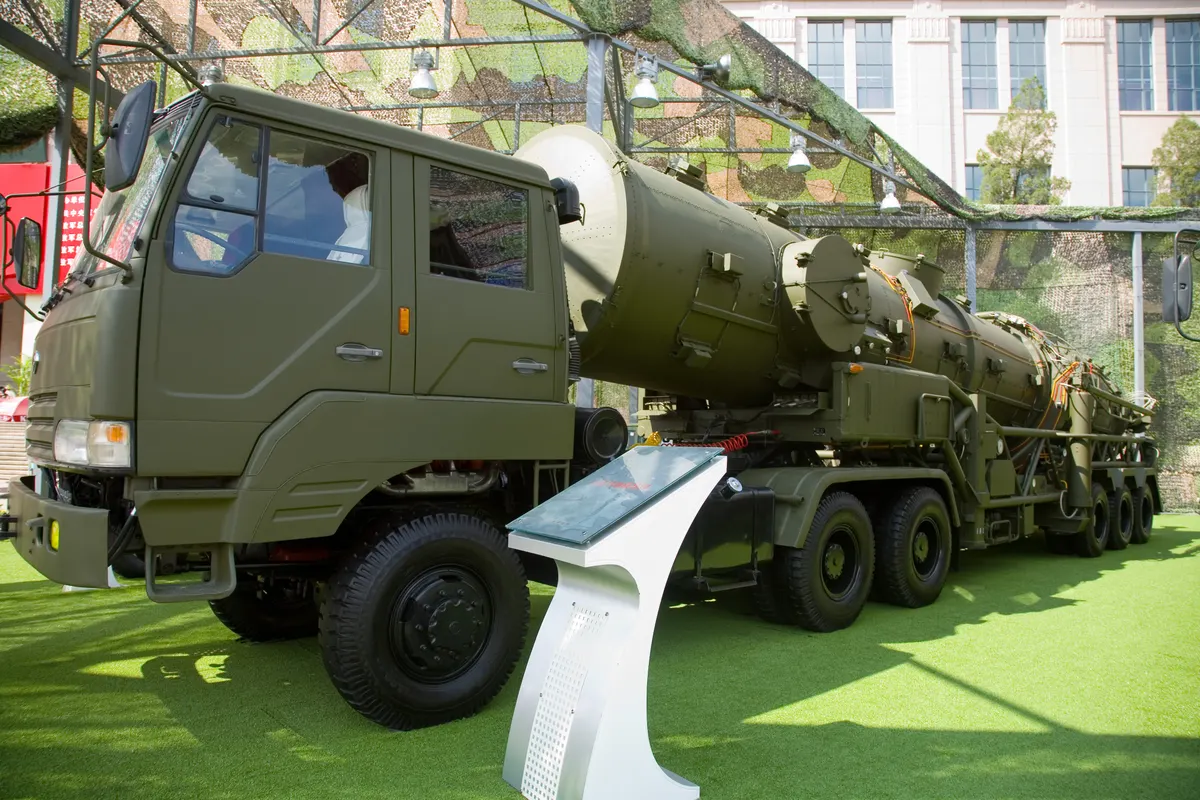
China fields much of its land-based nuclear role through variants of the DF-21, a road-mobile, solid-fueled missile in service since 1991. The baseline DF-21A, operational since 1996, carries a single nuclear warhead to a range of roughly 1,770 kilometers, while the later DF-21C added the ability to swap between nuclear and conventional payloads, becoming the type's first dual-capable version.6
India's nuclear-capable missile force grew out of the Agni program run by the Defence Research and Development Organisation. The Agni-II, in service since 2004, carries a payload past 2,000 kilometers, reportedly a nuclear warhead in the 150 to 200 kiloton range.7 The Agni-II Prime, an upgrade first tested in 2010, refined that airframe, and the newer Agni-P adds sealed canister launch tubes letting a mated warhead sit ready for rapid firing.8
Israel's Jericho-2, developed from the mid-1970s and believed to have entered service in the late 1980s, is widely assessed to carry a nuclear warhead despite Israel never officially confirming its nuclear arsenal, a stance long known as nuclear ambiguity.9 Ababeel and Jericho-2 sit at opposite ends of openness about that same underlying capability, one publicly test-announced, the other never acknowledged.
01Notes and Sources
- "R-5M", Astronautix — astronautix.com ↩
- "RSD-10 Pioneer (SS-20)", Missile Threat, CSIS — missilethreat.csis.org ↩
- "How US nuclear force modernization is undermining strategic stability, the burst-height compensating super-fuze", Bulletin of the Atomic Scientists — thebulletin.org ↩
- "Ababeel", Missile Threat, CSIS — missilethreat.csis.org ↩
- "Permissive action link", Wikipedia — en.wikipedia.org ↩
- "DF-21C Missile Deploys to Central China", Federation of American Scientists — fas.org ↩
- "Agni-II", Missile Threat, CSIS — missilethreat.csis.org ↩
- "Agni-P", Wikipedia — en.wikipedia.org ↩
- "Jericho 2", Nuclear Weapon Archive, Federation of American Scientists — nuke.fas.org ↩


