

Solid-fuel describes a ballistic missile whose rocket motor burns propellant cast as a single solid mass, fuel and oxidizer premixed into a rubbery grain sealed inside the missile's own motor case. This differs from a liquid-fuel missile, which stores fuel and oxidizer in separate tanks a ground crew has to pump into the combustion chamber before launch. A solid-fuel missile is loaded once, at the factory, and sits ready for years, needing only an igniter pulse to fire. A cryogenic liquid-fuel missile can instead need a fueling crew for tens of minutes to several hours before launch.
The gap matters most for a missile that has to move and hide rather than sit in a fixed silo. A road-mobile launcher carrying a liquid-fuel missile has to travel with support vehicles for fuel, oxidizer and handling gear, slowing deployment and making the convoy easier to spot. A solid-fuel missile skips that logistics train, its propellant already sealed inside the motor, which is why almost every mobile, quick-reaction missile fielded since the 1970s runs on solid fuel.
01American Solid-Fuel Pioneers and the End of the Fueling Wait
The shift began in the United States. Thiokol built the TX-18 Falcon in 1949, credited as the world's first solid-fuel missile, using rubbery polymer binders its chemists had spent the 1940s refining.1 The bigger push came when President Dwight Eisenhower approved the Minuteman program in 1955, aiming for a missile that could sit fully loaded for years and launch within minutes, something the liquid-fuel Atlas and Titan I could not do. Thiokol static-tested a Minuteman first-stage motor in Utah in 1957, delivering the basing flexibility and survivability liquid fuel had lacked, leaving only the heavy-payload Titan II on liquid propellant.2
02How a Solid Rocket Motor Actually Works
A solid rocket motor is mechanically simple next to a liquid engine. The propellant, a powdered oxidizer bound with aluminum fuel in a synthetic rubber binder, is poured as a slurry into the motor case and cured into a solid grain, a step called casting.3 A hollow channel through the grain's center lets it burn inside-out once an igniter lights the exposed surface, and that channel's shape gives engineers control over how thrust builds, without a moving part.
There is no turbopump, no separate oxidizer tank and no plumbing to leak or freeze, so a solid motor needs far less ground support.4 That simplicity is also why solid-fuel missiles tolerate rough handling on a road-mobile launcher better than liquid-fueled predecessors did.
01Soviet Catch-Up and the Global Spread of Solid-Fuel Missiles
The Soviet Union lagged by roughly two decades, running its theater missiles on liquid fuel well into the 1970s, until the Moscow Institute of Thermal Technology, under designer Alexander Nadiradze, adapted the upper stages of the RT-21 Temp-2S ICBM into a dedicated weapon. The result, the RSD-10 Pioneer (NATO code SS-20 Saber), became the Soviet military's first solid-fuel missile, entering service in 1976 on a MAZ-547 wheeled launcher able to disperse into forest cover within minutes.5
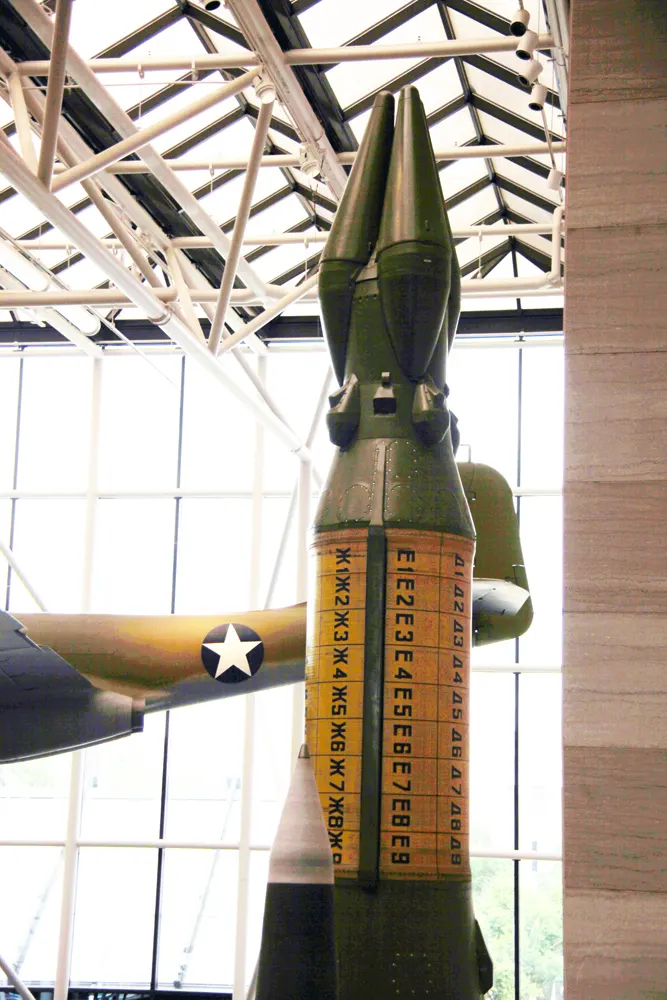
Its mobility unsettled NATO planners enough to trigger the Euromissile crisis, prompting the 1979 decision to station Pershing II missiles in Europe and the 1987 INF Treaty that eliminated the class.5 By the time the last RSD-10 Pioneer was scrapped in 1991, solid fuel was the default for any road-mobile force.
China's program followed a similar arc. The DF-21D family traces to the original DF-21, which entered service in 1991 as China's first solid-fuel, road-mobile land-based missile, developed from the JL-1 submarine-launched design.6 The conventional DF-21C and the anti-ship DF-21D followed around 2006, same solid motor, different payload.
Israel's Jericho 2 took a parallel, independently developed path, begun in 1977 after Washington declined to sell it the Pershing II. The two-stage solid-fuel missile became operational in 1989, launchable from a silo, a rail car or a mobile launcher without a fueling crew.7

India's Agni-P carries the same logic into a canisterized package, road-mobile on aluminum-fueled composite propellant and a direct descendant of the older Agni-II.8 Pakistan's Ababeel, a three-stage solid-fuel design first tested in 2017, and Turkey's Cenk missile, built around a dedicated solid-fuel plant at Roketsan's Kırıkkale facility, show newer programs still making the same choice decades later.9,10
Nearly eight decades on, the tradeoff still holds. A solid-fuel missile gives up some efficiency for a motor already loaded and ready to fire the moment an order arrives.
01Notes and Sources
- "Thiokol", Wikipedia — en.wikipedia.org ↩
- "ICBM: Over 65 Years of Technical Leadership", Northrop Grumman — northropgrumman.com ↩
- "Solid Propellants for Missiles and Rockets", U.S. Centennial of Flight Commission — centennialofflight.net ↩
- "Solid-propellant rocket", Wikipedia — en.wikipedia.org ↩
- "RSD-10 Pioneer (SS-20 Saber)", Missile Threat, CSIS — missilethreat.csis.org ↩
- "DF-21 (CSS-5)", Missile Threat, CSIS — missilethreat.csis.org ↩
- "Jericho 2", Missile Threat, CSIS — missilethreat.csis.org ↩
- "Agni-Prime (Agni-P), India's Rail-Mobile Canisterised Missile Explained", DefenceNiti — defenceniti.com ↩
- "Ababeel", Missile Threat, CSIS — missilethreat.csis.org ↩
- "Turkiye Unveils Giant Mystery Ballistic Missile Beside TAYFUN Block 4", Defence Security Asia — defencesecurityasia.com ↩


