


The DF-21D is the world's first operational anti-ship ballistic missile (ASBM), a road-mobile, two-stage, solid-fuel medium-range ballistic missile built by China to strike large warships, above all US Navy fleet aircraft carriers, while they are still hundreds of kilometers from the Chinese coast. Western defense journalism nicknamed it the carrier killer not long after its existence became public around 2009, and the label stuck so thoroughly that it now appears in Pentagon congressional testimony almost as often as the missile's own designation. NATO reporting names it CSS-5 Mod 5, distinguishing it from the older nuclear-armed DF-21 and DF-21A and the land-attack DF-21C.
- First operational ASBM, unmatched by any other navy's defenses
- Mach 10 exoatmospheric reentry speed complicates interception
- Conventional-only role frees it from nuclear escalation politics
- Road-mobile TEL basing is hard to find and preemptively strike
- Never publicly confirmed against a genuinely moving ship at sea
- Depends on a fragile, contestable satellite and radar kill chain
- Terminal seeker has only seconds to reacquire after reentry blackout
- Short range confines it to the first island chain, not the open Pacific
What makes the DF-21D unusual is the terminal problem it was built to solve, since its airframe is simply a derivative of a missile family China first deployed in 1991. A conventional ballistic missile flies a fixed, predictable trajectory to a fixed point on the map. A moving aircraft carrier, escorted by an area-denial screen and constantly changing course, is not a fixed point. The DF-21D pairs its ballistic booster with a maneuverable reentry vehicle (MaRV) carrying its own radar seeker, meant to detect a moving ship after reentry and steer onto it during the final seconds of flight. No other country had fielded this combination before China did.
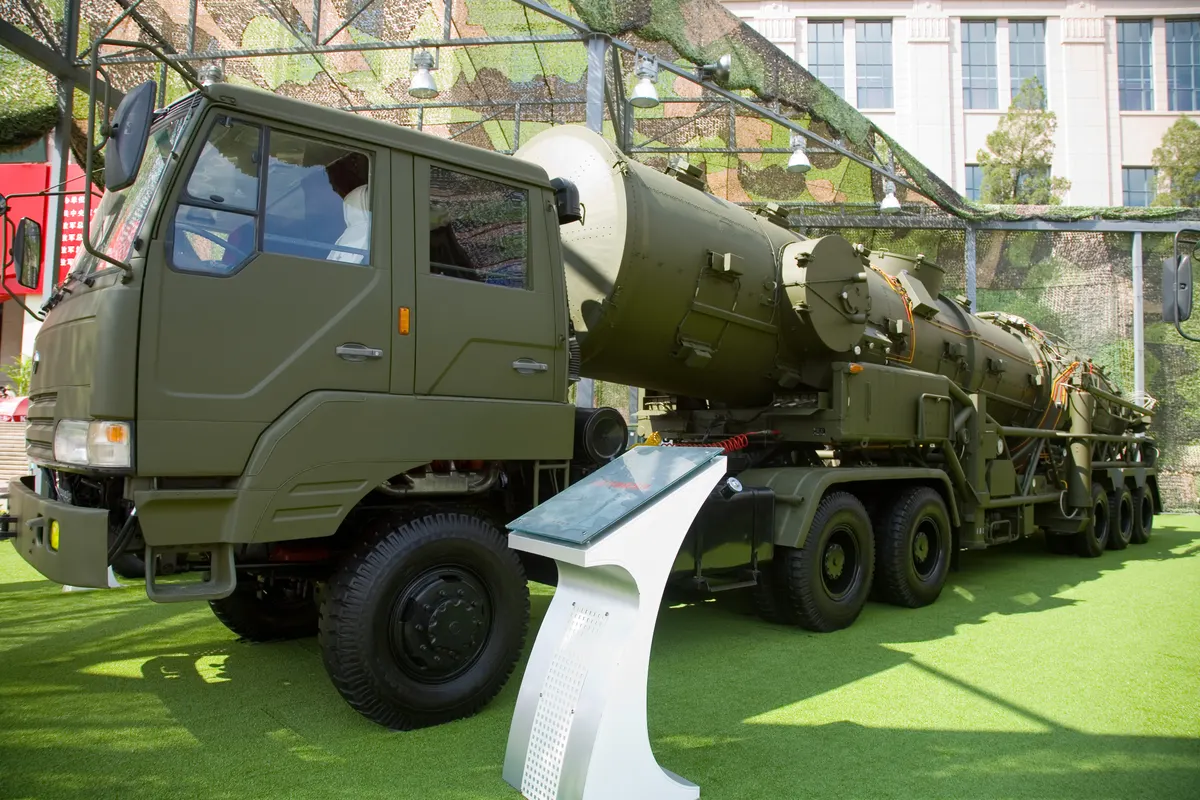
The missile grew out of the broader DF-21 program run by China's Changfeng Mechanics and Electronics Technology Academy, the solid-propulsion arm of China Aerospace Science and Industry Corporation (CASIC). Production of the DF-21 family's airframes and TEL hardware has also been tied to CASIC's Hubei-based subsidiary, the Sanjiang Space Group, which traces its own roots to a 1969 third-line defense-industry base and today builds both missile hardware and small space-launch vehicles derived from the same solid-rocket production line.1 Where the original DF-21 and DF-21A carried nuclear warheads and the DF-21C added terminal guidance against fixed land targets, the DF-21D strips the mission down to a single job, finding and hitting a warship underway. It carries roughly a 600 kilogram conventional warhead rather than a nuclear one, because the precision terminal-homing logic the mission requires is incompatible with the looser accuracy tolerance a nuclear yield would allow.2,3
The DF-21D sits at the center of what US defense analysts call China's anti-access/area-denial strategy, an approach built around making the seas near China too dangerous for US carrier strike groups to operate in without accepting serious risk. It is operated by the PLA Rocket Force (PLARF), the successor to the Second Artillery Force, and its road-mobile basing across mainland China's southeastern provinces lets it threaten shipping across the South China Sea and East China Sea without needing the missile itself to travel far. Whether the DF-21D can actually do what its nickname promises, hit a warship maneuvering at sea, remains the single most argued question in open-source Chinese military analysis, and this article covers both the missile's real capabilities and that unresolved debate in detail.
The Two-Stage Solid-Fuel Airframe Behind the DF-21D
Structurally, the DF-21D is a two-stage, solid-fuel rocket roughly 10.7 meters long and 1.4 meters in diameter, launched from a canisterized container on a wheeled transporter erector launcher (TEL) rather than a fixed silo. Solid propellant lets the missile sit fueled and ready for years and launch within minutes of an order, a major advantage over the liquid-fueled DF-3 and early Soviet-derived missiles China operated in the 1960s and 1970s, which needed lengthy fueling before launch. Launch weight is estimated at roughly 14,700 kilograms, broadly in line with the baseline DF-21 it derives from.2,4
- Füze SınıfıMRBM (anti-ship ballistic missile)
- TasarımcıChina Changfeng Mechanics and Electronics Technology Academy (CASIC)
- Uzunluk10,7 m
- Çap1,4 m
- Fırlatma Ağırlığı14.700 kg
- HizmetteEvet
US intelligence assessments, principally the National Air and Space Intelligence Center, put the DF-21D's range at approximately 1,450 to 1,550 kilometers, enough to cover the South China Sea and most of the East China Sea from launch sites well inland on the Chinese mainland but not enough to reach Guam or the open central Pacific. That range gap is precisely why China later fielded the longer-ranged DF-26, nicknamed the Guam killer, as a second tier of the same anti-ship concept. During its exoatmospheric midcourse phase the DF-21D reaches speeds cited as high as Mach 10, though several independent analysts argue the missile likely slows well below that, closer to Mach 5 and then Mach 2, once atmospheric drag takes hold during final reentry and maneuvering.2,5
- Tahrik TipiSolid-fuel rocket
- Kademe Sayısı2
- Yakıt TipiSolid
- Katı YakıtlıEvet
- KanisterliEvet
The Maneuverable Reentry Vehicle and the Terminal Guidance Problem
The part of the DF-21D that makes it genuinely novel is its maneuverable reentry vehicle. After the booster stages burn out and separate, the MaRV continues on a ballistic arc, then uses terminal guidance, reportedly a combination of inertial navigation and an active radar seeker, to detect a moving ship and steer onto it in the final seconds before impact. Estimated accuracy is often cited around 20 meters CEP, though because the DF-21D has never been independently verified against a real moving target, that figure is itself an extrapolation from the DF-21C's known terminal-guidance performance rather than a confirmed DF-21D result.2,3
- Azami Menzil1.550 km
- Geri Giriş Hızı (Mach)10 Mach
- Taşıma Kapasitesi (Throw Weight)600 kg
The physics of the terminal problem are unforgiving. During reentry, the reentry vehicle passes through a period of ionized plasma buildup around its airframe that blocks radar and radio signals, a well-known phenomenon called reentry blackout. Only after the vehicle descends into denser, cooler air does its seeker have a usable window to search for, lock onto, and steer toward its target, and that window is measured in seconds, not minutes. A carrier group can move roughly half a kilometer in the time between the last confirmed satellite fix on its position and missile impact, so the terminal seeker effectively has to do the last mile of the entire kill chain on its own, at Mach-plus speed, against a ship using electronic countermeasures and escort ships throwing up decoys and chaff.2,6
- Dairesel Hata Olasılığı (CEP)20 m
- Güdüm TipiAktif Radar
- Terminal GüdümEvet
- Manevra Kabiliyetli Geri Giriş Aracı (MaRV)Evet
The Kill Chain, Satellites, Over-the-Horizon Radar and the Targeting Debate
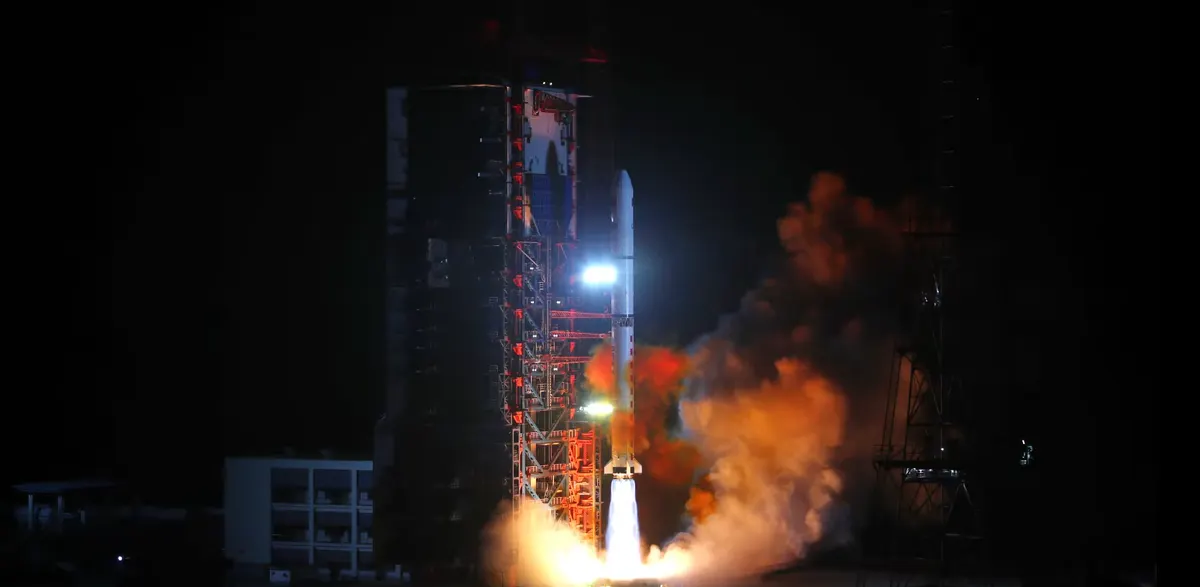
Hitting a target 1,500 kilometers away with a missile is the easy half of the DF-21D's mission. The hard half is finding that target in the first place, tracking it accurately enough to program a launch solution, and updating that data right up until the missile is committed. China built what analysts call a dedicated kill chain for this purpose, layering several sensor types so that the loss of any one does not collapse the whole system. The core is a constellation of Yaogan early-warning and optical-imaging satellites, several of them launched in triplet groups understood to be a naval ocean-surveillance configuration, supplemented by sigint and elint satellites that can passively detect a carrier's own radio and radar emissions.2,7
- Harp Başlığı TipiConventional penetrator
- NükleerHayır
- TermonükleerHayır
- MIRVHayır
- Harp Başlığı / RV Sayısı1
- Konvansiyonel KabiliyetliEvet
Backing up the satellites, China operates shore-based over-the-horizon backscatter radar arrays that bounce high-frequency signals off the ionosphere to detect large surface contacts thousands of kilometers out, well beyond a normal line-of-sight radar horizon, giving early cueing on a carrier group's general position long before any missile is launched. Maritime patrol aircraft, submarines and even armed fishing militia vessels reportedly round out the picture. None of this is unique in kind, other militaries use satellites and over-the-horizon radar too, but no other country has tried to wire that sensor mesh directly into a ballistic missile's terminal guidance loop against a moving warship at sea. That is the part of the DF-21D program Western analysts still say is unproven in the open literature, and the doubt is not really about the missile's own hardware, it is about whether the sensor-to-shooter chain can deliver a fresh enough targeting solution across 1,500 kilometers to matter in a real engagement.6
- Konuşlanma ŞekliRoad-mobile TEL (canisterized); air-launched variant reported
- Silo KonuşluHayır
- Karayolu Hareketli (TEL)Evet
- Rayda HareketliHayır
- Denizaltından FırlatılanHayır
- Kullanıcılar1
From the Nuclear DF-21 to a Conventional Anti-Ship Adaptation
The DF-21D's origins trace back to the base DF-21 missile, developed from the late 1960s and fielded from 1991 as China's first solid-fuel MRBM, itself descended in concept from the earlier liquid-fueled DF-2 and DF-3 missiles of the 1960s and 1970s. Through the 1990s and 2000s, China produced a family of DF-21 variants for different roles, the nuclear-armed DF-21 and DF-21A, and the conventionally armed, terminally guided DF-21C for fixed land targets. The idea of adapting the airframe specifically against moving ships appears to trace to Chinese strategic anxiety after the 1995 to 1996 Taiwan Strait Crisis, when Washington sent two carrier strike groups toward Taiwan and Beijing had no way to hold them at risk from a distance.2,8
Western analysts began writing seriously about a Chinese anti-ship ballistic missile program around 2009, based on Pentagon reporting and a technical paper by Andrew Erickson and others analyzing the concept's feasibility. Testing accelerated through the early 2010s, largely against fixed or simulated targets on land test ranges, and the US Department of Defense assessed the DF-21D had reached initial operating capability around 2010, with CSIS's Missile Threat project describing it as deemed operational by 2012. The missile made its first confirmed public appearance on 3 September 2015, when DF-21D launcher vehicles rolled through Beijing during the military parade marking the 70th anniversary of the end of World War II, reviewed by President Xi Jinping.2,3,9
Since entering service, the DF-21D has never fired in anger. Its role has been almost entirely deterrent and demonstrative, a weapon meant to shape US Navy planning by existing rather than by being used. The PLA Rocket Force has grown its overall missile brigade count substantially since 2015, from roughly 29 to 39 brigades by late 2019, a buildup that includes DF-21D and DF-26 units among newer systems, and the missile has become a recurring feature of Chinese state media coverage of military exercises intended to signal resolve toward Taiwan and toward any foreign carrier strike group operating nearby.12
The August 2020 South China Sea Test and the Claim That Was Never Confirmed
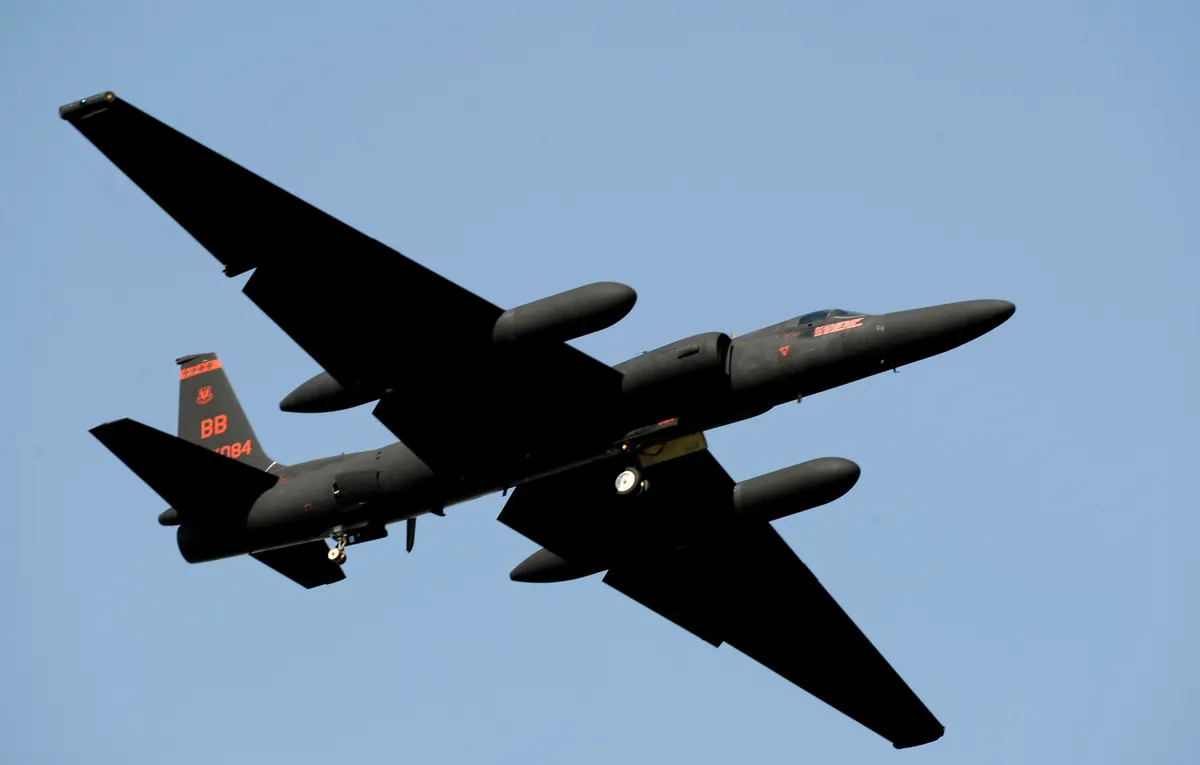
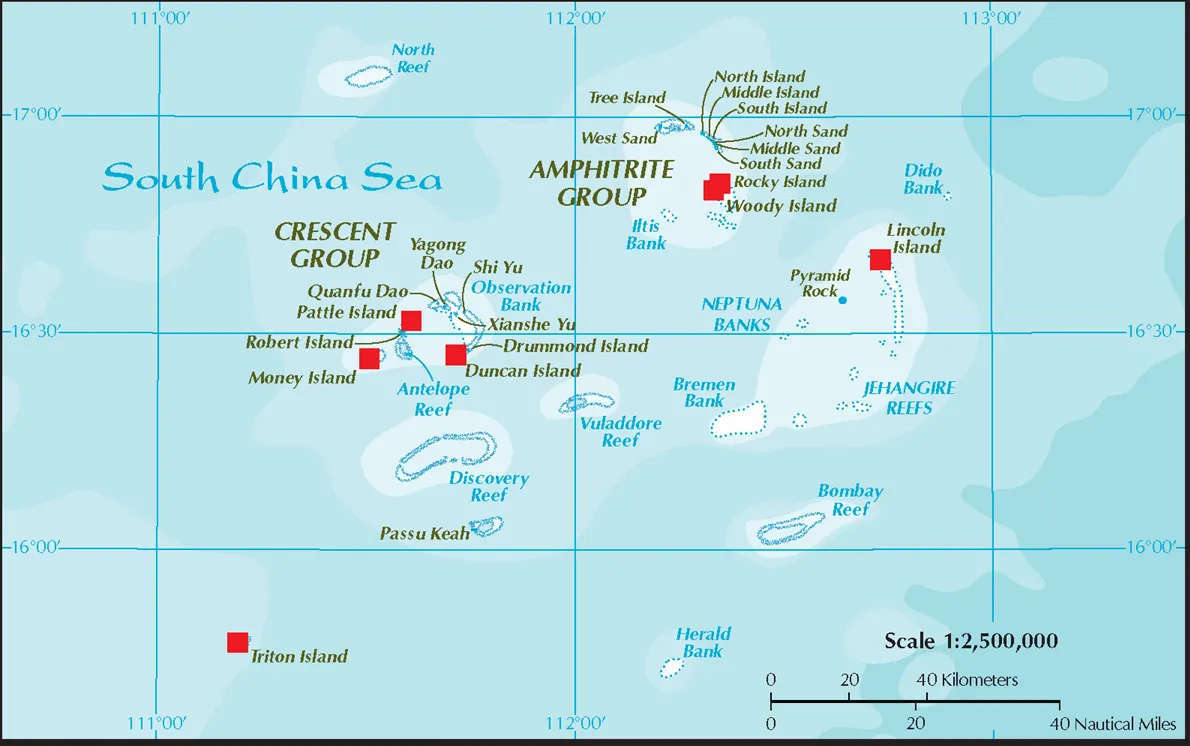
The DF-21D's single most reported test came on 26 August 2020, when the PLA Rocket Force launched a DF-21D from Zhejiang province and a longer-ranged DF-26B from Qinghai province, both splashing down in the South China Sea between Hainan Island and the Paracel Islands. The launch followed a diplomatic dispute over a US U-2 reconnaissance flight that Beijing said had entered a no-fly zone during a separate Chinese live-fire exercise in the Bohai Sea, and US media at the time widely read the missile test as a deliberate signal timed to that incident.10,11
Retired PLA senior colonel Wang Xiangsui later told the South China Morning Post that the two missiles had struck a moving vessel near the Paracel Islands, the first time a Chinese source had publicly claimed a moving-target hit for the DF-21D. US Indo-Pacific Command confirmed detecting the launches but pointedly declined to confirm any hit, and commercial satellite imagery of the impact area showed what appeared to be a stationary target barge rather than clear evidence of a ship underway at speed. No independent, open-source verification of a genuine moving-target hit has surfaced since.10,11,13
Desert Mock-Ups and the Case for Land-Only Testing
Reinforcing that skepticism, commercial satellite imagery analyzed by USNI News in November 2021 revealed that China had built full-scale mock targets shaped like a US Navy aircraft carrier and two Arleigh Burke-class destroyers on a remote missile test range in the Taklamakan Desert in Xinjiang, near a site previously used to test early DF-21D variants. The carrier-shaped target measured roughly 75 meters long with a recognizable island superstructure, mounted with poles believed to carry radar reflectors that simulate a full-sized ship's radar signature, and later imagery showed visible damage consistent with missile strikes.14
The existence of a purpose-built desert carrier target strongly suggests that at least some of China's DF-21D and related test program has continued to rely on fixed, land-based mock-ups rather than genuinely moving ships at sea, even years after the missile's declared initial operating capability. That does not mean the DF-21D cannot hit a moving target, static desert targets are a normal, sensible way to validate a terminal seeker's basic homing logic before ever risking an expensive live-fire test against a moving hull, but it does mean the open-source record still lacks the one test Western military planners most want to see, an end-to-end shot against an actual ship steaming at speed with its own defenses active.14
The DF-21D has never been fired at a real target in combat, but it has repeatedly functioned as a political weapon during periods of tension in the Taiwan Strait and the South China Sea, launched or paraded specifically to send a message rather than to strike anything. The clearest example came during the Fourth Taiwan Strait Crisis in August 2022, when Beijing responded to then-Speaker of the US House of Representatives Nancy Pelosi's visit to Taiwan with the largest set of live-fire military exercises around the island since the Third Taiwan Strait Crisis of 1995 to 1996. Taiwan's Ministry of National Defense reported that China fired eleven Dongfeng-series ballistic missiles toward waters around Taiwan on 4 August 2022, several of which reportedly overflew the island itself for the first time in the missile program's history, in a drill explicitly framed around denying outside naval intervention.12,16
That framing connects directly back to the missile's founding logic. China's anti-ship ballistic missile program is widely understood among US analysts to have originated from the 1995 to 1996 Third Taiwan Strait Crisis, when the United States sent the carrier strike groups of USS Nimitz and USS Independence toward the strait and China had no credible way to hold either ship at risk. The DF-21D, and the area-denial strategy it anchors, exists specifically to prevent that scenario from repeating, by making any future US carrier response to a Taiwan contingency a much riskier proposition than it was in 1996.8,12
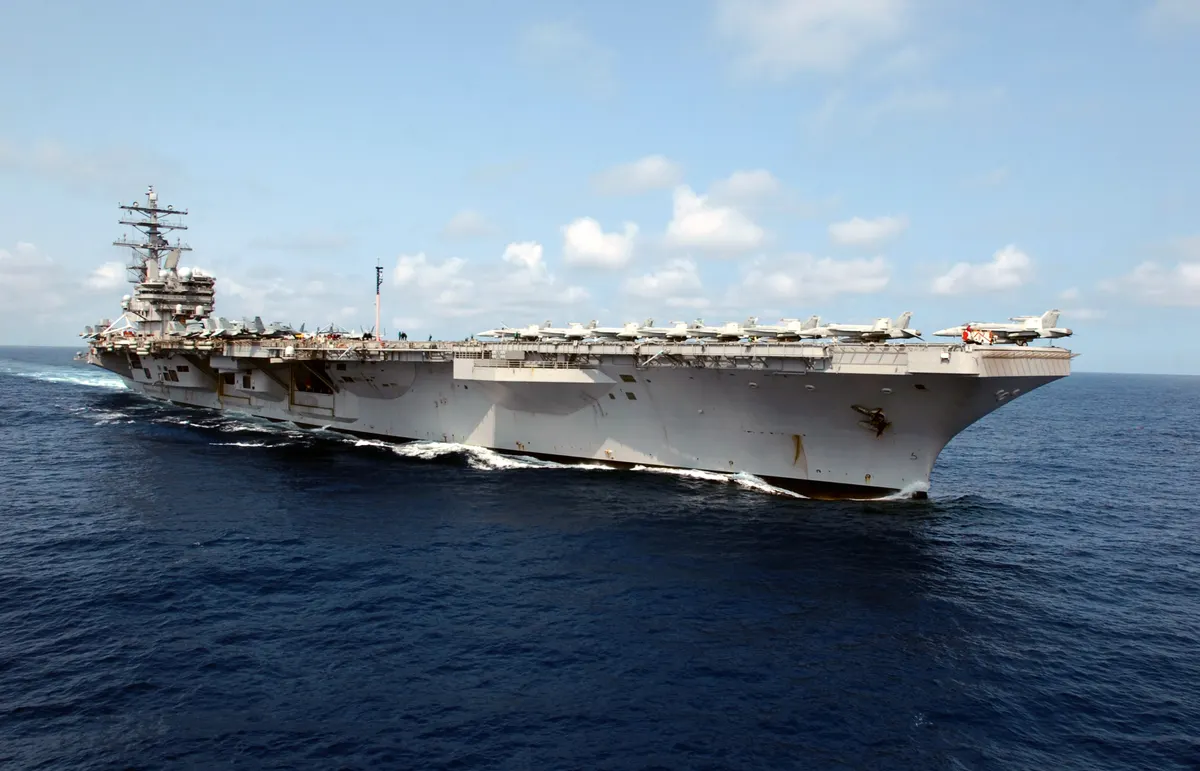
The August 2020 South China Sea test, covered above under History, is itself best understood as a conflict-adjacent signaling event rather than a purely technical trial, since Chinese and US commentary at the time explicitly tied it to the ongoing dispute over freedom-of-navigation operations and the contested U-2 overflight. In both the 2020 test and the 2022 exercises, the DF-21D's practical effect was the same regardless of its unresolved moving-target performance, it forced US Navy planners and regional observers to publicly account for a weapon that at least theoretically holds their most valuable ships at risk from well inside Chinese territory.
The core conventional DF-21D remains a road-mobile, ground-launched missile, but China has worked to extend the same anti-ship concept beyond fixed mainland TEL sites. The most significant development is an air-launched variant, reported in Western defense media under the provisional designation CH-AS-X-13, carried semi-recessed under the belly of the Xian H-6N bomber. The H-6N, first spotted publicly around 2019, is a modified version of China's long-serving H-6 bomber family with its bomb bay deleted in favor of a hardpoint built specifically for a large air-launched ballistic missile, first photographed carrying what analysts assess is this DF-21D derivative in October 2020.17
Launching the missile from an aircraft rather than a fixed mainland TEL matters because it changes the range problem. A ground-launched DF-21D is limited to roughly 1,450 to 1,550 kilometers from wherever its launcher happens to be parked on the Chinese mainland, but an H-6N carrying the same missile can fly a substantial distance out over open water before releasing it, extending the effective reach of the weapon well beyond the missile's own powered range and complicating the geography an adversary has to defend against. Some estimates of the combined aircraft-plus-missile reach for the CH-AS-X-13 run into the several-thousand-kilometer range, though official Chinese confirmation of the system's designation, status and precise performance has never been published, and its full details rely entirely on satellite and aircraft-spotter photography rather than confirmed exercises.17

The DF-21D's sole confirmed operator is China, specifically the PLA Rocket Force, the branch responsible for all of the country's land-based conventional and nuclear ballistic and cruise missiles. The Rocket Force is the direct successor to the Second Artillery Force, renamed and elevated to a full, independent service branch on 1 January 2016 as part of a sweeping military reform pushed through by Xi Jinping at the end of 2015, alongside the creation of a unified PLA Strategic Support Force.12
DF-21D brigades are believed to be based across southeastern mainland China, positioned to cover the South China Sea and East China Sea from well inland, with the missile's August 2020 test launched from Zhejiang province specifically. Independent counts of PLA Rocket Force missile brigades grew from roughly 29 to 39 between 2017 and late 2019, an expansion that included new DF-21D and DF-26 units among other systems, though open-source estimates of exactly how many DF-21D launchers and brigades exist specifically vary and China has never officially disclosed a number.12 No other country operates the DF-21D, and no confirmed export sale or foreign transfer of the system has ever been reported, unlike some other Chinese missile programs that have found export customers.
The DF-21D's closest institutional relative inside China's own arsenal is not a rival country's missile but its own successor, the DF-26, nicknamed the Guam killer for the longer reach that lets it threaten the US base on Guam rather than only the first island chain. Both missiles share the same anti-ship maneuvering reentry vehicle concept and the same PLA Rocket Force kill chain, but they occupy different tiers of China's layered anti-access strategy. The DF-21D, with its roughly 1,450 to 1,550 kilometer range, is the shorter-ranged, older and more thoroughly tested of the pair, while the DF-26 extends anti-ship coverage past 4,000 kilometers and adds a dual conventional and nuclear role the DF-21D was deliberately built to avoid.
| DF-21D | DF-26 | |
|---|---|---|
| Role | Anti-ship, conventional only | Anti-ship and land-attack, dual conventional/nuclear |
| Approx. range | 1,450 to 1,550 km2 | Over 4,000 km2 |
| Entered service | ~2010 (IOC)3 | ~201618 |
| Nickname | Carrier killer | Guam killer |
Outside China, the DF-21D has effectively no direct peer, because no other navy or missile force has fielded a comparable anti-ship ballistic missile at all. The United States retired its own land-based intermediate and medium-range ballistic missile programs decades ago under the 1987 Intermediate-Range Nuclear Forces Treaty and only regained the legal freedom to build new ones after withdrawing from that treaty in 2019, so its answer to the DF-21D has come from a different direction entirely, dispersing carrier operations further from China's coast, developing its own long-range anti-ship missiles like a maritime-strike variant of the SM-6, and investing heavily in hypersonic strike and missile-defense programs rather than fielding a like-for-like ASBM of its own. That asymmetry, one side building a purpose-made ship-killing ballistic missile and the other side building ways to avoid or intercept it, is itself the real story of the DF-21D's place in the wider Pacific balance, more than any single spec-sheet comparison against a rival missile can capture.
What is the DF-21D missile? The DF-21D is a Chinese road-mobile, two-stage, solid-fuel medium-range ballistic missile built specifically to strike large moving warships, including aircraft carriers, at ranges of roughly 1,450 to 1,550 kilometers. It is the world's first weapon system of its kind to reach declared operational status.2,3
Why is the DF-21D called the carrier killer? Western defense media coined the carrier killer nickname because the missile's maneuverable reentry vehicle and terminal guidance system were designed specifically to home in on a moving surface ship, with US aircraft carriers as the implicit primary target given their central role in American Pacific strategy.2
Has the DF-21D actually ever hit a moving ship? There is no independently confirmed, open-source case of the DF-21D striking a genuinely moving ship at sea. China claims a hit during its August 2020 South China Sea test, but US Indo-Pacific Command did not confirm it, and Western analysts including Andrew Erickson have stated the missile's performance against a real moving target remains unproven in open sources.10,13
What is the DF-21D's range? US intelligence assessments put the DF-21D's range at approximately 1,450 to 1,550 kilometers, considerably shorter than the follow-on DF-26, which covers over 4,000 kilometers and can reach Guam.2
Is the DF-21D still in service? Yes. The DF-21D remains an active part of the PLA Rocket Force's arsenal and continues to feature in Chinese military exercises and parades, most recently as part of the large-scale drills around Taiwan following the August 2022 Fourth Taiwan Strait Crisis.12,16
Who manufactures the DF-21D? The DF-21D was developed under China Aerospace Science and Industry Corporation, principally through its Changfeng Mechanics and Electronics Technology Academy, the solid-propulsion missile design institute responsible for the wider DF-21 family.2
- "Sanjiang Space Group", GlobalSecurity.org — globalsecurity.org ↩
- "DF-21", Wikipedia — en.wikipedia.org ↩
- "DF-21 (CSS-5)", CSIS Missile Threat — missilethreat.csis.org ↩
- "WU-14 Dong Feng-21D (DF21D) / CSS-5 Mod 5", GlobalSecurity.org — globalsecurity.org ↩
- "China's DF-21D and DF-26B ASBMs, Is the U.S. Military Ready?", Andrew S. Erickson — andrewerickson.com ↩
- "China's Carrier Killer, Threat and Theatrics", Air & Space Forces Magazine — airandspaceforces.com ↩
- "DF-21 Delta, Some Early Thoughts", Arms Control Wonk — armscontrolwonk.com ↩
- "China Aerospace Science and Industry Corporation", Wikipedia — en.wikipedia.org ↩
- "China Launches Antiship Ballistic Missiles in Test", CSIS Missile Threat — missilethreat.csis.org ↩
- "Destroyer Conducts South China Sea FONOP Day After Chinese 'Carrier Killer' Missile Tests", USNI News — news.usni.org ↩
- "Chinese Ballistic Missiles Fired Into South China Sea Claimed to Hit Target Ship", The Diplomat — thediplomat.com ↩
- "People's Liberation Army Rocket Force", Wikipedia — en.wikipedia.org ↩
- "Warning to the United States, China Fires DF-26B and DF-21D Anti-Ship Ballistic Missiles Into South China Sea", Andrew S. Erickson — andrewerickson.com ↩
- "China Builds Missile Targets Shaped Like U.S. Aircraft Carrier, Destroyers in Remote Desert", USNI News — news.usni.org ↩
- "DF-21D", MW Stats (Command: Modern Operations database) — mwstats.info ↩
- "China Fires Missile Strikes Over Taiwan Strait After Pelosi Visit", NPR — npr.org ↩
- "Chinese H-6N Bomber Spotted Carrying Possible Air Launched Ballistic Missile", The Aviationist — theaviationist.com ↩
- "DF-26", Wikipedia — en.wikipedia.org ↩