


On 16 January 2024, four Kheibar Shekan medium-range ballistic missiles lifted off from southern Khuzestan Province and flew roughly 1,250 kilometers to strike a target near Idlib, Syria, the longest-range ballistic missile shot Iran had ever fired.1 It was also the missile's combat debut, barely two years after the Islamic Revolutionary Guard Corps (IRGC) Aerospace Force had first shown it in public.1 That single flight told most of the Kheibar Shekan story at once. It is a single-stage, solid-fuel medium-range ballistic missile built in Iran to reach targets other Iranian missiles either could not reach as reliably or could not reach with a launcher this easy to hide and move.
- Solid-fuel motor, fast to prepare and launch
- Lighter airframe than earlier Iranian MRBMs of similar range
- Maneuverable warhead built to defeat terminal interception
- Road-mobile launcher disguisable as a civilian truck
- Confirmed used against Israel in multiple salvos since 2024
- Accuracy against small or hardened targets remains unverified
- Iranian claims (hypersonic speed, *multi-warhead* variant) are hard to check independently
- Its own name is confused with a different Iranian missile, complicating any battle-damage attribution
The name mixes a historical reference with a blunt description of intent. Kheibar recalls Khaybar, a fortified Jewish oasis near Medina that Muslim forces under the Prophet Muhammad took in 628 CE, and Shekan is Persian for breaker or shatterer, so the missile's name reads roughly as breaker of Khaybar.2 That naming choice sits alongside, and is regularly confused with, a separate and larger Iranian missile Iran itself names Kheibar, a liquid-fuel missile also known as Khorramshahr-4.3 Iranian state media has not always been careful about which Kheibar it means in a given announcement, and that ambiguity has repeatedly complicated outside assessments of exactly which missile Iran fired in a given salvo, a problem that recurs later in this article.

Iran's Islamic Revolutionary Guard Corps unveiled the Kheibar Shekan on 9 February 2022 at a Guards missile base, timed to the 43rd anniversary of the Islamic Revolution and attended by armed forces chief of staff Mohammad Bagheri and Aerospace Force commander Amir Ali Hajizadeh.4 Officials described it as Iran's third generation of IRGC-developed missiles, with a claimed maximum range of 1,450 kilometers, a body built about a third lighter than earlier Iranian designs of similar range, and a launch-preparation time cut to roughly a sixth of what earlier liquid-fuel missiles needed.4 Those are the real engineering claims behind the announcement, not just slogans, and they explain why the Kheibar Shekan matters more than its range figure alone suggests.
Iran classifies the Kheibar Shekan as road-mobile,4 launched from a wheeled transporter-erector-launcher that Iranian coverage says can be built on a disguised commercial truck chassis, part of the same dispersal logic that keeps Iran's missile force survivable against preemptive strikes.5 The warhead is quoted at 550 kilograms, small next to Iran's older liquid-fuel missiles, but paired with a claimed maneuverable reentry vehicle meant to dodge interceptors in the last seconds of flight rather than simply falling ballistically onto the target.1 Whether the Kheibar Shekan is still in active Iranian service is not really in question, given how often the IRGC has referenced it in wartime statements through 2026, but how many are actually fielded and how reliably the terminal maneuver works under real interception attempts are both harder questions to answer from open sources.
Wholly indigenous IRGC Aerospace Force development, part of Iran's post-sanctions self-reliant missile industry; no evidence of foreign licensing or components.
A Lighter Composite Case, and the Range It Bought
The headline engineering claim behind the Kheibar Shekan is weight. Iranian officials said the missile's structure, built from composite materials shared with the smaller Raad-500 short-range missile, cut overall mass by roughly a third relative to earlier Iranian missiles of comparable reach.4 At 11.4 meters long and 0.76 meters in diameter, the Kheibar Shekan carries a launch weight reported between about 4.5 and 6.3 tons depending on the source, a wide spread that likely reflects different configurations or simple inconsistency in Iranian public statements rather than one settled figure.1 A lighter missile is not a cosmetic detail for a country whose ballistic missile force lives inside underground tunnel complexes. Every kilogram shed from the airframe is a kilogram of extra warhead, extra fuel, or extra missiles that fit into the same storage footprint, and Iranian coverage of the Kheibar Shekan has repeatedly framed the weight cut in exactly those terms.1
- Füze SınıfıOrta menzilli balistik füze
- Hizmete Giriş Yılı2022
- TasarımcıIRGCASF
- Uzunluk11,4 m
- Çap0,76 m
- Fırlatma Ağırlığı4.500 kg
- HizmetteEvet

The solid-fuel propulsion is the other half of that story. Solid-propellant missiles arrive pre-fueled from the factory and need no fueling convoy or hazardous on-site loading before launch, which is why Iran describes the Kheibar Shekan's launch-preparation time as roughly six times faster than its older liquid-fuel missiles.4 That speed matters operationally in a way raw range does not. A liquid-fuel transporter-erector-launcher that needs an hour of fueling before it can fire is a much easier target for a preemptive strike than one that can already fire the moment it stops moving, and Iran's own messaging around the Kheibar Shekan leans on that contrast deliberately.
- Tahrik Tipikatı yakıtlı roket
- Kademe Sayısı1
- Yakıt Tipikatı
- Katı YakıtlıEvet
The Maneuverable Warhead and What Hypersonic Actually Means Here
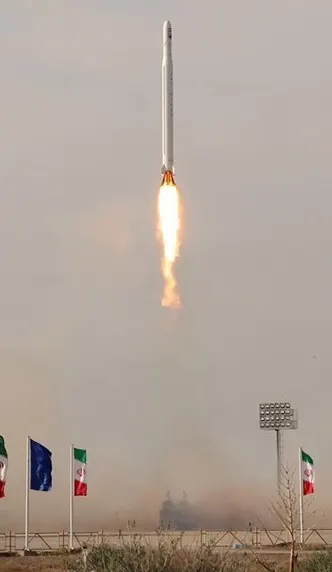
Iranian officials describe the Kheibar Shekan's reentry vehicle as capable of maneuvering in its terminal phase specifically to defeat missile defenses, rather than flying a fixed, predictable ballistic arc all the way to the target.1 Independent reporting on Iran's 2026 salvos against Israel has been careful to note that the hypersonic language Iranian state media sometimes attaches to this missile refers less to any single blistering top speed than to sustained maneuvering that disrupts an interceptor's tracking and intercept geometry.6 A missile that jinks during descent is harder to hit even at an unremarkable speed, and a missile that also flies fast is harder still, and Iranian statements have sometimes blurred the two effects together for propaganda purposes.6
- Azami Menzil1.450 km
- Geri Giriş Hızı (Mach)9 Mach
- Taşıma Kapasitesi (Throw Weight)550 kg
That distinction also explains a genuine inconsistency in the sourcing on this missile's reentry speed. Some outlets quote the Kheibar Shekan's impact velocity at only Mach 2 to Mach 3,1 a low figure that almost certainly describes the warhead after it has already bled speed performing its evasive terminal maneuver, since a maneuvering vehicle trades velocity for lateral movement. Other technical assessments place its peak descent speed in the Mach 7 to Mach 10-plus band typical of a modern MRBM reentry vehicle before terminal braking begins,6 which lines up far better with comparable Iranian missiles such as Haj Qasem and Khorramshahr. The lower Mach 2 to 3 figure describes the end of the flight, not its peak, and treating it as the missile's characteristic speed understates how fast the Kheibar Shekan is actually traveling for most of its reentry.
- Güdüm TipiAtaletsel / GPS
- Terminal GüdümEvet
- Manevra Kabiliyetli Geri Giriş Aracı (MaRV)Evet
Guidance combines inertial navigation with satellite-aided correction, which Iranian and outside sources both credit for the accuracy claims attached to this missile.3 A tri-conic reentry vehicle shape has been reported for the warhead, a design chosen to keep the vehicle stable while it performs its terminal maneuver rather than tumbling once it starts to deviate from a pure ballistic path.1 None of these guidance or maneuver claims have been independently confirmed against real interception data in public reporting, which is worth stating plainly rather than repeating Iranian claims as settled fact.
- Harp Başlığı Tipiyüksek patlayıcı
- NükleerHayır
- TermonükleerHayır
- MIRVHayır
- Harp Başlığı / RV Sayısı1
- Konvansiyonel KabiliyetliEvet
- Konuşlanma Şeklikarayolu mobil
- Karayolu Hareketli (TEL)Evet
- Denizaltından FırlatılanHayır
- Kullanıcılar1
- İlk Test2022
- Patlatma Mekanizması / Tapaçarpma
- Patlayıcı Dolgu Ağırlığı550 kg
From the Zolfaghar Family to a Third-Generation IRGC Missile
The Kheibar Shekan arrived as the latest in a line of IRGC-developed solid and hybrid-fuel missiles that had been getting progressively lighter and more accurate through the 2010s, following missiles such as Dezful and the broader Zolfaghar family.4 Iranian officials explicitly billed it as the third generation of that development track when they unveiled it, emphasizing continuity with the composite-case, maneuverable-warhead approach the earlier missiles had already established.4
The 9 February 2022 unveiling ceremony was a deliberately public event, staged at a Guards missile base with senior officers present and covered by Iranian state media the same day.4 That was a marketing decision as much as a military one. Iran has long used missile unveilings to signal capability to regional adversaries without actually testing the system in front of independent observers, and the Kheibar Shekan's rollout followed that same pattern down to the timing, deliberately anchored to the anniversary of the 1979 revolution.4
First Combat Use, Against a Target in Syria, Not Israel
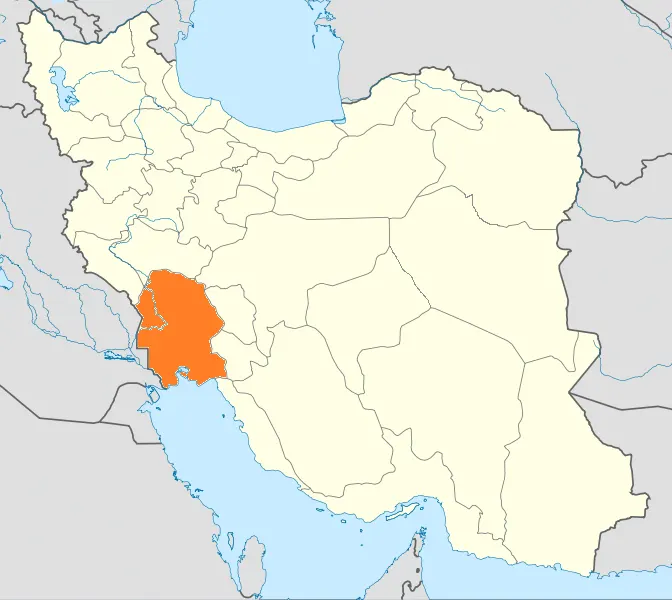
The Kheibar Shekan's actual combat debut came against a target far from Israel. On 15 to 16 January 2024, Iran fired a barrage of missiles and drones at sites in Iraq and Syria that it said were linked to the Islamic State and to Israeli intelligence, in retaliation for the deadly Kerman bombings earlier that month.7 Four Kheibar Shekan missiles, launched from southern Khuzestan Province, were aimed at what Iran described as a militant headquarters near Idlib, Syria, some 1,250 kilometers away, a flight distance longer than the missile's own 1,450 kilometer claimed maximum only by a comfortable margin, not by much.1 Syrian civil defense volunteers from the White Helmets later identified the wrecked building as a disused rural medical facility in Taltita village rather than any militant command post, an accuracy and targeting dispute that Iran has never fully addressed in public.1
Eleven of the fifteen missiles fired that night were actually aimed at Erbil, in Iraq's Kurdistan Region, where Iran said it was targeting an Israeli Mossad facility, killing four civilians and wounding seventeen more, a far bloodier outcome than the Idlib strike and a reminder that the Kheibar Shekan's own combat record is entangled with a wider, messier night of Iranian strikes rather than a single clean demonstration.8
Operation True Promise I and II, April and October 2024
Iran's first direct missile and drone attack on Israeli territory, Operation True Promise I on the night of 13 to 14 April 2024, followed the Israeli airstrike that killed IRGC officers at Iran's consulate in Damascus.9 Iranian reporting on the barrage of roughly 300 munitions described the Khorramshahr family and the Kheibar Shekan launching alongside Emad surface-to-surface missiles, part of a mixed salvo of ballistic missiles, cruise missiles, and Shahed drones meant to saturate Israeli and allied air defenses at once.9 Israel said it intercepted 99 percent of what Iran fired that night, with a handful of ballistic missiles reaching Israeli territory.9
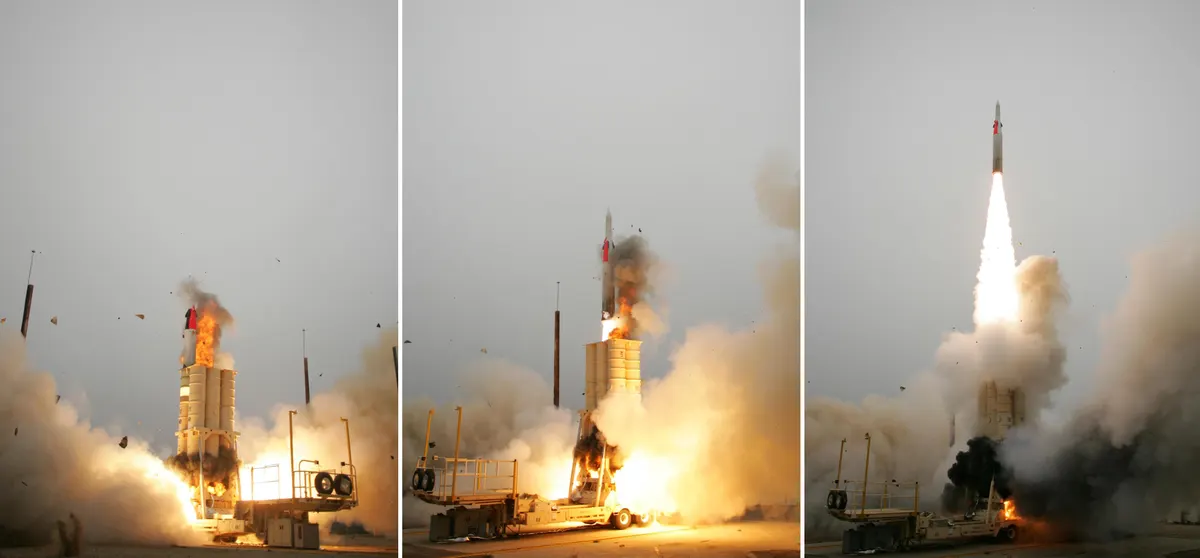
Operation True Promise II followed on 1 October 2024, after Israel's killing of Hezbollah leader Hassan Nasrallah and IRGC commander Abbas Nilforoushan. Iran fired roughly 180 to 200 ballistic missiles at Israel that night in a larger, more concentrated wave than April's, and Kheibar Shekan missiles were again reported among the types launched.10 Israel said its defenses intercepted the large majority of the barrage with no significant damage to air force capability, though Iranian and Israeli accounts of exactly how many missiles got through have never fully agreed.10 Three and a half weeks later, on 26 October 2024, Israel struck back at Iranian military-industrial sites, including facilities Israeli officials said were used to manufacture and store the solid propellant that fuels missiles like the Kheibar Shekan, a direct attempt to blunt the very production advantage Iran had built the missile around.1
The Twelve-Day War and the 2026 Iran War
Israel's surprise Operation Rising Lion on 13 June 2025 opened the Twelve-Day War, striking Iranian nuclear and military sites and killing senior commanders and nuclear scientists in the opening hours.11 Iran answered with over 550 ballistic missiles and more than a thousand drones against Israeli targets over the following days, and on 15 June 2025 a missile struck Bat Yam, a coastal city near Tel Aviv. Missile analyst Tal Inbar said the Bat Yam missile was most likely one of three candidates, the Emad, the Kheibar Shekan, or Haj Qasem, without Israeli authorities ever confirming which one actually hit.12 That unresolved attribution is a useful reminder that even a well-documented Iranian missile attack does not always yield a confirmed missile identification, debris analysis and independent verification are not always available even for strikes that make international headlines.
On 22 June 2025, during what Iranian media called the twentieth wave of Operation True Promise III, the IRGC announced it had fired a multi-warhead version of the Kheibar Shekan for the first time, targeting Ben Gurion Airport and other sites alongside dozens of other solid and liquid-fuel missiles.13 Separately, a Tass report described that same date as the missile's first-ever use against Israel at all, a claim hard to reconcile with the April and October 2024 reporting above unless Iranian sources are drawing a line between the baseline Kheibar Shekan and this specific multi-warhead configuration.14 The United States struck Iranian nuclear sites at Natanz, Isfahan, and Fordow on 22 June 2025, and a ceasefire between Israel and Iran took hold on 24 June.11
That ceasefire did not hold permanently. The 2026 Iran war began on 28 February 2026 after US and Israeli strikes killed Iran's supreme leader and a number of senior military officials during nuclear negotiations, opening a much wider conflict involving Israel, the United States, Saudi Arabia, the UAE, and Kuwait against Iran, Hezbollah, the Houthis, and allied Iraqi militias.15 On 2 March 2026, in what Iran called its tenth wave of attacks, the IRGC claimed it had fired Khyber missiles at Israeli government and military targets, with some reporting again framing the strike as involving a hypersonic-capable Kheibar Shekan and other coverage attributing it instead to the separate Khorramshahr-4, which Iran also calls Kheibar.6 That naming overlap, flagged earlier in this article, makes it genuinely difficult to state with confidence how many of Iran's 2026 salvos against Israel involved the Kheibar Shekan specifically rather than its larger liquid-fuel namesake. The war remained active through at least early July 2026, with a collapsed ceasefire, a US naval posture against Iranian shipping, and periodic missile and drone exchanges continuing.15
Only one Kheibar Shekan configuration has ever been formally unveiled, the baseline single-warhead missile shown in February 2022. Iranian state media's June 2025 announcement of a multi-warhead Kheibar Shekan fired during Operation True Promise III is the one significant variant claim on record, described by Tasnim and PressTV as carrying more than one warhead for greater precision and destructive spread.13 No independent source has confirmed how that multi-warhead payload is actually configured, whether it disperses several unitary warheads or something closer to a submunition pattern, and Iran has not released technical detail beyond the initial announcement. Coverage since has occasionally used the informal label Kheibar Shekan 3 for this configuration, though that name has not been confirmed as an official Iranian designation.13
The Kheibar Shekan should also not be confused with the separate, larger Kheibar missile, also called Khorramshahr-4, which Iran unveiled in 2023.3 The two missiles share a name element and a general resemblance in mission (both are Iranian MRBMs aimed at Israel) but differ in fuel type, size, and payload, the Khorramshahr-4/Kheibar is liquid-fueled with a claimed 2,000 kilometer range and a payload reported as high as 1,500 to 1,800 kilograms, roughly three times the Kheibar Shekan's 550 kilogram warhead.3 Several reports of 2026 strikes attributed to Kheibar or Khyber missiles cannot be cleanly sorted between the two systems from open reporting alone.6

The Kheibar Shekan is operated exclusively by Iran, specifically by the IRGC Aerospace Force rather than Iran's regular Artesh military, consistent with the Guards' broader control over Iran's more advanced ballistic missile inventory.4 No export sale or foreign operator has been reported for this missile, and given Iran's position under international missile-related sanctions, an overseas customer for the Kheibar Shekan in the near term looks unlikely regardless of Iranian interest in showcasing the design.
The Kheibar Shekan and the Emad launched together in the same April 2024 salvo against Israel, which makes the pairing a natural comparison rather than an abstract one.9 Emad is older, first tested around 2015, liquid-fueled, and built around a maneuverable warhead of its own, Iran's first missile publicly credited with terminal guidance rather than a pure ballistic path.1 The Kheibar Shekan takes that same terminal-maneuver concept and pairs it with a solid-fuel motor Emad never had, trading some of Emad's payload for a launcher that needs no fueling convoy and a missile body built roughly a third lighter for a comparable range. In practical terms, Emad represents Iran's earlier attempt at defeating missile defenses through a maneuverable warhead alone, while the Kheibar Shekan represents the next step, keeping that maneuver but wrapping it in a faster, more survivable delivery system.
| Spec | Kheibar Shekan | Emad |
|---|---|---|
| Fuel | Solid | Liquid |
| Range | ~1,450 km1 | ~1,700 km1 |
| Warhead | ~550 kg, maneuverable1 | ~750 kg, maneuverable1 |
| Unveiled | 2022 | 2015 |
Set against Haj Qasem, a similarly IRGC-branded missile with a comparable 1,400 kilometer range, the difference is less about fuel and more about how aggressively each missile is credited with terminal maneuvering, Haj Qasem carries a peak reentry speed reported around Mach 12 in Iranian and outside technical estimates, noticeably higher than the Kheibar Shekan's typical Mach 7 to 10 band, though both are described as flying a maneuvering rather than a purely ballistic terminal path. Neither comparison should be read as settled fact rather than the best available reading of frequently vague and sometimes contradictory Iranian disclosures.


What is the range of the Kheibar Shekan missile? Iran states a maximum range of 1,450 kilometers for the Kheibar Shekan, and its confirmed January 2024 combat flight covered about 1,250 kilometers, comfortably inside that claim.1
Is the Kheibar Shekan still in service? Yes. The IRGC has referenced the Kheibar Shekan in wartime statements as recently as the 2026 Iran war, and it remains part of Iran's operational ballistic missile inventory.15
Has Iran used the Kheibar Shekan missile in combat? Yes, repeatedly. Its combat debut was the January 2024 strike near Idlib, Syria, and it has since been named in Iranian reporting on the April 2024, October 2024, and 2025 to 2026 attacks on Israel, though some of those identifications remain disputed given naming overlap with the separate Khorramshahr-4/Kheibar missile.1
How much does a Kheibar Shekan missile cost? Iran has never published a unit cost for the Kheibar Shekan. Missiles in this range and payload class typically run into the low millions of dollars per unit, but no confirmed figure exists specifically for this system.
What does the name Kheibar Shekan mean? It combines Khaybar, the Jewish oasis fortress taken by early Muslim forces in 628 CE, with the Persian word for breaker, yielding a name that translates roughly as breaker of Khaybar.2
What caliber or warhead does the Kheibar Shekan carry? As a ballistic missile rather than a gun system, the Kheibar Shekan has no caliber in the conventional sense, but it carries a roughly 550 kilogram high-explosive warhead on a maneuverable reentry vehicle.1
- "Kheibar Shekan", Wikipedia — en.wikipedia.org ↩
- "Kheibar Shekan: Solid-fuel medium-range ballistic missile", MissileStrikes.com — missilestrikes.com ↩
- "Kheibar (missile)", Wikipedia — en.wikipedia.org) ↩
- "Iran unveils Kheibar Shekan missile with 1,450 KM range", Iran Watch (IRNA) — iranwatch.org ↩
- "Khaibar Shekan MRBM", GlobalSecurity.org — globalsecurity.org ↩
- "Iran Claims Hypersonic-Capable Kheibar Missile Launch Against Israel's Air Defenses", Army Recognition — armyrecognition.com ↩
- "Iran Executed Its Farthest Ballistic Missile Strike Ever With New Weapon", The War Zone — twz.com ↩
- "Iran launches missile strikes in Iraq and Syria citing security threats", Al Jazeera — aljazeera.com ↩
- "Iran's First Direct Attack on Israel, April 14th, 2024", Alma Research and Education Center — israel-alma.org ↩
- "October 2024 Iranian strikes on Israel", Wikipedia — en.wikipedia.org ↩
- "Twelve-Day War", Wikipedia — en.wikipedia.org ↩
- "Which Iranian missile hit Bat Yam? Emad, Kheibar Shekan or Haj Qasem", The Jerusalem Post — jpost.com ↩
- "True Promise III: Iran launches multi-warhead Kheibar Shekan missile for first time", Press TV — presstv.ir ↩
- "Iran uses Kheibar Shekan ballistic missile for first time in attack on Israel", TASS — tass.com ↩
- "2026 Iran war", Wikipedia — en.wikipedia.org ↩