

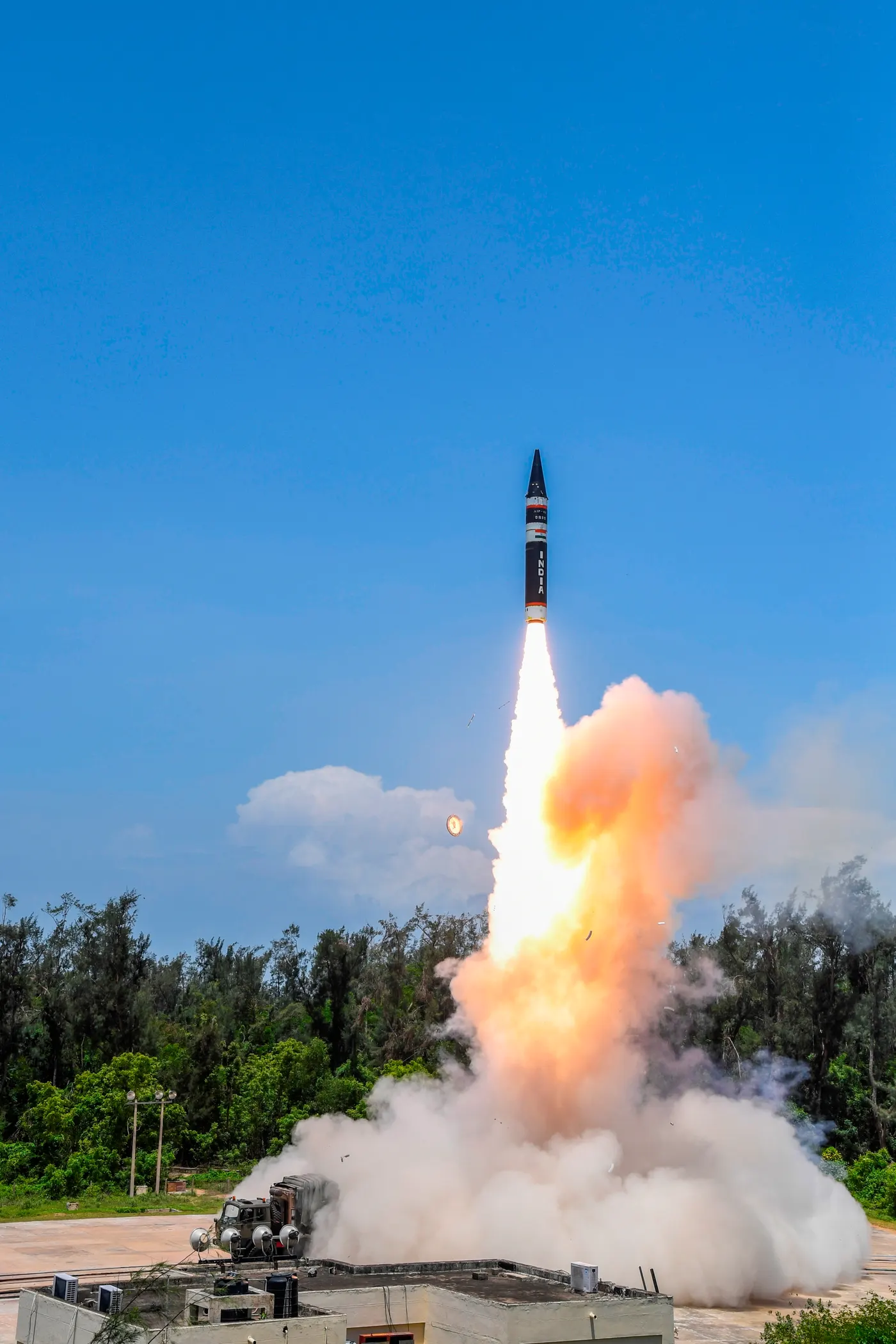

Agni-P (Agni Prime) is a two-stage, solid-fueled medium-range ballistic missile developed by India's Defence Research and Development Organisation (DRDO). It is the sixth missile fielded under the Agni program and the first to be fully canisterized from the outset, a design choice that lets the road-mobile launch vehicle carry a sealed, warhead-mated missile ready to fire on short notice rather than a bare airframe requiring separate assembly.1 DRDO engineers describe it as a new generation system, built around a lighter composite airframe and dual-redundant guidance rather than a straightforward upgrade of an older Agni.2
- Canisterized, fast launch readiness
- Far lighter airframe than the older Agni missiles it replaces
- Dual redundant guidance for high accuracy
- Road and rail-mobile basing
- Multiple successful pre-induction trials
- Range too short to threaten most of mainland China
- No confirmed combat use, deterrence-only role
- Rail-mobile variant still in early testing as of 2026
- Publicly available performance data is thin outside DRDO statements
The Agni-P missile occupies a specific niche in the wider medium-range ballistic missile category, a niche defined by its 1,000 to 2,000 km range band. That places it squarely between the shorter Agni-I and the older Agni-II, both of which it is intended to eventually replace in Indian service.1 Unlike those two missiles, Agni-P was built from the start around solid propellant composite motor cases and a maneuverable reentry vehicle, features earlier tested individually on the longer-range Agni-V and folded here into a smaller, road-and-rail-transportable package.3
First flight-tested on 28 June 2021 from Dr. APJ Abdul Kalam Island off the Odisha coast, Agni-P has since completed a string of successful trials, including night launches in 2023 and 2024 and, in September 2025, the first test of a rail-mobile canister launcher in India's missile program.4,5 It is aimed almost entirely at Pakistan. Its 2,000 km ceiling covers all of Pakistani territory but falls short of reaching most of mainland China, a distinction analysts at the International Institute for Strategic Studies have noted explicitly when assessing the missile's strategic purpose.4
Agni-P's manufacturer, Bharat Dynamics Limited, builds the missile under DRDO's technical direction, following the same design-agency-plus-production-house arrangement used across the Agni family.6 As of 2026, Agni-P's road-mobile configuration is widely reported to have entered service with India's Strategic Forces Command, though New Delhi has never issued the kind of formal induction ceremony announcement it gives newly commissioned ships or aircraft, so exact fielding numbers remain unconfirmed.5,7
Agni-P is a compact missile by the standards of its own family. It measures 10.5 meters long and 1.15 meters in diameter, with a launch weight of roughly 11,000 kg, figures drawn from DRDO's own technical briefings and repeated consistently across Indian defense reporting.1,3 By comparison, the older Agni-III, an intermediate-range missile with roughly double Agni-P's reach, weighs about 48,300 kg at launch.8 Indian press routinely describes Agni-P as 50 percent lighter than Agni-III, but that figure is imprecise. Measured against Agni-III's actual 48-tonne launch weight, an 11-tonne Agni-P is closer to a quarter of the mass, not half, even though the general point (a dramatically lighter airframe for the same design bureau's older intermediate-range missile) still holds.
- Füze SınıfıOrta menzilli balistik füze
- Tasarımcıdefence-research-and-development-organisation
- Uzunluk10,5 m
- Çap1,15 m
- Fırlatma Ağırlığı11.000 kg
- HizmetteEvet
The weight reduction comes chiefly from the motor casing. Both stages use a composite material casing technology matured during Agni-V development, replacing heavier maraging-steel or older composite formulations used on earlier Agni missiles.3 Combined with a more compact airframe and denser packaging of avionics, the result is a missile that DRDO can launch from an 8x8 wheeled transporter-erector-launcher instead of the larger, heavier vehicles Agni-II and Agni-III require.1
- Tahrik Tipikatı yakıtlı
- Kademe Sayısı2
- Yakıt TipiKatı yakıt
- Katı YakıtlıEvet
- KanisterliEvet
Guidance runs on what DRDO calls a dual redundant navigation and guidance system, pairing a ring-laser-gyro inertial navigation platform with a secondary micro inertial navigation unit, reportedly augmented by GPS and India's own NavIC regional satellite system.3 That combination is credited with the missile's reported circular error probable of around 10 meters, an unusually tight figure for a missile in this range class and one that, if accurate, would put Agni-P's terminal accuracy ahead of both Shaheen-II and Ghauri-II, the two Pakistani missiles it is most often measured against.1
- Asgari Menzil1.000 km
- Azami Menzil2.000 km
Agni-P also carries a maneuverable reentry vehicle, described in Indian reporting as using four delta control fins to alter its terminal trajectory during descent.3 The purpose is straightforward, a reentry vehicle that can change course in its last seconds of flight is harder for a ballistic missile defense interceptor to target than one following a fixed, predictable arc. The warhead bay is understood to accept high-explosive, thermobaric, or nuclear payloads, with a payload mass generally reported around 1,500 kg, though DRDO has not published an authoritative figure and outside estimates vary somewhat.1,3
- Dairesel Hata Olasılığı (CEP)10 m
- Güdüm TipiAtaletsel / GPS
- Manevra Kabiliyetli Geri Giriş Aracı (MaRV)Evet
Canisterization is the single design decision that most separates Agni-P from the Agni missiles it will eventually retire. Storing the missile pre-mated to its warhead inside a hermetically sealed canister means far less on-site assembly work before a launch order, better protection from weather and handling damage during years of storage, and a shorter window between a launch decision and an actual liftoff.1,10 It is the same underlying idea behind cold-launch ejection systems used on other canisterized missiles, where the missile is pushed clear of the canister by gas pressure before its main motor ignites, reducing thermal and structural stress on the launch vehicle itself.
- Harp Başlığı Tipinükleer, yüksek patlayıcı, termobarik
- NükleerEvet
- Konvansiyonel KabiliyetliEvet
Canisterization also enables salvo firing, launching more than one missile from the same battery or nearby launchers in quick succession, since each canister is an independently ready round rather than a shared assembly process bottlenecked by one crew.1 For a small nuclear power like India, spreading a limited number of warheads across many independently launchable canisters, rather than a few large, slow-to-prepare missiles, is itself a form of deterrence, since it complicates an adversary's calculation of how many missiles they would need to strike simultaneously to eliminate the force.
- Konuşlanma Şeklikarayolu mobil, demiryolu mobil
- Silo KonuşluHayır
- Karayolu Hareketli (TEL)Evet
- Rayda HareketliEvet
- Denizaltından FırlatılanHayır
- İlk Test2021
DRDO's public discussion of an Agni-I successor dates to at least 2016, when Indian defense reporting described a project then referred to informally as Agni-1P, intended to fold Agni-IV and Agni-V technology into a shorter-range missile.11 A DRDO scientist at the time described the approach as backward integration of technology, taking guidance, propellant, and materials work already proven on the longer-range Agni-IV and Agni-V and applying it to replace the older, less sophisticated Agni-I and Agni-II.11 The program that emerged, formally named Agni-P, represented a deliberate break from simply lengthening or re-engining an existing Agni airframe. DRDO instead built a new, purpose-designed missile around composite motor casings and canister launch from the start, technology that had been validated individually but never combined this way in a medium-range Agni missile.2,3
Regional developments sharpened the case for moving faster. China's continued deployment of the DF-21D and DF-26B anti-ship ballistic missiles through the 2010s, both intended to hold United States and allied carrier battle groups at risk across the Indo-Pacific, fed into Indian planning around a broader, more flexible missile force with a wider range of basing options.11 Agni-P's canisterized, mobile design answers a narrower and more regionally specific problem than those Chinese systems, but the same era of missile modernization across Asia forms the backdrop against which DRDO accelerated its own testing program.

Agni-P first flew on 28 June 2021, launched from a road-mobile canister launcher on Dr. APJ Abdul Kalam Island (also called Wheeler Island) off the Odisha coast. The Arms Control Association's contemporaneous reporting described a clean, by-the-book flight that validated the missile's aerodynamic configuration, guidance package, and canister ejection sequence in a single test.4 A second flight followed on 18 December 2021, validating additional subsystems and reliability data DRDO had not been able to confirm on the first attempt.1
A third test on 21 October 2022 flew the missile to its maximum design range, establishing terminal accuracy data at the far edge of its performance envelope.1 The fourth flight, on 7 June 2023, marked a shift in who was pulling the trigger. Rather than a DRDO-run developmental trial, this was described as the first pre-induction night launch conducted by the users themselves, meaning Strategic Forces Command personnel rather than DRDO scientists ran the test, a milestone Indian defense media described as clearing the path toward formal induction.12 A fifth test followed on 3 April 2024, again at night, again run jointly by Strategic Forces Command and DRDO, and again reported as validating performance data ahead of wider fielding.13
The most consequential test to date came on 24 or 25 September 2025 (reporting varies by a day depending on the outlet, likely reflecting the late-evening local timing of the launch), when DRDO and Strategic Forces Command fired Agni-P from a specially built rail-mobile launcher under what officials described as a full operational scenario.14,7 Indian defense analyst Ajai Shukla's independent reporting on the test noted that a rail-mobile canister launcher lets a missile move across the national rail network, including through tunnels and forested terrain that complicate satellite tracking, offering a survivability advantage over fixed silos or even road convoys that a determined adversary's reconnaissance assets can more easily follow.7 The test placed India in a short list of countries, alongside Russia, China, and North Korea, known to have deployed or tested rail-based ballistic missile launch systems.15,7
Agni-P's naming has occasionally confused observers who encounter Agni-II Prime as well. The two are unrelated programs. Agni-II Prime was a 2010 attempt to extend the older Agni-II with an enlarged first-stage motor and upgraded guidance, a test that ended in a control-system failure and crash shortly after launch. That program was subsequently folded into what became the longer-range Agni-IV, an intermediate-range missile with roughly double Agni-P's reach.16 Agni-P, despite the similar-sounding Prime suffix, is an entirely separate design effort begun years later and aimed at the shorter end of the Agni family's range spectrum rather than the longer end.
Agni-P has never been fired in anger and has no confirmed combat use. Its role is deterrence, and its test and development timeline runs alongside, rather than through, actual India-Pakistan hostilities. The most relevant recent episode is the brief 2025 India-Pakistan conflict, touched off after the April 2025 Pahalgam attack in Indian-administered Kashmir, in which India conducted Operation Sindoor, a campaign of missile and air strikes against targets it said were linked to the attack.17 Agni-P was not part of that strike package, which instead relied on conventional aircraft and precision munitions suited to a limited cross-border campaign. Agni-P's role is nuclear-capable strategic deterrence, and any actual use of it in a future war would represent an enormous escalation beyond anything seen in that conflict.
That timing did not stop Indian and Pakistani commentary from linking the two events. Several outlets described the September 2025 rail-launch test as a pointed signal to Islamabad only months after Operation Sindoor, even though DRDO and Strategic Forces Command framed the launch as a scheduled step in Agni-P's own testing program rather than a direct response to the conflict.18,7 Whether or not the timing was deliberate, the test underscored the same strategic logic analysts had already attached to Agni-P since its first 2021 flight, a missile whose range profile makes sense almost entirely as a Pakistan-focused deterrent, given that it cannot reach most of mainland China.4,7
DRDO has tested Agni-P in two distinct launch configurations rather than as separate named variants. The original configuration, tested from 2021 through 2024, launches from a road-mobile 8x8 wheeled transporter-erector-launcher, the same basic basing concept used for other canisterized Agni missiles.1 The second configuration, first tested in September 2025, launches from a purpose-built rail-mobile platform, intended to give Strategic Forces Command a mobile basing option that does not depend on road networks or fixed launch sites.14,7
Both configurations are understood to use the same missile airframe, guidance package, and canister, differing only in the launch vehicle itself. DRDO has not publicly assigned separate designations to the road-mobile and rail-mobile versions the way some other countries formally distinguish silo, road-mobile, and rail-mobile variants of the same missile under different names, so both are generally referred to simply as Agni-P in Indian defense reporting.7
DRDO has also floated a longer-term follow-on effort, a conventionally armed missile referred to as BM-04, with a stated range around 1,500 km and a boost-glide hypersonic reentry vehicle, shown publicly at a DRDO exhibition in Hyderabad in March 2025.1 BM-04 is a separate, still-early program rather than an Agni-P variant, and it illustrates the same broader shift toward maneuverable, hard-to-intercept reentry vehicles that shaped Agni-P's own design.

Agni-P is operated exclusively by India's Strategic Forces Command, the tri-service organization responsible for India's land-based nuclear deterrent.5 No export customer exists or has been proposed. India's missile technology control obligations under the Missile Technology Control Regime, which India joined in 2016, would in any case make an export sale of a missile in Agni-P's range and payload class extremely unlikely.4
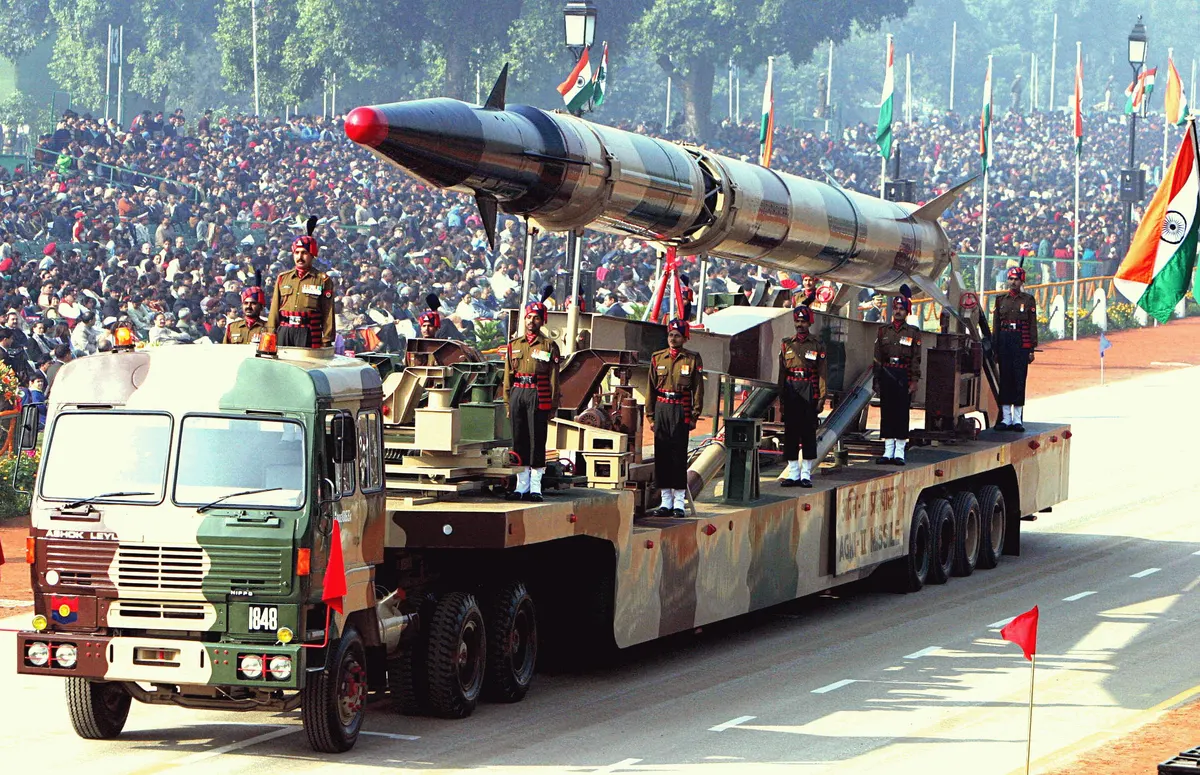
Given the absence of a formal induction ceremony, precise numbers in service are not public. What is publicly confirmed is a program status, the road-mobile configuration has passed the pre-induction night trials that Indian officials describe as clearing the way to service entry, while the rail-mobile configuration remains in a testing phase following its first confirmed launch in September 2025.12,7
Pakistan's Shaheen-II occupies almost the same 1,000 to 2,000-plus km range band as Agni-P, aimed at the same rival from the opposite direction, yet the two missiles solve that shared targeting problem with very different engineering. Shaheen-II is a much larger and heavier missile, at 17.5 meters long, 1.4 meters in diameter, and roughly 25,000 kg at launch, for a broadly comparable range.19 Agni-P covers similar distances at roughly 60 percent of Shaheen-II's length and under half its launch weight, a gap that traces directly to Agni-P's newer composite motor casings and more compact avionics package rather than any difference in the two countries' basic solid-fuel propulsion approach, since both missiles are two-stage solid-fueled designs.19,1
| Missile | Length | Diameter | Launch weight | Range | Propellant | Canisterized |
|---|---|---|---|---|---|---|
| Agni-P (India) | 10.5 m | 1.15 m | ~11,000 kg | 1,000-2,000 km | Solid, 2-stage | Yes |
| Shaheen-II (Pakistan) | 17.5 m | 1.4 m | ~25,000 kg | 1,500-2,000 km | Solid, 2-stage | No |
| Ghauri-II (Pakistan) | 18.0 m | 1.35 m | Not reliably documented | ~2,000-2,300 km | Liquid, single-stage | No |
Pakistan's other missile in this range class, Ghauri-II, offers a different kind of contrast, one of institutional maturity rather than raw dimensions. Ghauri-II descends from North Korea's Nodong-1 design and burns a liquid hypergolic propellant combination rather than solid fuel, a propulsion choice that generally means longer fueling procedures and more demanding storage and handling requirements than a solid-fueled, canisterized missile like Agni-P.20 More tellingly, Ghauri-II has flown only twice, in 1999 and 2004, and Pakistan's military has never assigned it an operational service designation in the two decades since.20 Agni-P, by contrast, has flown at least six confirmed times since 2021 and reached what Indian officials describe as pre-induction status within two years of its first flight, a test tempo and program maturity that Ghauri-II never achieved.
Within India's own arsenal, the relevant comparison is the older Agni-II that Agni-P is meant to eventually replace. Agni-II is a considerably larger missile, roughly 20 meters long and around 17,000 to 18,000 kg at launch, with a somewhat longer stated range of 2,000 to 2,500 km, but it is not canisterized and its launch preparation, while much faster than the earliest Agni prototypes, is still generally described as needing roughly 15 minutes of preparation once a launch order is given, compared to the far shorter window a pre-mated canisterized missile like Agni-P requires.21 The tradeoff India appears to be making across its own missile force is a familiar one, giving up some range and payload margin from Agni-II in exchange for Agni-P's faster reaction time, better mobility, and lower per-unit airframe mass, spread across a larger number of launchers.


Is Agni-P still in service? The road-mobile version is widely reported to have effectively entered service with India's Strategic Forces Command after clearing pre-induction night trials in 2023 and 2024, though the Indian government has not issued a formal public induction announcement of the kind it gives newly commissioned aircraft or ships.12,13
What is Agni-P's range? Agni-P has a publicly stated range band of 1,000 to 2,000 km, positioning it as a medium-range ballistic missile that covers all of Pakistan but not most of mainland China.1,4
How does Agni-P differ from Agni-I and Agni-II? Agni-P is a purpose-built canisterized missile using newer composite motor casings and a maneuverable reentry vehicle, features neither older missile has, and it is meant to eventually replace both Agni-I and Agni-II in Indian service.1,3
Is Agni-P nuclear-capable? Yes. Agni-P can carry nuclear, high-explosive, or thermobaric warheads, and its primary strategic role is nuclear deterrence against Pakistan.9,4
What is Agni-P's unit cost or price? DRDO and the Indian government have not published an official Agni-P unit cost, and reliable independent estimates are not available, unlike some other Indian missile programs where rough cost figures have circulated in defense press.
Who manufactures Agni-P? DRDO designed Agni-P, with production carried out by Bharat Dynamics Limited, the same state-owned firm that produces other Agni-series and Prithvi missiles for Indian service.6
- "Agni-P", Wikipedia — en.wikipedia.org ↩
- "Agni P missile: DRDO successfully tests lighter, deadlier weapon", The Week — theweek.in ↩
- "Agni-P (Prime)", Drishti IAS — drishtiias.com ↩
- "India tests new Agni-P missile", International Institute for Strategic Studies — iiss.org ↩
- "DRDO launches Agni-Prime IRBM from rail-mobile launcher", Broadsword (Ajai Shukla) — ajaishukla.com ↩
- "Bharat Dynamics Limited", Wikipedia — en.wikipedia.org ↩
- "India Just Launched A Ballistic Missile From A Train", The War Zone — twz.com ↩
- "Agni-III", Wikipedia — en.wikipedia.org ↩
- "India Tests New Agni Missile", Arms Control Association — armscontrol.org ↩
- "New Generation Ballistic Missile Agni-Prime successfully flight-tested by Strategic Forces Command & DRDO off the Odisha coast", Press Information Bureau, Government of India — pib.gov.in ↩
- "Agni (missile)", Wikipedia — en.wikipedia.org) ↩
- "Agni Prime Missile Triumphs In First Pre-Induction Night Test, Clearing Path For Induction", Swarajya — swarajyamag.com ↩
- "New Generation Ballistic Missile Agni-Prime successfully flight-tested by Strategic Forces Command & DRDO off the Odisha coast", DD News — ddnews.gov.in ↩
- "India Successfully Launches Agni-Prime Missile from Rail-Based Mobile Launcher", Overt Defense — overtdefense.com ↩
- "On track: India's rail-based Agni-Prime", International Institute for Strategic Studies — iiss.org ↩
- "Agni-IV", Wikipedia — en.wikipedia.org ↩
- "2025 India-Pakistan conflict", Wikipedia — en.wikipedia.org ↩
- "Months after operation Sindoor, India test-fires Agni Prime missile from rail-based mobile platform", India.com — india.com ↩
- "Shaheen-II", Wikipedia — en.wikipedia.org ↩
- "Ghauri-II", Wikipedia — en.wikipedia.org ↩
- "Agni-II", Wikipedia — en.wikipedia.org ↩