

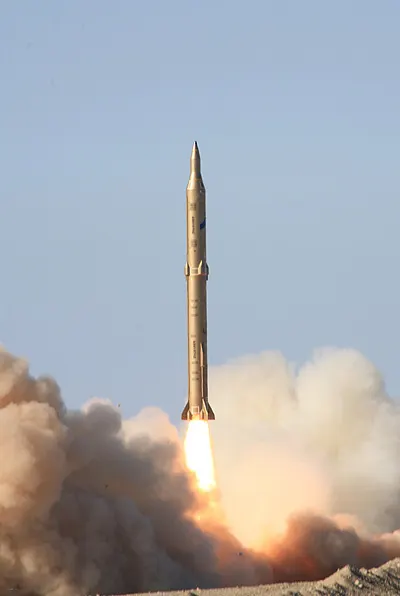

The Sejjil is Iran's first indigenously designed two-stage, solid-propellant medium-range ballistic missile, a technical break from the liquid-fueled Shahab-3 family that had anchored Iranian long-range strike capability since the 1990s. Where Shahab-3 and its derivatives must be fueled at the launch site, a process that can take an hour or more and leaves a missile visibly exposed, the Sejjil's solid-fuel motors arrive from storage already loaded. That single design choice, more than raw range or payload, is what analysts point to when they call the Sejjil program a genuine leap for Iran's missile industry rather than an incremental Shahab upgrade.1,2
- Solid-fuel motors mean launch-ready storage, no pre-launch fueling delay
- Maneuverable reentry vehicle complicates missile-defense intercepts
- Fully indigenous design, not a reverse-engineered foreign missile
- Road-mobile basing improves survivability against preemptive strikes
- Genuine mass-deployment status remains unconfirmed by independent sources
- Publicly reported accuracy (CEP) figures are not authoritatively verified
- Combat use to date has been limited, roughly a handful of confirmed launches
- Program went almost a decade with no publicly observed flight activity
Development is believed to have started in the late 1990s, drawing on solid-propellant work done for the shorter-range Zelzal rocket family, reportedly with early Chinese technical assistance.1 Iran's Ministry of Defense first flight-tested the missile successfully on 13 November 2008, after an unsuccessful precursor launch under the name Ashoura the previous year.2,3 A second round of tests beginning in May 2009 was publicized under the name Sejjil-2, and whether that label describes a genuinely upgraded missile or is simply Iran's own name for continued testing of the original design remains an open question in Western assessments, one this article treats honestly rather than resolving by assertion.4
The Sejjil sits close to a genuine classification boundary. Most range estimates cluster around 2,000 to 2,500 km, which places it inside the medium-range ballistic missile band by the commonly used cutoffs, but some Iranian and press accounts push the figure toward 2,200 km and beyond, brushing against the lower end of intermediate-range territory, the same kind of boundary tension already documented for systems like the Chinese DF-3 on this leaf. Rather than force a single label, this article treats Sejjil as an MRBM by the weight of sourcing while noting the ambiguity plainly.5,6
Iran's IRGC Aerospace Force is the missile's sole confirmed operator, and the Sejjil is manufactured domestically by the Aerospace Industries Organization through its Shahid Bakeri Industries Group subsidiary.7,1 Sejjil specifications, its actual combat record, and the question of whether Iran ever moved the missile from a tested prototype to a genuinely mass-produced weapon are all still debated among missile-proliferation analysts, and this article works through each of those threads in turn.
Composite Solid Propellant and the End of the Fueling Delay
The Sejjil's defining technical feature is its two-stage, solid-propellant rocket motor, a first for an Iranian missile of this range class.1 Liquid-fueled missiles like Shahab-3 need their oxidizer and fuel loaded shortly before launch, a step that both delays the missile from firing on short notice and gives adversary reconnaissance a window to spot launch preparations. A solid-fuel missile like the Sejjil can be stored fully fueled and fired on much shorter notice, a survivability advantage as important strategically as any range or payload number.2 Iranian officials have described the missile's solid propellant as making pre-launch detection considerably harder, a claim that Western analysts broadly accept even where they dispute Iran's other claims about the system.1
- Füze SınıfıOrta menzilli balistik füze
- Hizmete Giriş Yılı2012
- Tasarımcıiran
- Uzunluk18,2 m
- Çap1,25 m
- Fırlatma Ağırlığı22.500 kg
- HizmetteEvet
Length, Weight and a Real Spread in Public Figures
Public sourcing on the Sejjil's physical dimensions is close but not identical across outlets. Widely cited figures put the missile at approximately 18.2 meters long and 1.25 meters in diameter, with a launch weight in the range of 22,500 to 23,600 kg depending on the source.1,2 It carries a conventional high-explosive warhead reported at roughly 700 kg when flown to its longer ranges, rising toward 1,500 kg if flown shorter, the standard range-payload tradeoff for a ballistic missile of this class.1 The missile is fired from a large transporter erector launcher, keeping it road-mobile rather than tied to a fixed silo, which is itself a deliberate survivability choice against a first strike.2
- Tahrik Tipikatı yakıt
- Kademe Sayısı2
- Yakıt Tipikatı
- Katı YakıtlıEvet
Public accuracy figures for the Sejjil are considerably less solid than its size and weight. Some open-source estimates put its circular error probable at only a few tens of meters, but no authoritative government or think-tank source has published a verified CEP for the system, and Western intelligence assessments generally treat any precise accuracy claim for the Sejjil with real caution. Readers should treat any single-figure CEP claim, including any figure that has circulated for this system, as an estimate rather than a confirmed value.
- Asgari Menzil2.000 km
- Azami Menzil2.500 km
- Taşıma Kapasitesi (Throw Weight)700 kg
A Maneuverable Reentry Vehicle Behind the *Dancing Missile* Nickname
Iranian and foreign reporting both describe the Sejjil's reentry vehicle as capable of maneuvering during its terminal descent, altering trajectory in ways that complicate tracking by radar and interceptor systems such as Israel's Iron Dome and Arrow batteries.8 That maneuvering behavior, visible in the missile's wobbling flight path on video, is the origin of the nickname dancing missile that has attached to the Sejjil in recent reporting, particularly after its combat debut in 2025.8 The missile is believed to rely on an inertial guidance package, possibly supplemented by satellite-navigation updates on later-tested rounds, though the degree of upgrade between the original 2008 test article and the missiles fired in 2025 and 2026 is not independently confirmed.9
- Dairesel Hata Olasılığı (CEP)50 m
- Güdüm TipiAtaletsel / GPS
Sejjil Versus Ghadr-110, A Setup-Time Comparison That Matters More Than Range
A useful way to see what solid fuel actually buys Iran is to set the Sejjil beside the Ghadr-110, a hybrid liquid-and-solid Shahab-3 derivative with tighter accuracy (a reported CEP near 300 m against the older Shahab-3's roughly 2,500 m) and a broadly similar range band. Ghadr-110 cut its own launch preparation time to about 30 minutes through a faster-fueling design, a real improvement over the original Shahab-3's multi-hour setup. The Sejjil needs neither that 30 minutes nor any fueling step at all, since its motors are solid from the moment they leave the factory.10,2 That gap, not a difference in warhead size, is the real design distinction between the two missiles.
- Harp Başlığı Tipikonvansiyonel
- NükleerHayır
- TermonükleerHayır
- MIRVHayır
- Harp Başlığı / RV Sayısı1
- Konvansiyonel KabiliyetliEvet
- Konuşlanma Şeklikarayolu mobil
- Silo KonuşluHayır
- Karayolu Hareketli (TEL)Evet
- Denizaltından FırlatılanHayır
- Kullanıcılar1
- İlk Test2008
From the Zelzal Program to a 2007 Failure Under the Ashoura Name
Iran's road to a genuinely indigenous solid-fuel long-range missile ran through the Zelzal family of shorter-range artillery rockets, whose solid-propellant technology of the 1990s is the direct ancestor of the Sejjil's own motors.1 Before the Sejjil name appeared publicly, Iran tested a related design under the name Ashoura, and that November 2007 launch is reported to have failed, a detail that rarely makes it into short summaries of the program but matters for an honest test history.3 Iran's first publicly confirmed successful test of the missile under the Sejjil name came on 13 November 2008, reportedly flying roughly 800 km on a depressed trajectory typical of a test that deliberately avoids demonstrating full range.2,1
Production work on the new missile centered on the Khojir industrial complex east of Tehran, the same site associated with the Shahid Bakeri Industries Group and a separate Hemmat Industries Group, both subsidiaries of the Aerospace Industries Organization handling different stages of Iran's solid and liquid-fuel missile lines.7 That organizational split, solid-fuel work concentrated in one subsidiary and the older liquid-fuel Shahab and Ghadr lines in another, mirrors the technical divide between the Sejjil and the rest of Iran's ballistic missile inventory.
The Sejjil-2 Test Series and an Unresolved Naming Question
Iran conducted a second test in May 2009 that it publicized under the designation Sejjil-2, a name intended to signal improved guidance and navigation over the 2008 article.4 A follow-up launch on 28 September 2009 is reported to have failed, and Iran successfully tested what it called an upgraded Sejjil-2 again on 16 December 2009, with then-Defense Minister Mostafa Mohammad-Najjar calling the missile a strong deterrent and claiming it would be effectively impossible for anti-missile systems to intercept because of its radar-evading flight characteristics, a claim that should be read as Iranian messaging rather than independently verified capability.4 Further tests followed in October 2010 and February 2011, with the CSIS Missile Defense Project counting six flights in the public record and the Arms Control Association's own count reaching seven by early 2011, a discrepancy that itself illustrates how thin outside verification of Iran's missile testing really is.2,11 One of those later flights is reported to have reached roughly 1,900 to 2,200 km, near the top of the range band commonly cited for the type.2,11
Whether Sejjil-2 is a genuinely distinct missile or simply Iran's label for continued testing of the same design is, per the CSIS Missile Defense Project's own assessment, still unresolved in open-source literature.2 This article does not resolve that question either, since no authoritative technical breakdown distinguishing the two has been published outside Iran.
A Decade of Silence, Then a 2021 Reappearance
After the February 2011 test, the Sejjil essentially disappeared from public view for roughly a decade, appearing at military parades but not in any confirmed new flight test, a gap that fed Western skepticism about whether the program had actually reached genuine operational status or had instead stalled after its test campaign.2 Iran's official claimed in-service date for the missile is commonly given as 2012, but that claim sits awkwardly against the near-total absence of independently observed activity for years afterward.2 The missile resurfaced in January 2021 during the Great Prophet 15 IRGC exercises, its first widely reported launch activity in roughly a decade, though even that event added little independently verifiable detail about whether the underlying design had been meaningfully upgraded.13
The Twelve-Day War and Sejjil's Combat Debut
Despite appearing in Iranian military parades since roughly 2012, the Sejjil was not fired in anger until the Twelve-Day War between Iran and Israel in June 2025.14 On 18 June 2025, as part of the twelfth wave of what Iran called Operation True Promise III, the IRGC announced it had launched Sejjil missiles at Israeli targets, marking the type's combat debut nearly seventeen years after its first test flight.14,8 Israeli officials described intercepting the incoming missile, with only fragment damage reported on the ground, though independent confirmation of exactly how many Sejjil units were fired that night, and how many were intercepted versus how many failed on their own, is not available.8
Separately, reporting around the same period described at least one Iranian ballistic missile strike using a cluster warhead with roughly twenty submunitions dispersed across a wide area, though outlets covering the story were not able to confirm the specific missile type responsible, and this article does not attribute that particular payload to the Sejjil without better sourcing.15
Renewed Use in the 2026 Iran War
The Sejjil returned to combat use during the 2026 Iran war, a wider conflict between Iran, Israel, and the United States that began in late February 2026. In March 2026, Iranian state media reported the IRGC had launched a salvo of four Sejjil missiles against Israeli targets as part of what Iran called Operation True Promise IV, describing it as the type's first use in that specific round of fighting and pointing to its claimed roughly seven-minute flight time from Iran's Natanz region to Tel Aviv as evidence of the weapon's strategic reach.16,17
That claimed flight time matters mostly as messaging. Natanz is one of Iran's principal uranium-enrichment sites, and pairing a missile-flight-time claim with that specific location is a deliberate reminder of the exact concern that drove UN Security Council Resolution 1929's ballistic-missile language in the first place, even though the Sejjil itself carries no declared nuclear payload.6
As with the 2025 strikes, the scale, accuracy, and actual battlefield effect of these launches rest heavily on Iranian government statements, and Western reporting on the 2026 Iran war has generally treated Tehran's own casualty and effectiveness claims with the same caution applied throughout the broader conflict. What is not in serious dispute is that, as of these strikes, the Sejjil had moved from a two-decade test-and-parade program into a weapon Iran was actually willing to expend in combat, whatever the true number of rounds available in its inventory.16
Independent estimates of Iran's total Sejjil inventory are not publicly available, unlike the multi-thousand missile estimates commonly cited for Iran's broader Shahab, Zolfaghar, and Fateh-family arsenal. The four-missile figure reported for the March 2026 salvo, alongside the single confirmed launch in June 2025, is the closest thing to a public data point on how many Sejjil rounds Iran is actually willing to commit at once, though it says little about total stockpile size.16
Iran's own public messaging around the Sejjil rarely uses precise, stable variant names, and open-source reporting reflects that same ambiguity.
Sejjil-1 is the informal label some sources apply to the original design tested from 2008, with a commonly cited range around 2,000 to 2,400 km.1 Sejjil-2, as discussed above, may represent either a genuinely improved guidance and propellant package or simply Iran's own name for the 2009-2011 test series of the same basic missile, a distinction that has never been authoritatively settled in Western assessments.2 A third tier, sometimes labeled Sejjil-3, appears only in unconfirmed reporting describing a rumored three-stage missile with a launch weight around 38,000 kg and a maximum range near 4,000 km, pushing well into intermediate-range territory.1 No flight test of any three-stage Sejjil variant has been publicly confirmed, and this article treats the Sejjil-3 figure as an unverified upper-bound claim rather than a demonstrated capability, which is also why the commonly repeated 4,000 km maximum-range figure does not belong to the actually tested Sejjil or Sejjil-2.1

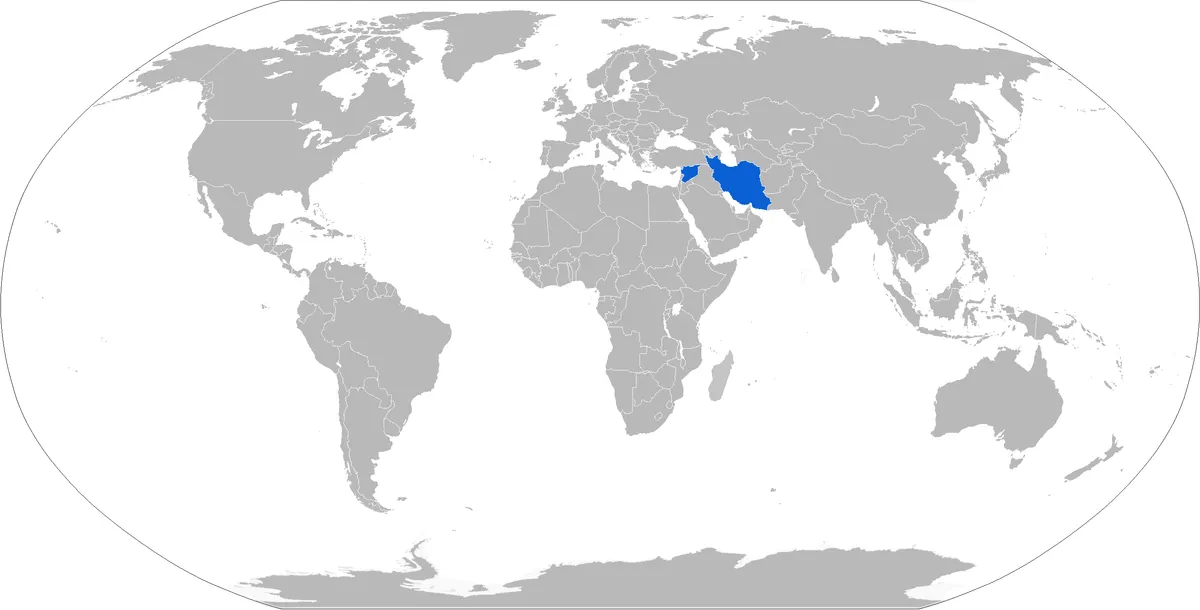
The Sejjil's only confirmed operator is Iran, specifically the IRGC Aerospace Force, which controls Iran's medium- and long-range ballistic missile inventory separately from the regular Islamic Republic of Iran Army.7 No export customer for the Sejjil has ever been reported, and given the missile's status under UN Security Council Resolution 1929 and subsequent US and EU sanctions targeting Iranian ballistic missile technology, an export sale to a third country would be a major, and currently unreported, proliferation event.6,5
Because the Sejjil has never been exported and Iran does not release IRGC unit organization details, any operator outside Iran itself remains purely hypothetical. No sanctioned or embargoed transfer to a third country has ever been reported, despite persistent Western concern over Iranian missile technology reaching allied governments or non-state groups Iran backs across the region.6
The gap between Iran's own claimed 2012 in-service date and the near-decade of publicly invisible activity that followed is itself a comment on how this particular operator relationship has worked in practice. The IRGC Aerospace Force appears to have held the Sejjil in reserve as a demonstrated but rarely used capability for most of the 2010s, only actually committing it to combat once broader war with Israel made that reserve worth spending.2,14
Iran fields the solid-fuel Sejjil and the liquid-and-solid hybrid Ghadr-110 side by side rather than treating one as a straightforward replacement for the other, and the reason is less about range, which overlaps considerably between the two, and more about what each missile is built to do on short notice. Ghadr-110 carries a tighter reported accuracy, a CEP near 300 meters against the far older Shahab-3's roughly 2,500 meters, thanks to a more sensitive inertial guidance package, and it improved on the original Shahab-3's multi-hour launch preparation with a setup time cut to roughly 30 minutes.10 The Sejjil answers a different requirement entirely. Its solid-propellant motors need no fueling step at all, trading some of Ghadr-110's demonstrated accuracy pedigree for a launcher that can fire on far shorter notice and is harder for satellite or drone surveillance to catch mid-preparation.2,10
The Emad missile, another Shahab-3 derivative fitted with a maneuverable reentry vehicle for improved terminal accuracy, sits closer to Ghadr-110 in this comparison than to the Sejjil, since Emad retains the older liquid-fuel first stage rather than adopting Sejjil's composite solid propellant.17 The pattern across Iran's arsenal is consistent. Accuracy improvements have mostly arrived through the liquid-fueled Shahab-3 derivative line, while the true generational leap in launch survivability and readiness belongs to the separate Sejjil program, a division of labor between Iran's two missile families rather than one simply outclassing the other.
| Spec | Sejjil | Ghadr-110 |
|---|---|---|
| Propellant | Two-stage solid1 | Liquid first stage, solid second stage10 |
| Reported range | ~2,000-2,500 km2,11 | ~1,800-2,000 km10 |
| Reported CEP | Not authoritatively confirmed | ~300 m10 |
| Launch preparation | No fueling step required2 | ~30 minutes10 |
Western analysts have generally leaned toward the view that Ghadr-110 carries the longer, more consistent operational track record, while the Sejjil's claimed 2012 in-service date rests more on Iranian statements than on independently observed deployment, at least until its confirmed 2025 and 2026 combat launches finally gave outside observers something concrete to point to.2,14


Is the Sejjil missile still in service? Iran claims an in-service date around 2012, but independent observers saw little confirmed activity for roughly a decade afterward. The clearest evidence of genuine operational status is the missile's confirmed combat use in the 2025 Twelve-Day War and again during the 2026 Iran war.2,14,16
What is the range of the Sejjil ballistic missile? Most credible open-source estimates put Sejjil's range between 2,000 and 2,500 km depending on payload, with a handful of higher figures reported for individual test flights. A widely repeated 4,000 km figure belongs to the unconfirmed, never flight-tested three-stage Sejjil-3 concept, not the tested missile.2,1
Is the Sejjil missile nuclear capable? The Sejjil carries a conventional high-explosive warhead and Iran has never declared a nuclear payload for it. Its range and payload class are exactly the profile UN Security Council Resolution 1929 had in mind when it barred Iran from ballistic missile activity capable of delivering nuclear weapons, language widely understood to cover the Sejjil among other Iranian systems.5,6
Who manufactures the Sejjil missile? Iran's Aerospace Industries Organization developed the Sejjil, with the bulk of manufacturing carried out by its Shahid Bakeri Industries Group subsidiary at the Khojir complex east of Tehran.7,1
How does the Sejjil compare to Iran's Shahab-3 and Ghadr-110 missiles? The Sejjil trades some of the accuracy record built up by the liquid-fueled Shahab-3 and Ghadr-110 line for a solid-fuel motor that needs no pre-launch fueling, making it faster to fire and harder to catch in launch preparation, even though all three missiles cover a broadly similar range band.10,2
What does the Sejjil missile cost? No independently sourced unit-cost figure for the Sejjil has been published. Iran does not disclose missile procurement costs, and Western agencies have not released an estimate specific to this system.
- "Sejjil", Missile Threat, CSIS Missile Defense Project — missilethreat.csis.org ↩
- "Sejjil", Wikipedia — en.wikipedia.org ↩
- "What we know about Tehran's long-range solid-fuel Sejjil missile", The New Arab — newarab.com ↩
- "Iran test fires upgraded Sajjil-2 missile", FDD's Long War Journal — longwarjournal.org ↩
- "Appendix E, Iran's Ballistic Missiles and the Nuclear Deal", Arms Control Association — armscontrol.org ↩
- "United Nations Security Council Resolution 1929", Wikipedia — en.wikipedia.org ↩
- "Shahid Bakeri Industrial Group", NTI — nti.org ↩
- "New missile enters Israel-Iran conflict, what we know about Tehran's Sejil", Euronews — euronews.com ↩
- "Iran fires 1,240-mile range Sejjil ballistic missile in war escalation", Interesting Engineering — interestingengineering.com ↩
- "Ghadr-110", Missile Defense Advocacy Alliance — missiledefenseadvocacy.org ↩
- "Iranian Ballistic Missile Developments, Non-Barking Dog and Dead Monkey", Arms Control Association — armscontrol.org ↩
- "Surat al-Fil", Wikipedia — en.wikipedia.org ↩
- "Sejjil 1/2", Missile Defense Advocacy Alliance — missiledefenseadvocacy.org ↩
- "Twelve-Day War", Wikipedia — en.wikipedia.org ↩
- "Iran just used ballistic missiles with cluster warheads to strike Israel", The War Zone — twz.com ↩
- "Iran Claims One of Its Most Advanced Sejjil Ballistic Missiles Used in New Strike Wave on Israel", Army Recognition — armyrecognition.com ↩
- "Emad, Ghadr, Shahab-3 Variants", Missile Threat, CSIS Missile Defense Project — missilethreat.csis.org ↩