


The Ghadr-110 (also transliterated Qadr-110, meaning Power-110 in Persian) is a road-mobile, liquid-fuelled medium-range ballistic missile built by Iran. It is not a clean-sheet design. The Ghadr-110 is a lengthened, lightened derivative of the Shahab-3, itself Iran's reverse-engineered version of North Korea's No-dong, and it carries the reworked warhead and guidance package that separates the whole late-generation Shahab-3 family from the original 1998 missile.1,2
- Extended range over the parent Shahab-3 from a lighter warhead
- Faster reentry speed complicates missile defense intercepts
- Much shorter launch preparation time (about 30 minutes)
- Produced domestically at scale, unlike Iran's earlier imported missiles
- Liquid propellant means slower fueling and less flexibility than Iran's newer solid-fuel missiles
- Published CEP accuracy (tens of meters to roughly 300 meters depending on source) trails Iran's dedicated precision-strike missiles
- No confirmed government-to-government export customer
- Airframe traces to 1990s No-dong technology, dating the design
Iran's Aerospace Industries Organization (AIO) oversees the program through its ballistic-missile subsidiary, the Shahid Hemmat Industrial Group, at the Hemmat Missile Industries Complex.3 Development began under wraps. The Paris-based opposition group National Council of Resistance of Iran reported in December 2004 that flight testing of a modified Shahab-3 airframe was already underway, and by March 2006 the same source claimed the program was roughly 70 percent complete.4 Iran publicly unveiled the missile at a military parade in September 2007, marking the anniversary of the Iran-Iraq War, presenting it as an upgraded Shahab-3 with a declared range of 1,800 kilometers.5
What makes the Ghadr-110 worth a separate entry from its parent missile is the nose. Iranian engineers replaced the Shahab-3's blunt conical reentry vehicle with a narrower, two-piece shape often described as a baby-bottle or bottleneck cone, a small cylindrical warhead section mounted on a wider skirt that tapers down before meeting the missile body.6 The redesign trims payload volume by roughly a fifth compared to the Shahab-3's warhead bus, and that lighter, denser reentry vehicle both extends range and reenters the atmosphere faster, which narrows the intercept window for missile defense radars and interceptors.7 The same reentry-vehicle shape reappears on Iran's later Emad missile, which is essentially a further-refined guided version of the same bus fitted to a Ghadr or Shahab-3 booster.8
Reported figures place the Ghadr-110 at roughly 15.9 to 16.6 meters long, about 1.25 to 1.38 meters in diameter, with a launch weight near 19 tonnes and a payload in the 650 to 1,000 kilogram range depending on which source and which sub-variant is being described.9 Range estimates cluster around 1,800 to 2,000 kilometers, enough to reach Israel, most of the Arabian Peninsula, and parts of southeastern Europe from launch sites inside Iran.10 The missile remains in active Iranian service and was fired in combat as recently as June 2025. The Ghadr-110 is unambiguously still in service today.11
The Ghadr-110 sits within Iran's broader medium-range ballistic missile (MRBM) inventory alongside newer solid-fuel systems such as the Sejjil and Khorramshahr, but it remains one of the two liquid-fuel long-range missiles, together with the Emad, that Iran keeps in frontline service. Persian-language state media most often refers to the missile simply as Ghadr or by its sub-variant letter, Qadr H, Qadr F, or Qadr S, and Western analysts frequently use Ghadr-110 and Ghadr-1 interchangeably for the same missile family.
Entirely domestically produced by Iran's Aerospace Industries Organization / Shahid Hemmat Industrial Group; built on reverse-engineered North Korean No-dong/Shahab-3 technology but with no further foreign parts or licensing in the Ghadr-110 modification itself.
Ghadr-110 specifications place it as a single-stage, liquid-propellant missile in most specialist assessments, including the Center for Strategic and International Studies' Missile Threat project, which lists the propulsion simply as liquid propellant without naming a second stage.9 This is worth stating plainly because sourcing genuinely disagrees here. Wikipedia's infobox for the missile describes a liquid-fuelled first stage paired with a solid-fuelled second stage, a configuration that would make the Ghadr-110 unusual among Shahab-3 derivatives, most of which (including the Shahab-3 itself) use a single liquid-propellant stage inherited from the No-dong.1 No public technical assessment fully resolves the discrepancy, and it may originate in confusion with the two-stage, all-solid Sejjil, a completely different Iranian missile that is sometimes discussed in the same breath as the Ghadr because both are described as replacing or complementing Shahab-3-class systems.
- Füze Sınıfımrbm
- Uzunluk16,3 m
- Fırlatma Ağırlığı19.000 kg
- HizmetteEvet
The reentry vehicle is the article's real design story. Iran's earlier Shahab-3 used a roughly conical warhead section similar to the original No-dong bus. The Ghadr-110's bottleneck-shaped nose separates the warhead into a slim forward cone and a wider aft skirt, a shape driven by ballistic and structural requirements rather than aerodynamics alone.6 A U.S. intelligence assessment based on a laptop reportedly smuggled out of Iran in 2004 suggested the same reentry-vehicle redesign work was tied to engineering studies for fitting an implosion-type nuclear device into the reduced payload volume, though Iran has always denied any nuclear-weapons application and the missile is fielded today as a conventional-capable system.7 The Ghadr-110 is not counted as nuclear-capable in most independent net assessments the way the original Shahab-3 and Khorramshahr sometimes are.12
- Tahrik Tipiiki kademeli
- Kademe Sayısı1
- Yakıt Tipisıvı ve katı
- Katı YakıtlıHayır
Guidance uses an inertial navigation platform paired with GPS correction, an upgrade over the Shahab-3's purely inertial system, and Iranian sources have claimed accuracy improvements from this package.9 Published circular error probable (CEP) figures vary sharply by source, from roughly 30 to 50 meters in some post-2020 estimates up to around 300 meters in earlier assessments from the mid-2000s, a spread that reflects both genuine improvement over time and the difficulty of independently verifying Iranian accuracy claims for a system that has rarely been used against precisely surveyed, publicly documented targets.13 Either figure is a large accuracy jump over the Shahab-3's roughly 2.5-kilometer CEP, explaining why the Ghadr-110 is treated as Iran's first credible medium-range precision-strike option rather than a pure area weapon.
- Asgari Menzil1.800 km
- Azami Menzil2.000 km
- Taşıma Kapasitesi (Throw Weight)750 kg
Setup time is one of the missile's most-cited operational improvements. Iranian officials and Western trackers alike put the Ghadr-110's launch preparation at around 30 minutes, against several hours for the older Shahab-3, a difference driven by airframe lightening and a redesigned transporter-erector-launcher rather than any change in propellant handling procedure (the missile is still fueled with storable liquid propellants, not the instant-launch solid motors used by Iran's Sejjil or Fateh-family missiles).9 The missile is road-mobile, launched from wheeled transporter-erector-launchers rather than fixed pads, though the road-mobile label alone undersells how Iran actually garrisons the type. Since the mid-2010s, Iranian state media has periodically released footage of tunnel networks dug into mountainsides, the so-called missile cities, that store Ghadr, Emad, and other long-range missiles on their launch vehicles underground between drills, driving them out to the surface only to fire.14 That storage model is distinct from a fixed underground silo (the vertical, in-ground launch tubes reported at sites such as Haji Abad appear to house Iran's shorter-range solid-fuel Zolfaghar and Dezful family instead), so describing the Ghadr-110 as road-mobile with hardened underground basing, rather than silo-based in the classic sense, better matches the open-source record.15
- Dairesel Hata Olasılığı (CEP)40 m
- Güdüm TipiAtaletsel / GPS
- Manevra Kabiliyetli Geri Giriş Aracı (MaRV)Hayır
- Harp Başlığı Tipikonvansiyonel
- NükleerHayır
- TermonükleerHayır
- MIRVHayır
- Harp Başlığı / RV Sayısı1
- Konvansiyonel KabiliyetliEvet
- Konuşlanma Şeklikarayolu mobil
- Silo KonuşluHayır
- Karayolu Hareketli (TEL)Evet
- Rayda HareketliHayır
- Denizaltından FırlatılanHayır
- Kullanıcılar1
- Patlayıcı Dolgu TipiBir
The Ghadr-110's development runs directly through the Shahab-3, which itself derives from North Korea's No-dong missile acquired by Iran in the 1990s. Where the baseline Shahab-3 reached roughly 1,300 to 1,500 kilometers with a heavier warhead, Iranian engineers spent the early 2000s reworking the airframe and reentry vehicle to squeeze out more range without a larger booster, since a wider or longer rocket motor would have required retooling Iran's limited liquid-engine production line.2 The Ghadr-101 designation is sometimes used for an intermediate airframe in this process, with Ghadr-110 marking the finalized, publicly displayed configuration.
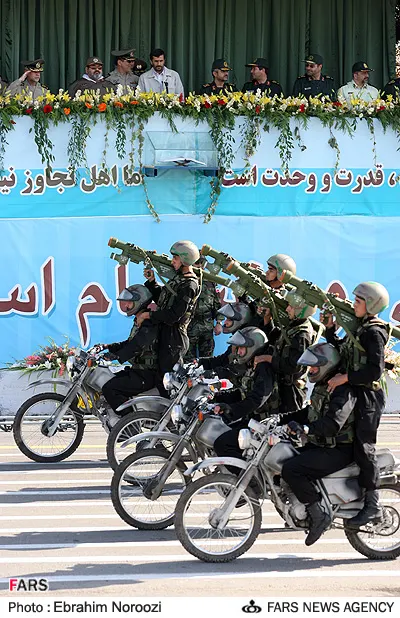
Iran unveiled the Ghadr-110 in September 2007 at a parade commemorating the outbreak of the Iran-Iraq War, presenting it alongside older Shahab-3 variants as evidence of an expanding domestic missile-production base.5 A widely reported test firing followed on November 21, 2015, with an apogee and range profile consistent with the Ghadr-110, an event the United States flagged as inconsistent with United Nations Security Council Resolution 2231's call for Iran to refrain from work on missiles designed to be capable of delivering nuclear weapons.17 Iran's foreign ministry rejected that framing outright, arguing that a missile carrying only conventional payloads cannot violate a resolution aimed at nuclear-capable systems, and Russia's UN delegation separately argued the resolution's non-binding wording made the word violation the wrong legal term regardless.17 A further test was reported in January 2017. Neither test drew a formal UN Security Council sanctions response, reflecting the same legal ambiguity.
Combat use began well outside Iranian territory. In November 2023, Israel's Arrow-3 exo-atmospheric interceptor scored its first confirmed combat kill against a missile fired by Yemen's Houthi movement toward Eilat, a launch multiple trackers identified as a Ghadr-110 or its Ghadr-F sibling, part of a wider Houthi ballistic-missile campaign against Israel during the Red Sea crisis.18 Analysts have noted the missile fired by the Houthis is functionally identical to the Iranian-declared Ghadr-F, underscoring Iran's role as the missile's only credible source given Yemen has no domestic long-range missile production of its own.19
The missile's largest confirmed combat employment came during the June 2025 Iran-Israel war, known on the Iranian side as Operation True Promise III. Iran launched over 150 ballistic missiles at Israel across multiple waves beginning June 13 to 14, 2025, with the Ghadr-110 named by multiple outlets among the leading systems used alongside the Khorramshahr and Sejjil.20 Iran's Islamic Revolutionary Guard Corps publicly confirmed use of the Qadr-H variant specifically during the campaign, its first acknowledged combat firing of that sub-type.21 Israel's military claimed it destroyed Ghadr-class missiles and their transporter-erector-launchers in strikes on facilities near Isfahan as part of a broader campaign against Iranian missile infrastructure during the same war.22
The Ain al-Asad airbase strike of January 2020, Iran's direct retaliation for the killing of Qassem Soleimani, is frequently and incorrectly associated with the Ghadr-110 in casual references. Open-source damage assessments and recovered missile debris instead identified the weapons used against 2020 Iranian attack on U.S. forces in Iraq as Qiam-1 short-range ballistic missiles and Fateh-313 precision-guided missiles, both shorter-ranged, solid or storable-fuel systems better suited to the roughly 400-kilometer distance from Iranian launch sites to the base in Iraq than a medium-range system built for targets 1,800 kilometers away.23 No credible reporting places the Ghadr-110 at Ain al-Asad, and the two strikes are worth distinguishing clearly for anyone researching either missile.
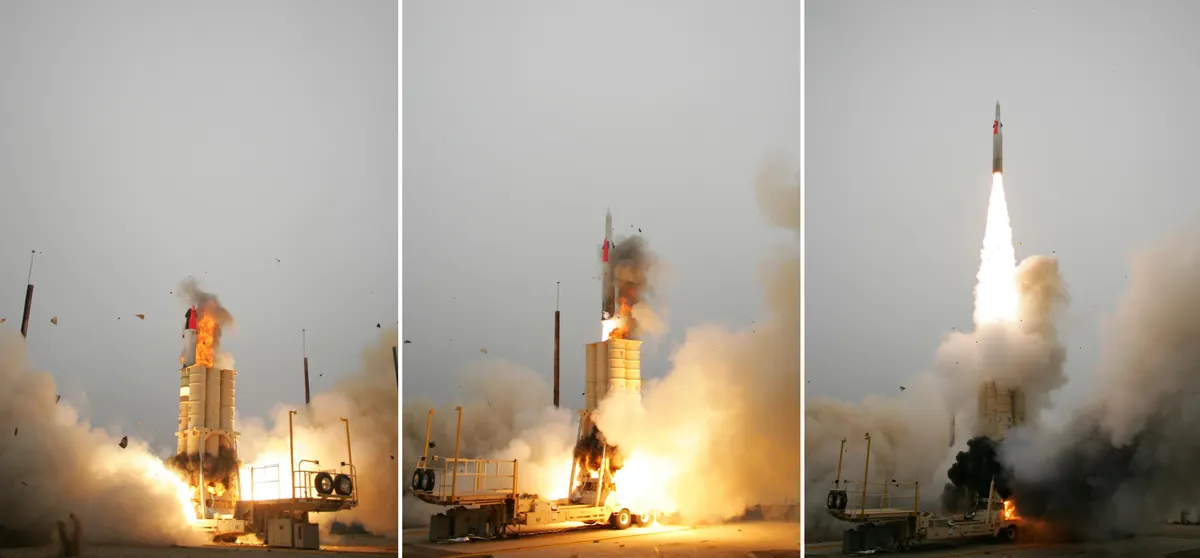
The Ghadr-110's real combat record runs through Israel instead. Houthi forces in Yemen, equipped through Iranian supply lines, have launched Ghadr-class missiles (reported as the Ghadr-F sub-variant) at Israeli territory multiple times since late 2023 as part of the Red Sea crisis escalation that followed the Gaza war, with the November 2023 Arrow-3 intercept over Eilat the first of several such engagements.18
The missile's largest declared use remains Operation True Promise III in June 2025, when Iran fired Ghadr-110 and Qadr-H missiles directly from Iranian territory at Israeli cities and infrastructure during the broader Iran-Israel proxy conflict escalation into open warfare, drawing Israeli strikes on Iranian missile production and storage sites, including reported hits on Ghadr launchers and support infrastructure near Isfahan.22
Taken together, these episodes give the Ghadr-110 a genuine, if unusual, combat record for an Iranian medium-range missile. Its confirmed uses have all come either in the hands of an Iranian proxy force or in a direct state-on-state exchange with Israel, never in a conflict involving Western ground forces, which is why casual conflation with the Ain al-Asad strike is worth correcting rather than repeating.
Iran markets the Ghadr-110 family under at least three named sub-variants, distinguished mainly by declared range and, implicitly, by warhead mass traded against fuel load. Qadr S reaches roughly 1,350 kilometers, Qadr H roughly 1,650 kilometers, and Qadr F roughly 1,950 kilometers, the longest-ranged of the group and the version most often associated with the missiles supplied to Houthi forces in Yemen.10 Western trackers do not always agree on which letter corresponds to which exact configuration, and Iranian state media has used the variant names inconsistently across different parades and announcements. That inconsistency is itself a useful caution against treating any single Ghadr-110 specifications table as definitive.
The Emad missile is best understood as the next design generation built on the same reentry-vehicle concept rather than a Ghadr sub-variant proper. Where the Ghadr-110 uses an unguided (or only lightly steerable) reentry vehicle, the Emad adds actual maneuvering fins to the warhead section for terminal guidance, a genuine accuracy upgrade over the Ghadr line that Iran unveiled in 2015.8 Some open-source treatments describe Emad as simply a new reentry vehicle bolted onto a Ghadr or Shahab-3 booster, a reasonable shorthand for how closely the two missiles share hardware.

Iran is the Ghadr-110's only confirmed state operator, fielded by the Islamic Revolutionary Guard Corps Aerospace Force since roughly 2007.5 No government-to-government export or transfer agreement has been publicly confirmed for the missile. The force's commander, Brigadier General Amir Ali Hajizadeh, has personally appeared in state-media footage touring the underground tunnel complexes where Ghadr-class missiles and their launch vehicles are stored, a recurring piece of Iranian deterrence messaging aimed as much at domestic and regional audiences as at any specific adversary.25

The Houthi movement in Yemen has fired missiles Western analysts and Israeli officials identify as Ghadr-class (most often the Ghadr-F variant), but this reflects Iranian materiel and technical support to a non-state armed group rather than a formal state acquisition, and Yemen itself has no confirmed Ghadr-110 inventory of its own.19
Reports of Hezbollah fielding a related long-range missile near Tel Aviv in 2024 likewise describe supplied hardware rather than an independent Lebanese state acquisition. No Arab state, and no country outside Iran's own axis of aligned armed groups, is confirmed to hold the Ghadr-110 in inventory, which keeps operator diversity for this missile far narrower than for widely exported Cold War-era ballistic missiles.
The Ghadr-110's closest domestic point of comparison is its own stablemate, the Sejjil, and the pairing illustrates a real Iranian procurement choice rather than a marginal spec difference. Iran developed the two missiles broadly in parallel through the 2000s, one refining the existing liquid-fuel Shahab-3 bloodline (the Ghadr-110), the other building a wholly new two-stage, all-solid-propellant airframe from scratch (the Sejjil). Solid propellant is pre-loaded and stable for long-term storage, which is why the Sejjil can launch in minutes rather than the Ghadr-110's roughly 30-minute preparation window, and why most defense analysts expect Iran's future medium-range force to lean more heavily on solid-fuel systems like Sejjil and Khorramshahr over time. The Ghadr-110 persists in frontline service anyway because Iran's liquid-engine production base is mature, the missile is comparatively cheap to build at scale, and its declared 1,800 to 2,000-kilometer range is a known, combat-tested quantity, while the Sejjil has seen far less confirmed operational use.
| Missile | Propulsion | Declared range | First confirmed combat use |
|---|---|---|---|
| Ghadr-110 | Liquid, single-stage | 1,800-2,000 km10 | Nov. 2023 (Houthi launch, Arrow-3 intercept)18 |
| Sejjil | Solid, two-stage | ~2,000-2,500 km24 | June 2025 (Iran-Israel war)20 |
Against the Emad missile, the comparison is less about range and more about terminal accuracy. Both missiles trace to the same bottleneck-shaped reentry vehicle, but the Emad adds actual maneuvering surfaces to steer the warhead during reentry, while the Ghadr-110's reentry vehicle is essentially ballistic once released. That makes the Emad the more precise of the two for a given target, at the cost of extra guidance-package complexity, while the Ghadr-110 remains the more numerous, more thoroughly combat-proven of Iran's liquid-fuel medium-range missiles. For a reader comparing Ghadr-110 vs Emad, the practical answer is that Iran treats them as complementary rather than as a straight replacement, still building and firing both well into the 2020s.


Is the Ghadr-110 still in service? Yes. Iran fired Ghadr-110 and Qadr-H missiles at Israel during the June 2025 Iran-Israel war, and the missile remains part of the Islamic Revolutionary Guard Corps' active medium-range inventory.11
What is the Ghadr-110's range? Most assessments place it between 1,800 and 2,000 kilometers, with named sub-variants (Qadr S, Qadr H, Qadr F) declared at roughly 1,350, 1,650, and 1,950 kilometers respectively.10
What caliber or fuel does the Ghadr-110 use? As a ballistic missile it has no caliber in the small-arms sense. It burns storable liquid propellant, most specialist assessments describe a single propulsion stage, though some sources describe a liquid first stage and solid second stage, a genuine point of disagreement in open-source reporting.9,1
Who manufactures the Ghadr-110? Iran's Aerospace Industries Organization, through its Shahid Hemmat Industrial Group subsidiary, designs and builds the missile domestically.3
Was the Ghadr-110 used in the January 2020 Ain al-Asad attack? No. That strike used Qiam-1 and Fateh-313 missiles. The Ghadr-110's first confirmed combat firing came later, in November 2023.23,18
What does the Ghadr-110 cost? Open wartime cost estimates from 2025 place Iran's Ghadr-110-class missiles in the 5 to 8 million dollar range per unit.16
- "Ghadr-110", Wikipedia — en.wikipedia.org ↩
- "Shahab-3", Wikipedia — en.wikipedia.org ↩
- "Iran's Missile Milestones", Iran Watch — iranwatch.org ↩
- "Clandestine Missile Projects of the Iranian Regime", Iran Watch / National Council of Resistance of Iran report — iranwatch.org ↩
- "Sejjil/Ghadr-110", GlobalSecurity.org — globalsecurity.org ↩
- "Ghadr -110", Missile Defense Advocacy Alliance — missiledefenseadvocacy.org ↩
- "Iran Missiles Nuclear Capable", International Institute for Strategic Studies — iiss.org ↩
- "Emad, Ghadr (Shahab-3 Variants)", Missile Threat, CSIS — missilethreat.csis.org ↩
- "Emad, Ghadr (Shahab-3 Variants)", Missile Threat, CSIS (specifications table) — missilethreat.csis.org ↩
- "Ghadr -110", Missile Defense Advocacy Alliance (variant ranges) — missiledefenseadvocacy.org ↩
- "IDF destroys Ghadr missiles at Isfahan, pushing toward hunting down 400 ballistic missile launchers", The Jerusalem Post — jpost.com ↩
- "Iran Missiles Nuclear Capable", International Institute for Strategic Studies (nuclear-capability assessment) — iiss.org ↩
- "Ghadr-110", Wikipedia (CEP estimates) — en.wikipedia.org ↩
- "Iran Shows Off Underground 'Missile City'", The War Zone — twz.com ↩
- "Silo mentality, Iran's Haji Abad missile base", International Institute for Strategic Studies — iiss.org ↩
- "The Price of Escalation: Accounting for the Military Costs of the 2025 Israel Iran Conflict", Gulf Research Center — grc.net ↩
- "Security Council Debates Latest UN Report on Resolution 2231", Arms Control Association — armscontrol.org ↩
- "In first, Arrow downs Eilat-bound missile from 'Red Sea area'; Houthis claim attack", The Times of Israel — timesofisrael.com ↩
- "Analysis: Houthi targeting of Israel suggests new, longer-range missile in play", Breaking Defense — breakingdefense.com ↩
- "Iran Just Used Ballistic Missiles With Cluster Warheads To Strike Israel", The War Zone — twz.com ↩
- "Tehran claims success in latest missile barrage against Israel amid rising tensions", The Jerusalem Post — jpost.com ↩
- "IDF destroys Ghadr missiles at Isfahan, pushing toward hunting down 400 ballistic missile launchers", The Jerusalem Post — jpost.com ↩
- "Iranian operations against el-Asad and Erbil bases: what can be learned from the imagery? Part One", Foundation for Strategic Research — frstrategie.org ↩
- "Missiles of Iran", Missile Threat, CSIS — missilethreat.csis.org ↩
- "Iran Unveils Latest Massive Underground Missile Facility", Foundation for Defense of Democracies — fdd.org ↩