

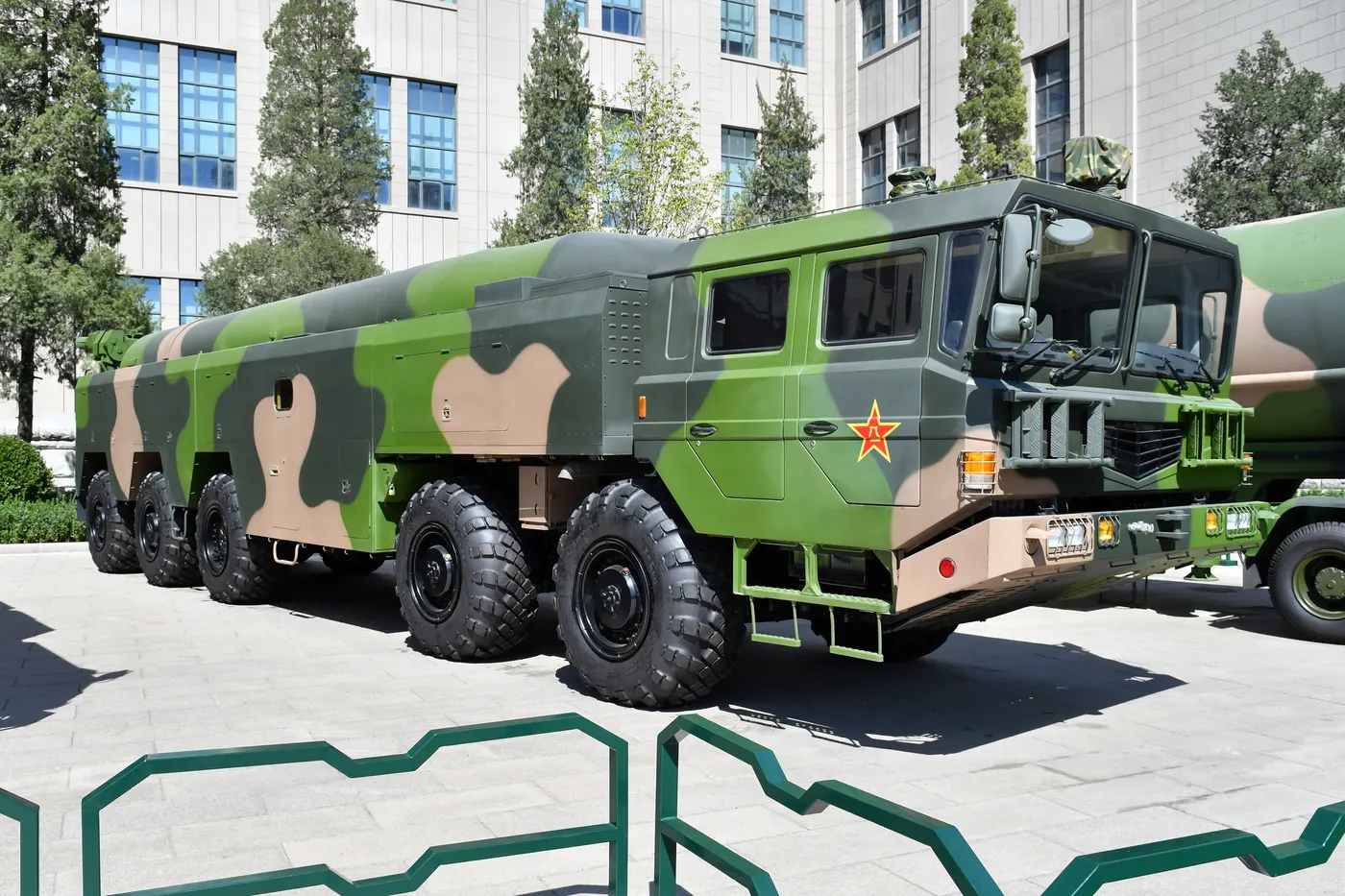

China's DF-16 (Dongfeng-16, NATO reporting name CSS-11) is a road-mobile, two-stage, solid-fuel ballistic missile built to close the capability gap between the short-range DF-11 and DF-15 (roughly 300 to 600 km) and the much longer-reaching DF-21 family (up to around 2,500 km).1 It sits at the boundary between what most catalogs class as a short-range ballistic missile and a medium-range ballistic missile, and the archive follows the dominant Western sourcing in classifying it as the latter. The PLA Rocket Force fields the DF-16 to reach targets across the Taiwan Strait, Okinawa, and northern Vietnam with a heavier payload and tighter accuracy than the older DF-11/DF-15 pair, while its combination of range, a maneuvering warhead, and terminal guidance makes it harder for missile defenses to intercept than its predecessors.2
- Terminal guidance with a maneuvering reentry vehicle
- Larger 500-1,000 kg payload class than DF-11/DF-15
- Road-mobile WS2500 TEL, hard to target preemptively
- Reported CEP in the single-digit meters
- Range (800-1,000 km) still short of DF-21's reach
- No confirmed combat use to validate real-world accuracy
- Designer attribution and cold-launch status remain disputed in open sources
- Nuclear-capable design reported but never confirmed as deployed
The missile is a China Aerospace Science and Industry Corporation (CASIC) program, developed by the corporation's Sanjiang Space Group (also known as Base 066), a detail that gets blurred in casual reporting because a different state conglomerate, the China Academy of Launch Vehicle Technology, later built the DF-17 hypersonic system around a modified DF-16 booster.3 Development reportedly began in the 2000s, and the missile carried the informal internal label DF-11C before analysts recognized it as a genuinely separate design.1

China first showed the DF-16 publicly on 3 September 2015, during the parade marking the 70th anniversary of victory over Japan, though Taiwanese defense assessments had already concluded the missile reached operational status years earlier.4 Western estimates place its range at 800 to 1,000 km, not the 1,600 km figure sometimes attached to it in secondary write-ups, an error traceable to confusion with the derivative DF-17 program.1 The DF-16 remains exclusive to the PLA Rocket Force as of the most recent open-source assessments, with no export or third-party transfer reported anywhere in Western intelligence literature.2
Search interest in DF-16 specifications, DF-16 range, and whether the DF-16 is nuclear capable reflects genuine ambiguity in the public record. What follows separates what is solidly sourced (the two-stage solid-fuel design, the WS2500 launcher, the 2015 parade debut) from what remains contested (cold-launch status, precise CEP, and the missile's exact designer).
Two-Stage Solid-Fuel Design and the WS2500 Transporter-Erector-Launcher
The DF-16 is a two-stage, solid-fuel missile with a body diameter of roughly 1.2 meters, noticeably thicker than the DF-11's airframe.5 Solid propellant lets the PLA Rocket Force keep the missile fueled and ready for extended periods, unlike older liquid-fuel Chinese systems that required fueling shortly before launch. No consistent, well-sourced figure for overall missile length or total launch weight exists across CSIS, Sinodefence, GlobalSecurity, or Wikipedia, so none is asserted here rather than guessing.
- Füze Sınıfımrbm
- TasarımcıSanjiang Space Group (CASIC, Base 066)
- Çap1,2 m
The missile rides on the WS2500, a five-axle, ten-wheeled transporter-erector-launcher built within the Sanjiang/CASIC corporate family, larger and heavier than the four-axle TEL that carries the DF-11.5 The TEL erects the missile to vertical before launch directly off its own bed. Whether the DF-16 uses true cold-launch ejection, where a gas generator pops the missile clear of the tube before the main motor ignites, is disputed. Wikipedia's Dongfeng missile article states the DF-16 is launched from a TEL similar to the DF-21's, but uses a new protective shell to cover the missile instead of a cold-launch storage tube, which reads as a departure from true cold-launch practice rather than a confirmation of it.4 Other open sources are silent on the point.
- Kademe Sayısı2
- Katı YakıtlıEvet
- Soğuk FırlatmaHayır
- KanisterliEvet
The missile is canisterized in the sense that it travels and launches under a protective covering rather than exposed on the TEL bed, whichever specific mechanism that covering represents.4 This is consistent with the general PLA Rocket Force shift toward canisterized, road-mobile solid-fuel systems across the DF-11 through DF-21 family, reducing preparation time and making individual launchers harder to find and strike before they fire.
- Asgari Menzil800 km
- Azami Menzil1.000 km
Guidance, MaRV Terminal Seeker, and CEP Precision Estimates
The DF-16 combines inertial navigation with satellite guidance (GPS/BeiDou) for midcourse correction, then hands off to a radar or optical terminal seeker paired with a maneuverable reentry vehicle in the terminal phase.6 The warhead itself uses a bi-conic shape that leaves room for growth toward more specialized terminally-guided or deep-penetrating payload variants, a detail Wikipedia's Dongfeng article highlights as part of the design's flexibility.4 Defense-industry analyst Sinodefence cites a circular error probable (CEP) as tight as roughly 5 meters, while more conservative aggregations describe single-digit-to-low-double-digit meter accuracy.5 If the tighter figure holds up, the DF-16 would rank among the most accurate ballistic systems in China's inventory, precise enough for point strikes against airbases, radar installations, and other hardened, high-value fixed targets rather than only area targets.
- Dairesel Hata Olasılığı (CEP)10 m
- Güdüm TipiAtaletsel / GPS
- Terminal GüdümEvet
- Manevra Kabiliyetli Geri Giriş Aracı (MaRV)Evet
Payload estimates run from roughly 500 kg at the conservative end to as much as 1,000-1,500 kg in some aggregated sourcing, a meaningfully heavier throw-weight than the DF-11 or DF-15 carry.1 Warhead options reported for the DF-16 include a high-explosive unitary charge, a submunition/cluster payload, and a bunker-penetrating variant for strikes on hardened bunkers and runways.1 Wikipedia's Dongfeng article also describes the DF-16 as capable of carrying a nuclear warhead, though no authoritative source confirms it is actually fielded in a nuclear role, so it stands as a reported design capability rather than a confirmed deployed mission.4 Claims that the DF-16 carries multiple independently targetable reentry vehicles are unsupported and likely a confusion with China's larger ICBM-class systems, and are excluded here.
- Harp Başlığı Tipiconventional unitary, submunition, and bunker-penetrating payloads; nuclear-capable design reported but not confirmed deployed
- NükleerHayır
- MIRVHayır
- Konvansiyonel KabiliyetliEvet
Range at 800-1,000 km, Not the 1,600 km Sometimes Quoted
CSIS Missile Threat, the Missile Defense Advocacy Alliance, GlobalSecurity, and Wikipedia converge on an 800 to 1,000 km range for the DF-16, sometimes stretched to 800-1,500 km in secondary aggregator write-ups.1 A handful of Taiwanese press reports claim up to roughly 1,200 km for maneuvering-warhead variants, but no reputable primary source backs a range anywhere near 1,600 km for the base DF-16.7 That higher figure belongs to the DF-17 hypersonic glide vehicle system, which shares a booster stage with the DF-16 family but reaches 1,600 to 2,500 km thanks to its glide vehicle's flight profile, a distinction covered further under Variants below.8
- Konuşlanma Şekliroad-mobile (WS2500 10x10 TEL)
- Silo KonuşluHayır
- Karayolu Hareketli (TEL)Evet
- Rayda HareketliHayır
- Denizaltından FırlatılanHayır
From the DF-11C Misidentification to the 2015 Victory Day Parade
Sanjiang Space Group, operating as Base 066 within CASIC, reportedly began development of the DF-16 in the 2000s as a next-generation solid-fuel missile intended to modernize and extend China's DF-11/DF-15 family of shorter-range systems, with an emphasis on accuracy over raw range.3 Analysts initially mistook early evidence of the program for a variant of the existing DF-11, temporarily labeling it DF-11C before recognizing it as a distinct missile with its own airframe and guidance package.4 The first images of the system appeared on Chinese websites in September 2012, around the same period Jane's Strategic Weapon Systems began reporting on it.4
China's first official, public confirmation of the DF-16 came on 3 September 2015, when the missile and its WS2500 launcher rolled through Beijing's Victory Day parade marking the 70th anniversary of Japan's defeat in the Second World War.4
The parade appearance ended years of Western analysts relying on grainy 2012-era website photographs and secondhand Taiwanese defense assessments for any concrete sense of the DF-16's shape, giving open-source trackers their first clear look at the missile alongside its WS2500 launcher in one frame.
The February 2017 Video and the Finned Maneuvering Warhead
A PLA exercise video that surfaced in February 2017 showed a DF-16 variant fitted with a distinctly finned maneuvering warhead, a configuration analysts had not previously observed on the system.4 Roughly a year later, on 9 January 2018, PLA Daily released test-fire imagery that several Western outlets initially linked to the DF-16, though the missile in the footage appeared closer in profile to the older DF-11, and the specific type shown was never conclusively confirmed.7 That ambiguity is a useful reminder that not every Chinese short-range missile test reported in Western media can be confidently attributed to the DF-16 specifically.
PLA Rocket Force Base 61 and the 617th Brigade in Zhejiang
The DF-16 is fielded by PLA Rocket Force Base 61, assigned to the Eastern Theater Command, with the 617th Brigade based at Jinhua in Zhejiang province specifically tasked with covering northern Taiwan.9 Other reporting places additional DF-16 brigades in Guangdong province, extending coverage toward Taiwan and northern Vietnam.

Deployment numbers vary across sources, GlobalSecurity cited 12 to 16 launchers as of March 2017, while CSIS's own tracking shows growth from roughly 12 launchers in 2017 to about 36 by 2021, with some aggregated estimates suggesting a total inventory approaching 50 missiles.1 These higher aggregate figures should be treated cautiously given the lack of a clearly identifiable primary source behind them.
The Pentagon's 2016 China Military Power report assessed that the DF-16, layered alongside the already-deployed conventional DF-21C, would improve China's ability to strike not only Taiwan but other regional targets, a category that includes Okinawa and the American bases stationed there, along with facilities in the Philippines.10
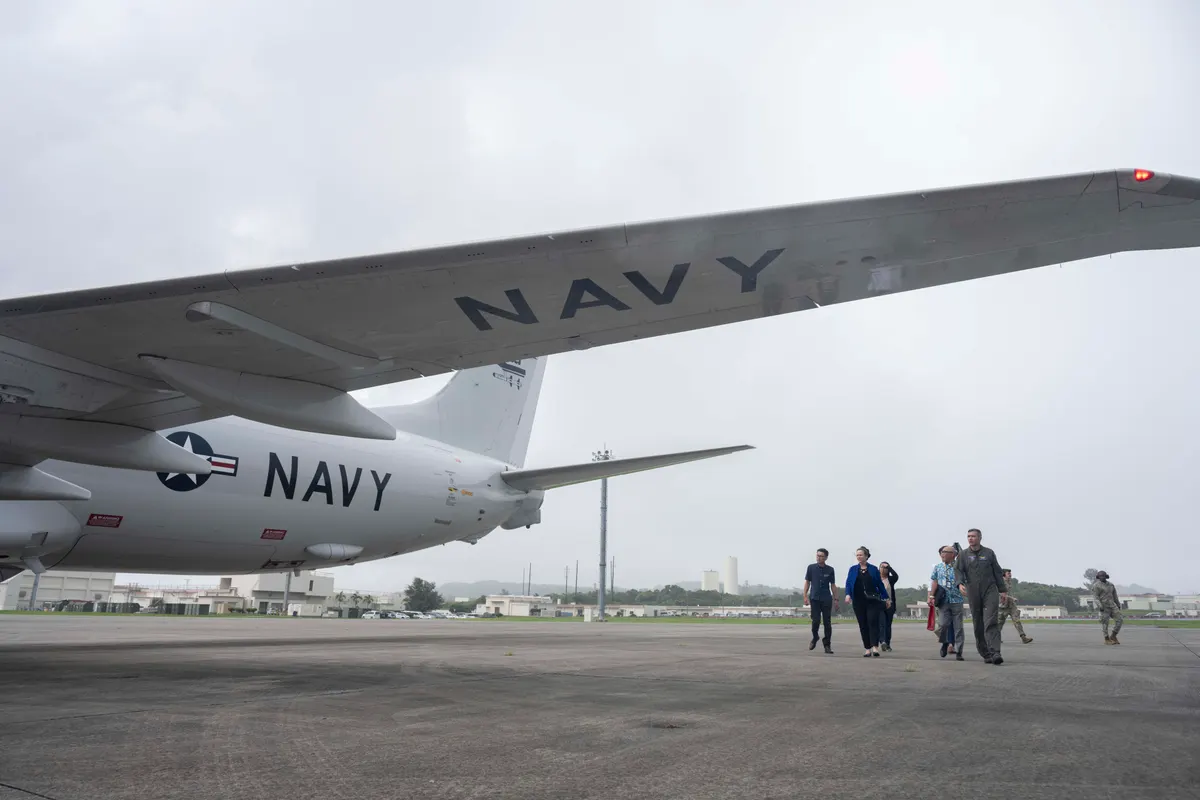
That reach is what places the DF-16 squarely within the broader Chinese strategy of complicating any allied response inside the first island chain, using range, accuracy, and warhead maneuverability together to make interception by systems like the American PAC-3 harder than it was against the older DF-11 and DF-15.1
Guam, which sits well beyond 1,000 km from mainland China, falls outside the DF-16's reach entirely and remains a mission reserved for the longer-legged DF-21 and DF-26, a distinction worth keeping in mind when the two missile families get lumped together in casual coverage of Chinese regional strike capability.
The Fourth Taiwan Strait Crisis and What Actually Flew in August 2022
During the Fourth Taiwan Strait Crisis in August 2022, following then-Speaker Nancy Pelosi's visit to Taiwan, the PLA Rocket Force fired 11 Dongfeng-series ballistic missiles into waters around the island as part of large-scale exercises.11 The missiles specifically identified in that barrage were DF-15B variants, not the DF-16, so it is not accurate to describe the DF-16 as having been fired during the 2022 crisis.
The correct framing is that DF-16 brigades sit within the same Eastern Theater Command force structure that conducted those 2022 exercises and remain assigned to cover Taiwan, without the DF-16 itself having a confirmed operational firing in that specific crisis.
The CSS-11 Mod 1, Mod 2, and the DF-16B Booster
The baseline CSS-11/DF-16 carries a unitary conventional warhead with maneuvering reentry vehicle terminal guidance.4 A CSS-11 Mod 1 variant adds an improved maneuvering warhead package. A further CSS-11 Mod 2, also referred to as the DF-16B, introduced the finned maneuvering warhead first seen in the February 2017 exercise footage described above.4 The DF-16B's booster stage is the piece that matters most for the missile's legacy beyond its own program.
DF-17, the Hypersonic Glide Vehicle Built on the DF-16B Booster
The DF-17 is the DF-16 family's most consequential derivative. Built by the China Academy of Launch Vehicle Technology, the DF-17 mates the DF-16B's rocket booster to the DF-ZF hypersonic glide vehicle, extending effective range to roughly 1,600 to 2,500 km, far beyond the base DF-16's 800-1,000 km.8 The DF-ZF glide vehicle first flew in a boosted test on 15 November 2017, and the completed DF-17 system made its public debut at the 1 October 2019 National Day parade in Beijing, entering service that same year.8 The shared booster is also the likely source of the persistent confusion in secondary reporting that inflates the base DF-16's own range toward figures that actually belong to its hypersonic derivative.

No confirmed variant of the DF-16 beyond the Mod 1, Mod 2/DF-16B, and the DF-17 derivative appears in the available sourcing, and none has been reported as exported or transferred outside PLA Rocket Force service.
That the DF-16B booster went on to anchor an entirely new hypersonic program, rather than the base DF-16 itself receiving further major upgrades, suggests Chinese military planners view the underlying rocket motor as mature enough to reuse rather than replace, reserving new investment for the far more novel glide-vehicle warhead package riding on top of it.

The DF-16 is operated exclusively by China's PLA Rocket Force. No open-source reporting identifies any export sale, license production, or third-party transfer of the system, unlike some other Chinese missile programs that have found buyers abroad. Every fielded DF-16 remains under PLA Rocket Force control, concentrated in the Eastern Theater Command brigades discussed above.
The DF-16 and the DF-21C both serve inside China's Rocket Force short-to-medium-range inventory, but occupy genuinely different roles rather than competing for the same mission. The DF-21C reaches roughly three times farther, giving it strategic depth against a much wider set of regional targets, while the DF-16 trades that range for a tighter accuracy profile and a shorter time-to-target against closer objectives like Taiwan and Okinawa. Where the DF-21 family originally entered service as a nuclear-capable system before gaining conventional variants, the DF-16 was built conventional-first, with its nuclear capability reported but never confirmed as an operational mission.4
| Spec | DF-16 | DF-21C |
|---|---|---|
| Range | 800-1,000 km1 | ~1,700 km10 |
| Stages | 2, solid-fuel5 | 1, solid-fuel |
| Basing | Road-mobile WS2500 TEL5 | Road-mobile TEL |
| Terminal guidance | Radar/optical, MaRV6 | Radar/optical, MaRV |
| Warhead role | Conventional-first, conventional-capable4 | Nuclear and conventional |
Against the older DF-11 and DF-15, the comparison runs in the opposite direction. Both of those short-range systems trade the DF-16's superior accuracy and heavier payload for a smaller, cheaper, more numerous force structure, and neither carries the DF-16's reported terminal MaRV guidance package. The practical result is that a PLA Rocket Force brigade equipped with the DF-16 can hold a smaller number of precisely targeted, harder-to-intercept aim points at risk, while DF-11/DF-15-equipped brigades favor larger salvo volume against less precisely defined targets. That division of labor, rather than a simple upgrade-and-replace relationship, is the more accurate way to read where the DF-16 fits inside China's short-to-medium-range missile force.
The DF-16 is often discussed alongside how well allied missile defenses could intercept it. The Pentagon's 2016 assessment specifically flagged the combination of range, maneuvering warhead, and terminal guidance as making interception by systems like the American PAC-3 harder than against the older, less capable DF-11 and DF-15.1 Whether the DF-16 is still in service is not in doubt, open-source order-of-battle tracking through 2021 shows a growing launcher inventory, and nothing in later reporting suggests retirement or replacement.


What is the range of the DF-16 missile? Western intelligence assessments converge on 800 to 1,000 km, not the 1,600 km figure sometimes quoted, which actually belongs to the derivative DF-17 hypersonic system.1
Is the DF-16 nuclear capable? Reporting describes the DF-16 as designed with the capability to carry a nuclear warhead, but no authoritative source confirms it is actually fielded in a nuclear role, so it should be treated as conventional-first with an unconfirmed nuclear option.4
What does DF-16 stand for and what is its NATO name? DF stands for Dongfeng, meaning East Wind, and the missile carries the NATO/DIA reporting name CSS-11.2
How accurate is the DF-16 missile? Estimates of its circular error probable run from roughly 5 meters at the most optimistic end to a broader single-to-low-double-digit meter range in more conservative aggregations, precise enough for point strikes on airbases and hardened facilities rather than only area targets.5
Who manufactures the DF-16 missile? Sanjiang Space Group, a Base 066 subsidiary of the China Aerospace Science and Industry Corporation, is the reported developer, distinct from the China Academy of Launch Vehicle Technology that later built the related DF-17.3
Is the DF-16 still in service? Yes. Open-source tracking shows PLA Rocket Force DF-16 launcher numbers growing through at least 2021, with brigades still assigned to Eastern Theater Command coverage of Taiwan.1
- "DONG FENG 16 (CSS-11)", CSIS Missile Threat — missilethreat.csis.org ↩
- "Dongfeng DF Ballistic Missiles", Army Technology — army-technology.com ↩
- "Sanjiang Space Group", GlobalSecurity.org — globalsecurity.org ↩
- "Dongfeng (missile)", Wikipedia — en.wikipedia.org) ↩
- "DF-16", Sinodefence — sinodefence.wordpress.com ↩
- "Dong Feng 16 (DF-16)", Missile Defense Advocacy Alliance — missiledefenseadvocacy.org ↩
- "Reports: China Tests DF-11, DF-16", CSIS Missile Threat — missilethreat.csis.org ↩
- "DF-17", Wikipedia — en.wikipedia.org ↩
- "Evolving Missions and Capabilities of the PLA Rocket Force, Implications for Taiwan and Beyond", Jamestown China Brief — jamestown.org ↩
- "DF-16", GlobalSecurity.org — globalsecurity.org ↩
- "An Overview of Chinese Military Activity Near Taiwan in Early August 2022, Part 1", Global Taiwan Institute — globaltaiwan.org ↩