


The Khorramshahr is a liquid-fuel medium-range ballistic missile (MRBM) built by Iran, one of the largest and heaviest weapons in the country's missile inventory. Iran first flight-tested the design on 29 January 2017 and publicly unveiled it seven months later, at the September 2017 military parade marking the anniversary of the Iran-Iraq War.1 Iranian officials never hid the missile's foreign roots. Brigadier General Amir Ali Hajizadeh, commander of the IRGC Aerospace Force, presented it alongside acknowledgment that its airframe traces to North Korean design work Iran had acquired years earlier.1
- Very heavy throw weight for its size class
- Storable hypergolic fuel, fast to prepare and launch
- Combat-proven against real air defenses in 2025 and 2026
- Road-mobile, survivable basing
- Confirmed accuracy is mediocre for a strategic weapon
- Liquid propellant is slower to prepare than solid-fuel rivals
- Heavily dependent on 1990s-2000s North Korean technology transfer
- Real payload and range figures remain publicly unverified
What makes the Khorramshahr's story unusual is not the missile itself but the chain of design transfer behind it. The core architecture descends from the Soviet R-27 submarine-launched ballistic missile of the 1960s, was adapted by North Korea into the ground-mobile Hwasong-10 (Musudan), and from there passed to Iran, which built its own production line and then kept upgrading it for nearly a decade after the North Korean connection became public.2 That upgrade path produced the Khorramshahr-4 (also called Kheibar), unveiled in May 2023 with a redesigned engine and a heavier, maneuverable warhead section, and it has since been fired in combat against Israel and against American bases in the Persian Gulf.3,4
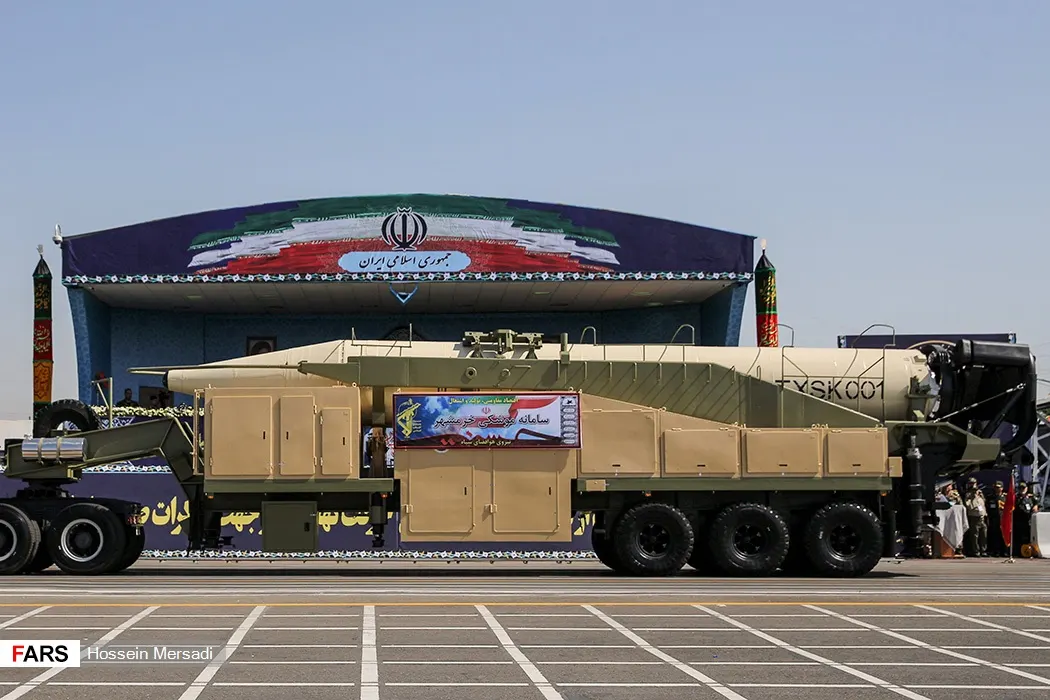
The missile carries a 1,000-2,000 km range and a launch weight near 19,500 kg, giving it a payload capacity well above most missiles in the same MRBM class.1 Iran presents the Khorramshahr as a strategic-strike weapon capable of reaching Israel and U.S. regional bases while still carrying a large conventional, or in Western assessments potentially nuclear-capable, payload, a claim Iran itself denies. Independent estimates of range, accuracy, and even the missile's stage count vary between sources, reflecting how little of the program Iran has actually opened to outside inspection.
Iran has repeatedly framed the Khorramshahr's name as a statement in itself. The missile is named after the city of Khorramshahr, on the Shatt al-Arab waterway near the Iraqi border, whose recapture from Iraqi occupation in May 1982 (Operation Beit ol-Moqaddas) is remembered in Iran as the war's turning point.5 A weapon named for that battle, unveiled specifically at an Iran-Iraq War anniversary parade, was never a subtle message.
The Khorramshahr-4 update carried the naming theme further. Its unveiling was scheduled for 25 May 2023, one day after the anniversary of the city's 1982 liberation, and Iran gave the same missile a second name, Kheibar, after a seventh-century military campaign, layering a second historical reference onto the same hardware.3
Whether the Khorramshahr remains in active service is not really in doubt. Iran has fired variants of it in at least two separate conflicts since 2025, including strikes reaching Tel Aviv and Persian Gulf air bases, so the practical answer to that frequently searched question is yes, and its combat record is now longer than its peacetime test record.4,6 What is genuinely uncertain is the exact missile used in specific strikes. Iranian state media, Western analysts, and open-source trackers do not always agree on whether a given launch was a Khorramshahr-4/Kheibar, an Emad, or a Ghadr-110, since all three are broadly similar liquid-fuel missiles fired from the same class of launcher.
A Single-Stage Airframe With Disputed Numbers
Most technical sources describe the Khorramshahr as a single-stage design, rather than the two-stage configuration sometimes listed for it, consistent with its Musudan/R-27 ancestry (both of those ancestor missiles are single-stage).2,7 Reported dimensions cluster around 13 meters in length, though the diameter is where sources diverge most, with roughly 1.5 meters cited most often against an outlier figure of 1.8 meters occasionally reproduced elsewhere.7,8 Launch weight is consistently placed near 19,500-20,000 kg, and CSIS's Missile Threat project, the closest thing to an authoritative open tally on Iranian systems, settles on a launch weight in that same 15,000-20,000 kg band with the higher end favored by most recent write-ups.7
- Füze Sınıfımrbm
- Hizmete Giriş Yılı2017
- TasarımcıAerospace Industries Organization (AIO) / Shahid Hemmat Industrial Group
- Uzunluk13 m
- Çap1,5 m
- Fırlatma Ağırlığı19.500 kg
- HizmetteEvet
The missile burns storable hypergolic propellant, unsymmetrical dimethylhydrazine (UDMH) fuel paired with a nitrogen tetroxide oxidizer, the same self-igniting combination used across the Musudan/R-27 family.2,8 That choice trades some performance against solid-fuel rivals for propellant that can sit fueled inside the missile for extended periods, letting crews cut launch preparation time to roughly 12 minutes once a road-mobile Transporter Erector Launcher reaches its firing position.8 The baseline Khorramshahr's engine is a derivative of the Soviet 4D10, the same engine family that powered the original R-27 and, in a locally modified form, the Hwasong-10.2 The Khorramshahr-4 variant replaces it with a new indigenous design, the Arvand engine, named after the Arvand Rud, Iran's own name for the Shatt al-Arab river that runs past the city the missile itself is named for.8,9
- Tahrik Tipibalistik
- Kademe Sayısı1
- Yakıt Tipisıvı
- Katı YakıtlıHayır
Reentry speed is reported at roughly Mach 8 inside the atmosphere after a much higher exo-atmospheric speed near Mach 16, figures that are broadly consistent across sources.4,7 Payload figures usually land at 1,500-1,800 kg, a genuinely heavy throw weight next to most missiles that share its 1,000-2,000 km range bracket, since designs in that bracket typically trade payload for range rather than the other way around.1,7 Guidance is inertial with a probable satellite-navigation update, and Iran states the Khorramshahr-4 adds a maneuverable reentry vehicle intended to complicate terminal interception, though independently confirmed accuracy figures range widely across open sources, from roughly 30 meters down to under 100 meters depending on which write-up is cited, itself a sign of how little verified test data exists.3,8
- Asgari Menzil1.000 km
- Azami Menzil2.000 km
- Geri Giriş Hızı (Mach)8 Mach
- Taşıma Kapasitesi (Throw Weight)1.500 kg
The 2019-2020 test series showed a further variant carrying a visibly smaller reentry vehicle, which analysts read as an attempt to stretch range toward 3,000 km at the cost of payload, a classic MRBM design tradeoff.7 Whether that smaller-warhead configuration ever entered service alongside the standard Khorramshahr is unclear. Iran itself has not published a single official line of succession for its own missile variants, and outside trackers have used inconsistent naming, Khorramshahr-1 through -4 plus the separate Kheibar name, for what may or may not be the same small number of underlying airframes.
- Güdüm TipiAtaletsel / GPS
- Terminal GüdümEvet
- Manevra Kabiliyetli Geri Giriş Aracı (MaRV)Evet
- Harp Başlığı Tipiyüksek patlayıcı
- NükleerHayır
- TermonükleerHayır
- MIRVHayır
- Harp Başlığı / RV Sayısı1
- Konvansiyonel KabiliyetliEvet
- Konuşlanma Şeklikarayolu mobil
- Silo KonuşluHayır
- Karayolu Hareketli (TEL)Evet
- Rayda HareketliHayır
- Denizaltından FırlatılanHayır
- Kullanıcılar1
- İlk Test2017
- Patlayıcı Dolgu Ağırlığı2.000 kg
From a Soviet Submarine Missile to an Iranian Road-Mobile Weapon
The Khorramshahr's lineage begins with the R-27 Zyb, a Soviet submarine-launched ballistic missile developed by the A.M. Isayev design bureau and first deployed in 1968 aboard Yankee-class ballistic missile submarines, known to NATO as the SS-N-6.2 In 1992, engineers from Russia's Makeyev Rocket Design Bureau, the R-27's original design house, reportedly agreed to help North Korea adapt the missile into a ground-launched system. Some of those engineers were intercepted before reaching North Korea, but others are believed to have made it in, and the result within a few years was the Hwasong-10, a road-mobile missile North Korea calls Musudan and the West sometimes labels BM-25.2
Iran's own relationship with North Korean missile technology predates the Khorramshahr by decades. Cooperation began with Scud transfers during the Iran-Iraq War in the 1980s, deepened into Nodong-based technology that became Iran's own Shahab-3 in the 1990s, and by the mid-2000s extended to the Musudan/Hwasong-10 itself.10 German press reporting from 2005 stated North Korea had sold roughly 18 Musudan missiles and associated production equipment to Iran, though North Korea's own Musudan force was never flight-tested successfully by North Korea itself before Iran began developing its own derivative.2,10
Iran's own version, developed under the Aerospace Industries Organization (AIO) and reportedly built by the Shahid Hemmat Industrial Group, was first flight-tested on 29 January 2017 near Semnan. The missile reportedly flew close to 950 km before suffering a structural failure during reentry, a partial test failure that nonetheless demonstrated a working airframe.7 Iran unveiled the completed design publicly at the September 2017 parade marking the Iran-Iraq War anniversary, deliberately pairing the missile's combat debut on a parade stand with its wartime namesake.1
That unveiling triggered an immediate reaction in Washington. Days after the parade, the Trump administration's Treasury Department sanctioned 25 individuals and entities tied to Iran's missile program, part of a broader diplomatic pattern of tightening sanctions in response to Iranian ballistic-missile tests through 2017.11 Then National Security Adviser Michael Flynn stated Iran had effectively been put on notice, language widely read at the time as a signal that further tests could draw a harsher response, and President Trump separately criticized Iran's missile program at the United Nations that same month.11
Iran continued testing modified Khorramshahr variants through 2019 and 2020, including a configuration with a visibly smaller reentry vehicle shown at the Eghtedar 40 exhibition in February 2019, before the program's next major public step came in 2023.7 On 25 May 2023, Iranian Defense Minister Mohammad-Reza Gharaei Ashtiani unveiled the Khorramshahr-4, describing it as carrying a heavier payload than the original and integrating the new Arvand engine.3 Iranian officials also introduced the parallel name Kheibar for the same missile at that unveiling, tying it to a second historical reference distinct from the Khorramshahr name.3
Combat Debut in the Twelve-Day War
The Khorramshahr family's first confirmed combat use came during the Twelve-Day War between Iran and Israel, which began on 13 June 2025 when Israel launched Operation Rising Lion against Iranian nuclear and military sites.6 Iran responded with a sustained retaliatory missile and drone campaign it called Operation True Promise III, firing more than 500 ballistic missiles at Israeli targets over the following twelve days.6 Iranian and Israeli sources both associate Khorramshahr-4 launches with strikes reaching central Tel Aviv and Ben Gurion Airport during that campaign, alongside other Iranian missiles like the Emad and Ghadr-110.4,12

One incident from that campaign drew particular attention from Western analysts. On 19 June 2025, one Iranian missile dispersed cluster submunitions over Israel, releasing roughly 20 bomblets, each carrying about 2.5 kg of explosive, across a footprint roughly 10 miles wide, an application of a cluster munition warhead to a strategic ballistic missile rather than the more familiar artillery or air-dropped context.13 Iranian state media had previously shown 2023 test footage of the Khorramshahr-4 associated with a similar dispensing warhead, but independent analysts, including missile researcher Jeffrey Lewis, cautioned that the specific missile used in the 19 June strike was not conclusively confirmed, and could instead have been an Emad or Ghadr-110 variant, both of which Iran has separately confirmed using during the same campaign.13 That uncertainty is itself informative. Even specialists tracking the war in real time could not always distinguish between Iran's various liquid-fuel MRBMs from missile-defense radar tracks and open-source video alone.
The Twelve-Day War ended without a durable settlement, and hostilities resumed on a larger scale in the 2026 Iran war, which began in late February 2026 after further strikes on Iranian nuclear and government targets by the United States and Israel.14 Iran's retaliation this time extended beyond Israel to American bases across the Persian Gulf. Reporting from March 2026 describes Iranian forces firing Khorramshahr-4 missiles at Qatar's Al Udeid Air Base, the largest U.S. military installation in the region and the forward headquarters for U.S. Central Command's air operations, as well as at Bahrain, home to the U.S. Navy's Fifth Fleet, in what open-source trackers list as the 2026 Iranian strikes on Bahrain.14,15
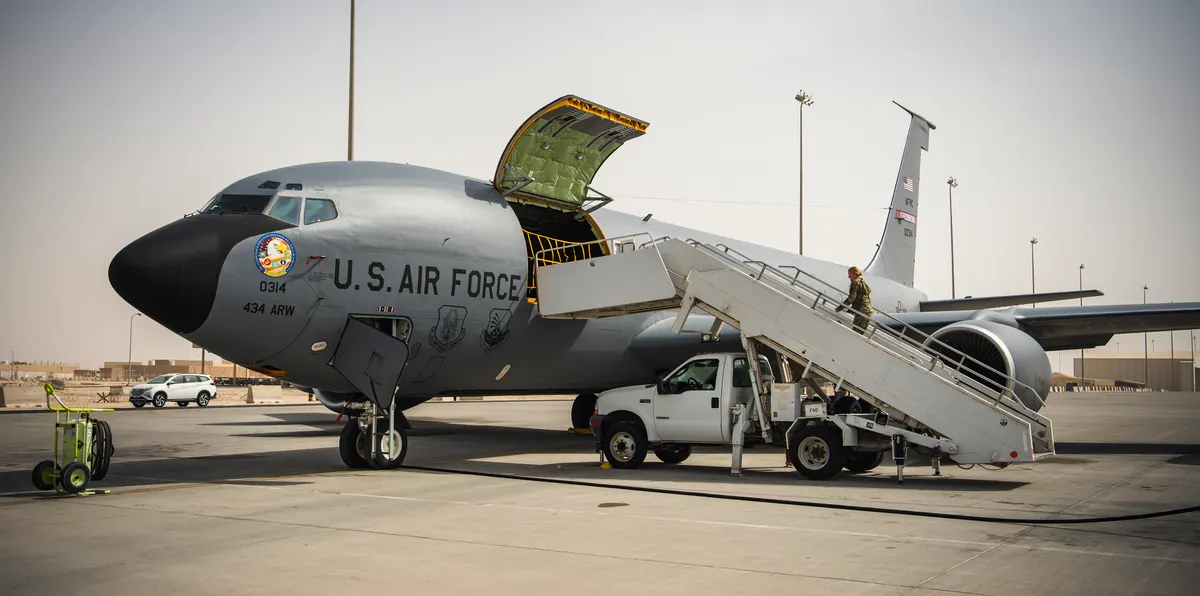
The scale of the March 2026 exchange dwarfed the 2025 campaign. Qatar alone reportedly absorbed over 200 missiles and dozens of drones between late February and mid-March 2026, with Bahrain targeted by more than a hundred missiles in the same window, and further Iranian strikes reported against Kuwait and Saudi Arabia as the ceasefire process repeatedly broke down.15 Set against its own namesake, the Khorramshahr missile's combat record has an odd symmetry. A weapon named for a 1982 land battle fought to expel an occupying army from Iranian soil has, four decades later, been used to strike foreign bases hosting forces Iran describes, in its own official framing, as a modern equivalent of that same threat.
Khorramshahr-1 Through Khorramshahr-4 (Kheibar)
Open-source trackers generally describe up to four iterations of the missile, though Iran itself has not published an official numbering scheme, so the sequence below reflects analyst convention rather than confirmed Iranian doctrine.7 The original Khorramshahr (sometimes labeled Khorramshahr-1) is the missile tested in January 2017 and unveiled that September, using the 4D10-derived engine and standard warhead section. A Khorramshahr-2 designation has been applied to footage from an August 2020 test, and a distinct configuration with a visibly smaller reentry vehicle appeared in 2019, read by analysts as a range-extended, reduced-payload variant sometimes informally called Khorramshahr-3.7
The Khorramshahr-4, unveiled 25 May 2023 and also marketed under the name Kheibar, is the most significant revision. It replaces the original engine with the new Arvand powerplant, reportedly increases the maximum reported payload to around 1,500-1,800 kg, and adds a maneuverable reentry vehicle intended to complicate missile-defense intercepts during descent.3,9 Iranian officials describe it as reaching operational service with the IRGC Aerospace Force shortly after its unveiling, and it is the variant most frequently cited in the 2025 and 2026 combat use described above.3,4
Given how closely the reported specifications of these variants overlap, and how rarely Iran allows independent verification of any single missile's configuration, some Western analysts treat the entire Khorramshahr-2/3/4 sequence as incremental refinements of one basic airframe rather than genuinely distinct missiles. That reading is plausible but unconfirmed, and it is one of the clearer examples in Iran's missile program of public messaging outrunning verifiable technical detail.

Iran is the only confirmed operator of the Khorramshahr family, and the missile is not known to have been offered for export.1 Within Iran, the missile is operated by the IRGC Aerospace Force rather than the regular Artesh military, consistent with Iran's practice of assigning its longest-range road-mobile strategic missiles to the Revolutionary Guard's dedicated missile branch rather than the conventional army.7 North Korea's own Hwasong-10/Musudan, the design ancestor of the Khorramshahr, has itself never been confirmed as fully operational within North Korea's own inventory despite years of parade appearances. It is one of the more unusual footnotes in the missile's history. The original design arguably reached genuine combat-relevant status abroad, in Iranian hands, well before its country of origin ever fired it in anger.2
The Khorramshahr's closest domestic points of comparison are the Emad and Ghadr-110, both liquid-fuel Iranian missiles descended from the older Shahab-3/Nodong lineage rather than the Musudan lineage the Khorramshahr comes from. That distinction matters more than it might first appear. Emad and Ghadr-110 trace back to a 1990s Nodong-based airframe that Iran has incrementally refined for decades, while the Khorramshahr represents a structurally different, heavier missile family Iran acquired far more recently and only partially domesticated. In practice this shows up in payload. The Khorramshahr's throw weight of roughly 1,500 kg sits well above what the Emad or Ghadr-110 typically carry over comparable distances, reflecting the Musudan family's larger overall airframe rather than any single design breakthrough unique to Iran.1,7
Range tells a more complicated story. Emad and Ghadr-110 are generally credited with somewhat longer confirmed range than the baseline Khorramshahr, which is one reason Iranian and Western trackers alike have sometimes struggled to say with confidence which missile struck which target during the 2025 and 2026 conflicts described above.13 A useful way to separate the three in practice is their design emphasis. Emad and Ghadr-110 were built primarily to reach distant, precise targets. The Khorramshahr and its Khorramshahr-4/Kheibar successor were built to deliver a heavier payload, sacrificing some range and accuracy for a bigger warhead and a harder-to-intercept reentry profile.
| Missile | Launch Weight | Payload | Range | Propellant |
|---|---|---|---|---|
| Khorramshahr | ~19,500 kg | ~1,500-1,800 kg | 1,000-2,000 km | Liquid (UDMH/N2O4) |
| Emad | ~1,750 kg (est. class) | ~750 kg | ~1,700 km | Liquid |
| Ghadr-110 | ~1,000 kg (est. class) | ~750-1,000 kg | ~1,600-1,950 km | Liquid |
Internationally, the Khorramshahr's nearest analogue is not really an Iranian missile at all but its own design ancestor, North Korea's Hwasong-10. The two share an airframe lineage closely enough that some of the reported Khorramshahr specifications, a single stage, hypergolic propellant, a comparable diameter, are essentially inherited rather than independently engineered by Iran. Where the two programs diverge is operational maturity. North Korea's Musudan force has a poor flight-test record and no confirmed combat use, while Iran's derivative has now been fired in two separate wars against Israel and Gulf-based American forces, making the Khorramshahr the more combat-proven of the two related designs despite being the technological copy rather than the original.2,6

Is the Khorramshahr missile still in service? Yes. Iran has fired Khorramshahr-4/Kheibar variants in combat as recently as the 2026 Iran war, including strikes on Qatar and Bahrain, so the missile remains an active part of the IRGC Aerospace Force's inventory rather than a retired or purely ceremonial system.14
What is the Khorramshahr missile's range? Most sources place the Khorramshahr's range between 1,000 and 2,000 km with a full payload, though some reports of a lighter-warhead variant claim up to 3,000 km, and the Khorramshahr-4/Kheibar is generally cited at around 2,000 km.1,7
What is the difference between the Khorramshahr and the Khorramshahr-4 (Kheibar)? The Khorramshahr-4, also marketed as Kheibar, replaces the original 4D10-derived engine with a new Arvand engine, reportedly carries a heavier payload, and adds a maneuverable reentry vehicle meant to survive missile defenses better than the original design.3,9
Is the Khorramshahr missile based on a North Korean design? Yes. Multiple analyses trace the Khorramshahr's airframe to North Korea's Hwasong-10 (Musudan), which North Korea itself developed from the Soviet R-27 Zyb submarine-launched missile with assistance from former Makeyev Design Bureau personnel.2
Why is the missile named Khorramshahr? It is named after the Iranian city of Khorramshahr, whose recapture from Iraqi forces in the May 1982 Operation Beit ol-Moqaddas is remembered in Iran as a turning point of the Iran-Iraq War.5
What is the Khorramshahr missile's manufacturer? It is developed under Iran's state-run Aerospace Industries Organization, with production reportedly carried out by the Shahid Hemmat Industrial Group, the same organization historically responsible for Iran's Shahab-series missiles.7
- "Khorramshahr (missile)", Wikipedia — en.wikipedia.org) ↩
- "Iran's Most Powerful Ballistic Missile Khorramshahr, How North Korea's Musudan Was Adapted for Middle Eastern Requirements", Military Watch Magazine — militarywatchmagazine.com ↩
- "Kheibar (missile)", Wikipedia — en.wikipedia.org) ↩
- "Mach-16 Shockwave, Iran's Khorramshahr-4 Ballistic Missiles Punch Through Israel's Air Defences, Strike Near Tel Aviv in Operation True Promise 4", Defence Security Asia — defencesecurityasia.com ↩
- "Battle of Khorramshahr (1982)", Wikipedia — en.wikipedia.org) ↩
- "June 2025 Iranian strikes on Israel", Wikipedia — en.wikipedia.org ↩
- "Khorramshahr", Missile Threat, CSIS Missile Defense Project — missilethreat.csis.org ↩
- "Khorramshahr Ballistic Missile, Iran", Army Technology — army-technology.com ↩
- "Khorramshahr-4 MRBM", Army Recognition — armyrecognition.com ↩
- "Iran's Khorramshahr Ballistic Missile, a development with Soviet and North Korean origins", EduardoDev — eduardodevelops.com ↩
- "Iran Shows Off Khorramshahr Ballistic Missile After Trump Speech", NBC News — nbcnews.com ↩
- "For the First Time and at a Distance of 2,200 km, the Israeli Air Force Strikes Khorramshahr Surface-to-Surface Missile Storage Facilities", Iran Watch — iranwatch.org ↩
- "Iran Just Used Ballistic Missiles With Cluster Warheads To Strike Israel", The War Zone — twz.com ↩
- "Iran Launches Its Most Advanced Ballistic Missile Khorramshahr-4 Against U.S. Bases in Qatar and Bahrain", Army Recognition — armyrecognition.com ↩
- "2026 Iranian strikes on Qatar", Wikipedia — en.wikipedia.org ↩