

Conventional-capable describes a ballistic missile engineered to deliver a high-explosive warhead accurately enough to do useful military damage on its own, rather than relying on a nuclear yield to guarantee an effect regardless of aim. For most of the ballistic missile's history this was not a real design choice. A missile without the trait is built and postured as a pure nuclear-delivery system, its accuracy tolerances set by whatever a nuclear warhead's blast radius will forgive rather than by what a conventional strike needs.
Many missiles carrying the flag are not conventional-only weapons. They are dual-capable, meaning the same airframe can be loaded with either a nuclear or a conventional warhead depending on the mission, which raises a strategic problem of its own. A handful of programs go the other way and build conventional-only from the start, giving up any nuclear role for a design freed of the political weight that comes with one.
01From the V-2 to Precision Guidance, Why Conventional Warheads Took Decades to Matter
Early ballistic missiles were poor conventional weapons almost by definition. Germany's V-2 landed with a circular error probable measured in kilometers, and the strategist Thomas Schelling later argued the rocket amounted to a terror weapon rather than a serious military tool because it lacked, in his words, a punitive payload worth carrying.1 The same logic applied to Scud-derivative missiles fired during the Iran-Iraq War of the 1980s, where an inaccurate inertial guidance system scattered conventional warheads across cities rather than onto specific targets. A nuclear warhead solved that accuracy problem by brute force. A conventional one could not, until guidance caught up.
Terminal guidance changed the calculation. The American Pershing II, fielded in West Germany in the 1980s, paired inertial flight with a radar area-correlation system that compared the ground below against a stored map in the final seconds of descent, cutting its error to a fraction of what earlier missiles achieved.2 That approach to precise reentry shaped the reasoning behind China's DF-21C, publicly identified around 2006 as a variant of the nuclear DF-21 family fitted with its own terminal-guidance package, the first missile in the DF-21 line credited with a genuinely useful conventional strike option.3
02Dual-Capable Missiles and the Nuclear-Conventional Ambiguity Problem
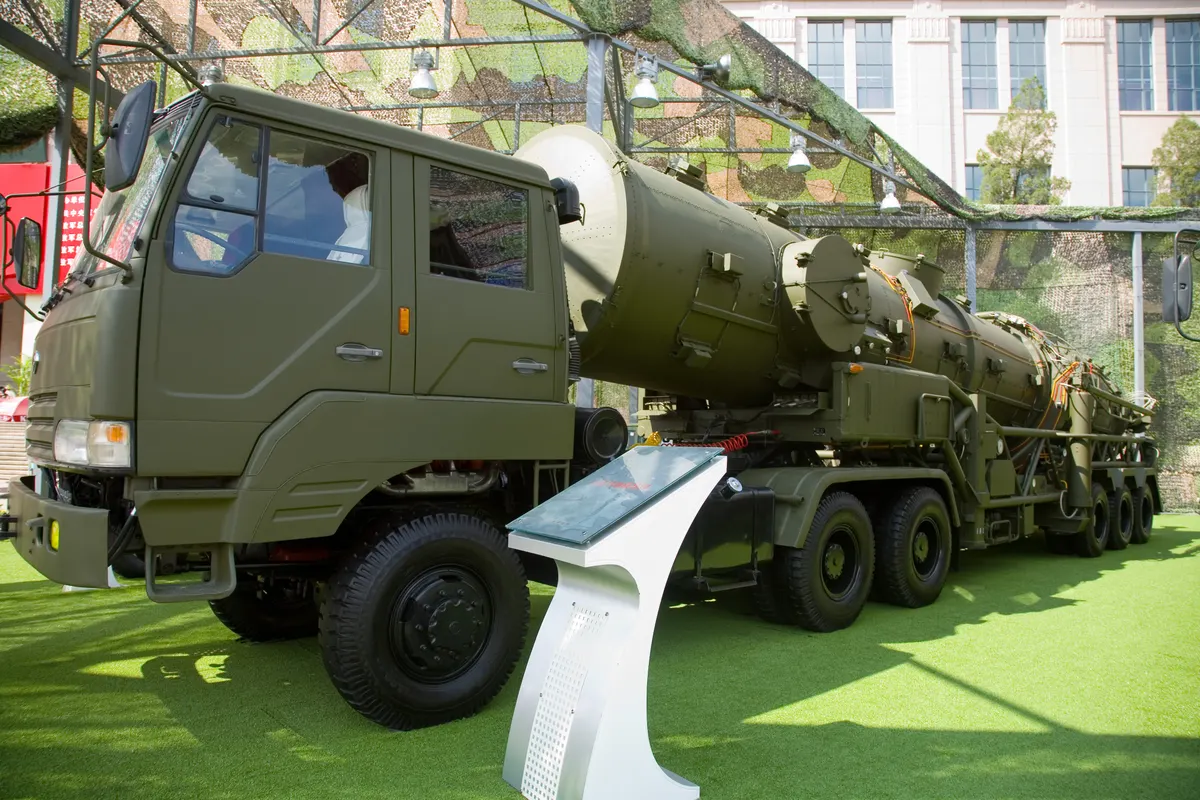
The DF-21C is dual-capable, able to carry either warhead type on the same body, and it is not alone. China's longer-ranged DF-26 follows the same pattern, and analysts describe that overlap as a deliberate feature rather than an oversight, since an adversary watching a transporter erector launcher prepare to fire cannot reliably tell which warhead is mounted before the missile leaves the ground.4,3 The same ambiguity shadows several Indian systems, including the Agni-P, which can carry nuclear, high-explosive, or thermobaric payloads on the same airframe, and the older Agni-II and Agni-II Prime, built primarily around India's nuclear deterrent against Pakistan while never publicly ruling out a conventional loadout.5
Israel's Jericho-2 sits in a stranger version of the same problem. Israel has never confirmed the missile carries a nuclear warhead under its policy of deliberate ambiguity, so outside analysts openly debate whether a conventionally armed Jericho-2 strike against a target such as Iran's nuclear infrastructure is even realistic, precisely because no government statement exists to confirm or rule it out.6 Pakistan's Ababeel, built primarily to defeat Indian missile defenses with multiple reentry vehicles, carries the same flag for the same reason, a single Shaheen-derived body accepting more than one kind of payload.
01Conventional-Only Designs and Where the Flag Applies Today
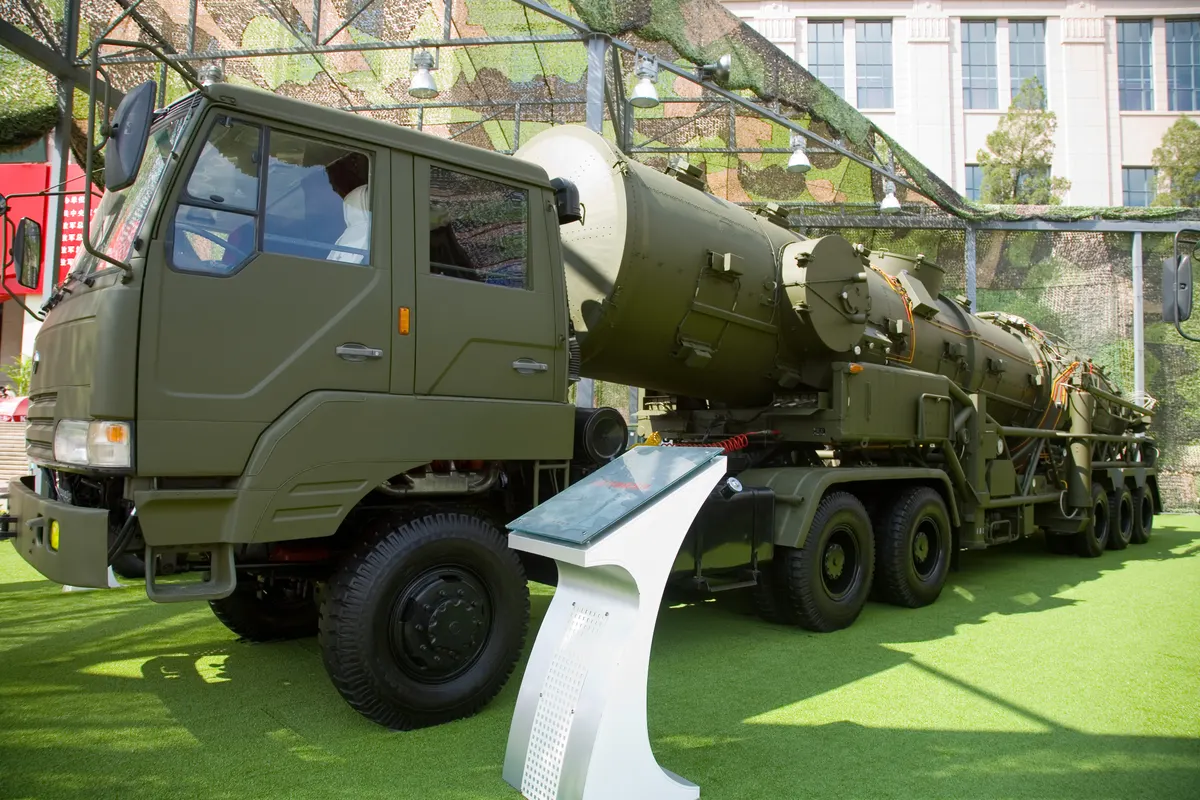
Some programs sidestep the ambiguity problem entirely by never carrying a nuclear option. China's DF-21D anti-ship variant is conventional-only, because its terminal radar seeker needs precise accuracy a nuclear yield does not require, and stripping the nuclear role out frees the missile from the escalation politics that follow a dual-capable system.3 Turkey's developing Cenk missile, built by Roketsan alongside the shorter-ranged Bora and Tayfun family, is described the same way by every open source tracking the program, a conventional medium-range system with no declared nuclear ambition attached to it.
The conventional-capable flag covers both ends of that spectrum today, from India's and China's dual-role deterrents to Turkey's and China's purpose-built conventional strike programs, and the difference between the two ends is exactly what a reader should check before assuming any conventional-capable missile also carries a nuclear one.
01Notes and Sources
- "Strategy in the New Missile Age", Journal of Strategic Studies (Taylor & Francis) — tandfonline.com ↩
- "Pershing 2", Missile Threat, CSIS Missile Defense Project — missilethreat.csis.org ↩
- "DF-21 (CSS-5)", Missile Threat, CSIS Missile Defense Project — missilethreat.csis.org ↩
- "China's Dual-Capable Missiles: A Dangerous Feature, Not a Bug", The Diplomat — thediplomat.com ↩
- "India Tests New Agni Missile", Arms Control Association — armscontrol.org ↩
- "Could Israel Use Conventionally-Armed Jericho Ballistic Missiles To Strike Iran?", The War Zone — twz.com ↩


