



The Dezful is a single-stage, solid-propellant medium-range ballistic missile fielded by Iran's Islamic Revolutionary Guard Corps Aerospace Force. It was unveiled in February 2019 as a stretched, longer-ranged derivative of the Zolfaghar missile, itself part of the Fateh-110 family of Iranian solid-fuel ballistic missiles.1,2 Where the base Zolfaghar reaches roughly 700 kilometers, the Dezful missile's officially claimed range of 1,000 kilometers is roughly double the range of the original short-range Fateh-110 design and represents a deliberate jump from short-range status into medium-range ballistic missile territory.1,3 The name itself carries weight. Dezful is a city in Khuzestan Province that was repeatedly hit by Iraqi ballistic missiles during the Iran-Iraq War, a naming choice Iran has repeated with other missiles honoring cities battered in that war, including the Khorramshahr missile named for the city recaptured in the Liberation of Khorramshahr in 1982.8
- Doubles the base Zolfaghar's range on a proven, already-fielded airframe
- Solid propellant means fast launch prep from mobile transporter-erector-launchers
- Detachable, maneuvering warhead complicates terminal interception
- Cheap relative to two-stage systems in the same family
- Independent CEP estimates are far less flattering than Iran's own claims
- Confirmed combat use specific to this missile (rather than sibling missiles) is thin
- Conventional high-explosive payload limits it to area or moderately hardened targets
- Single-stage design caps its range well below newer two-stage members of the family
Iran's Aerospace Industries Organization oversees production of the Dezful missile through its subordinate Shahid Bagheri Industrial Group, the same organization responsible for the Fateh-110 and Zolfaghar before it.9,10 The Dezful missile's specifications, its place inside Iran's expanding Fateh-110 missile family, and the genuine uncertainty over where it has actually been fired in anger are the subject of ongoing analysis, not settled fact. Anyone researching Dezful missile specifications or how the Dezful missile works usually ends up asking three questions, its real range, its real accuracy, and whether it has already seen combat, and the honest answer to the third question is less clear-cut than Iranian state media suggests.
Unlike an exported weapon with an open price list, no confirmed Dezful missile unit cost has been published, since Iran neither exports the type nor discloses domestic missile program budgets in detail. Anyone searching for a Dezful missile price figure will find estimates for the wider Fateh-110 family at best, not a number specific to this variant.
What is public is the missile's role. It is a road-mobile, quick-reaction system meant to saturate a battlefield or strike fixed targets across the Persian Gulf region and into Israel's periphery, not a precision strike weapon in the cruise-missile sense.
A Stretched Zolfaghar Airframe Behind the 1,000-Kilometer Claim
The Dezful missile keeps the Zolfaghar's 68-centimeter body diameter but lengthens the airframe to more than 12 meters, up from the Zolfaghar's 10.3 meters, packing in extra solid propellant to push the range from 700 kilometers to a claimed 1,000 kilometers.4,3 That stretch-the-tube approach is cheaper and faster to field than designing a new missile from scratch, and it explains why Iran calls the Dezful an upgraded Zolfaghar rather than a wholly new type.1 The warhead is conventional high explosive, reported at somewhere between 450 and 700 kilograms depending on the source, and like the Zolfaghar's missile warhead it separates from the spent motor body in the midcourse phase of flight.3,4 That separating, maneuvering payload functions as a maneuverable re-entry vehicle, a design choice meant to make the warhead harder to track and intercept than a unibody missile that stays in one piece all the way to the ground.3
- Füze SınıfıOrta menzilli balistik füze
- Hizmete Giriş Yılı2019
- HizmetteEvet
Guidance combines inertial navigation with satellite positioning, a common inertial GPS guidance pairing across the Fateh-110 family, and Iran states the missile reenters at roughly Mach 7.2 Where the numbers get genuinely contested is accuracy. Iranian state media describes a circular error probable of 5 meters, occasionally rounded to a claim of well under 10 meters, a figure repeated in Iran's own promotional coverage of the missile.5 Independent assessments are considerably more conservative. Open-source estimates place the Dezful's real-world CEP in the 10 to 30 meter range, still a meaningful improvement over older unguided Iranian rockets but nowhere near the single-digit precision Tehran advertises, and even the more generous outside estimates cap out around 100 meters for missiles in this family given the near-total absence of independently observed test data.4 A CEP of 5 meters would put the Dezful in the same accuracy class as a laser-guided bomb at a range of 1,000 kilometers, a claim no other ballistic missile in this class has ever had independently verified, which is why the figure belongs to Iran's own marketing rather than to an outside test record.
- Tahrik Tipikatı yakıtlı roket motoru
- Kademe Sayısı1
- Yakıt Tipikatı yakıt
- Katı YakıtlıEvet
The Dezful missile is road-mobile, launched from a wheeled transporter-erector-launcher that can fire with comparatively little setup time once positioned, a trait shared across the whole solid-fuel Fateh-110 line and one of the main reasons these missiles are difficult to preempt.4
- Azami Menzil1.000 km
- Geri Giriş Hızı (Mach)7 Mach
| Missile | Length | Range | Stage count |
|---|---|---|---|
| Zolfaghar | 10.3 m | 700 km | Single |
| Dezful | >12 m | 1,000 km | Single |
| Qasem / Haj Qasem | longer, wider first stage | 1,400 km | Two |
Every figure in that row for the Haj Qasem missile reflects Iran's next step past the Dezful missile, adding a second stage rather than simply stretching the tube again, because a single-stage airframe could not credibly be stretched much further without compromising structural integrity.3
- Dairesel Hata Olasılığı (CEP)20 m
- Güdüm TipiAtaletsel / GPS
- Harp Başlığı Tipiyüksek patlayıcı
- NükleerHayır
- TermonükleerHayır
- MIRVHayır
- Harp Başlığı / RV Sayısı1
- Konvansiyonel KabiliyetliEvet
- Konuşlanma Şeklikarayolu mobil
- Karayolu Hareketli (TEL)Evet
- Denizaltından FırlatılanHayır
- Kullanıcılar1
A City Named for What Iraqi Scuds Did to It
Dezful sits in Khuzestan Province, close enough to the Iraqi border that it became one of the most heavily targeted Iranian cities of the Iran-Iraq War. Iraq's first use of ballistic missiles in the war predates the Scud strikes entirely, with Frog-7 rockets fired at Dezful and Ahvaz early in the conflict.6 The first Scud-B missiles struck Dezful on 27 October 1982, killing 21 civilians and wounding around 100 more, and the city kept absorbing strikes for years afterward.6 Iranian press accounts from later in the war describe a single missile killing as many as 33 people and wounding 100 in Dezful alone, part of a wider campaign in which Iraq fired 533 ballistic missiles at Iranian territory over the course of the war, 414 of which hit Iranian cities and killed more than 2,300 civilians.7 Naming a modern Iranian missile after Dezful is not a random choice of geography. It echoes the same pattern behind the Khorramshahr missile, named for a city Iraq occupied between 1980 and 1982 before Iran recaptured it in a battle still marked every year.8 Both names turn wartime suffering into a durable, repeated reminder embedded in the country's current missile inventory.
From the Fateh-110 to the Zolfaghar to the Dezful
The Fateh-110, developed by the Shahid Bagheri Industrial Group under Iran's Aerospace Industries Organization and fielded from 2002, was Iran's first indigenous solid-fuel guided ballistic missile, with an initial range of around 200 kilometers.9,10 The Zolfaghar, unveiled in September 2016 by then-Defense Minister Hossein Dehghan, stretched that concept out to roughly 700 kilometers and entered service the following year, likely drawing on the earlier Fateh-313 as an intermediate step.3 The Dezful missile followed in February 2019, displayed by Major General Mohammad Ali Jafari inside an underground missile production facility during celebrations marking the 40th anniversary of the Iranian Revolution. Jafari framed the underground reveal itself as a message to sanctions-minded Western governments, describing it as a direct answer to Westerners who believe sanctions and threats can stop Iran from reaching its goals.1 Iran tested Zolfaghar and Dezful missiles together during IRGC snap drills in January 2021, one of the few instances of an openly acknowledged Dezful missile launch outside of an actual strike.2
The Zolfaghar missile's own combat debut came first, and it did not involve the Dezful missile at all. On 17 June 2017, in a strike Iran named Operation Night of Power, the IRGC Aerospace Force fired six Zolfaghar missiles from bases in Kermanshah and Kurdistan provinces at ISIL targets around Deir ez-Zor in Syria, a roughly 600-kilometer shot described at the time as Iran's first use of mid-range missiles in three decades.3 That 2017 strike, not any Dezful missile launch, was the moment that proved the Zolfaghar design worked under real firing conditions, which matters for judging how much of the Dezful missile's reputation rests on its own record versus its parent missile's.
Choosing an underground facility for the February 2019 unveiling, rather than an open parade ground, fit a broader pattern in how Iran presents the Dezful missile and its siblings. The setting was itself part of the message, meant to project that Iranian missile production could survive strikes on any single depot, not just to show off the missile's stretched airframe.1
The 2018 Koya Strikes Used the Fateh-110, Not the Dezful
On 8 September 2018, the IRGC Aerospace Force fired seven missiles at the headquarters of two Iranian Kurdish opposition parties, the Kurdistan Democratic Party-Iran and the Democratic Party of Iranian Kurdistan, in the town of Koy Sanjaq in Iraq's Kurdistan Region, also hitting a nearby refugee camp.11 Casualty figures varied between initial and later reporting, from 11 to as many as 18 people killed.11 It was the first such Iranian missile strike on Iraqi soil since 1996, and open-source analysis at the time identified the missiles used as Fateh-110s, the shorter-range parent design, rather than the newer Zolfaghar or Dezful.12 That distinction matters for anyone researching the Dezful missile specifically. The 2018 Koya strike is frequently cited alongside Iran's Zolfaghar-family missiles in general commentary, but the best contemporary sourcing ties it to the older Fateh-110, and no credible source ties it to the Dezful missile, which had not even been publicly unveiled at that point.11,12
January 2024, Erbil and Idlib, Kheibar Shekan and Fateh-110 Again
On 15 January 2024, Iran fired 15 ballistic missiles at targets in Iraq and Syria in retaliation for the Kerman bombings that killed dozens of Iranians earlier that month. Eleven missiles hit Erbil in Iraqi Kurdistan, aimed at the residence of a Kurdish businessman Iran accused of Israeli intelligence ties, while four struck Taltita in Syria's Idlib Governorate.13 Iran said it had hit an Israeli Mossad facility, a claim both the Iraqi and Israeli governments rejected. Four civilians were killed and 17 wounded in Erbil.13 The missiles identified in that barrage were Fateh-110 short-range types and the newer Kheibar Shekan medium-range missile, once again not the Dezful.13 The pattern across both 2018 and 2024 is consistent, when Iran has struck targets inside Iraqi Kurdistan, the missiles independently identified belong to other members of the wider Fateh-110 family, not to the Dezful specifically.
Operation True Promise and a Disputed Combat Debut Against Israel
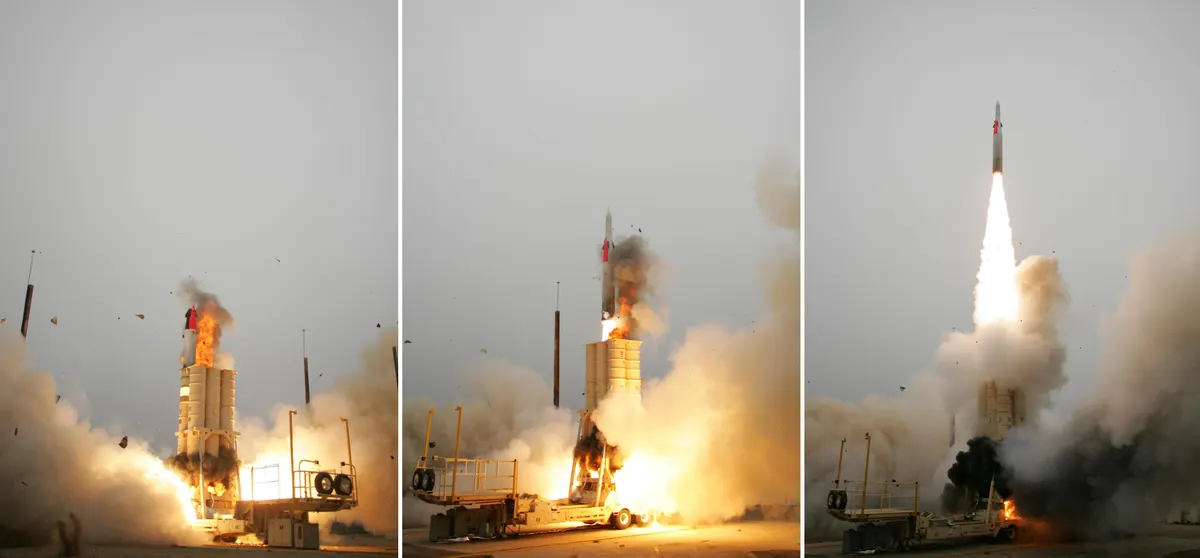
On 13 April 2024, Iran launched Operation True Promise, a direct attack on Israel combining loitering munitions, cruise missiles, and more than 100 ballistic missiles, in retaliation for the Israeli strike on Iran's consulate building in Damascus.14 This is where sourcing on the Dezful missile genuinely diverges. Iranian state media, in an account carried by Press TV, claimed the Dezful missile was used specifically against targets in the occupied Golan Heights, reasoning that the missile's roughly 1,000-kilometer range let it strike that northeastern sector of Israeli-held territory while flying a low trajectory meant to stay outside the interception envelope of the Arrow-3 system, maneuvering in the way the Emad missile does to defeat lower-tier interceptors.15 That account, however, stands largely alone. The most detailed independent reconstruction of the strike's ballistic-missile order of battle, built by Israeli researcher Or Fialkov and summarized in coverage of the attack, attributes the ballistic missiles fired that night to the Emad, the Ghadr-110, the Kheibar Shekan, and probably the Shahab-3B, without listing the Dezful missile at all.14 A separate detailed technical breakdown of the same attack by missile analyst Uzi Rubin likewise accounts for the Ghadr, Emad, and Kheibar Shekan without mentioning a Dezful missile.16
Roughly 99 percent of the incoming weapons were intercepted by Israeli and allied air defenses according to Israeli officials, though at least one Israeli newspaper put the figure closer to 84 percent, and a small number of missiles reportedly struck two air bases with only minor damage.14 Whether a genuine Dezful missile combat debut occurred that night against Israel is, honestly, unresolved. It rests on a single Iranian state media claim not corroborated by the more granular independent order-of-battle work on the same attack, and anyone asking whether the Dezful missile was used against Israel deserves that caveat rather than a confident yes.
No distinct sub-variant of the Dezful missile itself has been publicly documented. The Dezful functions as the single-stage, extended-range branch of the Zolfaghar line, sitting between the original 700-kilometer Zolfaghar and the two-stage, 1,400-kilometer Haj Qasem (also called Qasem) unveiled in August 2020 and named for slain Quds Force commander Qasem Soleimani.3 The base Zolfaghar has itself spawned a separate anti-ship derivative, the Zolfaghar-e Basir, fitted with an optical seeker and unveiled in September 2020, but that variant descends from the shorter-range Zolfaghar directly and is not a Dezful missile variant.3 Iran's pattern with this family has consistently been to add range either by lengthening the existing single-stage tube, which produced the Dezful missile, or by adding an entirely new stage, which produced the Qasem and Haj Qasem missiles.

The Dezful missile is operated exclusively by Iran, fielded by the IRGC Aerospace Force rather than the regular Artesh army, consistent with how Iran has organized its ballistic missile forces since the Fateh-110 entered service.9 No confirmed foreign operator of the Dezful missile specifically has been identified. That is a meaningful distinction from the base Zolfaghar, which Iran reportedly transferred to Iraqi Popular Mobilization Forces units in 2018 and which Yemen's Houthi movement is reported to have fired at Saudi Aramco facilities near Ras Tanura in March 2021, likely via Iranian supply.1,3 Whether the Dezful missile itself has ever left Iranian IRGC custody is not documented in open sources.
Iran keeps its whole solid-fuel Fateh-110 family, including the Dezful missile, under IRGC Aerospace Force command rather than splitting it with the conventional Artesh army, which fields its own, separate set of older liquid-fueled systems.9 That organizational split matters for anyone tracking who actually controls Iran's Dezful missile inventory day to day, since it sits entirely within the IRGC's parallel military structure rather than the regular armed forces.
Both the Dezful missile and the Kheibar Shekan were among the systems Iran fired at Israel during the April 2024 True Promise strike, at least according to Iran's own account, which makes their design differences worth examining side by side. The Kheibar Shekan is a genuinely newer design, using a two-stage solid-propellant layout to reach roughly 1,450 kilometers, compared with the Dezful missile's single-stage, 1,000-kilometer envelope.17 The Kheibar Shekan is also physically larger where it counts, at 76 centimeters in diameter against the Dezful missile's 68 centimeters, and its warhead maneuvers through the terminal phase of flight specifically to defeat missile defenses, whereas the Dezful's warhead separation happens earlier, in midcourse.17,4 The practical difference in role is straightforward. The Dezful missile is the cheaper, faster-to-build option built on an airframe Iran had already proven with the Zolfaghar, useful for putting large numbers of missiles into a saturation barrage. The Kheibar Shekan costs more engineering effort per missile in exchange for genuinely reaching Israel and Central Command bases in the Gulf from deep inside Iranian territory, a range the Dezful missile alone cannot cover without forward basing.
| Dezful | Kheibar Shekan | |
|---|---|---|
| Stages | 1 | 2 |
| Range | 1,000 km | 1,450 km |
| Diameter | 68 cm | 76 cm |
| Warhead behavior | Separates midcourse | Maneuvers in terminal phase |
Set against the liquid-fueled Emad, a Shahab-3 derivative with its own maneuvering re-entry vehicle, the Dezful missile represents a completely different engineering path toward similar goals. Iran runs two parallel missile lines rather than one, an older liquid-fueled Shahab-3 derived branch that produced the Emad and the Ghadr-110, and a newer solid-fuel Fateh-110 derived branch that produced the Zolfaghar, the Dezful missile, and the Kheibar Shekan. Solid propellant lets the Dezful missile launch faster from a mobile platform with less pre-launch vulnerability, while the older liquid-fueled missiles in Iran's arsenal generally carry heavier warheads over longer distances at the cost of a slower, more detectable launch sequence.


Is the Dezful missile still in service? Yes. Iran has kept the Dezful missile in its active ballistic missile inventory since its February 2019 unveiling, with a confirmed test firing during IRGC drills in January 2021 and a disputed claim of combat use in April 2024.1,2
What is the Dezful missile's range? Iran states 1,000 kilometers, roughly double the 700-kilometer range of the base Zolfaghar it was derived from.1,3
How accurate is the Dezful missile? Iran claims a circular error probable of around 5 meters. Independent assessments put the real figure closer to 10 to 30 meters, and some estimates for the wider missile family run as high as 100 meters given the shortage of independently observed tests.4,5
Was the Dezful missile used against Israel? Iranian state media claims it struck the Golan Heights during the April 2024 True Promise attack. The most detailed independent reconstructions of that attack's missile order of battle do not list the Dezful missile among the types used, so the claim remains unconfirmed by outside sources.15,14
What is the difference between the Zolfaghar and the Dezful missile? The Dezful missile is a lengthened Zolfaghar airframe carrying more solid propellant, extending range from about 700 to about 1,000 kilometers on the same 68-centimeter-diameter, single-stage design.4,3
Who manufactures the Dezful missile? Iran's Aerospace Industries Organization, through its Shahid Bagheri Industrial Group subsidiary, the same organization behind the Fateh-110 and Zolfaghar.9,10
- "Zolfaghar (Dezful, Qasem)", CSIS Missile Threat — missilethreat.csis.org ↩
- "Dezful (missile)", Wikipedia — en.wikipedia.org) ↩
- "Zolfaghar (missile)", Wikipedia — en.wikipedia.org) ↩
- "Dezful MRBM", GlobalSecurity.org — globalsecurity.org ↩
- "Dezful ballistic missile, a symbol of intelligence, accuracy in Iran's missile arsenal", Iran Press — iranpress.com ↩
- "Scud missile", Wikipedia — en.wikipedia.org ↩
- "Civilian casualties of Iranian cities by ballistic missile attacks during the Iraq-Iran war (1980-1988)", PubMed — pubmed.ncbi.nlm.nih.gov ↩
- "Khorramshahr (missile)", Wikipedia — en.wikipedia.org) ↩
- "Fateh-110", Wikipedia — en.wikipedia.org ↩
- "Shahid Bagheri Industrial Group (SBIG)", Iran Watch — iranwatch.org ↩
- "Rockets hit Iranian Kurdish opposition offices in Iraq's Koya", Al Jazeera — aljazeera.com ↩
- "Analysis: Iranian Missile Strikes Against Kurdish Dissidents in Iraq", FDD's Long War Journal — longwarjournal.org ↩
- "2024 Iranian missile strikes in Iraq and Syria", Wikipedia — en.wikipedia.org ↩
- "April 2024 Iranian strikes on Israel", Wikipedia — en.wikipedia.org ↩
- "How Iranian missiles and drones evaded Israel's much-hyped air defenses", Press TV via GlobalSecurity.org — globalsecurity.org ↩
- "Operation True Promise, Iran's Missile Attack on Israel", BESA Center — besacenter.org ↩
- "Kheibar Shekan", Wikipedia — en.wikipedia.org ↩