


North Korea's Pukguksong-2 (also transliterated Pukkuksong-2, and tracked by outside analysts under the US designator KN-15) is a road-mobile, two-stage, solid-fuel medium-range ballistic missile fielded by North Korea's Strategic Force. First flown on 12 February 2017, the Pukguksong-2 enlarges an existing design rather than starting from a blank sheet. It is a land-based version of the Pukguksong-1, the submarine-launched ballistic missile North Korea test-fired from a submersible barge in August 2016.1 Kim Jong Un reportedly ordered the land adaptation almost immediately after that submarine test succeeded, and within six months the Pukguksong-2 was flying from a mobile launcher on North Korean soil.1
- Solid-fuel motor cuts launch preparation to minutes
- Tracked TEL reaches unpaved, dispersed launch sites
- Cold-launch canister protects the missile and speeds reloading
- Shares a flight-proven two-stage solid-fuel motor with the Pukguksong-1 SLBM
- Confirmed flight tests cover only about 500 km, short of the quoted operational range
- Single unitary warhead, with no confirmed penetration aids
- Never tested with a live warhead or a maneuvering reentry vehicle
- Only two confirmed developmental test flights since 2017
The missile is judged at roughly 9.3 meters long and 1.5 meters in diameter, figures that track closely with the Pukguksong-1's own dimensions.1,2 Its solid-fuel rocket motor, spread across two stages, lets a launch crew fire the Pukguksong-2 within minutes of arriving at a firing point, a sharp contrast with North Korea's older liquid-fueled Hwasong missiles that need hours of visible fueling before launch.2,3 Analysts at the Center for Strategic and International Studies estimate an operational range of roughly 1,200 to 2,000 km, enough to reach all of South Korea and Japan from launch points well inside North Korean territory, though North Korean state media has at times implied a considerably longer reach.2,4 The missile's own flight tests, however, have only ever covered about 500 km on deliberately steep, lofted trajectories designed to avoid overflying neighboring countries.1
Two features set the Pukguksong-2 apart from the rest of North Korea's missile inventory. The first is its launch canister and cold-launch system, which uses pressurized gas to pop the missile clear of its tube before the rocket motor ignites in midair, the same basic principle used by Russian and American submarine-launched missiles. The second is its transporter erector launcher, which runs on tracks rather than the wheeled chassis North Korea normally adapts from Chinese heavy-truck designs.3,4 Both choices trade cost and simplicity for battlefield survivability, letting the missile fire from unpaved forest roads and dispersed sites that a wheeled launcher could not reach.
North Korea declared the Pukguksong-2 ready for serial production after its second test in May 2017,2 and by 2019 a United Nations Panel of Experts report placed the missile at bases near the border with China, alongside older Hwasong-9 Scud-ER launchers.1 The missile remains one of the least test-flown weapons in North Korea's arsenal relative to how long it has notionally been in service, which keeps basic questions about its accuracy and reliability open. It is nonetheless treated as fielded and nuclear-capable, one part of a growing Strategic Force arsenal that also includes the shorter-ranged Hwasong-9 and the far larger intercontinental Hwasong designs.
Coverage of the Pukguksong-2 outside North Korea has focused as much on politics as on hardware. Its 12 February 2017 debut test happened to fall during a summit between then-US President Donald Trump and Japanese Prime Minister Shinzo Abe at Trump's Mar-a-Lago estate in Florida, an episode covered in detail below that became a genuine controversy over handling sensitive national-security material in a public dining room.6,7 That political footnote has arguably kept the Pukguksong-2's name better known internationally than several North Korean missiles with longer service records.
A Two-Stage Solid-Fuel Motor Borrowed From a Submarine
The Pukguksong-2's most consequential design decision was made before the missile itself existed. When North Korea successfully tested the Pukguksong-1 submarine-launched ballistic missile in August 2016, Kim Jong Un ordered a land-based counterpart with greater range, and engineers responded by enlarging the SLBM's two-stage solid-fuel rocket motor rather than starting a new airframe.1,3 That decision mirrors a path China took decades earlier. Beijing's land-based DF-21 medium-range missile grew out of the submarine-launched JL-1, giving China a road-mobile missile that reused a naval program's propellant and airframe work rather than duplicating it from scratch.12 North Korea's Pukguksong-2 followed the same logic, sharing the Pukguksong-1's core motor and diameter while adding structure to survive being fired from a wheeled or tracked vehicle instead of a submerged launch tube.
- Füze SınıfıOrta menzilli balistik füze
- Hizmete Giriş Yılı2017
- TasarımcıNorth Korea
- Uzunluk9,3 m
- Çap1,5 m
- HizmetteEvet
Both missile stages burn solid propellant, which North Korea's older Hwasong-7 and Hwasong-9 missiles do not, since those trace to Soviet Scud and R-17 liquid-fuel designs. A solid motor is manufactured pre-loaded with propellant and needs no fueling truck or extended countdown, which is the whole strategic point of the Pukguksong-2. A liquid-fueled Hwasong crew needs to move fuel and oxidizer trucks to the launch site and spend potentially hours pumping propellant into the missile body, a window in which satellites or aircraft can find and strike the launcher.2,3 The Pukguksong-2, fired from a sealed canister already loaded with propellant, can in principle launch within minutes of stopping at a firing point.
- Tahrik Tipiroket
- Kademe Sayısı2
- Yakıt Tipikatı
- Katı YakıtlıEvet
- Soğuk FırlatmaEvet
- KanisterliEvet
The Tracked Launcher That Broke With North Korean Practice
Nearly every North Korean road-mobile missile before the Pukguksong-2, from the Hwasong-7 to the intercontinental Hwasong-15, rides a wheeled transporter erector launcher built around imported or copied Chinese heavy-truck chassis. The Pukguksong-2 instead debuted on a fully tracked launch vehicle that North Korea presented as an indigenous design, conceptually closer to the tracked Soviet 2P19 launcher built for the R-17M Elbrus missile than to anything in North Korea's own wheeled inventory.3 Analysts at 38 North judged the tracked chassis a genuine capability jump. Where a wheeled TEL is largely confined to paved roads and prepared hardstands, a tracked vehicle can leave the road network entirely, fire from a forest clearing or unimproved track, and disperse across far more potential launch points than North Korea's road infrastructure alone could support.3
- Asgari Menzil1.200 km
- Azami Menzil2.000 km
The launch tube itself uses canisterized cold-launch technology. Instead of igniting the rocket motor on the ground the way a Hwasong missile does, the Pukguksong-2's canister uses a gas generator to eject the missile several meters into the air before the motor lights in midflight.3 Photographs of the 2017 tests show a ring of slipper blocks falling away from the missile immediately after launch. These blocks act as bearings that keep the missile centered inside a smooth, railless tube as it is pushed clear, a system North Korean engineers appear to have studied from the American LGM-118 Peacekeeper ICBM, which used a comparable slipper-block cold-launch canister in the 1980s.3 Cold-launching lets the canister double as a reload container and spares the tube itself from rocket-motor blast damage, at the cost of the added engineering complexity of the ejection system.
- Güdüm TipiAtaletsel / GPS
- Terminal GüdümHayır
Guidance is by inertial navigation with what analysts describe as mid-course updates, feeding a single reentry vehicle carrying either a nuclear or a conventional warhead.2 North Korea has not disclosed a yield figure for any nuclear payload fitted to the Pukguksong-2, and no penetration aids or countermeasures package has been confirmed publicly. The missile's demonstrated accuracy remains essentially unknown, since both confirmed test flights were flown on lofted trajectories built to keep the flight path short and the impact point inside the Sea of Japan, rather than to demonstrate range or precision.1
- Harp Başlığı Tipinükleer ve konvansiyonel
- NükleerEvet
- MIRVHayır
- Harp Başlığı / RV Sayısı1
- Konvansiyonel KabiliyetliEvet
- Konuşlanma Şeklikarayolu mobil paletli TEL
- Silo KonuşluHayır
- Karayolu Hareketli (TEL)Evet
- Rayda HareketliHayır
- Denizaltından FırlatılanHayır
- Kullanıcılar1
- İlk Test2017
- Patlayıcı Dolgu Tipinükleer, konvansiyonel
Development From the Pukguksong-1 Submarine Missile
North Korea's solid-fuel missile program traces to the Pukguksong-1, first flight-tested successfully from a submersible launch barge in August 2016 after at least one earlier failed attempt.1 The test proved North Korea could build a genuinely solid-fueled ballistic missile of meaningful size, a capability the country had previously lacked outside shorter-ranged tactical rockets. Kim Jong Un is reported to have ordered work on a land-based derivative almost immediately, aiming for greater range than a submarine-launched design optimized for a cramped missile tube could offer.1 Two launches in October 2016, never officially confirmed by Pyongyang, are suspected by some analysts to have been early, failed Pukguksong-2 tests, though the missile's identity in those events has never been established with confidence.1
The 12 February 2017 First Test and the Mar-a-Lago Dinner
The Pukguksong-2 made its first flight on 12 February 2017, launched from a site near Kusong in North Pyongan province.1,2 South Korean and American tracking placed the missile's flight at about 500 km downrange and roughly 550 km in altitude, a steep, deliberately inefficient trajectory meant to demonstrate the motor and guidance system without sending the missile toward Japan on a realistic path.1 North Korean state media declared the test a complete success and, for the first time, published images of the tracked launcher alongside Kim Jong Un.
The test's timing was not lost on anyone. It fell on the day Abe was visiting Trump at his private Mar-a-Lago club in Palm Beach, Florida, the first meeting between a Japanese leader and the new American president after the two had spent the day golfing together.6 Word of the launch reached them that evening at dinner in the club's public dining room rather than in a secure facility elsewhere on the property.6,7 National Security Adviser Michael Flynn and chief strategist Steve Bannon left their own seats to gather around Trump's table as papers were produced and phone calls placed to officials in Washington and Tokyo, all in view of other paying club guests finishing their own dinners nearby.7,8 Because the patio was lit only by candles and moonlight, aides reportedly used the flashlight function on their mobile phones so Trump and Abe could read through the documents laid out in front of them.8,9
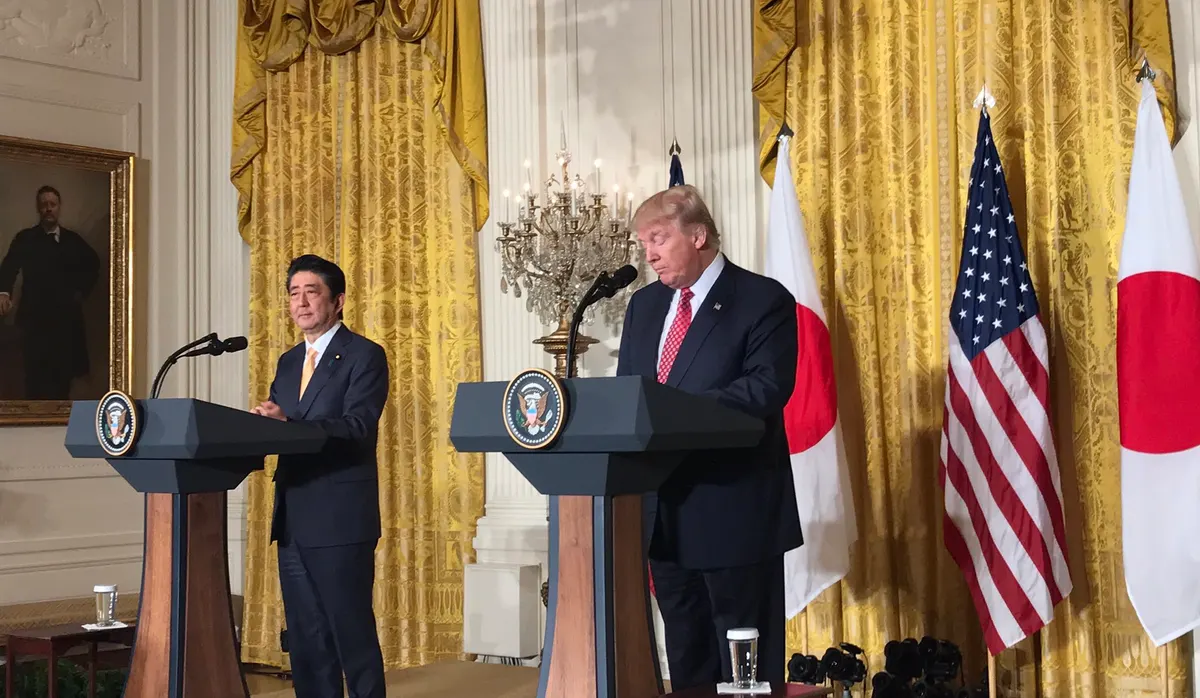
Trump and Abe stepped away to deliver a brief joint statement roughly twenty minutes later. Abe called the launch absolutely intolerable, and Trump pledged that the United States stood behind Japan, its ally, 100 percent, notably without mentioning South Korea by name.1,7 A Mar-a-Lago member, Richard DeAgazio, had already posted photographs of the dinner-table scene to Facebook, including images of aides huddled around papers and a shot identifying the officer carrying the president's nuclear launch materials. The White House maintained that only logistics for the coming press conference were discussed in public view, with any classified briefing held separately in a secure facility, a claim congressional Democrats and former government-ethics officials publicly disputed.6,9 A House Oversight Committee inquiry followed within days.8
The Second Test and Declared Operational Status
North Korea tested the Pukguksong-2 a second time on 21 May 2017, launching from the Pukchang area north of Pyongyang.1,2 The missile again flew about 500 km and reached roughly 560 km in altitude, results close enough to the first test that analysts read it as a confirmation flight rather than a new profile.2 State media went further this time, declaring the launch the missile's last developmental test and announcing that Kim Jong Un had approved the Pukguksong-2 for serial production and operational deployment, alongside the apogee-imagery claim covered above.1,5
North Korea has not published a confirmed Pukguksong-2 test since May 2017, an unusually thin flight-test record for a system state media describes as combat-ready. By 2019, a United Nations Panel of Experts report cited by outside researchers placed the missile at bases in the country's north, near the border with China, deployed alongside older Hwasong-9 units.1 North Korea displayed the Pukguksong-2 again at a nighttime military parade on 10 October 2020, marking the 75th anniversary of the ruling Workers' Party.1
Whether the missile has meaningfully progressed since 2017 is genuinely unclear from open sources. No additional flight test has surfaced publicly, and estimates of the Pukguksong-2's true operational range still vary widely, from roughly 1,200 km at a favorable shallow trajectory to figures above 2,000 km that outside missile trackers treat with caution, given that no test has ever flown anywhere near that distance.2,4,10 Whether North Korea has quietly refined the design, built a meaningful stockpile, or largely set the program aside in favor of newer solid-fuel missiles like the Pukguksong-3 is not something available reporting can answer with confidence.
The Pukguksong-2 has never been fired at a target in anger, and North Korea has no declared or reported combat use of the missile. Its closest connection to an active war surfaced in December 2024, when video circulating from Russia's Tyumen region reportedly showed a rail shipment of North Korean military equipment moving through Russian territory.10,11 Researchers tracking the footage identified what they judged, with real but incomplete confidence, as five tracked vehicles matching the Pukguksong-2's launcher, traveling alongside a shipment of North Korean M1989 Koksan self-propelled howitzers.10,11 Radio Free Asia reported that it could not independently verify the video, and no government has confirmed the shipment publicly.11
Analysts who track the transfer read it less as a sign Russia needs the Pukguksong-2's specific range, which does not obviously fill a gap in Russian ballistic-missile forces already fighting in Ukraine, and more as evidence North Korea wants combat data on a missile it has flown only twice in eight years.10 North Korea has already watched its shorter-ranged KN-23 missiles perform inconsistently in Ukrainian strikes, and a Pukguksong-2 shipment would give Pyongyang a chance to test the tracked launcher's durability and the missile's solid-fuel motor under conditions no peacetime exercise could replicate.10 None of this amounts to a confirmed conflict deployment. The Russia transfer is treated here as a reported, unverified development rather than an established fact.
On the Korean Peninsula itself, the Pukguksong-2 functions as a deterrent and crisis-signaling tool rather than a weapon with any combat record. Its presence at bases near the border with China, its repeated parade appearances, and its role in the February 2017 test that coincided with the Trump-Abe summit have all served that signaling purpose far more than any battlefield one.
North Korea has not disclosed distinct production variants of the Pukguksong-2 itself, and only two confirmed flight tests exist to compare against each other. The more meaningful variation sits one level up, across the wider Pukguksong missile program the Pukguksong-2 belongs to. The Pukguksong-1 remains the submarine-launched original, fired from a submersible barge and later from an actual ballistic-missile submarine.1 The Pukguksong-3, first tested in October 2019, extended the same solid-fuel approach to a larger, cold-launched submarine missile with notably greater range than the Pukguksong-1, launched from a submersible test barge off Wonsan.1 Later Pukguksong-4 and Pukguksong-5 designs, both revealed only at military parades rather than flight-tested, appear to push the same submarine-launched line toward larger, multiple-warhead payloads.
Within that program the Pukguksong-2 remains the only member built specifically for land-based, road-mobile launch rather than for a submarine or a static test barge. That distinction matters for anyone comparing Pukguksong-2 specifications against its siblings. Where the Pukguksong-1 and Pukguksong-3 answer questions about submarine tube diameter and a boat's limited payload margin, the Pukguksong-2's engineering answers a different question, how much range and mobility a fully tracked ground vehicle can add to the same core motor. North Korea has shown no sign of retiring the Pukguksong-2 in favor of its seaborne relatives. If anything, the missile's continued parade appearances through 2020 suggest Pyongyang still regards the tracked, land-based version as a distinct and useful part of its solid-fuel missile inventory, alongside rather than instead of the submarine-launched members of the same program.

The Pukguksong-2 has one confirmed operator. North Korea's Strategic Force, the Korean People's Army branch responsible for all ground-launched ballistic and cruise missiles, has fielded the Pukguksong-2 since state media declared it ready for serial production after the May 2017 test.1,2 No export sale, transfer, or foreign operator has been confirmed, and the December 2024 reports of Pukguksong-2 launchers reportedly moving into Russia remain unverified rather than a confirmed acquisition.10,11 No specific North Korean manufacturing plant or design bureau has been independently identified in open-source reporting as the Pukguksong-2's manufacturer, beyond its general attribution to North Korea's state missile-development apparatus.
Basing appears concentrated in North Korea's north. A United Nations Panel of Experts report from 2019 placed Pukguksong-2 units at bases near the border with China, alongside older Hwasong-9 launchers rather than segregated into their own dedicated garrison.1 That siting keeps the missile within striking distance of Japan and South Korea while placing the launchers themselves close to North Korea's most defensible interior terrain, consistent with the tracked TEL's advertised advantage of dispersing away from paved roads. Given how few confirmed test flights the missile has flown, independent estimates of how many Pukguksong-2 launchers and missiles North Korea has actually produced and fielded vary considerably, and no reliable open-source count exists.
Pukguksong-2 vs. Hwasong-9, Same Job, Opposite Engineering
North Korea's Strategic Force operates the Pukguksong-2 and the older Hwasong-9 side by side, and the pairing makes an unusually direct comparison possible because both missiles cover roughly the same target set from roughly the same bases. The Hwasong-9, itself a stretched version of the Soviet Scud-ER fueled by liquid propellant, manages roughly 700 to 1,000 km with a reduced payload, well short of the Pukguksong-2's estimated 1,200 to 2,000 km reach.2 Hwasong-9 crews need to move fuel and oxidizer trucks to a launch site and spend a lengthy, exposed countdown pumping propellant aboard, while a Pukguksong-2 crew fires from a pre-loaded canister within minutes of stopping.2,3 The genuine tradeoff runs the other way too. North Korea has built and fielded Hwasong-9 missiles by the hundreds over three decades, and its liquid-fuel, Scud-derived design is thoroughly proven, while the Pukguksong-2 remains a missile North Korea has flight-tested exactly twice.
| Pukguksong-2 | Hwasong-9 | |
|---|---|---|
| Fuel | Solid, two-stage2 | Liquid, single-stage2 |
| Range | ~1,200-2,000 km2,4 | ~700-1,000 km2 |
| Launcher | Tracked TEL3 | Wheeled TEL |
| Confirmed test flights | 2 (2017)1 | Dozens since the 1990s |
Pukguksong-2 vs. China's DF-21, a Shared Submarine-to-Shore Playbook
The more instructive comparison sits outside North Korea entirely. China's land-based DF-21 medium-range missile grew out of the submarine-launched JL-1 decades before North Korea tried the same approach with the Pukguksong-1 and Pukguksong-2.12 Both programs picked the identical shortcut, taking a compact naval missile's proven solid-fuel motor and diameter and building a road-mobile launcher around it rather than developing a ground missile from scratch. China's DF-21 went on to spawn anti-ship and maneuvering-reentry variants far beyond anything North Korea has publicly attempted with the Pukguksong-2, reflecting a much larger industrial base and a multi-decade head start. The comparison is useful mainly as a reminder that the Pukguksong-2's core idea, a submarine missile brought ashore, is a well-worn approach among countries building a solid-fuel missile force from a limited industrial base, not a uniquely North Korean shortcut.


What is the range of North Korea's Pukguksong-2 missile? Independent trackers at the Center for Strategic and International Studies estimate an operational range of roughly 1,200 to 2,000 km, though the missile's only two confirmed flight tests each covered about 500 km on deliberately steep trajectories.2,1
Is the Pukguksong-2 still in service? Yes. North Korea declared the Pukguksong-2 ready for serial production after its May 2017 test, and a 2019 United Nations report placed fielded units at bases near the border with China.1,2 No retirement or replacement has been reported since.
How does the Pukguksong-2 missile work? A gas generator inside the sealed canister ejects the missile several meters into the air before the two-stage solid-fuel motor ignites in midflight, the same cold-launch principle used on many submarine-launched missiles and, on the ground, on the American LGM-118 Peacekeeper.3
Why is the Pukguksong-2's first test linked to Donald Trump and Shinzo Abe? Its 12 February 2017 debut fell on the day Abe was meeting Trump at Mar-a-Lago. The two leaders and their aides reviewed the launch at a public dinner table, using phone flashlights to read documents, a scene photographed by a club member and criticized afterward as a national-security lapse.6,7,8
Has North Korea sent Pukguksong-2 missiles to Russia? Video reportedly filmed in Russia's Tyumen region in December 2024 showed tracked launchers that researchers identified, with real but incomplete confidence, as Pukguksong-2 systems, moving alongside North Korean artillery bound for the war in Ukraine. No government has confirmed the shipment.10,11
What is the Pukguksong-2's unit cost? No public unit-cost figure exists for the Pukguksong-2 or for any comparable North Korean missile. North Korea's defense economy is not market-priced, and the specialist trackers who publish detailed Pukguksong-2 specifications do not publish cost estimates.
- "Pukguksong-2", Wikipedia — en.wikipedia.org ↩
- "Pukguksong-2 (KN-15)", Missile Threat, CSIS — missilethreat.csis.org ↩
- "The Pukguksong-2: A Higher Degree of Mobility, Survivability and Responsiveness", 38 North — 38north.org ↩
- "Polaris-2 (Pukguksong-2/KN-15)", Missile Defense Advocacy Alliance — missiledefenseadvocacy.org ↩
- "North Korea Tests Its Pukkuksong-2 Solid Fuel Ballistic Missile Again, First Takeaways", The Diplomat — thediplomat.com ↩
- "Inside Mar-a-Lago, How Donald Trump Learned of the North Korea Missile Test", ABC News — abcnews.go.com ↩
- "The moment Trump learned of North Korean missile launch at Mar-a-Lago golf course", IBTimes UK — ibtimes.co.uk ↩
- "At Mar-a-Lago, Trump Puts Government Affairs on Display for All to See", War Is Boring (Medium) — medium.com ↩
- "Photos from Mar-a-Lago guest reportedly show Trump responding to North Korea tests", Yahoo News — yahoo.com ↩
- "N.Korea Likely Supplied New Ballistic Missile to Russia, Pukguksong-2 of at Least 1,200 km Range", Defense Express — en.defence-ua.com ↩
- "North Korea's mid-range ballistic missile systems spotted in Russia, expert", Radio Free Asia — rfa.org ↩
- "JL-1", Wikipedia — en.wikipedia.org ↩