

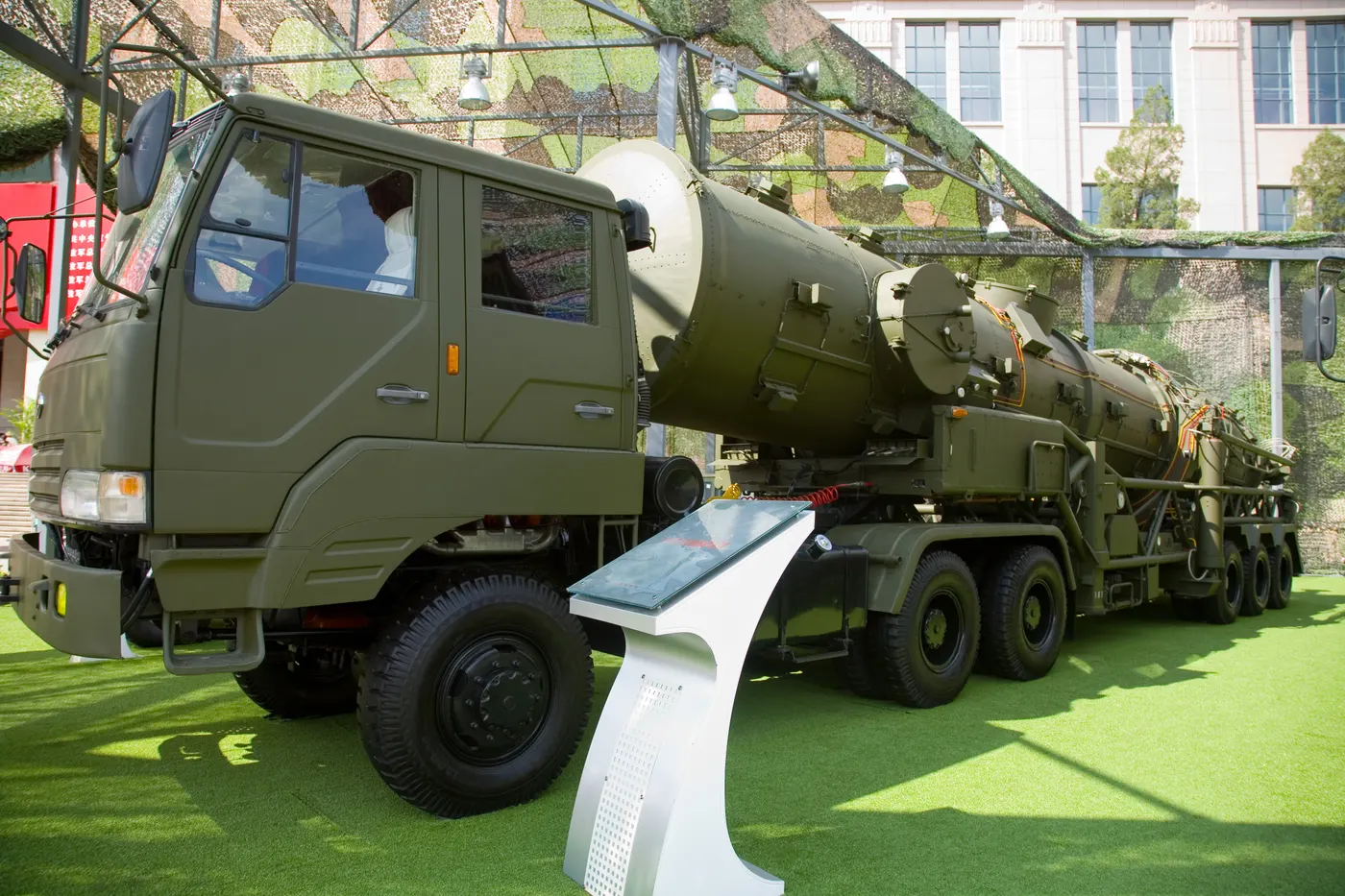

China's Second Artillery Corps accepted the two-stage, solid-fuel Dongfeng-21 into service in 1991, the point at which the People's Liberation Army fielded a road-mobile medium-range ballistic missile for the first time and stopped depending entirely on liquid-fuel missiles that needed hours of exposed fueling before they could fly.1 Known in NATO reporting as CSS-5, the DF-21 was built by the Changfeng Mechanics and Electronics Technology Academy, and its motor technology traces directly to the submarine-launched JL-1 program, itself years in development before the land-based missile followed.2 The DF-21's arrival let the People's Republic of China retire the ageing liquid-fuel DF-3 and DF-4 intermediate-range missiles from the nuclear deterrent role over the following decade, replacing systems that had to be fueled in the open for hours with one that a launch crew could erect and fire within roughly fifteen minutes.
- First Chinese solid-fuel road-mobile ballistic missile
- 10-15 minute launch preparation, hard to catch fueling
- Proven JL-1-derived motor, mature by the mid-1980s
- Became the base airframe for an entire missile family
- Baseline accuracy (300-700m CEP) was poor by modern standards
- Superseded operationally within five years by the DF-21A
- No confirmed foreign operator beyond a disputed Saudi sale
- Never displayed publicly in its original 1991 configuration
The baseline DF-21 covered in this article is the founding member of a much larger family. Its direct descendants, the improved-accuracy DF-21A, the GPS-aided conventional-strike DF-21C, and the anti-ship DF-21D later nicknamed the carrier killer, all share the same 10.7 meter, 1.4 meter diameter airframe and the same two-stage solid motor the baseline missile introduced.3 Anyone researching DF-21 specifications quickly runs into disagreement between sources on basic numbers, especially accuracy, because Beijing has never published verified test data and every open-source figure is an estimate built from limited observation.
How does the DF-21 work as a weapon system? The short answer is mobility. A wheeled tractor tows the missile, still lying flat, along ordinary roads to a pre-surveyed or improvised launch point, raises it to vertical on an erector arm, and fires it within minutes of stopping, denying an adversary's satellites and signals-intelligence network the long, fixed fueling window that made the older DF-3 and DF-4 vulnerable to a preemptive strike.1 That survivability, not any single spec on the sheet, is what let Chinese planners treat the DF-21 as a credible retaliatory weapon instead of one that had to be used quickly or risk being destroyed on the ground.
Whether the DF-21 is still in service today depends on which member of the family a reader means. The baseline missile described here was effectively superseded within its own decade, first by the improved-accuracy DF-21A in 1996 and later by the conventional-strike DF-21C and anti-ship DF-21D, both of which remain in active People's Republic of China service.3 Open-source estimates of a DF-21-family missile's unit cost vary widely, from roughly ten million to twenty million dollars, and neither Beijing nor an independent auditor has ever published a verified figure, so any specific number in circulation should be read as a rough approximation rather than a price tag.
The JL-1-Derived Two-Stage Solid Motor and the Changfeng Academy
The DF-21's two-stage, solid-fuel propulsion is not an original design, it was adapted from the JL-1 submarine-launched ballistic missile, a program that began in 1967 under China's National Defense Science and Technology Commission.2 Chinese defense scientist Zhang Aiping pushed for the JL-1's solid-propellant technology to be moved onto a land-based, road-mobile launcher rather than developing a separate liquid-fuel design, and formal work on that land derivative started around 1976 at the Second Aerospace Academy, the institution that later became the Changfeng Mechanics and Electronics Technology Academy.4 Two stages give the DF-21 a comparatively simple burn profile next to the liquid-fuel DF-3 and DF-4 it replaced, and solid propellant means the airframe can sit loaded and ready on its trailer for long stretches without the corrosive handling risks that liquid oxidizers demand. The DF-21's designation as the Dongfeng missile series' first solid-fuel land-based type is well documented across Chinese and Western sources alike, and it marked a genuine shift in Chinese missile design away from the liquid-fuel architecture used since the earliest DF-2 tests in the 1960s.5
- Füze SınıfıMRBM
- Hizmete Giriş Yılı1991
- TasarımcıChangfeng Mechanics and Electronics Technology Academy
- Uzunluk10,7 m
- Çap1,4 m
- Fırlatma Ağırlığı14.700 kg
- HizmetteHayır
DF-21 Range, the Wide CEP Dispute, and Why Its Guidance Stayed Inertial
Reported maximum range for the baseline DF-21 clusters around 1,770 kilometers, with a handful of sources citing figures up to 1,800 kilometers, enough to reach targets across northern India, Central Asia, the Russian Far East, and much of Southeast Asia from launch positions deep inside Chinese territory.1 Accuracy is a different story. Open-source estimates for the baseline missile's circular error probable cluster loosely between 300 and 700 meters, guided purely by an inertial platform without any terminal correction.3 The far tighter accuracy sometimes quoted for a DF-21, numbers below 25 meters, actually describes the anti-ship DF-21D's active-radar terminal guidance package riding a maneuverable reentry vehicle, not the baseline missile's simple inertial system, and conflating the two figures is a common error in casual summaries of the DF-21 family.6
- Tahrik TipiKatı yakıtlı roket
- Kademe Sayısı2
- Yakıt TipiKatı
- Katı YakıtlıEvet
- Soğuk FırlatmaHayır
- KanisterliHayır
That spread between a few hundred meters and a few kilometers, depending on which source and which family member a reader is looking at, is frequently cited in arms-control literature as a textbook case of how hard it is to pin down Chinese missile accuracy from open information, since none of the underlying figures come from disclosed Chinese test data.3 The baseline DF-21's inertial-only guidance was also a limiting factor in its short operational life, a gap the DF-21A closed within five years by adding a more capable digital computing complex to the same airframe.
- Azami Menzil1.770 km
- Geri Giriş Hızı (Mach)10 Mach
- Alçak Yörünge KabiliyetliHayır
Payload and Warhead, Nuclear-Only Until the DF-21C
The DF-21 carries a 600 kilogram payload section housing a single nuclear warhead, with open-source yield estimates ranging from 200 to 300 kilotons on the low end up to 500 kilotons in some assessments.1 Unlike the later DF-21C, the baseline missile had no confirmed conventional high-explosive option, its warhead was a nuclear-only design from the outset, and dual-capability with a conventional payload did not become a documented DF-21-family feature until the DF-21C's 2006 debut.3 The absence of any MIRV capability limited the DF-21 to single-warhead delivery throughout its service life, a design choice consistent with China's broader minimum-deterrence nuclear posture during the period.
- Dairesel Hata Olasılığı (CEP)500 m
- Güdüm TipiAtaletsel / GPS
- Terminal GüdümHayır
- Manevra Kabiliyetli Geri Giriş Aracı (MaRV)Hayır
The Semi-Trailer Transporter Erector Launcher and Its 10-15 Minute Launch Sequence
The DF-21 rides on a semi-trailer transporter erector launcher towed by a dedicated tractor unit rather than a single integrated wheeled vehicle, an open erector-cradle arrangement rather than a sealed launch canister of the kind used on China's later canisterized missile families.2 Whichever tractor a given brigade operated, the erect-and-fire sequence for the DF-21 consistently ran in the range of 10 to 15 minutes, the figure that made the missile survivable in a way the silo-bound and slow-fueling DF-4 never was.1 Deployment was road-based rather than cold-launched from a below-ground silo, since the DF-21 does not use a below-ground silo at all, and its basing depended entirely on dispersal across a network of pre-surveyed roadside and forested launch points rather than fixed infrastructure. Chinese and Western writing on the missile alike treats that short reaction time, more than any single number on the spec sheet, as the DF-21's defining engineering achievement, and it is the reason the missile answers so directly the question of how a Chinese road-mobile ballistic missile actually works in practice.
- Harp Başlığı TipiKonvansiyonel/Nükleer
- NükleerEvet
- TermonükleerEvet
- Patlama Gücü (başlık başına)500
- MIRVHayır
- Harp Başlığı / RV Sayısı1
- Konvansiyonel KabiliyetliHayır
- Konuşlanma ŞekliMobil fırlatıcı
- Silo KonuşluHayır
- Karayolu Hareketli (TEL)Evet
- Denizaltından FırlatılanHayır
- Kullanıcılar2
- Patlayıcı Dolgu Ağırlığı600 kg
From the JL-1 Submarine Program to a Limited 1991 Deployment

Work on the technology behind the DF-21 traces to 1967, when the JL-1 submarine-launched ballistic missile program began under the National Defense Science and Technology Commission, and the land-based derivative that became the DF-21 followed roughly a decade later, delayed in part when Zhang Aiping was removed from his post following Deng Xiaoping's own political fall in early 1976.4 The DF-21's first flight test came on 20 May 1985, with a second test in May 1987, and by 1988 the missile's basic design was considered complete, though Chinese authorities did not immediately commit it to full-scale production.4 A limited number of DF-21 missiles reached the Second Artillery Corps around 1991, but several Western assessments treat this initial batch as a developmental fielding rather than a mature operational capability, since the wide inertial-only CEP and the small number of units built left it a stopgap rather than a mainstay weapon.7
That gap was closed quickly. The improved-accuracy DF-21A completed its first successful flight test in January 1995, followed by further successful launches that August and November, and reached initial operational readiness in 1996, becoming the mainstay nuclear-armed member of the family while the original 1991-era DF-21 configuration was phased out of frontline use.4 U.S. Department of Defense assessments from 2008 put total DF-21-family missile numbers at 60 to 80 built, with roughly 60 launchers in the inventory and an estimated production rate of ten to eleven missiles per year at that point in the program's history.1 Early DF-21 brigades were based well inland, at facilities identified in older order-of-battle assessments as Chuxiong, Jianshui, and Tonghua, positions chosen to cover targets in Central Asia, the Russian Far East, and South Asia rather than the coastal, Taiwan-facing missions that later Dongfeng variants took on.7
A Derivative Airframe Becomes an Anti-Satellite Weapon in 2007

On 11 January 2007, China used a modified missile the U.S. Defense Intelligence Agency identified as the SC-19, built around a DF-21 first stage fitted with a kinetic kill vehicle instead of a warhead, to destroy its own defunct Fengyun-1C weather satellite at an altitude of 865 kilometers.8 The kill vehicle closed on the satellite at roughly 8 kilometers per second, and the resulting collision created more than 3,000 pieces of trackable orbital debris, the largest single debris-generating event ever recorded at the time, drawing sharp international criticism over the long-term collision risk the fragments posed to other satellites.8
The test was widely read outside China as demonstrating that the DF-21 airframe's boost stages were mature and reliable enough to be repurposed for a mission its designers had never originally intended, an anti-satellite kill vehicle rather than a nuclear or conventional reentry vehicle. It remains the clearest public evidence that the basic DF-21 rocket motor, developed originally to move JL-1 technology onto land, had matured into a flexible booster stage usable well beyond its original ballistic-missile role.
The Reported 2007 Sale to Saudi Arabia
According to reporting first published by Newsweek in January 2014, China sold a number of DF-21 missiles to Saudi Arabia in 2007 in a deal that won quiet approval from Washington on condition that CIA technical experts could verify the missiles were not configured to carry nuclear warheads.9 CIA analysts who reportedly examined the missiles' modified nosecones after import concluded they lacked the internal volume to accommodate an unsophisticated nuclear device, and the agency's own logistical costs for managing the arrangement, estimated at six to seven hundred thousand dollars, were reportedly buried in internal budget documents under a vague operations-support heading.10 Neither Beijing nor Riyadh has ever officially confirmed the sale, and it remains one of the least transparent chapters in the DF-21's history, resting almost entirely on investigative reporting rather than any government disclosure.
The Saudi deal stands out precisely because of how quiet it was. Saudi Arabia's older Chinese-supplied DF-3 missiles, bought in the late 1980s, were eventually paraded in public in 2014 as a deliberate signal of the kingdom's strategic reach, but no DF-21 has ever been shown at a Saudi parade or officially acknowledged by Riyadh.9 That contrast, a decades-old missile displayed openly against a newer one never confirmed at all, is itself evidence of how selectively Saudi Arabia has chosen to reveal its ballistic missile inventory to the outside world.
The baseline DF-21 has never been fired in anger, and no confirmed combat use of the type exists in open sources. Its role throughout its operational life was deterrence, keeping a survivable, mobile nuclear option available to Beijing during periods of tension with neighboring states rather than serving as a weapon employed in an active conflict. Early DF-21 and DF-21A brigades were oriented inland, toward Central Asia, the Russian Far East, and South Asia, rather than toward Taiwan, a posture that only shifted as later, more accurate family members entered service.7
It is worth being explicit about what the DF-21 was not involved in, since the family's later fame as a Taiwan-related deterrent invites confusion. When the People's Liberation Army fired eleven ballistic missiles around Taiwan during the August 2022 exercises following U.S. House Speaker Nancy Pelosi's visit, the missiles analysts identified were DF-15 variants and possibly DF-16 types, not the DF-21 family.11 The DF-21D anti-ship variant separately demonstrated a moving-target strike capability against a ship near the Paracel Islands in August 2020, but that event belongs to the DF-21D's own record rather than the baseline missile covered in this article.12
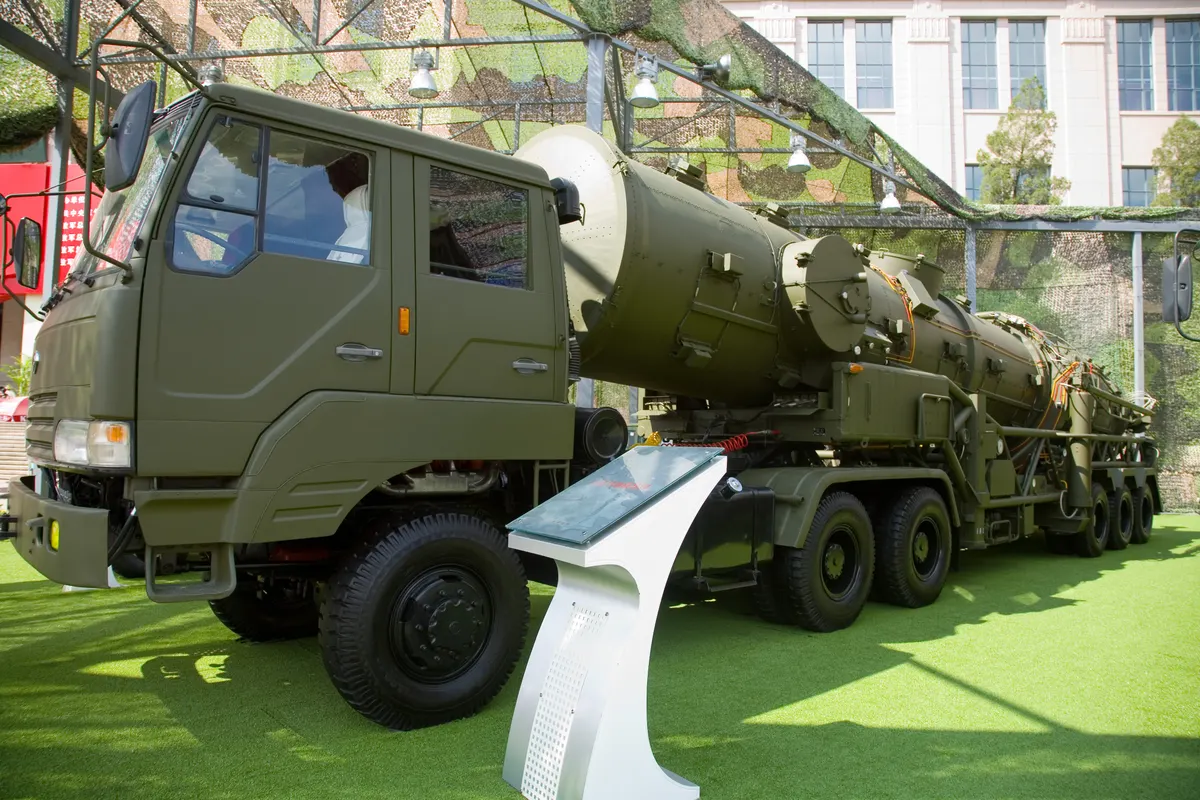
The baseline DF-21 sits at the root of a missile family that grew far beyond its original nuclear-deterrent role. The DF-21A entered service in 1996 with an improved digital guidance package that tightened accuracy to a widely cited 100 to 300 meter CEP range, and became the mainstay nuclear-armed member of the family for a decade afterward.3 A poorly documented DF-21B designation appears in some Western open-source assessments, though detail on any distinct configuration under that name is thin and inconsistent across sources.12 The DF-21C, revealed publicly around 2006, added GPS-aided terminal guidance and became the family's first dual-capable member, able to carry either a nuclear or a conventional high-explosive warhead with accuracy estimated at 40 to 50 meters CEP.3 The DF-21D, first paraded in 2015 and now the most famous member of the family under the carrier killer nickname, added a maneuvering reentry vehicle with active-radar terminal guidance intended to strike moving naval targets at sea, a role no earlier DF-21 variant attempted.3 Some Western assessments also describe a nuclear-armed DF-21E, revealed by U.S. Department of Defense reporting around 2016, though open-source detail on that designation remains sparse.3
None of these later variants would exist without the baseline DF-21's original two-stage solid motor and road-mobile TEL arrangement, which every subsequent family member has retained largely unchanged even as guidance, warheads, and mission sets diversified. The family sits alongside other Chinese short and medium-range systems developed across the same decades, including the shorter-ranged DF-16, a separate conventional-strike design rather than a direct DF-21 derivative.


| Yıl | Alıcı | Adet | Tutar | Bugünkü Değer (2025) |
|---|---|---|---|---|
| 2007 |  Suudi Arabistan | — | — | — |
The People's Republic of China is the DF-21's only confirmed operator, fielding the missile and its later variants through the Second Artillery Corps and its successor, the People's Liberation Army Rocket Force, since the early 1990s.1 Saudi Arabia is widely reported, though never officially confirmed by either government, to have purchased a batch of DF-21 missiles in 2007 with CIA-verified conventional-only nosecones, which would make it the only reported foreign operator of the type.9 No other country has a confirmed DF-21 acquisition on record, and the missile has never been offered for export in the same open, marketed way as some of China's other Dongfeng-series products.
The United States fielded its own solid-fuel, two-stage, road-mobile medium-range ballistic missile years before the DF-21 entered Chinese service, and only one of the two survived the decade that followed. The Pershing II entered United States Army service in West Germany in 1983, eight years ahead of the DF-21's 1991 debut, and paired its solid motor with an active-radar terminal guidance package that gave it a claimed 30 meter CEP, a generation more accurate than the DF-21's inertial-only, several-hundred-meter figure.13 The Pershing II's advantage did not last. The Intermediate-Range Nuclear Forces Treaty forced the withdrawal of every Pershing II from Europe by 1991, the same year the DF-21 was entering PLA service, and China, never a party to that treaty, kept developing the DF-21 family for decades afterward while the American missile disappeared entirely from the US arsenal.
| Spec | DF-21 (baseline) | Pershing II |
|---|---|---|
| Entered service | 1991 | 1983 |
| Range | ~1,770 km | ~1,770 km |
| Guidance | Inertial only | Inertial + active-radar terminal (MaRV) |
| CEP | 300-700 m | ~30 m |
| Fate | Base of an expanding family | Withdrawn 1991 (INF Treaty) |
That table understates how differently the two systems were used. The Pershing II was built around its accuracy, since its active-radar MaRV terminal guidance was designed specifically to hit hardened Warsaw Pact command bunkers within seconds of the treaty-mandated flight time from West Germany, while the DF-21's original 1991 configuration prioritized simply getting a solid-fuel, road-mobile missile into service at all, with accuracy improvements left to the DF-21A that followed within five years. Where the Pershing II's story ends in 1991 with a superpower arms-control agreement, the DF-21's continues well past that year, evolving into the conventional-strike DF-21C and the anti-ship DF-21D in a way no Cold War-era Pershing derivative ever had the chance to.


How far can the DF-21 missile travel? The baseline DF-21 has a maximum range of approximately 1,770 kilometers, enough to reach targets across northern India, Central Asia, and much of Southeast Asia from launch positions inside Chinese territory.1
Is the DF-21 missile nuclear or conventional? The original 1991-era DF-21 was nuclear-only, carrying a single warhead estimated at 200 to 500 kilotons. Conventional dual-capability did not appear in the family until the DF-21C variant debuted around 2006.3
What is the difference between the DF-21 and the DF-21D? The baseline DF-21 uses a non-maneuvering reentry vehicle with inertial-only guidance against fixed land targets. The DF-21D adds a maneuvering reentry vehicle with active-radar terminal guidance built specifically to strike moving ships at sea, earning it the carrier killer nickname.6
Is the DF-21 missile still in service? The original 1991 DF-21 configuration was superseded by the DF-21A within five years, but later family members, the DF-21C and DF-21D, remain in active PLA Rocket Force service today.3
Who makes the DF-21 missile? The Changfeng Mechanics and Electronics Technology Academy, successor to China's Second Aerospace Academy, developed the DF-21, adapting solid-fuel motor technology from the JL-1 submarine-launched missile program.2
Did China sell the DF-21 missile to Saudi Arabia? Investigative reporting first published by Newsweek in 2014 says China sold Saudi Arabia a batch of DF-21 missiles in 2007 with CIA-verified conventional-only nosecones, though neither government has officially confirmed the deal.9
- "DF-21", Wikipedia — en.wikipedia.org ↩
- "DF-21 (CSS-5)", CSIS Missile Threat — missilethreat.csis.org ↩
- "DF-21", Federation of American Scientists, China Nuclear Forces — nuke.fas.org ↩
- "DF-21 medium-range missile system", Missilery.info — en.missilery.info ↩
- "Dongfeng (missile)", Wikipedia — en.wikipedia.org) ↩
- "DF-21D and DF-26B: China's Missiles Built to Sink Navy Aircraft Carriers", The National Interest — nationalinterest.org ↩
- "JL-1", Wikipedia — en.wikipedia.org ↩
- "2007 Chinese anti-satellite missile test", Wikipedia — en.wikipedia.org ↩
- "Exclusive: CIA Helped Saudis in Secret Chinese Missile Deal", Newsweek — newsweek.com ↩
- "China Secretly Sold Saudi Arabia DF-21 Missiles With CIA Approval", The Diplomat — thediplomat.com ↩
- "An Overview of Chinese Military Activity Near Taiwan in Early August 2022, Part 1", Global Taiwan Institute — globaltaiwan.org ↩
- "DF-21 DF-21A (CSS-5) / DF-21B", Army Recognition — armyrecognition.com ↩
- "Dong Feng-21 (CSS-5)", Missile Defense Advocacy Alliance — missiledefenseadvocacy.org ↩