

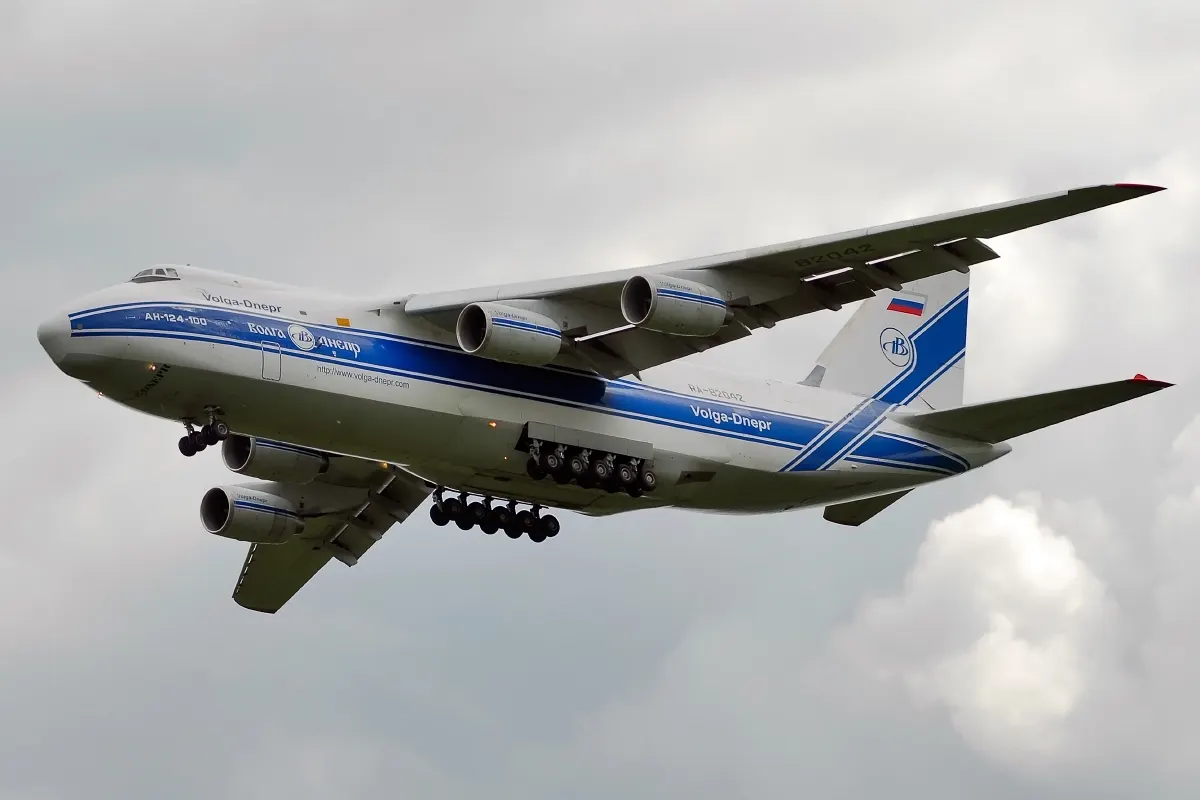

The Antonov An-124 Ruslan remains the largest military transport aircraft ever placed into series production, a distinction it has held since its first flight on 24 December 1982.1 NATO gave it the reporting name Condor, though inside the Soviet Union and among the crews who fly it the aircraft is simply Ruslan, named after the giant hero of Alexander Pushkin's poem Ruslan and Lyudmila.2 Only the one-off Antonov An-225 Mriya, a stretched six-engine derivative built for the Buran space shuttle program and destroyed at Hostomel in 2022, was ever bigger, and that aircraft never left single-prototype status.3 As a strategic airlifter, the An-124 was built to move cargo genuinely too large for any other production aircraft of its era, cargo that could not simply be split across multiple smaller flights.
- Only production aircraft able to carry a fully assembled GE90 turbofan
- Nose and tail cargo doors allow drive-through loading of vehicles
- 150,000 kg payload rating on the -100M-150 variant
- Kneeling landing gear eases loading of low-clearance cargo
- Requires roughly 3,000 m of runway at maximum weight
- Aging D-18T engines have suffered uncontained failures
- Ukraine-Russia production split ended new-build manufacturing
- Charter cost (often above EUR 300,000 per flight) limits routine use
Design work began in 1971 at the Antonov design bureau in Kyiv, and the Soviet government issued the formal development order in February 1972.4 The aircraft entered operational service with Soviet Military Transport Aviation in 1986.1 Production ran at two separate final-assembly lines simultaneously, one at the Antonov Serial Production Plant (the former Kyiv Aviant factory) in Ukraine and the other at what is now Aviastar-SP in Ulyanovsk, Russia.5 That dual-plant arrangement, unusual for a Soviet-era military aircraft, is why the manufacturing history of the An-124 cannot be cleanly assigned to one country even though the aircraft's design origin is Ukrainian, credited to the Antonov bureau.4 A total of 57 airframes were built between 1984 and 2004 before the joint production line wound down.6
The An-124 was never a single-purpose military asset. From the start it doubled as the backbone of a commercial oversize-cargo charter market that still has no real rival, and most flying Ruslans today spend far more hours moving turbines, satellites, and other aircraft than moving troops or armored vehicles.7 That dual identity, military airlifter by design and commercial heavy-freight workhorse by economic necessity, shapes almost everything that follows in its operational history.
Specs and Design for the Antonov An-124 Ruslan center on one design goal, moving indivisible loads too large or too heavy for any Western or Soviet transport aircraft available in the 1970s. The airframe is powered by four Progress D-18T turbofans, developed by the Ivchenko-Progress bureau and built by Motor Sich in Zaporizhzhia, each rated at roughly 51,500 lbf of thrust.8 Early Series 0 and 1 engines were prone to compressor surge, and civilian operators only fully transitioned to the more durable Series 3 by the 2000s.8 The engine's safety record still carries scrutiny into the present decade, an uncontained fan-disc failure on a Volga-Dnepr An-124 during takeoff from Novosibirsk on 13 November 2020 destroyed the number-two engine and forced a runway excursion on the return landing, and it triggered fleet-wide disc inspections across every operator.9
- Motor TipiProgress D-18T (D-18 Series 4 on -150 models)
- Motor Sayısı4
{{photo-req side=right q="Antonov An-124 nose visor cargo door open loading" caption="The An-124's hinged nose visor swings upward, allowing vehicles to be driven directly into the forward cargo hold." alt="Antonov An-124 with nose cargo door open"}}
- Seyir Hızı865 km/sa
- Hizmet Tavanı12.000 m
The Nose-and-Tail Loading System That Defines the An-124
What separates the An-124 from most large transports is not raw size alone but the way cargo actually gets aboard. A hinged visor nose lifts clear of the forward fuselage while a ventral ramp folds down at the tail, so vehicles and outsize loads can be driven straight through the fuselage rather than winched in from one end.10 A rear-loading ramp alone would have limited the aircraft to single-direction loading of long items, the drive-through arrangement instead lets ground crews load a locomotive or a helicopter from either end depending on ramp access at a given airfield. Kneeling landing gear lowers the cargo floor closer to ground level for loading, and the main gear uses 24 wheels distributed to keep runway loading pressure survivable for unpaved or lightly reinforced strips, though in practice the An-124 still needs roughly 3,000 meters of prepared runway at maximum weight.11
- Uzunluk69,1 m
- Boş Ağırlık181.000 kg
- Maks Kalkış Ağırlığı402.000 kg
The cargo hold measures around 36.5 meters in length and 6.4 meters in width, tall enough to carry a Boeing 777's GE90 turbofan fully assembled, a load no other production aircraft can accept without disassembly.12 Construction leans heavily on titanium for the wing box and landing-gear structure, with roughly 5 percent of the aircraft's total weight in carbon-fiber composites, a high figure for a design finalized in the late 1970s.13 Maximum payload on the baseline An-124-100 is rated at 120,000 kg, rising to 150,000 kg on the extended-payload -100M-150 standard.14 Cruise speed sits around 865 km/h at a service ceiling near 12,000 m, figures that trail a dedicated airliner but are unremarkable for an aircraft this size.1
Antonov's own design bureau traces the An-124 back to a 1971 in-house study known internally as Izdeliye 400, with the West initially assigning it the provisional designation An-40 before the aircraft's existence was confirmed.4 The Soviet government's formal go-ahead came on 2 February 1972, tasking the Kyiv-based bureau with a strategic transport capable of airlifting the largest armored vehicles and missile systems in the Soviet inventory.4 The first prototype flew on 24 December 1982, and the aircraft's Western debut came at the 1985 Paris Air Show, where it stunned observers used to the Lockheed C-5 Galaxy as the benchmark for large transports.16
{{photo-req side=right q="Antonov An-124 Paris Air Show 1985" caption="The An-124's 1985 Paris Air Show appearance was the aircraft's first public exposure to Western observers." alt="Antonov An-124 on static display"}}
Soviet Military Transport Aviation (VTA) took the An-124 into service in 1986, and the type set roughly 30 world records in its first years, including the heaviest single load ever carried by air (124 tonnes of generator equipment plus cradle, in late 1993) and the largest payload lifted to altitude.17 Series production was split between the Kyiv Aviant plant and Aviastar-SP (then the Ulyanovsk Aviation Industrial Complex), drawing components from more than 100 factories across the Soviet Union and, after 1991, across two separate countries.4 That cross-border arrangement grew steadily harder to sustain. By August 2014, Russian officials confirmed that joint production with Ukraine had effectively stopped amid worsening political relations, and Antonov subsequently explored restarting a Ukraine-only production line without Russian components, a plan that never reached serial output.18
The commercial side of the story began almost as early as the military one. Volga-Dnepr Airlines was formed in August 1990 in Ulyanovsk, jointly owned by Aviastar, the Antonov bureau, the Aviant plant, and the Progress engine design bureau, specifically to convert the An-124's spare military capacity into a commercial oversize-cargo charter business.19 By the start of the 2000s Volga-Dnepr's ten-aircraft fleet represented nearly half of all An-124s in commercial service worldwide and controlled around 60 percent of the global market for unique, oversized air cargo.19 NATO formalized its own reliance on the type in February 2006, signing the first Strategic Airlift Interim Solution (SALIS) contract to charter An-124-100s from a joint Antonov/Volga-Dnepr venture, giving alliance members guaranteed access to aircraft neither side wanted to buy outright.20
{{photo-req side=right q="Volga-Dnepr Antonov An-124 loading oversized cargo" caption="A Volga-Dnepr An-124 loads oversized freight, the commercial charter role that has defined most of the type's flying hours since 1990." alt="An-124 cargo aircraft being loaded with heavy freight"}}
Safety has not always matched the aircraft's reputation for capability. On 6 December 1997, a Russian Air Force An-124-100 crashed into a residential district of Irkutsk seconds after takeoff, when an engine surge at low altitude triggered a chain of powerplant failures, killing 23 aboard and 49 on the ground.21 Investigators later linked the disaster to fuel contamination from mixed cold-weather and standard fuel loads freezing in the tanks.21 More recent incidents, including the 2020 Novosibirsk engine failure, have kept pressure on operators to inspect aging D-18T fan discs across the fleet.9
The aircraft's sheer size has also made it a recurring prop in popular culture, well beyond aviation-enthusiast circles.
Military use of the An-124 has centered on logistics rather than direct combat exposure, but the aircraft has repeatedly appeared at the edge of active conflicts. Russia used five An-124s in 2015 to fly heavy military equipment, including components of the S-300 missile system, into Syria as part of the airlift that opened Moscow's intervention in the Russian military intervention in the Syrian civil war.22 Those flights were a visible demonstration of the type's original Cold War purpose, moving armor and air-defense systems into a theater no other aircraft in Russia's inventory could service as quickly.
The 2022 Russian invasion of Ukraine hit the An-124 program on multiple fronts at once. Russian paratroopers seized Hostomel (Antonov) Airport outside Kyiv on the opening day of the invasion, a battle that also damaged the Antonov works there, the state enterprise later reported three aircraft destroyed and five more damaged in the fighting, figures spanning several Antonov types rather than the An-124 alone.23 Separately, an An-124 belonging to Ukraine's Antonov Airlines happened to be undergoing overhaul at the Kyiv plant when the invasion began and could not be flown out, it remained grounded there for more than three years until a crew flew it to Leipzig, Germany, in July 2025, restoring Antonov's operational Ruslan fleet to six aircraft based outside Ukraine.24
{{photo-req side=right q="Hostomel Antonov Airport damage 2022" caption="Fighting for control of Hostomel (Antonov) Airport in February 2022 damaged the Antonov works where An-124 aircraft were assembled and based." alt="Damaged hangar at Hostomel Antonov Airport"}}
The war also stranded Russian-operated Ruslans far from home. A Volga-Dnepr An-124 that landed at Toronto Pearson International Airport on 27 February 2022, carrying COVID-era cargo, never flew again, Canadian sanctions grounded it within days, and Ottawa later moved to legally seize the aircraft for eventual transfer to Ukraine, becoming the first Western government to attempt such a transfer of a sanctioned Russian aircraft.25 Volga-Dnepr contested the seizure in Canadian courts. The episode, alongside blanket Western airspace bans on Russian carriers, effectively ended Russian-operated An-124 flights into NATO and EU airspace, cutting Volga-Dnepr out of the SALIS charter pool it had helped build two decades earlier.25
{{photo-req side=right q="Antonov An-124 grounded Toronto Pearson Airport" caption="A Russian-operated An-124 sat grounded at Toronto Pearson International Airport for more than two years under Canadian sanctions before a legal seizure effort began." alt="An-124 cargo aircraft parked at an airport under sanctions"}}
The baseline An-124-100 is the civilian-certificated standard used by most commercial charter operators, cleared for international cargo operations rather than restricted to Soviet military airworthiness rules.14 The An-124-100M-150 raised maximum payload to 150,000 kg and introduced a Western-compatible avionics fit aimed at satisfying international operating requirements.14 A further modernization, the An-124-102, replaced the original analogue flight deck with a glass cockpit and updated navigation equipment, though it was fitted to only a handful of airframes rather than becoming a fleet-wide standard.26
A stretched, six-engine derivative, the An-225 Mriya, was built directly from the An-124's wing and systems architecture to carry the Buran orbiter and other outsize spaceflight loads, only one example was ever completed and it was destroyed at Hostomel in the opening days of the 2022 invasion.3 Proposals for a further-enlarged An-124-300 with a stretched fuselage and updated engines circulated through the 2000s but never reached a production order, and Russia's own post-2014 successor concept, sometimes referred to informally as an Elephant airlifter, has so far remained a wind-tunnel model rather than a funded program.27


Russia operates the largest surviving military fleet, with most VTA Ruslans assigned to the 566th Military Transport Aviation Regiment at Seshcha and a smaller detachment with the 224th Flight Unit based at Ulyanovsk.28 Ukraine's fleet is operated commercially through Antonov Airlines rather than the Ukrainian Air Force directly, and as of 2025 numbers around six aircraft based at Leipzig after the last Kyiv-based airframe escaped the country.24 The United Kingdom has relied on chartered An-124 capacity for decades, including NATO SALIS access and direct Royal Air Force charters, to move outsize loads such as Chinook helicopters into Afghanistan before the RAF's own heavy-lift fleet matured.20
{{photo-req side=right q="Antonov An-124 Maximus Air UAE Abu Dhabi" caption="Maximus Air, based in Abu Dhabi, has operated an An-124-100 alongside Ilyushin Il-76 aircraft for Middle East and Africa outsize-cargo charters." alt="Antonov An-124 cargo aircraft on an airport apron"}}
The United Arab Emirates hosts commercial operator Maximus Air, which has flown an An-124-100 out of Abu Dhabi for outsize freight and Red Crescent relief charters since the 2000s.29 Libya briefly became the first country outside Russia and Ukraine to operate the type commercially, when Libyan Arab Air Cargo acquired two ex-Volga-Dnepr aircraft in 2001, one was later seized by Ukraine over a financing dispute and the other was destroyed on the ground during shelling at Mitiga Airport in June 2019.30 China has not operated its own An-124 fleet but has been among the type's heaviest charter customers for decades and has periodically discussed acquiring aircraft or production rights directly from Antonov, though no confirmed purchase has followed.31
The Lockheed C-5 Galaxy and the An-124 were both designed to be the biggest cargo aircraft flying, and the gap between them shows up in runway performance rather than raw size. The C-5, in its modern C-5M Super Galaxy form, needs only around 5,400 feet of runway at maximum weight thanks to a high-lift wing and modern CF6 engines, while the An-124 demands nearly 9,800 feet under the same conditions.32 In exchange, the An-124 carries a wider fuselage, a longer wingspan (73.3 m against the C-5M's 67.9 m), and roughly 23 tonnes more payload than the Galaxy.32 The United States accepted less raw lift capacity for a shorter takeoff run, while the Soviet Union accepted the longer runway requirement to maximize payload, and both aircraft have spent the decades since proving their own tradeoff workable often enough that neither design has been fully superseded.
| Metric | An-124 (-100M-150) | C-5M Super Galaxy |
|---|---|---|
| Max payload | 150,000 kg | ~127,000 kg |
| Wingspan | 73.3 m | 67.9 m |
| Takeoff run at MTOW | ~9,800 ft | ~5,400 ft |
| Max takeoff weight | 402,000 kg | 381,018 kg |
Numbers sourced per the specifications above.32
Against the Ilyushin Il-76, the comparison is really about scale of ambition rather than a shared Soviet design background. The Il-76 was built as a medium-heavy tactical and strategic hybrid, roughly a third of the An-124's payload class, intended for rough-field resupply as much as outsize freight.33 Where the An-124 needs a prepared major airport, the Il-76 can still reach forward strips the Ruslan never will, which is why Il-76s rather than An-124s make up the bulk of Volga-Dnepr's and the Russian VTA's routine sortie count even though the An-124 gets the marketing attention.19 The two aircraft ended up complementary in Soviet and post-Soviet service rather than competitive, one for reach, one for raw indivisible-load capacity.
Against the newer Boeing C-17 Globemaster III, the contrast is organizational as much as technical. The C-17 was built around a two-pilot digital flight deck and a single unified US Air Force logistics structure, while the An-124 still typically flies with a Soviet-style five or six person crew and was built to serve two air forces and one enormous commercial charter market simultaneously.15 The C-17 can use shorter, rougher strips than either the An-124 or the C-5, trading some of the Ruslan's raw volume for tactical flexibility Western planners valued more after the Cold War ended.


Is the Antonov An-124 Ruslan still in service? Yes. Russia's VTA continues to operate the type, and Ukraine's Antonov Airlines flies a smaller commercial fleet from Leipzig, though new production ended in 2004 and the joint Russia-Ukraine supply chain that once supported the fleet has been severed since 2022.18,24
What is the Antonov An-124's payload capacity? The baseline An-124-100 carries up to 120,000 kg, while the extended -100M-150 standard raises maximum payload to 150,000 kg, still the highest of any series-production cargo aircraft.14
How much does it cost to charter an Antonov An-124? Charter rates vary by distance and complexity, from roughly EUR 150,000 for short intra-European flights to more than EUR 500,000 for intercontinental missions.34
Why did An-124 production stop? Production relied on a joint Ukraine-Russia supply chain split between the Kyiv Aviant plant and Aviastar-SP in Ulyanovsk. Deteriorating relations between the two countries halted joint manufacturing by 2014, and no new airframes have been built since 2004.18
What replaced the An-124? Nothing has directly replaced it. Russia has floated wind-tunnel concepts for a successor sometimes called an Elephant airlifter, but as of the mid-2020s no funded program has reached metal-cutting, leaving the An-124 as the only aircraft in its payload class still flying.27
- "Antonov An-124 Ruslan", Wikipedia — en.wikipedia.org ↩
- "AN-124 RUSLAN", Antonov — antonov.com ↩
- "Antonov An-225 Mriya", Wikipedia — en.wikipedia.org ↩
- "Antonov 124 Condor: the complete story", Key.Aero — key.aero ↩
- "Antonov AN-124", Air Charter Service — aircharterservice.com ↩
- "Cargo Giant: 6 Fast Facts About The Antonov An-124", Simple Flying — simpleflying.com ↩
- "An-124-100 'Ruslan', world's largest freighters for outsize and heavyweight cargo", Volga-Dnepr Group — volga-dnepr.com ↩
- "Progress D-18T", Wikipedia — en.wikipedia.org ↩
- "Volga-Dnepr An-124 damaged in departure accident at Novosibirsk", FlightGlobal — flightglobal.com ↩
- "Antonov's Giant: the An-124 Ruslan", Aircraft InFormation.info — aircraftinformation.info ↩
- "Is A Lockheed C-5 Galaxy Bigger Than An Antonov An-124?", Simple Flying — simpleflying.com ↩
- "Antonov AN-124 ships engine for Swiss Airlines' Boeing 777-300ER", Airport Technology — airport-technology.com ↩
- "Antonov An-124 Ruslan (Condor)", Military Factory — militaryfactory.com ↩
- "Antonov AN-124-100, Icon of Heavy Lift Cargo Aircraft", Fliteline — fliteline.com ↩
- "Up Close With the AN-124", Cargo Facts — cargofacts.com ↩
- "12/26/1982: Maiden Flight of the Antonov An-124", Airways Magazine — airwaysmag.com ↩
- "Antonov flies its largest single piece of cargo", Air Cargo News — aircargonews.net ↩
- "Major Russian aircraft manufacturing plant hit in Ukrainian strike, General Staff says", Kyiv Independent — kyivindependent.com ↩
- "Volga-Dnepr Celebrates Its 31st Birthday", Simple Flying — simpleflying.com ↩
- "NATO to lease 2 An-124-100 airlifters from Ukraine", The Aviation Geek Club — theaviationgeekclub.com ↩
- "1997 Irkutsk Antonov An-124 crash", Wikipedia — en.wikipedia.org ↩
- "Russia using world's largest military planes to deliver S-300 system to Syria", The Times of Israel — timesofisrael.com ↩
- "The Antonov State Enterprise reported on the planes that were destroyed in Hostomel", Militarnyi — militarnyi.com ↩
- "Stunning Escape: An-124 Flees Kyiv After 3-Year Standoff", Simple Flying — simpleflying.com ↩
- "Canada moves to transfer grounded Russian AN-124 freighter to Ukraine amid legal battle", CAAS International — caasint.com ↩
- "Antonov An-124 Ruslan", Airforce Technology — airforce-technology.com ↩
- "Russia Shows Wind Tunnel Model Of An 'Elephant' Airlifter Replacement For The An-124", The War Zone — twz.com ↩
- "List of Antonov An-124 operators", Wikipedia — en.wikipedia.org ↩
- "Maximus Air Cargo Expands Fleet", Maximus Air — maximus-air.com ↩
- "Giants Of The Skies, The An-124 In Libyan Service", Oryx — oryxspioenkop.com ↩
- "China looking to buy heavy lift transports", Key.Aero forum — key.aero ↩
- "Is The An-124 Ruslan Bigger Than The C-5 Galaxy?", Simple Flying — simpleflying.com ↩
- "Antonov An-124 Ruslan", Airport Technology — airport-technology.com ↩
- "The Antonov An-124, The Ultimate Guide to the World's Heavy-Lift Aircraft", SafeFly — safefly.aero ↩
- "Category:Antonov An-124 Ruslan", Internet Movie Plane Database — impdb.fandom.com ↩
- "An-124", Call of Duty Wiki — callofduty.fandom.com ↩
- "Antonov An-124", Battlefield Wiki — battlefield.fandom.com ↩