

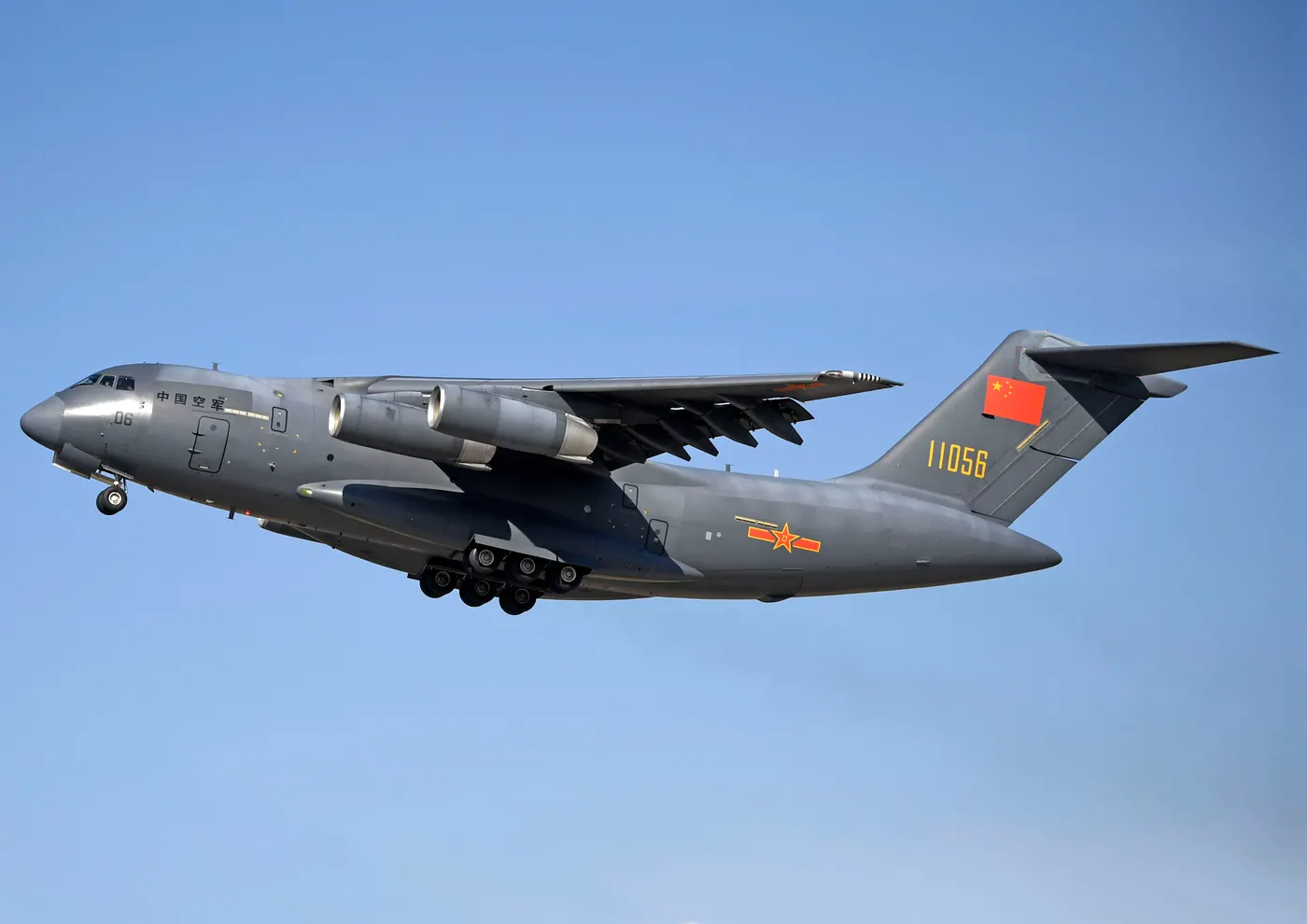

The Xian Y-20 is the first strategic airlifter designed and built entirely in China, and its arrival ended a dependence on imported Soviet and Russian heavy transport aircraft that had lasted more than half a century.1 Developed by the Xi'an Aircraft Industrial Corporation, a subsidiary of the state conglomerate AVIC, the aircraft first flew on 26 January 2013 and entered service with the People's Liberation Army Air Force (PLAAF) on 6 July 2016.1 Officially named Kunpeng, after a giant shape-shifting fish-bird from Taoist mythology, the aircraft is nicknamed Chubby Girl (胖妞, Pàng niū) inside China's aviation industry, a reference to a fuselage noticeably wider than any Chinese-built aircraft that came before it.1
- Ends China's reliance on imported Il-76 and leased An-124 sorties for heavy airlift
- 66,000 kg payload class, enough for a single Type 99A main battle tank
- Re-engining with the indigenous WS-20 turbofan on the Y-20B removes the last major foreign-sourced propulsion component
- Growing fleet supports both airlift and, via the YY-20 tanker derivative, extended fighter range
- Short 600 to 700 m takeoff run for an aircraft of its size
- Maximum payload still trails the Boeing C-17 by roughly 10 to 15 percent
- No confirmed export customer as of 2026, unlike the Il-76 or the Lockheed C-130
- The WS-20 engine only reached operational squadrons in 2023, a full decade after the type's first flight
- Publicly disclosed performance figures remain sparser and less independently verified than for Western equivalents
For decades before the Y-20 program matured, PLAAF heavy airlift depended on a small, aging fleet of Soviet and Russian-built Ilyushin Il-76 transports, backed up by medium turboprops that lacked true strategic range and payload.2 A 2005 contract for 34 additional Il-76 and four related Il-78 tankers collapsed when the Tashkent Mechanical Plant in newly independent Uzbekistan, the only factory still building the type, lost the skilled workforce and tooling it needed after the Soviet collapse.3 That failure is widely cited as the moment that pushed a Y-20 program already under study since 2007 into full development, since China could no longer count on buying its way to a heavy-airlift fleet.3,2
The Y-20's general high-wing, T-tail, four-engine layout invites comparison to the American Boeing C-17 Globemaster III, a resemblance sharpened by a well-documented espionage case in which a Chinese businessman admitted stealing hundreds of thousands of Boeing C-17 files years before the Y-20's first flight.4,5 As one of many strategic airlifters fielded since the Cold War, the Y-20 is defined less by any single technical breakthrough than by the fact that a country with no prior aircraft in this weight class managed to design, certify, and mass-produce one inside a decade.
The Engine Transition, From the Soloviev D-30KP-2 to the Indigenous WS-20
Early production Xian Y-20A airframes used four Soloviev D-30KP-2 turbofans, a Russian-built engine rated at roughly 117.7 kN (about 12,000 kgf) of thrust each.1 It was the same low-bypass engine long fitted to the Il-76 and to several Chinese bomber and tanker conversions, chosen for the Y-20 because no domestic engine of matching thrust existed when the airframe was ready to fly.1 Because that thrust ceiling kept the aircraft well short of its intended 66,000 kg design payload, Xi'an fitted an interim step first, the Chengdu WS-18, an improved domestic derivative of the D-30KP-2 already used on the H-6K bomber, before the definitive Shenyang WS-20 high-bypass turbofan reached flight test.9,10
WS-20 development ran through several public milestones. Single-engine ground and flight testing likely began around 2019, four-engine flight testing followed by late 2020, and photographs of production aircraft carrying the new engine's shorter, stubbier nacelles began circulating in 2022.7,6 The re-engined standard, formally designated Y-20B, reached operational PLAAF squadrons around March 2023.7,1 Publicly disclosed WS-20 thrust figures vary by outlet, cited anywhere from about 127 kN to 140 kN (29,000 to 31,000 lbf), still a clear step up from the D-30KP-2's 117.7 kN.6,8 That added thrust, not any change to the airframe itself, is what lets the Y-20B carry the full rated 66,000 kg payload that the interim engines could not reach.1
{{photo-req side=right q="Xian Y-20 transport aircraft PLAAF flight line" caption="A Xian Y-20 strategic airlifter on a PLAAF flight line" alt="Xian Y-20 military transport aircraft parked on an airfield"}}
Dimensions and Payload Set Against the C-17's Fuselage
The Xian Y-20 measures 47 m in length with a 50 m wingspan and a height of 15 m, and it has an empty weight of about 100,000 kg against a maximum takeoff weight of 220,000 kg.1 Maximum payload is rated at 66,000 kg, carried in a cargo hold roughly four meters tall and reachable through a powered rear ramp.1 The flight crew has been reduced to three, a figure closer to the Boeing C-17's crew of three than to the five-to-seven crew the older Il-76 typically required, reflecting a more digital cockpit than the earlier Soviet-designed type.1
Set beside the C-17, the numbers show a real but modest gap rather than a different weight class.
| Spec | Xian Y-20 | Boeing C-17 Globemaster III |
|---|---|---|
| Length | 47 m | 53 m |
| Wingspan | 50 m | 51.75 m |
| Max takeoff weight | 220,000 kg | 265,350 kg |
| Max payload | about 66,000 kg | about 77,500 kg |
| Typical crew | 3 | 3 |
Sources for the figures above.1,12
The Y-20 gives up roughly 10 to 15 percent of the C-17's payload and about six meters of fuselage length, a difference that shows up in vehicle capacity, the Y-20 rated for two Chinese ZTQ-15 light tanks or one heavier Type 99A main battle tank, where the C-17 can take a single M1 Abrams with margin to spare.1,12
Cargo Hold, Rear Ramp and the Airborne Corps Link
{{photo-req side=right q="military cargo aircraft rear ramp vehicle loading" caption="Vehicles loading through a strategic airlifter's rear cargo ramp" alt="Military transport aircraft with rear ramp lowered for vehicle loading"}}
Cargo and troops load through a powered rear loading ramp, the same basic arrangement used on every strategic airlifter since the Il-76 and the C-17, and an optional upper passenger deck can be fitted inside the hold above the main cargo floor without blocking freight loaded below it.13 On 8 May 2018 the Y-20 flew its first joint airdrop exercise with the People's Liberation Army Air Force Airborne Corps, a milestone that confirmed the airframe's paratroop role beyond straight cargo hauling.14 Published takeoff distance figures run from about 600 to 700 m, short for an aircraft in this weight class, though how well the type performs from rough or unpaved strips remains far less documented in open sources than the Il-76's long-established gravel-runway reputation, and that gap in verified detail should be read as a real gap in public information rather than evidence either way.
From a 2007 Program to a 2013 First Flight
Xi'an's strategic transport project began as an internal study in July 2007, years before any public confirmation, and the first images of a prototype under construction surfaced only in late 2012.1 The first prototype made its maiden flight at the Yanliang aviation base near Xi'an on 26 January 2013, with a second prototype following into the air before the end of that year.1 Structural testing, usually one of the slowest stages of a new airframe's certification, was completed in 194 days against an original schedule of roughly 300, and the Y-20 became an early adopter of 3D-printed titanium structural parts and a Model-Based Definition design process, following only the Airbus A380 and Boeing 787 among large aircraft to use the latter.1 The first production aircraft entered PLAAF service on 6 July 2016, immediately taking pressure off the small, overworked Il-76 fleet the air force had relied on since the 1990s.1
{{photo-req side=left q="Ilyushin Il-76 Chinese air force transport aircraft" caption="An Ilyushin Il-76, the Russian-built transport the Xian Y-20 was designed to replace" alt="Ilyushin Il-76 heavy transport aircraft in flight"}}
The Su Bin Espionage Case
Between 2009 and 2014, a Chinese businessman named Su Bin, operating out of Canada, conspired with two collaborators in China to hack into computer networks belonging to Boeing in Orange County, California, and other American defense contractors.4 The intrusions took roughly 630,000 digital files totaling about 65 gigabytes of data related to the C-17 program, along with material tied to the F-22 and F-35 fighter programs.4,5 Su Bin pleaded guilty in March 2016 to conspiring to gain unauthorized computer access and to violate the Arms Export Control Act, and a federal judge sentenced him that July to 46 months in prison plus a 10,000 US dollar fine.4,5 American prosecutors argued the stolen C-17 data carried real significance for a Xi'an Aircraft Industrial Corporation program building what the case's court filings described as a C-17 look-alike, the Y-20, though independent verification of exactly which stolen details influenced the finished aircraft has never been made public.5
WS-20 Entry Into Service and the Y-20B Milestone
The re-engined Y-20B, carrying the indigenous WS-20 turbofan in place of the imported D-30KP-2, reached PLAAF operational squadrons around March 2023, roughly a decade after the type's first flight.7,1 On 20 April 2026 a Y-20B flew its first confirmed overseas mission, traveling to South Korea to receive the remains of the 13th batch of Chinese People's Volunteers soldiers repatriated from the Korean War, and returned to Chinese airspace on 22 April escorted by four J-20 stealth fighters, the first time a Y-20-series aircraft had been given a J-20 honor escort.18,19 The mission mattered as more than ceremony, since it demonstrated that the WS-20 engine, after years of testing, was considered mature and reliable enough for a high-visibility flight outside Chinese airspace.18
The Xian Y-20 was not built as a combat aircraft, and its most consequential appearances near actual tension have come through the YY-20 aerial-refueling derivative rather than the baseline transport. In April 2023, as the PLA announced multi-day combat readiness patrols around Taiwan following heightened cross-strait tension, Chinese state media listed a Y-20U tanker among the aircraft flying into the southwestern edge of Taiwan's air defense identification zone alongside Shenyang J-16 fighters, part of the broader run of pressure activity tracked as the Fourth Taiwan Strait Crisis.16,17 Extending fighter patrol endurance from roughly 1,000 km to 1,500 km or more from base, the tanker variant turned single-sortie PLAAF fighter patrols into sustained presence over contested waters, a capability China had lacked before the Y-20 family entered service.16
{{photo-req side=right q="Tonga Nuku'alofa Pacific islands map" caption="Tonga, whose 2022 volcanic eruption and tsunami drew a record-distance PLAAF relief mission" alt="Map of Tonga and the surrounding Pacific islands"}}
The type's largest humanitarian deployment followed the January 2022 undersea volcanic eruption and tsunami near Tonga. Two PLAAF Y-20s flew more than 10,000 km from Guangzhou to Nuku'alofa carrying 33 tons of food, fresh water, water purifiers, and tents, a record distance for a publicly acknowledged Y-20 mission at the time and a flight that had to contend with lingering volcanic ash in the region's airspace.15 The Korean War remains repatriation flown by a Y-20B in April 2026, described above, sits alongside these humanitarian and patrol missions as the clearest evidence of how the aircraft is actually used day to day, moving people, cargo, and fuel rather than weapons.18
{{photo-req side=left q="J-20 stealth fighter formation flight" caption="Chengdu J-20 stealth fighters, which escorted a Y-20B on its first overseas mission in 2026" alt="Chinese J-20 stealth fighters flying in formation"}}
Taken together, tanker patrols, disaster relief, and remains-repatriation flights outnumber anything resembling direct combat exposure in the Xian Y-20's operational record so far, a fair reflection of how PLAAF planners have actually chosen to employ the type through 2026.
The Y-20A is the baseline production standard, originally delivered with Soloviev D-30KP-2 engines and later with the interim domestic WS-18, and it remains the largest single group within the fleet.1,9 The Y-20B is the re-engined production standard fitted with the Shenyang WS-20 turbofan, externally distinguishable by its shorter engine nacelles and internally by the extra payload and range its higher thrust unlocks.7,11
The YY-20A, informally referred to by some outlets as the Y-20U, is a dedicated aerial-refueling tanker built on the Y-20A airframe, fitted with wing-mounted hose-and-drogue refueling pods similar in concept to those on the Russian Il-78 and the Airbus A400M Atlas, and reported to carry as much as 90 tons of transferable fuel, roughly three times the payload of the older Xian HU-6 tanker it supplements.20 It entered service around 2022, and a further-upgraded YY-20B, based on the WS-20-powered Y-20B, followed into service around December 2024, with total tanker numbers estimated at several dozen aircraft by 2025.21,20
{{photo-req side=right q="Y-20 aerial refueling tanker hose drogue pod" caption="A YY-20 tanker refueling a PLAAF fighter in flight" alt="Chinese YY-20 aerial refueling tanker aircraft"}}
The KJ-3000 is an AWACS aircraft built on the Y-20B airframe, fitted with a large rotating radar array and, unusually, with an aerial refueling probe mounted above the cockpit rather than the boom-and-receptacle arrangement used on some rivals.22 It made its first public flight on 27 December 2024 and is intended to give China a jet-powered early-warning platform with higher operating altitude and better look-down performance against low-flying and stealth targets than the turboprop-based KJ-500 and KJ-2000 it will eventually supplement.22,23

The People's Republic of China is the Xian Y-20's only confirmed operator, flying the type exclusively through the People's Liberation Army Air Force.1 Roughly 100 airframes across the Y-20A, Y-20B, YY-20A, and YY-20B standards had been built by 2026, with estimates putting active PLAAF strength at around 55 straight transports and roughly 40 tanker-configured aircraft.1,21 No export sale has been confirmed as of 2026, a contrast with both the Il-76, which was widely exported across the former Soviet sphere and beyond, and the Lockheed C-130, the most widely exported strategic-adjacent transport in the world, and it leaves the Y-20's international reputation resting almost entirely on PLAAF service rather than on a foreign customer's independent evaluation.
China measured the Y-20 program against two very different benchmarks at two very different times. In the 2000s the comparison that mattered was practical, whether Beijing could keep buying Ilyushin Il-76 airframes fast enough to matter, and the 2005 collapse of the Tashkent production deal answered that question with a hard no.3 Only once the Y-20 airframe existed did the comparison shift to the aircraft it visually and functionally resembles most, the Boeing C-17 Globemaster III, the American design Su Bin's stolen files were tied to years before the Y-20 flew.4
Against the Il-76, the Y-20 is a generational replacement rather than a close rival. Both share a similar high-wing, rear-ramp layout suited to cargo and paratroop work, and early Y-20A production aircraft even shared the Il-76's Soloviev D-30KP-2 engine, but the Y-20's larger 66,000 kg payload, three-person crew, and (on the Y-20B) fully domestic propulsion give it a clear edge over an airframe design that first flew in 1971.1 Against the C-17, the comparison is closer and less favorable to the Chinese aircraft. The Y-20 gives up roughly 10 to 15 percent of the C-17's payload and around six meters of fuselage length, and it lacks the C-17's decades of combat-proven short and unpaved-field operating record, though its 600 to 700 m takeoff run suggests broadly comparable field performance on paved runways.1,12
| ÖZELLİK | Xi'an Y-20 | İlyuşin İl-76 | Boeing C-17 Globemaster III |
|---|---|---|---|
| Azami Faydalı Yük | — | — | — |
| Maks Kalkış Ağırlığı | — | 210000 kg | — |
| Azami Menzil | — | — | — |
The deeper story in the comparison is industrial rather than aerodynamic. The Il-76 comparison is about ending a foreign-supply dependency, and the C-17 comparison is about how far China's own aerospace industry has closed a gap that, as recently as the 2000s, forced it to rely on used Soviet-era imports for its heaviest airlift needs.3,2


Is the Xian Y-20 still in service today?
Yes. The Y-20 is the PLAAF's primary strategic airlifter as of 2026, with roughly 100 airframes built across the Y-20A, Y-20B, and YY-20 tanker standards, and production continuing on the WS-20-powered Y-20B and its tanker derivatives.1,21
How does the Xian Y-20 compare to the Boeing C-17 Globemaster III?
The two share a similar four-engine, high-wing, rear-ramp layout, but the C-17 carries roughly 10 to 15 percent more payload and is about six meters longer.1,12 The Y-20's advantage is availability to China's own air force rather than any single performance figure, since no Western strategic airlifter is sold to the PLAAF.
What engines does the Y-20 use?
Early production Y-20A aircraft used four Russian-built Soloviev D-30KP-2 turbofans, later aircraft used an interim domestic WS-18, and the current Y-20B standard uses four indigenous Shenyang WS-20 high-bypass turbofans, each producing roughly 130 to 140 kN of thrust depending on the source cited.1,6,9
What is the Xian Y-20's unit cost?
Reported unit cost has generally been cited around 160 million US dollars, a 2013-era figure that has not been meaningfully updated in public sourcing since, so the current per-aircraft price for a Y-20B or YY-20B likely differs from this older number.1
What is the Xian Y-20's payload and range?
Maximum payload is rated at 66,000 kg, enough for a single Type 99A main battle tank, with a range around 7,800 km carrying a near-maximum load and a ferry range of roughly 10,000 km with a lighter load.1
Has China exported the Y-20?
No confirmed export sale exists as of 2026. The type remains in service only with the PLAAF, unlike the Il-76 or the Lockheed C-130, both of which were exported to dozens of operators.1
- "Xi'an Y-20", Wikipedia — en.wikipedia.org ↩
- "China Is Now Building the World's Largest Transport Aircraft Faster Than the U.S. or Russia, Because It Finally Fixed the Engine", 19FortyFive — 19fortyfive.com ↩
- "Tashkent Mechanical Plant", Wikipedia — en.wikipedia.org ↩
- "Chinese National Pleads Guilty to Conspiring to Hack into U.S. Defense Contractors' Systems to Steal Sensitive Military Information", U.S. Department of Justice — justice.gov ↩
- "Su Bin, Chinese businessman, sentenced over hacking plot aimed at Boeing", The Washington Times — washingtontimes.com ↩
- "Shenyang WS-20", Wikipedia — en.wikipedia.org ↩
- "China's Y-20 Transport Appears To Be Finally Flying With Indigenous Jet Engines", The War Zone — twz.com ↩
- "China Brings New WS-20 Turbofan Engines Into Service For Y-20 Transports, A Major Boost to Airlift Capabilities", Military Watch Magazine — militarywatchmagazine.com ↩
- "Y-20 starts to use WS-20 engine, analyst", China Arms — china-arms.com ↩
- "Y-20 Engines", GlobalSecurity.org — globalsecurity.org ↩
- "Our Best Look At China's Re-Engined Y-20B Cargo Jet", The War Zone — twz.com ↩
- "C-17 Globemaster III vs Y-20, Aircraft Full Comparison", GlobalMilitary.net — globalmilitary.net ↩
- "China's Y-20 Cargo Jet Has An Upper Passenger Deck That Can Be Installed In Its Hold", The War Zone — twz.com ↩
- "Chinese Y-20 Military Transport Plane Carries 'Record Number Of Passengers'", Defense Mirror — defensemirror.com ↩
- "PLA's Y-20 cargo planes deliver disaster relief supplies to Tonga in record-breaking mission", People's Daily Online — en.people.cn ↩
- "China's New Y-20U Tanker Joined Dozens Of Other Warplanes Flying Near Taiwan", The War Zone — twz.com ↩
- "Tracking China's April 2023 Military Exercises around Taiwan", ChinaPower Project, CSIS — chinapower.csis.org ↩
- "China's Y-20B Airlifter's First Trip to South Korea Repatriates Korean War Soldiers' Remains", The Aviationist — theaviationist.com ↩
- "China's Y-20B Debuts Abroad, Escorted by Four J-20s", MiGFlug — migflug.com ↩
- "YY-20 / Y-20U tanker", GlobalSecurity.org — globalsecurity.org ↩
- "China expanding YY-20 aerial refueller fleet", Janes — janes.com ↩
- "China's New Domestically Developed Y-20 Airborne Early Warning Jet Spotted", The War Zone — twz.com ↩
- "What do we know about China's most advanced early warning plane, the KJ-3000?", South China Morning Post — scmp.com ↩