

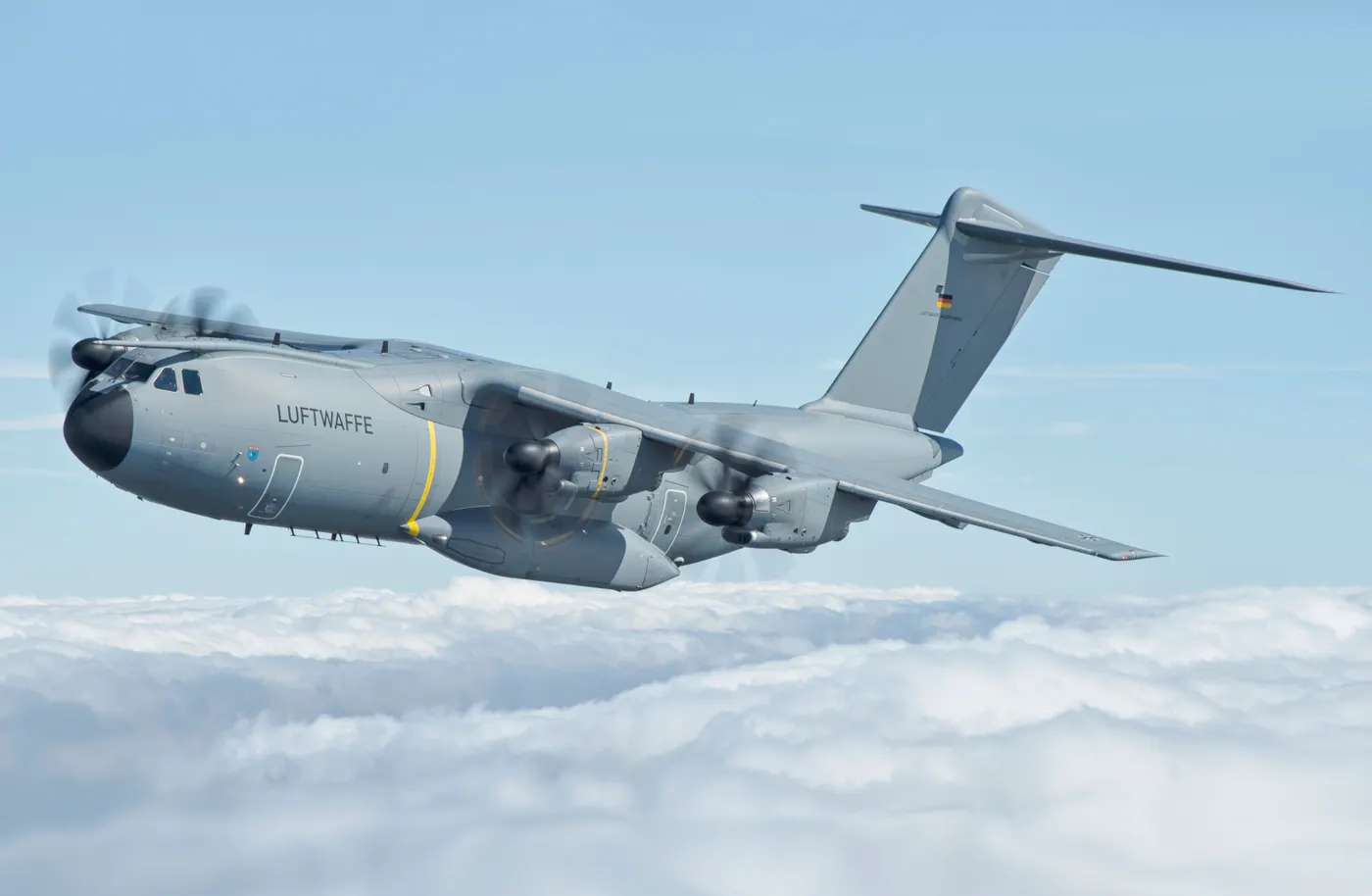

The Airbus A400M Atlas is built to do something most heavy transport aircraft cannot. It can carry an armored vehicle across a continent and then set that vehicle down on a dirt strip barely 750 meters long, closer to the front line than a Lockheed C-5 Galaxy or Antonov An-124 Ruslan would ever attempt.1 That dual identity, part strategic airlifter, part rugged tactical hauler, is the reason ten countries now fly it, from founding partners like France and Germany to later export customers such as Malaysia, Kazakhstan, and Indonesia.1
- Unpaved and short-field capability rivals typical outputs never reach
- Doubles as an air-to-air refueling tanker and medevac platform
- Fly-by-wire handling and modern glass cockpit reduce crew workload
- Genuine tactical airdrop and paratroop capability at strategic range
- Years of gearbox and software reliability problems after entry to service
- Payload well below dedicated strategic lifters like the C-5 or An-124
- Program cost overruns pushed unit prices far above original estimates
- Limited outsize cargo width compared to purpose-built heavy freighters
The program traces back to a 1982 European effort to replace the aging Transall C-160 and the Lockheed C-130 Hercules with a single airlifter sized between the two. What emerged, after two decades of shifting partnerships and a corporate reorganization from Airbus Military into today's Airbus Defence and Space, was a four-engine turboprop that first flew in 2009 and did not enter squadron service until 2013.1 The A400M Atlas is powered by four Europrop TP400-D6 engines, a joint design from Rolls-Royce, Safran Aircraft Engines, MTU Aero Engines, and ITP Aero that Airbus calls the most powerful turboprop engine ever certified in the West.3 It can lift roughly 37 tonnes of cargo, cruises at about 781 km/h, and its design ceiling reaches 12,200 meters on special high-altitude missions.1
{{photo-req side=right q="Airbus A400M Atlas rear cargo ramp open loading vehicle" caption="The A400M's rear ramp lets it load vehicles and pallets that would otherwise need a dedicated tactical airlifter." alt="Airbus A400M Atlas military transport aircraft with rear cargo ramp lowered"}}
Spain hosts the Final Assembly Line in Seville, which is why the database records Spain as the manufacturer country even though the program itself is a multinational effort led by Airbus, spanning France, Germany, the United Kingdom, Belgium, Luxembourg, and Turkey as founding partners.1 Total production has passed 130 aircraft against original orders of around 174, spread across the founding partner nations plus Malaysia, Kazakhstan, and Indonesia.1 The A400M Atlas price has always been a point of dispute. Airbus originally floated a unit cost near $80 million in 2003, but published national budget figures since then have run closer to $150 to $235 million per aircraft once development costs are folded in.19 Search interest in the phrases A400M Atlas specifications and A400M unit cost reflects exactly that gap between the original marketing pitch and what customer governments ended up paying.
The Europrop TP400-D6 and Its Gearbox Crisis
Each of the four Europrop TP400-D6 engines produces roughly 8,250 kW (11,000 shp), driving an eight-blade scimitar propeller through a reduction gearbox.3 That combination made the TP400-D6 the most powerful turboprop engine to enter Western service, and it is a large part of why the A400M Atlas can operate from strips that would strand a jet-powered airlifter.3 The engine program was not trouble-free. On New Year's Eve 2015, inspectors found cracks in the propeller gearbox on engines with clockwise-turning propellers, serious enough that flakes of metal could shed into the oil circuit.7 Germany grounded two of its three delivered aircraft in 2016 over the fault, and Airbus imposed a strict 20-flight-hour inspection interval until an interim truncated-plug fix reached certification that July.6,7 A permanent gearbox redesign slipped repeatedly, still pending full approval as late as 2018, well past the fix's original schedule.8
- Motor TipiEuroprop TP400-D6
- Motor Sayısı4
{{photo-req side=left q="Europrop TP400 engine propeller test stand" caption="The Europrop TP400-D6, built by a Rolls-Royce, Safran, MTU, and ITP Aero consortium, is rated as the most powerful turboprop in Western service." alt="Europrop TP400-D6 turboprop engine on test stand"}}
- Seyir Hızı781 km/sa
- Hizmet Tavanı12.200 m
Fly-by-Wire Cockpit and a Three-Person Flight Deck
The A400M Atlas uses a fly-by-wire flight control system with sidestick controllers and flight envelope protection, a layout borrowed conceptually from Airbus's commercial airliners rather than from older tactical transports.1 Eight large interchangeable displays fill the flight deck, and the standard crew is two pilots plus a loadmaster, well below the crew requirements of older-generation airlifters.1 The pressurized cargo hold measures 17.71 meters long, 4.00 meters wide, and 3.85 meters high, enough for a wheeled armored vehicle, a helicopter, or up to 116 fully equipped troops or 66 stretcher patients in medevac configuration.1
- Uzunluk45,1 m
- Kanat Açıklığı42,4 m
Short-Field and Unpaved-Runway Performance
Airbus advertises the A400M Atlas as able to deliver its full 37-tonne payload onto a runway under 750 meters long, unpaved if necessary, a figure well beyond what a Boeing C-17 Globemaster III or C-5 needs and one no pure strategic lifter can match on soft ground.1 In summer 2025, Airbus pushed that envelope further during trials at Altengrabow, Germany, landing a 123-tonne aircraft (near maximum weight) on a soft, vegetation-covered strip as short as 800 meters and as narrow as 20 meters, working with the German armed forces to validate an expanded operational envelope for humanitarian and special-forces missions.21,22
| ÖZELLİK | Airbus A400M | Boeing C-17 Globemaster III |
|---|---|---|
| Seyir Hızı | 781 km/sa | — |
| Hizmet Tavanı | 12200 m | 13716 m |
| Uzunluk | 45.1 m | 53.035 m |
| Kanat Açıklığı | 42.4 m | 51.511 m |
From FIMA to Euroflag, a Program Two Decades in the Making
The A400M Atlas began as the Future International Military Airlifter (FIMA) study in 1982, a joint effort by Aérospatiale, British Aerospace, Lockheed, and Messerschmitt-Bölkow-Blohm intended to replace both the C-130 Hercules and the Transall C-160.1 Lockheed dropped out in 1989 to build its own upgraded Hercules instead, and the remaining partners renamed the effort EUROFLAG, the European Future Large Aircraft Group.1 Airbus Military eventually absorbed the program and assigned it the A400M designation. A procurement agreement covering 212 aircraft was signed in May 2003, targeting a first flight in 2008 and first deliveries the following year.1
Delays, Weight Problems, and a Program Near Cancellation
Neither deadline held. By January 2009, EADS had postponed first delivery until at least 2012 and was pushing to renegotiate the entire contract.19 A French Senate report from that February put the overrun at €5 billion and the schedule slip at three to four years, with aerospace analysts estimating Airbus was losing €1 billion to €1.5 billion a year on the program.19 Reports at the time also found the airframe roughly 12 tonnes overweight, threatening the aircraft's ability to lift a Puma infantry fighting vehicle at all.19 Between 2009 and 2010 the program faced outright cancellation, and only continued political commitment from the customer nations kept it alive.1 Airbus later took an additional $1.6 billion charge against the program in 2018, on top of earlier writedowns, as gearbox and other technical fixes dragged on.20
{{photo-req side=right q="A400M Atlas first flight Seville 2009" caption="The A400M Atlas made its maiden flight from Seville, Spain, on 11 December 2009, more than a year behind the original schedule." alt="Airbus A400M Atlas prototype aircraft taking off"}}
The A400M Atlas finally made its first flight on 11 December 2009, from Seville.1 European Aviation Safety Agency certification followed in March 2013, and the first production aircraft was delivered to the French Air Force that August, a full decade after the original contract had been signed.1
The 2015 Seville Crash
On 9 May 2015, an A400M Atlas destined for delivery to the Turkish Air Force crashed shortly after takeoff from Seville, killing four of the six crew aboard.4 Investigators traced the cause to a software configuration error. During an engine control unit software reload the day before the flight, torque calibration data for three of the four engines was wiped and never restored, leaving those engines stuck at zero-thrust flight idle on takeoff with no cockpit warning to the crew.4 A later Spanish military investigation found the engine manufacturer had actually warned Airbus and EASA about this exact failure mode back in October 2014, before the crash occurred.5 The accident remains the deadliest single event in the A400M Atlas program's history and forced a review of software installation procedures across the fleet.4
First Operational Missions in Mali and the Sahel
The A400M Atlas flew its first operational mission on 29 December 2013, barely four months after entry to French Air Force service, delivering cargo in support of French forces fighting in the Mali War.9 From 2014 the aircraft became a workhorse of Opération Barkhane, France's counterterrorism campaign across the Sahel, flying troops, vehicles, and helicopters into austere airstrips that larger jets could not use.11 In September 2018, an A400M Atlas dropped 120 French paratroopers over the Ménaka area of Mali, the type's first operational parachute drop since entering French service.9 French crews also flew the aircraft directly onto a semi-prepared dirt strip at Madama, Niger, carrying helicopters and freight straight from metropolitan France in a single hop, and in 2020 an A400M Atlas airdropped roughly 40 tonnes of supplies to troops stationed deep in the Sahel.10
{{photo-req side=left q="French paratroopers Mali airdrop A400M" caption="French paratroopers prepare to jump during a Sahel operation, the kind of tactical airdrop mission a pure strategic lifter like the C-5 rarely performs." alt="French paratroopers boarding military transport aircraft for airdrop operation"}}
Combat Zones and the War on Terrorism
In July 2018, the German Air Force flew an A400M Atlas into an active war zone for the first time, carrying 75 soldiers from Wunstorf Air Base to Mazar-i-Sharif as part of Germany's contribution to the War in Afghanistan, part of the broader War on Terrorism.1 The aircraft flew with an armored protection kit installed against ground fire, and German officials called the mission a milestone proving the kit worked as intended.1
The 2021 Kabul Evacuation
The A400M Atlas played a central role in the chaotic August 2021 evacuation from Kabul, part of the 2020-2021 U.S. troop withdrawal from Afghanistan.12 Germany's first mission was widely criticized after its A400M Atlas left Kabul with only seven evacuees aboard, a result of chaos on the ground rather than any aircraft limitation.13 Later sorties told a different story. Up to 25 A400M Atlas aircraft from six operator nations flew more than 120 rotations between Kabul and staging bases in the Middle East and Central Asia.12 The Royal Air Force alone flew 31 evacuation missions with its Atlas C.1 fleet over 225 flight hours, at one point carrying 213 people on a single aircraft designed to seat around 160, well beyond its normal passenger rating.14
{{photo-req side=right q="Kabul airport evacuation crowd August 2021" caption="Crowds at Kabul airport during the August 2021 evacuation, the operation that put the A400M Atlas's passenger and cargo flexibility to its hardest test yet." alt="Crowd of evacuees at Kabul airport during 2021 evacuation"}}
Earthquake Relief in Turkey and Syria
After the devastating February 2023 earthquakes in Turkey and Syria, the A400M Atlas became the backbone of a multinational airborne relief effort. Turkey's own fleet of ten aircraft was joined by A400M Atlas transports from as many as seven other operator nations, moving ambulances, rescue teams, and mobile field hospitals into the disaster zone.15 Malaysian A400M Atlas aircraft alone delivered 106 personnel, including 41 doctors, to help stand up a field hospital within days of the quake.15
{{photo-req side=left q="2023 Turkey Syria earthquake affected region map" caption="The February 2023 earthquake zone in southern Turkey and northern Syria, where A400M Atlas transports from multiple operator nations flew relief missions." alt="Map showing the 2023 Turkey-Syria earthquake affected region"}}
Airbus never split the A400M Atlas into a family of separately designated sub-models the way many airlifter programs do, which is why the database carries no registered variant entries for this weapon. Instead, the same airframe is reconfigured mission by mission. Fitted with underwing hose-and-drogue pods or a centerline hose-and-drum unit, an A400M Atlas becomes an aerial refueling tanker capable of servicing fighters, other transports, or even helicopters at low speed.2 Reconfigured with stretcher racks and intensive-care fittings, the same aircraft carries up to 66 patients as a MEDEVAC platform.2 The Royal Air Force designates its fleet the Atlas C.1, while other operators simply fly it under the A400M name with national serial numbers, a naming difference that reflects procurement paperwork rather than any airframe change.14


Ten countries currently operate the Airbus A400M Atlas, split between the seven founding program nations and three later export customers.1 Germany flies the largest single fleet at 53 aircraft, after trimming its original 60-aircraft order during the program's cost crisis.1 France, the launch customer, ordered 50 and received its first aircraft in August 2013.1 The United Kingdom operates 22 as the Atlas C.1 from RAF Brize Norton, and Spain, home to the Seville final assembly line, ordered 27.1 Turkey flies 10, Belgium and Luxembourg jointly operate a combined squadron of 7 and 1 aircraft respectively based at Melsbroek, and Malaysia became the first export customer outside the founding group with 4 aircraft delivered from 2015.1
{{photo-req side=right q="RAF Atlas C.1 Brize Norton" caption="A Royal Air Force Atlas C.1, the RAF's designation for its A400M Atlas fleet, based at RAF Brize Norton." alt="Royal Air Force A400M Atlas C.1 transport aircraft"}}
Kazakhstan ended a long export drought in 2021 by ordering two aircraft, becoming the program's ninth operator and the first customer with no historical tie to the founding European partners.16 Indonesia followed, signing for two A400M Atlas aircraft in November 2021 with an option for four more, and taking delivery of its first aircraft in November 2025.17 That deal made Indonesia the tenth operator and, notably, only the third export customer in the program's history.17
A C-5 Galaxy needs a paved runway on the order of 3,000 meters to operate near its maximum weight. The A400M Atlas needs under 750 meters, unpaved if required.1,23 That single figure explains why the two aircraft rarely compete for the same mission despite both carrying the strategic airlifter label. The C-5 can lift up to about 122 tonnes, more than three times the A400M Atlas's 37-tonne payload, and its cargo hold is wide enough for outsize loads the A400M Atlas simply cannot swallow.23 What the C-5 cannot do is land that cargo anywhere except a proper airbase. The A400M Atlas trades raw lift for reach into the kind of forward airstrips European and allied forces actually use in the Sahel or Central Asia.
The Antonov An-124 Ruslan complicates that comparison because it was built from the start with rough-field operation in mind. Its 24-wheel undercarriage lets a fully loaded An-124 use a semi-prepared strip as short as about 900 meters, an unusually tactical trait for an aircraft that can carry up to 150 tonnes.24 Even so, the An-124's sheer size and Soviet-era origins mean far fewer operators can support it logistically, and most of the global fleet remains tied to Russia and Ukraine's small commercial and military operators rather than a broad NATO-style user base. The A400M Atlas, by contrast, is supported by a ten-nation operator community with shared spares, training, and maintenance arrangements, a network the An-124 never built outside its country of origin.
| Metric | A400M Atlas | C-5 Galaxy | An-124 Ruslan |
|---|---|---|---|
| Max payload | ~37 t | ~122 t | ~150 t |
| Min runway (loaded) | <750 m (unpaved) | ~3,000 m (paved) | ~900 m (semi-prepared) |
| Cruise speed | 781 km/h | ~830 km/h | ~800-850 km/h |
| Operator nations | 10 | 1 (USA) | Handful (mostly Russia, Ukraine) |
Sources: A400M Atlas figures per Airbus and Wikipedia data.1,23,24 C-5 and An-124 figures are approximate published maxima and vary by mission profile.
Against older Soviet-designed transports the comparison shifts again. The Ilyushin Il-76 was arguably the A400M Atlas's real spiritual predecessor, a jet-powered airlifter designed decades earlier around the same idea of combining strategic range with rough-field access, though its cargo hold and payload (up to roughly 60 tonnes in the modernized Il-76MD-90A) sit between the A400M Atlas and the true heavy lifters.25 Japan's Kawasaki C-2 covers similar payload territory to the A400M Atlas but was designed around Japan's own paved-airfield infrastructure and lacks the unpaved-strip ambitions built into the European aircraft from the outset.26 China's newer Xian Y-20 payload figures, estimated around 66 tonnes, place it closer to the Il-76's class, effectively splitting the difference between the A400M Atlas and the C-5/An-124 tier as Chinese airlift needs continue to grow.27 The retired American Lockheed C-141 Starlifter, the jet that the C-5 eventually succeeded in U.S. service, is a useful historical marker for how far the A400M Atlas's tactical field performance has pushed beyond what 1960s-era strategic jets attempted.


What is the range of the A400M Atlas? With a 30-tonne payload the A400M Atlas can fly about 3,300 km, and with lighter loads its range extends past 8,700 km, well into transcontinental territory for a turboprop.1
How much can the A400M Atlas carry? Its standard maximum payload is roughly 37 tonnes, or up to 116 troops or 66 stretcher patients in medevac configuration.1,2
Is the A400M Atlas still in service in 2026? Yes. Ten nations operate it as of 2026, with Indonesia and Kazakhstan still receiving deliveries and Airbus continuing to expand its short-field envelope through trials like the 2025 Altengrabow tests.16,17,21
What engines does the A400M Atlas use? Four Europrop TP400-D6 turboprops, a joint Rolls-Royce, Safran, MTU Aero Engines, and ITP Aero design rated as the most powerful turboprop engine in Western service.3
How much does an A400M Atlas cost? Reported unit prices vary widely by source and by what is included, from roughly $141 million per OCCAR's figures to $235 million once French development costs are folded in, well above Airbus's original 2003 estimate of about $80 million.19,28
What is the difference between the A400M Atlas and the C-130 Hercules? The A400M Atlas carries more than double the payload of a C-130J and flies faster and farther, while the smaller C-130 remains cheaper to buy and operate and can use even shorter strips in some configurations.1
- "Airbus A400M Atlas", Wikipedia — en.wikipedia.org ↩
- "A400M", Airbus — airbus.com ↩
- "Europrop TP400", Wikipedia — en.wikipedia.org ↩
- "2015 Seville Airbus A400M crash", Wikipedia — en.wikipedia.org ↩
- "Airbus knew of software problems that caused fatal A400M plane crash in May 2015", Computing — computing.co.uk ↩
- "Germany grounds A400M aircraft over engine worries", UK Defence Journal — ukdefencejournal.org.uk ↩
- "Fix For A400M's Cracked Propeller Gearbox Awaits Approval", Defense News — defensenews.com ↩
- "A400M gearbox fix slips into 2018", FlightGlobal — flightglobal.com ↩
- "French A400M flies first operational mission to Niger", defenceWeb — defenceweb.co.za ↩
- "A French A400M airdropped 40 tonnes of supplies to troops in the Sahel", The Defense Post — thedefensepost.com ↩
- "Barkhane, nouvelle démonstration des capacités tactiques de l'A400M au Sahel", French Ministry of the Armed Forces — defense.gouv.fr ↩
- "Perfect For The Job, The Airbus A400M's Role In The Kabul Airlift", Simple Flying — simpleflying.com ↩
- "Afghanistan, criticism as German military plane leaves Kabul with just seven people on board", Euronews — euronews.com ↩
- "RAF operations starring the A400M", Royal Air Force — raf.mod.uk ↩
- "An ally in a crisis, how the Airbus A400M aircraft rewrote the rules", Airbus — airbus.com ↩
- "Airbus ends A400M order drought with Kazakh deal", FlightGlobal — flightglobal.com ↩
- "Indonesia Welcomes First A400M Airlifter to Launch Strategic Lift Expansion With Four More Eyed", Army Recognition — armyrecognition.com ↩
- "Paint Job On Kazakhstan's New A400M Looks Like A Soviet Plane In A Bond Film", The War Zone — twz.com ↩
- "A400M Future Large Aircraft, FLA", GlobalSecurity.org — globalsecurity.org ↩
- "Airbus reports additional $1.6B charge in A400M aircraft program", Defense News — defensenews.com ↩
- "Airbus A400M, Landing where others can't to deliver more aid", Airbus — airbus.com ↩
- "Airbus A400M Safely Lands Heavy Payload on Grass Runway", The Defense Post — thedefensepost.com ↩
- "Lockheed C-5 Galaxy", Wikipedia — en.wikipedia.org ↩
- "Antonov An-124 Ruslan", Wikipedia — en.wikipedia.org ↩
- "Ilyushin Il-76", Wikipedia — en.wikipedia.org ↩
- "Kawasaki C-2", Wikipedia — en.wikipedia.org ↩
- "Xi'an Y-20", Wikipedia — en.wikipedia.org ↩
- "A400M, A Tactical and Strategic Airlifter, Fact Sheet", OCCAR — occar.int ↩