

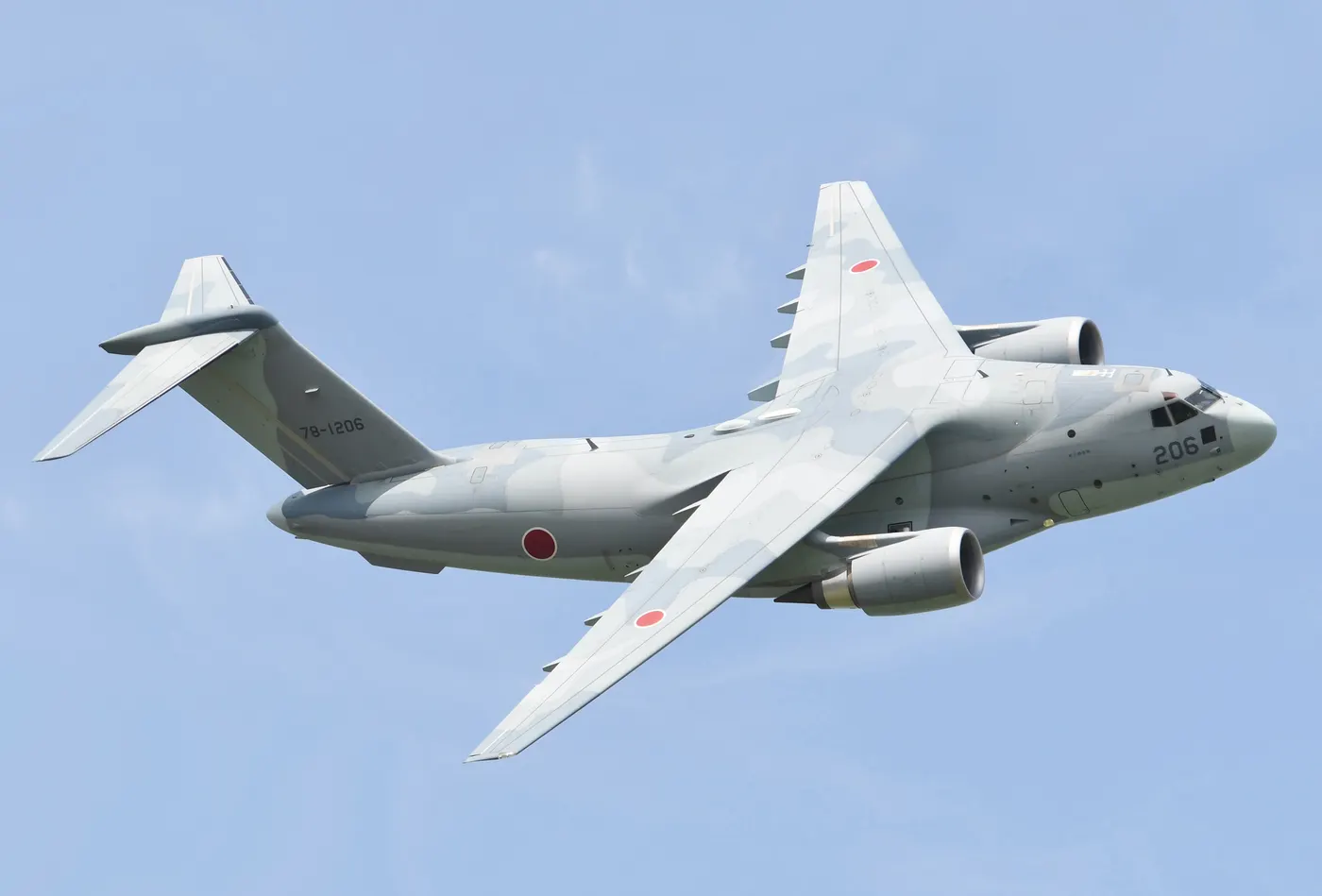

The Kawasaki C-2 is a Japanese four-engine (twin-turbofan) military transport aircraft built by Kawasaki Heavy Industries to replace the ageing Kawasaki C-1 and to complement, not duplicate, the Japan Air Self-Defense Force's Lockheed C-130H Hercules fleet.1 What sets the C-2 apart among strategic airlifters is the way it flies. Kawasaki's engineers designed the airframe to cruise at roughly Mach 0.8 and above 13,100 meters (43,000 feet), altitudes and speeds normal for a passenger airliner but unusual for a military cargo hauler.2 That places the C-2 faster and higher-flying than the much larger Boeing C-17 Globemaster III, the Airbus A400M Atlas, or the Ilyushin Il-76, all of which cruise well below Mach 0.75.1
- Airliner-like cruise speed (Mach 0.8) and altitude (43,000 ft)
- Doubles the C-1's payload and roughly triples its range
- Large, pressurized cargo hold sized for Japan's own armored vehicles
- Rear ramp openable in flight for airdrop
- Far more expensive per aircraft than a C-130J or A400M
- Optimized for paved fields, less rough-strip capability than the C-17 or A400M
- Small production run has kept unit costs climbing
- No confirmed export sale as of mid-2026
The Japanese Ministry of Defense reached this configuration after concluding that no aircraft already in production, including the C-17, the A400M, and later marks of the C-130, matched what the JASDF actually wanted, a jet that could climb above weather and keep pace with fighter escorts on the long overwater legs between Japan's home islands and Guam or Hawaii.1 The result is an aircraft that looks, from a distance, like a scaled-down C-17 but flies more like a stretched business jet. Development ran far longer and cost far more than planned, hobbled by rivet defects, a cracked undercarriage structure, and a cargo door that failed pressure testing in 2014, before the C-2 finally entered service with the JASDF on 30 June 2016.1
Only Japan operates the C-2, with 14 aircraft in front-line service as of 2024 out of roughly 15 airframes built, a run far short of the 40 the JASDF originally hoped to buy.1 Kawasaki and the Japanese government have spent nearly a decade trying to turn the C-2 into the flagship export product of Japan's post-2014 relaxed arms-transfer policy, pitching it to New Zealand and the United Arab Emirates in particular, so far without a signed contract.3,4 The aircraft's fate is therefore a useful test case for whether Japan's defense industry, long isolated by a strict self-imposed export ban, can actually compete for foreign orders once policy allows it to try.
{{photo-req side=right q="Kawasaki C-2 JASDF transport aircraft in flight" caption="A Japan Air Self-Defense Force Kawasaki C-2 in flight. The type cruises near Mach 0.8, faster than most strategic airlifters." alt="Kawasaki C-2 military transport aircraft flying"}}
A High-Bypass Airliner Engine on a Military Airlifter
The choice of powerplant is the clearest signal of the C-2's unusual design brief. Instead of a turboprop, standard on tactical airlifters from the C-130 to the A400M, or a dedicated military turbofan, Kawasaki fitted two General Electric CF6-80C2K1F high-bypass turbofans, each rated around 265 kN (roughly 59,600 lbf) of thrust, essentially the same engine family used on wide-body airliners like the Boeing 767 and early 747s.1,2 Ishikawajima-Harima Heavy Industries (now IHI Corporation) built the engines under license in Japan after Japan's Ministry of Defense selected the General Electric CF6-80C2 family over the Rolls-Royce Trent 800 and Pratt & Whitney PW4000 in 2003.1 Using a commercial engine gave the C-2 airliner-grade fuel efficiency and reliability at altitude, but it also meant designing the airframe around a genuinely large-diameter, high-bypass turbofan rather than a fuel-thirsty low-bypass military unit, a choice that shows up directly in the aircraft's swept wing and its relatively slim, area-ruled fuselage compared with the boxier C-17 or A400M.
Cargo Hold Sized for Japan's Own Hardware
The C-2's pressurized cargo compartment is built to swallow Japan's heaviest ground vehicles rather than merely stack pallets. It can carry a UH-60J helicopter, a Type 16 maneuver combat vehicle wheeled tank destroyer, a truck crane, or up to eight 463L cargo pallets, with a maximum payload in the region of 32 to 37.6 tonnes depending on how hard the airframe is loaded.1 A rear loading ramp, operable in flight for airdrop, and an automated pallet-handling system reduce the ground crew needed to load and unload compared with the C-1.1 The cockpit is a full glass cockpit with fly-by-wire flight controls and a head-up display intended for low-level flying in Japan's mountainous terrain, a notably modern avionics fit for an aircraft whose fuselage shape still echoes 1970s-era jet transports.1
{{photo-req side=left q="General Electric CF6-80C2 turbofan engine airliner" caption="A General Electric CF6-80C2-family turbofan, the same engine line Kawasaki chose to power the C-2." alt="CF6-80C2 high-bypass turbofan engine"}}
Trading Rough-Field Capability for Speed
Japan's original requirement for the C-1's replacement called for operation from unpaved or damaged strips, much like the C-130 it was meant to complement. That requirement was progressively relaxed as the design matured, and the production C-2 needs only about 500 meters of runway for takeoff but is optimized for improved, paved airfields rather than the soft or unprepared strips the C-17 and A400M are built to handle routinely.5 This is the central trade-off buried inside the C-2's headline cruise numbers, the airframe spends its weight and structural budget on speed and altitude rather than on the reinforced, low-pressure landing gear and rough-strip protection that define a true tactical airlifter.
{{photo-req side=right q="JASDF C-2 rear cargo ramp loading vehicle" caption="Cargo loading through the C-2's rear ramp. The type can carry a Type 16 wheeled combat vehicle or a UH-60J helicopter." alt="Kawasaki C-2 rear ramp cargo loading"}}
From the C-1's Shortfalls to a New Requirement
Kawasaki began lobbying Japan's Defense Agency for funding to replace the twin-engine C-1 as early as 1995. Formal requirements followed in 2000, calling for a jet-powered transport with roughly double the C-1's payload, six times its range, and enough legs to fly from Japan to Hawaii.1 The Ministry of Defense issued a request for proposals in May 2001, planned to buy up to 40 aircraft, and selected Kawasaki Aerospace as prime contractor that December.1 The design was internally designated XC-2 and studied under the C-X program name alongside the parallel P-X maritime patrol project that became the Kawasaki P-1.
Rivets, Cracks, and a Five-Year Slip
The first XC-2 prototype rolled out at Gifu Air Field on 4 July 2007, sharing the ceremony with its sister aircraft, the XP-1.1 Rollout was itself delayed by a problem traced to American-made rivets. Worse followed during ground testing, engineers found deformation in the horizontal stabilizer and cracking in the undercarriage trunnion structure and fuselage, faults that Kawasaki reportedly struggled to fix.1 A further blow came in 2014, when the rear cargo door failed during pressure testing, adding still more time and an estimated ¥40 billion (roughly $300 million in 2024 terms) to the program.1 By March 2016 the whole schedule had slipped about five years from the original plan, with total development cost estimated near ¥264 billion, roughly ¥80 billion above the original projection.1
{{photo-req side=left q="Gifu Air Field Kawasaki aircraft factory Japan" caption="Gifu Air Field, where Kawasaki assembled and first flew the C-2 prototype in 2010." alt="Gifu Air Field aircraft assembly Japan"}}
An Expensive Aircraft in a Small Fleet
Even after development ended, the price kept climbing. The JASDF's own budget filings put the unit cost near ¥20 billion (about $176 million) per aircraft as of 2017, well above the roughly ¥10 billion (about $80 million) Kawasaki had projected back in 2008, and industry reporting has since put later-year unit prices even higher, driven by a low production rate and limited domestic competition.7,1 With only 15 airframes built against an original ambition of 40, the C-2 never achieved the economies of scale that keep a C-130J or A400M's unit cost comparatively lower. The first three production C-2s reached the 403rd Tactical Airlift Squadron at Miho Air Base in March 2017, and the type's first operational overseas mission followed that November, a resupply run to the Japan Self-Defense Force Base in Djibouti, established to support Japan's counter-piracy patrols off the Horn of Africa.7
Japan's 2014 Export Policy and a Decade of Marketing
Kawasaki's export push depends entirely on a 2014 policy shift. Under Prime Minister Shinzo Abe, Japan replaced its decades-old blanket ban on arms exports with the Three Principles on Transfer of Defense Equipment and Technology, opening the door, for the first time since the 1960s, to selling complete weapons systems abroad.8 Kawasaki began actively marketing the C-2 to foreign air forces the following year, displaying it at the Dubai Airshow in November 2017 and again in 2018 and 2021, and at the Royal International Air Tattoo in the United Kingdom in 2018.7,9 In February 2019 a C-2 flew to the Australian International Airshow specifically to be pitched to the Royal New Zealand Air Force, which was shopping for a C-130H replacement under its Future Air Mobility Capability program.4 New Zealand chose the C-130J Super Hercules instead in June 2019.4 Japan then turned its main export hopes toward the United Arab Emirates, which approached Tokyo about buying an unspecified number of C-2s after the aircraft's repeated Dubai Airshow appearances.9 That effort suffered a serious setback in May 2026, when the UAE instead signed a contract for up to 20 Embraer KC-390 transports from Brazil, the largest export order in that Brazilian aircraft's history and the first Middle Eastern sale for the type.10 As of mid-2026 the C-2 still has no confirmed export customer.
An Arsenal Plane Concept
Japan's Ministry of Defense has also studied turning the C-2 into a stand-off weapons platform rather than only a cargo hauler. The concept, similar in spirit to the United States' Rapid Dragon palletized-munitions program, would drop long-range missiles such as the AGM-158 JASSM or an improved air-launched Type 12 surface-to-ship missile out of the C-2's rear ramp mid-flight before their engines ignite, requiring only modest airframe changes.11 The Ministry of Defense budgeted roughly $25 million for the concept in fiscal 2023, with technical studies running through fiscal 2024, though Japan's small fleet of around 13 to 15 C-2s would limit how many aircraft could realistically be converted.11
The C-2 has never operated in direct combat, but it has flown into at least one active crisis. When the Taliban seized Kabul on 15 August 2021 during the collapse of the internationally recognized Afghan government, the Fall of Kabul triggered a scramble by dozens of countries to evacuate their citizens and local staff.12 Japan was slow off the mark. Its National Security Council did not meet until 23 August, eight days after the city fell, and only then did the Minister of Defense order a C-2 and support aircraft to depart for the region as part of the broader 2021 Kabul airlift.12 By the time the mission wound down on 31 August, the JASDF had evacuated just one Japanese national and 14 Afghans at the request of the United States, far short of the roughly 500 people Japan had hoped to move out, and a stark contrast with the roughly 80,000 evacuated by the United States, 15,000 by the United Kingdom, and about 390 by South Korea.12,13 The episode became a domestic embarrassment in Japan and a case study in how a capable aircraft cannot make up for a slow political decision to use it.
{{photo-req side=right q="Hamid Karzai International Airport Kabul 2021 evacuation" caption="Hamid Karzai International Airport during the August 2021 evacuation. A JASDF C-2 arrived here only after Japan's government convened, eight days after Kabul fell." alt="Kabul airport evacuation 2021"}}
Away from crisis response, the C-2's first operational deployment abroad was a routine one, a November 2017 resupply flight from the 403rd Tactical Airlift Squadron to the Japan Self-Defense Force Base in Djibouti, Japan's only permanent overseas military base, opened to support anti-piracy patrols in the Gulf of Aden.7 That mission mattered less for combat exposure than for proving the C-2 could sustain the kind of long-range logistics run its whole design brief was built around.
{{photo-req side=left q="Japan Self-Defense Force Base Djibouti" caption="Japan's base in Djibouti, the destination of the C-2's first overseas deployment in November 2017." alt="Japan Self-Defense Force Base Djibouti"}}
Kawasaki and the JASDF have so far converted existing C-2 airframes into two specialized derivatives rather than building all-new variants from scratch.
The RC-2 is an electronic intelligence (ELINT) conversion, intended to replace the elderly NAMC YS-11EB in the signals-collection role. The second C-2 prototype was converted at Gifu Air Field, first flying in that configuration in February 2018, and the RC-2 entered service at Iruma Air Base in October 2020.1
A second derivative, the EC-2, is a stand-off electronic-warfare jammer under development since 2021, built around the third C-2 airframe. It carries a distinctively bulbous nose and fuselage blisters housing electronic-support, electronic-countermeasure, and satellite-communications equipment, inheriting its jamming suite from the older EC-1. First spotted publicly in February 2026 and reported to have flown for the first time the following month, the EC-2 program had roughly ¥41.4 billion allocated to it, with service entry planned at Iruma's Electronic Warfare Operations Group.1
{{photo-req side=right q="JASDF RC-2 electronic intelligence aircraft Iruma" caption="The RC-2, an electronic-intelligence conversion of the C-2 airframe, entered service at Iruma Air Base in 2020." alt="JASDF RC-2 electronic intelligence aircraft"}}
Neither derivative changes the base airframe's cruise performance or cargo dimensions, both remain airframes built on the same swept wing and CF6-80C2 engines described above, with their mission equipment fitted inside or added to the fuselage rather than requiring a structural redesign.

Japan is the only confirmed operator of the Kawasaki C-2, flying it exclusively through the Japan Air Self-Defense Force.1 JASDF C-2s are based principally at Miho Air Base, home of the 403rd Tactical Airlift Squadron, and at Iruma Air Base, which hosts the 402nd Tactical Airlift Squadron along with the specialized RC-2 and future EC-2 variants.1 Of roughly 15 airframes delivered, 14 remained in front-line tactical-airlift service as of the mid-2020s, with the remainder converted to the RC-2 and EC-2 roles described above.1
No foreign air force has yet ordered the C-2. New Zealand evaluated and rejected it in 2019, and the United Arab Emirates, Japan's most persistent prospective customer, signed instead with Brazil's Embraer in 2026. Japan continues to display the C-2 at international air shows, but as of this writing the type remains a single-operator aircraft, an unusual position for a program explicitly built to anchor Japan's return to the export market.
{{photo-req side=left q="JASDF Miho Air Base tactical airlift squadron aircraft" caption="Miho Air Base, home of the JASDF's 403rd Tactical Airlift Squadron and the C-2's main operating base." alt="JASDF Miho Air Base transport aircraft"}}
Kawasaki's own marketing for the C-2 draws its most direct comparison against the Boeing C-17 Globemaster III, even though the C-17 is considerably larger and heavier. Both aircraft were built around the same idea, moving heavy military cargo over long distances at jet speed. The C-17 cruises around 450 knots (roughly 830 km/h, Mach 0.74) and can land a full payload on unprepared or damaged strips as short as 3,500 feet (about 1,065 meters), a rough-field capability central to its entire design.14 The C-2 cruises noticeably faster, near Mach 0.8, and climbs higher, to 43,000 feet against the C-17's typical operating altitudes in the low thirties of thousands of feet, but it pays for that speed with a design optimized for paved runways rather than the C-17's dirt-strip, tactical-delivery mission.1,14 The C-17 also simply carries more, up to about 77.5 tonnes of payload and equipment as large as an entire Boeing CH-47 Chinook helicopter, well beyond the C-2's roughly 36 to 37.6 tonnes and single medium helicopter.14
Against the Airbus A400M Atlas, the comparison inverts in an interesting way. The A400M is turboprop-powered rather than turbofan-powered, yet its propellers are large enough and its wing efficient enough that it too cruises in airliner territory, around Mach 0.68 to 0.72 and up to 37,000 feet, occasionally reaching 40,000 feet.15 That leaves the C-2 still the faster and higher-flying of the two by a real margin, but the gap is smaller than against the C-17 or the propeller-driven Il-76. Where the A400M clearly wins is rough-field access, it can put its full roughly 37-tonne payload onto an unprepared strip under 750 meters long, a genuine soft-field capability the C-2 was not built to match.15 The A400M's maximum payload is also close to the C-2's, making payload capacity a near-draw where speed and field access are not.
| Spec | Kawasaki C-2 | Boeing C-17 | Airbus A400M |
|---|---|---|---|
| Cruise speed | Mach 0.8 (~890 km/h)2 | Mach 0.74 (~830 km/h)14 | Mach 0.68-0.7215 |
| Service ceiling | 43,000 ft1 | ~45,000 ft (typical low-30,000s cruise)14 | 37,000-40,000 ft15 |
| Max payload | ~36-37.6 t1 | ~77.5 t14 | ~37 t15 |
| Minimum unpaved field | Not optimized for unpaved strips5 | ~1,065 m14 | ~750 m15 |
None of this makes the C-2 a bad aircraft, it makes it a specialized one. Japan built a jet that can outrun weather and keep pace with fighter escorts on the long Pacific legs its own geography demands, and accepted a real cost in rough-field flexibility and total payload to get there. Whether that specialization is worth its price tag is precisely the question New Zealand and, so far, the UAE have each answered by buying something else instead.


What is the Kawasaki C-2 used for? The Kawasaki C-2 is a strategic military transport aircraft operated exclusively by the Japan Air Self-Defense Force, used to move troops, vehicles, and equipment (including helicopters and Japan's own wheeled combat vehicles) over long distances, replacing the older Kawasaki C-1.1
How fast does the Kawasaki C-2 fly? The C-2 has a cruise speed of about Mach 0.8 (roughly 890 km/h) and a maximum speed near Mach 0.82 (about 920 km/h), unusually fast for a strategic airlifter, and it cruises as high as 43,000 feet.1,2
Is the Kawasaki C-2 still in service? Yes. The C-2 entered Japan Air Self-Defense Force service in June 2016 and remains active in 2026, flying from Miho Air Base and Iruma Air Base, though it has never been exported.1
How much does a Kawasaki C-2 cost? Reported unit costs have risen over the program's life, from an early-2000s estimate near ¥10 billion (about $80 million) to roughly ¥20 billion (about $176 million) per aircraft by 2017, driven up by a small production run and limited domestic competition.7,1
Has anyone bought the Kawasaki C-2 for export? No confirmed export sale exists as of mid-2026. New Zealand evaluated the C-2 for its Future Air Mobility Capability program but chose the C-130J-30 Super Hercules in 2019, and the United Arab Emirates, long considered Japan's best export prospect, signed with Brazil's Embraer for the KC-390 in May 2026 instead.4,10
What engines power the Kawasaki C-2? Two General Electric CF6-80C2K1F high-bypass turbofans, the same engine family used on some wide-body airliners, built under license in Japan by IHI Corporation.1
- "Kawasaki C-2", Wikipedia — en.wikipedia.org ↩
- "Kawasaki C-2 - History, Technical Data & Photos", AeroCorner — aerocorner.com ↩
- "Japan hopes UAE will become first Kawasaki C-2 export customer", AeroTime — aerotime.aero ↩
- "Japan is into selling Kawasaki P-1 and C-2 to New Zealand", C4 Defence — c4defence.com ↩
- "A Brief Guide To Japan's Kawasaki C-2 Military Transport Aircraft", Simple Flying — simpleflying.com ↩
- "Kawasaki Delivers First Mass-produced C-2 Transport Aircraft to JASDF", Kawasaki Heavy Industries — global.kawasaki.com ↩
- "Japan's C-2 airlifter makes its international debut", Defense News — defensenews.com ↩
- "Japanese arms-export ban", Wikipedia — en.wikipedia.org ↩
- "JAPAN COULD SELL KAWASAKI C-2 CARGO AIRCRAFT TO UAE", The Aviation Geek Club — theaviationgeekclub.com ↩
- "UAE Buys up to 20 C-390 Millennium Transport Aircraft in Embraer's Largest Overseas Order", The Aviationist — theaviationist.com ↩
- "Japan Eyes Turning C-2 Cargo Jets Into Standoff Missile Carriers", TWZ — twz.com ↩
- "Examining Japan's Afghanistan Evacuation Operations", Nippon.com — nippon.com ↩
- "10 Afghan evacuees arrive in Japan; more expected to come", Japan Today — japantoday.com ↩
- "C-17 Globemaster III", U.S. Air Force Fact Sheet — af.mil ↩
- "A400M", Airbus Defence — airbus.com ↩