

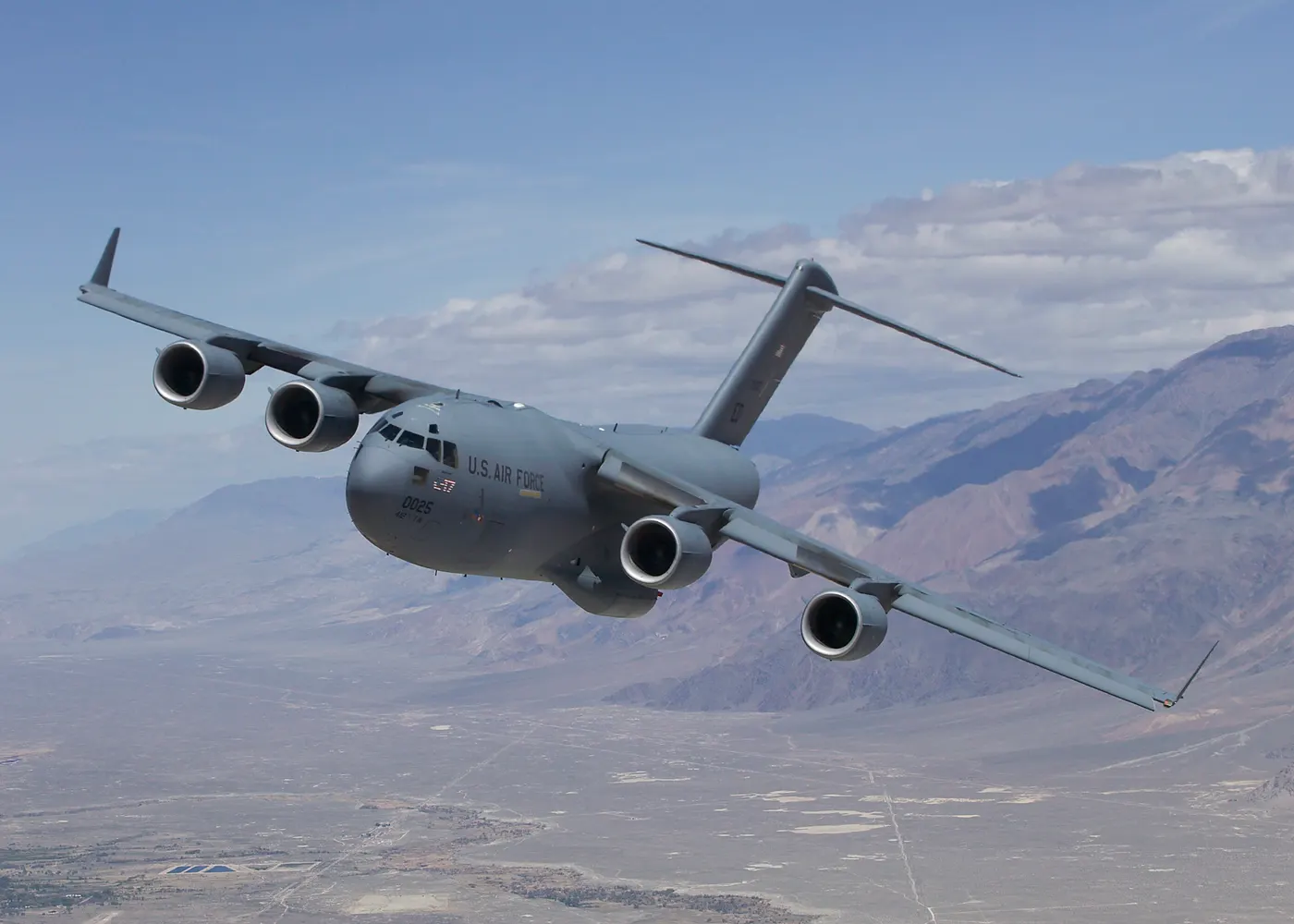

The Boeing C-17 Globemaster III combines two capabilities that rarely sit in the same airframe. It can carry a loaded M1 Abrams tank across an ocean, then put that tank down on a dirt strip barely longer than three football fields. That combination, intercontinental range paired with a runway footprint measured in a few thousand feet, is the trait that has kept the jet in continuous demand since the mid-1990s, and it is why the type sits at the center of the strategic airlifters category rather than at its edge.
- Lands on unpaved 3,500 ft strips
- Carries outsize cargo, including tanks
- Backs up under its own engine thrust
- Wide, mature international operator base
- High per-flight-hour operating cost
- Wing/engine complexity limits some austere fields
- Slower cruise than a dedicated jet freighter
- Production ended in 2015, no new-build option
The United States Air Force operates the largest fleet, more than 220 aircraft, and seven other governments fly the same airframe today, the United Kingdom, Australia, Canada, Qatar, Kuwait, the United Arab Emirates, and India, alongside a NATO-run consortium flagged under Hungary.1 279 were built in total between 1991 and 2015 at a single Boeing assembly line in Long Beach, California, a run that began as a McDonnell Douglas program and ended nearly two decades after that company itself had disappeared into Boeing.2
The C-17 Globemaster III's own program history explains a lot of its design compromises. Cost overruns and schedule slips very nearly killed it in the early 1990s, and the aircraft that emerged from that near-cancellation was deliberately built to do two jobs that had previously needed two different aircraft types, an intercontinental hauler like the older Lockheed C-5 Galaxy and a rough-field tactical transport. Design features borrowed from the smaller YC-15 demonstrator, externally blown flaps and a T-tail among them, let the C-17 land short and steep without sacrificing the wide, high-set cargo hold a strategic hauler needs.3
{{photo-req side=right q="C-17 Globemaster III landing unpaved dirt airstrip" caption="A C-17 Globemaster III demonstrates its short, unpaved-runway landing capability." alt="Boeing C-17 Globemaster III landing on a dirt airstrip"}}
Unit cost is one of the more frequently searched facts about the C-17 Globemaster III, and it varies more than most buyers expect. Early U.S. Air Force procurement lots priced out around 160 to 193 million dollars per airframe, while export customers negotiating smaller lots later in the production run paid considerably more, India's 2011 order of ten aircraft averaged close to 580 million dollars each once training, spares, and support packages were bundled in.4 That price spread matters for anyone asking whether the C-17 Globemaster III is still in service today, since sustainment cost, not airframe age, is now the main driver of fleet decisions across all nine operators. Every C-17 still flying is well within its designed structural life.
The Pratt & Whitney PW2000 Turbofans and Their Reversed-Thrust Trick
Four Pratt & Whitney engines power the C-17 Globemaster III, military-designated F117-PW-100 but derived directly from the commercial PW2000 family that also powers the Boeing 757.5 Each engine produces roughly 40,400 lbf (179.9 kN) of thrust, giving the aircraft enough excess power to climb steeply out of a threat area on takeoff.6 The more unusual feature is what the engines do in reverse. Their thrust reversers direct exhaust forward and upward rather than down onto the runway, which lets a C-17 back itself up on the ground under engine power, useful on a single-runway forward strip with no room to turn around.7
- Mürettebat3
Production aircraft gained wingtip winglets starting in 2001, a modification unique among purpose-built military transports at the time, aimed purely at trimming cruise fuel burn on long transoceanic legs.8 Two decades later the Air Force is still refining that same wing. Small aerodynamic add-ons called microvanes, tested on the aft fuselage, have measured further fuel savings of roughly 1 to 1.5 percent on top of the original winglet gains.9
- Motor TipiPratt & Whitney PW2000
- Motor Sayısı4
A Cargo Hold Built for a Main Battle Tank
The cargo compartment measures roughly 27 m long, 5.5 m wide, and 3.76 m high, sized specifically so two armored vehicles can sit side by side or a single M1 Abrams main battle tank can roll straight up the rear ramp.2 Maximum payload runs to about 74,797 kg (164,900 lb), operated by a crew of just 3 (two pilots and one loadmaster), a strikingly small crew for an aircraft that can carry roughly 102 paratroopers or a fully loaded tank.6 Empty weight sits around 128,142 kg, and the type has a service ceiling of 13,716 m (45,000 ft), well above most man-portable air-defense threats it might overfly on approach to a forward base.6
- Hizmet Tavanı13.716 m
{{photo-req side=right q="C-17 Globemaster III loading M1 Abrams tank cargo ramp" caption="An M1 Abrams tank being loaded through the C-17's rear cargo ramp." alt="M1 Abrams tank loaded into the cargo bay of a C-17 Globemaster III"}}
- Uzunluk53,035 m
- Kanat Açıklığı51,511 m
- Boş Ağırlık128.142 kg
Range depends heavily on payload. Fully loaded, the C-17 Globemaster III flies about 4,480 km (2,420 nmi) without refueling, and considerably farther empty or with a partial load, with virtually unlimited range once aerial refueling is added.6 Top speed is around 830 km/h (515 knots), with a typical cruise in the Mach 0.74 to 0.77 range, noticeably faster than older turboprop tactical transports but slower than a dedicated passenger jet, a deliberate trade favoring low-speed handling on short fields over outright cruise speed.10
Digital Fly-by-Wire Controls and the Externally Blown Flap Wing
The wing carries large flaps positioned directly in the exhaust path of the engines, a technique called externally blown flaps that increases lift at low speed far beyond what a conventional flap can generate, which is what allows the approach speeds needed for a 3,500 ft landing strip.3 A digital fly-by-wire system and a head-up display for both pilots simplify hand flying a large aircraft onto a short, often unlit or debris-strewn runway at night, a routine requirement in both Iraq and Afghanistan.2 None of this made the program cheap to develop. An October 1992 wing static test failed at 128 percent of design load against a 150 percent requirement, forcing a roughly 100 million dollar wing redesign, one of several crises that piled up nearly 1.5 billion dollars in development losses for McDonnell Douglas before the aircraft ever reached squadron service.3
McDonnell Douglas won the C-17 competition in 1981, building on lessons from its smaller YC-15 short-takeoff demonstrator of the 1970s.3 The program nearly did not survive the following decade. In April 1990, Defense Secretary Dick Cheney cut the planned order from 210 aircraft to 120 to save money, and by late 1993 the Department of Defense had issued an ultimatum, fix the persistent cost overruns and quality problems within two years or the contract would be terminated after only 40 aircraft.3 The first C-17 flew on September 15, 1991, about a year behind schedule, and the first production aircraft reached Charleston Air Force Base on June 14, 1993.2 The type was declared operational on January 17, 1995, and Boeing absorbed McDonnell Douglas entirely in 1997, two years into C-17 service, folding what had been an independent manufacturer's flagship military program into Boeing's own defense unit.2
{{photo-req side=right q="Boeing C-17 Long Beach assembly line production" caption="C-17 Globemaster III airframes on Boeing's Long Beach, California assembly line." alt="Boeing C-17 Globemaster III aircraft under assembly at the Long Beach factory"}}
Production ran for 24 years after that. Boeing tried, twice, to sell a stretched civilian freighter derivative, first pitched by McDonnell Douglas itself in 1997 and later rebranded the BC-17X under Boeing ownership, but the very features that made the C-17 valuable to the military, its weight, its short-field wing, and its high fuel burn at commercial cruise settings, made it a poor economic fit for cargo airlines, and the civilian version never found a launch customer.11 The military line kept running instead, closing only when export orders finally ran dry. The 279th and final C-17 Globemaster III departed the Long Beach plant on November 29, 2015, flown first to a Boeing facility in San Antonio and delivered from there to the Qatar Emiri Air Force in early 2016, the last customer standing on a production line that had, by then, run for a generation.12
{{photo-req side=right q="Gail Halvorsen Candy Bomber Berlin Airlift pilot portrait" caption="Gail Halvorsen, the Berlin Airlift's Candy Bomber, was honored with a C-17 dedication in 2022." alt="Portrait of Gail Halvorsen, the Berlin Airlift Candy Bomber"}}
That 2022 dedication was a deliberate link back to the founding moment of American strategic airlift, the 1948 to 1949 Berlin Airlift, and it framed the C-17 Globemaster III explicitly as the modern-day heir to that mission rather than as a plain cargo hauler. The aircraft's own name, Globemaster, was itself reused from two earlier Douglas transports, the C-74 and the C-124, a deliberate choice to signal continuity with the same airlift mission the Air Force still traces back to 1948.2
The C-17 Globemaster III entered its first major combat test during the Iraq War. On the night of March 26, 2003, 15 USAF C-17s flew the largest combat airdrop since the 1989 invasion of Panama, dropping 1,000 paratroopers of the 173rd Airborne Brigade over Bashur in northern Iraq, then followed up ferrying M1 Abrams tanks, M2 Bradleys, and artillery into the same airfield once it was secured.17 Over the buildup to that war, C-17s and C-5 Galaxy aircraft together flew more than 11,400 sorties, a sustained tempo that established the C-17 as the backbone of American strategic airlift rather than a supplementary type.17
{{photo-req side=right q="173rd Airborne Brigade Bashur Iraq airdrop 2003" caption="Paratroopers of the 173rd Airborne Brigade prepare for the March 2003 combat jump into Bashur, Iraq." alt="US paratroopers preparing for an airborne combat jump during the Iraq War"}}
In the war in Afghanistan, the C-17 Globemaster III did the same job under harder conditions. Most Afghan airfields it served were around 3,500 feet long, unpaved, and pitted with debris and potholes, exactly the environment the aircraft's short-field wing was designed for.18 From the opening day of the war on October 7, 2001, C-17s flew two to four humanitarian daily-ration drops a day, each aircraft releasing roughly 17,000 ration packets from 25,000 feet.18 That same theater produced the aircraft's most widely covered single mission two decades later. On August 15, 2021, a C-17 using the call sign Reach 871 was on the ground at Hamid Karzai International Airport in Kabul when panicked Afghan civilians climbed onto its open ramp as the security situation collapsed. The crew chose to take off anyway rather than force people off the aircraft, carrying what was later confirmed as 823 people, more than double the roughly 300 the aircraft is rated for in a passenger configuration, to Al Udeid Air Base in Qatar.19 No passenger seats were fitted, evacuees sat on the cargo floor using cargo straps run wall to wall as makeshift restraints, and the mission commander later said the crew acted on saving lives rather than on capacity limits.20
Two smaller but still notable conflict deployments round out the record. Under the Arab Winter, Air National Guard C-17s evacuated wounded anti-Gaddafi fighters out of Libya in November 2011 at the request of the State Department, and Qatari-operated C-17s were later reported moving materiel between Libya and Syrian opposition groups through Turkey, illustrating how widely this single airframe has been used across that broader regional upheaval by more than one operator.21 During Operation Serval in Mali in January 2013, U.S. Air Force C-17s established an air bridge from Istres in southern France to Bamako, moving a French mechanized infantry battalion and its equipment, with additional aircraft contributed by Canada, the United Kingdom, and the United Arab Emirates.22
{{photo-req side=right q="French troops Mali Operation Serval 2013" caption="French forces deployed into Mali during Operation Serval, an intervention that leaned heavily on allied C-17 airlift support." alt="French military personnel and equipment during the 2013 Mali intervention"}}
Only one operational configuration of the C-17 Globemaster III has ever been built, but export customers received a small, meaningful upgrade over the earliest U.S. Air Force jets. Aircraft delivered to Qatar onward carry an extra internal fuel tank in the center wing box, marketed as the extended-range configuration and often informally called the C-17ER, which stretches unrefueled range on the ferry legs export customers fly home after delivery.23 Every subsequent foreign sale, to the United Arab Emirates, India, and the rest, has used this extended-range standard rather than the baseline U.S. configuration.23
The only true derivative that never reached production was a stretched civilian freighter, first floated by McDonnell Douglas in 1997 and carried forward briefly by Boeing as the BC-17X. Commercial airlines never bought in, because the size, weight, and short-field wing that make the aircraft valuable to an air force translate into high fuel burn and limited revenue cargo volume on a normal airline route, and the project quietly lapsed without a single order.11


The United States Air Force remains by far the largest C-17 Globemaster III operator, with over 220 aircraft spread across active-duty, Air National Guard, and Reserve wings including Charleston, McChord, and Travis.1 Beyond the U.S., India's air force is the largest foreign customer with 11 aircraft, delivered between 2013 and 2019.1 The United Kingdom and Australia each fly 8, Qatar and the United Arab Emirates each operate 8 as well, Canada flies 5 under the designation CC-177, and Kuwait rounds out the bilateral customer list with 2 delivered in 2014.1
{{photo-req side=right q="NATO Heavy Airlift Wing C-17 Papa Air Base Hungary" caption="A Strategic Airlift Capability C-17 Globemaster III at Pápa Air Base, Hungary, home of the NATO Heavy Airlift Wing." alt="C-17 Globemaster III of the NATO Strategic Airlift Capability program at Papa Air Base"}}
A ninth arrangement operates outside the normal single-country buyer model entirely. The Strategic Airlift Capability, established in 2008, is a 12-nation consortium (the United States plus 11 NATO and partner states including Hungary, Bulgaria, Estonia, Lithuania, the Netherlands, Norway, Poland, Romania, Slovenia, Sweden, and Finland) that jointly owns three C-17s flown under Hungarian Air Force markings out of Pápa Air Base and crewed by the multinational Heavy Airlift Wing, activated on July 27, 2009.24 No member state owns an aircraft outright, each simply buys flight hours from the shared fleet, a model that let smaller air forces gain strategic airlift access none of them could have justified buying individually.25
The clearest way to place the Boeing C-17 Globemaster III against its rivals is by runway requirement rather than by raw size, because the aircraft it is most often compared against is bigger in every dimension that matters on a spec sheet. The Lockheed C-5 Galaxy is longer, has a wider wingspan, and carries close to double the payload and range of the C-17 Globemaster III, yet the U.S. Air Force still operates both types side by side rather than retiring the smaller aircraft once the bigger one existed.26 The reason is runway access. The C-5 Galaxy needs roughly 8,300 feet of paved runway to operate at heavy weights, while the C-17 Globemaster III can land in 3,500 feet on unpaved or damaged surfaces, which matters far more in a forward theater than a few thousand extra kilograms of payload.26
| Metric | Boeing C-17 Globemaster III | Lockheed C-5 Galaxy |
|---|---|---|
| Max payload | ~74,800 kg6 | ~122,000 kg26 |
| Unrefueled range (loaded) | ~4,480 km6 | ~8,900 km26 |
| Minimum runway | ~1,067 m (3,500 ft), unpaved6 | ~2,530 m (8,300 ft), paved26 |
| First flight | 19913 | 1968 |
Against the Antonov An-124 Ruslan, the comparison shifts from a sibling-fleet question to a market one. The An-124 is a similarly outsized Soviet-era design that ended up doing most of its flying commercially, chartered by operators like Volga-Dnepr to move single oversized industrial loads (turbines, locomotives, mining equipment) that no airliner could carry, a role the C-17 Globemaster III essentially never fills, since it stayed a purely military type with no civilian charter market of its own.27 Where the C-17 was engineered from the outset around unprepared forward airstrips, the An-124 leans on its far larger cargo hold and nose-and-tail loading doors for cargo that simply will not fit through a smaller opening, at the cost of needing longer, harder runways to do it.
The Ilyushin Il-76 and the Airbus A400M Atlas sit closer to the C-17 Globemaster III's own tactical-plus-strategic formula, particularly the A400M, which was designed to close the same gap between a C-130-class tactical transport and a pure strategic hauler, though at roughly half the C-17's payload and a smaller cargo cross-section that cannot swallow a main battle tank. Whether the Boeing C-17 Globemaster III is worth its price compared to these rivals depends entirely on whether a buyer needs the short, unprepared-field capability at all. A country that only ever needs to move cargo between paved international airports has cheaper options among these aircraft, while a country that needs to land troops and armor on a strip its own engineers built with a bulldozer the week before has, for three decades running, had essentially one credible choice.
Is the C-17 Globemaster III still in service? Yes. All nine operators, led by the United States Air Force, continue to fly the type as of 2026, since the airframes are well within their designed structural life and production ended because export demand ran out, not because the design aged out.1
How much does a C-17 Globemaster III cost? Reported unit costs range from roughly 160 million dollars for early U.S. Air Force production lots to over 550 million dollars per aircraft for smaller, later export orders bundled with training and spares, so there is no single accurate price figure without specifying the buyer and the year.4
What is the C-17 Globemaster III used for? Its core mission is moving troops, vehicles, and cargo, including outsize items like tanks and helicopters, directly into forward or austere airfields rather than only between major air bases, plus airdrop, aeromedical evacuation, and humanitarian airlift.6
What is the C-17 Globemaster III's range and payload? Loaded, it flies about 4,480 km without refueling while carrying up to roughly 74,800 kg of cargo, with virtually unlimited range once aerial refueling is added.6
Who manufactures the C-17 Globemaster III? Boeing built every C-17 Globemaster III from 1998 onward, having absorbed original developer McDonnell Douglas in 1997, though the aircraft's design and most of its early production run predate that merger.2
Can the C-17 Globemaster III land on dirt runways? Yes. The design requirement was a runway as short as 3,500 feet and as narrow as 90 feet, including unpaved or semi-prepared surfaces, and its externally blown flaps plus reverse-thrust engines let it operate from strips no other aircraft in its size class can use.6
- "The Global C-17 Fleet, 222 Aircraft in 8 Countries", C-17 Pilot — c17pilot.com ↩
- "Boeing C-17 Globemaster III", Wikipedia — en.wikipedia.org ↩
- "Globemaster III, Acquiring the C-17", Air Mobility Command — amc.af.mil ↩
- "Boeing C-17 Globemaster III, Cost Analysis", C-17 Pilot — c17pilot.com ↩
- "The History Of The Boeing C-17 Globemaster III Over The Years", Simple Flying — simpleflying.com ↩
- "C-17 Globemaster III", U.S. Air Force — af.mil ↩
- "The Flexible C-17 Globemaster III has Impressive STOL Capabilities", The Aviationist — theaviationist.com ↩
- "More Burn for the Buck", Aerospace Testing International — aerospacetestinginternational.com ↩
- "Money-Saving Microvanes Inch Closer to Fleetwide C-17 Use", Air & Space Forces Magazine — airandspaceforces.com ↩
- "C-17 Globemaster III, history, features, and performance", AeroTime — aerotime.aero ↩
- "McDonnell Douglas Actually Tried To Sell A Commercial C-17 Globemaster, Here's Why It Failed", Simple Flying — simpleflying.com ↩
- "Final Boeing C-17 Globemaster III Departs Long Beach Assembly Facility", Boeing — boeing.mediaroom.com ↩
- "Afghan baby named 'Reach' after Air Force C-17 flight", Task & Purpose — taskandpurpose.com ↩
- "Cargo plane given moniker paying tribute to legendary Berlin Airlift candy bomber", Stars and Stripes — stripes.com ↩
- "C-17 Globemaster III, An aircraft as versatile as AE crews", Air Mobility Command — amc.af.mil ↩
- "C-17 Globemaster III", Call of Duty Wiki — callofduty.fandom.com ↩
- "C-17 Globemaster III", GlobalSecurity.org — globalsecurity.org ↩
- "Military Airlift, C-17 Aircraft Program", EveryCRSReport — everycrsreport.com ↩
- "Kabul Evacuation Flight Sets C-17 Record With 823 On Board", Air & Space Forces Magazine — airandspaceforces.com ↩
- "Inside Reach 871, A US C-17 Packed With 640 Afghans Trying to Escape the Taliban", Defense One — defenseone.com ↩
- "Air Force, National Guard C-17 crews transport injured Libyan fighters to U.S.", Air National Guard — ang.af.mil ↩
- "U.S. Airlift of French forces to Mali", U.S. Africa Command — africom.mil ↩
- "C-17 Globemaster III Production", GlobalSecurity.org — globalsecurity.org ↩
- "The Strategic Airlift Capability", Strategic Airlift Capability Program — sacprogram.org ↩
- "First C-17 plane welcomed at PAPA Airbase", NATO — nato.int ↩
- "The Striking Differences Between The C-17 Globemaster and The C-5 Galaxy", Simple Flying — simpleflying.com ↩
- "An-124-100 Ruslan, world's largest freighters for outsize and heavyweight cargo", Volga-Dnepr Group — volga-dnepr.com ↩