

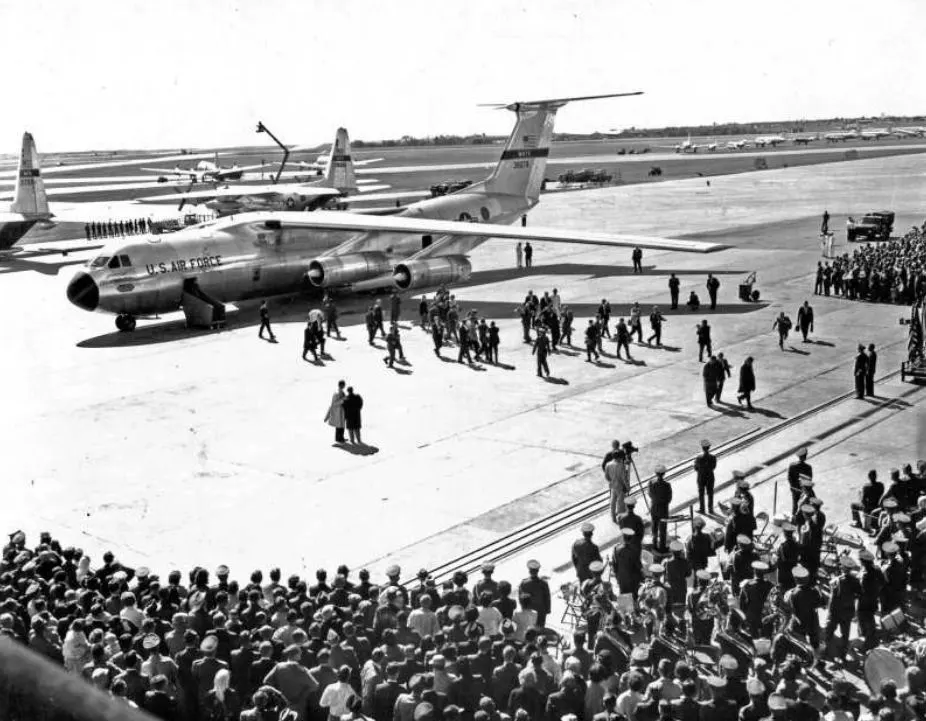

The Lockheed C-141 Starlifter was the first aircraft the United States Air Force ever built from a blank design as a jet-powered military transport, instead of adapting an airliner or stretching a propeller-driven cargo type.1 The requirement behind it, Specific Operational Requirement 182, was issued in the spring of 1960 and asked for an aircraft able to carry a 60,000 lb load over a radius of at least 3,500 nautical miles, while still being able to airdrop paratroops and supplies at low altitude.1 Lockheed built the answer at its Marietta, Georgia plant. It first flew on December 17, 1963, and the C-141A entered service in April 1965 with the 1501st Air Transport Wing at Travis Air Force Base, California.1 Production ran from 1963 to 1968 and totaled 285 airframes, one of them delivered to NASA rather than the Air Force.1
- First purpose-built jet strategic airlifter
- Fast cruise speed cut trans-Pacific/Atlantic transit times sharply
- Stretch program (C-141B) added a third more capacity without buying new airframes
- Rear ramp handled palletized cargo, troops, paratroops, and litters from one airframe
- Cargo hold bulked out before it massed out, wasting lift capacity until the stretch fix
- Narrow, low cargo compartment could not carry outsized loads like tanks or helicopters
- Required improved, paved runways, unlike the C-130 it worked alongside
- Never exported, so the whole fleet depended on one customer's budget cycles
The Starlifter replaced the piston-engine Douglas C-124 Globemaster II and Douglas C-133 Cargomaster, both of which needed far longer to cross an ocean.1 It belongs to the strategic airlifters category alongside later types like the Boeing C-17 Globemaster III and the much larger Lockheed C-5 Galaxy, which entered service a few years afterward and shared the same Cold War airlift mission.1 Unlike the C-5, the C-141 was never sold abroad. Every one of the 285 built flew only under an American flag, from Travis and Charleston Air Force Bases in the 1960s through the Air Force Reserve and Air National Guard units that flew it into the 2000s.2
{{photo-req side=right q="Lockheed C-141 Starlifter USAF cargo aircraft on runway" caption="A Lockheed C-141 Starlifter of the United States Air Force." alt="Lockheed C-141 Starlifter strategic transport aircraft on a runway"}}
Is the C-141 Starlifter still in service today? No. The type was formally retired on May 6, 2006, when the last flying example, the Hanoi Taxi, landed at the National Museum of the United States Air Force outside Dayton, Ohio, closing a 43-year career.2 The Boeing C-17 Globemaster III had already taken over most of its missions by then, combining the C-141's jet speed with a short-field capability the Starlifter never had.1 What is remembered about the Starlifter today is less its raw specifications and more what it carried, from combat troops and battlefield casualties in the Vietnam War to the first American prisoners of war flown out of Hanoi in 1973.
Four Pratt & Whitney Turbofans and a High T-Tail
The Lockheed C-141 Starlifter's airframe follows a formula that later became standard for jet freighters, a high-mounted swept wing, a T-tail kept clear of the cargo stream, and a rear ramp built into the upswept tail section.1 Four Pratt & Whitney TF33-P-7 turbofans, rated at roughly 20,250 lbf (90 kN) of thrust each, are mounted on pylons under the wing.1,5 That gave the original C-141A a cruise speed near 495 knots (910 km/h) and a maximum speed of about 567 mph (912 km/h, Mach 0.74) at altitude, figures that made it noticeably faster than the propeller transports it replaced and that stayed essentially unchanged through later Starlifter models.4,5 Service ceiling was 41,000 feet (12,497 m), and takeoff distance to clear a 50-foot obstacle at maximum weight ran around 5,800 feet (1,770 m), long enough that the C-141 generally needed paved, improved runways rather than the semi-prepared strips a Lockheed C-130 Hercules could use.4 It never gained the true unpaved-short-field capability the tactical requirement in SOR 182 had originally asked for.
{{photo-req side=left q="C-141 Starlifter loadmaster rear cargo ramp loading" caption="Loadmasters guide cargo through the C-141's rear ramp." alt="US Air Force loadmasters loading cargo into a C-141 Starlifter through its rear ramp"}}
The C-141A's cargo hold measured roughly 7,019 cubic feet and could carry 154 troops, 123 paratroopers, or a maximum payload near 62,700 lb.6,1 That sounds generous until it is compared with the aircraft's structural lifting capacity. The hold filled with bulky, low-density cargo (what aviation crews called bulking out) long before the airframe reached its allowable takeoff weight, so a large share of the C-141A's genuine lift capability went unused on most missions.13
The Fuselage Stretch That Was Cheaper Than Buying New Aircraft
Between 1977 and 1982, Lockheed's Marietta plant took 270 in-service C-141As apart just forward and aft of the wing and inserted two fuselage plugs, a 160-inch section ahead of the wing and a 120-inch section behind it, lengthening each aircraft by 23 feet 4 inches.1,13 The resulting C-141B had a cargo volume of about 9,190 cubic feet, close to a third more than the A model, and could carry 205 troops, 168 paratroopers, 103 litter patients, or 13 standard 463L pallets, against a maximum payload near 90,880 lb (41,222 kg).6,5 The Air Force estimated the stretch program delivered as much added airlift capacity as buying 90 entirely new aircraft would have, at a fraction of the cost, and it remains a textbook case of extracting more capability from an existing fleet rather than starting a new production line.13 The first C-141B reached the Air Force in December 1979, and the conversion of all 270 aircraft finished in 1982.1
{{photo-req side=right q="C-141B Starlifter fuselage stretch modification Lockheed Georgia" caption="A C-141A undergoes conversion to C-141B standard, with a fuselage plug inserted ahead of the wing." alt="C-141 Starlifter fuselage during the stretch modification program"}}
The B-model conversion also added an aerial refueling boom receptacle above the cockpit, making the type in-flight refuelable for the first time and letting a C-141B extend a mission well past its roughly 2,935-mile (4,723 km) range with maximum payload, or its 6,140-mile (9,880 km) ferry range with no cargo and full fuel.1 A 1981 flight demonstrated the point directly, carrying 67,000 lb of cargo non-stop from McGuire Air Force Base in New Jersey to Saudi Arabia with three in-flight refuelings.1
A further upgrade in the 1990s produced the C-141C, fitting about 63 aircraft with a digital autopilot, a Ground Collision Avoidance System, GPS, and one of the earliest glass cockpit displays used on any USAF transport, replacing much of the original electromechanical instrumentation.7 Typical flight crew across the Starlifter's career ran five to seven, two pilots, one or two flight engineers, a navigator (carried mainly for airdrop missions in later years), and one or two loadmasters, with five additional medical personnel added for aeromedical evacuation flights.1
From the Berlin Airlift's Lessons to Specific Operational Requirement 182
The push for a purpose-built jet transport traces back to Lieutenant General William H. Tunner, who had commanded the Hump airlift over the Himalayas in World War II and then the Berlin Airlift of 1948-1949.3 Tunner argued that a future crisis would need aircraft that could move heavy loads over intercontinental distances fast, not the piston-engine transports available in the 1950s, and by 1960 that argument had become SOR 182, the formal Air Force requirement the Starlifter was built to satisfy.3,1 The C-141 itself never flew during the Berlin Airlift, which had ended more than a decade before its first flight, but the operational lessons Tunner drew from it shaped the aircraft directly.3
{{photo-req side=left q="General William H. Tunner USAF portrait" caption="General William H. Tunner, whose Berlin Airlift command experience shaped the requirement that produced the Starlifter." alt="Portrait of General William H. Tunner of the United States Air Force"}}
Lockheed (renamed Lockheed Martin after its 1995 merger with Martin Marietta) built the C-141 at its Marietta plant, the same Georgia factory that later produced the C-5 Galaxy.16 The C-141A became operational with the 1501st Air Transport Wing at Travis Air Force Base in April 1965, under the Military Air Transport Service, which was renamed Military Airlift Command later that year and eventually became Air Mobility Command.1
Operation Blue Light and the Vietnam War
The C-141's first major test came almost immediately. In December 1965, twelve C-141s and four C-133 Cargomasters flew the 3rd Brigade, 25th Infantry Division, from Schofield Barracks, Hawaii, to Pleiku in South Vietnam's Central Highlands, moving more than 3,000 soldiers and an estimated 2,000 to 4,000 tons of equipment in what was, at the time, the largest airlift of troops into a combat zone in history, a record it held until Operation Desert Shield in 1990.8 The operation, code-named Blue Light, showed that a jet transport could move a combat brigade across the Pacific in days rather than the weeks a ship crossing required.
{{photo-req side=right q="25th Infantry Division troops boarding aircraft Vietnam 1965" caption="Soldiers prepare to deploy to Vietnam by air during Operation Blue Light, December 1965." alt="US Army soldiers boarding a transport aircraft during Operation Blue Light in 1965"}}
For the rest of the Vietnam War, the C-141 Starlifter carried out both logistics and medical evacuation missions on a scale no earlier American transport had managed. The first aeromedical evacuation flight flew on July 15, 1965, and by 1968, as combat casualties peaked, roughly 9,000 patients a month were being moved by air.8 Between July 1965 and December 1972, C-141s flew about 6,000 dedicated evacuation missions, at times shipping 37,000 pints of blood a month to forward hospitals, and the wider Military Airlift Command evacuation effort moved more than 400,000 patients over the course of the war.8,1 The type suffered losses too, including two fatal crashes in Vietnam in March and April 1967 and a combat death of an airman at Udorn air base in July 1968, a reminder that even a rear-echelon logistics aircraft operated inside a war zone.8
Operation Homecoming and the Hanoi Taxi
The C-141's best-known moment came at the end of the war. On February 12, 1973, a C-141 with the tail number 66-0177 flew into Gia Lam Airport near Hanoi, North Vietnam, and became the first aircraft of Operation Homecoming to carry released American prisoners of war out of captivity, with 40 former POWs aboard on that first flight.9 Navy Commander Everett Alvarez Jr., the first American pilot shot down over North Vietnam and the second-longest-held POW of the war, was among them after more than eight and a half years in captivity.9 Between February 12 and March 29, 1973, Operation Homecoming flights returned 591 American military and civilian personnel, with the last arriving on American soil on April 4, 1973.8,10 The aircraft earned its nickname, Hanoi Taxi, from writing POWs left on its flight engineer's panel during that first freedom flight, and it flew for another 33 years before becoming the last operational C-141 retired, in the same paint scheme it wore in 1973, at the National Museum of the United States Air Force in May 2006.9,2
{{photo-req side=left q="Operation Homecoming 1973 prisoners of war celebrate aircraft" caption="Released American prisoners of war celebrate aboard a C-141 during Operation Homecoming, February 1973." alt="American prisoners of war celebrating aboard a C-141 Starlifter in 1973"}}
An Unlikely Second Career as a Flying Telescope
One early C-141A had a career almost entirely separate from military transport. Converted from Lockheed's own demonstrator for a proposed civilian version of the Starlifter, it became NASA's Kuiper Airborne Observatory, carrying a 36-inch infrared telescope through a hole cut in its fuselage to altitudes up to 48,000 feet, above most of the water vapor that blocks infrared astronomy from the ground.11 Based at NASA's Ames Research Center, it flew more than 1,100 research missions and logged over 15,000 hours of airborne observation between the mid-1970s and its retirement in 1995, when it was replaced by the larger SOFIA flying observatory.11 The aircraft itself survived until 2023, when it was finally dismantled, with its cockpit going to the Pima Air and Space Museum and its telescope to the Moffett Field Museum.12
Vietnam and the Peak of the C-141's Combat Logistics Role
The Vietnam War remained the C-141 Starlifter's defining conflict for its first decade of service, running almost daily flights of troops, ammunition, and supplies into Vietnam alongside the medical evacuation missions described above.8 As the war wound down, the Starlifter took on a different mission during Operation New Life in the spring of 1975, part of a mixed fleet that flew 375 airlift sorties evacuating more than 50,000 South Vietnamese civilians and American personnel before the fall of Saigon.8
{{photo-req side=right q="C-141 Starlifter aeromedical evacuation litter patients loading" caption="Aeromedical evacuation crews load litter patients aboard a C-141 Starlifter." alt="US Air Force medical crew loading litter patients onto a C-141 Starlifter"}}
The Cold War's Broader Airlift Mission and the Gulf War
Beyond Vietnam, the C-141 formed the backbone of American strategic airlift throughout the Cold War, moving reinforcements, equipment, and cargo to Europe and elsewhere as tensions with the Soviet Union required.1 Its last large-scale test came at the very end of that era. During Operation Desert Shield and Operation Desert Storm in 1990-1991, C-141s flew 8,536 missions, moving 159,462 short tons of cargo and 93,126 passengers into the Gulf War theater, working alongside the far larger Lockheed C-5 Galaxy and civilian charter aircraft under the Civil Reserve Air Fleet program.1 It was the largest airlift the type had flown since Vietnam, and one of the last times the full C-141 fleet operated together before age and the incoming Boeing C-17 Globemaster III began pulling airframes out of service through the 1990s.
{{photo-req side=left q="Operation Desert Shield C-141 Starlifter cargo ramp Saudi Arabia 1990" caption="A C-141 Starlifter unloads cargo during the Operation Desert Shield buildup in Saudi Arabia, 1990." alt="C-141 Starlifter on the ramp during Operation Desert Shield in Saudi Arabia"}}
By the mid-1990s the Air Force had begun retiring its oldest, most fatigued C-141s outright rather than repairing them, a process that accelerated once the C-17 reached operational squadrons, and the type's last active-duty examples left service in 2004, two years before the final Air National Guard and Reserve airframes followed in 2006.2
- C-141A, the original production version, first flown in 1963, with a 7,019 cubic foot cargo hold and no aerial refueling capability.1,6
- C-141B, 270 C-141As stretched by 23 feet 4 inches between 1977 and 1982, raising cargo volume to about 9,190 cubic feet and capacity to 205 troops, 168 paratroopers, or 13 pallets, and adding an in-flight refuelable boom receptacle.1,6
- C-141C, roughly 63 C-141Bs modernized in the 1990s with a digital autopilot, a Ground Collision Avoidance System, GPS, TCAS, and an early glass cockpit display.7
- NASA C-141A (Kuiper Airborne Observatory), a single airframe permanently modified to carry a 36-inch infrared telescope for high-altitude astronomy, unrelated to any USAF cargo mission.11

The United States was the only country ever to fly the Lockheed C-141 Starlifter. All 285 production aircraft served with the United States Air Force (minus the one built for NASA), beginning with Military Air Transport Service and Military Airlift Command squadrons at Travis and Charleston Air Force Bases in the 1960s, and later with Air Force Reserve and Air National Guard units after transfers began in 1986.1,2 The last active-duty C-141s left service by 2004, and the final Reserve and Guard airframes, including the Hanoi Taxi, retired in May 2006, ending a run that never included a single export sale, a contrast with contemporaries like the Lockheed C-5 Galaxy or the later C-17, both of which found or were designed for at least limited use outside the United States.2
Several retired C-141s survive on public display today. The Hanoi Taxi (66-0177) sits in the National Museum of the United States Air Force's outdoor airpark at Wright-Patterson Air Force Base.9 The C-141B nicknamed the Golden Bear (63-8088) is preserved at the Travis Air Force Base Heritage Center in California, near where the type first entered service in 1965.15 A C-141A, tail number 65-0277, sometimes called the Tacoma Starlifter, is displayed at the McChord Air Museum in Washington state, and the Air Mobility Command Museum at Dover Air Force Base, Delaware, holds both the first production C-141 built and a later C-141B.14,13
The Lockheed C-141 Starlifter and the Lockheed C-5 Galaxy came from the same Marietta, Georgia factory and entered Air Force service only a few years apart, but the Air Force never intended them to do the same job. The C-141 was sized around SOR 182's demand for speed and reach with a moderate, palletized load, while the C-5 was built to swallow outsized cargo, main battle tanks, helicopters, and self-propelled artillery, through a nose that opens on top of a kneeling landing gear.1 A C-5 can carry roughly four times the payload of a C-141B in a single lift, but the Starlifter's smaller size meant more of them could be built and based, and its narrower footprint let it use more airfields worldwide, including many that could not take a fully loaded C-5. In practice the two aircraft operated as a team through the Cold War and the Gulf War, the C-141 handling the higher-volume, lower-bulk half of the airlift mission (troops, ammunition pallets, litter patients) while the C-5 covered the loads that would not fit in any other American transport.
| Metric | C-141B Starlifter | C-5 Galaxy |
|---|---|---|
| Max payload | ~90,880 lb (41,222 kg)5 | ~261,000 lb (118,000 kg) |
| Cargo type | Palletized, troops, litters | Outsized (vehicles, helicopters) |
| Cruise speed | ~495 kt (910 km/h)4 | ~450 kt (830 km/h) |
| Units built | 2851 | 131 |
The Boeing C-17 Globemaster III tells a different story, because it is the aircraft that made the C-141 Starlifter obsolete rather than a wartime partner. The C-17's defining advantage over the C-141 was never top speed, the two cruise at similar speeds, it was the ability to combine strategic range with tactical, unpaved-short-field landings on rough or short airstrips, a job that had previously needed a separate aircraft like the Lockheed C-130 Hercules.1 A single C-17 could fly a load from the continental United States directly into a forward airstrip that a C-141 would have needed a C-130 to relay cargo onward from. That single-type flexibility, more than any raw payload number, is why the Air Force retired its entire C-141 fleet by 2006 once enough C-17s had reached its squadrons, rather than keeping a mixed fleet the way it had with the C-141 and C-5 for three decades.
Outside American service, the Soviet Union pursued a broadly similar idea with the Ilyushin Il-76, which entered service in 1974 as its own purpose-built jet freighter, but with a design brief closer to the C-17's than the C-141's, since Soviet doctrine wanted true rough-field performance from a jet transport rather than accepting the C-141's dependence on paved runways.1 The C-141 and the Il-76 make an instructive pair precisely because they answered the same basic question (how does a country build a jet-powered replacement for its piston-engine military transports) with different priorities baked in from the start.


Is the C-141 Starlifter still in service? No. The United States Air Force retired its last C-141, the Hanoi Taxi, on May 6, 2006, replacing the type with the Boeing C-17 Globemaster III.2
What replaced the C-141 Starlifter? The C-17 Globemaster III, built by Boeing, which combined the C-141's jet range and speed with short, unpaved-field landing capability the Starlifter never had.1
How much cargo could the C-141 Starlifter carry? The stretched C-141B could carry about 90,880 lb (41,222 kg), or 205 troops, 168 paratroopers, 103 litter patients, or 13 standard cargo pallets, roughly a third more than the original C-141A.5,6
Why was the C-141 stretched into the C-141B? The C-141A's cargo hold filled with volume before the airframe reached its allowable weight, wasting lift capacity. Stretching 270 aircraft by 23 feet 4 inches between 1977 and 1982 added cargo volume equal, by Air Force estimates, to buying 90 new aircraft.1,13
What is the Hanoi Taxi? The Hanoi Taxi is the C-141 (tail number 66-0177) that flew the first Operation Homecoming mission out of Hanoi on February 12, 1973, carrying released American prisoners of war, and which became the last operational C-141 retired in 2006.9,2
How much did a C-141 Starlifter cost? Lockheed's own figures put the flyaway unit cost near $8.1 million in 1992 dollars, though the type was never sold to another country and its original 1960s procurement cost differed from that later figure.1
- "Lockheed C-141 Starlifter", Wikipedia — en.wikipedia.org ↩
- "USAF Retires Last Lockheed Martin C-141 StarLifter, World's First Jet-Powered Airlifter Completes 43-Year Career", Lockheed Martin — news.lockheedmartin.com ↩
- "Here's why the C-141 is possibly The Most Significant Aircraft in History of Airlifter Design", The Aviation Geek Club — theaviationgeekclub.com ↩
- "C-141B Starlifter", GlobalSecurity.org — globalsecurity.org ↩
- "Lockheed C-141 Starlifter Specifications", flugzeuginfo.net — flugzeuginfo.net ↩
- "C-141B", C-141 Flying Squadrons — c141flyingsquadrons.com ↩
- "C-141C Starlifter", GlobalSecurity.org — globalsecurity.org ↩
- "Often Overlooked, The C-141 Starlifter Played A Central Role During the Vietnam War", HistoryNet — historynet.com ↩
- "Hanoi Taxi", Wikipedia — en.wikipedia.org ↩
- "Operation HOMECOMING, Fifty Years Later", DVIDS — dvidshub.net ↩
- "Kuiper Airborne Observatory", Wikipedia — en.wikipedia.org ↩
- "NASA's Kuiper Airborne Observatory, From Skyward Science to Collectible Aviation History", Vintage Aviation News — vintageaviationnews.com ↩
- "C-141B Starlifter", Air Mobility Command Museum — amcmuseum.org ↩
- "MAM Collection, C-141", McChord Air Museum — mcchordairmuseum.org ↩
- "C-141B", Travis Air Force Base Heritage Center — travisafbaviationmuseum.org ↩
- "C-141 StarLifter", Lockheed Martin — lockheedmartin.com ↩
- "Air Force One (1997 film)", Internet Movie Plane Database — impdb.fandom.com) ↩