

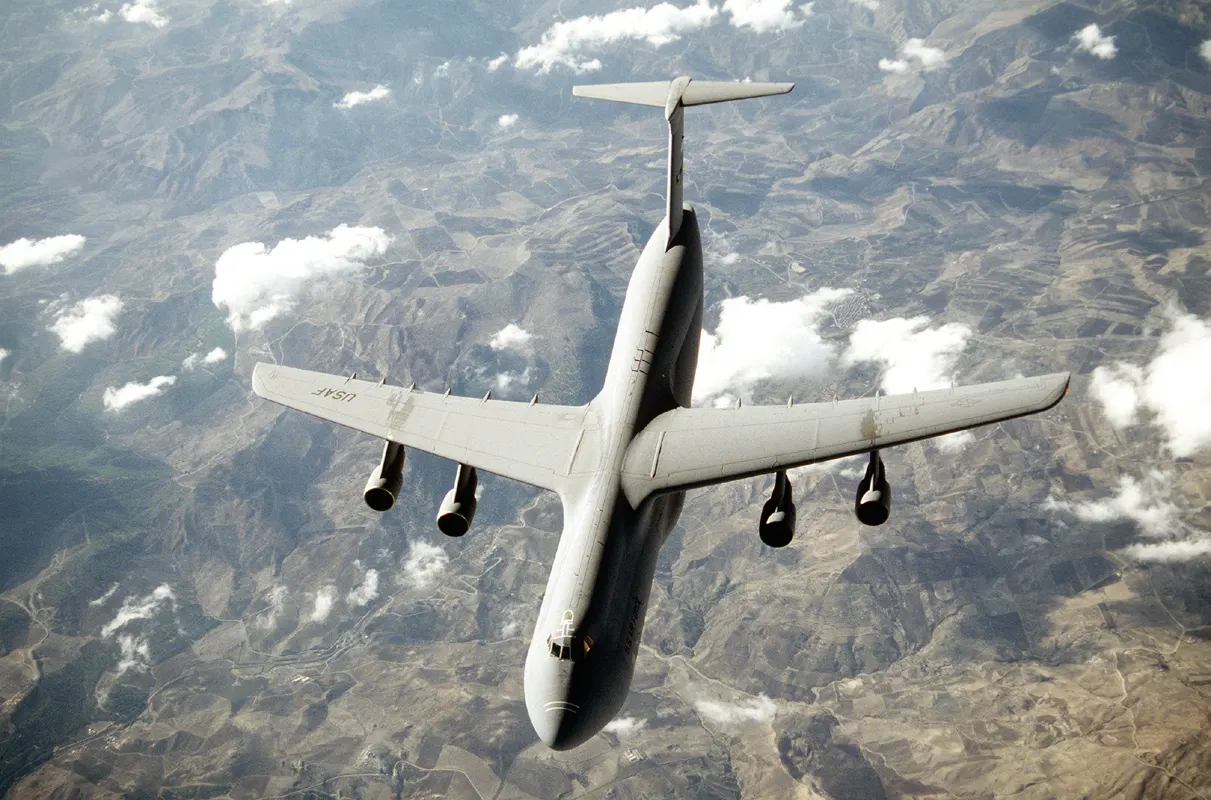

The Lockheed C-5 Galaxy is the largest aircraft ever operated by the United States Air Force, and by cargo volume it remains the biggest airlifter in the USAF inventory today. Built by Lockheed (now Lockheed Martin) at its Marietta, Georgia plant, the C-5 Galaxy was designed from the outset to move loads no other Western transport could carry in one piece, ICBM boosters, main battle tanks, helicopters, and entire mobile hospitals, loaded straight through the fuselage from either end. That drive-through capability, a nose that swings up like a visor and a separate rear ramp, is the aircraft's defining feature and the reason it is still flown today as the C-5M Super Galaxy more than five decades after its first flight in 1968.
- Largest cargo volume and drive-through loading of any USAF aircraft
- Can carry outsize cargo (ICBM canisters, Abrams tanks, helicopters) no other Western airlifter fits
- C-5M re-engining restored full payload and cut takeoff roll significantly
- Kneeling landing gear lets it load from truck-bed height without ground equipment
- Extremely high operating cost per flight hour compared to smaller airlifters
- Early C-5A wing fatigue cracking forced years of payload restrictions
- Needs long, paved runways, unlike more tactically flexible rivals
- Small remaining fleet (52 airframes) limits total lift capacity at any one time
Crews gave the aircraft an unofficial nickname almost from day one, FRED, reportedly short for Fantastic Ridiculous Economic Disaster, a jab at the cost overruns and early technical troubles that dogged the program.8 The name stuck even as the aircraft matured into one of the most capable heavy-lift transports in the world, central to the strategic airlifters mission that keeps a superpower's military supplied anywhere on the globe.
The C-5 Galaxy's rivals tell the story of the strategic airlift mission during and after the Cold War. The Soviet Union answered it with the Antonov An-124 Ruslan, and the USAF itself later fielded the smaller, more agile Boeing C-17 Globemaster III to share the load. Both comparisons matter because the Galaxy was never meant to work alone. It was built to move the cargo nothing else could touch, while other aircraft handled the rest.
The Nose Visor and Drive-Through Loading Design
What sets the Lockheed C-5 Galaxy apart from almost every other cargo aircraft is that it loads from both ends at once. The entire nose, including the flight deck, swings upward on a hinge like a visor, opening the full width and height of the cargo hold. A separate ramp and door at the tail does the same thing from the other direction.9 A truck, a tank, or a string of vehicles can be driven in the front and straight out the back without ever having to turn around inside the fuselage, and loadmasters can load and unload from both ends simultaneously to save time on the ground.10 The kneeling landing gear lowers the cargo floor by roughly three meters, from about three meters off the ground down to truck-bed height, which lets cargo transfer directly from flatbed trucks without cranes or built-up ramps.9 The cargo compartment itself runs roughly 36.9 meters (121 feet) long on the C-5M, tall and wide enough to swallow two M1 Abrams-sized vehicles side by side or a disassembled helicopter.
- İlk Uçuş1968
{{photo-req side=right q="C-5 Galaxy nose visor door open loading vehicle" caption="The C-5 Galaxy's nose visor swings open, exposing the full cross-section of the cargo hold for drive-through loading." alt="Lockheed C-5 Galaxy with its nose visor door raised during cargo loading"}}
- Motor TipiGeneral Electric F138-100
- Motor Sayısı4
The airframe's other unusual visual signature, a high T-tail mounted above the fuselage, traces directly back to the aircraft's origin as one of three competing designs for the U.S. Air Force's 1964 Heavy Logistics System (CX-HLS) requirement. Lockheed's engineers used the T-tail and an elevated cockpit profile to keep the tail surfaces clear of the wide bodies' turbulent wake and to leave the entire nose free for the visor door.5 The wing itself sits high on the fuselage (a shoulder-wing layout) to keep it clear of the cargo floor, and the aircraft's four engines hang from pylons well forward of the wing's leading edge, both features shared with most large cargo aircraft designed after it.
- Seyir Hızı833,328 km/sa
- Azami Hız855,55 km/sa
- Hizmet Tavanı12.496,8 m
General Electric Engines, From the TF39 to the F138
The original C-5A and C-5B were powered by four General Electric TF39 turbofans, the first high-bypass turbofan engine ever built for a production aircraft, developed specifically for the CX-HLS competition.1 That same core technology, refined into GE's commercial CF6 engine family, later powered airliners including the Boeing 747 and DC-10. The current C-5M Super Galaxy replaces the TF39 with four General Electric F138-GE-100 engines, the military designation of the commercial CF6-80C2 turbofan, each rated at roughly 50,000 pounds of thrust, about 22 percent more than the aircraft's original engines.4 The re-engining cuts takeoff roll by roughly 30 percent and improves climb rate to initial cruise altitude by about 38 percent, letting a fully loaded C-5M clear obstacles and reach cruising altitude far faster than the C-5A ever could.4
- Uzunluk75,286 m
- Kanat Açıklığı0,229 m
- Boş Ağırlık172.368 kg
Avionics Modernization and the C-5M Super Galaxy
Beginning in 1998, the Avionics Modernization Program (AMP) replaced the C-5's original analog flight instruments with a digital glass cockpit, new navigation systems, a modern autopilot, and updated communications equipment to keep the fleet compliant with civil and military airspace rules.4 AMP alone did not touch the engines. The follow-on Reliability Enhancement and Re-engining Program (RERP) added the new GE F138 engines, new pylons, an upgraded auxiliary power unit, and dozens of smaller reliability fixes, more than 70 changes in total, and the combined airframe became the C-5M Super Galaxy.4 Low-rate production modifications began in August 2009, full-rate production followed in 2011, and the U.S. Air Force received its last modernized C-5M on 1 August 2018, completing a program that touched 52 aircraft (49 former C-5Bs, two C-5Cs, and one C-5A) at a total program cost of roughly $13 billion.14
- Toplam Üretim131
{{photo-req side=left q="C-5M Super Galaxy glass cockpit flight deck" caption="The C-5M Super Galaxy's modernized glass cockpit, installed under the Avionics Modernization Program before the RERP re-engining." alt="Digital glass cockpit instrument panel of a C-5M Super Galaxy"}}
The wingspan of the Lockheed C-5 Galaxy is 67.88 meters (222 feet 9 inches) across every model from the C-5A to the C-5M, confirmed across USAF and manufacturer specification sheets.1
Winning the CX-HLS Competition Boeing Later Turned Into the 747
The U.S. Air Force issued its Heavy Logistics System requirement, CX-HLS, in April 1964, asking for an aircraft able to carry loads no existing airlifter could handle, including armored vehicles and ICBM stages, over intercontinental distances. Boeing, Douglas, and Lockheed each received a year-long study contract for competing airframes, while General Electric and Pratt & Whitney competed to build the engine.1 Boeing's design used a raised cockpit pod above the fuselage and a hinged nose door, technically the stronger proposal in the Air Force's own judgment, but Lockheed's bid came in at $1.9 billion against Boeing's $2.3 billion, and the lower bid won the contract in September 1965.2 General Electric's new TF39 high-bypass turbofan was selected the same year to power it.
Boeing did not walk away empty-handed. It folded the CX-HLS concepts it had already designed, the raised cockpit, the wide fuselage, the nose-loading door, into a civilian wide-body airliner project instead. That project became the Boeing 747, the aircraft that would go on to define the jumbo-jet age even though its military ancestor lost the actual competition.1
{{photo-req side=right q="Boeing 747 prototype rollout 1968" caption="Boeing's raised-cockpit CX-HLS design lost the C-5 competition to Lockheed, but its layout became the basis for the Boeing 747." alt="Boeing 747 prototype aircraft on the ground during its 1968 rollout"}}
The first C-5A flew on 30 June 1968, and the program was troubled from the start. In January 1968, a Lockheed cost analyst named A. Ernest Fitzgerald discovered that the C-5A's total program cost was running far ahead of its original estimate. His testimony to a Senate subcommittee in November 1968 put the overrun at roughly $2 billion against an original bid of $1.9 billion for the whole 115-aircraft buy, and the Air Force's later attempt to dismiss him from his job over the disclosure became a landmark whistleblower case that reached the Nixon White House and, eventually, the Supreme Court.15
Wing Cracks and the Re-Winging Program
Structural testing in the late 1960s found that the C-5A's wing could not meet its design requirement of surviving 150 percent of limit load. A July 1969 test failed at 128 percent, and even after design changes a second test in July 1970 still failed at only 125 percent.3 The fleet was restricted to 80 percent of its designed maximum loads as an interim fix, and by the mid-1970s cracks were showing up throughout the operational fleet, forcing a cargo limit as low as 22,680 kilograms (50,000 pounds) per aircraft, well under the type's intended payload.3
Lockheed and the Air Force responded with a wing redesign using an aluminum alloy that had not existed when the C-5A was first built. A $1.5 billion re-winging effort, informally called the H-Mod program, began fitting the strengthened wing starting in 1976, with the main production run of new wings installed across the C-5A fleet between 1981 and 1987.3 The new wing raised the type's structural service life to a minimum of 30,000 flight hours and lifted the payload restriction, allowing a re-winged C-5A to carry up to 86,000 kilograms (190,000 pounds) instead of the roughly 74,000 kilograms (164,000 pounds) it had been limited to.3 Lockheed incorporated the improved wing from the factory into the second production block, the C-5B, effectively the direct successor to the original C-5A Galaxy, when that line opened in the 1980s.
Operation Babylift and the Deadliest Loss in the Type's History
The C-5 Galaxy's worst day came during the final weeks of the Vietnam War. On 4 April 1975, a C-5A flying the first mission of Operation Babylift, the emergency evacuation of Vietnamese orphans ahead of the fall of Saigon, suffered an explosive decompression shortly after takeoff from Tan Son Nhut Air Base when improperly refitted rear door locks failed at altitude.6 The crew, led by Captains Dennis Traynor and Tilford Harp, fought the crippled aircraft back toward the airfield and crash-landed it in a rice paddy short of the runway. Both pilots were awarded the Air Force Cross for the landing, and flight nurse Regina Aune became the first woman to receive the Cheney Award for her actions helping the children aboard.7 The crash killed 138 of the 314 people on board, making it the deadliest single accident in the aircraft's history and one of the deadliest involving any U.S. military aircraft.6
{{photo-req side=left q="Operation Babylift orphans boarding aircraft 1975" caption="Vietnamese children are prepared for evacuation during Operation Babylift, the mission a C-5A Galaxy was flying when it crashed in April 1975." alt="Vietnamese orphan children being boarded onto a military transport aircraft during Operation Babylift"}}
{{photo-req side=right q="Tan Son Nhut Air Base Saigon map 1975" caption="Tan Son Nhut Air Base outside Saigon, where the Operation Babylift C-5A went down on approach after an in-flight decompression." alt="Map showing Tan Son Nhut Air Base near Saigon, South Vietnam"}}
Launching an ICBM From the Air and Carrying the Space Shuttle
The C-5 Galaxy's outsize cargo hold made it useful for tests no ordinary transport could support. On 24 October 1974, the Air Force's Space and Missile Systems Organization extracted an 86,000-pound (39,000-kilogram) LGM-30 Minuteman ICBM out of the rear ramp of a C-5A at 20,000 feet over the Pacific Ocean and parachute-launched it, proving that an intercontinental ballistic missile could in principle be air-launched from a large transport aircraft, a Cold War hedge against a first strike on fixed silo fields.1 NASA separately considered the C-5 for the Space Shuttle Carrier role in the early 1970s before settling on a modified Boeing 747, but the Air Force still modified two Galaxies, redesignating them C-5C, with a widened aft door and no troop compartment specifically to move Space Shuttle-related cargo containers too large for any other aircraft in the inventory.1
{{photo-req side=left q="C-5 Galaxy cargo hold interior oversize cargo" caption="The C-5C variant's widened aft cargo door was built specifically to move Space Shuttle program hardware too large for other USAF transports." alt="Interior of a C-5 Galaxy cargo hold showing its large open cross-section"}}
The C-5 Galaxy entered squadron service in 1970, in time to fly cargo and troop support missions into the Vietnam War, where it also flew the Operation Babylift evacuation described above. Its next major combat test came during the Gulf War, when C-5s formed the backbone of the strategic airlift into Saudi Arabia during Operation Desert Shield and Desert Storm, hauling M1 Abrams tanks, Bradley fighting vehicles, and helicopters that no other Western transport of the era could carry whole.11 The Gulf War buildup is frequently cited by USAF planners as the moment that validated the entire outsize-cargo concept behind the aircraft, since armored units that would otherwise have needed weeks of sealift arrived by air within days.
{{photo-req side=right q="C-5 Galaxy loading M1 Abrams tank cargo" caption="A C-5 Galaxy loads an M1 Abrams tank during the buildup to the Gulf War, the mission the aircraft's outsize cargo hold was designed for." alt="An M1 Abrams tank being loaded into a Lockheed C-5 Galaxy through its rear cargo ramp"}}
The type also supported both major post-9/11 campaigns, moving personnel, vehicles, and equipment into the war in Afghanistan and the Iraq War alongside the newer C-17, though by then the smaller, more austere-field-capable C-17 was absorbing an increasing share of the day-to-day tactical lift while the Galaxy concentrated on outsize and strategic-distance loads.13
The production run of 131 aircraft split into two main generations. The original C-5A Galaxy, 81 built between 1968 and 1973, was the version that suffered the wing-cracking problems described above and later received the H-Mod re-winging.3 The C-5B, 50 built from 1985 to 1989, incorporated the redesigned wing and numerous system improvements from the factory rather than as a retrofit. Two aircraft were converted to the C-5C configuration for Space Shuttle and outsize NASA cargo support, with a widened aft door and no troop compartment.1 Every surviving airframe still in USAF service today has since been brought up to C-5M Super Galaxy standard under the AMP and RERP programs described in Specs and Design.

The United States is the only operator the C-5 Galaxy has ever had. All 52 remaining C-5Ms fly with Air Mobility Command and its Reserve associate units, based primarily at Dover Air Force Base in Delaware, Travis Air Force Base in California, and Westover Air Reserve Base in Massachusetts.4 The aircraft has also flown presidential support missions for decades, moving the armored presidential limousine (nicknamed the Beast), Marine Corps helicopters, and Secret Service vehicles ahead of a president's arrival at a foreign or domestic stop, work it shares with the smaller C-17.16 No export sale or foreign operator has ever been recorded for the type, unlike several of its rivals.
The clearest way to place the Lockheed C-5 Galaxy against its Cold War Soviet counterpart, the Antonov An-124 Ruslan, is by cargo hold cross-section rather than headline payload. The An-124's hold is both wider (6.4 meters versus 5.8 meters) and taller (4.4 meters versus roughly 4.1 meters on the C-5M) than the Galaxy's, and it can lift a heavier maximum payload, commonly cited around 150 tonnes against the C-5's roughly 127 to 140 tonnes depending on the source and mission fuel load.11,12 The Galaxy answers back with a longer cargo deck, about 43.8 meters on the C-5M, which matters when the cargo is long rather than wide or heavy, multiple vehicles nose to tail, or oversized bridging and construction equipment. Both aircraft share the drive-through nose-and-tail loading layout, a design solution both nations converged on independently for the same problem, moving armor and awkward loads without turning them around inside the fuselage.
| Metric | Lockheed C-5 Galaxy (C-5M) | Antonov An-124 Ruslan |
|---|---|---|
| Cargo hold width | ~5.8 m | ~6.4 m12 |
| Cargo hold height | ~4.1 m | ~4.4 m12 |
| Cargo deck length | ~43.8 m | shorter, wider hold12 |
| Max payload (cited) | ~127–140 t | ~150 t11 |
Against the Boeing C-17 Globemaster III, the comparison is about mission role rather than raw size. The C-17 was procured specifically because the C-5 could not do everything the Air Force needed a heavy transport to do, it needs long paved runways and extensive ground support, while the C-17 can land on runways as short as roughly 3,500 feet (1,067 meters), including semi-prepared and unpaved strips, and deliver cargo directly to a forward airfield close to a conflict zone.13 The C-5 in turn carries substantially more, around 281,000 pounds against the C-17's roughly 170,900 pounds, and its combination of nose and tail loading handles items the C-17's single rear ramp cannot always accommodate in one piece.13 The two aircraft were never meant to replace each other. Air Mobility Command runs them as a matched pair, the C-5 covering intercontinental legs and true outsize cargo, the C-17 covering the tactical delivery leg into and out of forward locations the Galaxy cannot reach.

How much cargo can the Lockheed C-5 Galaxy carry? A C-5M Super Galaxy can carry a maximum payload of roughly 127,460 kilograms (281,000 pounds), including outsize items such as M1 Abrams tanks, AH-64 Apache and UH-60 Black Hawk helicopters, and ICBM canisters loaded whole through the nose or tail.4
Is the C-5 Galaxy still in service? Yes. As of the mid-2020s the U.S. Air Force operates 52 C-5M Super Galaxies, all modernized under the Avionics Modernization Program and Reliability Enhancement and Re-engining Program, with a planned service life extending to 2040 or beyond.4
How does the C-5 Galaxy's loading system work? The C-5 Galaxy loads through both ends of the fuselage at once. A hinged nose visor swings up over the flight deck for front loading while a separate rear ramp and door handle loading from the tail, and kneeling landing gear lowers the cargo floor to truck-bed height for vehicles to drive straight through.9,10
What is the difference between the C-5 Galaxy and the C-17 Globemaster III? The C-5 Galaxy carries more cargo and can move genuinely outsize loads over intercontinental range, but it needs long paved runways. The C-17 Globemaster III carries less but can land on short, semi-prepared airstrips much closer to a conflict zone, so the U.S. Air Force runs both types side by side rather than choosing one over the other.13
How much does a C-5M Super Galaxy cost? The RERP modernization that converts an older C-5B into a C-5M Super Galaxy has been quoted at a fly-away unit cost of roughly $90 million in fiscal year 2009 dollars, with the full 52-aircraft modernization program totaling roughly $13 billion.14
Why is the C-5 Galaxy nicknamed FRED? Ground crews began calling the aircraft FRED, widely explained as short for Fantastic Ridiculous Economic Disaster, not long after it entered service, a reference to the type's early cost overruns and wing problems, and the nickname has persisted even as the aircraft's reliability improved.8
- "Lockheed C-5 Galaxy", Wikipedia — en.wikipedia.org ↩
- "C-5 History", GlobalSecurity.org — globalsecurity.org ↩
- "PLRD-82-38 C-5A Wing Modification", U.S. Government Accountability Office — gao.gov ↩
- "C-5M Super Galaxy Transport Aircraft, United States of America", Airforce Technology — airforce-technology.com ↩
- "Why Did Lockheed Martin Build The C-5 Galaxy With A T-Tail?", Simple Flying — simpleflying.com ↩
- "1975 Tan Son Nhut Lockheed C-5 crash", Wikipedia — en.wikipedia.org ↩
- "The tragic crash of C-5A Galaxy Number 68-0218 during Operation Babylift", The Aviation Geek Club — theaviationgeekclub.com ↩
- "The unofficial nickname of the US' largest cargo plane may surprise you", We Are The Mighty — wearethemighty.com ↩
- "C-5 Galaxy", GlobalSecurity.org (design page) — globalsecurity.org ↩
- "The C-5 Galaxy Carries Cargo So Large It Makes Other Military Transports Look Like Regional Jets", Simple Flying — simpleflying.com ↩
- "Is A Lockheed C-5 Galaxy Bigger Than An Antonov An-124?", Simple Flying — simpleflying.com ↩
- "A look at the biggest cargo aeroplanes: Antonov An-124 and Lockheed C-5 Galaxy", Evergreen Aviation — evergreenaviation.com ↩
- "C-5 Galaxy vs C-17 Globemaster III: What's the Difference Between These Cargo Aircraft?", War History Online — warhistoryonline.com ↩
- "Saving the Galaxy: The C-5 AMP/RERP Program", Defense Industry Daily — defenseindustrydaily.com ↩
- "A. Ernest Fitzgerald", Wikipedia — en.wikipedia.org ↩
- "How Is The Presidential Limo Transported? (And No, Air Force One Doesn't Carry It)", SlashGear — slashgear.com ↩