

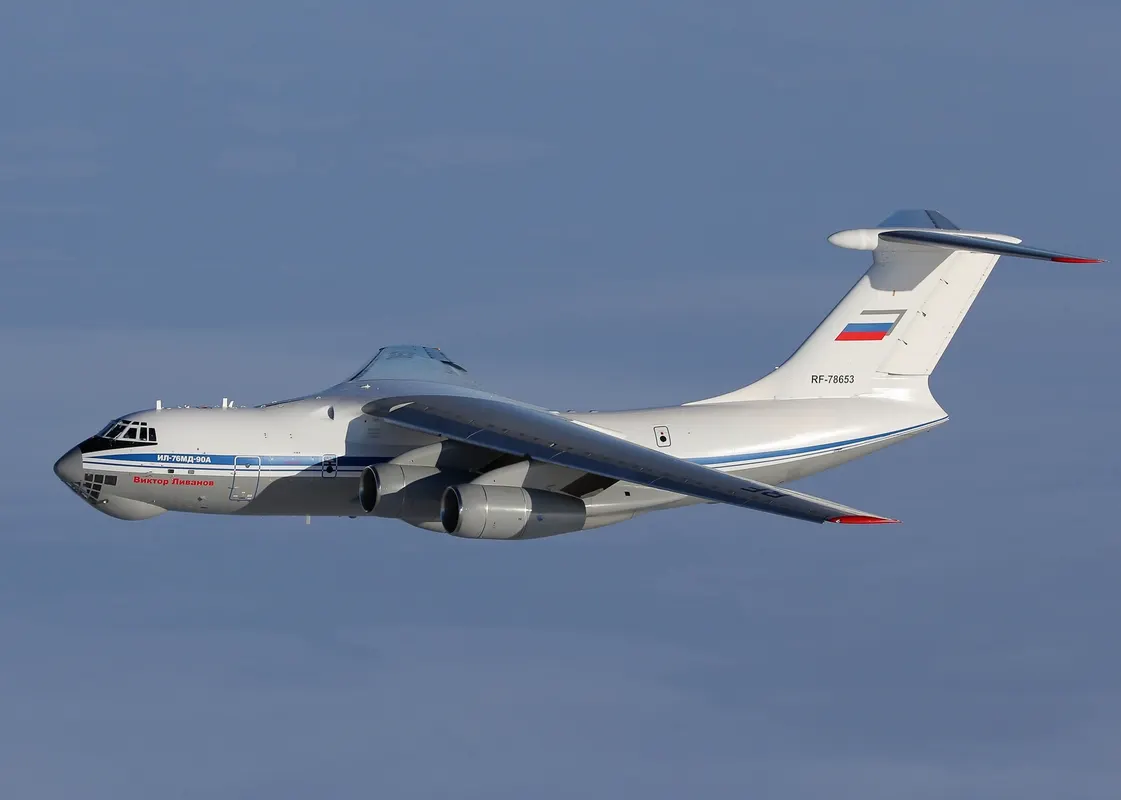

The Ilyushin Il-76 is a four-engine, Soviet-designed heavy transport aircraft that has become the single most widely operated strategic airlifter in the world, flying today with at least 43 air forces and cargo operators across every inhabited continent.1 NATO assigned it the reporting name Candid. The Ilyushin design bureau built it to a 1967 Soviet Air Force requirement for a freighter able to carry 40 tonnes over 5,000 kilometers in under six hours while still operating from short, unprepared airstrips across Siberia and the Soviet Arctic, conditions the existing Antonov An-12 could not meet at the payload and range the military wanted.2,3 The prototype first flew on 25 March 1971, and the type entered Soviet Air Force service in June 1974.2
- Short, unpaved-runway takeoff and landing capability
- Rugged, many-wheeled landing gear for rough fields
- Huge worldwide supply of cheap spare parts and used airframes
- Rear-loading ramp handles vehicles, pallets, and paratroopers alike
- Five-person flight crew, costlier to run than modern twin-pilot jets
- Basic airframe design dates to the early 1970s
- Long history tied to illicit and gray-market cargo flights
- Payload trails the much larger Antonov An-124 Ruslan
That unpaved-runway requirement shaped almost every visible feature of the airframe, from its high-mounted wing and four Aviadvigatel turbofans to a rugged, many-wheeled undercarriage built to spread the aircraft's weight across soft or damaged ground.3 More than 981 airframes have been built across dozens of official variants since production began, and a modernized version, the Il-76MD-90A, remains in low-rate production at Aviastar-SP in Ulyanovsk, Russia, more than half a century after the original design study.4
Cheap availability drives much of that operator spread. Thousands of Soviet-trained aircrew and a huge stock of ex-Soviet airframes entered the commercial market after 1991, and an Il-76 can still be chartered or bought for a fraction of what a Western-built heavy freighter with similar capacity would cost.5 The result is a fleet split unevenly between two worlds, dedicated military transport squadrons in Russia, India, China, and elsewhere, and a sprawling civilian charter industry built around operators such as Volga-Dnepr Airlines and Silk Way Airlines that hauls everything from oil-field equipment to, at times, undeclared arms shipments.5
{{photo-req side=right q="Ilyushin Il-76 landing unpaved airstrip Russia" caption="An Ilyushin Il-76 on an unprepared airstrip, the rough-field capability that shaped its landing-gear and wing design." alt="Ilyushin Il-76 transport aircraft on an unpaved runway"}}
The type's military role extends well past hauling cargo. Ilyushin and the Beriev bureau adapted the same airframe into the Il-78 aerial-refueling tanker and the Beriev A-50 airborne early-warning aircraft, both still in frontline service, and a firefighting conversion able to drop 49,000 liters of water in a single pass has fought wildfires as far apart as Siberia, Greece, and Chile.6,28,29 Combat use runs from the Soviet-Afghan War of the 1980s through the ongoing Russo-Ukrainian War, and Il-76s have also turned up, sometimes through legitimate contracts and sometimes through the murkier world of Cold-War-surplus arms brokering, in African civil wars from Angola to Sierra Leone.8,9
Whether the Ilyushin Il-76 counts as a genuinely modern aircraft or a Cold War holdover kept flying on cheap parts depends heavily on which operator gets asked. Russia's own air force still flies well over a hundred of them alongside a small, newer batch of Il-76MD-90A aircraft rolling off the Aviastar-SP line, while several African and Central Asian operators keep older Soviet-built airframes flying largely on the strength of cheap maintenance and a deep spare-parts pool rather than any planned modernization.
The Ilyushin Il-76, a Cold War-era heavy transport aircraft, carries a crew of five on the flight deck, two pilots, a navigator, a flight engineer, and a radio operator, arranged around a stepped cockpit with a glazed nose position for the navigator that gives the aircraft its distinctive profile.2 That crew size, standard for large Soviet military aircraft of its generation, is a point where the Il-76 has aged less gracefully than its rivals. Both the Boeing C-17 Globemaster III and China's newer Xian Y-20 fly with two or three flight-deck crew rather than five.10,31
- Mürettebat5
The Aviadvigatel D-30KP and the Newer PS-90A-76
Most Il-76s built since the 1970s fly on four Soloviev, later Aviadvigatel-branded, D-30KP turbofans, each rated at roughly 117.7 kN of thrust, an engine chosen for its tolerance of dust and debris ingestion on unpaved strips rather than for fuel efficiency.11 The modernized Il-76MD-90A, the version still in production at Aviastar-SP, instead uses the newer, quieter Aviadvigatel PS-90A-76 turbofan, which meets noise and emissions rules that grounded older D-30KP-powered Il-76s from much of Western European airspace.2 Only a minority of the worldwide Il-76 fleet has actually been re-engined this way, most of the type's 43 operators still fly D-30KP-powered aircraft built decades ago.
- Motor TipiAviadvigatel PS-90A-76
- Motor Sayısı4
{{photo-req side=right q="Ilyushin Il-76 landing gear multiple wheels bogie" caption="The Il-76's four main landing-gear legs, each carrying four wheels, spread the aircraft's weight across soft or damaged runway surfaces." alt="Ilyushin Il-76 multi-wheel landing gear close-up"}}
- Hizmet Tavanı12.200 m
Landing Gear Built for Siberian Dirt Strips and Unpaved Runways
The undercarriage is the clearest physical expression of the Il-76's original requirement. Four main landing-gear legs, each fitted with four low-pressure tires, distribute the aircraft's weight so it can operate from packed dirt, gravel, or snow-covered strips that would collapse under a conventional airliner's gear.3 Ground clearance under a loaded Il-76 exceeds five meters, and the reinforced belly and wing structure tolerate the gravel and debris a rough airstrip throws up during takeoff and landing runs.3 That rough-field capability is also why the Il-76 rates well above most Western heavy transports of comparable size for operating off damaged or unpaved runways, even though its raw payload trails the much larger Antonov An-124 Ruslan by a wide margin.
- Uzunluk46,6 m
- Boş Ağırlık92.500 kg
- Maks Kalkış Ağırlığı210.000 kg
Cargo capacity centers on a hold roughly 20 meters long, 3.4 meters wide, and 3.4 meters tall, reached through a rear ramp and clamshell doors that let vehicles drive straight in rather than being winched aboard piece by piece.12 Standard Il-76 variants carry a maximum payload of around 48,000 kilograms, rising to roughly 52,000 kilograms on the stretched Il-76MF freighter version, figures that place the type well below the Antonov An-124 Ruslan's payload but comfortably ahead of most Western tactical airlifters with a similar engine count.12,13 Maximum takeoff weight on the current Il-76MD-90A production standard reaches 210,000 kilograms, cruise speed sits in the region of 750 to 800 km/h, and service ceiling on late-production aircraft reaches roughly 12,200 meters.13
- Varyantlar78
Soviet planners issued the requirement that became the Ilyushin Il-76 in 1967, calling for a freighter able to lift 40 tonnes over 5,000 kilometers in under six hours while operating from short, unprepared strips across Siberia and the Arctic, twice the payload and range of the existing Antonov An-12 without any loss of rough-field performance.2,3 Genrikh Novozhilov, who succeeded the aging Sergei Ilyushin as general designer of the Ilyushin bureau in 1970, led the project through its testing phase, and the prototype made its first flight on 25 March 1971 at Moscow's Khodynka Aerodrome.14
{{photo-req side=right q="Genrikh Novozhilov Soviet aircraft designer portrait" caption="Genrikh Novozhilov, general designer of the Ilyushin bureau from 1970, led the Il-76 program through its testing and into series production." alt="Portrait of Soviet aircraft designer Genrikh Novozhilov"}}
From Tashkent to Aviastar-SP, a Production Line Split by Politics
Series production began at the Tashkent Aviation Production Association, now the Tashkent Mechanical Plant, which assembled roughly 90 percent of all Soviet-era Il-76 airframes.2 That single-site arrangement became a serious problem once the Soviet Union collapsed. Tashkent ended up inside newly independent Uzbekistan, cutting Russia's own defense industry off from its main Il-76 production line just as replacement aircraft were needed. Russia eventually shifted new-build production to Aviastar-SP in Ulyanovsk, where the modernized Il-76MD-90A first rolled out in 2014 and entered serial delivery to the Russian military in 2019.15
Exports began within a few years of Soviet service entry, and by the 1980s the type counted Iraq, India, and Libya among its foreign operators, alongside the Warsaw Pact air forces that received it first.1 China took delivery of its first Il-76s in the early 1990s, then placed a much larger order for roughly 38 additional Il-76 and Il-78 aircraft in 2005, a deal that dragged on for years over price disputes between Moscow and Beijing before most of the order was finally delivered.16 That contract dispute, unusual for two governments normally aligned on defense trade, shows how thin Russia's actual production capacity for new-build Il-76s had become once the Tashkent line was out of reach.
Total production reached 981 airframes across a wide family of transport, tanker, airborne early-warning, and test-bed variants, though the pace of new construction slowed to a handful of aircraft a year once Aviastar-SP became the sole assembly line.4 Russia has stated plans to raise Il-76MD-90A output in the years ahead, though annual deliveries have consistently lagged those targets.15
The Soviet-Afghan War and a Remarkably Low Attrition Rate
No conflict tested the Ilyushin Il-76 more thoroughly than the Soviet-Afghan War. Between 1979 and 1991, Soviet Il-76s flew roughly 14,700 sorties into Afghanistan, carrying an estimated 786,200 servicemen and 315,800 tonnes of freight, figures that account for around 89 percent of all Soviet troops and 74 percent of all cargo airlifted into the country during the war.8 Afghan insurgents rarely managed to bring an Il-76 down at cruising altitude, so fighters concentrated shoulder-fired missiles and heavy machine-gun fire on the vulnerable takeoff and landing phases at airfields like Kabul and Bagram instead.8
{{photo-req side=right q="Soviet Il-76 transport aircraft Afghanistan Kabul airfield" caption="Soviet Il-76 transports carried the large majority of troops and cargo moved into Afghanistan during the Soviet-Afghan War." alt="Soviet Ilyushin Il-76 at an Afghan airfield"}}
The airframe's rugged construction meant it often absorbed serious damage and still landed safely. Only two Il-76 combat losses are documented across the entire war, one on 25 December 1979 near Kabul and a second, shot down on final approach, on 27 October 1984.8
{{photo-req side=right q="map Kabul Bagram Afghanistan airfields" caption="Kabul and Bagram, the principal airfields Soviet Il-76 transports flew into throughout the Soviet-Afghan War." alt="Map of Afghanistan showing Kabul and Bagram"}}
The 1995 Kandahar Hijacking of an Il-76 Charter Flight
A stranger episode of the same broader conflict came a few years after the Soviet withdrawal. On 3 August 1995, Taliban fighters forced a civilian Il-76TD, flying a private charter under the callsign Airstan and carrying roughly 30 tonnes of ammunition for the internationally recognized Afghan government, to land at Kandahar.18 The seven-man crew, commanded by Vladimir Sharpatov, spent 378 days in captivity before overpowering their guards and flying the aircraft out of Taliban-held territory to Sharjah on 16 August 1996, one of the more unusual aircrew escapes documented from that period of the war.18,19,20
Firefighting, Arms Trafficking, and the Iraqi Aircraft Exodus to Iran
Away from combat, an Il-76 conversion has fought a different kind of emergency. The Il-76TD waterbomber variant carries up to 49,000 liters of water or fire retardant and can lay down a spray roughly 1.2 kilometers long in under 15 seconds, a capacity Russia's Emergencies Ministry (EMERCOM) has used against wildfires well outside Russia, including a 39-day firefighting deployment to Chile in 2017 and repeated missions into Turkey and Greece.6,27 That role carries its own accident record. An EMERCOM Il-76TD crashed into a hillside while fighting wildfires near Irkutsk on 1 July 2016, killing all ten aboard.7
{{photo-req side=right q="Il-76 firefighting water drop wildfire" caption="An Il-76TD waterbomber drops its load during a wildfire suppression mission, a role that has taken the type to Chile, Turkey, and Greece." alt="Ilyushin Il-76 dropping water on a wildfire"}}
The Il-76 has drifted into conflicts through channels far less official than a state air force, too. Arms broker Viktor Bout built much of his fleet around surplus Soviet Ilyushin and Antonov freighters after the Cold War and used them to move weapons into African wars, including both sides of the Angolan Civil War and, through supplies to former Liberian president Charles Taylor, the Sierra Leone Civil War.9,21 Angola and Sierra Leone both still list the Il-76 among their military aircraft today, some of that surplus stock was absorbed directly into national service once the fighting that brought it there had ended.9
Iraqi Il-76s ended up in Iranian hands through a very different route. During the 1991 Gulf War, at least 15 Il-76 transports of the Iraqi Air Force were among more than 115 Iraqi military and civilian aircraft flown across the border into Iran to escape the American-led air campaign.22 Iran, citing unresolved reparations claims from the earlier Iran-Iraq War, refused to return the aircraft once the fighting stopped and simply folded them into its own air force, where several remained in service for decades afterward.22 Iran's Il-76 fleet, built partly on those impounded airframes, later suffered the type's single deadliest accident anywhere, a crash near Kerman on 19 February 2003 that killed 275 Islamic Revolutionary Guard Corps personnel.33
The Il-76 in the Russo-Ukrainian War and the Second Nagorno-Karabakh War
More recent conflicts have kept the type in the headlines. During the opening days of Russia's 2022 invasion of Ukraine, part of the wider Russo-Ukrainian War, roughly 18 Il-76s carrying reinforcements and equipment for the 76th Guards Air Assault Division were reportedly staged to fly into Hostomel's Antonov Airport once Russian airborne troops secured it, a follow-on airlift that never actually landed once Ukrainian forces recaptured the airfield, and Ukrainian air defenses were separately reported to have shot down at least one troop-carrying Il-76 near Vasylkiv in the days that followed.23,24
{{photo-req side=right q="Hostomel Antonov Airport aftermath 2022" caption="Hostomel's Antonov Airport, the objective of a Russian airborne assault the Il-76 follow-on airlift never reached." alt="Damaged buildings and aircraft wreckage at Hostomel Antonov Airport"}}
Russia continued to rely on the type for logistics and, controversially, prisoner transport well into the war's third year. A Russian Il-76 crashed in Belgorod Oblast on 24 January 2024 while reportedly carrying 65 Ukrainian prisoners of war toward a scheduled exchange, killing everyone aboard, though responsibility for the crash remains disputed between Moscow and Kyiv.25,34
The Second Nagorno-Karabakh War of 2020 brought the Il-76 into a smaller, more localized conflict. Armenia reportedly used one of its own Il-76 transports, nominally flying civil cargo routes, to move fighters and Kornet anti-tank missiles from Russia into Armenian territory during the fighting, while Azerbaijan relied on Silk Way Airlines Il-76 flights to move ammunition and additional personnel closer to the front.26
The Ilyushin Il-76 family split early into military and civilian branches. The baseline Il-76M and its improved Il-76MD version, fitted with strengthened wings and extra fuel capacity, equipped Soviet and later Russian military transport regiments, while the Il-76T and Il-76TD stripped out defensive equipment for Aeroflot and export civilian cargo work.2 The stretched Il-76MF, lengthened by roughly 6.6 meters and re-engined with early Aviadvigatel PS-90A turbofans, first flew in 1995, but only two were built before the program stalled, and its lessons fed directly into the later, more successful Il-76MD-90A modernization.2
{{photo-req side=right q="Beriev A-50 Mainstay AWACS rotodome" caption="The Beriev A-50, built on the Il-76 airframe, carries a rotating radar dome above the fuselage and serves as Russia's principal airborne early-warning aircraft." alt="Beriev A-50 airborne early warning aircraft"}}
Two derivatives turned the Il-76 into something other than a transport altogether. The Il-78 and its improved Il-78M version convert the cargo hold into fuel tankage and fit hose-and-drogue refueling pods, giving the Russian Aerospace Forces, and in the customized Il-78MKI version the Indian Air Force, an aerial-refueling capability built entirely on Il-76 airframes and spare parts.28 The Beriev A-50, meanwhile, replaces the cargo hold with mission electronics and mounts a rotating radar dome above the fuselage, giving Russia, and through the related KJ-2000 also China, an airborne early-warning and control aircraft built on the same rugged transport base.29
A handful of far more specialized conversions never reached large production runs but remain operationally significant. The Il-76PP carries electronic-jamming equipment in place of cargo, the A-60 mounts an experimental airborne laser in a modified nose and dorsal fairing for anti-satellite and missile-defense research, and the Il-82 serves as an airborne command post for Russia's strategic forces.2 A dedicated Il-76 MDK conversion flies steep parabolic arcs to give cosmonauts and researchers repeated bursts of weightlessness, a role once filled by an older Tupolev Tu-104 and still used today to train crews bound for orbit.2
 Amerika Birleşik DevletleriAKTİF
 AngolaAKTİF
 AvustralyaAKTİF
 AzerbaycanAKTİF
 BahreynAKTİF
 BelarusAKTİF
 Birleşik Arap EmirlikleriAKTİF
 Birleşik KrallıkAKTİF
 Burkina FasoAKTİF
 CezayirAKTİF
 Çin Halk CumhuriyetiAKTİF
 Ekvator GinesiAKTİF
 EndonezyaAKTİF
 ErmenistanAKTİF
 GürcistanAKTİF
 HindistanAKTİF
 IrakAKTİF
 İranAKTİF
 İsrailAKTİF
 KazakistanAKTİF
 KırgızistanAKTİF
 Kongo Demokratik CumhuriyetiAKTİF
 KübaAKTİF
 Kuzey KoreAKTİF
 LaosAKTİF
 LibyaAKTİF
 MacaristanAKTİF
 MaliAKTİF
 MısırAKTİF
 MoldovaAKTİF
 ÖzbekistanAKTİF
 PakistanAKTİF
 PolonyaAKTİF
 RusyaAKTİF
 Sierra LeoneAKTİF
 SırbistanAKTİF
 SudanAKTİF
 SuriyeAKTİF
 TürkmenistanAKTİF
 UkraynaAKTİF
 ÜrdünAKTİF
 YemenAKTİF
 ZimbabveAKTİF
The Ilyushin Il-76's operator list is the widest of any strategic-class airlifter flying anywhere, spanning at least 43 countries from major powers like Russia, China, and India down to small air arms in Armenia, Bahrain, and Equatorial Guinea, alongside a long tail of civilian cargo carriers that fly the type commercially rather than under military colors.1 Three forces stand well above the rest in fleet size. Russia's own air force still operates well over a hundred Il-76s of various sub-types, China's People's Liberation Army Air Force flies roughly 26 Il-76MD/TD transports alongside a smaller Il-78M tanker fleet, and the Indian Air Force, which nicknamed its fleet Gajraj (elephant king), operates around 17 Il-76s alongside dedicated Il-78MKI tankers and A-50EI early-warning aircraft built to its own specified radar fit.1
{{photo-req side=right q="Indian Air Force Il-76 Gajraj transport" caption="An Indian Air Force Il-76, part of a fleet the service nicknamed Gajraj, elephant king, for its heavy-lift role." alt="Indian Air Force Ilyushin Il-76 transport aircraft"}}
That spread is not simply Cold War politics lingering decades later, it reflects a genuinely different export model than the one Western manufacturers used. Soviet and later Russian Il-76s reached export customers with far fewer end-use restrictions than comparable American aircraft, and after 1991 a wave of cheap, low-hour ex-military airframes and idle Soviet-trained aircrew flooded a commercial charter market with no real Western equivalent.5 Several African operators on the list, including Algeria, Angola, and Sudan, first acquired their aircraft through exactly that route, buying or inheriting Cold War-surplus airframes rather than negotiating new-build contracts.9
Civilian operators make up a large, often overlooked share of the worldwide Il-76 fleet. Volga-Dnepr Airlines, TransAVIAexport Airlines, and Silk Way Airlines between them operate dozens of Il-76s on scheduled and charter cargo routes, competing directly with the Antonov An-124 Ruslan for oversize freight jobs that neither a Boeing 747 freighter nor a Lockheed C-141 Starlifter, itself long retired from commercial service, could realistically handle.5
Scale, not raw sophistication, is what actually separates the Ilyushin Il-76 from the Antonov An-124 Ruslan, the aircraft it gets compared against most often. Both trace to the same Soviet design tradition and the same insistence on unpaved-runway capability, but the An-124 was built a full step up in size. Its payload rating of up to 150,000 kilograms dwarfs the Il-76's roughly 48,000 to 52,000 kilograms, and its cargo hold can swallow loads, main battle tanks, space-launch hardware, entire other aircraft fuselages, that no Il-76 could carry at all.30 That extra capability came at a steep cost in numbers built. Only 57 An-124 airframes were ever produced against 981 Il-76s, and the An-124 remains a scarce, expensive charter asset flown by a handful of operators, while the Il-76 became cheap and common enough to equip air forces that could never have afforded a Ruslan.30 A buyer choosing between the two is really choosing between raw lift capacity and sheer availability, and for most of the world's smaller air forces, availability has always won.
| Metric | Ilyushin Il-76 | Antonov An-124 Ruslan |
|---|---|---|
| Max payload | approx. 48,000 to 52,000 kg | up to 150,000 kg |
| Airframes built | 981 | 57 |
| Flight crew | 5 | 6 |
| First flight | 1971 | 1982 |
China's Xian Y-20 tells a different comparison story, one about industrial independence rather than raw capability. Beijing operated the Il-76 for decades in numbers consistently described as too small to matter, before developing the Y-20 specifically so its strategic airlift fleet would no longer depend on Russian production lines, Russian spare parts, or Russian willingness to deliver on schedule, the very dependency that dragged China's 2005 Il-76 order through years of price disputes with Moscow.16,17 The Y-20 already outlifts the Il-76, carrying roughly 66,000 kilograms against the Il-76's 48,000 to 52,000, and needs only three flight-deck crew rather than five, yet China continues to fly both types side by side rather than retiring the Il-76 outright, a sign of how useful the older design's sheer numbers and rough-field reputation remain even after a more capable indigenous replacement enters service.10,17
Against Western rivals, the comparison shifts again. The Boeing C-17 Globemaster III matches or beats the Il-76 on payload and cargo-hold volume and flies with a similarly small crew, but the United States has sold it to barely a dozen close allies under tightly controlled Foreign Military Sales terms, nothing like the open, multi-continent spread of Il-76 operators.31 The Lockheed C-141 Starlifter, a genuine Cold War contemporary of the Il-76 first flown in 1963, was retired from American service in the early 2000s, while Il-76 production, in the form of the modernized Il-76MD-90A, continues in Russia today, giving the Soviet-era design a service life its American counterpart never matched.32


Is the Ilyushin Il-76 still in service? Yes. Russia, China, India, Ukraine, and dozens of other air forces and cargo airlines still fly it, and a modernized version, the Il-76MD-90A, remains in low-rate production at Aviastar-SP in Russia.4,15
How much does an Ilyushin Il-76 cost? Reported prices vary enormously by variant, era, and buyer. Export deals for older Il-76 airframes have gone for as little as $20 million to $22 million per aircraft, while Russia's own modernized Il-76MD-90A has been estimated at well over $100 million per airframe once development costs and low production volume are factored in.15,16
What replaced the Ilyushin Il-76? Nothing has fully replaced it. Russia continues building the modernized Il-76MD-90A rather than a clean-sheet successor, and China developed the Xian Y-20 as a complement rather than a full replacement, flying it alongside, not instead of, its existing Il-76 fleet.17
What is the Ilyushin Il-76 used for besides cargo transport? Beyond hauling freight and troops, Il-76 airframes have been converted into the Il-78 aerial-refueling tanker, the Beriev A-50 airborne early-warning aircraft, a firefighting waterbomber, an airborne command post, and a parabolic-flight trainer used to give cosmonauts brief periods of weightlessness.6,28,29
Why does the Ilyushin Il-76 have so many operators? A large stock of cheap, ex-Soviet airframes, comparatively loose Soviet and Russian export controls, and the type's genuine ability to operate from rough or unpaved airstrips combined to spread the Il-76 across at least 43 countries, more than any rival strategic-class airlifter.1,5
- "List of Ilyushin Il-76 operators", Wikipedia — en.wikipedia.org ↩
- "Ilyushin Il-76", Wikipedia — en.wikipedia.org ↩
- "Ilyushin Il 76, The versatile Soviet strategic transport aircraft", Avio Space — aviospace.org ↩
- "IL-76 - Production", GlobalSecurity.org — globalsecurity.org ↩
- "Cargo beast, all about the Ilyushin IL-76", Flightradar24 Blog — flightradar24.com ↩
- "Il-76P (TDP) Firefighting aircraft", Redstar.gr — redstar.gr ↩
- "Waterbomber", Wikipedia — en.wikipedia.org ↩
- "List of Soviet aircraft losses during the Soviet-Afghan War", Wikipedia — en.wikipedia.org ↩
- "Under the Radar, Airborne Arms Trafficking Operations in Africa", ResearchGate — researchgate.net ↩
- "Xian Y-20 (Kunpeng) Long-Range Strategic Airlifter Transport Aircraft", Military Factory — militaryfactory.com ↩
- "Iljuschin / Ilyushin Il-76, Specifications, Technical Data", Flugzeuginfo.net — flugzeuginfo.net ↩
- "Ilyushin IL-76T and IL-76TD", Air Charter Service — aircharterservice.com ↩
- "Ilyushin IL-76, History, Technical Data and Photos", AeroCorner — aerocorner.com ↩
- "Genrikh Novozhilov", Wikipedia — en.wikipedia.org ↩
- "How much does IL-76MD-90A cost Russia", TopWar.ru — en.topwar.ru ↩
- "China to Buy 38 IL-76 Heavy Transports, IL-78 Tankers", Defense Industry Daily — defenseindustrydaily.com ↩
- "Y-20 transport aircraft enters service, using Russian engines while load capacity 1.5 times that of Il-76", China-arms.com — china-arms.com ↩
- "1995 Airstan Ilyushin Il-76 hijacking", Wikipedia — en.wikipedia.org ↩
- "Vladimir Sharpatov", Wikipedia — en.wikipedia.org ↩
- "The story of the Russian Il-76 crew that was forced to land at Kandahar by Taliban MiGs", The Aviation Geek Club — theaviationgeekclub.com ↩
- "Arms trafficking", Wikipedia — en.wikipedia.org ↩
- "Iraqi Warplanes Flee to Iran", Aerospaceweb.org — aerospaceweb.org ↩
- "Russian Airborne Disaster at Hostomel Airport", Aberfoyle International Security — aberfoylesecurity.com ↩
- "The Battle for Hostomel Airport, 24th February 2022", Tank Encyclopedia — tanks-encyclopedia.com ↩
- "Russia says Ukraine shot down military plane carrying 65 Ukrainian prisoners of war", NBC News — nbcnews.com ↩
- "Nagorno-Karabakh and the military balance", CACI Analyst — cacianalyst.org ↩
- "Russian emergencies ministry's Il-76 arrives at Turkey's Antalya to extinguish wildfires", TASS — tass.com ↩
- "Ilyushin Il-78", Wikipedia — en.wikipedia.org ↩
- "Beriev A-50", Wikipedia — en.wikipedia.org ↩
- "Antonov An-124 Ruslan", Wikipedia — en.wikipedia.org ↩
- "Boeing C-17 Globemaster III", Wikipedia — en.wikipedia.org ↩
- "Lockheed C-141 Starlifter", Wikipedia — en.wikipedia.org ↩
- "2003 Iran Ilyushin Il-76 crash", Wikipedia — en.wikipedia.org ↩
- "2024 Korochansky Ilyushin Il-76 crash", Wikipedia — en.wikipedia.org ↩