
01 / Genel Bakış
Roketsan built the missile that ended Turkey's decades-long dependence on imported anti-ship weapons, the Atmaca, and it did so from a standing start as a Cold War Stinger-parts subcontractor. Roketsan (formally Roketsan Roket Sanayi ve Ticaret A.Ş.) is Turkey's state-owned missile, rocket, and precision-munitions manufacturer, headquartered in Ankara. It was incorporated on June 14, 1988 by decision of Turkey's Defense Industries Executive Committee, with an explicit mandate to design, develop, and manufacture rockets and missiles domestically.1 Roketsan's first contract was not glamorous. As a member of the European Common Production Program, it built propulsion sections for the FIM-92 Stinger man-portable air-defense missile under license, a subcontractor role that gave the young company its first exposure to solid-rocket motor manufacturing and quality standards it would later apply to entirely indigenous systems.2
Almost four decades later Roketsan is the backbone of Turkey's surface-to-air missile, short-range ballistic missile, anti-ship missile, and precision-guided munition programs, selling into roughly 50 export markets and posting $1.28 billion in 2024 revenue by one widely cited estimate, with Defense News' own Top 100 methodology crediting it with $1.55 billion in defense-specific revenue for the same year (the gap reflects total-company sales versus defense-only accounting, not a factual dispute).3,4 The company is wholly state-linked in ownership. The Turkish Armed Forces Foundation (TSKGV) holds roughly 55 percent, with ASELSAN and MKEK holding about 15 percent each and Vakıflar Bankası most of the remainder, so Roketsan has no free-floating public shares and no stock ticker despite its industrial scale.1
- Fully indigenous missile and rocket design chain, rare outside a handful of states
- Broad product breadth from man-portable munitions to strategic ballistic missiles
- Fast export growth (roughly 50 markets) at competitive pricing versus Western rivals
- Deep co-development ties with ASELSAN and TÜBİTAK SAGE spreading technical risk
- Some flagship systems (SOM, HISAR sensors) still depend on partner-supplied subsystems
- Export customers exposed to Turkey's own foreign-policy and sanctions volatility
- Newer strategic systems (Tayfun, Gezgin, Gökbora) still short combat-proven service records
- State ownership limits capital-raising options compared to listed Western primes
02 / Şirket Profili
Roketsan's corporate structure reflects Turkey's broader model of concentrating defense manufacturing inside state-affiliated holding companies rather than private industry. Ownership sits with the Turkish Armed Forces Foundation and three other state-linked firms, ASELSAN, MKEK, and Vakıflar Bankası, with a small remaining stake attributed to HAVELSAN.1 Roketsan has never listed shares on Borsa Istanbul, so is_publicly_traded correctly reads false for the company, and there is no ticker to report. Murat İkinci serves as General Manager (the Turkish title functionally equivalent to CEO) as of 2025 and 2026, presiding over a period of the fastest revenue growth in the company's history, with 2025 preliminary revenue reported above $2 billion and roughly $750 million of that from exports.6,7

Employee count has grown quickly alongside that revenue. Wikipedia's infobox, sourced to Roketsan's own reporting, put headcount at 5,000 for 2024, with 2,000 of those in research and development, a sharp rise from the low-thousands figures cited in older profiles and reflecting the company's ongoing hiring wave tied to new production lines.1 Roketsan's main production complex sits at Elmadağ outside Ankara, spanning roughly 88,000 square meters, alongside the newer Lalahan site (about 94,000 square meters) that hosts a Satellite Launch and Space Systems research center and an explosive raw-material production plant opened in 2020.8 In 2026 Roketsan inaugurated a Lalahan warhead-integration facility described as the largest warhead manufacturing installation in Europe, a declared $350 million investment spread across 26 production and integration buildings.1 A further expansion is underway at Kırıkkale, where construction began in December 2022, part of a combined $407 million investment across the Ankara and Kırıkkale sites announced for 2025 to keep pace with order backlogs.9
That growth has been visible in Roketsan's expanding footprint abroad as well as at home. Beyond the domestic plants, the company has publicly discussed manufacturing sites under development in Azerbaijan, with plants in Saudi Arabia and Indonesia reported to follow, extending Roketsan's production base into partner countries rather than exporting finished rounds alone.10 The company's history since 1988 has moved in roughly three phases, an early phase built on license production and small unguided rockets through the 1990s, a middle phase from the 2000s defined by the joint HISAR air-defense program with ASELSAN, and a current phase, roughly since 2015, defined by fully indigenous long-range strike systems such as the Bora and Tayfun ballistic missile families.
 Ankara, Türkiye
(15 ürün)
(13517 ürün)
03 / Ürün & Üretim · 24 platform
Roketsan's catalog spans short unguided artillery rockets through strategic ballistic missiles, organized loosely around a handful of program families rather than a single product line.
Its oldest continuously produced line is multiple rocket launcher ammunition, including the TR 107 107mm rocket and the longer-ranged TRG-300 Kasırga 300mm system (also sold abroad as Kaplan), both feeding Turkish and export MLRS launchers.11 A related but distinct rocket, the 122mm laser-guided TRLG-122, adds precision terminal guidance to that same rocket-artillery family and has no dedicated database entry yet despite being a real, fielded Roketsan product from roughly the mid-2010s.

Precision guided munitions form Roketsan's largest and most export-successful family. The Roketsan Cirit is a laser-guided 2.75 inch rocket originally built for helicopter gunships and now widely exported for its low unit cost relative to larger anti-armor missiles.12 The MAM-L Smart Micro Munition and its lighter sibling, the 6.5 kilogram MAM-C (missing from the database despite being a real, distinct, fielded product), turned Turkey's Bayraktar TB2 (built by Baykar) and Anka drones into precision strike platforms years before Western militaries fielded comparable small munitions, and both have seen extensive combat use since 2016.13 Roketsan's anti-tank missile family includes the helicopter-launched UMTAS (effective out to roughly 8 km) and its laser-guided L-UMTAS variant, plus the shorter, ground-platform-focused OMTAS (missing from the database, a genuinely separate medium-range system rather than a UMTAS variant, developed for tripod, vehicle, and remote turret mounts).14 A new long-range addition, the CİDA anti-tank missile unveiled at SAHA Expo 2026, extends engagement out to 35 km from ground platforms and 55 km when launched from ATAK helicopters, using a TV/infrared/laser hybrid seeker (also absent from the database as a brand-new 2026 unveiling).15
Roketsan's surface-to-air missile work is a joint program with ASELSAN under the HISAR name. Roketsan builds the HISAR airframes and propulsion while ASELSAN supplies radar, seekers, and command electronics, spanning the short-range Hisar-A and medium-range Hisar-O variants and a newer RF-seeker Hisar-O+ and naval Hisar-D RF.16 A 2025 contract package worth more than $1.5 billion, split between Roketsan, ASELSAN, and TÜBİTAK SAGE, covers mass production of HISAR alongside the longer-range Siper system for delivery between 2025 and 2029.16 Roketsan's own directed-energy program, ALKA, is a Roketsan-developed laser and electromagnetic counter-UAS weapon (ASELSAN contributes a supporting jammer subsystem) capable of downing small drones out to 4 km with jamming and destroying targets at shorter range with its laser, and it is already operational with the Turkish Armed Forces.17 Turkey's newest man-portable air-defense missile, SUNGUR, is a fifth-generation, imaging-infrared MANPADS developed solely by Roketsan and delivered to the Turkish Land Forces from 2022, but it has no database entry despite being the country's first indigenous MANPADS and its first-ever MANPADS export inquiry as of 2024.18
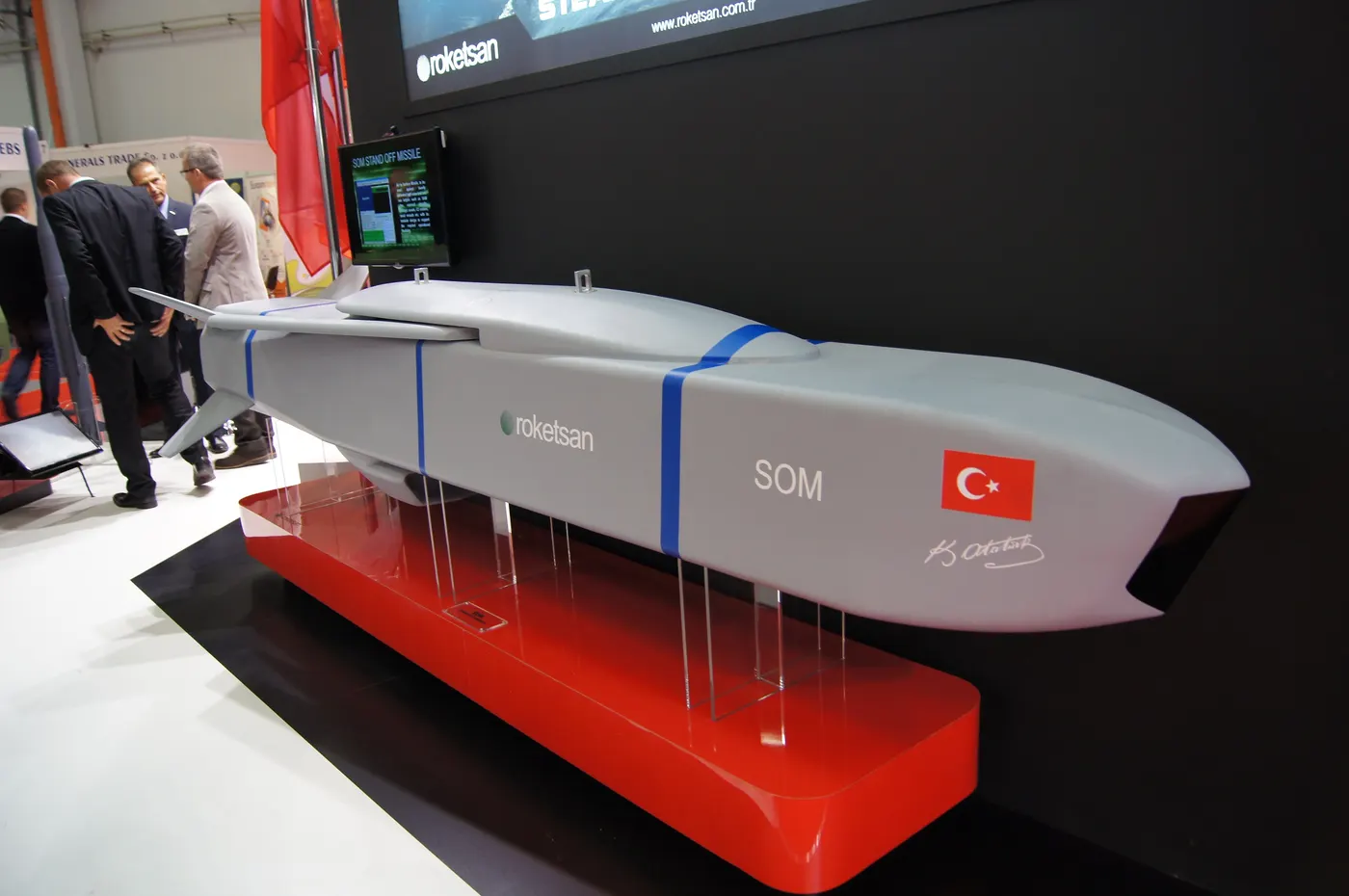
Cruise and ballistic missiles anchor Roketsan's strategic-strike portfolio. The SOM (missile) is a stealthy, terrain-following air-launched cruise missile with a range beyond 250 km, designed by TÜBİTAK SAGE, with Roketsan holding the manufacturing and export-marketing role, a common division of labor across several Turkish missile programs.19 The Atmaca is Roketsan's own indigenous anti-ship missile, Turkey's answer to decades of dependence on the American Harpoon, and Indonesia became its first export customer with a 45-missile order.20 The J-600T Yıldırım was Roketsan's first indigenous short-range ballistic missile, and its successor, the Bora, (exported under the name Khan, the same missile family under a separate export designation) has become the backbone of Turkey's ground-launched deep-strike force, with Indonesia again the lead export customer.21 The newest member of that family, Tayfun and its longer-ranged Tayfun Block-4 variant, pushes Turkish short-range ballistic missile range and payload well past Bora, and Roketsan's own CEO has said Tayfun Block-4 is nearing its next test phase.22
A wave of newer systems, unveiled between 2025 and 2026, has no database presence at all yet. Gökbora, a solid-fuel ramjet air-to-air missile exceeding 185 km (100 nautical miles) range for internal carriage on the Turkish KAAN fighter and Kızılelma unmanned combat aircraft, is Turkey's first indigenous long-range air-to-air missile of this class.23 Gezgin, first submarine-launch tested from Aksaz Naval Base in May 2025, is a long-range land-attack cruise missile developed by TÜBİTAK SAGE with Roketsan again in a manufacturing role, comparable in ambition to the American Tomahawk and reportedly exceeding the range of SOM and Atmaca.24 Akata, unveiled at IDEF 2025, is a new stealth submarine-launched cruise missile intended to give the Turkish Navy a land-attack option from its Type 214-class submarine boats.25 Roketsan has also disclosed work on a 300 ER air-launched ballistic missile with a reported 500 km supersonic strike range, though this sits outside every current database leaf category, none of the existing ballistic-missile leaves cover an air-launched variant, so it is reported here rather than forced into an ill-fitting one. One existing database weapon, the Roketsan Eren loitering munition, is already correctly attributed to Roketsan by name but was not yet linked in the company's own weapon list, a straightforward missed link rather than a research gap.
04 / Ticaret & Anlaşmalar · 1 anlaşma

Roketsan describes itself as exporting to roughly 50 countries, a scale that puts it among the fastest-growing arms exporters tracked by Defense News' annual rankings.3 Indonesia has emerged as Roketsan's single most important export relationship of the last decade, having ordered the Khan ballistic missile system, HISAR air-defense missiles, and 45 Atmaca anti-ship missiles in a series of separate contracts, making it the first export customer for both Khan and Atmaca.20 Bangladesh signed for the TRG-300 (marketed there as Kaplan) multiple rocket launcher system, with first deliveries completed by mid-2021.26 Turkey's parallel defense-cooperation agreements with Azerbaijan, Pakistan, Qatar, and the United Arab Emirates function as priority channels for further Roketsan sales, and the company has discussed locating manufacturing, not just delivering finished rounds, inside Azerbaijan, with Saudi Arabia and Indonesia flagged as likely next sites.10
On the supply side, Roketsan functions as the assembly and propulsion partner inside a small circle of Turkish state defense firms. ASELSAN supplies radar, seeker electronics, and jamming subsystems for HISAR and ALKA, while TÜBİTAK SAGE designs SOM and Gezgin and leans on Roketsan for manufacturing scale and export marketing.16,19 That triangular relationship, sometimes joined by a fourth partner for a specific program, is now formalized in joint contracts. The 2025 HISAR/Siper mass-production award was split between Roketsan, ASELSAN, and TÜBİTAK SAGE as three co-signatories.16
| Yıl | Alıcı | Ürün / Hizmet | Adet | Bedel | Tür | Durum | |
|---|---|---|---|---|---|---|---|
| 2016 |  Azerbaycan | Kasırga roket sistemi | 20 | — | new-build | Teslim |
05 / Küresel Erişim · 24 ülke · 5 çatışma
Roketsan-made systems now sit in the inventories of a geographically wide set of operators, from NATO's eastern flank through the Gulf to Southeast Asia, a spread that mirrors Turkey's own defense-export diplomacy as much as pure product competitiveness. The Indonesia relationship covers ballistic, air-defense, and anti-ship systems simultaneously, an unusually broad single-country footprint for one supplier and a marker of how far Turkish-Indonesian defense cooperation has moved since the mid-2010s.20

Bangladesh's TRG-300 order reflects a narrower rocket-artillery relationship, while the ALKA counter-drone system and the Cirit and MAM munition families have both seen genuine combat employment inside Turkey's own campaigns against Kurdish militant groups and in Turkish-backed operations in northern Syria, giving Roketsan products a live-fire record that few first-time export competitors can claim.12,13
The strategic missile lines (Bora, Tayfun, and the emerging Gezgin and Akata systems) remain overwhelmingly in Turkish service for now, positioned as sovereign deterrent and strike capability rather than export commodities, though Bora's Khan export variant shows that boundary is already shifting.


06 / Rekabet
Domestically, Roketsan's closest peer is ASELSAN, though the two firms are joint-venture partners on HISAR and ALKA as often as they are rivals, splitting Turkey's missile-electronics value chain rather than competing head-to-head for the same contracts. TÜBİTAK SAGE, a state research institute rather than a manufacturing company, plays a similar dual role, designing SOM and Gezgin while Roketsan builds and exports them. Internationally, Roketsan competes most directly against MBDA, Rafael Advanced Defense Systems, and Lockheed Martin's missile lines for export customers in the Gulf, South Asia, and Southeast Asia, typically underpricing all three while offering a narrower technology-transfer package than the Israeli or European incumbents.10 Further east, Chinese exporter Norinco and South Korean firms Hanwha Aerospace and LIG Nex1 compete for the same price-sensitive customer base, while Russia's Almaz-Antey and Tactical Missiles Corporation remain the default suppliers for legacy Soviet-standard air-defense and cruise-missile customers that Roketsan is now actively courting away with systems like HISAR and Atmaca. Roketsan's core competitive advantage is less raw technology than export flexibility, its status as a wholly state-owned Turkish company lets it offer government-to-government deals, financing terms, and local-production commitments that Western public companies bound by stricter export-control regimes often cannot match.
 Almaz-Antey
 Hanwha AerospaceLIG Nex1
 Lockheed Martin
 MBDA
 Norinco
 Rafael Advanced Defense SystemsTactical Missiles Corporation
Şirket web sitesi: https://www.roketsan.com.tr/en
- "Roketsan", Wikipedia — en.wikipedia.org ↩
- "Roketsan: Turkey's Missile & Munitions Defence Manufacturer", MissileStrikes — missilestrikes.com ↩
- "Roketsan expands global reach as Turkish defense industry sees record growth", Türkiye Today — turkiyetoday.com ↩
- "Defence top 100, ASELSAN, TUSAŞ and Roketsan on the List", TURDEF — turdef.com ↩
- "ROKETSAN | KÜRE Encyclopedia" — kureansiklopedi.com ↩
- "Roketsan aims for 50% growth in 2025 with expanding export portfolio", Türkiye Today — turkiyetoday.com ↩
- "Roketsan projects major acceleration in missile production capacity in 2026", Türkiye Today — turkiyetoday.com ↩
- "Roketsan Satellite Launch, Space Systems & Advanced Technologies Research Center and Explosive Raw Material Production Plant Launched to Service", Defence Turkey — defenceturkey.com ↩
- "Roketsan eyes production surge in 2026 on back of new investments", Anadolu Agency — aa.com.tr ↩
- "Turkiye's Roketsan eyes top 10 exporter rank amid Middle East conflict", Al Jazeera — aljazeera.com ↩
- "SUNGUR MANPADS Air Defence Missile System Delivered to Land Forces", TURDEF — turdef.com ↩
- "Roketsan Cirit", Wikipedia — en.wikipedia.org ↩
- "Roketsan's Smart Micro Munition Product Family Continues to Prove Itself in the Field", Defence Turkey — defenceturkey.com ↩
- "OMTAS", Wikipedia — en.wikipedia.org ↩
- "Roketsan's CİDA Missile Strengthens Türkiye's Role in NATO Long-Range Anti-Armor and Precision Strike Warfare", Army Recognition — armyrecognition.com ↩
- "Hisar (missile family)", Wikipedia — en.wikipedia.org) ↩
- "Roketsan's ALKA Laser Weapon System Tackles Growing Threat of Drone Swarm", Army Recognition — armyrecognition.com ↩
- "Roketsan's Sungur MANPADS Displayed at LandEURO 2025 Signals Türkiye's Entry into Global SHORAD Market", Army Recognition — armyrecognition.com ↩
- "SOM (missile)", Wikipedia — en.wikipedia.org) ↩
- "Indonesia Acquiring Roketsan Missiles", Asian Military Review — asianmilitaryreview.com ↩
- "Bora (missile)", Wikipedia — en.wikipedia.org) ↩
- "Tayfun Block-4 ballistic missile nears testing phase, Roketsan CEO", Türkiye Today — turkiyetoday.com ↩
- "IDEF 2025, Roketsan expands Türkiye's stealth fighter lethality with first ramjet air-to-air missile Gökbora", Army Recognition — armyrecognition.com ↩
- "Türkiye developing 'own Tomahawk' with GEZGIN cruise missile", Türkiye Today — turkiyetoday.com ↩
- "IDEF 2025, Turkish Navy gains stealth attack capability with new Roketsan Akata submarine-launched cruise missile", Army Recognition — armyrecognition.com ↩
- "Turkey's missiles manufacturer 'Roketsan' signs exports contract with Bangladesh", Defensehere — defensehere.com ↩