

01A Missile That Waits
A loitering munition occupies a narrow space between two older categories of weapon. Unlike a cruise missile or a guided bomb, it does not fly a fixed profile straight to a pre-planned target; it can circle over a search area for minutes or hours, waiting for a target to appear or be confirmed, before diving in to destroy itself against it. Unlike a reconnaissance drone, it never returns: the airframe itself is the payload delivery vehicle, and a strike ends its service life in a single flight. That combination, search-then-strike endurance paired with a one-way, expendable airframe, is what separates the loitering munition from everything that came before it, and it is why the category is also known by the more informal names "suicide drone" and "kamikaze drone."
The category's two founding branches solved different problems and only converged decades later. Israel built the first branch in the 1980s to hunt a single, specific target type — enemy air-defense radar — and spent the next thirty years extending that airframe toward general-purpose strike work. The United States built the second branch after 2010 to give infantry squads their own precision-strike capability at ranges beyond a rifle or a mortar, with no radar-hunting mission involved at all. Iran, Turkey, Russia, and Ukraine each entered the field later, and each did so for a reason specific to that country's own wars, discussed below. The 2020 Nagorno-Karabakh war and the full-scale Russian invasion of Ukraine in 2022 then did to loitering munitions what the Gulf Wars had done for precision-guided bombs a generation earlier: they moved the category from a specialized niche into a weapon every mid-sized military now fields or is racing to acquire.
01Israel's Head Start
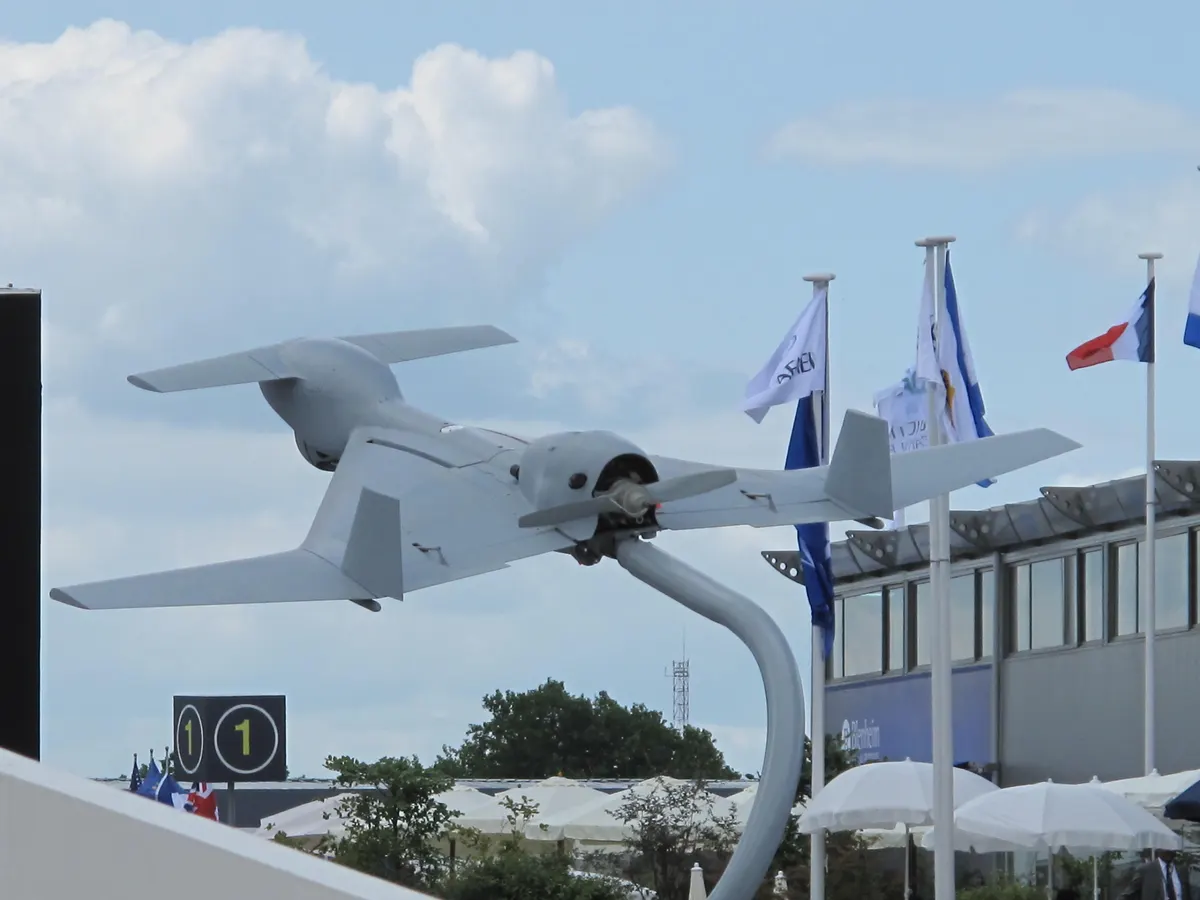
Israel Aerospace Industries built the category's founding airframe, the IAI Harpy, specifically to find and destroy enemy air-defense radar by homing on its own emissions, loitering over a suspected radar's operating area until the radar switched on and gave itself away. That single-purpose design, flying since the late 1980s, predates the term "loitering munition" itself. IAI's own follow-on design, the IAI Harop, added an electro-optical/infrared seeker on top of the original anti-radiation homing mode, letting an operator visually confirm and strike a much wider range of targets than radar alone, and it became the airframe most directly associated with the category's breakout combat use during the 2020 Nagorno-Karabakh war, where Azerbaijan used it against Armenian armor and air-defense systems.
IAI's broader loitering-munition line grew to cover weight classes the original Harpy never touched. The IAI Green Dragon scaled the concept down to a man-portable, tactical-level system, while Elbit Systems' SkyStriker built a rival mid-weight design for the same infantry- and brigade-level strike role, giving Israeli industry two competing products in the same segment rather than one. At the smallest end of the Israeli lineup, Rafael's Spike Firefly, a derivative of Rafael's long-running Spike anti-tank missile family, was purpose-built for close urban combat, small enough for a single soldier to carry and fly into a room or behind cover that a larger munition cannot reach. UVision, a newer Israeli entrant, built its own family from the smallest tactical size up to systems capable of vehicle-portable ranges; the UVision Hero-120 sits toward the top of that range and, unlike most of its Israeli siblings, found a large confirmed United States customer, with a US Army contract reported in the hundreds of millions of dollars.
01America's Man-Portable Answer
The United States built its own branch of the category for a distinct reason: giving a dismounted infantry squad, not a national air-defense-suppression campaign, a precision-strike option beyond the range of a rifle or a mortar. AeroVironment's Switchblade 300, fielded in Afghanistan from 2011, was the result — a tube-launched munition light enough for one soldier to carry and fire without any vehicle or launcher beyond the tube itself. AeroVironment's larger Switchblade 600 followed as a dedicated anti-armor answer, trading the 300's man-portable size for a warhead and range closer to a genuine anti-tank guided missile, and it became one of the more prominent American-supplied systems in Ukraine's arsenal after 2022.
When Russia's 2022 invasion created sudden, large-scale Ukrainian demand for loitering munitions faster than the existing US industrial base could supply at scale, the Pentagon turned to AEVEX Phoenix Ghost, a program built and delivered on an unusually compressed timeline specifically for Ukraine, with US officials describing it publicly as tailored to Ukraine's stated operational requirements rather than adapted from an existing shelf product. Cumulative deliveries were reported in the thousands of airframes within two years of the program's public unveiling, making it one of the fastest loitering-munition programs to reach that kind of volume anywhere in the category's history.
01Turkey's Twin-Track Program
Turkey's STM built its own loitering-munition family around two airframes that split the same design problem two different ways. The STM Kargu-2, a rotary-wing quadcopter, is built to hover and loiter over a target area before its terminal dive; the STM Alpagu, a fixed-wing, tube-launched design, trades hover capability for a faster single-pass strike, and the two are frequently marketed and delivered to customers as a bundled pair rather than as separate competing products. Kargu-2 carries the added distinction of being the system named in a March 2021 United Nations Panel of Experts report on the Libyan civil war, which described "lethal autonomous weapons systems" hunting retreating forces near Tripoli in 2020 — a passage that made Kargu-2, rightly or wrongly, one of the most internationally debated single weapons in the entire loitering-munition category, regardless of how one reads the underlying autonomy claims.
Turkish industry did not stop at the man-portable scale. Baykar, better known for the Bayraktar TB2 armed drone, built the Baykar Kemankes-1, an air-launched, jet-powered loitering munition designed to be released from an aircraft rather than fired from the ground, extending the same national industrial base that produces Turkey's larger combat drones into the loitering-munition category as well.
02Iran's Mass-Production Model, and Its Export Line to Russia
Iran took the category in a different direction from Israel, the United States, or Turkey: rather than build a small number of expensive, precision-guided systems, HESA's Shahed 136 was designed from the outset for cheap mass production and mass employment, trading individual-strike precision for the ability to saturate air defenses with sheer numbers of airframes at a unit cost far below any Western or Israeli rival. Iran built a family around the same basic concept at different scales, including the smaller Shahed 101 and Shahed 131 and the larger Shahed 236, giving its own forces and export customers a graduated range of options built on shared design lineage.

Iran's export of the Shahed-136 to Russia became the loitering-munition category's largest single wartime employment program to date. Russia's domestic production line, run by IEMZ Kupol, builds a licensed derivative under the name Geran-2, and Russian industry separately fields the Alabuga Gerbera, a related airframe used in both a decoy role, intended to exhaust Ukrainian air-defense interceptors against cheap, low-value targets, and in an armed strike role, depending on the specific round's fit-out. Russian mass strikes combining Shahed/Geran-family drones with cruise missiles against Ukrainian cities and energy infrastructure, running continuously since autumn 2022, are the most sustained large-scale use any loitering-munition design has yet seen in a real war.
01Russia's Precision Answer, and Ukraine's Domestic Response
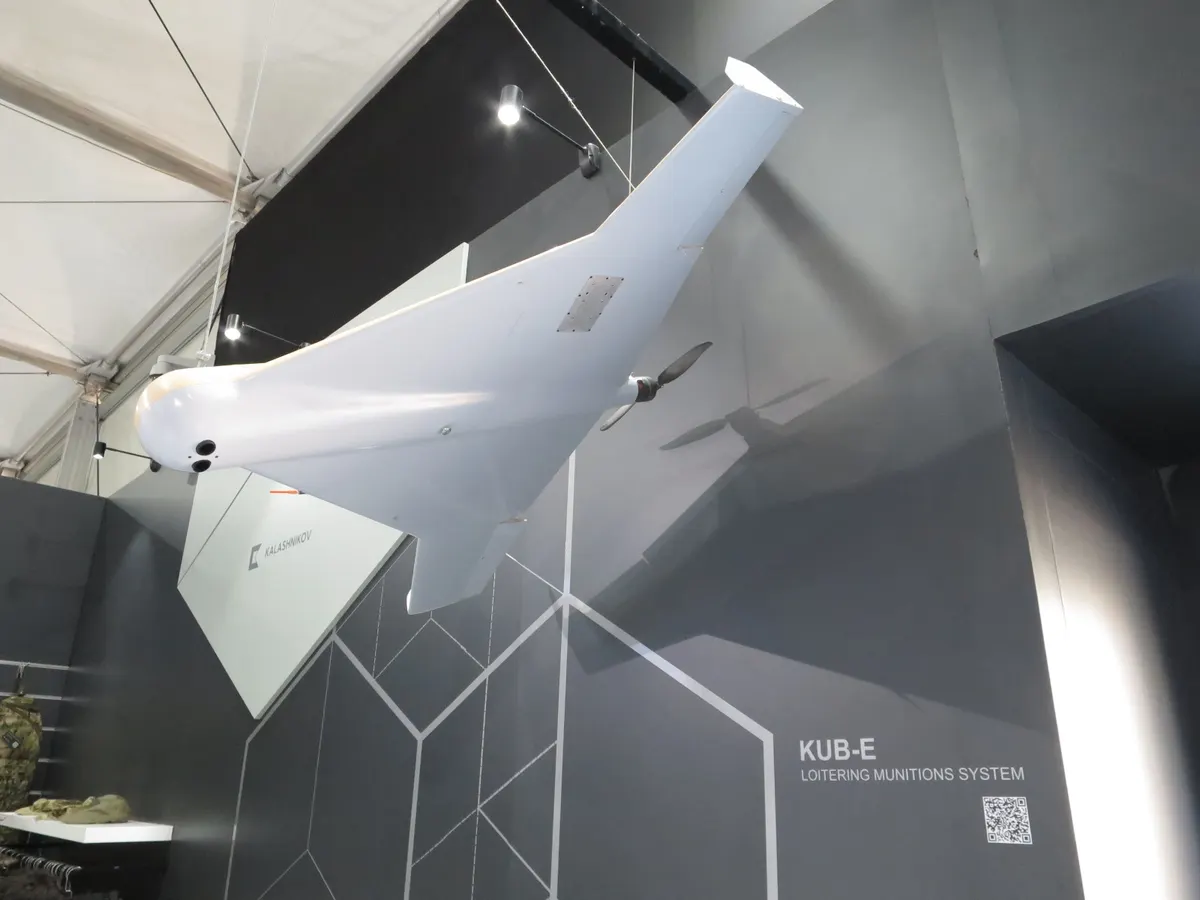
Where the Shahed/Geran family is built for saturation, Russia's other major loitering munition, ZALA Aero's Lancet, is built for precision strikes against individual armored vehicles, artillery pieces, and air-defense systems, and it became one of the most consequential single weapons of the Russia-Ukraine war's artillery and armor duel from 2023 onward. ZALA's earlier, smaller KUB-BLA predates Lancet and served as a technology precursor to it, seeing more limited combat use by comparison.

Ukraine built its own answering capability under intense wartime pressure rather than through a peacetime procurement program. Fire Point's FP-1 and Antonov's Liutyi AN-196 both emerged as long-range, one-way attack drones built to strike targets deep inside Russian territory, a mission closer to a low-cost cruise missile than to a battlefield-tactical loitering munition, illustrating how far the edges of the category have stretched once a country at war needs deep-strike reach and cannot wait for a purpose-built cruise-missile program to mature.
01Poland and India Build Their Own Entries
Outside the Israeli, American, Turkish, Iranian, and Russian-Ukrainian centers of gravity, other national industries built their own loitering munitions to reduce dependence on imports. Poland's WB Group fielded the WB Electronics Warmate, a tactical loitering munition marketed to NATO and partner air forces as a domestically produced alternative to Israeli and American systems. India's Defence Research and Development Organisation built the DRDO ULPGM, a UAV-launched precision-guided munition developed alongside Bharat Dynamics Limited as part of India's broader push to reduce reliance on foreign-sourced precision munitions for its own armed forces.
01What Comes Next
The loitering-munition category this article has traced grew out of two unrelated design problems — Israel's need to hunt air-defense radar, and America's need to arm a single infantry squad — and was then reshaped almost entirely by two wars. Nagorno-Karabakh in 2020 proved the category could shift the outcome of a conventional war between two regular armies; the Russian invasion of Ukraine from 2022 proved it could be produced and expended at an industrial scale no earlier planner had assumed necessary, on both sides of the front line simultaneously. Iran's mass-production model, Russia's parallel pursuit of both saturation (Geran-2) and precision (Lancet), and Ukraine's wartime domestic answers (Fire Point FP-1, Liutyi AN-196) all trace directly back to lessons that war forced on the belligerents in real time rather than in a peacetime requirements document.
What is likely to define the category's next phase is convergence rather than divergence: the same low-cost, mass-manufacturable logic that built the Shahed/Geran family is now visible in smaller Western, Turkish, and Ukrainian programs racing to cut unit cost without losing the precision that Israeli and American designs built their reputations on, while deep-strike systems like Fire Point FP-1 and Liutyi AN-196 blur the line between "loitering munition" and "cruise missile" further with each new airframe. Whichever of those two pressures wins out in a given country's program will likely be decided the same way it always has been in this category: by whichever country is actually fighting a war large enough to force the answer.
02Notes and Sources
- Loitering Munitions archive — IAI Harpy, IAI Harop, Military Archive — /en/weapons/iai-harpy, /en/weapons/iai-harop ↩
- Loitering Munitions archive — IAI Green Dragon, Elbit Systems SkyStriker, Spike Firefly, UVision Hero-120, Military Archive — /en/weapons/iai-green-dragon, /en/weapons/elbit-systems-skystriker, /en/weapons/spike-firefly, /en/weapons/uvision-hero-120 ↩
- Loitering Munitions archive — AeroVironment Switchblade 300, Switchblade 600, AEVEX Phoenix Ghost, Military Archive — /en/weapons/aerovironment-switchblade-300, /en/weapons/aerovironment-switchblade-600, /en/weapons/aevex-phoenix-ghost ↩
- Loitering Munitions archive — STM Kargu-2, STM Alpagu, Baykar Kemankes-1, Military Archive — /en/weapons/stm-kargu-2, /en/weapons/stm-alpagu, /en/weapons/baykar-kemankes-1 ↩
- Loitering Munitions archive — HESA Shahed 136, Shahed 101, Shahed 131, Shahed 236, Military Archive — /en/weapons/hesa-shahed-136, /en/weapons/shahed-101, /en/weapons/shahed-131, /en/weapons/shahed-236 ↩
- Loitering Munitions archive — IEMZ Kupol Geran-2, Alabuga Gerbera, Military Archive — /en/weapons/iemz-kupol-geran-2, /en/weapons/alabuga-gerbera ↩
- Loitering Munitions archive — ZALA Lancet, ZALA KUB-BLA, Military Archive — /en/weapons/zala-lancet, /en/weapons/zala-kub-bla ↩
- Loitering Munitions archive — Fire Point FP-1, Antonov Liutyi AN-196, Military Archive — /en/weapons/fire-point-fp-1, /en/weapons/antonov-liutyi-an-196 ↩
- Loitering Munitions archive — WB Electronics Warmate, DRDO ULPGM, Military Archive — /en/weapons/wb-electronics-warmate, /en/weapons/drdo-ulpgm ↩


