



The IAI Green Dragon is a tactical, canister-launched loitering munition built by Israel Aerospace Industries (IAI) of Israel for small infantry units and special-operations teams.1 It sits in the man-portable to light-vehicle-portable weight class: a 15 kg fixed-wing airframe carrying a roughly 3 kg warhead, sealed inside a canister until a small booster ejects it and its wings snap open in flight.1,2 IAI markets the system as low-cost compared with its larger stablemates, intended to give a squad or platoon its own organic strike-and-surveillance asset rather than relying on brigade-level drones.2
- Silent, low-acoustic-signature electric propulsion for close approach to a target
- Canister rack (12-16 rounds) gives small units rapid, repeatable firepower
- Sub-1-meter CEP with man-in-the-loop abort/go-around to limit collateral damage
- Land and naval canister configurations for the same core airframe
- Compact enough to move on light vehicles, small vessels, or in a squad's kit
- No independently verified combat-use record has surfaced as of this writing
- No publicly confirmed export customer, unlike sibling systems Harop and Rotem
- Open-source specifications for range, endurance, and weight vary noticeably between IAI's own materials and trade press
- 3 kg warhead is modest next to anti-armor rivals like Switchblade 600 or SkyStriker
- Publicly overshadowed by IAI's better-documented Harop and Harpy programs
Green Dragon's electric motor and pusher propeller are its main selling point: the airframe runs silently enough, IAI says, to approach a target undetected before its 3 kg warhead strikes with a claimed accuracy better than 1 meter circular error probable (CEP).1,3 A day/night electro-optical (EO/IR) camera under the nose feeds video to a tablet-sized ground control unit, and the operator keeps a human "in the loop" throughout the flight, able to abort or wave off an attack run to avoid hitting the wrong target.2,3 Publicly reported figures place its range at roughly 40 km, with some IAI and industry materials citing up to 50 km, and endurance variously reported between 75 minutes and 2 hours depending on the source and version cited — a spread addressed further below.1,3,4,7

Within IAI's loitering-munition catalog, Green Dragon occupies a middle tier: bigger and longer-ranged than the quadcopter-style Rotem L, but smaller and shorter-ranged than the long-endurance Harop.7,10 Confusingly, several industry and open-source-intelligence accounts refer to it interchangeably as the "Mini Harop," a nod to how closely its EO/IR-guided, man-in-the-loop attack profile mirrors its larger relative, just scaled down for tactical units.7,8
Green Dragon specifications: airframe, launch, and warhead
Green Dragon's airframe folds into a sealed canister about 1.6-1.7 m long, with dual main wings and winglets that rotate into place and a cruciform, inverted-V tail that deploys once the round clears the tube.1,2,4 A small expendable booster gets it out of the canister and is jettisoned shortly after, at which point the electric pusher motor takes over for the silent cruise and attack phases.3 IAI's literature says the weapon can be fired near-vertically out of its canister or launched at a shallow angle, letting operators tuck a launch vehicle behind cover rather than exposing it broadside to the target area.2 A single light vehicle, in IAI's own product photography, carries a battery of 12 to 16 rounds, and the same canister concept scales down to a handful of tubes on a small naval vessel.1,2,5
The warhead is reported at approximately 3 kg, though one 2018 trade-press account describes a 2.5 kg anti-personnel/anti-tank charge inside a roughly 3 kg munition section, suggesting the figures describe slightly different things (warhead mass versus loaded section mass) rather than a straightforward contradiction.4 Guidance is fully electro-optical: a day/night HD camera in the nose lets the operator search, identify, and track a target before committing to an attack, and the claimed precision — better than 1 m CEP — is consistent across every source that quotes a number.1,2,3
Guidance, control, and the man-in-the-loop link
Control runs through a low-power tactical datalink to a tablet-sized ground control station, small enough for one operator to carry and run without a dedicated command vehicle.2,3 IAI advertises non-line-of-sight (NLOS) operation, meaning the munition can search for and strike targets the launch crew cannot see directly, relying instead on the onboard camera feed.7 The same man-in-the-loop discipline that defines the larger Harop is preserved here: an operator can abort an attack run mid-flight and re-loiter rather than being locked into a single terminal dive once launched.2
Development and the Singapore Airshow debut, 2016
IAI first showed Green Dragon publicly at the Singapore Airshow in February 2016, pitching it at armies and special-operations forces below the funding level of programs like Harop.2,9 It shares its EO/IR sensor concept and man-in-the-loop control logic with IAI's older loitering munitions, scaled into a tube-launched, infantry-relevant package.9
Eurosatory 2018 and continued maturation
By Eurosatory in Paris in June 2018, IAI was showing Green Dragon alongside its Rotem and Mini Harop-branded systems, describing the airframe as having reached technology readiness level (TRL) 7-8 and planning further development through the rest of that year.4 Trade coverage from that show put endurance at roughly 75 minutes at the time, with IAI suggesting it could potentially double in a later production configuration — which likely explains why endurance claims for Green Dragon climbed toward "up to 2 hours" in later years.4,7
Naval canister variant, 2017-2019
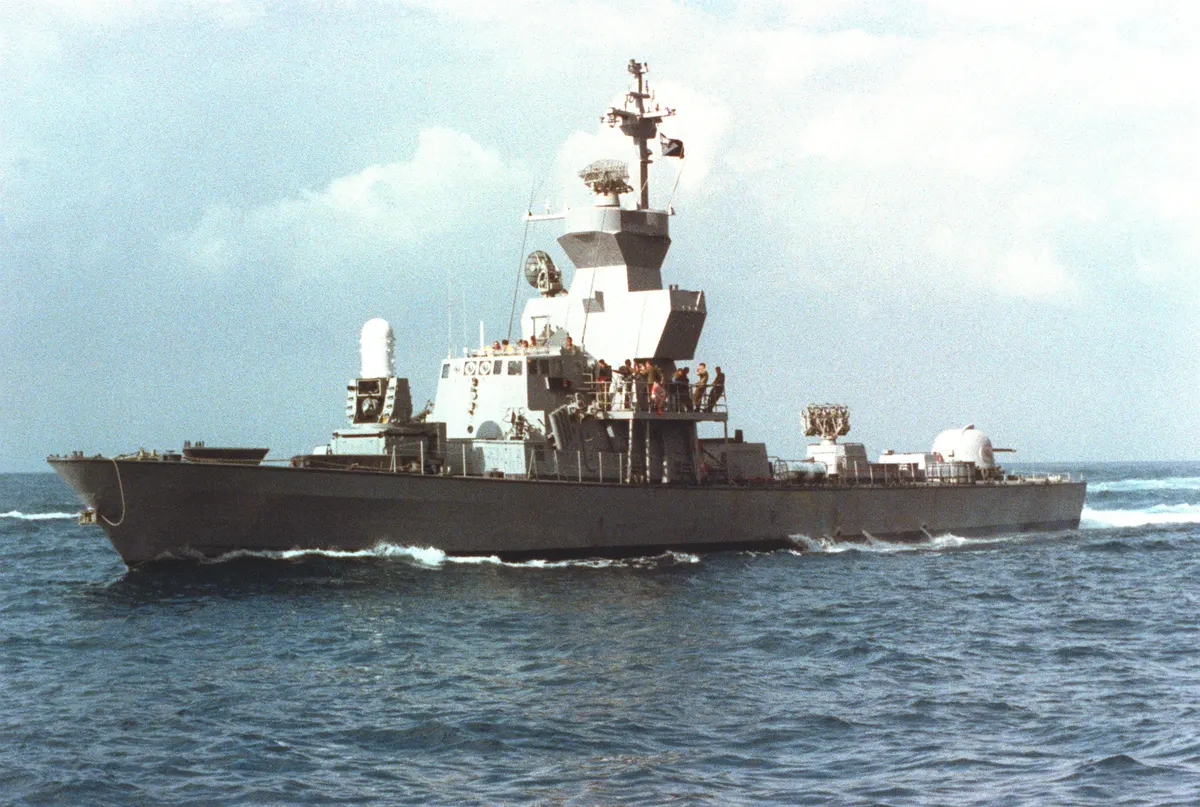
IAI unveiled a marine-adapted version in June 2017, adding a marine-approved canister and a stabilized communications antenna so the same core weapon could be launched from combat ships, offshore patrol vessels, and smaller patrol boats, with a single small craft able to carry up to 12 rounds.5 In February 2019, photographs taken during an Israeli prime ministerial visit to the Haifa naval base showed a Green Dragon canister rack fitted to INS Nirit, a Hetz-class (Sa'ar 4.5) missile boat — evidence the naval variant had moved from a marketing concept to at least a demonstrated fit on an active Israeli Navy hull, though the available reporting documents a demonstration rather than a confirmed, named operational deployment.6
No independently verified, named combat use of Green Dragon specifically has surfaced in open-source reporting as of this writing. That is a meaningfully different position from IAI's own Harop, whose strikes have been documented in multiple conflicts, or Rafael's Spike Firefly, whose manufacturer confirmed battlefield use in the Gaza Strip in 2024.8 Coverage of Israeli loitering-munition operations around the Gaza war has focused on other systems by name, and none of the sources reviewed for this article attribute a specific strike to Green Dragon.
Open sources describe Green Dragon primarily through two canister configurations built around the same core airframe, rather than distinct named production variants:
| Configuration | Launch platform | Notable feature |
|---|---|---|
| Land canister | Light tactical vehicle | 12-16 rounds per rack1,2 |
| Naval canister | Combat ships, OPVs, patrol boats | Marine-approved canister, stabilized antenna, up to 12 rounds per small vessel5 |
IAI's broader loitering-munition line places Green Dragon between the smaller Rotem L quadcopter (about 6.5 kg, 10 km range, roughly 45-minute endurance, 1.2 kg grenade-based warhead) and the much larger, long-endurance Harop, rather than representing a step in a single evolving Green Dragon-specific product line.10

The one operator on record is Israel, reflecting IAI's home market and the demonstrated (if not fully confirmed in independent reporting) fit of the naval canister variant to an Israeli Navy Hetz-class missile boat in 2019.6 No acquisition year or unit quantity for Israeli use has been published in open sources.

No third-country operator of Green Dragon specifically has been publicly confirmed. IAI has reported roughly $100 million worth of "loitering munitions" orders from unnamed Asian countries in past years, but that reporting is tied to IAI's Harop and Rotem lines in the trade coverage reviewed for this article, not to Green Dragon by name, so it should not be read as an export confirmation for this system.1
Green Dragon vs Switchblade 600
Green Dragon's 15 kg weight sits almost exactly on top of the AeroVironment Switchblade 600's roughly 14.9 kg round weight, making the two a natural size-class comparison despite coming from rival national programs.1,11 Switchblade 600 is built around a shaped-charge anti-armor warhead and a baseline range beyond 40 km, reaching out to about 90 km with data-link relay extensions, and flies for a little over 40 minutes total — roughly 20 minutes transiting to 40 km, then 20 minutes loitering.11 Green Dragon's reported endurance figures (75 minutes to as much as 2 hours, depending on source and generation) run longer than Switchblade 600's mission profile, though its 3 kg warhead is smaller and less armor-focused than Switchblade 600's anti-tank charge.4,7,11 Switchblade 600 has also amassed a public combat and export record — including confirmed U.S. Army orders — that Green Dragon has not matched in open reporting.11
Green Dragon vs SkyStriker
Fellow Israeli manufacturer Elbit Systems' SkyStriker is the more direct market rival: both are silent, electrically propelled, tube/canister-oriented tactical loitering munitions built for infantry and special-operations customers. SkyStriker, however, is a heavier system at roughly 40 kg maximum takeoff weight, with a far longer quoted range of 100-200+ km and a 5 kg or 10 kg warhead option, trading Green Dragon's smaller footprint for substantially greater reach and payload choice.12 SkyStriker has also secured at least one confirmed European buyer, giving it a public export record Green Dragon currently lacks.12
Is Green Dragon in IDF service?
IAI's marketing and Wikipedia's infobox describe Green Dragon as in service, and the naval canister version was photographed fitted to an Israeli Navy missile boat in 2019, but no independent, named account of an IDF unit training with or operating the system was found in the sources reviewed for this article.1,6 The honest answer is: manufacturer-claimed in-service status, thin independent confirmation.
What are Green Dragon's key specifications?
Reported Green Dragon specifications center on a 15 kg airframe, roughly 40-50 km range, endurance quoted anywhere from 75 minutes to 2 hours across different sources and years, a 3 kg warhead, and sub-1-meter CEP accuracy from its electro-optical guidance.1,2,3,4,7
What does the Green Dragon cost?
No unit price or program cost figure for Green Dragon has been published in any source reviewed for this article. IAI describes it only qualitatively as "low-cost" relative to larger loitering munitions like Harop.2
Green Dragon vs Switchblade — how do they compare?
Both are silent, electric, tube/canister-launched tactical loitering munitions in a similar roughly 15 kg weight class, but Switchblade 600 leans toward anti-armor strikes with a shaped-charge warhead and has a public U.S. combat and export record, while Green Dragon's smaller warhead and unconfirmed combat history make it the less independently documented of the two.1,11
Who makes the Green Dragon?
Green Dragon is designed and built by Israel Aerospace Industries (IAI), Israel's state-owned aerospace and defense manufacturer, alongside IAI's other loitering munitions such as Harop, Harpy, and Rotem.1,2
- "IAI Green Dragon", Wikipedia — en.wikipedia.org ↩
- "Green Dragon Tactical Loitering Missile", Army Technology — army-technology.com ↩
- "IAI Green Dragon Expendable Loitering Munition Unmanned Air System (UAS)", Military Factory — militaryfactory.com ↩
- "New loitering munitions from IAI", EDR Magazine — edrmagazine.eu ↩
- "IAI Introduces New Naval Application for its Green Dragon Loitering Munition", Israel Defense — israeldefense.co.il ↩
- "Israeli Navy Sa'ar 4.5 Fast Attack Craft Fitted with IAI Green Dragon", Naval News — navalnews.com ↩
- "Let's Talk About The Israel Air Industries Loitering Munitions And What They're Capable Of", The Aviationist — theaviationist.com ↩
- "Meet Israel's 'Suicide Squad' of Self-Sacrificing Drones", The War Zone — twz.com ↩
- "Green Dragon Tactical Loitering Missile, Israel", DSIAC — dsiac.dtic.mil ↩
- "IAI Rotem L", Wikipedia — en.wikipedia.org ↩
- "Switchblade 600", AeroVironment — avinc.com ↩
- "SkyStriker Tactical Loitering Munition", Elbit Systems — elbitsystems.com ↩